



Baptist General Convention of Texas Executive Director Julio Guarneri and BGCT President Debbie Potter challenged BGCT Executive Board members in separate remarks during the board’s September meeting.
‘One people, one mission’
Texas Baptists are entering a new season marked by organizational restructuring, budget reductions, staffing changes, and strengthening local churches, Guarneri told Executive Board members Sept. 21.
Guarneri centered his remarks on Jesus’ prayer for unity in John 17, saying fulfilling the mission God has given Texas Baptists requires them to be “one people” pursuing “one mission.”
“Being one people is not just an organizational slogan,” Guarneri said. “It is the nature of a mutual relationship of disciples of Jesus. As Texas Baptists step into the future, with all the changes that entails, our focus is on the lost,” he said.
Guarneri said the unity Jesus prayed for among his disciples was not based on complete agreement, compromise, or conformity. Instead, he described it as a spiritual unity that flows from believers’ relationship with God.
Organizational strategies and structures will only be effective to the extent the Holy Spirit is at work, he said. “Real oneness is a spiritual product of oneness with Christ,” he said.
‘New day’ for Texas Baptists
Guarneri described the convention as being at the “threshold of a new day” following approximately two-plus years of prayer, listening, planning, and organizational development. The next step is implementation, he said.
The organizational changes the Executive Board would consider during its business session Sept. 22 were made after considering Texas Baptists’ current resources, ministry context, and core mission, Guarneri said.
“It hasn’t been an easy process by any means,” he said. “Decisions have been difficult. It hasn’t been easy on our staff, although they’ve been champions about it.”
Sign up for our weekly edition and get all our headlines in your inbox on Thursdays
Guarneri said decreased Cooperative Program receipts were a major reason for the staff rightsizing, while also emphasizing the convention is financially strong.
“It’s also true that the financial posture of the organization is strong,” he said. “We’re not in trouble now. However, if we don’t make these budget adjustments now, we could be in trouble in the future.”
Guarneri noted declining Cooperative Program contributions are not unique to Texas Baptists, saying other state conventions and the Southern Baptist Convention are experiencing similar trends. The Cooperative Program Task Force is working to address the issue, he said.
Even without the Cooperative Program decline, however, organizational changes would still be necessary for greater effectiveness, Guarneri said.
GC2 Strong places local churches at the center
Turning his attention to GC2 Strong, Guarneri described it as the primary expression of how Texas Baptists believe God is leading the convention into the future.
The strategy focuses on strengthening a multiplying movement of churches that live out the Great Commandment and the Great Commission in Texas and beyond, he said.
“It is the culture that will permeate everything that we do together,” he said, emphasizing GC2 Strong is not a department or program of the convention.
Guarneri cited Texas’ population growth as a major reason for the strategy’s emphasis on churches. He said approximately 32 million people currently live in Texas and projected that number could approach 50 million by 2050. At least half of the state’s current population is estimated not to know Jesus as Savior and Lord, he added.
“We urgently need a Great Commandment and Great Commission awakening,” Guarneri said. “It is urgent that we focus on God’s mission.”
The role of Texas Baptists is to facilitate collaborative action while keeping local churches at the center, he said.
Churches at different stages—including church plants, struggling churches, thriving churches, and multiplying churches—all have a role to play, Guarneri continued.
Potter reflects on culture, calling and leadership
BGCT President Debbie Potter reflected on how culture can shape the way people understand calling, leadership, and what is possible for others.
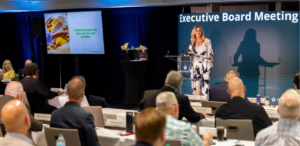
Potter recounted sensing her call as early as 7 years old. Despite the clarity of her call, she later set it aside because of cultural expectations surrounding women. She eventually pursued a career in education before stepping into ministry, where she discovered limits on what she could do because she was a woman.
Potter framed her experience through the biblical account of Jesus’ encounter with the Samaritan woman at the well in John 4.
Jesus did not shame or silence the woman, Potter said, but engaged her, asked questions, listened, told her the truth, and ultimately gave her a voice and a role in pointing others toward him.
For Potter, the account also raised questions about how Christians understand leadership and authority.
She said she has spent her life working under authority and does not view ministry as a means of exercising authority over others.
“I am in ministry to serve people,” Potter said. “I am in ministry to point people to Jesus.”
She said healthy Christian leadership should not produce people who are afraid to think, speak, ask questions, or identify unhealthy situations. Instead, she said, it should point people toward Jesus.
Potter questioned whether discussions about women in ministry sometimes become too focused on who gets to be in charge rather than on how a person’s gifts and calling can be used to help others see Jesus.
“Leadership is not ultimately about who has authority over people,” Potter said. “It is about how we help people see Jesus.”
She challenged Texas Baptists to consider what kind of culture they are creating—one in which people are seen, heard, valued, protected, and given room to use the gifts God has given them.
“The gospel is bigger than our culture,” Potter said. “Jesus is bigger than our traditions.”
She concluded by expressing her hope Texas Baptist churches would become places in which people know there is a place for them, that they are seen, valued, and loved, and, most importantly, that Jesus sees them.











We seek to connect God’s story and God’s people around the world. To learn more about God’s story, click here.
Send comments and feedback to Eric Black, our editor. For comments to be published, please specify “letter to the editor.” Maximum length for publication is 300 words.