


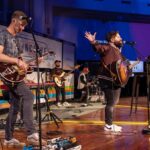
A gathering designed to help churches become places of greater belonging for people with disabilities and their families brought pastors, ministry leaders, and others together for practical training and discussion Aug. 20 in Dallas.
The Worship As One gathering was organized by With Ministries in partnership with the Baylor Center on Disability and Flourishing.
The event was the third gathering organized through the initiative, which seeks to provide church leaders with practical guidance for creating more inclusive congregational communities.
The event brought pastors and church leaders together for research, personal stories, interactive learning, conversation, and worship focused on disability and belonging in the church, said Nakoa Merritt, community engagement and partnership coordinator for With Ministries.
The summit challenged leaders to move beyond creating programs for people with disabilities and toward building churches where people with and without disabilities worship, serve, lead, and grow in faith together.
Friendship and community
Young adults with disabilities shared their experiences in church during a panel discussion.
At the heart of the discussion was the desire for friendship and genuine relationships, Merritt said.
Panelists talked about the importance of having someone walk alongside them as they enter church, introduce them to others, and help them become part of the community.
“They wanted more than assistance. They wanted to be known, build relationships, have a friend and belong,” Merritt said.
Sign up for our weekly edition and get all our headlines in your inbox on Thursdays
One participant identified “the crucial role of friendship” as a key takeaway and said they were excited about “creating opportunities for connection, friendship, and finding out about the gifts they have to share.”
“The message was simple: Presence is not the same as belonging,” Merritt said. “Relationship is at the heart of belonging.”
Jason Le Shana, program director for the Baylor Collaborative on Faith and Disability, said churches can miss important gifts when their structures unintentionally communicate to people with disabilities they do not truly belong.
Increasing participation
Churches were challenged to consider whether people with disabilities are primarily receiving ministry to or for them, or whether they are increasingly participating with others and helping shape ministry by using their gifts and leadership.
That idea resonated strongly with participants.
One participant described what was called the “to, for, with, and by discussion” as the most “revolutionary” part of the summit.
Another said the “‘with, by’ perspective was key and crucial for our congregation.”
The panel also addressed real barriers, including sensory and communication differences, while emphasizing inclusion is not simply about accommodation.
“It is about creating meaningful opportunities to participate in the life of the church,” Merritt said.
Environment matters
Churches also can unintentionally communicate through their physical spaces and structures that people with disabilities do not truly belong.
“Environments communicate who belongs before a single word is spoken, and families experience inclusion through what the environment makes possible,” Merritt said.
Physical space matters, but every church has different resources, limitations, and possibilities, she said.
Leaders were encouraged to look beyond the room itself and consider what participation can look like within the environment they already have—from a “set-up and tear-down” church to congregations with shared or dedicated spaces.
Leadership opportunities
Le Shana also identified leadership and contributions as another area where churches can grow.
People with disabilities can serve in visible leadership roles as well as contribute behind the scenes, he said.
Merritt said those roles can include reading Scripture, serving communion, greeting others, sharing testimonies, participating in Bible studies, serving in children’s and youth ministries, leading groups, and helping shape ministry.
“The goal is not to create a separate set of opportunities for people with disabilities,” Merritt said. “It is to recognize and make room for the gifts, voices, and contributions already present within the body of Christ.”
Participants experienced that approach firsthand through the summit’s concluding worship service. People with disabilities led, sang, signed, read Scripture, and participated in responsive readings.
“When churches don’t attend well to the kinds of barriers that can keep people with disabilities, even unintentionally, away from those roles … it’s to the detriment of the entire church,” Le Shana said.
For Le Shana, the issue is not simply providing accommodations or creating opportunities for people with disabilities to attend church. It also involves recognizing their relationships, leadership, gifts, and contributions as important parts of the body of Christ.
Continuing hunger for learning
For Le Shana, the third Worship as One gathering indicated a hunger among church leaders to take additional steps toward becoming places of belonging for people with disabilities and their families.
The first gathering took place in August 2025, the second during winter 2026.
The third gathering included morning sessions focused on introductory topics for those attending for the first time, including the importance of belonging and disability in the church.
Participants also heard about recent research conducted through the Baylor Center on Disability and Flourishing.
The gathering concluded with an inclusive worship service in which people with disabilities participated in leading worship, readings, and other aspects of the service. The service gave participants an opportunity to reconsider what worship can look like when people with disabilities are involved in leading, Le Shana said.







We seek to connect God’s story and God’s people around the world. To learn more about God’s story, click here.
Send comments and feedback to Eric Black, our editor. For comments to be published, please specify “letter to the editor.” Maximum length for publication is 300 words.