



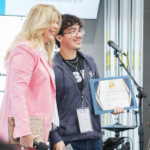
As B.H. Carroll Theological Seminary doctoral student Arcadis Solano Silvera stepped onto the stage to receive his degree, the moment represented far more than an academic milestone. It marked the culmination of a journey shaped by unexpected turns, unwavering determination, and God’s provision.
For Silvera, a Cuban refugee now living in Miami, Fla., this diploma was nothing short of a miracle, the tangible result of a path he believes was carved out by God.
In 2009, Silvera was serving as a pastor in Cuba with the Eastern Cuban Baptist Convention. He had been serving as a pastor for 10 years and had heard about the B.H. Carroll program in Camaguey, the central province on the island.
Arcadis got his first taste of theology during his master’s degree work. He immersed himself in learning all he could throughout the program and, after earning a Master of Arts in Theology, Scripture Witness, he was challenged by Carroll Seminary’s founder, Bruce Corley.
Corley hoped to have one of the master’s program students in Cuba complete their doctorate. Arcadis felt a tug at his heart. He knew he was that student.
“I went to Dr. Corley and asked him: ‘Dr. Corley, can I be part of this? I would like to be part of this,’” Silvera said. “And he asked me: ‘How do you see yourself in the next few years? Do you see yourself as a seminary doctoral graduate?’
“I was pretty nervous because it was Dr. Bruce Corley asking me that. But I said, ‘Well, I want to say this humbly… yes, I would like to be a doctor.’ And then he told me: ‘Then you have obtained the first prerequisite. You have completed the first requisite—to see yourself as a doctor.’”
The journey begins
In 2014, Silvera’s journey toward a doctoral degree truly began. Although he had been accepted into the program, he still had several prerequisites to complete, most notably biblical languages and German.
Determined to move forward, he traveled to New Orleans Theological Seminary for summer coursework, where he enrolled in four semesters of biblical Hebrew condensed into intensive summer terms. The challenge was significant. He learned Hebrew through English instruction while navigating his native Spanish, juggling three languages at once.
Sign up for our weekly edition and get all our headlines in your inbox on Thursdays
The following year, in 2015, Silvera returned to New Orleans to tackle biblical Greek in another rigorous summer session. Again, he faced the same linguistic triad—Spanish, English, and Greek—but he pressed on, crediting God for giving him the strength to complete each step.
One major requirement remained: German. Without the financial means to enroll in formal classes, he taught himself the language, studying independently until he felt prepared. When the time came, he sat for the German proficiency exam with B.H. Carroll and passed.
In 2019, with that final hurdle cleared, he was finally ready to begin his doctoral studies in full.
Challenges
Challenges remained in navigating a doctoral program with spotty internet access. Arcadis would sometimes sit in a park in the rain to submit his homework because he had no internet at home. B.H. Carroll set up a VPN, giving him a secure way to submit his assignments.
“I told myself: ‘Arcadis, you cannot stop. You cannot make excuses.’”
“Most of the time, I was the first to submit my papers; my professors can attest to that,” Silvera said.
“Dr. Karen Bullock taught me to be proactive. Then COVID brought new challenges, including limited access to books without services like Amazon, but even then, God continued to open doors.”
Arcadis’ 23-year ministry began to attract the Cuban government’s attention. He was very involved in church planting, and a movement had ignited with churches popping up all over the island. Silvera started being interrogated monthly by the Cuban authorities, and threats were made to his children and his wife.
“When you have children, everything changes,” Silvera said. “When it is just you as an adult, it is OK, you can suffer, you can even die. But when you are faced with sacrificing your children, that changes everything. Like Abraham presenting Isaac before the Lord, he suffered. And the Lord told me, ‘You have to escape.’ God opened every door for us.”
Fleeing
When Silvera and his family reached the Cuban airport, authorities pressed them with repeated questions about their travel plans. He told them they were headed to the Dominican Republic on a tourist trip, and after several rounds of questioning, they were finally allowed to board their flight.
The family spent five months in the Dominican Republic before continuing on to Mexico, a journey he describes as marked by God’s protection at every turn.
Their time in Mexico unfolded safely as they moved from Toluca to Hermosillo, where a local pastor met them at the airport and took them under his care.
Even when their car broke down an hour outside Hermosillo on the day of their interview at the Nogales U.S. border crossing, another vehicle arrived unexpectedly to get them there on time.
The entire journey felt almost like a movie, a series of close calls met with timely provision. Through each moment, minute by minute, second by second, the family felt guided and protected by the Lord, eventually arriving safely in the United States.
The family applied for entry into the United States through the U.S. Customs and Border Protection. Their application was approved, granting them refugee status and opening the door for a new beginning in America.
“I did not come to the United States in search of the American dream,” Silvera said. “I love Cuba, and God was blessing my ministry there. Cuba is a poor country, but God has always provided for my family with food, good health, and financial stability. I understand that coming to America was God’s plan because we were in real danger in Cuba, and we had to escape.”
More challenges
The hustle and bustle of American life took a toll on Arcadis and his family. It impacted him in ways he did not expect. “I started to think in terms of being busy: working, lacking time, making excuses,” he said.
One of his professors, James Denison, often reminded students, “God redeems what he allows.” That truth became reality when new U.S. regulations revoked work authorization for refugees. On June 20, 2025, Arcadis lost his job as a chaplain. His wife Yadely, who worked as a certified nursing assistant, and his son Daniel, also lost their jobs.
“It was a big, big challenge,” he said. “We had good jobs and a stable income, and suddenly we had nothing.”
The Lord continued to guide the Silvera family with the provisions they needed through the generosity of believers and even a few nonbelievers.
God’s provision
His hope, he said, has always rested in God. He shared a moment when his family had to choose between paying rent or buying food. They prayed and chose food. That same day, while at the grocery store as a family in Miami, they were unexpectedly offered paid work as movie extras, earning exactly the amount needed to cover rent.
“God has never abandoned me,” he said. “This situation will not be the exception.”
Without the ability to work, Arcadis shifted his time and energy to his dissertation, completing it in just four months and defending it in November 2025.
“This degree is about my wife, who has been my greatest support, and my children, who respected my time and sacrifices,” he said. “They gave up family moments so I could finish.”

For Arcadis, the doctoral degree represents something far greater than personal accomplishment. “This is a way to glorify God,” he said. “I stand here representing Cuba—many pastors and professors who desire this kind of education but cannot afford it.”
He sees his graduation as the fulfillment of a shared dream, supported by institutions and mentors who believed in him and invested in the vision.
Moving forward, Arcadis plans to devote his life to teaching, research, and ministry. “I am a pastor, but I am also a teacher,” he said. “I want to train pastors, not only in Cuba, but in Latin America, Africa, and beyond, so they can handle Scripture faithfully and serve their communities well.”
Dr. Arcadis wants to encourage others pursuing God’s calling. “It is not about where you are,” he said. “It is about obedience. God owns all the resources. If he is calling you, do not give up. Keep going.”









We seek to connect God’s story and God’s people around the world. To learn more about God’s story, click here.
Send comments and feedback to Eric Black, our editor. For comments to be published, please specify “letter to the editor.” Maximum length for publication is 300 words.