



In 1777 amid the Revolutionary War, Baptist minister Isaac Backus believed too many people had forgotten who Roger Williams was, what he had done for democracy and religious liberty, and what a newly formed society should learn from Williams.
One may assume discussing religious liberty would not be a top priority during a war for independence, but for Backus, it was of paramount importance. For him, the new society forming must be established on proper principles pertaining to civil and religious powers.
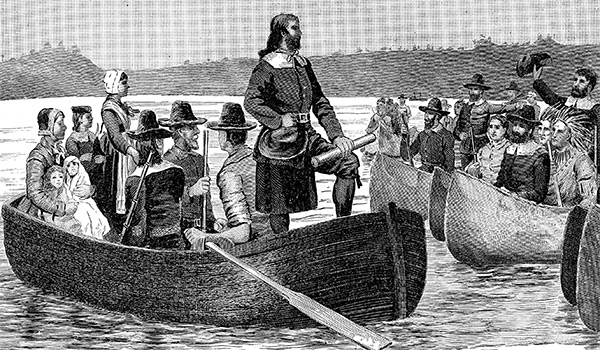
As quoted in Edwin Gaustad’s book, Roger Williams, Backus promoted the words of Williams as the nation’s guide, as no other individual “acted so consistently and steadily upon right principles about government and liberty as Mr. Williams did.”
In 2026, in a society often described as experiencing multiple societal upheavals, we would again benefit from patterning ourselves after someone as consistent as Roger Williams.
Perhaps today, the founder of Rhode Island and the First Baptist Church of America, the champion of separation of church and state, an advocate for the protection of conscience, and a defender of religious pluralism needs to be top of mind, not just for Christians, but for all Americans, as we continue this American experiment.
Religion and politics
Our society faces serious challenges, including a misguided relationship between religion and politics that seeks to elevate a narrow strand of conservative religious nationalism as the preeminent definition of a true Christian and a true American.
This nationalism seeks to define patriotism in terms of politically motivated, religiously infused policies and rhetoric that disregard the religion clauses of the First Amendment.
Whether it be the forcing of public schools to hang the Ten Commandments on the walls of classrooms, the required teaching of Bible lessons in public school curriculum, the denial of the concept of separation of church and state by our political leaders, or the anti-Islamic rhetoric coming from governmental authorities, the current embrace of a partisan, right-leaning politicized faith threatens not only liberty of conscience, but free expressions of faith, along with the witness of Christianity itself.
If we wish to know Williams’ thoughts on such uses of governmental power to coerce others to conform to a favored state political religion, consider his rather blunt assessment: “Forced worship stinks in God’s nostrils.”
Sign up for our weekly edition and get all our headlines in your inbox on Thursdays
Reacquainting ourselves with the words and philosophy of Roger Williams would potentially lead us to a freer and healthier body politic for all, while simultaneously protecting authentic expressions of faith from political coercion, control, and corruption.
Remembering Williams’ caution
We all should heed the words of Roger Williams in The Bloody Tenent of Persecution: “When Christianity began to be choked, it was not when Christians lodged in cold prisons, but down beds of ease, and persecuted others.”
According to Williams, the downfall of Christianity is not found in the oppression of it by the state, but in being co-opted by the state.
A politicized faith that promotes a certain brand of partisan theology while attacking, through fear and falsehoods, the free exercise of other faiths may succeed politically in the short-term, but it is destined to fail, leaving both democracy and faith weakened.
As Williams also wrote: “God requires not uniformity of religion to be enacted and enforced in any civil state. Such enforced uniformity sooner or later is the greatest occasion of civil war, of the ravishing of conscience, of the persecution of Christ Jesus in his servants, and of the hypocrisy and destruction of millions of souls.”
Religious freedom
Williams envisioned a society where people of all faiths and no faith would exist peacefully and respectfully in a free society.
In a letter to the town of Providence in 1655, Williams compared a free society to a ship at sea, writing:
“It hath fallen out sometimes, that both papists [Catholics] and protestants, Jews and Turks [Muslims], may be embarked in one ship; upon which supposal I affirm, that all the liberty of conscience, that ever I pleaded for, turns upon these two hinges—that none of the papists, protestants, Jews, or Turks, be forced to come to the ship’s prayers or worship, nor compelled from their own particular prayers or worship, if they practice any.”
Additionally, he likewise called out English supremacy toward Native Americans writing: “Boast not proud English of thy birth and blood, thy brother Indian is by birth as good. Of one blood God made him, and thee, and all as wise, as fair, as strong, as personal.”
Williams did not sit idly by while attacks against others occurred. While he was far from perfect, Williams did not fear becoming too political. He did not place loyalty to a political or denominational tribe over his faith. He spoke out boldly.
Williams then and now
Today, current office holders, as well as some seeking office, continue to malign our Muslim neighbors, falsely labeling them as dangerous and subversive, while simultaneously attacking the free exercise of their faith. These attacks are reminiscent of Puritan and colonial attacks against Native Americans, Muslims, and other religious minorities of Williams’ time.
Now is the time to speak out against these injustices.
Those continuing to spread falsehoods while also seeking to tear down the wall of separation between church and state should instead repent, respect pluralism, champion free exercise of faith and freedom of conscience, and learn anew from Roger Williams.
As Gaustad wrote, “[Williams’] bequest to America, then, of liberty, responsibility, and civility has enriched the American past and can preserve the American future.”
I pray all Americans will once again embrace the separation of church and state, religious liberty for all people, freedom of conscience, and equal protection for all. Perhaps an old voice can be rekindled for our guidance.
Jack Goodyear is a professor of political science and a member of a Texas Baptist church. The views expressed in this opinion article are those of the author.








We seek to connect God’s story and God’s people around the world. To learn more about God’s story, click here.
Send comments and feedback to Eric Black, our editor. For comments to be published, please specify “letter to the editor.” Maximum length for publication is 300 words.