


(RNS)—It’s been nearly 10 years, but I still remember the poster—each hand-drawn bubble letter a joyful riot of color and pattern—hanging at the end of the hallway I was walking down with my 6-year-old daughter, tightly clutching her little hand as we both entered her new school for the first time together: “Treat Others How You Want to Be Treated.”
There was no chapter and verse, but I instantly recognized it as Scripture hanging on the wall of her new public school—the Golden Rule, rendered in English plain enough for the first graders who’d soon be trying to read it for themselves.
As my oldest was starting public school, I was learning to let go. Seeing the Bible in her school that day settled me. I imagined it came from a kind teacher’s heart who would teach my daughter the same sort of lessons I desired her to learn.
But now, about a decade later, as Texas legislators have adopted curriculum changes and laws to increase Christian content in our state’s public schools—like hanging the Ten Commandments in public schools—I feel something different: alarm, skepticism, and frustration.
And it’s not because I’ve lost my faith.
I believe the Bible is infallible and subscribe to orthodox Christian doctrines. I attend and work at a West Texas evangelical Presbyterian church in a bedrock Republican community. My kids are in church so frequently the building feels like an extension of our own living room.
You might think someone like me—who subscribes to “traditional family values” and takes Scripture seriously—would be thrilled by efforts of the Texas Legislature and State Board of Education to make public schools Christian again. But it’s precisely because my faith is deeply important to me that I’m troubled by their actions.
Legislation
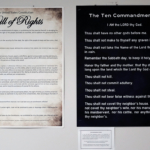
In 2025, Texas legislators passed two bills regarding religious instruction in public schools. One required public school classrooms to display copies of the Ten Commandments starting in September 2025. An appeals court upheld that in April 2026, though a group of Texas parents are asking the Supreme Court to overturn the law.
The other required every Texas school district to vote on whether to establish periods of worship during the school day. Interestingly, even in a deeply religious state where 67 percent of adults call themselves Christians, fewer than 25 of Texas’ 1,200-plus school districts voted to dedicate class time to prayer and worship. Thankfully, our school also declined to allocate time.
Sign up for our weekly edition and get all our headlines in your inbox on Thursdays
Then in June of this year, the Texas State Board of Education approved revamped history and reading curriculums for the state, infusing more Bible stories at every grade level beginning in the 2030-2031 school year.
On the one hand, there’s much about the reading lists I celebrate—a return to classics and rigor in an era of creeping illiteracy. And even a secular case can be made that biblical literacy is an important component of understanding Western civilization.
To be a well-rounded, well-educated person who understands, for example, the work of people like Frederick Douglass and Harriet Tubman and the abolitionists in the Underground Railroad, you also need to know and understand the Exodus story.
Furthermore, having some sort of fundamental foundation of shared values and a code of ethics, which is part of the stated goal of the curriculum shifts, is an important component of social cohesion. And Lord knows, we need more of that.
And it certainly doesn’t harm a student to study religious texts or historical documents they personally reject but nevertheless ought to understand. If someone’s faith is so flimsy and weak it cannot hold up to encountering the belief systems found within the Quran, the Bhagavad Gita, or the Sermon on the Mount, the problem is deeper than encountering different ideas.
A step back
So why does this moment feel to me like a step back to a darker time?
Because, unlike the poster in the school hallway all those years ago that flowed out of the love and faithfulness of an individual teacher’s heart, thoughtfully shared in such a way as to not press an undue burden of forced belief on any of her students, the actions of our state leaders smell more like partisan politics than an exercise in genuine Christian faithfulness.
Although my faith tradition teaches me it is hard to know the hearts of man (Jeremiah 17:9) and “I should judge not, lest (I) be judged” (Matthew 7:1), it also calls me to be discerning and wise.
If state leaders’ actions within schools are taken in totality with the trajectory of much of state politics in Texas right now, it doesn’t seem like our politicians are committed to religious liberty for all at all.
For example, the same state leaders who are expanding the influence of Christian teachings in public schools are also involved in things that pointedly intend to make Muslims feel less welcome.
But my primary objection is I do not want government employees, such as public school teachers, forced into reducing our family’s deeply held beliefs and sacred texts into pseudo-religious screeds that serve political ends.
As a Christian parent, this alarms me.
Cheapening the gospel
Back in 2022, I listened to a podcast where David French, The New York Times columnist, interviewed Paul D. Miller, a Georgetown University political theorist and professor.
Miller said something in their conversation I still remember four years later: “The church has the unique and exclusive prerogative to teach in Jesus’ name.” Handing that role to the state inevitably flattens the real differences between Anglicans and Apostolicos, Baptists and the Brethren, turning Christianity into little more than bland civic religion, Miller said.
“Can you not understand why Americans are so biblically illiterate? It’s because we allowed the government to teach us a watered down, moralistic, therapeutic deism and slapped a Christian name on it for so long,” Miller said.
Many of the local teachers I’ve talked to who are faithful Christians themselves say they feel coerced into hanging the 16-by-20-inch poster of the Ten Commandments in a highly visible classroom location.
Ironically, this law is being enforced by Attorney General Ken Paxton, a man whose wife filed for divorce “on biblical grounds” because of his violation of the seventh commandment: thou shalt not commit adultery.
“I hate this stuff with a passion, actually, because it cheapens the gospel—it cheapens the goodness,” Alison Brown, a local teacher who is a Christian, told me. “It makes it easy for those who want to check a box, but I’m not looking to just check a box, because that’s not true faith; that’s not true love.”
Another teacher I know, who no longer is a practicing Christian, said assuming any responsibility for the religious instruction of a faith she doesn’t actively practice crosses a sacred line. “I’m a math teacher. I can teach anyone how to love and understand mathematics. But I am not and should not be a preacher.”
What my children see
Meanwhile, Christian students, like my children, who have been taught at home that the tenets of our faith are true, foundational for building a life upon and worth sharing—in love—with the world around us, are seeing their faith reduced to something that’s a little shameful and embarrassing, cringe-worthy precisely because, even as teenagers, they can see how coercive and functionally shallow it all is.
Take my own 15-year-old, for example. She says most students don’t really care about the Ten Commandments posted on the wall, but she suspects the ones most likely to notice are also the ones who most likely will feel a pang of exclusion when they see them up there. This is exactly the opposite of what we’ve taught her about what it means to follow Jesus.
The Pharisees used religion as a way to delineate who was in and who was out. The Jesus she knows and loves welcomes the outsiders and the misfits and the people who don’t fit neatly in the status quo. Using the tenets of our faith as a tool to undermine belonging bothers her.
And I’m so glad it does. I never wanted my children to absorb a watered-down cultural Christianity message, and in many ways, the actions of our Texas politicians feel like an infringement on my religious liberty.
I want my children to treat others the way they want to be treated, which means having a healthy respect for the separation of church and state. After all, the point of separating church and state is to protect the liberty of religious minorities—which could be any of us someday, so we’d all be wise to defend it.
Words without love
In 1 Corinthians 13:1, Scripture offers a description of what I think is happening in Texas right now: Many words said without love render everything we say hollow and shrill and empty and meaningless—turning us, and our cultural influence, into nothing more than a “resounding gong or a clanging cymbal.”
Nobody wants to listen to that.
Carrie McKean is a West Texas-based writer and the communications director at First Presbyterian Church in Midland. The views expressed in this opinion article are those of the author.







We seek to connect God’s story and God’s people around the world. To learn more about God’s story, click here.
Send comments and feedback to Eric Black, our editor. For comments to be published, please specify “letter to the editor.” Maximum length for publication is 300 words.