


Baptist World Alliance annual meetings include many breakout sessions based on the 14 BWA Commissions.
General topics range from theological reflection to healthy churches, human rights, humanitarian aid, evangelism and discipleship, worship and prayer, Baptist doctrine, religious freedom, and justice.
Religious freedom
Katie Frugé, director of Texas Baptists’ Christian Life Commission, participated in a panel discussion on religious freedom.
“Educating people right now is one of the most fundamental things the church in America needs to do: helping people see the importance of religious liberty and religious freedom for all people. It is not the role of the government to coerce the conscience of the individual,” Frugé continued.
“When we see the government trying to put its thumb on the scale, it’s ultimately trying to take the role of the Holy Spirit in the process of conviction, speaking to the individual, and leading that person into a relationship with Christ. We want people to willfully, lovingly, joyfully choose a relationship with Christ.”
Justice
Presenters for the session “Truth Telling and Repair: Race, Gender, and Migration” explored how Christians are called to pursue justice through truth-telling, reconciliation, and faithful action in response to racial injustice, gender inequity, and migration. The panel challenged participants to see justice as an essential expression of discipleship.
Anyra Cano, director of programs and outreach for FaithWorks and a minister at Iglesia Bautista Victoria en Cristo in Fort Worth, opened the discussion by examining the story of the Hebrew midwives in Exodus as a model of faithful resistance to unjust systems.
“Migration is not just a political issue. Immigration is a human issue. And for followers of Christ, it’s also a discipleship issue,” Cano said.
She highlighted the work of Como Nacido Entre Nosotros, an ecumenical network of churches and organizations across Latin America that provides shelter, advocacy, legal support, and humanitarian assistance to migrants.
Sign up for our weekly edition and get all our headlines in your inbox on Thursdays
Grassroots ministries like Como Nacido Entre Nosotros, many of them led by women, demonstrate how churches can creatively mobilize limited resources to protect vulnerable people and uphold their dignity, Cano said.
Dreisen Heath, founder and executive director of the “Why We Can’t Wait Reparations Network,” framed reparations as both spiritual work and an ongoing process of repair that extends beyond acknowledgment of historical harms.
She distinguished truth-telling from reconciliation, arguing meaningful reconciliation requires concrete acts of repair following an honest accounting of injustice.
“Reparations is spiritual work. It is also the work of resurrection,” Heath said. “It’s a never-ending process that you have to be committed to, essentially, until the harm ceases. I feel like culturally, we understand reparations just as compensation. But it is more than compensation, and it has to account for all of the economic and moral damages.”
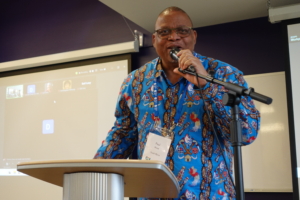
Heath connected the legacies of slavery, settler colonialism, forced displacement, and systemic racism to present-day inequities, while also highlighting the compounded effects of gender-based violence and family separation.
Paul Msiza, South African pastor and former BWA president, concluded the session by reflecting on his experiences growing up under apartheid and calling the global church to embrace justice, healing, and reconciliation as central to the Christian witness.
Drawing on South Africa’s history of racial oppression and restoration, he encouraged churches to confront painful truths with humility, work toward repairing broken relationships, and embody Christ’s vision of a community where all people are welcomed with dignity and hope.
“We are not prepared to deal with the truth. Whenever we deal with the truth, it will take us to the mirror to see who we are. … Without the truth, there can never be justice,” Msiza said.
Support for survivors and the disabled
Ministry leaders and guests focused on the church’s response to global suffering, beginning with a call to address gender-based violence within communities and churches.
Discussions ranged from standing against gender-based violence and domestic violence, urging Baptists to recognize the issue as a reality affecting families and congregations.
The session also included featured testimony from Ukrainian Baptist leaders who described how churches have served as places of refuge and humanitarian support during Russia’s ongoing war against Ukraine.
They shared stories of congregations providing food, shelter, evacuation assistance, spiritual care and support for displaced families, soldiers and communities affected by attacks. Leaders emphasized that churches have become “Christ’s tables”—places where people experiencing loss and trauma encounter practical help and hope.
The session also featured stories from Baptist women’s leaders in Latin America and Asia highlighting ministries addressing teenage suicide, supporting elderly adults, and expanding gospel outreach.
Participants also discussed the importance of creating a place at the table for women and people with disabilities, including a proposed resolution on disability inclusion.
Katie Frugé shared how her daughters’ experiences with disabilities have shaped her understanding of the gifts people with disabilities bring to the church, while Lee Spitzer shared the story of his son Joshua, who serves as a deacon despite living with autism.






We seek to connect God’s story and God’s people around the world. To learn more about God’s story, click here.
Send comments and feedback to Eric Black, our editor. For comments to be published, please specify “letter to the editor.” Maximum length for publication is 300 words.