Harvey brings Athens and Rockport churches together

ROCKPORT—Charles McKnight has seen plenty of highs and lows in Rockport during his 35 years as pastor of St. Paul Baptist Church.

One of the toughest times occurred last August when Hurricane Harvey blew the roof off his church’s sanctuary and destroyed its fellowship hall. One of the highlights is the ongoing relationship First Baptist Church in Athens has established with the Rockport congregation in the storm’s aftermath.

A volunteer from First Baptist Church in Athens works on St. Paul Baptist Church in Rockport. (Photo courtesy of Steve Akin, First Baptist Athens)

“It’s one thing for people to associate with you when things are good. It’s another thing for people to come all the way down here when you really need help,” McKnight said.

In recent months, construction crews from First Baptist in Athens have installed a new metal roof on the Rockport church building and replaced damaged paneling with drywall.

Ministering to ‘the faithful remnant’

St. Paul Baptist Church—and Rockport in general—had endured hardship even before Hurricane Harvey struck last year, McKnight noted.

“It used to be that my men here were Gulf shrimpers,” the 76-year-old pastor recalled.

When much of the shrimping industry moved elsewhere, Rockport’s economy suffered, and church members moved to Corpus Christi and other cities in the region to find work, he noted.

Even so, McKnight and what he calls “the faithful remnant” continued to keep the church going. Attendance at St. Paul ranges from 35 to 50 on any given Sunday—“sometimes more, sometimes less” he said.

“At a small church like this, you build relationships with people, and you know all their children,” he said. “I’ve preached a lot of funerals, but the remnant that’s here are their children and grandchildren. I’m the oldest thing that there is around here.”

Hurricane ‘kind of rearranged things’

When Harvey made landfall last August as a Category 4 hurricane, it devastated the community, McKnight noted.

“Harvey came in and kind of rearranged things,” he said. “I didn’t know we had that much stuff here in Rockport, until you’d look at all the debris that ended up piled by the side of the road.”

St. Paul Baptist Church was “down a couple of Sundays,” but once electricity was restored and a tarp installed to keep out rain, the congregation continued to worship in its damaged building, McKnight said. The church adjusted its Sunday schedule accordingly.

“We cut out a lot from the services. They’re only an hour to an hour and 20 minutes now,” he said.

‘The right fit’

In the immediate aftermath of Hurricane Harvey, disaster relief volunteers from First Baptist in Athens served in Houston, Wharton and Orange, helping residents and churches, Minister of Missions Steve Akin noted. Members who were unable to volunteer contributed financially to the relief efforts.

“When we had done as much as we felt we should do in Orange, we still had money to spend, because our people had given so generously,” he said. “We wanted to invest it in helping a church get back to place where it could minister.”

So, Akin contacted Fred Ater, South Texas regional representative for the Baptist General Convention of Texas, to inquire about needs. Ater took Akin on a tour of some of the hardest-hit areas to show him churches that had sustained varying levels of damage.

“We wanted to help a church where we could have the greatest impact that was about the right size for us,” Akin said.

Ater noted St. Paul Church is the only African-American Baptist congregation in Rockport, and he pointed to its potential if the congregation’s facilities were repaired.

When Akin met McKnight and saw St. Paul Baptist Church, he recognized it as “the right fit”—not only in terms of his congregation’s ability to meet its immediate needs, but also as far as having the potential to establish an ongoing partnership.

Desire for ongoing relationship

In 2005, after Hurricane Katrina struck South Louisiana, First Baptist in Athens developed a relationship with Galilee Baptist Church in the 9th Ward of New Orleans. Volunteers from the Athens congregation helped renovate the New Orleans church after the hurricane, and they have returned multiple times in the years since then to partner in ministry activities.

“At Rockport, we believed we might develop a similar relationship to do ministry together,” Akin said.

In January, a dozen members of First Baptist in Athens made the 350-mile trip to Rockport to install a metal roof on the St. Paul Baptist church building.

“The work was done by volunteers with professional oversight,” Akin said.

In early April, nine volunteers from Athens removed warped paneling and damaged insulation, installed drywall and began the process of taping and bedding the walls. First Baptist Church in Corpus Christi providing housing and showers for the volunteer workers.

Within a few weeks, Akin will lead another crew from Athens to work on texturing and painting the walls of the Rockport church building. Volunteers also will replace seven windows in the church’s sanctuary.

This summer, a youth group from First Baptist in Athens will help St. Paul Baptist conduct a Vacation Bible School.

“I know there’s a better tomorrow coming,” McKnight said. “As others are sharing ministry with us, seeds are being planted. … We can learn from them. And I think they can learn from us, after everything we’ve gone through.”


Minister uses amputation to pour hope into others’ lives

MOUNT PLEASANT—In 2005, Shawn Findley was working through a day like any other day at a local fabrication shop. That stopped as quickly as the punch press machine that mangled his hand.

Findley was rushed to the hospital, where he learned his life had changed forever. He was going to lose his hand. In the hospital bed, he had time to think. He felt depression creeping in.

‘Studying the book of Job’

“I was in the hospital for nine days,” he said. “You’re just laying there getting poked and prodded. It was a lot of me reading my Bible, studying the book of Job.”

Findley endured 12 surgeries in the next four years in attempts to ease the pain in his left arm. He took medicine three to five times daily to the point that he felt like it affected him. He feared he was on the edge of becoming addicted.

“The more it hurt, the more pain medicine I had to take,” he said. “The more pain medicine I took, the less I was myself.”

He took the only action he knew would end the pain—one final surgery. He chose to amputate his arm at the middle of his forearm.

Difficult journey begins

The immediate loss of his hand followed by years of pain was a difficult journey, Findley admits. It was emotionally trying and faith testing. In some ways, he’s still adjusting when he encounters a new situation to navigate with his prosthetic hand.

“It’ll change you,” said Findley, associate pastor and youth minister of Nevill’s Chapel Missionary Baptist Church in Mount Pleasant. “It’ll change you in a heartbeat. Going through that process and learning to live with change, heavily relying on faith, it changed the way I view people.”

Buoyed by his faith, Findley has pushed through. Energy radiates from him, encouraging those around him. He even sees ways the amputation is helpful.

“I have embraced the amputation to a point that I use it as a teaching tool,” he said. “Not every preacher has a built-in teaching tool.”

A teaching tool

Findley has used his amputation to teach young children, “It’s OK to be different.” He’s used it to help teens accept change—even unwanted change. For adults, Findley uses his story to help people know they can overcome obstacles in life and thrive.

“Whatever lot you’re dealt, it can be a detriment or you can use it to glorify God,” he said. “I try to do that every day.”

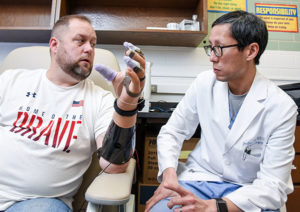
Shawn Findley (left), associate pastor and youth minister of Nevill’s Chapel Missionary Baptist Church in Mount Pleasant, is learning to use his robotic hand under the direction of Dr. Jonathan Cheng at UT Southwestern Medical Center. (Photo courtesy of UT Southwestern Medical Center)

Findley’s ministry has reached beyond Mount Pleasant. He’s involved in a cutting-edge research project at UT Southwestern Medical Center in Dallas, where doctors are attempting to improve communication between a person’s nerves and prosthetic devices so the prosthesis moves and reacts more naturally.

Hope for amputees

The effort could revolutionize the lives of amputees. While the hand can perform up to 22 different functions simultaneously, the most sophisticated commercially available robotic hands can only control three functions—one at a time.

Recently, two technologically advanced research-grade robotic hands have emerged, both of which have 20 to 30 distinct functions. But the newest devices don’t have practical applications yet because researchers have not mastered natural communication between a person and the devices. The UT Southwestern project is attempting to resolve those issues to the degree patients can type on a keyboard or play a musical instrument. Recently, Findley relearned how much pressure is required to pick up small weights.

“Feeling your hand is absolutely the purpose here,” said Dr. Jonathan Cheng, who is leading the study. “For all of my other patients, being able to feel with their hand is mandatory. It should be no different for patients using robotic hands.”

The research is exciting, Findley said. The amputation journey is a difficult one. He hopes this research helps people around the world.

Change perspective

The accident and amputation “changed my view on a lot of things,” he said.

“If I can get involved in some of these things and improve the product, increase the information out there, I’m all for it,” Findley said.

“I have a 19-year-old son in the Marines. You hope they all stay out of harm’s way, but you want to have done what you could. If something did happen, well, you know you might have helped in some way. You’ve got to have someone willing to do this, and I’m here (for the study) for as long as they want me.”

Findley’s accident is part of him, as is the road that led to the amputation of his hand. He prays he can use both to reach others for Christ.

“Be willing to be used,” he said. “The great accomplishments in life required somebody to try. Limitations don’t have to define you. The limitations are meaningless when it comes to being used by God.”


BUA inaugurates Jaquez as president

SAN ANTONIO—Because of its past accomplishments, Baptist University of the Américas is “poised to do new things,” Abraham Jaquez said at his inauguration and formal installation as the school’s eighth president.

BUA has accepted the challenge to continue to provide education for men and women to serve congregations throughout Texas and around the world, Jaquez told participants at his March 2 inauguration at Trinity Baptist Church in San Antonio.

Rolando Rodriguez (right), director of Hispanic ministries at the Baptist General Convention of Texas, prays for newly inaugurated Baptist University of the Americas president Abe Jaquez and his family—wife Kelly and children, Faith and Gabriel. Also joining in the prayer are BGCT Executive Director David Hardage (2nd from left) and Doug Diehl (2nd from right), pastor of Crossroads Baptist Church in San Antonio and chair of the BUA board of trustees. (Photo / Isa Torres)

“We will prepare biblical servant leaders who are ready to lead and serve in a cross-cultural environment,” he said. “That need for cross-cultural Hispanic Christian leadership is even greater today than it was yesterday, and it will be even greater in the years to come.”

Currently, 65 percent of Hispanic leaders in Texas Baptist churches are BUA graduates, he said.

“Our bridge must be paved with the mission of providing a holistic, cross-cultural education, founded on biblical principles for Hispanic men and women,” he said.

While the goal to provide theological education to a rising number of Hispanics in the state can be challenging, Jaquez said, he knows he can count on the support of Texas Baptist churches to achieve that goal.

“For the task before us we will clothe ourselves with humility, with understanding, and knowing that we serve the Almighty,” he said. “It’s a brand new day. Now, let us go and build that bridge.”

Since Jaquez accepted the role of BUA president last August, he has established a good relationship with the students and provided them a good model to follow, student Jason Martinez said.

“He shows that he really loves Christ,” Martinez noted.

The inauguration featured both local and denominational dignitaries, including state Rep. Thomas Uresti, San Antonio Mayor Ron Nirenberg, Hispanic Baptist Convention of Texas President Rolando Aguirre, Convención Executive Director Jesse Rincones and Baptist General Convention of Texas Executive Director David Hardage.


Baptist disaster relief in Texas sets new records

Texas Baptist Men disaster relief workers may have wondered this time last year how they ever could top the 12,000-plus volunteers days they gave in 2016. If so, they could not have foreseen surpassing 40,000 volunteer days this year.

Due primarily—but not exclusively—to Hurricane Harvey, TBM and its out-of-state partners who worked alongside them in Texas set new records in 2017 in most categories for disaster relief ministry.

Year to date, TBM volunteers responded to 19 disasters at 54 sites, beginning in mid-January and continuing throughout the year with few breaks.

As a result, Baptist disaster relief volunteers working in Texas made 25,925 personal contacts with affected individuals, compared to 8,294 last year, and they prepared more than 1.6 million meals—about 10 times the number they cooked the previous year.

They distributed 5,592 Bibles so far this year, compared to 762 in 2016. Consequently, they recorded 265 professions of faith in Christ, compared to 23 the year before.

‘Largest response in our history’

“This has been the largest response in our history,” said Terry Henderson, state director of disaster relief with TBM.

An Arizona Baptist mud-out crew begins their day with prayer before resuming work on a home in South Houston. (Photo / Ken Camp)

In particular, Hurricane Harvey stretched TBM beyond its available resources—but not beyond its ability to respond in partnership with other Baptist volunteers, he noted.

“Our mutual aid plan went into effect, and we had 31 states come here to help,” Henderson said. Baptist groups from as far away as Canada, Hawaii and Guam have worked in Texas after Hurricane Harvey, he noted.

Because of the rapid response by volunteers, TBM was able to begin rebuilding efforts in some locations while continuing disaster relief at other sites.

Volunteers needed for TBM Rebuild

All that has contributed to “volunteer fatigue,” Henderson acknowledged. The rebuild currently is on hiatus until January, and disaster relief also expects to suspend its operations Dec. 16 and resume as needed after Jan. 1.

While TBM Rebuild projects are scheduled in January, the demand currently exceeds the number of groups who have volunteers so far, he noted.

“We need volunteers for rebuilding,” he said.

For more information about the TBM Rebuild, click here or email TBMrebuild@texasbaptistmen.org.

To contribute financially to TBM disaster relief, click here or send a check designated “disaster relief” to Texas Baptist Men, 5351 Catron, Dallas 75227.


Tamiko Jones elected Texas WMU executive director-treasurer

DALLAS—The Woman’s Missionary Union of Texas board of directors elected Tamiko Jones, minister of missions and young adults at Bethlehem Baptist Church in Mansfield, as the organization’s executive director-treasurer, effective Nov. 1.

Woman’s Missionary Union of Texas welcomed and pledged to pray for Tamiko Jones (center), whom the board of directors elected as executive director-treasurer. (Photo / Liz Encinia)

She is the first African-American to hold the top administrative position with Texas WMU in its 137-year history.

Jones’ experience with Texas WMU, business background and vision for the future impressed the search committee that unanimously recommended her to the board at its Oct. 6 meeting, said Barbara Springer, who chaired the committee.

“As we ranked candidates throughout the search process, she stayed in the No. 1 position almost from Day One to the end,” Springer said. “God has worked throughout the process to make it clear the direction we should follow.”

Jones succeeds Sandy Wisdom-Martin, who left Texas WMU last year to become executive director-treasurer of national WMU, and Carolyn Porterfield, who has served in the interim leadership role.

WMU involvement

Jones worked on the planning team for the Texas WMU annual meeting the last three years, and she has been a frequent workshop facilitator in a variety of settings.

Naomi Key (left) of Fort Worth talks with Tamiko Jones, newly elected executive director-treasurer of Woman’s Missionary Union of Texas. (Photo / Liz Encinia)

Jones has been involved in leadership roles with Sisters Who Care since 2009. She has served on the Texas WMU African American Advisory council since 2011 and as its chair since 2015.

She was on the resolutions committee for the Baptist General Convention of Texas annual meeting in 2014 and 2015, serving as vice chair 2015.

She also is a member and treasurer of the Texas Baptist Women in Ministry board of directors.

‘A person called to ministry’

Jones has served Bethlehem Baptist Church as minister of missions and young adults since 2014, a role that includes work as coordinator of church mission outreach, overseeing more than 40 church ministries.

“It is obvious she is a person called to ministry, as demonstrated by her life and by her love for God’s people,” said Michael Evans, pastor at Bethlehem Baptist Church.

Ministerial responsibilities at Bethlehem Baptist Church include counseling, developing curriculum, leading the women’s ministry and overseeing the social media team. She previously was the church’s director of Christian education.

Tamiko Jones (left), newly elected executive director-treasurer of Woman’s Missionary Union of Texas, visits with Irma Ynostrosa of Dallas. (Photo / Liz Encinia)

She also spearheaded Bethlehem Baptist’s involvement in disaster relief with Texas Baptist Men and led other missions endeavors, Evans noted.

“We hate to lose her on our church staff, but I feel blessed to retain her as a co-worker in the gospel ministry,” he said.

Before she entered the ministry, Jones worked 15 years as an engineer and in a variety of management roles with Nokia Siemens Networks and Motorola.

Jones earned an undergraduate degree in electrical engineering from North Carolina Agricultural & Technical State University in Greensboro, N.C., a Master of Business Administration degree from the University of Dallas and a Master of Arts in Christian Education degree from Dallas Baptist University. She is a doctoral candidate in DBU’s Gary Cook School of Leadership.


Abraham Jaquez elected BUA president

SAN ANTONIO–Abraham Jaquez—an executive with Buckner International and longtime Baptist Student Ministry director—was named the next president and chief executive officer of Baptist University of the Américas.

Jaquez, 52, begins work as the eighth president in the 70-year history of BUA Aug. 21 after his election by the school’s board of trustees July 20.

He succeeds Réne Maciel, who left the university to become community life pastor at First Woodway Baptist Church in Waco. Moisés Rodriguez, executive vice president at BUA since 2013, has served as the school’s acting president since last October.

Abraham Jaquez 150Abraham Jaquez “I am so grateful to the trustees of BUA for placing their trust and confidence in me to lead this great school,” Jaquez said. “BUA stands at a cross-cultural crossroads as a unique Christian university training servant leaders for ministry.”

Jaquez has been executive director for Buckner Children and Family Services in Dallas since 2011. At Buckner, he oversaw all facility business operations and human resources and had oversight of the agency’s Dallas campus.

He previously served 20 years as a Baptist Student Ministry director with the Baptist General Convention of Texas.

Jaquez holds a doctor of education degree in educational leadership from Dallas Baptist University, a master of divinity degree from Southwestern Baptist Theological Seminary and a bachelor of arts degree in business administration and marketing from West Texas State University.

“I truly believe God has brought all of my past educational and professional experiences together for this moment,” Jaquez said. “BUA is poised to move forward in a strong way and I’m thrilled to be part of that as I lead this wonderful group of professors, administrators and students.”

Van Christian, chair of the BUA board, noted the presidential search committee unanimously recommended Jaquez to the trustees.

“The committee is absolutely convinced that Dr. Jaquez is God’s leader for BUA at this point in our history,” said Christian, pastor of First Baptist Church in Comanche. “We are excited about the talents and leadership qualities that Dr. Jaquez brings to BUA. We believe he is poised to lead the university into the next great era of success.”

Jaquez and his wife, Kelly, have two children, Gabriel, 12, and Faith, 14.

BUA, a BGCT-affiliated school at 7838 Barlite Blvd. in San Antonio, trains about 300 students from more than 20 countries, offering five bachelor’s degrees, as well as an associate’s degree in cross-cultural studies.


Texas Baptists Committed to cease operations

Texas Baptists Committed—the moderate organization that for nearly three decades resisted a “fundamentalist takeover” of the Baptist General Convention of Texas and its affiliated churches—will cease operations at the end of July.

Lack of financial support 

The group’s board of directors voted July 7 to close, citing lack of financial support.

“From one standpoint, this has been an easy decision—we simply no longer have the funds to sustain this ministry,” TBC Executive Director Bill Jones wrote July 8 on the organization’s blog and to readers of the TBC Weekly Baptist Roundup electronic newsletter. “From another standpoint, this has been a difficult, gut-wrenching decision.”

More than 18 months ago, Jones and the board convened a meeting at Wilshire Baptist Church in Dallas to discuss the organization’s future.

“At that meeting, I announced that I planned to step down by July 1, 2017, and suggested that, for TBC to make a significant impact, the board needed to look for an executive director who is younger than I am and has stronger credentials, and provide that executive director with a staff—at a minimum, an associate executive director and secretarial assistance,” Jones wrote. “Unfortunately, the funds never materialized to support any of that.”

‘Battle fatigue’ sets in

During its heyday in the late 1980s and throughout the 1990s, TBC mobilized thousands of messengers to vote for moderate candidates for BGCT office at the state convention’s annual meetings.

However, after the “Baptist battles” ceased in the Southern Baptist Convention in the early 1990s and Baptists in Texas who supported the direction the SBC formed a state convention in 1998 to compete with the BGCT, interest waned, and support for TBC decreased.

“With no visible ‘battle’ for control of the Baptist General Convention of Texas, as there was through most of the 1990s, many Baptists just haven’t felt the urgent need for a ‘watchdog’ like Texas Baptists Committed,” Jones wrote. “‘Battle fatigue’ was a factor, too.”

How Texas Baptists Committed originated

In 1988, moderates concerned about the direction of the Southern Baptist Convention created Baptists Committed as a national organization, with an office in Houston. That group included many of the leaders and financial supporters of Laity for the Baptist Faith & Message, formed in 1985.

A few months later, moderates in Texas created a state chapter of Baptists Committed, and the group hired San Angelo rancher David Currie as field coordinator and Oeita Bottorff of Houston as project director.

In 1992, the national organization ceased to exist, as many moderate churches turned their allegiance from the SBC to the new Cooperative Baptist Fellowship.

However, Texas Baptists Committed continued with Currie as executive director, and the organization focused on supporting a slate of moderate candidates for election at each BGCT annual meeting.

After many congregations that supported the “conservative resurgence” within the SBC withdrew from the BGCT in 1998 to form the Southern Baptists of Texas Convention, contested officer elections at the BGCT became uncommon.

So, for the next decade, TBC focused primarily on helping pastor-search committees identify ministerial candidates who would not seek to lead their congregations away from the BGCT.

At the same time, TBC continued to work behind the scenes to influence BGCT officer elections, calling for increased diversity in leadership posts. With TBC endorsement, the BGCT elected the first Hispanic president, Albert Reyes, and the first African-American president, Michael Bell, as well as the first two women to serve in that role—Joy Fenner and Kathy Hillman.

In September 2009, Currie retired as TBC executive director. After more than a year of minimal activity by the organization, the board elected Jones as executive director in January 2011.

Optimism and concern about the future

Looking to the future, Jones noted optimism about the future of Fellowship Southwest—a new Cooperative Baptist Fellowship network that includes Texas, Oklahoma and the Western United States. Marv Knox will step down as editor of the Baptist Standard July 31 to become the network’s coordinator.

However, he voiced concern about the BGCT’s future, citing friendly overtures by BGCT Executive Director David Hardage toward Paige Patterson, president of Southwestern Baptist Theological Seminary, and actions messengers to the 2016 BGCT annual meeting approved to remove from fellowship congregations that identify as welcoming and affirming of LGBT individuals.

“A lot of us will not be messengers (to BGCT annual meetings) any more, and the vote on the next issue that comes up won’t be as close next time,” Jones said in an interview. He is a member of Wilshire Baptist Church in Dallas, one of the congregations the BGCT voted to disfellowship.

In recent years, Jones said, when he met with BGCT Executive Board staff leaders, he realized TBC “didn’t have influence anymore, because they didn’t feel a threat as keenly.”

Fellowship Southwest will provide “a more robust CBF presence” in Texas, and Jones voiced confidence it will provide a home for churches and individuals committed to principles such as the priesthood of every believer, soul competency, local church autonomy, religious liberty, separation of church and state, and freedom to interpret Scripture.

However, he acknowledged, the network will not political in nature, and with the demise of TBC, the task of championing “historic Baptist distinctives” within BGCT life will fall to “individual watchdogs.”

“If we were to see clear evidence the BGCT is departing from Baptist principles, I wonder if there could be support to recreate something along the order of TBC—some kind of organized effort,” Jones said.


Baylor University elects Linda Livingstone to return as 15th president

WACO—Baylor University has elected Linda Livingstone, a veteran dean and business professor, as its 15th president and the first woman to lead the school, founded by Texas Baptists in 1845.

Linda Livingstone 180Linda LivingstoneLivingstone received unanimous support from Baylor’s board of regents after being recommended by a 12-member presidential search committee, the university announced April 18. She will assume the office June 1.

She succeeds Ken Starr, who lost his job almost 11 months ago in the sexual assault scandal that rocked Baylor, and particularly its football program, the past two years. David Garland, former dean of Baylor’s Truett Theological Seminary, has been interim president since last summer.

Livingstone is dean and professor of management at George Washington University’s School of Business. Previously, she was dean of the business school at Pepperdine University. Before that, she was an associate dean and associate professor in Baylor’s Hankamer School of Business. She has specialized in studying and teaching organizational behavior, leadership and creativity.

During her earlier time at Baylor, she was a member of Calvary Baptist Church in Waco. Most recently, she and her family have been members of First Baptist Church in Washington, D.C.

Back where she started

“It is an honor to return to Baylor where I started my academic career,” Livingstone said. “I chose to begin … at Baylor in significant part because of Baylor’s Christian mission.

“To return to Baylor to partner with the exceptional faculty, staff, students and administrators to fulfill the university’s vision to be a top-tier research institution, committed to excellence in all aspects of university life, while strengthening the Christian mission is an opportunity I look forward to with enthusiasm.”

“Dr. Livingstone brings an accomplished academic career to Baylor, combined with a strong appreciation and support of Baylor’s mission,” noted Ron Murff, chair of the Baylor board of regents. “A longtime Baptist and former Baylor faculty member, she has a passion for the distinctiveness of Baylor’s Christian mission in higher education.”

Although Livingstone broke the gender barrier by becoming Baylor’s first female president, that was neither the search committee’s nor the regents’ goal, Murff noted.

“We understand this is a significant moment in Baylor’s history. Our goal was to make history by hiring Baylor’s next great president. Our goal was not specifically to look for a female,” he said.

“We were looking for a leader who had impeccable credentials and the ability to bring the Baylor Family together—to reach Baylor’s potential, to build on its Christian foundation and to reach its Christian mission. We believe we found that person in Dr. Livingstone.”

Livingstone noted she appreciates Baylor’s history and the significance of being the university’s first woman president. “But it’s not the first time in my career I’ve been ‘the first woman,’” she said. “I think I can take that on.”

She comes to Baylor as an ongoing controversy over sexual assault raises questions of student safety, particularly for female students.

“Regarding sexual assault and the vulnerability of women, obviously, I take those issues very seriously,” she said. “They affect the entire community.

“At Baylor, we’re going to do the right things. … We’re going to do everything we can to provide a safe and healthy environment for all our students. I’m committed to that, and I know the board is committed to that.”

Affirmation and support

Drayton McLane, a Baylor regent emeritus and member of the presidential search committee, noted Livingstone’s longstanding Baylor connection in citing her qualifications to lead the university.

“We began with Baylor’s mission in mind and based our search on the Christian values that Baylor stands for. That set the criteria for the type of individual we were looking for,” McLane said. “Dr. Livingstone met all our requirements. She, her husband and their family are outstanding, committed Christians.

“Dr. Livingstone has taught at Baylor and understands the Christian heritage, which is so important to the university. I am very pleased with the outcome of our search and the strong leadership Dr. Livingstone will provide Baylor University.”

Livingstone came to Baylor out of a process that began last fall and generated 400 recommendations for the presidential search committee, Murff said. The committee and its consulting firm, Heidrick & Struggles, conducted about 150 screening conversations and 61 first-round candidate interviews.

“We had strong interest in the position from accomplished candidates both inside and outside of academia,” Murff said. “Candidates admired Baylor’s significant growth over the past decade and saw tremendous potential in elevating the university’s academic profile even further while staying true to our Christian mission.”

Livingstone topped a talented, crowded field, reported Bob Brewton, chair of the search committee.

“The presidential search committee had a very strong candidate pool coming from the traditional academic fields as well as nontraditional candidates from government, military and corporate life,” Brewton said. “In the end, Dr. Livingstone’s experience uniquely fit the profile of the dynamic faith and transformational leader which Baylor needs at this point in time in our history.”

“The range of Dr. Livingston’s experiences—including her expertise in the area of accreditation and commitment to preserving the timeless values of Baylor’s founders—will be critical to helping the Baylor Family navigate through these challenging times,” said Fred Norton, president of the Baylor Line Foundation, successor to the Baylor Alumni Association and publisher of The Baylor Line.

“We welcome her return to the Baylor Family—many of whom already know her and respect her—and we look forward to supporting her efforts to rebuild Baylor’s reputation and standing in a spirit of transparency and accountability.”

“Unique culture of care and compassion”

Livingstone taught at Baylor from 1991 to 2002. She began her Baylor career as an assistant professor in the Hankamer School’s management department and was promoted to associate professor in 1997. Beginning in 1998, she was the school’s associate dean for graduate programs.

“My time at Baylor as a faculty member and associate dean was formative in my academic career and in developing my passion for academic administration,” Livingstone said in the Baylor release. “Baylor’s unique culture of care and compassion—that I experienced personally from my colleagues and that I saw demonstrated among faculty, staff and students—continues to inspire and influence me as an administrator.

“Continuing to strengthen Baylor’s culture, where faculty, staff and students are encouraged, inspired and cared for by one another, is a priority.”

Pepperdine, GWU and OSU

Livingstone left Baylor for Pepperdine in 2002 and served there 12 years. She oversaw a $200 million expansion of the Pepperdine business school’s graduate campus and construction of an executive conference center. The school’s full-time, executive and fully employed MBA programs grew on her watch.

Since 2014, Livingstone has guided George Washington University’s School of Business, which trains about 3,500 undergraduate, master’s and doctoral students. She led the school through a comprehensive strategic planning process to capitalize on its commitment to service.

“Linda Livingstone has been a stellar dean and an excellent colleague,” said university President Steven Knapp. “I am sure that our entire GW community joins me in wishing Linda all success in her important new role and that Baylor University will benefit tremendously from her leadership.”

Livingstone is a native of Perkins, Okla., and a graduate of Oklahoma State University, where she earned bachelor’s, master’s and doctoral degrees. She also lettered four years on the women’s basketball team, from 1978 through 1982.

She is a member of Oklahoma State’s Spears School of Business Hall of Fame. She was the first recipient of the Outstanding Ph.D. Alumnus Award, and she was recognized in 2015 with the OSU Distinguished Alumni Award.

Livingstone previously served as chair of the board of the international Association to Advance Collegiate Schools of Business in 2014-15 and has expertise in accreditation issues. The association is the professional organization for business schools and accredits 786 business schools globally in 53 countries and territories. She chaired the association’s Committee on Accreditation Policy in 2015-16.

Her husband, Brad Livingstone, is dean of students and teaches history at Trinity Christian School in Fairfax, Va. He also played basketball at Oklahoma State.

Their daughter, Shelby, recently completed her junior season on the volleyball team at Rice University.

Appreciation for Garland

Murff expressed particular appreciation for David Garland, Baylor’s interim president.

“I want to thank Dr. Garland for stepping in and serving Baylor this last year,” Murff said. “He has led with tremendous grace, integrity and passion for Baylor.

“On behalf of the entire Baylor Family, I want to express our appreciation for the sacrifices he has made and the model of selfless character and leadership he has shown us all.”

Editor’s note: This article has been updated to include material from a media conference call conducted by newly elected Baylor University President Linda Livingstone and Ron Murff, chair of the Baylor board of regents.


Texas Baptist professors denounce political sins and confess complicity

More than two-dozen faculty and staff at six Texas Baptist universities joined 1,100 other Christian scholars who signed a statement of confession and commitment denouncing a political environment “marked by fear, polarization and violence.”

“The current political climate reveals longstanding national sins of racism, misogyny, nativism and great economic disparity,” says the “confessing faculty” statement, an expanded version of a document originally drafted by faculty and staff at North Park Theological Seminary in Chicago and Westmont College in Santa Barbara, Calif.

‘Privilege and power’

The scholars who signed the statement identify as “Christian faculty members of institutions of higher education who represent varying degrees of privilege and power,” but they make clear they are speaking as individuals, not as institutional representatives.

“A large portion of our communities is weeping,” the statement says. “The fear of deportation is real. The anxiety of being assaulted is real. The fear of being forgotten or mistreated is real. Many people of color, women and other marginalized groups feel increasingly alienated not only in the current national context but in much of the white evangelical culture as well. Acknowledging that pain and woundedness may take many forms, we humbly entreat Christian communities to seek healing, reconciliation and justice.

“Regardless of where Christians stand politically, the gospel demands we recognize vulnerable populations among us. The gospel also demands that Christians recognize ways we benefit from and participate in structural injustices. Ignoring policies that denigrate and even endanger vulnerable groups is not a faithful option, even if privilege allows some to do so. When we have power, we are called to use it justly and for the good of all.”

‘God first’ not ‘America first’

Roger Olson, the Foy Valentine Professor of Christian Theology and Ethics at Baylor University’s Truett Theological Seminary, said he endorsed the statement because the nation faces a moment of potential crisis “in which America could possibly go completely wrong in terms of empire and misusing God to justify ‘America first.’”

“As Christians, even American Christians, we ought to say, ‘God first’ and ‘America insofar as it is with God’—not assuming that God is with us in whatever we do just because we are America,” Olson said.

“That was the mistake Israel and Judah made—assuming God was on their side, regardless of their obedience to God’s way. The prophets spoke into that decision of crisis and reminded Israel and Judah that God requires mercy over sacrifice—obedience to God’s way over lip service.”

Confession and penitence

The statement includes confessions of failure “in calling out injustice, in loving and knowing our neighbors, and in properly stewarding God’s creation.”

“We pray for genuine conviction to undo the harm we have caused,” the statement says.

Myles Werntz, who holds the T.B. Maston Chair of Christian Ethics at Hardin-Simmons University’s Logsdon Seminary, said he was drawn to the statement by “the penitent nature of it.”

“As Christian educators, it is essential for us to model not only the proper confidence of the faith, but also the penitence of it—that we aspire to be emissaries of God’s grace, but often do so in ways which are convenient and not at all costly to us,” Werntz said. “The statement is a vision of charity amidst differing political positions, of reasoned discourse, and of unity in an age of divisive soundbites.”

‘Radical commitment to truth’

Bob Ellis, associate dean for academics at Logsdon Seminary, noted he would have phrased a few points differently, but overall the statement “offers a profound commitment to particular values I think are under assault in our day.”

Ellis particularly noted the statement on truth, which says: “As Christian educators, we affirm our deep resolve to pursue truth, to reason carefully and to rely on sound evidence. While we ‘see through a glass darkly’ (1 Corinthians 13:12), we stand resolutely against any falsehood that seeks to undermine truth and any propaganda intended to obscure it.”

“Some in our culture who have loud voices seem to think that opinion which is neither rational or verifiable is somehow as valid as truth,” Ellis said. “Such a view is threat to our society and an affront to the gospel.”

While he also affirmed the statements of commitment to the vulnerable and marginalized, he particularly noted his appreciation for the statement’s emphasis on confession.

“We who are Christian educators have also failed at times to pursue a radical commitment to truth, and we fail all too often to show compassion for the marginalized in our actions, as well as our words,” he said. “We, along with the rest of the church, need a recommitment to truth and compassion.”

Other faculty and staff from Hardin-Simmons University who endorsed the statement are Rick Hammer and Teresa Ellis.

‘Too long in coming’

Barry Harvey, professor of theology at Baylor University, insisted the affirmations in the faculty statement “have been too long in coming.”

Harvey cited the “Letter from Birmingham Jail,” in which Martin Luther King Jr., pointed to a time “when the church was not merely a thermometer that recorded the ideas and principles of popular opinion,” but rather when people in power accused Christians of being agitators and “disturbers of the peace.”

He also pointed to Dietrich Bonhoeffer’s words that in assessing what is just or unjust, “the community of the faithful … is not bound by political or national ties.”

“It is instead the obligation we have, not just to Jesus Christ, but to our sisters and brothers and to all human beings, that ultimately binds our minds and hearts,” Harvey said.

Other Baylor faculty and staff who endorsed the statement are Natalie Carnes, Christopher Hansen, Moises Park, Beverly Roberts Gaventa, Lynn Whitcomb, Robert Woodberry, David Sherwood, Ellen Hampton Filgo, Tiffany Hogue, Pete Ramsey and Elise Edwards.

Derek Hatch from Howard Payne University also signed the statement, as did three East Texas Baptist University faculty members—Gerald Nissley, Robert Benefield and Troy Ladine. Three Houston Baptist University faculty members—Curtis Henderson, Mary Osterloh and Brenda Whaley—endorsed the statement, and two Wayland Baptist University professors—Jerry Faught and Peter Bowen—signed it.

EDITOR’S NOTE: Derek Hatch was named associate professor of religion and endowed chair of Baptist Studies at Georgetown College in September 2020.