Editorial: We need water

Maybe it’s just me, but it seems people are thirsty. We need water.

Ask people from Lubbock to Amarillo who endured record rainfall earlier this month and they might say, “No more water, please.” Plenty of other West Texans gladly would take some more.

But I’m not referring to the chemical compound H2O. I’m referring to a different kind of water and a different kind of thirst. Yes, I’m referring to something biblical.

People are thirsty for peace, but there is precious little peace.

We are thirsty for security, but fear propagates like zebra mussels in a Texas lake.

We thirst for economic relief, but the experts have managed only to slow inflation, not stop it.

We long for more constructive politics, but combative is the order of the day.

This is less an opinion about the issues we face than an echo of that pervasive cry: “We thirst.” It is also a call to wake up to our thirst and to carry more water to thirsty people.

Temporary water

When we aren’t thirsty, we can take all day to drink a glass of water. If we’ve been exercising or working outside in the summer heat, we can down a full glass of water in seconds without taking a breath. I’m referring to this kind of thirst, a longing in our bones.

I see this kind of thirst just about everywhere I look these days. I see it in local and global news. I see it in our denominational conversations. I see it in the kinds of videos that go viral.

One of those viral videos is Belgian shot-put and hammer-throw champion Jolien Boumkwo running 100-meter hurdles to save her team from disqualification. She took one for the team—as she put it—and provided a shot of joy in our cut-throat world. We’ll take sips of that all day.

Before too long, though, this shot of joy will be buried and forgotten under millions of views of other viral moments. Their momentary relief is heavy on the “momentary,” light on the “relief.”

Biblical water

Felisi Sorgwe, associate professor of theology at Houston Christian University, in his recent book I Will Be With You: God’s Favorite Promise, recounts the Israelites’ thirst in the wilderness. This wilderness was rocky, dusty, arid and barren, and they’d been in the middle of it for days, if not weeks. They were thirsty enough to fight about it.

Moses cried—complained—to God for help, and God said: “I will stand there before you by the rock at Horeb. Strike the rock [with your staff], and water will come out of it for the people to drink.”

Moses did as he was told (Exodus 17:1-7).

Amid lament over Israel’s unfaithfulness, Scripture recounts God providing water from that rock:

He split the rocks in the wilderness
and gave them water as abundant as the seas;
he brought streams out of a rocky crag
and made water flow down like rivers
(Psalm 78:15–16).

While celebrating God’s love for Israel, Scripture remembers God’s provision of water:

He opened the rock,and water gushed out;
it flowed like a river in the desert
(Psalm 105:41).

Paul reinterprets the literal water from the rock as spiritual water from the Rock:

They all … drank the same spiritual drink; for they drank from the spiritual rock that accompanied them, and that rock was Christ (1 Corinthians 10:4).

Paul’s description of Jesus as the source of wilderness water squares with Jesus’ own self-description, as well as Old Testament prophecy.

Jeremiah called God the fountain of living water (Jeremiah 17:13).

Jesus told the Samaritan woman during their conversation at Jacob’s well: “Everyone who drinks this water will be thirsty again, but whoever drinks the water I give them will never thirst. Indeed, the water I give them will become in them a spring of water welling up to eternal life.” (John 4:13–14).

When we’re in a desert wilderness surrounded by miles and miles of sand and rock, we’ll settle for a momentary stream. All too often, that’s where we are, and that’s what we do.

Everlasting water

What causes you to long for God? Maybe a better way to ask that is: What causes you to be aware of your longing for God?

Sometimes, busyness gets in the way of our awareness. Sometimes, fear or anger, bitterness or worry does. Often, satiation with lesser things gets in the way.

But then, I read a book like A.W. Tozer’s Knowledge of the Holy or listen to beautiful songs of worship such as Fernando Ortega’s albums The Shadow of Your Wings or Come Down O Love Divine, and I am reminded what I most want and need—what I long for most profoundly—is God.

In those moments, I can’t help but turn to God to find fulfilment in God’s completeness—Father, Son, Spirit; Creator, Redeemer, Sustainer. And God meets my longing.

Do I have to continually return to God for this fulfilling water? Yes. But I’ve not found the bottom of the well yet, though I’ve quickly found the bottom of so many other promises.

The world needs us to be fully awake to our longing for this everlasting water, for us to know full well its source, and for us to be satisfied by it. Because when we are, we become directional signs pointing other thirsty souls straight to who will quench their deepest thirst.

The world is enduring a summer drought of the soul. The world is thirsty and grabbing for a glass of water, sometimes finding momentary satisfaction, often meeting a mirage.

May we be made awake to what we really long for, may we turn directly to God to be made complete in God’s completeness, and may we carry this water to a thirsty world.

Eric Black is the executive director, publisher and editor of the Baptist Standard. He can be reached at eric.black@baptiststandard.com. The views expressed are those of the author.


Volunteers help North Texas family recover from house fire

Mark Korenek sat in a chair in the middle of his burned-out Grand Prairie home looking a little overwhelmed. Soot-covered Texas Baptist Men volunteers swirled around him, some with wheelbarrows, moving charred personal items from the fire that burned his home in January.

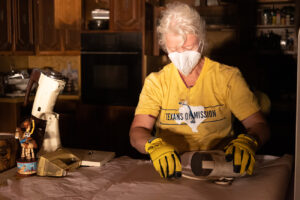
TBM volunteers showed the love of Christ by removing debris—and recovering treasured personal items—from a burned-out home in Grand Prairie. (TBM Photo)

The sound of a revving skid steer moving everything from sheetrock to clothing into a massive 40-yard trash container threatened to drown him out as he recalled the tragedy that burned the home he shares with his wife, Karen, and sent him to the hospital for almost two months.

“It was Jan. 12,” he recalled. “I got up and got my wife off to work at First Baptist Church Dallas and went back to bed for an hour. At 6:30, the smoke alarm sounded. The fire started far away from me but traveled through the attic.

“When I woke up, I could see nothing because of the smoke. I grabbed my cell phone, ran to the hall and saw nothing but flames.”

His call was recorded by 911 at 6:32 a.m.

 “I told them, ‘I’m going to be in the back yard, I have five dogs and no one else is in the house,’” said Korenek. “I crawled down the hall and went to the backyard. I fainted going through the back door. I felt myself fainting and rolled on my back. I knew when the firemen arrived, but I never really came out of it.”

Three of his dogs made it out with him. Two died in the home, overcome by smoke. While not injured by the flames, Korenek spent months recovering from the effects of smoke inhalation.

“The firemen hit me with a shot,” he explained. “The chemicals in our house produced cyanide. The shot was used to draw the cyanide out of my body. They took me to Parkland (Hospital), and Parkland put me in a medical coma for four weeks. Their job was cleaning my lungs. My kidneys shut down. My pancreas shut down.

“I am told by the nurses I coded (ceased heartbeat) five times,” he said. “It was awful for my wife, Karen. She’d be holding my hand, and I’d code, and they’d kick her out.”

When Korenek woke from his coma, he said his medical team “reminded me I was in the fire, and then they began the trauma of dialysis and put me on insulin because my pancreas had shut down.” He  was intubated four weeks to clean his lungs.

Still sitting in his chair, Korenek grinned as he said: “I’m happy to say I lost 72 pounds, … the wrong way. They got me up the next day and started me walking. I was there until late February. I think I witnessed to every nurse there with the message, ‘God saved me.’”

Speech therapy and psychiatric tests followed to see if the smoke inhalation had affected his brain. He began rehabilitation, and his latest round of tests indicate no permanent damage.

‘We knew we’d need an army’

Mark Korenek of Grand Prairie, whose home burned in January, appreciated the recovery ministry of TBM volunteers Curt and Ann Neal and the teams they coordinated. (TBM Photo)

As he wrapped up his story, TBM volunteers continued to swarm around him, busily moving the remains of the home to the trash dumpsters.

By the end of the week, 45 volunteers helped reduce the house down to its studs to prepare the family for the next step of recovery.

Sabrina Pinales, TBM ministry advancement coordinator, called the week “a two-team effort. We have several trained disaster relief volunteers on site, and we also have day volunteers who have a desire to serve.”

TBM volunteer Curt Neal, the on-site coordinator, called the week-long project “unique.”

“We solicited anyone and everyone who would help. We knew we’d need an army, because the house was full of things,” Neal said. “This couple are collectors, which made the cleanout task more difficult.”

Since Mark and Karen Korenek are collectors, TBM volunteers gave special attention to recovering and storing items found in their burned-out home. (TBM Photo)

By the end of the week, the TBM team removed five 40-yard and five 30-yard trash containers of material and possessions from the home.

Neal’s wife Ann served as a coordinator at the site, as well as trailer manager and chaplain to the volunteers and homeowners. She said the project embodies TBM’s desire to bring “help, hope and healing.”

“When we first come in, we’re help, but after even a few minutes, you quickly see the hope. When you get to this point in a clean out, survivors are seeing things get back on track,” she said.

“We’ve seen (Mark) break down and cry, and (Karen) has broken down and cried several times today. I told them, ‘We’re cleaning out your house, but we’re here for you, to love on you, and do whatever you need.’”

Volunteer Jan Rahmandar echoed the sentiment.

“I came out to show God’s love. I can only do one day, but God said, ‘Go do what you can do.’ I’m pulling nails because it helps the homeowner get back on his feet,” Rahmandar said.

“It’s a job that’s overwhelming for the family,” volunteer Steve Glover agreed. “We’re helping get them organized so insurance can come in.

“TBM is a family, and what a great witness it is to this family to know we’re doing it and asking nothing in return.”


What does the Bible say a pastor is? It’s complicated

WASHINGTON (RNS)—During their annual meeting in New Orleans, Southern Baptists drew a clear line in the sand: Give a woman the title of “pastor” and your church no longer fits in the nation’s largest Protestant denomination.

But as nearly 13,000 local church messengers departed the Big Easy in mid-June, a crucial question was left unanswered.

What exactly is a pastor?

Answering that question is complicated.

That’s in part because, when Southern Baptists talk about the word “pastor,” they are discussing three things at the same time: job description, gender and church governance. And there’s a difference between how Southern Baptist doctrine defines the word and how churches use the term.

That disconnect has caused enough confusion that last year, a prominent Southern Baptist Convention committee wanted to form a study group to sort out how the word “pastor” is used in local churches. That request was soundly rejected, with one influential leader insisting Southern Baptists know exactly what a pastor is.

And in New Orleans this year, the Southern Baptist Convention made it clear if a woman is a senior leader of a congregation or preaches regularly, that church is out.

But what happens at the estimated 2,000 SBC churches where women have a number of support roles, such as associate pastor, worship pastor and children’s pastor? Are they also in danger of being kicked out of the SBC?

And is using the term “minister”—often seen as a synonym for pastor—for women staffers also a violation of Southern Baptist doctrine?

What does the Bible say?

Bigstock Image

Answering that question is not simple, in part because the Bible uses a series of titles for church leaders, including elder, overseer (often translated as bishop), pastor and deacon.

“The New Testament does not define the word ‘pastor’ in any way near the way we define it today,” said Scot McKnight, author and professor of New Testament at Northern Seminary, a private Baptist seminary in Lisle, Ill.

Three of the most common words used for leaders in the New Testament are the Greek words “presbyteros,” which is often translated as elder; the word “episkopos,” translated as overseer or bishop; and the term “poimen,” which is translated as pastor.

Because the Christian church was in start-up mode during the time the New Testament was written, none of the structures that developed later were yet in place. And Christian groups have come to interpret those words differently.

For example, the term “overseer” or “bishop,” in the Catholic Church and among Protestants such as Lutherans and Methodists, is someone who oversees a geographic area, whereas a pastor leads a local congregation.

Presbyterians, Baptists and some other Protestants, by contrast, don’t have a hierarchy of bishops, and most congregations are overseen by local leaders, such as a pastor or board of elders.

“There’s a long debate about the relationship between an elder and overseer,” McKnight said. “And there is a long debate because the New Testament is not at all clear.”

Ray Van Neste, dean of the school of theology and missions at Union University, a Baptist college in Jackson, Tenn., disagrees. He said there’s long been a consensus among Southern Baptists that the three main words for pastor—elder, overseer and pastor—refer to the same distinct role in the church. That role is set apart from other church members, who may also be involved in church leadership and ministry.

How do Southern Baptists use the term?

But while the New Testament’s teaching about pastors is clear, Van Neste said, Southern Baptists have not always been careful in how they use language, especially when it comes to job titles and job descriptions within the church.

“We love Jesus and try to get people saved,” he said. “Those things are crucial, but failure to pay attention to definitions has led to sloppy language, which leads to confusion.”

Van Neste said a woman who leads the children’s ministry or music ministry of the church could be called a minister without violating biblical teaching. But he’d prefer they use the job title of director instead, as people sometimes confuse the terms “pastor” and “minister.”

Bart Barber, recently elected for a second term as SBC president, offered a solution to the confusion about job titles.

Bart Barber is pastor of First Baptist Church in Farmersville and president of the Southern Baptist Convention. (RNS Photo / Riley Farrell)

At First Baptist Church in Farmersville, where Barber serves as pastor, both men and women have leadership roles in ministry. But anyone with the title of pastor must be eligible for the senior role at the church, while those with different titles needn’t be.

Barber said churches that use the word “pastor” differently could simply change job titles and be in line with SBC doctrine. He also noted the overwhelming support during the annual meeting for the belief that only men can serve as pastors.

Gender an underlying issue

Still, the gender restrictions on the role of pastor are also debated. While many Christian groups, including Southern Baptists and Catholics, restrict that role to men, the New Testament shows women taking prominent leadership roles.

Amy Peeler, author of Women and the Gender of God and an associate professor of New Testament at Wheaton College, said the restriction of women pastors played a role in her leaving the SBC, where she had been raised.

 “I really love teaching, and I love teaching the Bible,” Peeler said. “I realized there wasn’t a place for me in the SBC.”

She now is an associate rector at St. Mark’s Episcopal Church in Geneva, Ill., adding she was also drawn to a more liturgical style of worship.

Peeler said there are valid interpretations of the Bible that see all the terms used for the pastor as referring to one role—and that the role is limited to men. But there are also valid interpretations, she said, that define the terms differently and see the role of pastor as open to both men and women.

“Let’s show respect to someone that reads the Bible differently,” said Peeler, who has always found the Bible empowering to women because it shows women acting as leaders and pastors, no matter what their title.

What did women do in early churches?

McKnight also believes there are several ways of interpreting a prominent passage found in 1 Timothy, where the Apostle Paul says he does not allow women to teach or have authority over men.

Southern Baptists point to that verse to support limiting the role of pastors to men. McKnight believes that statement dealt with a specific situation in a specific church, rather than applying universally. The New Testament also shows women teaching and leading, he said, at times in partnership with Paul.

“You can’t prohibit women from doing what they were doing in the early church and be consistent,” he said.

During their meeting in New Orleans, Southern Baptists approved a change to their statement of faith to clearly state the terms “elder,” “pastor” and “overseer” refer to the same office. That change must be ratified next year.

How are churches governed?

The change may also have unintended consequences for church governance.

Many local Southern Baptist congregations use what’s known as an “elder-led” model, where the pastor is one of a group of men who serve as a governing board for the church. That model has become increasingly popular in churches as a way of making sure that one person—often the pastor—doesn’t hold all the power.

While many scholars agree having multiple elders at a church is good, not all church governance boards are led by elders in the SBC. And not every pastor on a church staff is always included on the church elder boards.

Also, in many cases, the church’s deacons—another role mentioned in the New Testament but not always defined—serve as the board, while the pastor is not called an elder.

Van Neste said that structure doesn’t match the biblically defined role for deacons. Instead, he said, it shows the way Southern Baptists have not been precise in their language. He said Southern Baptists understand what they believe about pastors and elders. Now it is time to practice what they preach when it comes to church leadership.

“We need to sit down with the understanding, which is pretty clear, and ask hard questions about whether or not we’re being true to that understanding,” he said.


Voices: How pastors and churches can respond to ChatGPT

“Church leaders must be careful to ensure that the use of ChatGPT complies with legal and regulatory requirements, is transparent, and considers privacy concerns,” wrote Duke Taber—a pastor in Mesquite, Nev.

Actually, Taber didn’t write that. At the end of the article, Taber includes the following disclosure: “This paper was written by ChatGPT with editorial oversight and guidance by Duke Taber.”

A recent Associated Press article reports that among clergy, the consensus is AI “can’t replicate the passion of actual preaching.”

Hershael York, a pastor in Kentucky and professor of Christian preaching and dean of Southern Baptist Theological Seminary’s School of Theology, told David Crary of Associated Press he believes “lazy pastors might be tempted to use AI” to write sermons, “but not the great shepherds, the ones who love preaching, who love their people.”

Responding to challenges of AI

While many see benefits to using ChatGPT in ministry, I see some challenges.

Busyness is part of our lives, and pastors could become more likely to depend on this time-reducing application than searching out the word of God through prayer and dependence upon the Holy Spirit. Pastors could rely more on artificial intelligence than the Bible or other credible biblical materials.

For the congregants, why bother to listen to a sermon that might have been written by AI? If I don’t sense the Holy Spirit’s part in my pastor’s preparation, I would be tempted to avoid listening, and rightly so. I want to hear from God through my pastor. Many congregants might decide not to attend church at all.

Using AI for any form of teaching—such as blogs, devotionals and Bible studies—could create a distrust of church literature. People could become distrustful of reading Christian books, magazines and articles, and listening to Christian podcasts, not knowing if the source is human.

In response, new policies and rules need to be written regarding using artificial intelligence of any sort in a sermon, for Bible study preparation or for Christian teaching. Also, training is needed on the acceptability—or the lack thereof—of pastoral staff and volunteers using AI.

Teaching biblical integrity

AI creates a challenge to integrity. Many believers do not have a solid handle on biblical integrity. This must be taught. Churches and Christian schools should provide ways to instill integrity in their members and students.

For example, just as first-semester college students are required to attend a seminar by the library staff on how to use the library and its features, what would happen if Christian institutions required students to participate in a workshop on Christian integrity?

Churches and Christian schools should begin with the question, “What is God’s will?” Specifically, what is God’s will regarding honesty, working hard, character, discerning godly behavior, yielding oneself to Christ, being honorable, having peace, being controlled by the Holy Spirit, renewing our minds daily and living victoriously in Christ?

Maybe the solution to all this is to stop relying so much on technology and depend more on God’s word to guide our writings and sermons.

While we may reminisce about the good old days—sitting on the front porch of our homes, playing kickball outside and listening to our 45 RPM records—AI technology is here to stay. We must adjust and adapt to it.

The University of Texas offers a certificate in industry-valued AI and machine-learning skills. Certification programs at some point may become degree plans, if they haven’t already.

As we respond to AI, we must slow down, intentionally process our life, spend time in prayer, study God’s word and seek guidance from him.

Maybe—even possibly—artificial intelligence is an opportunity for believers to build new character traits and become more Christlike in their behavior and thoughts. That’s something to think about.

Patti Greene is a graduate of Baylor University and Dallas Baptist University, a member of Second Baptist Church in Houston, and the author of seven books. This article is adapted from her March 17, 2023, blog post. The views expressed are those of the author.


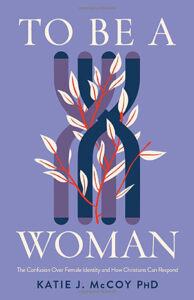
Katie McCoy addresses female gender dysphoria

DALLAS (BP)—It’s not about pink dresses, blue button-downs, 18-wheelers or Barbies. For theologian Katie McCoy, dispelling gender dysphoria rests on Scripture undiluted by cultural stereotypes society assigns.

Neither is Scriptural truth in conflict with the science of gender dysphoria, McCoy said upon the release of her latest book intended to guide mothers and ministers in addressing the rapid onslaught of gender dysphoria among females.

“The theology of humanity, and the evidence that we’re seeing about all of gender dysphoria, its source, its treatment and its affects, they are in harmony,” McCoy said. “In other words, what secular sociologists, psychologists, endocrinologists, sexologists are all describing from their own perspectives of expertise, harmonizes with the truth that we find in Scripture of how God created humanity.”

Some of the scientific evidence is difficult to find, McCoy said, as it is typically not reported in mainstream media, or is dispelled to protect “politically prescribed narratives.”

“But when all of the facts are known, the world of nature and the laws of nature confirm the laws of God,” McCoy said upon the release of To Be a Woman: The Confusion Over Female Identity and How Christians Can Respond.

McCoy, director of women’s ministry at the Baptist General Convention of Texas, gives guidance amid an onslaught of gender dysphoria and the denial of God’s created bilateral gender.

Rapid-Onset Gender Dysphoria, as termed by Brown University physician-scientist Lisa Littman, overwhelmingly affects biological females. Gender dysphoria was rare decades ago. It was more prevalent in boys, typically presenting itself between ages 2 and 4.

Long-simmering ideas boiling over

But in the last decade, McCoy’s research shows, it has skyrocketed. In 2007, the United States had only one gender clinic for adolescents. By 2021 there were at least 50.

“Gender confusion is not only just growing,” McCoy said. “It’s erupting, and by a landslide, it’s girls who seem to be most affected by the explosion.”

McCoy likens it to a crockpot of soup.

“The way we arrived at this moment is a little bit like throwing a lot of ingredients into a big pot to make a big soup. And into this soup are ideas about what it means to be human, to be happy, to be fulfilled, our relationship to society, and then even our relationship to our own bodies,” McCoy said.

“And these ideas have been allowed to simmer for decades, and we are just now seeing them come to fruition.”

McCoy wrote the book, she said, to assert that “female identity is socially guided, philosophically formed, relationally confirmed, biologically grounded and theologically bestowed.”

Address with Scripture and with love

Gender dysphoria should be addressed with Scripture and with love, two variables which are not in conflict. The problem should be addressed with an admission of societal sins and an acknowledgement of who God is.

“Jesus said the truth sets us free, and what a confession is, is to acknowledge with God what he says about who we are, what we believe and what we’ve done,” she said.

“We are presenting a truth that does not belong to us, because it doesn’t originate with us. We are messengers. We are ambassadors. And we’re not trying to make the world, somehow, exclusively, socially different. This is about protecting the image bearers of God from the self-inflicted harm that comes from denying their creator.”

She describes gender dysphoria not as a sin, but as a symptom of an underlying problem, trauma or a sense of not fitting into a societal peg.

“It can stem from things that are wrong, but the feeling of gender dysphoria is a feeling. It is something that is indicating an inner issue that is out of alignment,” she said. “And for so many girls and young women who have gender dysphoria … when they get to the root of it and fix that, so many times the gender dysphoria dissipates or resolves.”

To get to the truth of what it means to be a woman, McCoy dispels cultural stereotypes of gender that society has used for generations.

“We need to separate that which comes from the Bible and that which comes from culture,” McCoy said.

A biblical woman “will be a woman who evidences courage and boldness, but she does it according to her femaleness. And that will express itself in a different way, or present itself in a different way, than a man,” she said.

“This is where the cohesive union between our biological selves and our gender selves comes into play, because we don’t have to systematize these behaviors. Rather, if you have a woman who is trying to follow God faithfully in all of her life and relationships, she’s going to express that in her marriage relationship, in her ministry in the church, in her relationship to her children, in her priorities,” McCoy said, acknowledging that statements of faith are more detailed.

“In other words, if we allow simply how God created women to be and allow the Holy Spirit to guide them in their lives and relationships according to his word, I believe we’re going to see the true meaning of biblical womanhood.”


BGCT Family Gathering celebrates ‘Household of God’

McALLEN—The Baptist General Convention of Texas will gather for the 138th Annual Meeting on July 16-18 at the McAllen Convention Center.

Every five years, the BGCT annual meeting is a Family Gathering, held in conjunction with the Hispanic Baptist Convention, the African American Fellowship, and other ethnic and cultural partners.

The theme, from Ephesians 2:19, is coming together as the “Household of God” (or in Español, “La Familia de Dios”) and was chosen to reflect that unity.

 “At the Family Gathering, we will join our hearts together to celebrate our unity and diversity by sharing Christ—the good news of salvation available to all people—and showing love to God and others,” said Craig Christina, associate and acting executive director of Texas Baptists.

“Though there are many Christian denominations and nondenominational groups, there is no one exactly like Texas Baptists. Why not come to McAllen and help us celebrate and protect our cherished faith and unity that makes us one in him?”

Featured speakers include Greg Ammons, senior pastor of First Baptist Church in Garland; William Dwight McKissic, senior pastor of Cornerstone Baptist Church in Arlington; Ellis Orozco, coach to pastors for Kārooso Ministries and retired pastor of First Baptist Church of Richardson; and Thong Lun, senior pastor of Greater Houston Burmese Christian Fellowship.

Worship will be led by Ray Sanchez, pastor of worship and administration at First Baptist Church of Weslaco; the worship team from Calvary Baptist Church in McAllen; the Singing Men of Texas; Roy and Niya Cotton; and El Trio de Hoy.

During the business sessions, messengers will elect officers and vote on the 2024 proposed budget and on nominations for affiliated boards and ministries.

The committee on the annual meeting has chosen not to include resolutions in the convention’s business at the 2023 Family Gathering.

Julio Guarneri, president of Texas Baptists and lead pastor of Calvary McAllen said the decision was made in order to prioritize a focus on unity and worship among Texas Baptists.

“Because of the nature of the Family Gathering, this year our committee on the annual meeting has decided not to include resolutions in our business sessions,” Guarneri said. “Our focus will be on what unifies us both spiritually and missionally.”

Although no rallies will be held this year, several workshops and mission opportunities will be available. Attendees are encouraged to visit exhibit halls throughout the Family Gathering to learn more about Texas Baptists’ resources and partnering ministries and institutions. Several meals and receptions will be hosted by Texas Baptists’ ministries and partners.

 “The Texas Baptist Family Gathering this July will be an exciting time of celebration,” Guarneri said. “As we rally around the theme ‘Household of God’ based on Ephesians 2:19, we will rejoice in our unity in diversity.

“As our at-large family joins with the Hispanic Convention, the African American Fellowship, the Chinese Fellowship, the Vietnamese Fellowship and others, we will enjoy a rich time of worship, fellowship, inspiration and necessary business.”


UMHB professor answers God’s call to Estonia

Like many people around the world, Brenda and Dave Morton huddled around their TV last year, watching tensions escalate between Russia and Ukraine.

As the unrest grew and the Russian invasion of Ukraine neared, they answered countless calls from concerned family and friends.

“You’re not still going, are you?” they asked incredulously of their impending trip to Estonia, which borders Russia.

“We both just felt like God was telling us to go,” said Brenda Morton, an associate professor in the College of Education at the University of Mary Hardin-Baylor. “The State Department wasn’t telling us it was unsafe to go. There was no reason not to go.”

The Mortons headed to the airport Feb. 27, 2022, just three days after the invasion that killed thousands and instigated a mass exodus of refugees to nearby countries. Missile attacks continued as they waited at their gate to take off. Putting their faith in God, the couple left their doubts behind and boarded the plane to Estonia.

When they landed, American Embassy officials were there to meet them. Embassy personnel provided an emer­gency phone number for Marine Post One at the U.S. Embassy and an emergency evacuation plan to get out of the country fast—just in case.

Brenda Morton’s faith still was un­wavering. There was a reason God put her in Estonia as a Fulbright Specialist at that specific time. She just didn’t realize how big of a purpose God had in mind.

Training teachers to teach about trauma

Morton changed her clothes at Tallinn Airport and went straight to Tallinn University, where she walked into a classroom full of somber Estonians. A heaviness hung in the air.

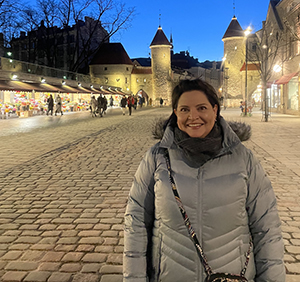
Brenda Morton enjoys her first evening in Old Town Tallinn. (UMHB Photo)

For more than 50 years, until 1991, Estonia suffered under Soviet occupation, and Russia’s invasion of Ukraine conjured memories Estonians tried hard to forget.

“They see themselves in the story of the Ukrainian people, because it was also their story—their shared story,” Morton explained. “So, the fact that I’m in a country dealing with a lot of historical trauma made it a unique time to be there.”

For four and a half weeks, Morton’s job was to pro­vide educational tools and train educators and students to teach others about trauma. It was easy to see the irony in her situation, but Morton looks back now and knows it was no coincidence she was there to teach trauma.

Because of funding, the pandemic and other reasons, her trip to Estonia had been canceled or re­scheduled at least three times. Still, every twist and turn in her journey led her to that exact time and place to help traumatized Estonians when they needed it most.

“God had a plan for all of this,” said Morton, who has taught classes online for Tallinn University since 2019. “There was never a time we felt like we were in danger or unsafe. If anything, we felt like God postponed this trip on three separate occasions, and he put us in this country three days after the war began. There’s a reason we’re here.”

Fell in love with Estonia

The Mortons’ first encounter with Estonia was during a vacation trip to Finland in 2015. On a whim, they decided to take a ferry to visit Estonia for four days and fell in love with the country.

When Brenda Morton walked into her classroom last year, her heart went out to her students as she saw the tension and fear on their faces.

“I had a student that started to cry, which is culturally unheard of,” she said. “Students were asking permission to have their phones out, because they wanted to be able to contact relatives if the sirens went off and we needed to take shelter. I even had a student who asked to bring her baby to class the next day, because she didn’t want to be more than seven minutes away from her child. You could feel the anxiety and stress in the country was just palpable.”

God prepared Morton

Morton didn’t just decide on a whim to go through trauma training.

“I thought I did, but there’s no way. I see that God prepared me to come to this place at this time to do this particular work,” she said.

God began preparing her more than a decade earlier when she was finishing her last year as a high school teacher.

“I had a foster child in one of my English courses. I didn’t know anything about foster care, and the more I got to know these kids and their backstories, I felt like God was asking us to become foster parents,” she said.

The Mortons set out to learn more. They went through the foster training and filled out all the forms.

“God’s got a sense of humor,” Brenda Morton recalled with a chuckle. “We asked to foster one child, a girl, and we wanted her to be younger than my youngest child. God sent us a sibling group of four.”

What she learned during her experience as a foster parent became the basis for her dissertation on foster care.

“No one is talking about trauma when it comes to these foster kids,” she discovered. “I started asking questions, and nobody knew the answers. I realized that these are kids hidden in plain sight.”

Eager to learn more, she enrolled in a postdoctoral cer­tification program in trauma and started working with the Oregon Department of Human Services doing advocacy around foster care.

The story of God’s preparation continues

Two years before coming to UMHB, Morton worked as a professor at George Fox University in Oregon. She was named a Fulbright Scholar to Estonia and spent seven months at the University of Tartu.

While there, a friend at the U.S. Embassy encouraged her to apply to come back again and continue her work as a Fulbright Specialist, which is how she ended up in Estonia last February to teach trauma-informed practices.

But her story didn’t end there.

After her trip as a Fulbright Scholar to Estonia, the couple began looking to move to Texas, where their oldest daughter had moved. As Morton began exploring opportunities, she was also working on a research project that connected her to Aida Ramos, who had worked as an associate professor in the College of Humanities and Sciences at UMHB. That’s when Morton learned about UMHB and an open teaching position in the Col­lege of Education.

“When I interviewed, I thought, ‘Wow, this is an amaz­ing group of people.’ At the time, I was interviewing at several other institutions and didn’t feel the same about them. When I came to the UMHB campus, I walked away feeling like there’s something different here,” she said.

After joining UMHB two years ago, she received a re­search grant that allowed her to interview 55 foster care students enrolled in a Texas college or university. The research is the basis for another book she is writing about children in the system and their experiences getting into college. She plans to use the book in her trauma class at UMHB as part of the educational advocacy program.

“There are a lot of barriers to them being successful, and all of that is trauma-based,” she said.

Since she began working with Estonians, Morton has helped train more than 300 Estonian teachers on trauma.

She also recently began a new project with a friend at the University of Tartu, creating a video series on trau­ma-informed practices, and will be offering a trauma class at UMHB next fall and spring. Most recently at UMHB, she wrote the curriculum for the first study-abroad trip to Estonia and is preparing to take her first group of students in May 2024.

“We will use the University of Tartu as our home base, and I’ll take them to see what a com­munity church looks and feels like, which is very different than anything experienced here,” she said.

When Morton reflects on the path God put her on to help Estonians through one of their most difficult times, she feels overwhelmed by God’s blessing.

“It was a blessing to be able to do something to be helpful—a great feeling like I was able to do something to help both the Estonian people and the Ukrainians in a country that was dealing with so much,” she said. “All of it was just a blessing.”

This story is republished by permission from UMHB Life Magazine.


Russell Dilday, Baptist statesman, dead at 92

Russell H. Dilday, whose tenure as president of Southwestern Baptist Theological Seminary, in Fort Worth saw the school’s endowment more than double while leading the seminary to its greatest period of growth but who was fired in 1994 by fundamentalists controlling the board of trustees, died June 21. He was 92.

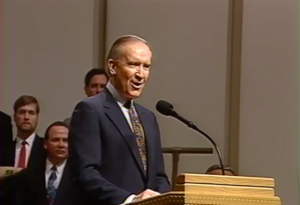
Russell H. Dilday delivered the Southwestern Baptist Theological Seminary Founders Day address in 1993. (Screen capture image)

Dilday had been in failing health the past two years, according to his daughter, Nancy Dilday Duck. He was living in Dallas at Ventana by Buckner senior living community.

“Daddy never lost his wonderful sense of humor and his heart for ministry,” his family said in a statement. “Everyone around him loved and admired him. We are sad to lose him, but we are grateful for his amazing life and all he did for the kingdom of God. We have lost a wonderful father and Baptists have lost a great leader.”

Man of ‘character’ and ‘integrity’

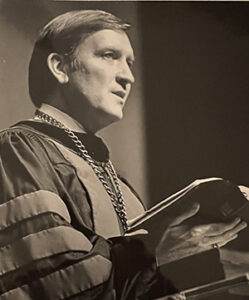
Russell H. Dilday addresses graduates during a Southwestern Baptist Theological Seminary commencement. (Courtesy Photo)

Dilday served as president of Southwestern Seminary from 1978 to 1994. During his tenure, the school became the largest theological seminary in the world and was responsible for training more than half of all Southern Baptist missionaries at the time.

His time as president of the school was marked by ongoing battles with a fundamentalist board during the height of Southern Baptists’ political struggles for control of the nation’s largest non-Catholic denomination.

Toby Druin, former editor of the Baptist Standard, remembered Dilday’s grace in the face of difficult times for Southwestern and Southern Baptists.

“Russell Dilday was the epitome of a Christian leader and statesman and a staunch defender of Baptist principles. He was outspoken in his defense of the authority of the Bible,” Druin said. “He was president of Southwestern Seminary during its greatest years.

“I will always remember him for his character and integrity and his friendship toward The Baptist Standard,” Druin said.

After his firing March 9, 1994, Dilday served as president of the Baptist General Convention of Texas and in leadership roles at two other BGCT-affiliated schools. He was a retired distinguished professor of homiletics at Truett Theological Seminary and special assistant to the president of Baylor University.

In 2002, he served as interim president of Howard Payne University in Brownwood, and he was instrumental in the founding of the B.H. Carroll Theological Institute, serving as its first chancellor.

William M. Pinson Jr., BGCT executive director emeritus, described Dilday as “a wonderful friend” and a “deeply dedicated follower of Jesus.”

“He greatly loved and was devoted to his personal family and his Baptist family,” Pinson said. “Brilliant with a strong sense of humor, he was willing to tackle challenging, controversial circumstances. His faith in Christ and courage, coupled with the support of his wife and family, enabled him to serve steadfastly during turbulent times in Baptist life.”

In addition to his service in institutional and denominational life, Dilday was the founding pastor of Tallowood Baptist Church in Houston and pastor of Second Ponce de Leon Baptist Church in Atlanta, along with churches in Antelope and Clifton. He also served several churches as interim pastor.

Throughout his career, Dilday was a prolific author, writing numerous articles and books, including his highly regarded commentary on 1 and 2 Kings for The Preacher’s Commentary series. In addition, he contributed to numerous books and anthologies.

‘Higher Ground’

Known as one of the Southern Baptist Convention’s leading statesmen during his career, Dilday was only the second president of an SBC seminary to preach the convention’s annual sermon in 1984, following in the footsteps of E.Y. Mullins, who was the subject of Dilday’s doctoral dissertation.

That sermon in Kansas City, Mo., put him in the crosshairs of fundamentalist leaders of the convention. Titled “Higher Ground,” Dilday called on Southern Baptists to put aside denominational politics and power struggles and aspire to a higher standard.

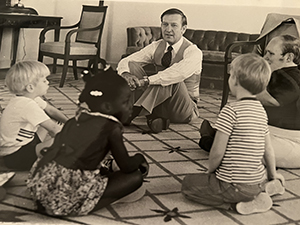
Russell Dilday enjoys time with children at the Southwestern Baptist Theological Seminary Child Care Center. (Courtesy Photo)

“Stay on the heights, Southern Baptists,” he urged messengers. “You’re doing a great work. Stay close to the Lord and to the task he has called you to perform. Be faithful to your historic heritage. Don’t dabble in controversies or exhaust your energies arm-wrestling for denominational control. Stay on the higher ground of spiritual persuasion, autonomous individualism, (and) the Christ-like humility where you belong.”

In 2007, Dilday released a book titled Higher Ground: A Call for Christianity Civility, in which he called for Baptists “to move beyond the lowlands of caustic controversy to the higher ground of Christianity civility.”

His firing from Southwestern Seminary sent shockwaves through the SBC. A photo of the locks on his office being changed circulated through Baptist state papers and brought a torrent of criticism on trustees. Media outlets from across the country covered the story.

Dilday later recalled a rally of students outside his home the day after the firing. “Betty and I led them in singing ‘Open our eyes, Lord, we want to see you.’ I will always remember that moment. It was a moment that said to them and to us: ‘God is at work in all things for good. God can bring good out of evil. God’s way is to leave the past behind and focus on Jesus.”

“The grace with which Dr. Dilday handled his firing amazes me to this day,” said Alan Lefever, Baptist historian and director of the Texas Baptist Historical Collection. “There was no desire for revenge, no bitterness at being unjustly dismissed, only a conviction to follow God’s call.

“I believe history will remember Russell Dilday in the same way we recall George Truett or R.C. Buckner. He was a man of grace, charity, and conviction. We should all seek to emulate his example.”

Dr. Dilday’s 2004 book Columns: Glimpses of a Seminary Under Assault, gives a detailed account of events leading up to his dismissal.

“My disagreement (with SBC fundamentalists) was always aimed at the fundamentalist spirit, the secular political methodology of the takeover party and their disregard for authentic Baptist principles,” he wrote.

Todd Still, dean of Truett Seminary where Dr. Dilday served after his firing at Southwestern, called him “an unusually gifted preacher, administrator, and leader. Dr. Dilday helped to light the way for innumerable students, myself included, as well as for congregations, institutions, and a denomination for years on end.”

Still added, “I am, and we are, diminished by his death even as we were blessed by his life. He will always be the standard of a Christian gentleman and scholar.”

Native Texan and minister’s son

A native Texan, Dilday grew up in a Texas Baptist minister’s home. His father, Hooper Dilday, served a number of Texas churches, and was on the staff of the BGCT 20 years in Sunday school, discipleship training and church services, and was longtime minister of education at First Baptist Church in Wichita Falls.

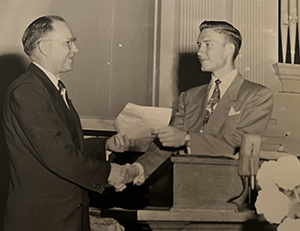
Russell H. Dilday is ordained to the gospel ministry. His father, Hooper Dilday, presents his son the certificate of ordination. (Photo courtesy of the Dilday family)

His mother Opal Spillers Dilday was born in Memphis, Texas, and was a children’s educational specialist in Baptist churches in Amarillo, Port Arthur, Port Neches, Wichita Falls and Dallas.

Russell Hooper Dilday was born Sept. 30, 1930, in Amarillo. He was the older of three brothers and a sister born to Hooper and Opal Dilday. He earned his bachelor’s degree from Baylor University, where he met his wife Betty, who died in 2018. The couple first met in a Bible class at Baylor University and were married 66 years.

He earned his Master of Divinity and his Doctor of Philosophy degrees from Southwestern Seminary.

Dilday was preceded in death by his wife Betty, a younger brother, Don Dilday, and son Robert Dilday. Survivors include his two daughters, Nancy Duck and husband Nolan, and Ellen Garrett and husband Shannon, along with six grandchildren, six great-grandchildren, and numerous nieces and nephews. He is also survived by his sister Ann Young and her husband Mack, along with a brother Jim Dilday.

The family has requested memorials be made to the Russell H. Dilday Chair in Baptist Life and Leadership at Baylor University’s George W. Truett Theological Seminary by contacting Jon Sisk at jon_sisk@baylor.edu or calling 254-715-6124. A memorial service is planned for Saturday, July 8 at 10 a.m. at Park Cities Baptist Church in Dallas.


TBM brings relief in sweltering East Texas after storms

When 100 mph winds knocked out the power to about 150,000 East Texans and large trees fell across houses, people searched for help in the face of oppressive Texas heat.

Families struggled to eat as their electric appliances were rendered useless and food went bad in their refrigerators. Many were stuck, as trees fell on their homes or their cars.

Texas Baptist Men disaster relief teams converged on the area to help people where they were and carved a way for them to get out.

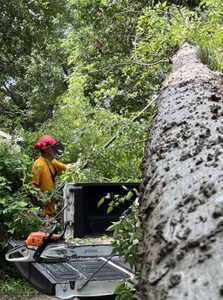
TBM chainsaw volunteer Bruce Slaven works to clear a fallen tree from a home in East Texas. (TBM Photo / Ferrell Foster)

Two TBM chainsaw teams are cutting and removing the fallen trees and limbs, while a TBM emergency food service team is providing meals in multiple cities.

The affected area spans seven counties, and the Texas Department of Emergency Management has received more than 1,000 requests for assistance. The TBM hotline for chainsaw work requests rings at least every four minutes.

“There’s so much damage, it’s unbelievable,” said Wendell Romans, TBM coordinator of the East Texas response. “People don’t understand what’s here. I’m about to put all our chainsaw teams on standby, and I’m about to start rotating them through.”

This will be a lengthy TBM deployment.

“TBM volunteers are working one project at a time,” said Rupert Robbins, associate director of TBM disaster relief. “They’re helping one family at a time. We’re committed to being there for an extended time. We’re looking at being in play there for weeks.”

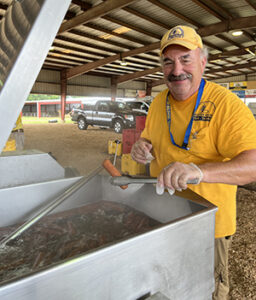
TBM volunteer Andy Stern works with an emergency food service crew in East Texas. (TBM Photo / Ferrell Foster)

Hours after the storm, the TBM chainsaw team from the Harmony-Pittsburg Baptist Association deployed to help their neighbors. Since then, they’ve crisscrossed East Texas helping people, and they’ve been joined by the TBM chainsaw crew from the Collin Baptist Association.

Melissa Bernal is among the people the Harmony-Pittsburg team helped. She huddled in her closet and prayed for protection as the storm moved over her house. The storm blew a large tree over on her car, shattering the windows.

Shortly after, the TBM team showed up. With skid-steers, chainsaws and a variety of equipment, they cut up the tree and placed it where it will be removed.

“We have these beautiful people that are out here helping to clear it all up, and we’re so grateful, so grateful,” Bernal told KLTV.

TBM volunteers valiantly are fighting heat indexes above 110 degrees. They’re eating breakfast at 5 a.m. so they can start sawing earlier and still work full days.

 “It’s incredibly hot. It’s dangerously hot,” Robbins said. “We’re hammering people to stay hydrated. They’re standing up to the task to get it done.

“Everything in the first week of disaster is chaotic, but they’re being flexible, so they can feed people and take care of people who have trees on their houses.”

Romans asked Christians to pray for “strength to start with. Endurance. I feel so sorry for the guys in the heat. They come in dragging.”

“They don’t want to quit. They want to help so bad,” Romans said. “A guy came in yesterday and said, ‘I had to quit when I couldn’t lift the saw anymore.’”


Editorial: To all women in ministry, I am sorry.

To all women in ministry: I made an unwise decision that affects you, and I am sorry. I did not stand beside you when I should have.

I published two op-eds—a Voices article on April 3 and an editorial on May 17—responding to and referencing a list of Southern Baptist churches with women as pastors in various roles. Prior to those articles being published, the compiler of the list sent it to pastors throughout the Southern Baptist Convention.

Some people used the list to harass women named on it. I made the decision to host a copy of that list on our website as a means of holding the list compiler accountable. In both the articles, I included a link to the list.

I don’t know if any harassment came as a result of the list being on our website, but the possibility is there. I did not intend for anyone to be harassed—least of all women in ministry—and yet it happened.

We removed the list and links to it from our website after one of you contacted me this week expressing concern about the list being on our website. I am grateful that person contacted me. It shouldn’t have taken that for the list to be removed.

Women should not be harassed—especially by fellow Christians. Women, who are created in God’s image and carry the breath of God just as men, should not be harassed. I am grieved and angry women have been harassed for following God’s call to serve in ministry.

It also shouldn’t take having a woman in ministry in your life to feel that way. But it did for me.

God called my wife to ministry, as well as one of her sisters. I know how seriously they take God’s call, and I’ve seen their dedication to God lived out over decades.

When I was a pastor, I affirmed women in ministry. Affirming women in ministry is important enough to my wife and me that when I left the pastorate to become editor of the Baptist Standard, we joined a church that shares our conviction and also affirms women in ministry.

To all women in ministry, whatever your title—pastor, minister, director, leader, missionary, deacon, teacher, musician, chaplain, communicator, assistant, volunteer, spouse, parent or otherwise—God’s call on you should not be doubted, mocked or minimized—certainly not more than God’s call on a man.

On the contrary, the fact you have endured hardships, questions, doubts, criticisms and more just for being a woman following God’s call is worthy of honor and respect.

Women in ministry, whatever your title or role, you need our encouragement. You need our prayer and support. You need us to work alongside you.

My decision to host the list did the opposite, and I am sorry.

My apology cannot be the end of the story. Affirmation of women in ministry must be born out in action. What must follow is for me to encourage you directly and to stand alongside you, taking hits with you and dividing the load. I encourage others who affirm women in ministry to do the same.

Eric Black is the executive director, publisher and editor of the Baptist Standard. He can be reached at eric.black@baptiststandard.com. The views expressed are those solely of the author.


Voices: Positively navigating church conflict

Conflict is part of life. We all experience conflict somewhere, yet conflict often has a bad reputation. We often stigmatize conflict by avoiding it or blowing it out of proportion.

Visible conflict seems to indicate a bad marriage, a failed parent or a hostile work environment. Political conflicts have escalated to astronomical levels, resulting in broken families and split churches. Conflict can be bad, but does it have to be?

The business world recognizes conflict can lead to healthier, happier and more productive environments. Psychology has known for some time some conflict is not only healthy, but is necessary even for growth and self-development.

Conflict is complicated. It is not always good, but it can have benefits if addressed in a healthy way.

Ministry is navigating conflict

Everything Christians do can be and, in many traditions, has been framed as spiritual conflict. From the earliest days, Christianity has understood itself to be in conflict with the world.

“We wrestle not against flesh and blood but against the rulers, authorities, powers of this dark world and against the spiritual forces of evil” (Ephesians 6:12).

The basis of our faith is someone who experienced conflict and died to it. Jesus always seemed to walk among conflict. His public ministry started only after conflict in the desert. Salvation is the rejection of an old life and old master; it is the death of the old person and birth of the new.

Ministers encounter a lot of conflict. The entirety of our job is to handle conflict. Our job necessitates navigating conflict within ourselves and conflict within our congregations.

Two models of conflict

Of the different models addressing conflict, I will mention two.

The Thomas-Kilmann model describes five modes of conflict resolution: competing, accommodating, avoiding, collaborating and compromising. A person typically handles conflict according to their levels of assertiveness and cooperativeness, which corresponds with one of the five modes.

As ministers, we likely will recognize each of these categories within our churches, and we should recognize and respect people’s different responses. Once we understand people’s motivations, we take a step toward hearing their voice.

Bowen Family Systems Theory is a complex model that explains anxiety and stress inherent in family relationships. Individuals are part of a family unit in which each individual constantly is exerting their emotions on others in the family, while also being exerted upon. Each person impacts and is impacted by the family.

For instance, a bad day at work doesn’t affect mom only, but affects everyone at home, increasing their stress levels. This goes for every member of the family and applies to congregations, as well. One congregation member experiencing tension due to life circumstances brings that tension into the church. This tension can spread further.

Robert Creech, author of Family Systems and Congregational Life: A Map for Ministry, has written several books relating family systems to ministry.

Addressing congregational conflict

The communal nature of anxiety and tension is important. Our conflicts don’t exist in a vacuum. They often impact those outside the immediate conflict. Realizing this will help us navigate complicated situations.

Language

To navigate conflict, I recommend we begin with our language. Conflict often is associated with shame and guilt, two emotions modern Americans struggle to understand. Instead of preaching conflict as a grievous sin to be ashamed of, we ought to preach healthy conflict as a way to restoration.

When reframing conflict, we should take it out of the privatized sphere and remind our congregants of the broad effects. Jesus encouraged his disciples to go and make right with their brothers before going to offer a sacrifice.

Direct honesty

Next, we should encourage our congregants to be direct and honest with one another. Seek one another out, and do not leave grievances hidden to fester. Tell someone honestly how you have been hurt and why it hurts, while being prepared to hear the same.

Come to conflict humbly and genuinely seeking to understand the other person, while being ready to admit our own faults. Only when communication is open, honest and kind can conflict be resolved healthily.

Penance

Third, we should embrace penance. Penance can have a bad reputation among Protestants, yet it was essential for the ancient church. Tertullian and Cyprian talked of daily penance that included prayer, fasting and almsgiving. Penance was a communal effort intended to repair one’s relationship with God and relationships between congregants.

Penance was a means of restoration and forgiveness. In cases where a congregant harmed another, the guilty party would beg for forgiveness outside church while those inside the church would offer intercessory prayers on their behalf, thereby maintaining fellowship with the penitent. Eventually, the wronged person would forgive, and the penitent would be welcomed back into service.

I’m not suggesting we make people beg at the door. I’m suggesting we adopt this mentality: going and begging for forgiveness, spending hours in prayer, fasting as a physical sign of lament, and performing genuine acts of love—such as washing the feet of our enemies.

If we approached conflict this way in our personal and congregational relationships, our spiritual lives would grow astronomically and our churches would be healthier and happier places.

Conflict happens. Our lives and churches are full of it. When Jesus came with good news, it was good news for our relationship with God and good news for our relationships with one another. The church should be at the forefront of conflict resolution as we claim to be a people of peace and love.

Bobby Mosier currently serves as a resident chaplain at Baylor University while pursuing a Master of Divinity at Truett Theological Seminary. The views expressed are those of the author.


Biden urged to discuss human rights in India with Modi

The U.S. Commission on International Religious Freedom urged President Joe Biden to raise concerns about religious freedom and human rights in India during Prime Minister Narendra Modi’s state visit this week.

The Indian government, led by the Bharatiya Janata Party, has supported discriminatory policies that severely hinder and restrict the religious freedom of minority groups, commissioners said.

“With India’s upcoming state visit, the Biden administration has a unique opportunity to explicitly incorporate religious freedom concerns into the two countries’ bilateral relationship,” said USCIRF Commissioner David Curry.

“It is vital the U.S. government acknowledge the Indian government’s perpetration and toleration of particularly severe violations of religious freedom against its own population and urge the government to uphold its human rights obligations.”

Discriminatory policies commissioners noted include hijab bans, anti-conversion laws and the Citizenship Amendment Act, which excludes Muslims from the fast track to citizenship offered to other migrants from Afghanistan, Bangladesh and Pakistan.

“During this state visit, we ask President Biden to raise religious freedom with Prime Minister Modi directly, including by urging him to amend or repeal polices that target and repress religious minorities,” Commissioner Stephen Schneck said.

USCIRF repeatedly has recommended the U.S. Department of State designate India as a Country of Particular Concern for engaging in systematic, ongoing and egregious violations of religious freedom.

Eighteen members of the U.S. Senate and 57 members of the House of Representatives—all Democrats—also sent a letter to the White House urging Biden to discuss human rights issues with Modi, Reuters reported.

Violence continues in Manipur

More than a month after mob violence began in the Manipur State of northeast India, at least 250 churches have been burned, and casualty reports grow daily. Officials report more than 300 people have been injured, and about 37,000 displaced people are in relief shelters. More than 4,000 cases of arson have been reported. (Photo distributed by CSW)

In the Manipur State of northeast India, mob violence that began May 3 has developed into “ethnic cleansing” and “religious persecution” against Christians, said Pastor Thong Lun of Greater Houston Burmese Christian Fellowship.

Thong’s church has a longstanding ministry among Burmese refugees in northeast India, and he has maintained close contact with sources there.

At least 250 churches have been burned in the Manipur State, a month and a half after mob violence began there, Thong reported.

Conflict between the predominantly Christian Kuki ethnic group and the mostly Hindu Meitei people began as a political dispute over land rights and scheduled tribal status. Scheduled tribes have constitutionally granted property protection, and tribal members are entitled to political representation, educational benefits and affirmative action in employment.

However, after mobs raided police stations and seized more than 5,000 weapons, both Kuki and Meitei Christians have been targeted.

On June 2, Manipur Chief Minister Biren Singh announced the death toll reached 98, but other sources estimate a significantly higher number of fatalities.