Commentary: Taking advantage of old folks

I know that is a terrible title for an article, but hopefully you will hang with me on this one.

A young pastor friend of mine recently complained of too many senior adults in his congregation. Since I am myself a senior adult, I wondered why that was a problem. It seemed to me that he was missing a great opportunity.

While it is obvious that each church has its own context, it has been my experience that senior adults have always been an incredible resource in the life and ministry of the church.

‘A huge blessing’

The church I served as pastor was located in a coastal community at the end of the interstate highway. As a result, beginning in the 90s, we had an influx of retirees to our town. It continues even now as more and more ‘boomers’ head for the coast.

Of course, we already had a wonderful cadre of older members who had been a part of the fellowship for many years. All of this has proven to be a huge blessing for our church, all because we decided to ‘take advantage of the old folks.’

When my colleague in ministry, Jim Everette, joined our staff, I suggested that he should visit every non-profit ministry in town to learn what their needs were. While we both assumed that they could all use some extra money, what we learned was that they needed help—volunteers.

‘The results were amazing’

Another thing we learned was that all these retirees moving to town were looking for ways to connect and serve in the city that was to be their new home. We learned that many of them showed up with resources, expertise and time. So, every time a newly retired person or couple showed up at our church, Jim and I would engage them to learn their gifts and interests, and then we set about to connect them with one of the ministries in our city or our church.

The results were amazing for our congregation, for our non-profit partners, and for the newly retired residents of our city. We took advantage of the old folks . . . and they loved it.

‘Something good and important’

Now that I am ‘sort of’ retired, I was looking for some place where I might be of help. One of the ministries our church supports is a ‘half-way house’ for people coming out of prison. I had always been impressed by how that non-profit was able to stretch a dollar. While having coffee one morning with their Executive Director, Frankie, I asked if there was anything he needed where I could be of help.

He said, “As a matter of fact, pastor, there is. One of our men has called on us to form a men’s group, not a prayer or Bible study group, but a men’s group, where men can talk about men’s stuff.”

I told him if that was what he needed, I would give it a try. While talking with one of the recently retired deacons in our church, I told him about the group and he volunteered to help me. We have been at it for several months now, and I am not sure who is helping whom the most.

We meet at 6 p.m. every Monday evening. A different crowd shows up each week. The residents set the agenda and my friend, Don, and I are just members of the group. We don’t lead any more than the rest of them. There is usually a topic for the evening: trust, honor, family, self-confidence, selfishness, prayer and honesty to name just a few. There has been laughter, and there have been tears. But something good and important is taking place. Friendships are being established.

‘Take advantage’

This is but one example of dozens of opportunities that exist in every community and every church for life-changing ministry. So, rather than bemoaning the fact that there are a lot of older folks in the church, take advantage of them. They are busy, but they have more time to serve than ever in their lives. They long to make connections and to make a difference. The church that pays attention to its older adults and gives them good and important ministry to do will be enriched by their work.

Finally, it is also important to celebrate their service and to let them know just how valuable they are in the community and in the church. Let them have a time and space to tell the stories of their ministry and the people they have met and the lives that have been changed.

The Bible is filled with stories of older folk whom God called upon to do amazing things. It still happens. Every minister and every church need to “take advantage of the older folks.”

They are still changing the world.

This article originally appeared at the Center for Healthy Churches. Mike Queen is a consultant for CHC, the founder of Hopeful Imagination, and a recently retired pastor.


Young Hispanic professional women challenged to ‘bloom’

SAN ANTONIO—Speakers at the inaugural Bloom Conference challenged young Hispanic professional women to grow in their relationship with Christ and fulfill their God-given potential.

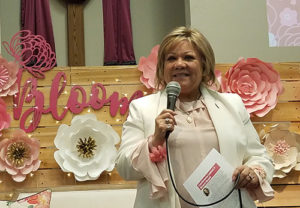
Bea Mesquias, executive director-treasurer of Union Femenil Misionera de Texas, welcomed women to the Bloom Conference. (Photo / Isa Torres)

Inspired by the success of the Shine Conference for girls, leaders of Union Femenil Misionera de Texas initiated Bloom Conference at Agape Baptist Church in San Antonio to provide a similar event for young professionals.

Keynote speaker Zoricelis Dávila, a Puerto Rico-born Christian counselor and psychotherapist from Fort Worth, urged Christian young women to “bloom” into all God intends for them to be and to reflect Christ.

Dávila emphasized blooming as a gradual and ongoing process.

“Bloom is an active word,” she said. “God is calling you to continue blooming.”

God’s promise to the Old Testament patriarch Abraham, “I will bless you and make you a blessing,” also is God’s plan for every Christian today, she stressed.

Flowers do not choose whether or not to bloom, she noted. Likewise, a Christian cannot choose to bloom only when things are going well and life is not hard, she said.

Women experience difficulties in life, and those challenges cannot be ignored, but

Christians can continue to bloom when life’s hard winds blow by being rooted in Christ, she explained.

Zoricelis Dávila prays for participants at the Bloom Conference. (Photo / Isa Torres)

Dávila urged the young Hispanic professional women not to lose focus on the hope Christ gives, even when they don’t feel like it. Often, actions must precede desire—what psychotherapists call “behavioral activation,” she explained.

When people wait until they have a desire or a drive to take action, they are putting the cart before the horse, she said.

Be like Christ and follow him, even when the drive is lacking and the desire is not present, she urged.

A “blooming” Christian—one who reflects the love of God—has the courage and commitment to serve others, Dávila said.

“There is no such thing as knowing Christ and not serving,” she said.

Serving others may sound simple, but service may push Christians to do something scary or intimidating, Dávila said. In those moments of fear and doubt, being rooted in Christ is important, she insisted.

“You must have courage not because of you, but because of the person God is calling you to be,” she said.

God wants young Christian women to continue to discover the new destinations and new wonders he has in store for them, Dávila said.

“There are still new parts of God you have not seen before,” she said.


Baptist Standard receives 10 national awards

The Baptist Standard and CommonCall received 10 awards from the Associated Church Press, including a special achievement award for former Editor Marv Knox and a best in class award for Marketing Manager Julie Sorrels.

Distinguished service

Marv Knox
Marv Knox

At the recent Best of the Church Press awards event in Chicago, Associated Church Press named Knox recipient of its highest honor, the William B. Lipphard Award for distinguished service to religious journalism.

Knox, who stepped down as editor last year to become coordinator of Fellowship Southwest, is the seventh person in the last 44 years to receive the special recognition.

The award recognizes individuals who have made distinguished contributions to religious journalism over a significant period; have performed with unusual distinction, courage or integrity in the religious press; have contributed influence that has advances the ideals of Associated Church Press; and possess exemplary personal qualities and talents.

Social media presence enhanced

Julie Sorrels
Julie Sorrels

Sorrels earned Best in Class honors for overall excellence in the social media presence division. In 2017, Baptist Standard registered a 33.5 percent increase in social media engagement.

Sorrels won an award of excellence in social media marketing campaign and brand awareness for the baptiststandard.com relaunch.

The Baptist Standard and the RBMM brand design studio also received honorable mention in visual communications for the website redesign.

Opinion articles capture judges’ attention

Knox received an award of excellence for his editorial, “Could Jesus get elected dog-catcher here?” He also received an honorable mention in the “magazine/journal” division for his “Edgewise” column in CommonCall.

Three Texas Baptist Voices columnists collectively won an award of excellence in the “department: online publications” category—Meredith Stone for “A moment of reckoning, and not just for sexual harassers”, Craig Nash for “Why aren’t women pastoring Baptist churches?” and Jake Raabe for “Put not your trust in guns.”

Stone also received honorable mention for her article, “Pence, propriety and devaluing half the American population.”

News reporting recognized

Ken Camp
Ken Camp

Managing Editor Ken Camp won a reporting and writing award of merit in the “in-depth coverage: news service/website/blog” category for his coverage of Hurricane Harvey and its aftermath.

Read the articles here,  here, here,  here,  here,  here, here and here.

Camp also won an honorable mention in feature writing for “Mineral Wells couple felt God’s calling to foster parenthood.”


Zapata helps churches focus outwardly

SAN ANTONIO—Jorge Zapata hopes to help Texas churches in Texas resist the temptation to focus inwardly and instead recognize opportunities to make an impact in their communities.

Before Zapata became San Antonio-based coordinator of missions and Hispanic ministries at the Cooperative Baptist Fellowship of Texas, his ministry was geared toward community outreach and neighborhood involvement. Now, he wants to share his experience with others.

Jorge Zapata

“We work to help establish a bridge between the church and the community,” Zapata said.”’

All churches face changes, he recognizes. In the Hispanic context, churches that began with first-generation Spanish-speaking immigrants must learn to give room to the next generation that tends to be younger, better educated and more comfortable with English.

“They still have the roots, but their way of doing ministry is totally different,” Zapata observed.

‘Keep the door wide open’

But all churches face changes, he recognizes. That’s why his recommendation to Hispanic churches also apply to non-Hispanic churches with whom he works.

First, a church needs to take a hard look at the community surrounding it, Zapata said. Then the church needs to ask, “How inclusive are we going to be?”

When a church opens its doors to others, whether they are of another generation or a different ethnicity, the church is encountering new culture and people who think differently, he observed.

But if the church is true to its calling, it must keep the door wide open, he said.

“You cannot just open a small space,” he said.

Revival and relevance

Looking outwardly and being inclusive can bring a revival to church, Zapata said.

The churches that have grown in their relationship with the community are those congregations that have opened their doors to everyone in the community, he noted.

“The churches become relevant because they are responding to the community,” he observed.

The consequences of a church failing to open up to the community can be devastating, he added.

For a church to become diverse in its membership, diversity must start in its leadership, and it must move beyond tokenism, Zapata insisted.

“You cannot just have one staff member that is a minority,” he said. “The inclusion has to be complete.”

Communities respond to churches that care

Through ministries such as donating school supplies and backpacks to children, bringing medical assistance to families and mentoring the youth in ministry, Zapata has seen how communities can respond positively to the local church.

Children in Hidalgo receive a bed built by Park Cities Baptist Church in Dallas.

Community ministry takes a variety of forms, he noted. Some churches like First Baptist in Plainview operate community centers. Congregations like The Crossing in Mesquite offer English-as-a-Second-Language classes. Park Cities Baptist in Dallas sponsors a bed-building ministry that provides for children in colonias along the Rio Grande. Churches like those recognize service to others as acts of worship toward God, Zapata said.

As churches focus outwardly, it opens new doors for ministry and opportunities for partnership, even across denominational lines. Zapata noted 35 non-Baptist churches in the Rio Grande Valley and 15 in the Houston area have contacted him to see if they can partner with CBF Texas. Many of those churches are of Pentecostal background, and they noticed the work CBF churches are doing in their areas.

“They have come to tell me: ‘What you are doing is so great. We thought pastors at your churches were dead, but now we are seeing that is not the case,’” Zapata said.

Churches face challenges as they deal with new generations, other cultures and different denominations, but God always is at work, he added.

“This is like a puzzle, and we are seeing God put the pieces together,” Zapata said.


Todd D. Still: The ‘sacred trust and true pleasure’ of shaping tomorrow’s ministers

Since April 2015, Todd D. Still has served at Baylor University’s George W. Truett Theological Seminary as the Charles J. and Eleanor McLerran DeLancey Dean and the William M. Hinson Chair of Christian Scriptures, teaching and conducting research in New Testament and Greek.

From deep in the heart of one Texan, he shares his background and thoughts on leading Baylor’s seminary. To suggest a Baptist General Convention of Texas-affiliated leader to be featured in this column, or to apply to be featured yourself, click here.

Background

How long have you been at Baylor?

I came to teach New Testament and Greek as an untenured associate professor at Baylor’s Truett Seminary in the fall of 2003. I was granted tenure in 2006, promoted to the rank of professor in 2011, and appointed by then Truett Dean David E. Garland to the William M. Hinson Chair of Christian Scriptures in 2012.

At the conclusion of a committee-led national search, I was named the fifth dean of Truett by then Baylor President Kenneth W. Starr at the end of February 2015 and began serving in that role at the beginning of April 2015.

Where else have you worked, and what were your positions?

I have served Baptist congregations in Texas, North Carolina and Scotland in a variety of capacities over the years, including janitor, music minister, pastoral intern, youth minister, college minister, education minister, pastor and interim pastor.

My first full-time academic position was at Dallas Baptist University, where I served as assistant and then associate professor of New Testament and Greek from 1995–2000. Before coming to Baylor in 2003, I served as an associate professor of New Testament Studies and held the Bob D. Shepherd Chair of Biblical Interpretation at Gardner-Webb University’s School of Divinity in Boiling Springs, North Carolina.

Where did you grow up?

I was born in Wichita Falls, Texas, and lived there for the first 12 years of my life. From ages 12 to 16, I lived in Meridian, Texas. Prior to my junior year in high school, I moved with my family to Waco, Texas, and have gladly and proudly called Waco home for the last 35 years.

How did you come to faith in Christ?

I entrusted my life to Jesus Christ as Lord and Savior at the age of eight at a Vacation Bible School in Wichita Falls. One year later, I was baptized into the First Baptist Church of Wichita Falls by my childhood pastor, Dr. William M. Pinson, who would later serve as president of Golden Gate Seminary and as executive director of the Baptist General Convention of Texas.

Where were you educated, and what degrees did you receive?

After graduating from Midway High School in Waco, Texas, I attended Baylor University, from where I graduated with a Bachelor of Arts in Greek and sociology in 1988. Thereafter, I enrolled at Southwestern Baptist Theological Seminary and completed the Master of Divinity with Biblical Languages in 1991.

Then, in 1996, I earned the doctorate in New Testament Studies from the University of Glasgow in Scotland. I have also had occasion to study at the University of St. Andrews, Scotland, the University of Cambridge, England, and the University of Exeter, England.

Ministry/Profession

Why do you feel called to your particular vocation?

Growing up, my father would sometimes say to me, “If you do what you love, son, then you will never work a day in your life.” I am blessed beyond measure because I love the work that I am privileged to do, the place where I work, the people with whom I work and the students, churches and organizations that Baylor’s Truett Seminary is honored to serve. To join hands with others in shaping those whom God is calling for ministry in the church and the world is simultaneously a sacred trust and a true pleasure.

Frederick Buechner once described vocation as “the place where our deep gladness meets the world’s deep need.” Beyond gladness and need, however, I believe that God has led me to do the work that I am doing in theological education. It is this conviction of calling that encourages and sustains me in the midst of both joys and struggles inherent to my work.

Please tell us about your BGCT institution—the breadth and nature of its work, including its mission, measures of scope, etc.

As readers of The Baptist Standard likely know, Republic of Texas officials chartered Baylor University in Independence, Texas, in 1845. As such, it is the oldest institution of higher education in continuous existence in the State of Texas.

Baylor University’s George W. Truett Theological Seminary itself is of relatively recent vintage. Established in 1991, Truett began offering classes in 1994 in the education building of First Baptist Church, Waco. In 2002, the seminary moved to its present facility at Baylor University—the beautiful Baugh-Reynolds campus, featuring the Paul W. Powell Chapel, the Paul and Katy Piper Great Hall, the Heritage Room, the Baugh Lecture Hall and the Reynolds courtyard.

Over the course of its short history, Truett Seminary has prepared roughly 1,500 graduates for gospel ministry in and alongside the Church, which is our institution’s mission. At present, an accomplished faculty and skillful staff of 40 serve a gifted, diverse student body of 350 students, who come to us from all over the United States and 13 foreign countries.

As one of Baylor’s twelve schools and colleges, Truett currently offers three masters degrees (M.Div., M.A.C.M., and M.T.S.), five “joint degrees” (M.Div./J.D., M.Div./M.B.A., M.Div./M.M., M.Div. or M.A.C.M./M.S.W., and M.Div./M.S.Ed. or M.A.Ed.), and one doctoral degree (D.Min.). Moving forward, Truett anticipates offering additional degrees, launching extension sites, and increasing collaboration with other institutions.

What do you like best about leading your institution? Why?

I suppose the thing I like most about serving as dean of Baylor’s Truett Seminary is the challenge and the variety that is part and parcel of the role. Recruitment, enrollment, placement, advancement and development are always before me. I am constantly asking how we as an “embedded seminary” can best serve our university, our students, our alumni and our constituents—not least our Texas Baptist churches.

Furthermore, theological education in the 21st century is no easy nut to crack. It sometimes seems that there are more schools offering training than there are students to train! Moreover, questions of affordability and accessibility persist and sometimes appear to compete with our twin commitments at Truett to both academic rigor and spiritual formation.

What aspect(s) of your institution and/or its mission do you wish more people understood?

Five things spring to mind immediately:

  1. That Truett Seminary belongs to Baylor University and to the remarkably generous people, not least Texas Baptists, who have made and continue to make our school possible through their financial gifts and spiritual support.
  2. That Baylor’s Truett Seminary is of, by and for the Church. We exist to equip God-called people for gospel ministry in and alongside the Church. At Truett, we love the Church and long to serve God’s people as we are asked and are able.
  3. That we are far more affordable than some might imagine. Due to the generosity of our university and our donors, all of our students, whether Baptist or not, receive significant scholarship assistance, and most of our students pay less than 70 percent of “sticker price.” To think that the vast majority of Truett students can study with our world-class faculty in first-class facilities at a top-tier university among some of the most gifted ministerial students anywhere for what amounts to roughly $1,000 per three-hour course continues to amaze and delight me.
  4. That Truett is a historically orthodox, broadly evangelical seminary in the Baptist tradition that seeks to instill in students, in the words of J. B. Lightfoot, “the highest reason and the fullest faith.” We are a seminary grounded in Christ, rooted in Scripture, which we regard to be authoritative for matters of faith and practice, and committed to the Great Commandment and the Great Commission.
  5. The vast majority of our roughly 1,500 graduates are actively involved in faithful, fruitful gospel ministry in and alongside (Baptist) churches.

How has your institution and its mission changed since you began your career?

At Baylor in general, we continue to “double down” on our mission and on our aspiration to become a preeminent Christian research university in the Baptist tradition. Such lofty aims necessarily occasion change at every conceivable level. At Truett Seminary in particular, we continue to seek to be both appreciative of and responsive to the needs of our students and constituents, especially churches.

How do you expect your institution and/or its mission to change in the next 10 to 20 years?

Because of our mission to equip God-called people for gospel ministry in and alongside Christ’s church by the power of the Holy Spirit, we will have to continue to adapt. What that looks like is hard to say, but I do not think that questions of affordability and accessibility that continue to concern educators in general and theological educators in particular will go away anytime soon.

Name the three most significant challenges and/or influences facing your institution.

Enrollment is an ongoing challenge for Truett and other theological schools. The same may be said regarding revenue streams and perceived relevance by certain churches and the broader public.

What one aspect of your job gives you the greatest joy or fulfillment?

Helping others in ways that I am tasked, asked and able as they go about their professional pursuits and personal lives.

About Baptists

What are the key issues facing Baptists?

Increased polarization among and between congregations and unprincipled, and sometimes seemingly unwitting, accommodation to broader ambient culture.

What would you change about the Baptist denomination—state, nation or local?

Greater skill, efficiency and sensitivity in placing and replacing ministerial staff.

About Todd

Who were/are your mentors, and how did/do they influence you?

There are too many to mention by name; I have accrued incalculable debts along the way. It has indeed taken a village to raise this child!

Were I to name but a few of those who have selflessly and lavishly poured into my life, they would include the following: my parents (Willard and Betty Still), my wife (Carolyn Christian Still), Bill Pinson, Dawson McAllister, Richard Creech, Mark Wright, Mike Toby, Jerry Pipes, Louie Giglio, Kay Mueller, John Wills, Earle Ellis, Bruce Corley, Doyle Young, John Barclay, Herbert Reynolds, Gary Cook, Tim Trammell, Charles Wade, Wayne Stacy, Robert Sloan, Elizabeth Davis, Levi Price, David Garland, Paul Powell and Ken Starr.

Taken together, they have sought to teach me to take my work and witness seriously but to do so with joy and humility.

Other than the Bible, name some of your favorite books or authors, and explain why.

Beyond Scripture, I tend to read in my academic discipline of New Testament studies, particularly Pauline studies. I also enjoy reading sermons, poetry and biography, and, on occasion, I will allow myself a diversion into fiction, typically in the form of a John Grisham novel.

What is your favorite Bible verse or passage? Why?

This hardly seems a fair question to ask a Bible scholar! Were I to pick but a single passage, it would be Philippians 2:5–11, where Paul calls the Philippians and subsequent recipients of the letter to embrace and exemplify the humble mindset and faithful life of Christ Jesus.

Who is your favorite Bible character, other than Jesus? Why?

Paul, due to his ardent devotion to Christ in life and death and the profound letters he composed that we are still privileged to read and interpret.

Name something about you that would surprise people who know you well.

Although I exercise for 45 minutes to an hour most every day, it is not necessarily something that I enjoy doing.

If you could get one “do over” in your career, what would it be, and why?

I would seek to spend at least a semester, if not a year, in a non-English-speaking context, preferably a Spanish-speaking or German-speaking country, and thereby be forced to speak a language and learn a culture other than my own.

Write and answer a question you wish we had asked.

Tell us about your family?

I am happily married to Carolyn Christian Still from Houston, who is also an educator, trained at Baylor and Southwestern Baptist Theological Seminary, and one of the three founders of Live Oak Classical School in Waco. We have been married for 27 years and have two sons—Samuel, a Baylor senior (and likely to be a Truett student beginning in the fall of 2018), and Andrew, a Baylor freshman.

Our family loves music, our pets (two dogs, a cat and a chinchilla) and offering hospitality to others in our home.



Voices: Can understanding history help Christians combat racism?

Being a first-year seminary student, I have learned quite a bit in class regarding theology, the Bible and leadership in the church. But when I read firsthand accounts of how colonizers perpetuated racial systems of subjugation, I was at a loss for words.

Suddenly, the pain of growing up as a young brown child looking for somebody to physically relate to in the visual guides to our Bible stories had resurfaced when I began to understand why Jesus had blue eyes, blonde hair and fair skin.

Moreover, it became even more real in another class when the following words of a hymn included in the 1975 Baptist Hymnal were read to my class by our professor:

“From north to south the princes meet
To pay their homage at his feet
While western empires own their Lord,
And savage tribes attend his word.”

My professor asked the class, “Who would be considered the descendants of the ‘western empires’ in our churches?”

Directly following a moment of silence, the professor then said something to the extent of, “Our answer to that question ultimately answers who society views as descendants of ‘savage tribes.’ Which camp would you fall in?”

Though talks about racial reparations have become more common in our day, can the church adequately combat racism without first attempting to “decolonize” our narrative?

Before giving my thoughts, there are two points that I would like to make.

It’s easy to get sidetracked

It’s easy to let fear of the unknown consume. It’s also easy to fail to consider that some are deprived of systemic problems that don’t directly affect them (or their worldview, for that matter) daily. And, ironically, it’s also easy for the oppressed to become the oppressor when there is a failure to extend grace that is rightfully expected from others.

My point is, it’s easy to get sidetracked. But failure to move beyond what is “easy” ultimately perpetuates a failure to expand Christian imagination beyond what colonialism deemed “normal” by forcefully imposing European standards upon a “New World.”

Exploitation of Mexico by Spanish Conquistadors mural by Diego Rivera
Complete mural of “Exploitation of Mexico by Spanish Conquistadors” by Diego Rivera (1886-1957), Palacio Nacional, Mexico City.

Though not an easy task, if the church desires to press on in this journey, it will require gracious ears and empathetic hearts from both sides.

Christ’s body as a counternarrative

For the church, Christ’s body at the cross and table reminds us that our divinely enabled redemption is contingent upon our ability to love our neighbor, hear their stories and situate them beside us as people who equally bear witness to the irrevocable image of God.

Such was highlighted by St. Maximus the Confessor when he said, “The mercy of God is hidden in mercifulness to our neighbor.”

If there is any hope in moving beyond a subjugating colonial narrative, we must remember that Christ’s body counter-politically tells another narrative of equality, mercifulness and love.

Rethinking our strategy

I will be the first to tell you that I don’t have it all figured out. However, I believe a modest proposal for those desiring to combat racism would be to rethink our strategy.

In other words, before thinking we can adequately discuss racism, perhaps the first thing we need remember is that the ground we stand upon is haunted by the sinful stain of colonization.

As a Texas Baptist, when I think about Waco being home to Baylor University and George W. Truett Theological Seminary, I find it unavoidable to also consider that Waco was home to one of the most egregious lynchings in southern history.

For pastors, theological educators and seminarians, how we accomplish such a task may differ from context to context. In the same way, approaches may also vary for laypeople. But just as the church remembers the darkness of Holy Saturday that preceded the resurrection, so too might we need to recognize the world we currently inhabit before envisioning another.

A step in the right direction?

Be it through the reading of a book or the exchanging of stories, I have faith that the church can allow our stories to “story” other people’s stories with the help of the Spirit.

Having said such, if we ever hope to see a day where racial reparations are truly made, perhaps committing ourselves to “decolonizing” Christian imagination would be a step in the right direction to bring about a day where brothers and sisters of color no longer view themselves as descendants of “savage tribes” but beloved children of God.

Bobby Martinez is a Master of Divinity Student at Baylor’s George W. Truett Theological Seminary and a recent graduate of Howard Payne University.


Voices: The high stakes of wading into political waters

I looked up.

They were gone.

Where were they?

The manager of our fitness center explained that some people were offended and disturbed by the news networks on the overhead televisions and demanded their removal.

“We’re committed to total wellness,” the young man pleasantly explained.

Apparently, the news can be bad for our health.

‘No reasonable escape’

There is an ancient Chinese curse that says, “May you live in interesting times.”

We’re living in them.

That’s why some people are so upset at the news they’re demanding not to have to watch it.

How can the sincere disciple of Jesus navigate through the rushing, turbulent rapids of our present political discourse and be true both to conviction and to Christ? Without getting capsized and drowned in vitriol and superficial, hyperbolic “talking-head” nonsense?

There seems no reasonable escape—nor any escape to reason. We must sail into this.

‘What’s a Christian to do?’

President Trump’s first year in office was the wild ride most of us expected. His second promises more uncertainty, midnight tweets, charges, counter-charges and general provocation, denial, frustration, disruption and confusion.

On both sides.

There appears no civility or normality in the political forecast. We ride upon a national storm of anger and division. We scan the horizon and see only the gathering clouds.

What’s a Christian to do? Compartmentalize? Never permit the peace of worship on Sunday to interfere with the culture war on Monday? Or do we seek the more difficult and thoughtful path of a holistic, integrated faith that speaks to all of life?

Consistently.

Including politics.

 ‘A moral exception in politics’?

Jesus denounced “an eye for an eye.” He said that loving our neighbors and hating our enemies wasn’t good enough. Instead he told us to love our enemies.

Jesus commanded us to bless those who curse us, to do good to those who hate us and to pray for those who persecute us. He reminded us that the sun rises on both the good and the evil. The rain, he said, “falls on both the just and the unjust” (Matthew 5: 38–45).

Is this viable? In the world in which we live? Is it realistic? In politics?

Most Christians voted for Donald Trump because they figured he’d fight for them.

He has.

Trump has boldly and bluntly battled the Democrats and the media. He may not share their evangelical faith, but he has championed the Christian causes. He put a brilliant conservative on the Supreme Court. Like the ancient unbelieving Cyrus, Trump has been a friend to Israel, recognizing its sacred city, Jerusalem, as the nation’s rightful capital.

Given the high stakes, maybe we should make a moral exception in politics.

But is there any place where Jesus doesn’t go? Is there any area of our lives where we’re allowed to check our faith at the door? Is there any arena of human endeavor where Jesus Christ hasn’t already declared, “This is mine”?

As the Dutch statesman Abraham Kuyper said, every square inch is his.

‘Must we win’?

Christians must seek God’s face and pray. We must ask for divine wisdom to figure this out—to think it through. We must find an answer that honors our faith in Christ before our loyalty to a president or a party.

Must we win—at any cost?

Have Christians ever truly prevailed over the world in the struggles of politics and culture? Must we now—even at the price of our Christian witness? Have we ever actually been a Moral Majority?

Haven’t the followers of Jesus been more often on the scaffold than the throne?

Yes, in the end we do win. Because Christ wins and we’re with him. But do we prevail in this fallen world? Is political power our weapon and election victory our goal?

Is politics our idol? Do we worship at the altar of power?

Are we called to be successful? Or faithful?  “Is this vile world a friend of grace?” asked hymn writer Isaac Watts. Chuck Colson, who once flew too close to the alluring flame of power, later wisely observed, “The kingdom of God will not arrive on Air Force One.”

Anger, revenge and hate toward others are not signs of courage or conviction. They are sins.

The Church of Jesus Christ prevailed over Caesar in the violent first century not by electing believers to the Roman Senate.

The weapons of our warfare are not the world’s. But they are mighty to the pulling down of strongholds (2 Corinthians 10:3–4).

The stakes for our faith are high.

Let us choose wisely.

Jack Wyman, a former preacher, pastor, community leader and politician, is the Director of Advancement & Donor Relations for Haggai International.


Voices: Where is your hope?

The brokenness of this world sometimes makes it feel as if we are stumbling through a dense fog trying to find where to take our next step.

News from the doctor, strife in our family, or the loss of a loved one can all fill our eyes with tears and break our hearts with grief. We live in a broken world and, deep down in our souls, we know things are not supposed to be this way, this broken.

Sin, evil and death seem to have the upper hand because many times they are all we can see.

Despair in the fog of brokenness

If we walk only by sight in this broken world, we will walk in despair. Hebrews 11:1 tells us, “Now faith is the assurance of things hoped for, the conviction of things not seen.”  God calls us to walk by faith and not by sight in a world filled with sin, evil and death.

Our hope is not in what we can see. When we look around at the brokenness of this world and the brokenness of our lives and focus only on what we can see, then we miss the peace and joy offered to us in the gospel.

The problem is it is much easier to walk by sight and not by faith. It is much easier to be consumed with only what we can see. It is much easier to be filled with despair than to cling to the hope of the gospel.

God calls us to look deeper than what we can see. God calls us to the conviction of things not seen. He calls us to trust in his plan and his purpose even when what we see doesn’t seem to line up with his promises.

Where do we turn when what we see leads us to despair?

If our hope is not in what we see, then where is our hope?

Hope in being seen

Our hope is in the gospel. Our hope is in Jesus Christ and him crucified and risen. Our hope is by our faith in him we are loved, accepted and welcomed. Our hope is in his promises of his presence and his purpose. Our hope is in Christ we are seen.

Psalm 34:15 says, “The eyes of the Lord are toward the righteous and his ears toward their cry.” In Christ we are made righteous and therefore in Christ we are seen.

Our hope is not what we see. Our hope is that we are seen. We are seen by God, loved by God and heard by God. This is our hope.

Faith is trusting God’s goodness and power even when we can’t see God’s redemption and restoration physically, yet. Faith is trusting God is sovereign and he is good. Faith is trusting that God sees us in our weakness and suffering and he is with us in our weakness and suffering. Even when we cannot see him, we can trust him because of Jesus.

We see cancer, we see sickness, we see suffering and we see death. What we see can lead us to despair. We must hold on to the assurance of things hoped for. We must cling to the conviction of things not seen. We must rest in the promise of God that we are seen and we are heard by him. “Behold, the eye of the Lord is on those who fear him, on those who hope in his steadfast love” (Psalm 33:18).

God does not leave us alone in our trials. God is there. He is with you and he is for you. In the dense fog of the brokenness of this world, he shines the light of the world to help us find our way home. When we can’t see to take our next step, we step anyway because we have faith, faith that God sees us and guides our steps.

When what we see leads us to despair, we have to cling to the conviction of things not seen. We have to cling to the promises of God and the truth of the gospel.

Our hope is not in what we see. Our hope is that we are seen and loved by God.

Zac Harrel is pastor of First Baptist Church in Gustine, Texas.


Women at Texas WMU annual meeting urged to pursue Christ

GEORGETOWN—God wants Christians to pursue a close relationship with him to bring others to faith in Christ and to edify all God’s people, speakers stressed at the Woman Missionary Union of Texas annual meeting and missions celebration.

What is inside a person spills out

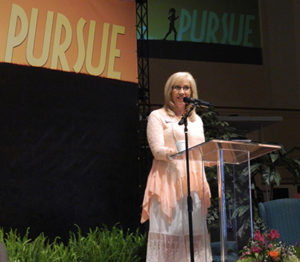
Linda Cooper, president of national Woman’s Missionary Union, speaks to the WMU of Texas annual meeting in Georgetown. (Photo / Ken Camp)

Linda Cooper of Tompkinsville, Ky., president of national Woman’s Missionary Union, challenged the Texas women to pursue a fresh relationship with God in Christ, because whatever is inside a person is what comes out in day-to-day life.

“People need to see Christ in us—not only in our lips but in our lives, as well” she said.

Cooper—who works as a dental hygienist in a Christian dentist’s office—talked about the importance of making the most of opportunities God provides to tell other people about Christ.

“I have sharp instruments and a captive audience. People are going to hear about my Jesus,” she said.

She described encountering a truck driver from Texas whose rig was broken down near her workplace. When she saw the man standing in a parking lot, she invited him into the dentist office to join the staff in their morning prayers.

Although he acknowledged he was “not a churchgoing man,” he listened as employees shared prayer requests, and he joined hands with Cooper and another worker to pray.

He left the office after the prayer meeting in tears, overcome that Cooper had chosen to “welcome a stranger” into such an intimate gathering.

“Love others so they are open to hear the good news” of Christ, she urged.

‘We are servants’

God’s people need to understand their identity before they can accomplish their assignment in his kingdom, said Michael Evans, senior pastor of Bethlehem Baptist Church in Mansfield.

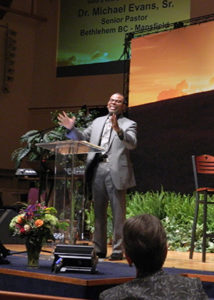
Michael Evans, pastor of Bethlehem Baptist Church in Mansfield, speaks to the Woman’s Missionary Union of Texas annual meeting in Georgetown. (Photo / Ken Camp)

“We need to know who we are. We are servants,” he said.

God calls all Christians to serve, but he does not call them to serve alone, Evans stressed.

“We are workers together,” he said, emphasizing the changes that must occur before God can use his people effectively.

“Pettiness and denominational skirmishes cannot be tolerated,” he said. “We don’t have time for that. It’s a new day now. …

“Old stereotypes must die. Distinctions must no longer matter. We are full partners in the mission. … Old habits need to change. Mouths that criticize must start to encourage.”

Discipleships grow from relationships, and Evans challenged Christian women to pursue those discipling relationships with intentionality. God shapes the character of his people as they serve him together, he emphasized.

“We cannot do it alone,” he said. “When I am working for God, God is working on me.”

Move beyond personal fulfillment

Christians should not see the pursuit of godly lives through devotional times and spiritual disciplines simply as beneficial to themselves, said Shirley McDonald of Greens Creek Baptist Church in Dublin, who was elected to another term as Texas WMU president during the annual meeting.

“Our Bible studies and prayers must lead us out of ourselves,” McDonald said.

Nelda Hoffman (right), past president of Woman’s Missionary Union of Texas, prays for newly elected officers (left to right) President Shirley McDonald, Vice President Elida Salazar and Secretary Susan Morgan, joined by Earl Ann Bumpus with the Texas WMU nominating committee and outgoing Vice President Charlotte Watson. (Photo / Ken Camp)

As Christians grow in their relationship with God in Christ, it should spur them to “be a light to shine for Christ” as they engage in missions service, she stressed.

In addition to McDonald, other officers elected at the annual meeting were Elida Salazar from First Baptist Church in Carrizo Springs as vice president and Susan Morgan of Tallowood Baptist Church in Houston as secretary.

Tamiko Jones, executive director-treasurer of Texas WMU, emphasized discipleship means more than accumulating biblical knowledge.

Rather, it means “taking on the character of Christ” and “continuing the cycle of redemption” as other lives are transformed, Jones said.

“We are called not only to learn the teachings of Jesus Christ but to live them,” she said.

Quoting German theologian and martyred pastor Dietrich Bonhoeffer, Jones emphasized the cost of discipleship.

“The cost of following Jesus Christ is your life,” she said. “It will cost you everything. … Who is your guide? Who directs your steps? Who is your compass?”

‘Join in what God is doing globally’

Jair Campos, director of Texas Baptists’ Missionary Adoption Program, challenged Baptist women to lead their churches to sponsor indigenous missionaries.

“Today, 140,000 people will die without Jesus,” he said, pointing out missionary-sending agencies cannot provide enough non-native missionaries to reach all the spiritually lost. However, God is working through Christians who have the cultural and language skills to reach their own people with the gospel.

“Join in what God is doing globally,” he urged.

Jalil Dawood, executive director of World Refugee Care and pastor Arabic Bible Church in Dallas, spoke about the plight of refugees from his personal perspective as a refugee from Iraq.

“Nobody wants to leave his family and go to an unknown place and start at zero,” he said.

Dawood encouraged the Baptist women to recognize refugees as neighbors whom God has called them to love.


Baptist Bible Institute program pivotal to BUA mission

SAN ANTONIO—The Baptist Bible Institute at Baptist University of the Américas—a series of off-site instructional centers that provide basic training to Hispanic church leaders—is rooted in the school’s founding mission, said Pablo Juarez, director of the institute.

BUA started in 1947 as the Mexican Baptist Bible Institute under the direction of San Antonio Baptist Association to provide theological education in Spanish for Mexican-American ministers.

Since then, the school has changed its name, as well as the language of instruction in its classes, and it has received accreditation to offer baccalaureate degrees. Through it all, the basic Bible classes for church leaders, offered in church settings, have remained a core part of BUA.

“The truth is that BUA is BBI,” said Juarez, who also serves as the university’s dean of student services.

While BUA now looks at developing and educating leaders for the future, Juarez said, it does not forget to maintain its relationship with ministers already serving congregations.

“BBI represents BUA’s tentacles that reach out towards the community,” Juarez said. “That is where you see the connection with ministers—the fellowship.”

Accessible and affordable classes

Ministers who did not have the opportunity to receive theological education and who need an affordable program in their language, offered at accessible sites on a flexible schedule, can receive that opportunity through BBI, he explained

“Our main focus is to provide the tools our pastors and churches need to do the ministry,” Juarez said.

While the program greatly benefits those who already are serving in ministry, it really is a service to all members of the church, Juarez said.

“We understand that every Christian is a minister,” he said. “Every member is a minister with a different role.”

The requirements for admittance to the courses are simple. Students must be Christians and provide letters of recommendation from a pastor.

Deepens discipleship

Pablo Juarez, dean of student services at Baptist University of the Americas, also serves as the program director of BUA’s Baptist Bible Institute.

Because the program is open to anyone in a congregation, it helps ministers and churches develop stronger discipleship programs, Juarez noted.

A church that seldom meets other than for its weekly Sunday worship can have a difficult time discipling its members who come from different contextual backgrounds. Discipleship can be difficult for a pastor to accomplish with just a few minutes of preaching a week, he said.

At the Baptist Bible Institute, every student starts with a “biblical foundation and a spiritual formation to be a good minister,” he explained.

The curriculum is divided into three levels, with certificates of completion offered at the end of each.

Level One focuses on basic biblical studies. Level Two teaches practical tools necessary to be a minister. Level Three is geared toward students who have been called to serve as a pastor or church planter.

The essence of all the levels—and of the program as a whole—is discipleship, Juarez stressed.

Equips laity to assume leadership

Juarez views discipleship as a core of the church’s identity. He is convinced God calls and gifts church members for service, and the Baptist Bible Institute classes help them sharpen the tools God has given them.

As churches go through transitions, the program equips students to serve, he noted. Courses help members be prepared to assume additional responsibilities when a pastor leaves a congregation or equip them to serve when a church notices it needs more ministers, he said.

“BBI is not putting the theologically training in the hands of only one person. It is putting it in the hands of the whole church,” he said. “The roles may change, but they will all have the theological training.”

Juarez believes in the program’s effectiveness, and he want to make it accessible to more people. Whether Hispanic church members speak English or Spanish, he wants to offer them the tools to follow the call God has given them.

It is made for Christians to follow Christ in service, Juarez noted. It’s emphasis is practical rather than academic—not just “informational” but “transformational,” he said.

Living proof

For any who wonder whether the classes can benefit them, Juarez points out he is a product of the Baptist Bible Institute program.

He learned about it from a friend in North Carolina while he already was engaged in ministry, and he finished the program in 2001. It marked the first step in his pursuit of theological education. He went on to complete a bachelor’s degree in religion, a Master of Divinity degree and a Doctor of Ministry degree from Campbell University.

Juarez, who has worked at BUA seven years, sees the Baptist Bible Institute program as an investment in and for the church.

Any congregation can start the process to become a center, he added. Currently 14 centers operate throughout Texas.

“I hope BBI will be available and accessible at every church in Texas,” he said. “That may not be possible for me to do, but it is possible for God.”


Voices: Signs of the times: The problem with ‘In God We Trust’

Recently, the Tennessee state legislature passed a bill that would require all schools to display the phrase “In God We Trust” somewhere “where students are likely to see it.”

It isn’t clear if governor Bill Haslam will sign the bill into law, as he’s expressed ambivalence on the proposal.

Lawmakers in four other states are debating similar legislation, while Florida has already passed such a bill through the state House of Representatives.

Much of this movement, specifically in Florida, seems to be in response to the recent shooting at Marjory Stoneman Douglas High School. Florida bill sponsor Kimberly Daniels was explicit in claiming that this measure was a possible solution to violence in schools: “[God] is the light. And our schools need light in them like never before.”

I don’t disagree that God is the light, or that schools need this kind of light. But is mandating that schools install plaques a helpful step toward this goal?

I see two problems.

A problematic witness

We should perish the thought that a plaque reading “In God We Trust” has any sort of evangelistic value. Simply seeing a sign—especially one so culturally saturated as “In God We Trust”—isn’t likely to convince someone to confess faith in Christ. The Christian gospel is too complicated for that.

A person of faith isn’t likely to be impacted by such a plaque. And, increasingly, American public schools are not attended only by professing Christians. According to Pew’s most recent survey of the American religious landscape, one out of four people in the United States are either non-religious or participate in a religion other than Christianity.

In our “culture-war” climate, a plaque reading “In God We Trust” won’t be read to mean “God is trustworthy and we hope you put trust in God.” The message it sends is something closer to: “This institution is for Christians.”

For students who don’t confess to be Christians, this ends up translating into: “You don’t belong here.” It’s a message of isolation that ends up undermining the witness we’re trying to show.

If our goal is to make disciples for Christ, mandated plaques won’t accomplish it. In fact, they’ll harm that mission by isolating those we’re claiming to love and doing it in God’s name.

Symbols without meaning

For Christians specifically, there’s another danger in being careless with religious signs and symbols.

To avoid charges of infringing on laws against the government promoting any particular religion, Tennessee lawmakers have emphasized that “In God We Trust” is being used as an American symbol rather than a Christian one.

That should immediately raise a red flag for Christians.

The 2010 case of Salazar v. Buono affirmed the right of a national park to display a large cross while forbidding the building of a similar Buddhist monument, partially on the grounds that the cross no longer has a uniquely Christian meaning.

I remember hearing Christian commentators celebrating the decision, as it meant that the cross standing at the park in question would not be removed. I felt that this decision signaled a greater loss for American Christianity than they realized.

The cross is a torture device; it was the waterboarding table of its day, an ominous, ugly symbol. Nobody would use it to mark their tombstone or decorate their house; Jesus’ admonition to his followers to “take up their cross and follow him” was, most literally, an invitation to be tortured to death.

Similarly, to say “in God we trust” is also to say that we do not trust in our own might; we are declaring that our safety comes from God alone, and not from our powerful military, collection of firearms or our money.

I don’t think we honestly can make that statement at this time.

Faith or superstition?

Putting a sign in schools that reads “In God we trust” isn’t a sign of faith in God; it’s a form of superstition at best.

In the book of Jeremiah, God warned the people living in Jerusalem against superstition. They thought that they were impervious to invasion from the Babylonians because the Temple was in the city.

Jeremiah chided the people for treating the Temple as a magic talisman to ward off evil. According to Jeremiah, religious words were being substituted for actual repentance, and this would ultimately do nothing for the people. Through Jeremiah, the Lord said, “Do not trust in these deceptive words: ‘This is the temple of the Lord, the temple of the Lord, the temple of the Lord’” (Jeremiah 7:4).

Let’s not repeat the mistakes of the Israelites living in Jerusalem.

At the very least, let’s remember that “In God We Trust” plaques and cross statues aren’t substitutes for repentance and action.

Jake Raabe is a student at Baylor University’s George W. Truett Theological Seminary in Waco, Texas. He is also a co-founder of Patristica Press, a Waco-based publishing house.


Commentary: Five communication mistakes your church probably is making

“Communication works for those who work at it.” – John Powell

What are churches doing wrong when it comes to effective communication strategies? After almost 20 years as an administrative assistant, communications manager, educator, communications specialist or communications consultant (or any other title sent my way), I’ve had time to reflect on what we’re doing wrong when it comes to effective communication. Since my time as a professional has also been spent as a minister’s spouse and often working with or through churches, I’ve identified five mistakes churches make and ways to fix them.

1. No ‘keeper of the message’.

You’ve heard the fable of the ants walking on an animal unfamiliar to them. Each share what they see: a long flat surface, or hairy threads, or a sloping tube. Without communicating to one another and without a central leader to put the pieces together, they cannot understand that they are walking on an elephant.

We often run around in the same manner at church. Without one key person to help us keep a focus on our message and see the smaller moving parts and the big picture of our communication strategy, we’re not working as an organized body.

The ‘keeper of the message’ is one who should be thinking about the attitudes we demonstrate through communication, the vision and mission of the church, the audience itself and, most importantly, the purpose of communication in the first place. Churches need a designated keeper of the message, who should be included in all conversations about communication and who should have the authority to say when, where, how and, especially, no.

2. Relying on one channel (and not knowing what they all are)

One mistake churches often make is relying on one main piece, or channel, to communicate—and that piece is usually the print newsletter. Unfortunately, this channel reaches only one audience, and in today’s communication world, we must use a lot of channels to reach a diverse and vast audience. Often, if there are other church communication pieces, they are a scattershot of options based on recommendations from church members, knowledge from the administrative assistant, or “something we saw someone else do.”

A list of available channels should include print (newsletter, flyers, postcards, signs), email (personal, groups, enewsletter), website and blog (on both desktop and mobile/tablet), phone (personal calls, phone tree, text messages), social media (top platforms include FacebookTwitterYouTubeInstagram and LinkedIn, as well as others), on-site platforms (bulletin boards, marquees, digital signs), Sunday morning bulletin, Wednesday night program, Sunday school notices and verbal announcements (usually from the pulpit).

Note that these channels don’t have equal importance (or purpose) or the same audience, and yet we often treat them the same.

3. Not enough tools in your tool belt

It’s clear there are more than enough channels to reach our audience, but it’s unlikely that any one person (much less your ‘keeper of the message’) knows how to use all of those channels effectively. They need more tools to make the job easier, efficient and useful.

Thankfully, the advancement of technology has provided better tools than we’ve ever had before. Unfortunately, your staff is going to require time, space, training and probably some investment of money to be equipped. A few examples include online print design options like Scribus.net or tutorial sites like Lynda.com, e-newsletter templates like ConstantContact.com or MailChimp.com, easy website platforms like WordPress.com or SquareSpace.com, and resources like mashable.comchurchmarketingsucks.com or wired.com. Also watch (or search) for conferences and events for communication directors/managers.

4. Not receiving (or asking for) feedback

How do you know if what you’re doing is working? We usually measure the success of communication on whether or not folks show up at an event. However, attendance is only one small, and not very reliable, form of feedback. In fact, when I have conducted surveys for churches, most people reply that they don’t even offer feedback when communication is lacking.

We need to get better at asking, in as many channels as possible, how we are doing, whether people feel informed and, if not, why or how can we do better.

Some feedback can come in the form of metrics through website or social media sites. We can also conduct surveys using sites like SurveyMonkey.com or Wufoo.com. Also, make sure that the person who actually does receive feedback (perhaps your front desk receptionist) is in a position to make changes and feels ownership to pass along the feedback received.

5. Using insider language

Often the communication we do receive from our church includes abbreviations such as, “The CFJ Circle of OBC will meet in room L105” (to save space), partial information, such as “see more in the Announcer” (to save space), or references to previously mentioned news (to save space). All of this type of language, unfortunately, implies that some of the audience is “in the know” and the rest of us need to figure it out on our own. It feels exclusive, and instead of encouraging people to become more informed (through our main channel, most likely), it turns them off and away.

Another significant way that we use insider language is our obsessive focus on events in all forms of communication. We neglect (and often don’t know how) to tell our stories, experiences, trials, joys and journeys, possibly because we forget that not everyone has lived it with us. By only communicating our programming, we lose the opportunity to connect, be personable and provide entry points for those just joining in.

Effective communication in this chaotic and noisy world is not easy; however, noticing our mistakes and working to change them will connect us with our congregation and community and provide us the opportunity to be the presence of Christ in their lives.

Natalie Aho has spent over eleven years as a professional in communications and another four years as an educator. She has an MS in Interactive Media from Quinnipiac University and a BS in Education from Baylor University. Her specializations include social media, websites, content marketing, writing for the web and online community engagement, and she is a frequent presenter. She is a consultant for CHC.

This article first appeared on the Center for Healthy Churches blog.