Walter C. Jackson: Pastoring pastors and helping churches in South Central Texas

Since June 2012, Walter C. Jackson has been the director of missions for the Guadalupe Baptist Association, which serves 55 churches in seven counties and is based in Victoria, Texas. From deep in the heart of one Texan, he shares his background and thoughts on church and ministry. To suggest a Baptist General Convention of Texas-affiliated leader to be featured in this column, or to apply to be featured yourself, click here.

Background

Where else have you worked, and what were your positions?

I pastored Silver Springs Baptist in Magnolia for almost two years, Seventh & Main Baptist Church in Bonham for four years, Highland Park Baptist in Texarkana for three and half years and FBC DeKalb for eleven years.

I also currently teach a class for the South Texas School of Christian Studies located in Corpus Christi.

Where did you grow up?

I grew up in Northwest Houston.

How did you come to faith in Christ?

I grew up in the Methodist church. My mother was a Sunday School teacher. On occasion, she would take me with her to the Bible bookstore and would let me pick out a “Chick evangelistic tract,” those small cartoon stories that led to an evangelistic presentation of salvation.

One November day, when I was ten years old, I was in my bedroom reading the track “The Fool” and, for the first time, when I got to the end of the little story, realized I was lost and needed to give my life to Jesus. I went out into our garage, got down on my knees, put my elbows up on an antique trunk and followed the prayer at the back of the tract.

That day, knowing that God loved me and could not lie, that if I confessed my sin and invited Jesus into my life I would be saved, I did just that. A side note: that old antique trunk now sits in my office as a personal altar of praise to God for that day.

Where were you educated, and what degrees did you receive?

I like to proudly say I was a part of the first graduating class of Cypress Creek High School in 1980. I received my Bachelor of Arts from Houston Baptist University, with a double major in Christianity and psychology, my Master of Divinity from Southwestern Seminary and my Doctor of Ministry from Trinity Seminary.

Ministry/Profession

Why do you feel called to your particular vocation?

When I had been in Bonham about two years, our director of missions retired. I was asked to serve on the search committee with four other pastors. As we met at the associational office, these other pastors, who were older than I was and had more years of experience than I did, began to talk about what they wanted in the next DOM.

I will never forget the feeling I had as they talked about this, and in my heart I thought “That is the dream ministry.” If I had had just a few more years of experience as a pastor I would have asked that day to be removed from the committee because I wanted to throw my name in the hat for the position.

I continued pastoring and staying very involved in each of the associations where I served. Around 2008, the desire really began to grow in me again, and God began to confirm the calling, leading me here to the GBA in 2012.

Please tell us about your association—where it’s located, the key focus of its work and ministry, etc.

We are in South Central Texas. Our office is in the city of Victoria, and we have churches in the six counties that surround Victoria County. We are located across the street from the University of Houston Victoria and Victoria College. Because of this we double as the BSM building, and one of our key works is in reaching the campuses.

Recently, the Lord has begun bringing the world into our building. We offer a free lunch for students each Tuesday, supplied by a different church each week. A group of women who are learning English have begun coming. We are now offering a time for them to stay after lunch and work on their conversational English.

As I type this, there are ladies from Italy, Iraq, Turkey, Taiwan, Egypt and Pakistan all enjoying lunch and will soon be playing games that help them speak English. Their husbands are here working, and they are wanting to go to school, so they are taking ESL classes and now also coming here. What an opportunity.

What do you like best about leading your association? Why?

When I arrived here and began having the opportunity to preach in our churches, I would ask the congregation if any of them knew what a DOM did. Rarely would a hand go up. I explain that I am “a pastor to pastors and helper of churches.” I believe that concisely says what I do. I love being able to encourage pastors and staff and helping churches find resources they need to accomplish their mission.

What aspect(s) of associational ministry and/or its mission do you wish more people understood?

During my first two years, as I attended meetings with other DOMs, I would come back to Victoria and feel like a failure as I listened to all the things the other associations were doing. Finally, it dawned on me that just as every church is different, so also are associations.

The need here in the GBA was not the same as elsewhere in the state. It was Roger Yancy (the supreme DOM) who helped me to see this. He asked me once about what I did the most of in our association. As I explained it to him, he responded, “So how much do you think it would cost each church to retain a consultant to do what you are doing for them?”

That was a powerful conversation for me. I wish people in our churches would realize how valuable their own DOM is for this need. We spend a great deal of our time studying church life so that we are able to give sound counsel when a church has a need. We serve as the local resource, in essence, for all things church related.

How has your association and its mission changed since you began your career?

I think “changed” would be the word I would use. There has been a wonderful increase in the relationships between pastors in our area. I have worked to help pastors meet each other and spend time with each other. It has been encouraging to hear when a pastor will tell me he called one of the other men and they have gone to lunch together. Or that a pastor called another just to check on him and have prayer with him. This wasn’t happening a few years ago.

How do you expect your association and/or its mission to change in the next 10 to 20 years?

This is probably something that most other DOMs would attest to, but the financial situation is even now an ongoing concern—not just for the sake of my continuing to have a ministry, but for some of our churches.

The always-changing oil production, the remaining aftereffects of Hurricane Harvey, the fluctuation among the industry plants in our area—we have seen these things impact our churches recently as people have been transferred out of the area or just lost their jobs.

As I know is the case everywhere, we have some churches that are really struggling financially to exist. We also have the potential in the next five to 10 years of having a handful of pastors who could retire. Because most of our churches are small, it makes finding another pastor difficult.

Also, the mobility of people today and desire for “more” in a church: we have people that drive by, in some cases, three or four churches to go to another church. This is another factor making it harder for the smaller churches to continue.

What one aspect of your job gives you the greatest joy or fulfillment?

Time spent with pastors.

About Baptists

What are the key issues—opportunities and/or challenges—facing Baptist churches?

I believe that learning new ways to impact our culture is essential right now. That too many churches have become myopic in their vision and are missing the point of reaching their communities.

I believe Terry Coy’s book, “Return to the Margins,” hits the nail on the head in that we, once again, as churches and individually as Christians, have got to find ways to impact society from the “margins,” the sidelines. It is not profound to state that we find ourselves on the outside looking in, where once the church was prominent in our society and Christians were held to a level of respect. Those days are gone. As one of our pastors says with his staff regarding financial constraints, we must “learn to do better with less.”

What are the key issues facing Baptists as a people or denomination?

I am troubled (perhaps because I’m now considered old) by the idea that a “regular” attender is a person who is at church once or twice a month. I struggle to see a real level of commitment to the local church.

I know all the sayings about not having to go to church to be a Christian; however, we are made for fellowship and ministry together. As busy as families are today outside the church, I see many churches struggling to exist. So the state of the smaller local church over the next five to ten years is a concern to me. I wonder if, rather than so much emphasis on starting new churches, we should put more effort into helping existing, struggling churches?

About Walter

Who were/are your mentors, and how did/do they influence you?

I wrote a book two years ago targeting young ministers as they are beginning their ministry, (shameless plug: “Start Strong”). In the beginning of the book, I stated that when I was young in the ministry, I did not know that I should have sought a mentor. However, in not knowing what I did not know, God blessed me with a wonderful pastor.

Brother Billy Crosby came to Northwest Memorial Baptist Church (now Houston Northwest Baptist), and God used him to change my life and call me to the ministry—not in a personal, one-on-one kind of way, but his preaching brought about a love for God’s word in me. And his genuineness in loving people had a great impact on me as to what a pastor is. To this day, though Brother Billy has retired and lives in Louisiana, I still refer to him as my pastor.

Other than the Bible, name some of your favorite books or authors, and explain why.

Chuck Swindoll and Max Lucado have been favorites for a long time. Dr. Jimmy Draper’s book “Don’t Quit Before You Finish” is a book I wish he had written thirty years ago. Most recently, Barna’s book, “Churchless,” and Peter Greer and Chris Horst’s book “Mission Drift” have helped me in my desire to find things that will help pastors and churches.

That is my emphasis in reading these days: works that I find will help churches. Of course, Thom Rainer’s books and blog I read regularly.

What is your favorite Bible verse or passage? Why?

My favorite verse is John 3:30, where John the Baptist speaks in reference to Jesus: “He must increase, and I must decrease.” I will admit I don’t always live up to this, but it is my desire.

If you could get one “do over” in your career, what would it be, and why?

This goes back to my days at HBU and then Southwestern. I would have studied more in learning Greek. I was never a scholar, very average, in fact. I went into the languages wanting to learn how to learn, to know how to find and use reference works. If I could do it over again, I would work much harder at understanding the languages of the Bible.

Dr. Robert Creech, our Greek professor at HBU, gave the opportunity in second-year Greek for some extra credit, which I needed, if we would read the book by A. T. Robertson, “The Minister and his Greek New Testament.” I did, and afterward I told Dr. Creech I thought that should be required reading for Intro to Greek students. It changed the way I thought about learning New Testament Greek.

Pastor helps Caldwell mission gain vision for community ministry

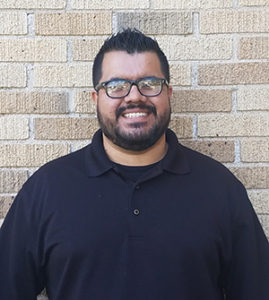
CALDWELL—Four years ago, when a Baptist mission congregation in Caldwell was almost ready to close its doors, the congregation called Ruben Burguete as pastor to help bring a new vision.

Iglesia Bautista Emanuel had experienced multiple pastoral changes through the years, and its members lacked a clear sense of how to be involved in ministry in their area.

Now the mission plans to constitute as a church soon, and Burguete noted the congregation is involved deeply in the community.

Ruben Burguete

First Baptist Church in Caldwell started the mission about 40 years ago. So, Burguete insists he simply is “harvesting from the labor others have done before.”

He also expressed appreciation for the support First Baptist has provided, even when it means the mission provides culturally contextualized ministry that may be unfamiliar to the sponsoring church.

“It is different to do ministry in a Hispanic congregation, and they know not everything has to be done the same way,” he said.

Burguete works part-time at First Baptist, where Pastor Steven Johnson has served as his mentor in ministry.

“I don’t know if I would still be here without his mentorship,” Burguete said.

Burguete and his wife, Karem Salinas, both originally hailed from Mexico. They lived in San Antonio and several Central Texas communities before moving to Caldwell.

Through it all, Burguete and his family have learned to discern how to remain faithful to God’s calling wherever he leads.

In Caldwell, Burguete said, he was able to gain the trust of the congregation readily. Most of Emanuel’s members accepted Christ as Savior at the church, he noted.

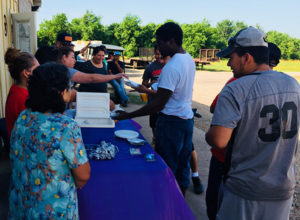
Members of Iglesia Bautista Emanuel in Caldwell feed workers who are at a job site near the mission. (Photo / Ruben Burguete)

Caldwell is a community about 4,000 people, one fourth of them Hispanic, and about 300 are first-generation Texans.

To meet their needs, Mision Emanuel has partnered with other organizations to provide English-as-a-Second-Language and high-school-equivalency classes.

The congregation soon will begin offering citizenship classes, he added.

The mission increasingly is opening its doors to community ministry, and it already is experiencing growth, Burguete said.

None of it would have been possible without his wife’s support, he noted.

“She has chosen to be supportive of me and of the ministry we are doing,” he said, noting she has reminded him God has called them to Caldwell, and they will have all they need until God calls them somewhere else.

Burguete views his calling as pastor to equip others step up and lead when necessary. So if God calls the Burguetes somewhere else, the congregation will be more than ready to continue the vision they have received, he added.

“Even though Caldwell is a small town, the Hispanic population here is growing,” Burguete said. “We want to have people here ready to serve as soon as God calls them.”


Buckner sends aid and relief to Guatemala after volcano erupts

Buckner International is sending aid to people in Guatemala affected by the eruption of Volcán del Fuego, which killed at least 62 people June 3 outside the capital city.

Buckner serves Guatemala through Buckner Family Hope Centers, humanitarian aid, family reunification efforts, child safety consultation and foster care. None of the ministries, children or families served by Buckner was directly affected by the eruption.

Buckner Guatemala sent about 560,000 food rations donated by USAID, 2,160 pairs of shoes donated through Buckner Shoes for Orphan Souls, 1,200 pairs of socks, 250 items of clothing, 62 blankets and 80 mattresses to the area and continues to assess ways it can minister further.

The government’s department of social works, Iglesia Casa de Dios and the Buckner Family Hope Center in Jocotenango will distribute the donated supplies.

“This situation is tragic,” said Steve Watson, Buckner director of International Humanitarian Aid. “We’re seeking to shine hope into this terrible situation in any way we can.

“We are asking the Buckner family to continue praying for the children and families affected by this disaster, as well as our staff who are serving the hurting during this trying time.”


Narrow ruling in favor of Christian baker prompts varied reactions

WASHINGTON—The U.S. Supreme Court ruled in favor of a Colorado Christian baker who refused to design a cake for a same-sex couple’s wedding reception, but the ruling’s narrow scope prompted widely ranging responses—and even led opposing lawyers to claim at least partial victory.

The Supreme Court ruled 7-2 on behalf of cake baker Jack Phillips in Masterpiece Cakeshop v. Colorado Civil Rights Commission, but the justices focused primarily on how the commission handled the case rather than on broader questions of religious liberty and discrimination.

Commission showed ‘hostility’ toward religious convictions

The same-sex couple—David Mullins and Charlie Craig—filed a complaint with the commission, saying they were being discriminated against on the basis of their sexual orientation. Phillips insisted he should be granted an exemption to Colorado’s Anti-Discrimination Act based on his sincerely held religious views about marriage.

The state Civil Rights Commission’s consideration of the case was “inconsistent with the state’s obligation of religious neutrality,” Justice Anthony Kennedy wrote in the majority opinion, noting the baker’s refusal was based on “his sincere religious beliefs and convictions.”

“The Civil Rights Commission’s treatment of his case has some elements of a clear and impermissible hostility toward the sincere religious beliefs that motivated his objection,” Kennedy wrote.

No ‘blanket exemption’ to nondiscrimination laws

Holly Hollman

The court failed to address the core question by basing its decision on the actions of the administrative commission charged with enforcing civil rights laws, rather than determining whether the business owner violated the law by refusing to provide a service, said Holly Hollman, general counsel for the Baptist Joint Committee for Religious Liberty.

“Religious liberty protects beliefs and actions related to marriage. It does not mean that religious beliefs provide blanket exemptions to nondiscrimination laws that protect our neighbors,” Hollman said.

At the same time, she added: “Religious objectors, like all Americans, have the right to be treated with respect and not to have their religious beliefs denigrated. As we consider these difficult issues in future cases, we all will fare better when we acknowledge the legitimate interests on both sides of these disputes and approach each other with civility and respect.”

Last October, the Baptist Joint Committee filed a brief with the Supreme Court arguing Colorado’s public accommodation law, as applied in the Masterpiece Cakeshop case, “strikes the right balance between respect for religious liberty and the protection of individuals’ right to participate in the commercial marketplace free from discrimination.”

‘A win for all Americans’

More than a month earlier, the Southern Baptist Convention’s Ethics & Religious Liberty Commission had filed a brief arguing the “free exercise of religion by secular vocations in the marketplace should be no less protected than sacred vocations in the ministry.”

Russell Moore 150
Russell Moore

“The Supreme Court got this one right,” said Russell Moore, president of the Ethics & Religious Liberty Commission, who called the court’s ruling “a win for all Americans.”

“At stake at this debate was the question of whether or not the state can force an individual to violate their conscience. We need to live in the kind of country where we can be free to persuade one another, not bully each other into silence,” Moore said.

“The Supreme Court’s responsibility is to protect Americans from governments and agencies that would make such and demand. I’m glad to see they have. My hope is that this will be a sign that the court will continue to uphold conscience freedom and personal liberty in future cases.”

Both sides claim partial victory

The American Civil Liberties Union, which represented Mullins and Craig during the appeal process, claimed at least a limited victory, saying the Supreme Court “did not accept arguments that would have turned back the clock on equality by making our basic civil rights protections unenforceable.”

“The court reversed the Masterpiece Cakeshop decision based on concerns unique to the case but reaffirmed its longstanding rule that states can prevent the harms of discrimination in the marketplace, including against LGBT people.” said Louise Melling, deputy legal director of the ACLU.

The Alliance Defending Freedom, a legal firm that aided Phillips early in the case, likewise claimed a victory in the court’s decision, saying its “makes clear that the government must respect … (Phillips’) beliefs about marriage.”

“Creative professionals who serve all people should be free to create art consistent with their convictions without the threat of government punishment,” said Kristen Waggoner, senior counsel for the Alliance Defending Freedom.

Colorado and its Civil Rights Commission was “openly antagonistic” toward Phillips and toward his religious views about marriage, she added.

“The court was right to condemn that,” Waggoner said. “Tolerance and respect for good-faith differences of opinion are essential in a society like ours.”


Country church takes root in upscale North Dallas

DALLAS—A western-heritage church may seem out of place in North Dallas, sandwiched between one of the nation’s most affluent neighborhoods and upscale NorthPark Center. But leaders of Highland Country Fellowship believe God planted the congregation there for a reason.

“The people here don’t live in the country, but they own ranches or know people who do,” Executive Pastor Kyle Carper said.

‘Feels like family’

More importantly, people encounter something at Highland Country Fellowship they don’t necessarily find right away at mega-churches, Teaching Pastor Bill Rector added.

“It’s a friendly place where everybody knows your name,” he said. “It feels like a family.”

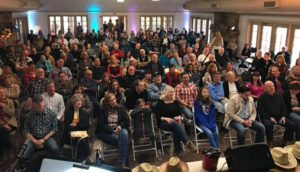
Members and guests from Highland Country Fellowship fill a venue at White Rock Lake in Dallas for an event featuring country singer Rudy Gatlin. (Photo courtesy of Kyle Carper)

Highland Country Fellowship grew out of a merger between two congregations last fall—Country Fellowship of Dallas, a growing mission church that had been meeting in a barbecue restaurant in Richardson, and Highland Baptist Church, a long-established congregation that had occupied the property near University Park since 1993.

Worship Pastor Sammy Davenport planted Country Fellowship of Dallas with the help of Dallas Baptist Association and the Baptist General Convention of Texas and the blessing of sponsor church South Garland Baptist Church. Rector joined him as teaching pastor about a year later.

Initially, Davenport—whose musical background ran more toward classical, jazz and early contemporary Christian music than country—had his doubts about serving at a western-heritage church.

“I’m not a cowboy. I can’t find stirrups short enough to fit my legs,” he said. “Then I found out it really was about creating a church that doesn’t smell like, taste like or feel like a church.”

Urban cowboy church

Country Fellowship—which Davenport described as “an urban version of the cowboy church”—flourished. He noted a Billboard Magazine article reported 42 percent of the general population identify as country music fans, including half of the people with an income of $100,000 or more.

By early last year, the church realized it had outgrown the space it occupied for Sunday worship. Then last summer, Davenport learned the barbecue restaurant’s management decided it no longer would make its facility available, and the church had 30 days to find another place to meet. So, he contacted Dallas Baptist Association to explore other options.

At about the same time, Highland Baptist Church was approaching a point where its leaders and congregation faced hard choices. The church—formerly known as Highland Park Baptist Church—had moved in 1993 into the building formerly occupied by Fellowship Bible Church, but it had experienced steady decline for an extended time, said Carper, who became senior pastor in 2014 after several years as a member.

Carper and Davenport met in late July last year to see if Country Fellowship might rent space from Highland Baptist. By the end of their four-hour conversation, they instead began asking if God might be leading the two congregations to unite.

Carper, Davenport, Rector and their wives met together and realized in spite of the differences between the two congregations, their leaders had compatible visions for ministry.

Taking the Bible seriously, not themselves

Dallas Baptist Association had helped Highland Baptist create a Next Steps Committee to determine where God might be leading the congregation. So, Davenport met at length with that committee, and its members enthusiastically endorsed the idea of the two congregations uniting—even though Davenport warned them, “We may be too weird for y’all.”

Highland Baptist followed a traditional organizational structure and formal worship. Country Fellowship was much more informal and loosely structured.

“We take the Bible seriously. We don’t take ourselves seriously at all,” Rector explained.

Even so, the two congregations successfully united last fall.

“We haven’t lost a single person,” Carper said. “In fact, we’ve had some come back who had left us.”

For the first time in 25 years, the church is starting to make an impact on its immediate neighborhood, rather than just drawing members from a distance, he added.

‘Never knew church could be like this’

At the same time, Highland Country Fellowship also has drawn worshippers from as far away as Bonham and Decatur—each about 70 miles distant from the church facility.

“People will drive to be with family,” Rector noted. “After all, how far will you drive for family dinner at Thanksgiving?”

Highland Country Fellowship has created a family feeling that puts newcomers at ease and make people feel welcome—whether they are traditional churchgoers, unchurched people or folks who dropped out of church due to a bad experience along the way, Davenport noted.

In spite of a bit of culture shock, former members of Highland Baptist have adjusted and embraced the new identity, Carper noted.

“I’ve had people say to me, ‘I never knew church could be like this,’” he said.


Tony Celelli: Helping Christian leaders fulfill their God-ordained calling

Since November 2005, Tony Celelli has served as president and CEO of the Christian Education Activities Corporation, d/b/a South Texas School of Christian Studies, in Corpus Christi, Texas. From deep in the heart of one Texan, he shares his background and thoughts on leading that seminary. To suggest a Baptist General Convention of Texas-affiliated leader to be featured in this column, or to apply to be featured yourself, click here.

Background

Where else have you worked, and what were your positions?

  • Founding pastor of The Station Church, Corpus Christi, Texas (July 1999 – May 2005)
  • Minister of spiritual formation/administration, Second Baptist Church, Corpus Christi, Texas (Jan. 1998 – Nov. 2005)
  • Minister of education and youth, Crestview Baptist Church, Georgetown, Texas
  • Director of operations, Grace-Aire Medical Foundation, Corpus Christi, Texas
  • Minister to students, First Baptist Church, Baird, Texas
  • Youth minister, Belmont Baptist Church, Abilene, Texas
  • Summer associate minister, Central Baptist Church, Clovis, New Mexico

Where did you grow up?

I grew up as an Air Force brat (a military dependent of parents who served in the United States Air Force) and lived essentially in two locations: Davis Monthan AFB in Tucson, Arizona, and Cannon AFB in Clovis, New Mexico.

How did you come to faith in Christ?

A godly neighbor in Clovis, New Mexico, took my sister and me to VBS and then church. When I was twelve, I heard for the first time that I was a sinner and needed a savior. I also saw a friend getting baptized and it made me curious, so I began to ask questions of the pastor.

Pastor Bob Vest took time to share with me the love of God through his Son, Jesus Christ, and how Jesus wanted to “sit in the big chair of my heart, but I had to invite him in.” I contemplated what it meant to ask Jesus to be Lord of my life.

Some weeks later, I walked the aisle on a Sunday night during a summer revival service and gave my heart to Jesus.

Where were you educated, and what degrees did you receive?

  • D. leadership studies/ethics, Dallas Baptist University, 2012
  • Div., Logsdon Seminary, Hardin-Simmons University, 2000
  • B.S. applied theology/psychology, Hardin Simmons University, 1993

Ministry/Profession

Why do you feel called to your particular vocation?

Dr. James Shields was my faculty advisor during my undergraduate days at HSU. During my last semester, he challenged me to consider following God to the “unpopular places of ministry.” He said, “Young preacher boys like you seem to hear God call them to big cities, big churches, and big salaries. Why don’t you break the mold and not carry more water to the ocean?”

Those words of encouragement and chastisement shaped my ministry calling more than any other. At that moment, I asked God to send me to the unpopular places.

Now, the ironic part of my calling to SCS and the analogy of carrying water to the ocean is almost lost on the fact that my office overlooks the Bay of Corpus Christi and the Gulf of Mexico. Nevertheless, South Texas has never been a particularly easy or popular place for Baptist workers because of the strong Roman Catholic culture.

My calling to higher education came through the local church.

Please tell us about your BGCT institution—the breadth and nature of its work, including its mission, measures of scope, etc.

History (copied from website)

In 1945, several leading Baptists of South Texas met to consider the possibility of beginning a local college to train ministers and teachers. Two years later, Texas Baptists gave their support to the establishment of the University of Corpus Christi (UCC) on Ward Island, previously the site of a Top Secret U.S. military radar station. UCC continued as an effective four-year university until 1972. During these years the university fulfilled its purpose of training teachers and ministers who would become leaders in South Texas and beyond.

In 1970, Hurricane Celia destroyed most of the campus, with damages totaling over a million dollars. Due to the enormous financial pressure, Texas Baptists voted to give over two hundred acres of Ward Island to the city of Corpus Christi, who in turn made it available in 1973 to the state for the establishment of Texas A & I at Corpus Christi. The school later became Corpus Christi State University and is now Texas A&M University – Corpus Christi.

From the beginning of this process, however, Texas Baptists retained ten acres of land adjacent to the larger campus to be used for religious education. Baptists led the way for other denominations when undergraduate classes in religion began in the fall semester of 1977 through Howard Payne University (HPU). Despite the many challenges, SCS opened its main building, housing classrooms and offices, an auditorium, prayer chapel, library, and kitchen in 1980. The following year celebrated the first student to graduate from HPU at SCS.

In 1997, President Linn Self partnered with Dr. Vernon Davis, Dean of Logsdon School of Theology at Hardin-Simmons University, to offer the Master of Divinity program in Corpus Christi. By 2004, SCS opened the Stark Conference Center, adding much-needed classroom space, as well as living quarters for resident faculty and visiting guests. In the Fall of 2011, Hardin-Simmons University began offering bachelor degrees for South Texas students at SCS.

Read “The Lost Baptist University” by Dr. Tony Celelli for a detailed account of our journey from UCC to SCS.

Mission

SCS exists to equip the educationally underserved followers of Christ for service in the church and community.

  • Underserved: nontraditional students are bivocational, older and ethnically diverse. SCS’s target audience is not the typical 18-to-24-year-old student, but rather the individual who feels called to sustained ministry preparation and can’t leave South Texas for various reasons.
  • Service in the local church is the hallmark of SCS. We judge our success on the success of the local church.

What do you like best about leading your institution? Why?

Helping Christian leaders fulfill their God-ordained calling to be 21st-century ministers and missionaries in a desperate and dying world. We are making an eternal difference in the lives of those we equip and in the lives of those they reach and serve.

What aspect(s) of your institution and/or its mission do you wish more people understood?

The value of educating local church leaders. Society expects those with dangerous knowledge to be adequately trained. The doctor has dangerous knowledge about one’s body, the attorney has dangerous knowledge about one’s social affairs, but it is the pastor who has dangerous knowledge about one’s soul.

Pastoral leaders must be equipped with greater dedication and intentionality than even those of the medical and legal professions for the sake of leading God’s people effectively.

How has your institution and its mission changed since you began your career?

Increasingly high value on multiculturalism and centrality of the church in ministry preparation. SCS is not where we want to be, but we are making steps toward those two goals.

How do you expect your institution and/or its mission to change in the next 10 to 20 years?

The mission will remain the same while the strategy is evolving in order to reach and equip more underserved followers of Christ for service in the church in the South Texas region, from San Antonio to Houston and to the Valley.

We aspire to have more partnerships with local churches and thereby increase the number of teaching sites with affordable and accessible theological education for nontraditional students.

Name the three most significant challenges and/or influences facing your institution.

Three Challenges facing our institution are those becoming increasingly more common among institutions of theological higher education: overall enrollment, the nontraditional student demographic and financial affordability.

However, these challenges are also our strengths, as SCS is making remarkable headway in each of these areas.

What one aspect of your job gives you the greatest joy or fulfillment?

At SCS, we equip ministry leaders with more than a degree, but with a clearer sense and direction of their calling and ministry vocation.

Greatest fulfillment is seeing SCS alumni apply their theological education in their various life ministry callings and contexts, whether they are a senior pastor or supportive pastor, a chaplain in the military or hospital, or an adjunct professor at SCS pursuing their doctorate.

About Baptists

What are the key issues facing Baptists?

  • The lack of identity and appreciation for the historical sacrifices made by our Baptist forefathers.
  • Repeating old mistakes or missing new opportunities because of ignorance to Baptist distinctives.

About Tony

Who were/are your mentors, and how did/do they influence you?

Bill Cason was an elderly rancher in my second church who “took” me visiting every Monday evening. It wasn’t in Bible class or even in seminary where I learned the work of evangelism—it was from a humble saint of God who loved people enough to tell them about Jesus.

Other than the Bible, name some of your favorite books or authors, and explain why.

Dietrich Bonhoeffer, “Life Together.” His book doesn’t deal with church community as it should be, but rather as it actually is experienced. This book reminds me that although the church has its problems, it is still the means by which Jesus intends for his message to be spread throughout the world.

What is your favorite Bible verse or passage? Why?

Micah 6:8—“He has shown you, O mortal, what is good. And what does the LORD require of you? To act justly and to love mercy and to walk humbly with your God.”

This verse has become a life verse for me in that it highlights a few basic virtues and values for godliness: justice, love, mercy and humility.

Who is your favorite Bible character, other than Jesus? Why?

David—because he worked, worshipped, and wept mightily.

Name something about you that would surprise people who know you well.

Designing and building furniture.

If you could get one “do over” in your career, what would it be, and why?

When I was young in the ministry, I was also very zealous. If a “mulligan” were available in ministry, then I would do over a difficult conversation I had with a church treasurer. We both had the same goals of financial integrity and church sustainability, but my enthusiasm and eagerness to help the church grow also led me to be more confrontational than necessary. We exchanged difficult words, and it severed our relationship for many years.

Thank God for mercy and second chances!


Voices: Pastoring with the next pastor in mind

One of the growing experiences pastors will go through is leaving a church and watching the church call a new pastor. I’ve experienced this twice and am grateful that both times have been positive experiences.

Reflecting back, I’ve learned something that I believe is important for every pastor to consider: every pastor needs to serve with the next pastor in mind.

This is not always easy. It is easier to focus on the daily tasks. It is easier to think primarily about one’s own legacy. It is easier, in other words, to forget that there will be a day when the pastor is no longer there, the church will move forward, and a new pastor will be called.

Nevertheless, if pastors truly care about their churches, they must think beyond themselves to the time when another pastor will succeed them. In my experience, I’ve learned a few lessons that I hope pastors will find helpful.

Four ways pastors can succeed in succession

1. Leave the church healthier than when you arrived.

I remember someone once told me, “Ross, you’ll leave every church you pastor stronger in some areas and weaker in some areas.” It’s humbling to hear this, but it is true.

The reality is that there will be areas of weakness when any pastor leaves, but the focus needs to be on leaving the church in a healthier place than when we began.

2. Do not “kick the can down the road” on important issues that need to be addressed.

It can be challenging to address important areas of discomfort and conflict. The temptation is to ignore these areas and leave them for someone else to address. If one of the goals, though, is to leave a church healthier, certain areas of discomfort and conflict will have to be addressed.

I remember one of the challenges in my first church was to have to lead the church to stand up to what can best be described as a “church bully.” It was a hard and anxiety-ridden time to stand up to the person, but I was thankful that my successors never had to address the same person/issue.

3. Set the standard for the pastor and church relationship.

The reciprocal relationship between pastors and churches is crucial for the health and growth of the church. The health of this relationship, or lack thereof, can impact a church for generations. Therefore, it is not only important for the current pastors to model biblical servant leadership for their time at the church but also for the pastors who follow.

For example, it is important for pastors to neither be pushovers or dictators. Either of these extremes causes sickness in churches and fosters disrespect for the office of the pastor.

When a pastor, though, seeks to lead with godliness, a God-exalting vision, a willingness to apologize when wrong, service, a love for people and hard work, the health that is fostered between the church and pastor can provide a solid foundation and legacy of health for successive pastors.

4. Talk about your predecessors the same way you hope your successors will talk about you.

It is easy to look back and see how one would do things differently. There will also be people in the church who criticize the previous pastor and flatter the current pastor.

It’s tempting to scorn humility and accept it as truth. The better way, however, is to redirect the conversation and find ways to build up one’s predecessor.

Ultimately, pastoring with the next pastor in mind is done within the context of the biblical belief that the head of the church is Christ. The church does not belong to a pastor (or the membership).

Pastors are stewards of Christ’s church, and there will be pastors who follow us. Therefore, let’s keep our call as stewards at the fore as we lead toward health, keeping in mind the call of those who inevitably follow.

Ross Shelton is senior pastor of First Baptist Church in Brenham, Texas.


CommonCall: Hope restored in Refugio

REFUGIO—Joann Moya’s house on First Street in Refugio is the same one where her grandmother lived many years. The house holds many fond memories—and one terrifying one.

“Every time I hear the wind blow, I get real emotional,” she said.

Moya was at her mother’s house, about a mile away, when Hurricane Harvey hit their town last August.

“The hurricane stayed right on top of us all night,” she recalled.

When she returned to her home, she found it uninhabitable.

“I gave up hope when all this happened,” she confessed.

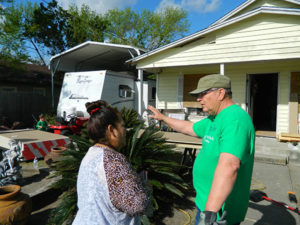
Roy Joe Ham, minister of administration at First Baptist Church in Norman, Okla., talks with Joann Moya about the work his crew is doing on her storm-damaged home in Refugio. (Photo / Ken Camp)

But in the months that followed, volunteers—particularly Christian groups, such as a mission team from First Baptist Church in Norman, Okla.—slowly but surely restored her hope.

‘They must love me’

With assistance, Moya secured a travel trailer and parked it in her carport. She has lived in its cramped quarters seven months, while volunteers have worked to restore her home.

A crew from Chicago put a tarp on the roof, volunteers from San Antonio removed debris from the home’s interior, and a church group from Waco tore out damaged drywall.

Most recently, she has benefited from the labor of volunteers from First Baptist Church in Norman.

“God sent them to me,” she said. “If it weren’t for these people, I wouldn’t have a place to stay. They must love me.”

Remembering how Texans served in Oklahoma

When Hurricane Harvey hit Port Aransas and made full landfall at Rockport, the hearts of people at First Baptist Church in Norman broke, said Roy Joe Ham, minister of administration. They remembered how Texas Baptist Men volunteers and other Texans traveled to their area to help with relief, recovery and rebuilding after a tornado hit Moore in 2013.

“We housed many church groups from Texas at our family life center as they came to work,” Ham said.

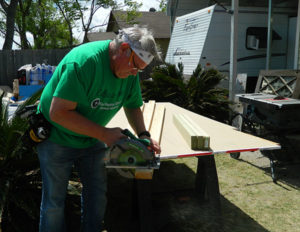
Make Dollard, a volunteer from First Baptist Church in Norman, Okla., works on a storm-damaged home in Refugio. (Photo / Ken Camp)

The church immediately launched its Hands for Harvey ministry and began seeking out people to assist who either had no insurance or were dramatically underinsured.

The 5th Ward Community Development Corporation in Houston helped the congregation discover homeowners who needed assistance.

So, 22 members of First Baptist Church traveled from Norman to Houston in late October to install sheetrock and insulation in the homes of a single senior adult woman and a senior adult couple in the 5th Ward. The Hands for Harvey volunteers from Norman worked in partnership with South Main Baptist Church and Willow Meadows Baptist Church in Houston.

‘Go to a place that had been forgotten’

Ham, who grew up in Uvalde and lived 10 years in Corpus Christi, recognized small communities in South Texas had been damaged, but they didn’t garner the same media attention as Houston.

“My goal was for us to go to a place that had been forgotten,” he said.

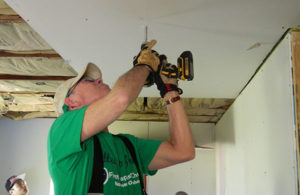
Steve Carter from First Baptist Church in Norman, Okla., installs drywall on the interior ceiling of a storm-damaged home in Refugio. (Photo / Ken Camp)

Ham called friends in the area, and several mentioned Refugio. So, he contacted T. Wayne Price, pastor of First Baptist Church in Refugio.

First Baptist Church sustained $2 million in damage to its facility after winds blew the roof off its sanctuary, Price said. However, First Baptist Church was insured, but a small African-American congregation that Harvey destroyed—Saints Memorial Church of God in Christ—was not.

In December, Ham traveled to Refugio to survey the damage and talk with local leaders.

Price introduced Ham to Darius Robertson, the pastor of that congregation, and he learned Saints Memorial had just completed a long-awaited remodeling project on its facility a short time before the hurricane hit.

Ham promised volunteers from his church would complete the interior demolition of Robertson’s church building and install insulation and drywall.

Introduced to families in need

Price also told Ham about 95 percent of the members of First Baptist Church were affected by the storm, but they were blessed to have insurance.

However, Price knew who would be aware of families in greatest need. Sheriff “Pinky” Gonzales, a member of First Baptist, was coordinating relief and recovery in the county. His wife, Melissa, superintendent for the Refugio school district, would be aware not only of students in need, but also school employees, like Joann Moya.

Gonzales directed Ham to Bayside, a Refugio County community of 325 on the west side of Copano Bay.

“I’d say 90 percent of the residents of the county were affected by the storm. It was close to 100 percent in Bayside,” he said.
Months after the hurricane swept through Bayside, plywood still covers windows, blue tarps remain on roofs and debris still is piled up on roadsides, but red, white and blue “Bayside Strong, Texas Proud” banners fly all over town.

Price also connected Ham to another member of his congregation, Coach Jason Herring, athletic director for the school district and high school football coach.

“This man led the football team to four state championships, but that’s not the most important thing about him. The greatest thing about him is that he loves people,” Price said later.

In the immediate aftermath of the hurricane, Herring worked around the clock to locate students and ensure their safety. He also organized the distribution of donated supplies and helped coordinate rebuilding efforts.

Herring pointed Ham to a single mother with five children who was working hard but struggling financially even before the storm devastated her home.

Return trips from Norman to Refugio County

In mid-January, a crew from First Baptist in Norman journeyed to South Texas to work at Saints Memorial church and begin working on two homes in Refugio. First Baptist Church in Corpus Christi provided lodging for the volunteer group, and the crew worked in close cooperation with Carpenter’s Helpers, a Christian group from Wimberley.

In mid-March, three-dozen volunteers from Norman returned to Refugio County. A Texas couple from Utopia—Bill and Lanell Kellner—who were classmates of Ham’s wife, Lydia, read about the mission trip on Facebook and also volunteered to work with the crew.

In one week, the Oklahoma Baptist volunteers completed five projects, and they delivered supplies to their partners in Refugio.

They gave Robertson more than a dozen boxes of nonperishable food to distribute to members of his congregation and others in need.

They delivered boxes of school supplies for students in the Refugio school district, collected by children in the TeamKID discipleship program at First Baptist in Norman—including a few who helped the crew in Refugio County.

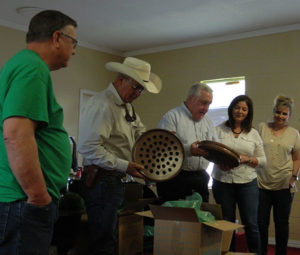
T. Wayne Price (3rd from left), pastor of First Baptist Church in Refugio, and Sheriff “Pinky” Gonzales (2nd from left) react with joy when they receive a new communion set to replace the one destroyed by Hurricane Harvey. (Photo / Ken Camp)

They also presented a set of communion trays and offering plates to First Baptist Church in Refugio to replace the ones destroyed by the hurricane. Price noted the congregation had planned to observe the Lord’s Supper the Sunday after the Norman crew was due to return home, and the church would put the new set of supplies to use.

Turning to Herring—the chief usher at his church—Price also expressed particular delight at the offering plates.

“They’re deep,” he said, with a smile.

‘God has opened the doors’

First Baptist in Norman most likely will return to South Texas for another rebuilding project in the fall after the worst of the summer heat is past.

“I’m looking out for my senior adults,” Ham said. “They’re not used to the humidity down here.”

Assuming a group from the Norman church returns for a third mission trip to Refugio, Ham—who entered vocational ministry at age 42 and “grew up swinging a hammer”—remains confident God will provide the workers.

“They come from all walks of life,” he said, noting the crew in March included retired attorneys, nurses, students and homemakers, as well as a petroleum engineer, a former police officer and a grocery store clerk.

“God has opened up the doors. Every trip, we have enough skilled people to teach those who have never done this kind of work before. Some of the people who had no experience on the first trip are teaching others now,” Ham said.

Most importantly, God has connected the people in Norman with brothers and sisters in Christ whom they never had met before.

“Our people have fallen in love with Refugio,” he said.

Read more articles like this in CommonCall magazine. CommonCall explores issues important to Christians and features inspiring stories about disciples of Jesus living out their faith. An annual subscription is only $24 and comes with two free subscriptions to the Baptist Standard. To subscribe to CommonCall, click here


Americans love VBS, even if they are not usually churchgoers

NASHVILLE, Tenn.—Back in the 1890s, a pair of Sunday school teachers—D.T. Miles of Hopedale, Illinois, and Virginia Hawes of New York City—both had the same idea. School kids were off for the summer. So, why not invite them to church to study the Bible and maybe sing a few songs and have some fun along the way?

The idea was a hit.

Today, Vacation Bible School remains one of the most popular church programs in America. Two-thirds of American parents say they plan to send kids to VBS this summer—even if they skip church themselves.

Six in 10 Americans attended VBS

Six in 10 Americans say they went to VBS growing up. And almost everyone involved had a great time, according to a new survey from Nashville-based LifeWay Research.

“Each week of the summer there are thousands of VBS programs going on around America,” said Scott McConnell, executive director of LifeWay Research. “It’s one of the things that people love about church.”

LifeWay Research surveyed 1,200 American adults about their experience with VBS.

Twenty-two percent say they went every summer growing up, while 14 percent said they went most summers. Another 13 percent went occasionally. Five percent went more than once. Forty percent never went.

Many attended because of a family tie. Forty-two percent say they went to VBS because their family attended that church. Twenty-five percent participated because their parent or another family member was one of the leaders. Twenty-six percent attended because the church was near their home. Twenty-five percent went because a friend invited them.

Precious memories

Among their memories: spending time with kids their own age (46 percent), learning Bible stories (45 percent), singing songs (40 percent), creating crafts (37 percent) and playing games (34 percent).

One in six (17 percent) remember making a spiritual commitment at VBS.

Most (88 percent) say VBS helped them better understand the Bible. That includes two-thirds who either completely (37 percent) or mostly agree (26 percent). Twelve percent disagree.

Among Americans who didn’t go to VBS as a child, 31 percent didn’t go to church at all, 31 percent attended a church that did not offer VBS, 10 percent said they were too busy, and 7 percent weren’t invited. Five percent say their family went to a church that offered VBS, but they weren’t interested in going.

More than half (61 percent) of American adults who did not go to VBS agree they still have some positive thoughts about the program. That includes 28 percent who completely (14 percent) or mostly agree (14 percent). Thirty-three percent slightly agree. Thirty-nine percent disagree.

A majority of Americans (57 percent) who did not go to VBS also believe the program could have helped them better understand the Bible—at least a little. Forty-three percent disagree.

About half (52 percent) agree the program could have affected their spiritual growth. Forty-eight percent disagree.

VBS matters

The survey’s results are a great reminder of why VBS matters, said Jana Magruder, director of LifeWay Kids.

“It’s a strong affirmation of the work that churches put into VBS programs,” said Magruder. “I hope churches are encouraged by this research to continue to host VBS for their communities.”

About half (47 percent) of parents with kids under 19 say their child has been to VBS.

The most common reasons: The family attended the church where the program was held (38 percent) or the parents were also taking part in VBS (33 percent). Twenty-nine percent say they valued their child’s spiritual growth. Twenty-seven percent valued studying the Bible.

A quarter (26 percent) say their child went to VBS because someone—other than family—invited them.

Positive experience

Most parents (95 percent) say VBS was a positive experience for their child. A similar number say VBS helped their child better understand the Bible (94 percent) and influenced their child’s spiritual growth (95 percent). Most (95 percent) also say that VBS is one of their child’s most meaningful church experiences.

Among the reasons parents didn’t send kids to VBS: The family didn’t go to church (29 percent), the family was too busy (14 percent) or the child was too busy (13 percent).

Still, parents who didn’t send their kids to VBS have a positive view of the program (83 percent) and say it would have helped their child better understand the Bible (69 percent) or grow spiritually (71 percent).

Two-thirds of parents say children likely to attend VBS

This summer, Vacation Bible Schools may be packed again, according to LifeWay.

Two-thirds of parents (64 percent) say their child is likely to go to VBS this year—including about half who completely (29 percent) or mostly (18 percent) agree. A third (36 percent) disagree.

More than half (58 percent) say their child may go to more than one VBS. Forty-two percent disagree.

“Two-thirds of American parents are eager to send their children to a church activity where they will have fun experiences centered on what churches care about most—Bible stories, the gospel and worship,” Magruder said.

Many parents say they’ll send their kids to VBS even if it’s held at someone else’s church. Sixty percent say they will encourage their child to attend a VBS program at a church where the parent does not attend services.

More parents will encourage their child to attend VBS at another church if a friend invites them (69 percent).

“People still believe Vacation Bible School is good for kids,” McConnell said. “Even parents who don’t go to church want their kids to go to VBS.”

A demographically balanced online panel was used for interviewing American adults. LifeWay Kids sponsored the study.

The survey was conducted March 7-10, 2018. Analysts used quotas and slight weights to balance gender, age, ethnicity, education and region. The completed sample is 1,200 surveys, which provides 95 percent confidence the sampling error from the online panel does not exceed plus or minus 3 percentage points. This margin of error accounts for the effect of weighting. Margins of error are higher in sub-groups.


Commentary: An open letter to the SBC

Dear SBC (Southern Baptist Convention),

I spent this morning praying, asking God to please reveal Himself to the people I love, entreating Him to sift me, confessing my sins and thanking Him over and over again for His grace and mercy. I write this while on vacation, burdened again by difficult news coming from within our ranks.

I wakened with a sort of undecorated, plain grief, a kind of gray feeling that is worn out of hoping. I reprimand myself in times like these because hope is radical, and it is real, and as I spend every day reading the book of Romans in preparation for a book I’m writing, I know hope is one of the most assured and beautiful words in the Gospel. Hope does not disappoint, yes, but perhaps it’s better stated that my expectations are tired.

You already know this, but I am a woman. I am a wife to a man who empowers me and a mother to three world-challenging and world-changing adult children. I attend a large SBC church, and I am utterly grateful for the opportunities afforded me there. So my angst is not with them. Instead it’s directed toward the structures built within this denomination that have seemingly been bent toward preserving reputation and circling the wagons rather than authentic, biblical repentance when it comes to the treatment of women.

I don’t need to rehash what others have eloquently stated. But I can say this: I know I am one woman in a large denomination. I know there are many more noble and studied women in my midst. I don’t speak for all women; I simply speak for me. I also know this: I am flawed. I grew up longing to be noticed, so Jesus continues to redirect that childhood desire toward Him. While I don’t always live for an audience of One, I hope and pray that my life moves more and more toward that aspiration.

So I understand that being overlooked, unheard, dismissed, and relegated are hard for me. I have a prayer team that helps me sort through this, and they’ve been with me since before I published my first book.

When I emote online, when I write blog posts about the absolute devastation of sexual abuse (one of Satan’s greatest weapons against us all), when I speak up in cases of abuse of power within the church with its dismissal of victims and cover up of perpetrators and those who enable them, it is with this limping, this fear: that somehow my words would be about me and not about the issue. But the bigger fear which ultimately makes me click publish is this: that those who have been marginalized, dismissed, silenced, demeaned, made fun of, or called shrill would know that they are not alone.

Women make up more than half of all SBC churches. We love, serve, teach (in sometimes limited settings), pray, and help others. We see injustices and speak up. We make up a significant percentage of missionaries overseas. Yet we are often underrepresented in positions of leadership, influence, and service. While we all possess voices, many times those voices are dismissed or diminished.

Women, like men, are gifted by the Holy Spirit to serve the body of Christ. I believe we do better together rather than segregated into overly straight-jacketed roles. In Paul’s closing to Romans, he lists a significant amount of women (10)  holding various positions. He lauds them, encourages them. Consider Phoebe and Priscilla in Romans 16:1-5:

I commend to you our sister Phoebe, who is a deacon in the church in Cenchrea. Welcome her in the Lord as one who is worthy of honor among God’s people. Help her in whatever she needs, for she has been helpful to many, and especially to me. Give my greetings to Priscilla and Aquila, my co-workers in the ministry of Christ Jesus. In fact, they once risked their lives for me. I am thankful to them, and so are all the Gentile churches.Also give my greetings to the church that meets in their home.

I would love to be able to say my denomination welcomes each woman “in the Lord as one who is worthy of honor among God’s people.” But after the past several months and years, the very public stances the SBC has taken reveals more disregard, far less honor. In light of all that, it’s my ardent prayer that the SBC leadership would collectively hit their knees, continue to seek God earnestly, and open-heartedly listen to the women in their midst–as fellow image bearers of the One true God.

I would love to see the SBC become a denomination where:

  • All people felt safe in approaching their leadership about sexual assault or domestic violence, knowing that their leadership will report it to the authorities as required by law.
  • Similarly, domestic violence, sexual assault, sexual harassment would all be seen not simply as sins to be dealt with within our ranks, but crimes, best dealt with by the criminal justice system. (Romans 13 comes to mind).
  • Public statements by PR firms, carefully crafted toward reputation preservation, would be replaced by genuine repentance and a plea for forgiveness when members are harmed or wronged by leadership.
  • Women have a voice and are no longer dismissed, stereotyped, or relegated to sub-committees. Instead, they felt heard, dignified, and empowered.
  • Sexual predators are no longer given cheap and instant grace, and survivors are no longer harshly scrutinized, silenced, and callously told to forgive quickly.
  • Truth would be welcomed, no matter how difficult. (I believe our fear of ruining Christ’s reputation, or perhaps better said, mess with our bottom line, is unfounded. The world would welcome transparency and repentance far more than it tolerates our fearful coverups. For instance, if a church wrote something like “We discovered sexual misconduct, reported it, and are deeply sorry for the harm it has caused. In light of that, we are cooperating with authorities, and we’re working on solutions to provide counseling and help for the victims,” I believe many would stand and cheer. But as it is, we are deserving the world’s deeply entrenched mockery for our continued insistence on cover up, glossing over, and our unique ability to honor those (sometimes with standing ovations) who preyed on the innocent. I believe these words from Paul, though deeply sobering, are for the church today: “For, as it is written, “The name of God is blasphemed among the Gentiles because of you” (Romans 2:24).)
  • Political power is no longer curried, but viewed with a Jesus-like skepticism. That we would embrace the beautiful truth that life change happens in small places through a paradoxical weak-is-strong kingdom.
  • The Gospels would be revisited, particularly the Sermon on the Mount where we see the beautiful dynamic of the least being the greatest. That we would look again at Jesus who went out of his way to listen to and heal the masses, the hurting, the least, those living in the outskirts. May we be known as a church who loves the broken, welcomes the downtrodden, and winsomely stands against injustice–no matter how it may “harm” our reputation.
  • The SBC convention in June featured more than 12 minutes of women’s voices from the platform, though I know that the schedule has been fixed.

I love my church. I love serving within its ranks. I am grateful to have had the opportunity as a communicator to author dozens of books, pray for many on my daily prayer podcast, and speak up for the broken–all while being encouraged by the leadership of my SBC church. So my letter isn’t meant to be mean spirited or punitive. Instead, my prayer is that we can see the recent news events as a wake up call from the Lord to reevaluate our hearts, listen to those who have left the church in anguish, and seek to be people of justice and mercy in a world in extreme need of both.

Praying,

Mary DeMuth

Mary DeMuth is the author of over 30 books and is a podcaster (Pray Every Day) and international speaker. A sexual abuse survivor, she often advocates for the broken and marginalized. She makes her home in Rockwall, Texas, where her husband Patrick serves as an elder at Lake Pointe Church. Married 28 years, they have three adult children.

This article originally appeared on Mary DeMuth’s website and does not necessarily represent the views of the Baptist Standard.


Commentary: The tale of two presidents at Southwestern Baptist Theological Seminary

Southwestern Baptist Theological Seminary, a Southern Baptist Convention seminary in Fort Worth, Texas, has relieved President Paige Patterson of his responsibilities.

Patterson’s status has been in question for weeks after reports surfaced that years ago he advised an abused woman to remain with her husband and forgive him.

Although he initially stood by his actions, Patterson later issued an apology and SWBTS’s Board of Trustees scheduled a special meeting after a letter, signed by thousands of Southern Baptists, was published that condemned Patterson’s actions, comments and ideology.

On Tuesday, while SWBTS trustees were meeting, The Washington Post reported on allegations that Patterson, then serving as president at Southeastern Baptist Theological Seminary in North Carolina, told a student who had informed SBTS administrators she had been raped not to report it to the police and to forgive the alleged assailant.

Early Wednesday morning, trustees officially removed Patterson from leadership and released a statement regarding his status.

Yet, according to The Washington Post, SWBTS has provided him with a lucrative compensation package that includes housing accommodation on campus and the titles “theologian-in-residence” and “president emeritus.”

In the spring of 1994, I was on the campus of SWBTS as an aspiring student.

Growing up in very conservative churches in Oklahoma, I was astounded at the high level of education I was receiving from professors under the leadership of then president, Russell H. Dilday.

President Dilday was a well-respected leader and theologian that had a great rapport with students and admiration from the seminary faculty. Entering into my spring semester as a first-year seminary student, I was happy with my decision to attend Southwestern.

Then, everything changed when the trustees arrived on campus.

During their annual meeting, trustees gave Dilday a vote of confidence as seminary president. However, the next day those same trustees voted to fire Dilday for not offering enough support for a fundamentalist takeover of the Southern Baptist Convention.

As they voted to fire Dilday, they locked the doors of his office, escorted him to the president’s house with armed guards, and prohibited him from walking anywhere on campus. They treated him as a criminal whose crime was not being conservative enough in their eyes.

For those still confused about what the Southern Baptist’s wars were all about, you are now seeing first-hand the dark shadow moderate-conservatives, moderates and progressives saw rising from those who gained power in the Southern Baptist Convention.

Using the Bible as a tool to gain control over others, Patterson and other Southern Baptists leaders blatantly lied and misrepresented the truth about faithful Baptists in their quest for power and privilege. Nothing would stop their aspirations of reaching the highest levels of authority within the world’s largest Protestant denomination.

Once the Southern Baptist Convention was taken over by right-wing conservatives, they quickly began to put their “theological” convictions into practice.

While numerous issues were touted — such as biblical inerrancy, marriage between a man and woman, pastoral authority, and breaking down the wall of separation between church and state — the one issue that seemed to be at the forefront of the SBC’s predominately-male leadership was the submission of females to male authority.

Time and time again, Southern Baptist men passed motions and implemented policies that demeaned women and categorized them as second-class citizens in the kingdom of God.

From wives submitting to their husbands to women not being allowed to teach men, Southern Baptist leaders have waged war on women over the last four decades. In Southern Baptist seminaries, women professors have been fired and not granted tenure based merely on their gender and skewed interpretations of a few biblical texts.

Therefore, when the news broke about Patterson’s departure at Southwestern, I could not help but think back to that spring semester when I witnessed the evils of right-wing conservative theology on display.

While one of the kindest and thoughtful Christian men to ever walk on the campus of Southwestern was treated as a criminal for not being “conservative” enough, Patterson was ushered out the door with a golden parachute. Apparently, for Southern Baptist leaders, it pays well to keep the party line and keep women in their place.

As an alumnus (MDivBL, ’97) of SWBTS, I am appalled and ashamed of the actions the trustees took towards Patterson this week. While his removal as president was appropriate, the message trustees sent with the exit package they provided was crystal clear.

As far as Southern Baptist leaders are concerned, the reputation and well-being of their male leaders far outweigh the rights and lives of abused women everywhere, statements about condemning “all forms of abuse” notwithstanding.

Southern Baptists must correct this evil course they find themselves on today.

With stories like these, evil ideas and practices are warping the message of the gospel — the message of Jesus that seeks to liberate, protect and give salvation to every victim of sinful abuse.

When I read the Gospels, I am quite confident Jesus would have been ministering to the abused women and condemning the male leaders for their sinful behaviors.

For the sake of abused women everywhere — especially those suffering at the hands and oversight of Baptist leaders — I pray a groundswell of Baptists follow the words and actions of Jesus.

Faithful Baptists of all types — conservatives, moderates and progressives — need to rise up, condemn these actions, and demand equality for all people.

Baptists can no longer let misogyny be an acceptable theological practice. We must demand more from our leaders and champion an egalitarian theology that empowers all Baptists.

Mitch Randall is executive director of EthicsDaily.com. You can follow him on Twitter @rmitchrandall. This article originally appeared at EthicsDaily.com and has been reprinted with permission of the author.


Voices: Are thoughts and prayers enough?

We are only 20 weeks into 2018, and there have already been 22 school shootings in America.

Twenty-two occasions of parents across the country breathing a sigh of relief that it wasn’t their kid’s school this time while others are forced to mourn the loss of their children.

In less than six months, there have been 22 opportunities for our elected officials to offer their thoughts and prayers.

I don’t know what the victims were doing the day before, but I do know they will never get to do it again. Next year, when my boys are on the soccer field running around with their friends again, these children will still be dead. Those who survived these shootings will never be the same.

I write this as a Christian, and while I hope everyone will read it, I admit I am writing specifically to those who throw themselves at the foot of the cross alongside me.

When will it be enough?

When will we demand more of our leadership beyond their thoughts and prayers? When will we demand they put their faith into action?

As Christians, we know we live in a broken world, and we know the power of prayer. But we also know the dangers of speaking with forked tongues; because of our faith, we should know the dangerous nature of hypocrisy. James warned us in his book that faith without works is dead.

Let our faith reveal itself in our good works.

Who can blame the world for their anger at our proclamation of thoughts and prayers? We feed the hopelessness the world feels when we respond with words but without actions. With 58 dead in Las Vegas, 26 in Sutherland Springs, four in Rancho Tehama, and two in Aztec, I pray that the next time this happens, and it will happen again, we put our faith into action.

While it is unrealistic to take away people’s guns, something must be done. Let’s start by putting our faith, and words, into action.

When will we act?

Thoughts and prayers are easy; convictions and actions are difficult. I plead for the leadership of our country to stop weaponizing our faith through simple platitudes and, instead, put faith into action. I call on the church to ask itself what it will finally take for us to hold ourselves and our elected officials accountable.

Do we speak with apathy or with healing (Proverbs 12:18)?

Pastor Rick Warren notes, “What you say has a direct connection to your heart.” But he takes it one step further: “God’s warning for talkers is this: You also have to act.”

James warns us in chapter three about the power of the tongue and the dangerous temptation of speaking without thinking or out of turn. Evidence of spiritual maturity can be identified by one’s use of the tongue. Spiritual growth and maturity is not optional but can be ignored at our own peril (1 Peter 2:1–3).

Theologian Sinclair Ferguson states it plainly: “How easily the failure to master the tongue can destroy the effect of every grace that had taken years to build into our lives! Introduce poison here and we endanger everything.”

How many more children have to get shot before we refuse to allow this sort of godlessness to rule us no more? This goes beyond gun control or any single policy issue. My concern is with the witness of the church and its body.

Sin is failure to do what one knows he should do (James 4:17). Sinful actions and, more pertinent to our reflexive response of thoughts and prayers, non-actions are to be forsaken. Let us refuse to poison the grace of God no more.

Let us not love with just words or speech but also with actions and in truth.

Smith Getterman lives in Waco, Texas, with his wife and two sons. He holds a BA and MA from Baylor University and an MTS from Dallas Baptist University. You can find him on Twitter @getterman or by email at sgetterman@gmail.com.