Voices: A man one dark night

It was dark as I headed to church one recent Wednesday evening. Traffic was heavy. Pedestrians were hard to see, crossing between cars, so I focused.

At the Westheimer and Dairy Ashford intersection for my turn-off, I was about five cars back from the traffic light. I could barely make out on the median a man with a cup and some sort of paper in his hand. He had a bucket to sit on, though at the moment, he was walking down the median, car to car, looking into each driver’s window soliciting for help.

The man was dressed in a pair of jeans, a pull-over shirt, a jacket and athletic shoes. There in the dark of night, in a not-so-safe and very busy intersection near 7 p.m., he was doing what he could to survive.

He came to my window, but I looked straight ahead. I pacified myself with the thought we help people like this man every day in our church.

As he moved down the median, I watched him in my mirror. The darkness cloaked his presence. I could make out his outline and shoes, nothing more.

His beginnings

I thought of this man’s beginning. He looked about 40 years old. I wondered about the day his mom gave him birth. I am sure it was in a hospital. I imagine the greatest care was given to him and his mom.

I would not doubt a dad was somewhere nearby waiting with nervous expectation. Maybe a dad wasn’t there. Maybe his mother decided, in the father’s neglectful absence, she’d brave the task of raising a child alone. Maybe the woman’s mother was there for her, or a sister or a friend.

Let’s say it was on a March 5th when the woman gave birth to this man who is now making his way back toward my truck after exhaustingly searching for help from every car awaiting the light to change.

After she gave birth to a baby boy, she held him. She caressed him. Perhaps she even prayed for him and his future. She wondered what his life would be like, what theirs together might face.

I would imagine she was full of hope, even if she faced the harshest of realities. She had dreams for this baby son she held in her arms, all wrapped in the warm white and green-striped blanket, wearing a little blue onesie the hospital provided along with a little blue cap for his tiny head.

The mom soon would take him to her bare apartment. Again, maybe the proud daddy was in tow. Maybe not. The little boy would speak his first words, take his first steps, enter his first day of school. He would be in school choirs, play on school sports teams and go on school field trips with his classmates.

His present

I could not help but stare at the man with the cup and a piece of paper, in a pair of jeans, a pull-over shirt, a jacket and sports shoes.

I was struck with the question: “Is this what this mother envisioned for her son? Did she imagine him being homeless with no hope, no job, no one to lean on, depending on the kindness of strangers for each day’s sustenance?”

Just then, someone rolled down their window and handed him a bottle of water.

Walking back to his spot at the head of the intersection, the light turned green before I could give him the only dollar I had on me.

I drove forward heading to church, looking in my rearview mirror in the dark at the man I did not help.

What caused him to be in this situation? Was it a bad break or a bad choice. Was he raised in a home or put out as a teen? Were drugs involved or some mental illness? I prayed for him, but this seemed empty.

His presence

I was running late for church. I tried to justify not helping, but this did me no good. God gave me a story, a picture, a visible need, and I drove by. How could I face our church family and listen to Pastor Seye lead our Bible study, knowing I left a man without giving aid?

Do you know what? I turned my truck around. I got back into that traffic on Westheimer, first going in the opposite direction of church, then U-turning so I could get back in line for the light.

I wondered if the man would be there or if he had been an angel God used to test me. I prayed he was a man and still there. He was.

As he made his walk to my truck seven cars from the light, I rolled down my window immediately, waiting. I had my dollar bill in my left hand. When he came to my truck, I held it out.

He took it and said: “Thank you. God bless you.”

He made his way down the median in the dark of night.

The next morning, the Christian radio station I listen to played a new song called “Looking Up.” The song told of a homeless guy on a median in the dark, who was out of luck and had no way out but looking up to the God who cares.

My encounter was no accident. I pray we see with the eyes of God.

Johnny Teague is the senior pastor of Church at the Cross in West Houston and the author of several books, including his newest The Lost Diary of Mary Magdalene. The views expressed in this opinion article are those of the author.



Voices: Unintended consequences and rural life

I arrived in Muleshoe in 1991 at age 28. The changes to rural Texas have been drastic and rapid. Many of those changes impact both rural and urban areas.

For instance, demographic shifts, declining volunteerism, political division and religious disinterest impact all of society. However, some changes are unique to rural life. Many of these changes are unintended consequences.

Unintended consequences arise from societal choices, legislation, technological advances and more. They may be positive, neutral or negative.

For instance, the invention and proliferation of the cell phone enabled greater freedom in communication and data. An unintended consequence was the loss of privacy.

As Lee Child wrote: “Imagine the uproar if the Federal government tried to make everyone wear a radio transmitter around their neck so we can keep track of their movements. But people happily carry their cell phones in their purses and pockets” (A Wanted Man).

Unintended consequences come in all shapes and sizes.

I want to give you a small sample of the effects of unintended consequences faced in rural living. The issues I describe are not unique to rural Texas, but to rural America.

Speed

I am grateful for the 75 mph speed limit. Most of my hospital visits are 70 miles to the southeast and 100 miles to the northeast. I remember making those trips at 55 mph.

Sen. Phil Gramm argued in favor of raising the speed limit: “Most people traveling from Dallas to Lubbock give up before they get there.”

I am thankful for the additional speed. Higher speed limits allow people and goods to move from population center to population center more quickly. However, the 75 mph speed limit had unintended consequences that radically reshaped rural living.

The 75 mph speed limit allows people to live in urban areas but make a rural living. Farmers and dairymen now can live 100 miles or more from their land. Their families gain the advantage of a variety of shopping and dining, easier access to medical care, private school choices, access to university events and more.

However, a rural community deeply feels the loss of every family that moves to the city. The school system loses good students and involved parents, merchants lose valuable customers and churches lose good members. The 75 mph speed limit enables all of it.

Mechanization

When rural America was settled, there was a family on every 40 acres. As mechanized farming gained traction, fewer people were required to farm the same number of acres. Since the 1960s, the size and scope of farm implements have grown exponentially.

Before performing a funeral in a rural community, a proud deacon gave me a tour of their facility.

“This church was overbuilt the day it was completed. Eight-row equipment changed this part of the country,” he said.

Today, farmers use 24-row equipment. Satellite and cellular technology enable farmers to manage sprinkler systems from anywhere, allowing farmers to live away from their land.

The advances in agriculture feed and clothe billions of people but require fewer workers. Factory and dock workers worry about losing jobs to automation. Those unintended consequences came to the farm decades ago.

Health care

A topic too complicated for this brief article is rural health care. The perils of rural health care are covered extensively in regional and national media.

Rural hospitals struggle daily to provide care and cover expenses. The health professionals who serve rural patients are to be commended for their dedication.

Education

The Texas state legislature is debating a policy called “school choice.” For the last few years, the rural legislators have taken the blame for gumming up the works and denying “school choice.”

Rural school systems will feel the changes in student enrollment quickly. Rural districts are concerned by the potential loss of a valued student and a loss in funding. Every remaining student will feel that loss.

In a city filled with 6-A school systems, there might appear to be an endless supply of students to accommodate every educational circumstance. But in rural America, where every student makes a difference and contributes to the life of the school, the “school choice” debate is personal and will be filled with unintended consequences.

Community

I never would suggest rural challenges are more significant than urban challenges. They’re simply different.

If you gather rural pastors, they will speak of these issues and others. There is a strong commitment and calling among rural pastors. Christ is neither an urban nor rural Savior.

As I write this, I plan to have dinner with a young couple creating a path in the cattle industry. Their life choices are rural choices. They will raise and educate their children, encourage others and serve their Lord in our community. Our job is to ensure they have the fellowship of a Texas Baptist church that nurtures them along the way.

One unintended consequence of their choice is they never will be required to leave early because of the traffic. They may leave early because of snow, but never traffic.

Stacy Conner is pastor of First Baptist Church in Muleshoe. The views expressed in this opinion article are those of the author.


Voices: A slap in the face to sex abuse survivors

For the past few years, I have followed the developments within the Southern Baptist Convention as we have investigated allegations of sexual abuse and cover-up within our convention. To say I have very mixed and very strong feelings about it all would be a profound understatement.

However, I was encouraged to learn recently the Department of Justice closed its investigation into the SBC’s Executive Committee and other entities without filing any further charges than those brought against Matthew Queen.

Unfortunately, I was shocked and disgusted by some of the public comments I saw from prominent Southern Baptists in the wake of this news.

For example, Denny Burk, a professor at Southern Seminary, said: “So here’s the bottom line on the SBC abuse ‘crisis.’ There wasn’t one.”

Screen shot of Denny Burk’s response on social media to the DOJ dropping its investigation of the SBC’s handling of sexual abuse.

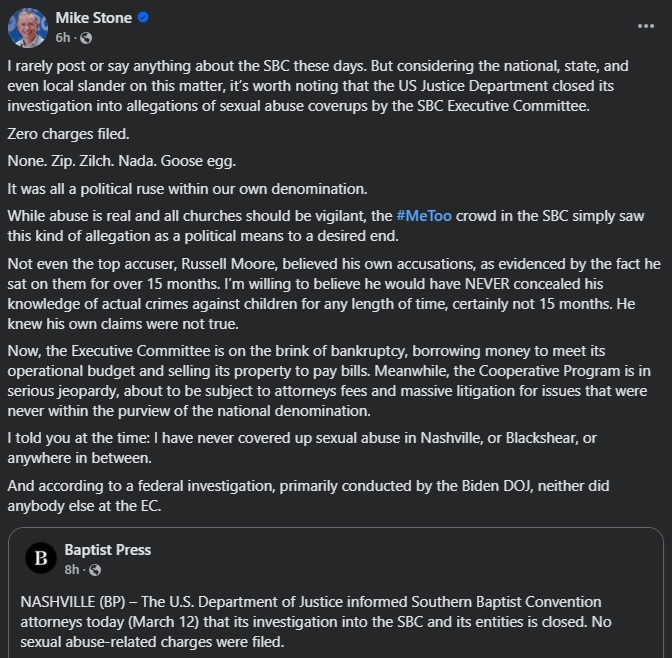
Pastor and former Executive Committee chairman Mike Stone said, “It was all a political ruse within our own denomination.”

Screen shot of Mike Stone’s response on social media to the DOJ dropping its investigation of the SBC’s handling of sexual abuse.

That was not all they said, and they were not the only ones who said it. But you get the idea. Numerous individuals jumped onto the internet to publicly declare there really never has been a sex abuse crisis within the SBC, and it was all just a bogus scandal engineered by leftists and liberals within the convention.

To be frank, these remarks are shockingly ignorant at best and outright dishonest at worst, and they are a slap in the face to sex abuse survivors, both within the SBC and beyond.

The scope of the DOJ investigation

It is bizarre that anyone would think the Department of Justice closing its investigation represents anything like an exoneration of the SBC regarding sexual abuse and cover-ups.

The DOJ investigates violations of federal law. The DOJ does not have jurisdiction over state or local crimes, and the DOJ does not bring charges against actions which are not illegal. The SBC became the subject of a DOJ investigation to see if there was any violation of federal law.

Most cases of sexual abuse are not federal crimes. Most cases of sexual abuse cover-up are not federal crimes. They can be federal crimes under certain circumstances, but they are not such automatically. The fact the DOJ brought no charges against the SBC or its entities does not mean no crimes were committed. It simply means no federal crimes were committed.

But even more importantly, many of the ways in which SBC leaders were accused of mishandling sexual abuse allegations and mistreating survivors were not illegal at all.

The most prominent example is probably Augie Boto, former Executive Committee general counsel, who has been accused of suppressing sexual abuse allegations and attacking sexual abuse survivors in ways which, while morally reprehensible, are (to my knowledge) not technically criminal.

The DOJ closing its investigation into the SBC is not an exoneration from anything except federal crimes. That’s it.

The money problem

One of the biggest complaints many Southern Baptists have expressed over this whole process has been legal expenses. The Executive Committee has spent more than $13 million on legal fees and other costs related to the sexual abuse investigation. This has left the committee nearly bankrupt and may force them to use Cooperative Program dollars to pay those bills.

Southern Baptists who faithfully give money to the Cooperative Program understandably are dismayed at the idea their gifts will be used, not for missions and ministry, but for paying legal fees.

However, critics of the sexual abuse investigation have sought to discredit the investigation because of these mounting legal bills. After calling the investigation a “political ruse,” Mike Stone continues: “Now, the Executive Committee is on the brink of bankruptcy … [and] the Cooperative Program is in serious jeopardy.”

Stone and others are saying the sexual abuse investigation was a waste of time and money, and that supporters of the investigation—such as Russell Moore—are responsible at least partially for the convention’s financial woes.

But you know who Stone doesn’t mention? Johnny Hunt or David Sills. Both men are suing the SBC and are responsible for millions of dollars of those legal fees threatening to bankrupt the Executive Committee.

Why are Hunt and Sills suing the convention? After all, both men have admitted to committing sexual misconduct. But they claim their sexual sins were consensual. Therefore, Hunt and Sills are suing the SBC—and GuidePost Solutions—for defamation, since both groups publicly called Hunt and Sills’ sins sexual abuse.

You read that right: Two self-admitted adulterers (and accused sexual abusers) are suing their fellow Southern Baptists (1 Corinthians 6, anyone?) for accusing them of sexual abuse. And that is a major reason for the Executive Committee’s financial woes. But somehow, those financial woes actually are Russell Moore’s fault?

A standard smear tactic

I have noticed a common tactic in many of the public attacks leveled against the SBC’s sexual abuse investigation—accusations of “liberalism.” I’m not sure if these critics mean political or theological liberalism, but they most likely mean a mix of both.

This is just a standard smear tactic certain activists like to use when they have nothing of substance to say. Make no mistake, I believe there are legitimate, substantive criticisms to be offered regarding how the SBC has handled this investigation. But throwing around accusations of “liberalism” and “Marxism” is pure nonsense.

Terms like those have become essentially meaningless, particularly in SBC circles of late. The idea any major figure in the SBC truly is liberal—in either the political or theological sense—is absolutely laughable. And that’s exactly the response such accusations deserve—laughter.

The SBC has plenty of flaws, both theologically and politically. I think some within the SBC are too lax on certain matters of doctrine and ethics. But that’s a different essay. However, there is nothing—absolutely nothing—inherently “liberal” in opposing sexual abuse and standing up for victims.

The SBC sexual abuse investigation is not above criticism, but to label the Southern Baptists who initiated and support the investigation as “liberals” or “leftists” is simply crazy. Such accusations belie an emotionally immature and intellectually vapid approach to debate that deserves no respect from anyone, let alone Southern Baptists.

And it is a slap in the face to survivors of sexual abuse everywhere.

Joshua Sharp is the senior pastor of First Baptist Church in Chappell Hill, and a graduate of Southwest Baptist University in Bolivar, Mo., and Baylor University’s Truett Theological Seminary in Waco. The views expressed in this opinion article are those of the author.


Voices: Why my church gave up on Annie’s offering

Annie Armstrong, a historical figure in Southern Baptist life largely responsible for the creation of the Woman’s Missionary Union and known for cooperative missions, has an offering named after her that supports the work of the North American Mission Board.

She is credited with blazing a path for women to serve in the Southern Baptist Convention when our society did not allow women to vote, and notably gained support for two of the first Black female missionaries.

For this reason, I took notice when news was shared that NAMB will continue to be exclusive in its distribution of its offering funds in Texas, only allowing them to be utilized by churches willing to plant other churches that affirm the Baptist Faith & Message 2000.

Exclusivity in sharing the gospel is not part of Annie’s legacy, and I find it difficult to imagine her being pleased with this situation.

NAMB’s theological position notwithstanding, you can be sure many gave what once was considered sound biblical and theological reasoning to oppose Annie’s work to include women as both missionaries and organizers of mission work.

Over time, however, these secondary theological issues took a backseat to the primacy of gospel cooperation in a previous era of SBC history.

Today, I serve a conservative, cooperative, autonomous Texas Baptist church that recently voted to cease giving to the Annie Armstrong Easter Offering due to NAMB’s continued insistence my church’s values be excluded in its church-planting partnerships.

On being conservative

While many associate conservatism with numerous ideas and movements, when used in a positive sense in Baptist life, it typically is associated with theological orthodoxy and a prioritizing of the Bible.

Before I was called to my current church, they went through a two-year, intentional-interim period in which they identified “Bible-teaching, preaching, and practicing” as one of their core values. From this value comes a self-identified mission “to serve, evangelize, and disciple individuals while loving God, and loving others.”

For us, a large part of being conservative is to prioritize the Great Commission and the Great Commandment.

When being interviewed by the search committee, I was “grilled” by the oldest member of the group, a matriarch of the church, about which version of the BFM I affirmed.

I told her I affirmed the 1963 BFM for three reasons:

1. Unlike the 2000 BFM, the 1963 BFM does not purport itself to be an instrument of doctrinal accountability.

2. The 1963 BFM favors a Christocentric view of Scripture, which more naturally lends itself to a prioritizing of the Great Commission and Great Commandment.

3. And the 1963 BFM does not seek to tell churches who they can or cannot call as pastors in fulfilling the Great Commission.

She responded, “That’s what I needed to hear.”

On being cooperative

Does this mean our church is ready to hire a female as its next pastor, since the 1963 BFM does not prohibit doing so? Likely, not. We do not even have female deacons at this point.

We reflect the typical, traditional values you would expect in a small-town, county-seat community.

We do not largely think of ourselves as “progressive,” nor do we strive to “rock-the-boat” on most theological or political issues.

That being said, when push comes to shove, we value and protect the importance of cooperation due to our history and how we have seen God use this value in our midst.

We have had members serve and support Texans on Mission—formerly Texas Baptists Men—short-term mission teams across denominational lines, and individual missionaries and organizations without worrying about whether we were in full agreement on secondary issues, because we were confident in our unity in the gospel.

Perhaps, we understand this most intimately and regularly on a local level, where we get the privilege of being a “community church” that not only connects with numerous kids and youth from non-churched backgrounds during our mid-week programming, but also utilizes and welcomes volunteers from other gospel-oriented churches in sharing Jesus with them.

In an effort to celebrate this cooperation, I have “pulpit-swapped” with the pastor of our local Methodist church and even allowed him to baptize—by immersion, in the Llano River—a child whose family attends our church, since she received Christ at camp with him.

On being autonomous

Autonomy is a buzz word in Baptist life, but the profile that described my church to me as a potential applicant demonstrated it was much more to our people. While the profile recognized the spiritual leadership and call of the pastor, it also affirmed the role of committees and other groups and individuals in bringing decisions before the church during conference.

As if this did not make it clear enough, the profile summarized and clarified their intent by affirming: “We are committed to congregational church governance.”

For reasons outside the purview of this article, autonomy can be overlooked and compromised in Baptist churches. Whether in an effort to “kowtow” to the charismatic personality or authoritarian demands of a dynamic pastor, or in the name of efficiency and relevancy, processes and systems that promote autonomy under the lordship of Christ sometimes are done away with in an effort to “get things done.”

If my congregation is not willing to sacrifice the value of autonomy in its ordinary operations, it most certainly will not stand for it from a denominational entity.

My conservative, cooperative, autonomous church gave up on Annie’s offering because NAMB gave up on the spirit of Annie’s legacy.

Matt Richard is pastor of First Baptist Church in Llano.


Voices: Baptists, baptism and open membership

The Smith family has decided to join your church. They’re already in Sunday school and involved with various ministries. They even have participated in the Lord’s Supper since your church is seeker-friendly.

However, when applying for membership, it comes to light Mr. Smith was baptized as an infant. Even when he had a born-again experience in college, where he met the soon-to-be Mrs. Smith, a Baptist, he didn’t feel right about receiving what he considered to be a “re-baptism.”

The question now is, should Mr. Smith be accepted as a member? Or will he be listed under “watch-care” while his family joins as full members?

Closed vs. open membership

Traditionally, most Baptist churches have insisted on a believers’ church, that is, a church made up only of those who have received a believer’s baptism by immersion. This view is called the “closed membership” position.

I, however, have become convinced Baptist churches should adopt the “open membership” position. This view assumes a church can accept members based on their professions of faith, even if they were baptized in another mode.

To be clear, these open-membership Baptist churches still only perform full-immersion baptisms for professing believers. In other words, if you were baptized as an infant, they can accept you as a member, but if you, as a member, ask them to baptize your infant or baptize someone by pouring, they will refuse.

Baptists can remain firm on the commitment to administering believer’s baptism, even when taking a charitable stance in accepting Christians who practice things differently.

Exceptions to tradition

We also should admit even traditional Baptists allow for exceptions when it comes to baptism. Consider, for instance, the scenario of a hospital deathbed conversion: The individual requests baptism, but immersion is impossible.

While in seminary, I took a course taught at a Baptist school by a Baptist minister and was presented with this case and instructed to administer baptism by pouring. Why? Because the pastoral call to care for this individual’s unique need outweighs the “proper” way to baptize.

That same Baptist minister in that same Baptist course told us about tragic cases of infant mortality, where parents request their baby be baptized. In such a case, my professor instructed us to baptize the child, because the spiritual need is urgent and so a pastoral response is required.

Is that the “correct” kind of baptism? Is it “ideal”? No, but nothing about this situation is ideal. In fact, in cases where pastoral care is most needed, the situation is often least ideal.

One of the earliest Christian texts to address the issue of baptism, other than the New Testament, is a work written around A.D. 95 called the Didache. One section explains how to baptize, which is by full immersion.

Then, the text discusses another way that is not ideal, but is acceptable: If there is not enough water for immersion, one is allowed to pour water over the head. It does not specify when this is allowed or what circumstances would prohibit having enough water. The Didache is likely from Syria, so we may be talking about a desert context.

The point, of course, is in extenuating circumstances, pastors sometimes must make exceptions.

Baptism through church history

In the centuries that followed, Christians also began to allow infant baptism, apparently because of cases of infant mortality. But for hundreds of years, the norm still was full immersion for professing believers.

As the Mediterranean world became thoroughly Christianized and as infant mortality continued to rise in the Middle Ages, more parents requested their babies be baptized in this admittedly less-than-ideal way.

Let’s just say the situation became problematic with generations of Christians baptized as infants. In fact, no one even questioned the practice until the “Radical” part of the Reformation. And when they did, Baptists had to defend believer’s baptism courageously in order to establish a believers’ church—as opposed to a church of merely nominal Christians.

Even then, the earliest Baptists, like John Smyth, practiced “believer’s baptism” by pouring instead of immersion.

So, while it is true many in the so-called Anabaptist tradition died as martyrs because they insisted on reclaiming the New Testament ideal, today, with that ideal firmly established, it is time to re-assess how a believers’ church can make exceptions and incorporate members from other traditions.

Fifteen years ago, Curtis Freeman argued in favor of open membership (see also his 2014 Contesting Catholicity). Curtis is a Texan, a lifelong Baptist and a scholar whose work I admire.

I suspect Curtis’s experience in and commitment to interdenominational dialogue likely has a big part to play in his views. I sympathize with that motive, but to be clear, I am addressing this matter from a different angle.

Aligning belief and practice

I have served several churches on their pastoral staff, as interim pastor, guest preacher, teacher and consultant. Many churches are struggling with the issue of incorporating believers who come from paedobaptist denominations.

It is safe to say most of our churches—certainly most of our growing churches—have appropriated the seeker-friendly approach, even on Sundays when we serve the Lord’s Supper.

Those who practice “open” communion and “closed” membership have set up an inconsistent situation. You are welcome to the Lord’s table, because we recognize you are—in some way—baptized into Christ, but we do not accept you as a member of Christ’s body, the church. So, should we revert to a closed table, or shift into open membership?

Is a born-again believer who remained in their childhood’s paedobaptist denomination part of the church universal? All Baptists would say, “Yes,” because baptism is not a matter of salvation.

So, when that person who belongs to the universal church wishes to move their membership to our local church, why would we not embrace them?

I suggest Baptists adopt an open membership policy and welcome the Mr. Smiths of the world, recognizing them as full members of Christ’s body, the church.

David Wilhite is professor of historical theology at Baylor University’s Truett Theological Seminary. The views expressed in this opinion article are those of the author. A contrasting view can be read here.


Voices: Baptism by immersion for Baptist church membership

There are some persons who say they believe in Jesus and believe they are saved, but it is only words, and they do not have saving faith.

As an example, in some instances, a person may say they believe in Jesus and accept him as Savior—including believing Jesus died for their sins and rose from the grave—but they do not accept Jesus as Lord, have not repented of their sins, and do not have a changed heart and life, which is necessary to receive eternal life.

Knowing the role of baptism is also important. It may be some churches are not explaining to people the necessity of repentance and having a changed heart and life to be saved.

Scripture on salvation

Some verses that address salvation include Romans 5:8—Christ died for our sins; John 3:16—believe in Jesus for everlasting life; Romans 10:9—confess Jesus as Lord and believe he was raised from the dead; and Mark 1:15—repent and believe the gospel.

In John 3:3, 5, we read a person must be born again, born of the spirit, to enter the kingdom of God. We see in 2 Corinthians 5:17, if a person is in Christ, he is a new creature, old things are passed away and things now are new.

Salvation does require repentance of sins and a regeneration of the new believer, where they become, through the work of the Holy Spirit, a new person in Christ Jesus with a changed heart, turning to God with the desire to follow Jesus for eternal life (John 10:27-28) as Lord and obey his commandments to confirm they know him (1 John 2:3-4).

Scripture on baptism

Baptist churches allow believers to be members of the church only after they have been baptized by immersion in water, which is the only mode authorized in the Bible, following Jesus’ command to be baptized. Baptism is also a confirmation of their faith.

The New Testament church was formed by baptized believers, and the Bible tells us new believers were obedient and were baptized by immersion in water almost immediately after their confession of faith.

They were identified with Jesus in baptism, as we see in Romans 6:3-4—“Know ye not that so many of us as werebaptized into Jesus Christ were baptized into his death. Therefore, we are buried with him by baptism into death, that like as Christ was raised up from the dead by the glory of the Father, even so we also should walk in newness of life.”

Baptist practice

Baptist churches usually accept persons who have been members of another Baptist church into their membership. Some Baptist churches, but not all, will accept those who have made a profession of faith and been baptized by immersion in water in a church that is not Baptist.

Those who say they have been baptized but were sprinkled or poured should not be allowed membership in a Baptist church. Sprinkling and pouring are modes not authorized by the Bible. They do not meet the definition or meaning of the word “baptism.”

Substituting sprinkling or pouring for immersion may indicate a change or addition to Scripture is being made, which is prohibited. These modes cannot meet the action or the purpose given in Romans 6:3-4, which requires immersion in water.

Jesus confirmed the mode of baptism being immersion when he was baptized by John the Baptist prior to him beginning his ministry.

Baptism for salvation?

It has been pointed out baptism may not be required to be saved, since it is not mentioned in verses of belief and faith. Many believe this, because the thief on the cross was not baptized but was saved. Of course, he was not able to be baptized. Baptists do not say a person must be baptized to be saved, which is an act of obedience and a confirmation of faith.

There are some church groups that believe believers must be baptized to be saved.

This belief is based on Bible verses such as:

• Mark 16:16—“He that believeth and is baptized shall be saved; but he that believeth not shall be damned.”
• Acts 2:38—“Then Peter said unto them, ‘Repent, and be baptized every one of you in the name of Jesus Christ for the remission of sins, and ye shall receive the gift of the Holy Ghost.’”
• Acts 22:16—“And now why tarries thou? Arise, and be baptized, and wash away thy sins, calling on the name of the Lord.”
• 1 Peter 3:21—“The like figure whereunto even baptism doth also now save us (not the putting away of the filth of the flesh, but the answer of a good conscience toward God,) by the resurrection of Jesus Christ.”

Baptism as confirmation

The Bible tells us there is no salvation without repentance and faith. When a person becomes a believer and has faith in Jesus as Savior, they also must repent of their sins and turn to God with a changed heart and a new life with the help of the Holy Spirit to be born again.

This also is a commitment to follow Jesus as Lord with a desire to keep his commandments, which includes baptism. Baptism is an act of confirming a person’s faith and identifying with Jesus. It is also an act of obedience to Jesus’s command to be baptized.

Seeing the examples of obedience by new believers in the Bible and reviewing the verses on turning to God with a changed heart and life, if a person has knowledge, opportunity and is physically able, with a changed heart and is a true born-again believer, they should desire to be baptized as soon as possible.

If a person has not followed Jesus’ command to be baptized, or if they do not have an intention to be baptized, it may be an indication they did not have a born-again experience and do not have eternal life.

However, only God knows the heart. He will choose who will enter his kingdom. For church leaders, it seems best, instead of saying baptism is not required to be saved, to explain to new believers the necessity of repentance and new life and how baptism is part of the salvation experience.

John H. Trow Jr. is a member of First Baptist Church in Houston. The views expressed in this opinion article are those of the author. A contrasting view can be read here.


Voices: What would you do if you were Esther?

Look at the two images below. Is there anything similar in these images set apart 2,500 years?

King Xerxes, Haman and Esther.

Screen capture from C-Span video of Ukrainian President Volodymyr Zelenskyy meeting with U.S. President Donald Trump and Vice President JD Vance, Feb. 28, 2025.

Did Ukrainian President Volodymyr Zelensky behave in the Oval Office as a glorious Queen Esther or more like a disgraced Queen Vashti? Let’s look at the Holy Scroll.

Esther’s advocacy

“In the first month, the month of Nisan, the pur (that is, the lot) was cast” (Esther 3:7).

And Haman said to the king: “There is a certain people … who keep themselves separate. Their customs are different from those of all other people, and they do not obey the king’s laws. … Let a decree be issued to destroy them, and I will give ten thousand talents of silver … for the royal treasury” (3:8-9).

The Persian king is commonly thought to be Xerxes I (the Great), who reigned 486-465 B.C. He is best known for his invasion of Greece in 480 B.C. It ended in a humiliating Persian defeat.

“‘Keep the money,’ the king said to Haman, ‘and do with the people as you please’” (3:10).

Just a few days later, “dispatches were sent by couriers to all the king’s provinces with the order to destroy, kill and annihilate all the Jews—young and old, women and children … and to plunder their goods” (3:13).

That’s when Queen Esther “disrespected” a common rule well-known to “all the king’s officials and the people of the royal provinces … that for any man or woman who approaches the king in the inner court without being summoned the king has but one law: that they be put to death” (4:11).

Her request was only three words but impossible and improper. Not only did it challenge the king’s prior decree, but it threatened the legal framework of the whole Persian Empire. She dared to resist the royal decision that her people “have been sold to be destroyed, killed and annihilated.” She asked to reverse the Persian law “which cannot be repealed.”

She said, “Spare my people” (7:3).

Esther’s courage

We don’t know how respectful her tone was. We don’t know how proper Esther’s suit may have looked in modern eyes. The previous Queen Vashti is believed by many to have been commanded to come to King Xerxes naked—“wearing her royal crown [only]” (1:11).

She refused to obey. She may have preferred to save her dignity rather than her crown. Was it a smart move? What would I do?

As a result, “the king became furious and burned with anger,” and a decree was issued that “every man [male] should be ruler over his own household” (1:12, 22).

We don’t know what a young orphan girl experienced making her way through the bureaucracy and intrigues of the world’s most powerful court to see the king.

But we know and admire her words: “I will go to the king, even though it is against the law. And if I perish, I perish” (4:16).

‘For such a time as this’

I see two things in common in the images above. President Zelensky also went against the rules and etiquette of the Earth’s highest court to ask for his people’s lives. He didn’t ask for escape or a safe place for himself, his family or his money. He asked just for the security of his people.

If anyone doubts Ukrainian people need safety more than minerals, search the internet for “Bucha massacre,” “siege of Mariupol,” “Irpin terror,” “Russian torture chambers in Ukraine,” or “Russia’s persecution of Ukrainian Christians.”

If you don’t believe what you read, find someone you trust from Ukraine or who has been to Ukraine recently. Don’t rely on media or politicians who frequently change their opinions. Search for the truth, and you will find it.

The deal was made. The king and Haman “went to drink” (3:15). But the true King of kings interfered and changed the course of the “game.” And he used an ordinary girl who didn’t even have parents.

What can you do with all the resources and connections you have? Would you dare to raise your voice in support of innocent people being sold for death? Can you stand out in the media, social networks or churches for the lives of 30 million people?

Maybe you even can find a few minutes to make a few calls to your representatives.

Ask God where he may direct you. Listen to the ancient voice of Mordecai that hasn’t lost its relevance 2,500 year later:

“For if you remain silent at this time, relief and deliverance for the Jews [Ukrainians] will arise from another place. … And who knows but that you have come to your … position for such a time as this” (4:14).

Rostyslav Semikov, cofounder and CEO of Audubon Bioscience Co. and the Peace and Development Foundation, is a medical doctor, cancer researcher, biotech entrepreneur and member of City Rise West University Baptist Church in Houston. The views expressed in this opinion article are those of the author.


Voices: Correcting misunderstanding about BGCT/NAMB agreement

It has become obvious in recent years that clarity is our friend in the church. A lack of clarity inevitably leads to a misunderstanding and miscommunication among the people of God, which unnecessarily fractures our unity.

Responding to Toby Druin

In a recent opinion piece for the Baptist Standard, Editor Emeritus Toby Druin made some comments regarding the recent church planting agreement between Texas Baptists and the North American Mission Board of the Southern Baptist Convention.

In the opinion article, Druin surmised the vote by the BGCT Executive Board to enter into the agreement with NAMB “nullified the convention action” from the BGCT’s 2024 annual meeting, during which the messengers voted down a motion to affirm the 2000 Baptist Faith & Message.

Unfortunately, Druin’s opinion is based on misunderstood and/or misconstrued facts about the agreement. Therefore, he has painted the action of the board in a very negative light and misinformed Texas Baptists regarding the revised relationship between the two conventions. The facts need to be clarified.

Clarifying the facts

‘Closely identifies’

First, Druin stated: “The Southern Baptist Convention requires any church considered a ‘fully cooperating’ SBC church must adopt the 2000 BFM. It has become the SBC creed.”

I understand Druin’s is an opinion piece, and the last statement clearly is his opinion. However, the first part of that statement is unequivocally untrue.

The SBC constitution states: “The Convention will only deem a church to be in friendly cooperation with the Convention … which: 1. Has a faith and practice which closely identifies with the Convention’s adopted statement of faith” (Article III.1.1).

This is the only qualification within the SBC constitution that establishes any guideline for a church’s statement of faith, or which defines if any particular statement must be adopted. There also is no additional “fully cooperating” category listed anywhere else in the document.

In a 2023 article, Jay Adkins, a Louisiana pastor who has served various local, state and national Baptist entities, including serving as first vice president at the 2024 SBC annual meeting, wrote: “It is a fact that our confessional statement has never been a litmus test for entrance into the SBC. There is no requirement to adopt a particular statement of faith to join us in our work … not even the Baptist Faith and Message (BFM) in any of its forms.”

So, let’s be clear: The SBC does not, and never has, required a church to adopt the 2000 BFM—or any other statement of faith—in order to be a fully cooperating church.

Grant isn’t new

Second, Druin writes: “What came out of the meetings, according to the Standard, was a plan, subsequently endorsed by NAMB, to provide a $300,000 grant to the BGCT for planting churches …”

He seems to imply—at least, it’s my interpretation—the $300,000 is something new. However, this is not the case. The $300,000 grant from NAMB to Texas Baptists has been in place for almost 15 years, in the same way it has been with many southern state conventions.

In fact, the new agreement states: “NAMB will continue to relate to BGCT as a grant state convention at the same rate of $300,000 a year …” (emphasis added). Nothing has changed regarding the amount.

Statement of faith

Third, Druin states the agreement requires church plants “have to approve the 2000 BFM to obtain start-up money from the North American Mission Board.”

This is true. However, it’s not new. This was the agreement ever since the grant began. And doesn’t it just make sense? It is common sense to expect an organization with a statement of faith/beliefs/values to ensure its money is only used to fund initiatives that match its adopted system of beliefs.

Yes, I believe a church could plant a biblical Baptist church that has as its statement of faith the 1963 or 1925 BFM, or even the New Hampshire Confession or some other orthodox statement of faith.

But it is not the SBC’s responsibility to open wide their church-planting coffers to anyone and everyone, and then have to vet every nuanced belief statement that comes their way. Having the convention voted-on and approved statement of belief be the standard to receive SBC church planting funds simply makes sense.

An unfortunate detail

Finally, I do want to note an unfortunate piece in the agreement that I believe lacks clarity, and which Druin correctly identifies.

He states the grant is for “planting churches in good standing in the SBC, that is, which sign the 2000 BFM, and the new churches also will be expected to sign the 2000 statement.”

Through the discussion process leading up to this agreement, it was stated repeatedly that the planting church would not have to be a 2000 BFM-affirming church, but simply had to plant a 2000 BFM-affirming church. Somehow, this was not reflected in the final agreement, or at best, the language lacks clarity. Whether that will change officially or unofficially remains to be seen.

Even so, why would we reject the partnership between Texas Baptists and NAMB simply because they have this stipulation tied to the grant?

More planting funds available

As Druin notes himself, according to BGCT Executive Director Julio Guarneri, the $300,000 grant only accounts for 10 percent of the BGCT’s church planting funding. In other words, 90 percent of the church-planting budget is available to any church within the BGCT to plant a church.

Let the many 2000 BFM-affirming BGCT churches pull first from the grant, while the remaining budget is still wide open for all BGCT churches, regardless of BFM version or their affiliation with the SBC. There’s plenty of money available.

In fact, at the end of 2024, there was $300,000 left in the BGCT church-planting budget. In 2023, there was around $700,000 remaining. I would suggest the real issue here is not the source or “restrictions” of the church-planting funds, but the need to plant more churches collectively.

Opens more resources

This matter between Texas Baptists and NAMB has been raised, discussed, worked out and approved. It doesn’t encroach on any BGCT church’s autonomy or opportunity for church planting. And, in addition to the funding, it provides a wide array of church-planting resources and guidance that are open to the entire BGCT family of churches.

The agreement and the $300,000 it continues to provide are not bait. It’s not the traitor’s lure, as has been uncharitably suggested. It’s a partnership. It’s cooperation, and cooperation is not coercion. To suggest otherwise suggests less than honorable motives.

Paul encouraged Titus, the young church planter in Crete, to “avoid foolish debates, … quarrels, and disputes about the law, because they are unprofitable and worthless” (Titus 3:9).

Isn’t it time we who call either—or both—the BGCT and SBC home agreed with Paul?

Dustin Slaton is pastor of First Baptist Church in Round Rock and serves on the BGCT Executive Board. The views expressed in this opinion article are those of the author.


Voices: The invisible impact of women in ministry

The hardest part of being a woman in ministry isn’t the work itself. It’s knowing no matter how much you contribute, you may never be truly seen.

The first word that comes to mind when I think about my time in ministry is invisible.

The night we buried my father, I stood in front of our church body, leading a ministry fundraising event as if my world hadn’t just shattered. I never had felt immobilized by emotion before that day.

That afternoon, I wept, the weight of grief pressing against my chest so heavily it felt impossible to stand, let alone fulfill my responsibilities. But I did. Because I had to. Saying “no” wasn’t an option. Asking for help would have made me look weak, incapable. And in ministry, especially as a woman, weakness is not tolerated.

Women in ministry often bear an unseen weight, as they are expected to keep going no matter the cost. Even in the midst of profound grief, there was no space for me to step back, to process, to breathe.

I had given so much of myself to the church, and yet, when I needed something in return—time to mourn, time to heal—there was nothing. No recognition of my need, no space to rest.

Even later, when I sought wisdom from the lead pastor on how to navigate my healing, he had nothing to offer.

The burden of being a woman in ministry

As I reflect on the role of women in ministry, I am reminded of the monumental impact women had during Jesus’ ministry. They were instrumental in advancing the kingdom, yet today, even in the 21st century, women often are given a backseat when it comes to leadership, influence and recognition.

I felt this firsthand. I stepped into ministry eager to make a difference, believing my gifts, my leadership and my commitment would be valued.

I took on responsibilities that carried deep theological and pastoral weight guiding new believers through baptism, welcoming and discipling those who walked through the church doors for the first time, ensuring the integrity of ministry processes. I devoted myself to the work of the church, leaving a nonprofit ministry of 15 years to pursue my calling more fully.

But no matter how much I gave, I still was limited. I had to defend my role on multiple occasions.

My pay was lower because my title wasn’t pastoral. My contributions were rarely, if ever, acknowledged. Every ounce of effort I poured into the church was taken, but when I needed time to grieve, time to recover from the immense personal loss of my parents, it was not given.

A culture that needs to change

This is not just my story. It is the reality for many women in ministry. The expectation to be endlessly available, to bear the emotional and spiritual burdens of others while suppressing our own, is ingrained in church culture.

Men in leadership, while often expected to be reserved emotionally, rarely are penalized for needing time or space. Many are offered sabbaticals on a regular basis. But for women, the moment we acknowledge our own needs, we risk being seen as incapable. The church preaches grace and rest, yet often denies it to those who serve within it.

So, what do we do?

For church leadership, this means reevaluating the way women in ministry are supported. It means recognizing the toll of emotional and spiritual labor and ensuring women have space to rest, grieve and set boundaries without fear of losing credibility. It means weaving in a cycle of rest for those who serve.

For women in ministry, it means unlearning the belief that our worth is tied to our ability to push through exhaustion and pain. It means advocating for ourselves and refusing to let the fear of perception keep us from taking the rest we deserve. It means pursuing wholeness in our body, mind and spirit, so we lead in the fullness of our design.

For the church as a whole, it means creating a culture where both men and women in leadership can express their emotions, where grief is not seen as weakness, and where the contributions of women are not just acknowledged, but truly valued.

It means every person stepping up as part of the body of Christ, because the service of the church is too burdensome to rest on the shoulders of a few.

Ministry is not just about serving others. It’s about recognizing the humanity in those who serve. Until the church embraces that truth, women in ministry will continue to bear an invisible impact—seen only when it is convenient, felt only when they are absent.

Jessica Pietsek is a former minister and founder of Rhythm 2 Wellness, a Christ-centered coaching practice focused on breathwork, life coaching and trauma-informed healing. She is passionate about helping women find restoration and wholeness by integrating mind, body and spirit in alignment with their faith. The views expressed in this opinion column are those of the author.


Voices: The slow, tragic demise of evangelism, Part 2

In Part 1, I considered the threat to evangelism posed by liberalism and political power. I continue that examination here.

Founding principles

The question of the role of Christianity in the birth of our nation is complex and beyond the scope of this brief essay.

There is little doubt Christianity had an influence on the values and philosophical foundation of our country. This is one reason the Founding Fathers were able to write of all men being “created equal” and, with the same breath, defend the institution of slavery. Christians long have been adept at maintaining such paradoxes of beliefs and practices.

Whatever role Christianity played in the founding documents of our country, one thing is certain: Those documents anticipated a pluralistic society in which every person was free to worship the god of their choosing, or no god at all. In other words, the Founding Fathers anticipated a society in which Christianity was not the only option.

Whose Christianity?

There is nothing wrong with wanting our country to reflect Christian values. The pertinent questions are: Which Christian values? And, how do we achieve that end?

My contention, and the thesis of this essay, is using the power of the state—“power of the sword”—to achieve those ends is problematic for a number of reasons, not the least of which is it spells the demise of evangelism.

First, there is the sticky conundrum of deciding which Christian values will guide our country’s leaders and the decisions they make.

“Turn the other cheek” (Matthew 5:39, Luke 6:29), “Do unto others as you would have them do unto you” (Matthew 7:12), and “Love your enemies” (Matthew 5:44) are all fundamental Christian values delivered straight from the lips of Jesus.

Are these the Christian values Christian nationalists want to see at the highest levels of government? I’ve never heard a single Christian nationalist speak of them.

Jesus’ Christianity

When Jesus described the moment when we all will stand before God and give an account of the way we spent our lives, the defining values on which God’s judgment hangs are these:

“For I was hungry and you gave me something to eat, I was thirsty and you gave me something to drink, I was a stranger and you invited me in, I needed clothes and you clothed me, I was sick and you looked after me, I was in prison and you came to visit me” (Matthew 25:35-36, emphasis mine).

The word in verse 36 my Bible translates as “stranger” is the Greek word zenos. It’s the word that means “different” or “alien.” In Jesus’ world, it almost always referred to the immigrant.

When asked, “What is the one character trait that proves beyond a shadow of a doubt you belong to the kingdom of heaven,” Jesus answered, “The way you treat the person who is vulnerable and powerless simply because they don’t belong.”

Jesus was not alone in placing this value in a position of preeminence. The two most frequently addressed issues in the Old Testament are idolatry and care for the poor, the widow and the stranger.

Is that the Christian value that Christian nationalists want reflected in our country? I don’t think so.

Codified Christianity

The problem with all the talk about building our country on Christian values is we invariably cherry-pick which Christian values we want codified into the laws of the land. And we often choose poorly.

This glaring hypocrisy is not lost on non-Christians. It certainly is not lost on an entire generation of younger Christians. They are leaving the church in droves, disgusted with our hypocrisy.

We can get our cherry-picked, biblically based laws passed. We can get the U.S. Supreme Court justices who will do our bidding. We can get closed borders and concentrated wealth and homogeneity. Our guns and state-mandated school prayers and “Christ” in Christmas all will be safe.

But in the process, we risk losing an entire generation of young souls who see through our blatant hypocrisy.

Worse, the non-Christians who feel the sword of the Christian state at their throats will submit to our wishes and obey our laws, rather than suffer the consequences. However, they will never call on the name of the Jesus who held that sword at their throats.

No one wants to join the religion bullying them.

It’s a giant stake in the heart of evangelism.

Blasphemous ‘Christianity’

A second and equally fatal problem with Christian nationalism has to do with the identity and authority of Christ.

The earliest Christian statements of belief and purpose were embedded in the New Testament writings and have one common trait: They begin and end with the identity, authority and teachings of Jesus Christ. They exalt Christ and Christ alone.

The early Christian church didn’t need the help of Caesar to change the world. They had Jesus and the Holy Spirit to do that work.

Perhaps the most horrifying aspect to the Christian nationalist voice is it screams, “Jesus is not enough.”

Christian nationalism suggests we need the help of our American Caesar to get the job done. We need the sword of the state at the throats of our enemies to protect what we have built. We need the power of the law to ensure Jesus remains on his throne. As if God needs our help.

This is both blasphemous and idolatrous. It very well could be the final nail in the evangelism coffin.

If in the 1960s and 1970s Christian liberalism was eroding evangelism from the far left, the new millennium finds that same erosion occurring from the far right.

If the Christian nationalists are successful in overtaking the evangelical church—and there’s every indication they will be—and can continue to build significant political influence, the first and most obvious casualties will be those who look different from the rest of us.

The unspoken and perhaps unintended casualty will be Christian evangelism.

Ellis Orozco served as a pastor 30 years. He is the founder and CEO of Karooso Ministries and the public theologian in residence at Stark College & Seminary, where this article first appeared. It has been adapted and republished by permission.


Voices: Executive Board action nullifies vote by BGCT

In their recent annual meeting in Waco, messengers of the Baptist General Convention of Texas soundly defeated a motion to approve the 2000 Baptist Faith & Message.

In their recent meeting in Dallas, the BGCT Executive Board effectively nullified the convention action by approving a plan to start churches that have to approve the 2000 BFM to obtain start-up money from the North American Mission Board.

The BGCT, now also known as Texas Baptists, repeatedly has affirmed the 1963 BFM as its statement of faith, although somewhere along the way it has been noted some BGCT churches also endorse the 2000 statement. The affirmation does not mean a BGCT-affiliated church has to adopt the 1963 statement. It is only a guide for faith and practice. It is not a creed.

The Southern Baptist Convention requires any church considered a “fully cooperating” SBC church must adopt the 2000 BFM. It has become the SBC creed.

BGCT / NAMB relationship

A year ago, BGCT Executive Director Julio Guarneri told the Executive Board the SBC’s North American Mission Board no longer would fund BGCT church starts in Texas, because the BGCT did not affirm the 2000 BFM, which was underscored by the BGCT action in Waco.

According to a Baptist Standard article published Feb. 18, NAMB and BGCT leaders met earlier this year to “negotiate a new agreement.” No press representatives were allowed in the meetings.

What came out of the meetings, according to the Standard, was a plan, subsequently endorsed by NAMB, to provide a $300,000 grant to the BGCT for planting churches in good standing in the SBC, that is, which sign the 2000 BFM, and the new churches also will be expected to sign the 2000 statement.

There were some other events and information to be provided by NAMB, but the $300,000 seemed to be the big thing, although Guarneri noted it would be only 10 percent of what the BGCT will spend on church starting. If it’s only 10 percent, why not find some other way to provide it instead of getting involved with the SBC and its creedal entanglements?

BGCT’s ‘big tent’

The Standard story said Guarneri noted he had heard concerns the BGCT’s annual meeting vote against affirming the 2000 BFM might mean the BGCT “was moving toward the left” and that churches affirming the 2000 statement might not be welcome in the BGCT. He gave a “resounding no” to both concerns and said the BGCT is a “big-tent” convention that serves all Texas Baptist churches.

In 1963, the SBC and BGCT were conservative conventions. If there has been any movement to the left or right, it hasn’t been by the BGCT. Let the SBC and NAMB go their creedal way. Forget NAMB’s $300,000 bait. In these inflationary times, it looks more like 30 pieces of silver.

Toby Druin is editor emeritus of the Baptist Standard. The views expressed in this opinion article are those of the author.


Voices: Where should Christians look for wisdom and guidance?

The present political environment has spawned a level of vitriol and hatred that long has been hidden under the guise of politeness, decorum and once-common unspoken rules of protocol.

However, the sensationalizing of “gotcha journalism” and the less-principled medium of social media has soiled the public sphere.

People who once held their thoughts close and closed in their minds now have the license to release the less-flattering sentiments in an echo chamber that composes a mixture of less-than-intelligent preconceived notions about anything and anybody.

Rather than rational thoughts, one is left to their own imagination to unscramble public discourse they do not know or seek to understand.

It makes for a toxic political environment that leaves a lot to be desired and little to be accomplished.

Where should the Christian look for wisdom and guidance in the midst of this?

When guidance can’t be found

There was a time when most Americans would point to a person of influence as the point of contact.

Unfortunately, we find ourselves living in a time when, more often than not, clergy are struck now with the stress of attempting to determine the parishioner’s ideological leanings. In many cases, a good straight answer no longer is offered, because the clergy works hard to avoid offending people, rather than guiding them toward spiritual wholeness.

Usually, the person seeking wisdom and guidance is overwhelmed with frustration, because they tend not to receive what their inquiring mind desires. As a result, the clergy is not always the most reliable source, especially in this age of separating the ideologically normative sheep from the goats.

Our institutions that once were bastions of thought known as safe grounds for debate and free thinking no longer widely exist but in isolated corners of now-abandoned intellectual spaces.

When humanity fails us, and institutions fail us, we can always go to the Bible.

God’s word guides

The word of God is what we need when we are seeking wisdom. It long has been the belief and understanding of traditional Baptists that God’s word—Scripture—is essential for understanding the strategies needed to navigate life’s challenges.

As far back as the 1800s, Baptists have been guided by the “Articles of Faith” to believe “the Holy Bible was written by men divinely inspired, and is a perfect treasure of heavenly instruction; that it has God for its matter; that it reveals the principles by which God will judge us; and therefore, is and shall remain to the end of the world, the true center of Christian union, and the supreme standard by which all human conduct, creeds and opinions should be tried.”

That belief in the inspired word of God encourages and emboldens the servant to participate and thrive in life.

Guided by Psalms

Psalm 119:97–105 is one of the most-noted verses of Scripture that magnifies this thought:

“Oh how I love your law! It is my meditation all the day. Your commandment makes me wiser than my enemies, for it is ever with me. I have more understanding than all my teachers, for your testimonies are my meditation. I understand more than the aged, for I keep your precepts. I hold back my feet from every evil way, in order to keep your word. I do not turn aside from your rules, for you have taught me. How sweet are your words to my taste, sweeter than honey to my mouth! Through your precepts I get understanding; therefore I hate every false way. Your word is a lamp to my feet and a light to my path” (ESV).

The psalmist expresses the level of intense satisfaction one engenders with the level of confidence and security one experiences when keeping the commands of God. The psalmist speaks of a level of clarity and conviction that can be recognized only by an individual who has been in the presence of the Holy Spirit.

The reader can feel the spirit of fulfillment that comes from encountering the divine counsel that reverberates internally at the whispering tones of enunciating the words.

God’s word speaks to every aspect of our lives and pushes the weary warrior forward. It is his word that empowers us and inspires us.

Spurred by God’s word

How can the Christian not aspire toward the greater good when he or she reads Romans 8:31-32?

“What then shall we say to these things? If God is for us, who can be against us? He who did not spare his own Son but gave him up for us all, how will he not also with him graciously give us all things?”

Who can dare not be conscripted into right action when dealing with matters of politics and social justice when God speaks through Micah 6:6-8?

“With what shall I come before the Lord, and bow myself before God on high? Shall I come before him with burnt offerings, with calves a year old? Will the Lord be pleased with thousands of rams, with ten thousands of rivers of oil? Shall I give my firstborn for my transgression, the fruit of my body for the sin of my soul? He has told you, O man, what is good; and what does the Lord require of you but to do justice, and to love kindness, and to walk humbly with your God?”

In these times, when we must block out the confused noise of less-than-intelligent and uninspired rhetoric, we must find our inspiration in the word of God.

In the words of the late song writer Glenn Burleigh: “It is God’s word that saves sinners, reclaims backsliders, and encourages believers.”

Let us never forget where the power behind our purpose exists.

Rev. Dr. Michael Evans Sr. is the senior pastor of Bethlehem Baptist Church in Mansfield and past president of the Baptist General Convention of Texas. The views expressed in this opinion article are those of the author.