Voices: Affirming unlimited roles for women in ministry

Read the companion article ‘Affirming limited roles for women in ministry’ here.

The role of women in the church has been a point of contention among Christians for a long time. In this polarized cultural moment, we can show a better way. It starts by reframing the conversation.

Let’s begin by restating a well-known framework for maintaining unity in the body of Christ: “In all things core, unity; in all things non-core, freedom; and in all things, grace.”

As we maintain and nourish a Christ-centered, biblical faith, the core gets very tight, like the point of a spear. It comes down to believing the gospel, becoming like Jesus and joining him on mission. This focus has allowed the Great Commission to prevail throughout the world for millennia.

As a pastor, my reasons for advocating for women in ministry are three-fold: the gospel and its implications, the life and example of Jesus, and the advancement of his mission in the world.

It’s helpful to begin by realizing there is a vast spectrum across the complementarian-egalitarian continuum. Simply labeling oneself and others is reductionist and unproductive.

Most pastors I know agree women and men are created equally in the image of God, are gifted by God to serve him, and are called to employ their spiritual gifts to glorify him and spread the gospel.

Opinions differ when it comes to roles within the church, particularly as it relates to leadership, preaching and the role of the pastor.

Foundational questions

We first must answer some key foundational questions: How, if at all, did Jesus change the place and role of women? How does the gospel applied drive our understanding? What is leadership, and what did it look like in the first-century context compared to leadership today?

What did the first hearers of the New Testament understand the Gospel writers and Paul to be saying about women in the church? How does God dispense his gifts to his children? What is prophecy in the New Testament?

How do the roles of women and men reveal the glory of God and advance the gospel throughout the world? Finally, why does this matter today?

There is not space here to answer all of these questions.

A guiding principle

After years of thorough exegesis of key passages regarding women in ministry—1 Corinthians 11:2-16; 14:33-36, 1 Timothy 2:11-15, Ephesians 5, Romans 16 and more—I have come to advocate for and raise up women in ministry.

A guiding hermeneutical principle that helps me interpret the debated and implicit passages is to look at the explicit life of Jesus as our guide. Unique to Christian theology is our acknowledgement that Jesus is perfect theology personified.

The Bible will not contradict itself, and thus will never contradict Jesus. If it ever seems to, the clarity most often lies in the hard work of the historical and contextual nature of the text and its application today.

Jesus liberated women more than anyone in history, and Paul turned cultural norms and roles of women upside down throughout the Greco-Roman world.

What makes our conclusions challenging is we cannot map today’s understanding of leadership over the churches in the New Testament. There, we see a very different model of smaller gatherings, most often house churches, with very different roles and positions from what we see today.

Modern leadership in our churches too often mirrors more of an American corporate model than a biblical model of leadership. We are challenged by our presuppositions of leadership in our context up against a first-century model of ecclesiology.

What we do see in Jesus and in Paul is the ongoing theme of a radical reversal within the kingdom of God that applies to leadership.

Jesus’ and Paul’s empowerment of women

Jesus’ entire ministry challenged the honor-shame culture that consisted of power, hierarchy, titles and patriarchy, which was a significant part of the fabric of the Greco-Roman and Jewish world.

Jesus announced a complete reversal within the kingdom, where the weak are strong, the last are first, and the servant is the most powerful person in the room. He speaks to this contrasting vision in Matthew 20:25-28, noting how the Gentile leaders rule over others, “but it should not be among you.”

This is relevant especially as we talk about leadership in the church, because he turned secular leadership on its head. The leader as slave was a radical notion, as it is even in our day. It is one of the most revolutionary things Jesus ever said and then embodied—such as in washing the disciples’ feet (Matthew 26) while taking on the form of a servant (Philippians 2).

Following his Savior’s lead, Paul laid out a new vision of leadership in 1 Corinthians and applied those principles in the church, in marriage and in the household codes (Ephesians 5).

Using the language of culture, Paul redefined what it means to be “head” as a loving servant, while raising up women as equal yet different from men in a beautiful picture of equality and mutual submission under the headship of Christ.

Paul summarized this new vision of life in God’s kingdom by challenging the cultural ideas of hierarchy, race, sex and equality, saying, “there is neither Jew nor Greek, there is neither slave nor free, there is no male and female, for you are all one in Christ Jesus” (Galatians 3:28).

Gifts greater than roles

It’s more profitable to talk about gifting than roles. Jesus did not genderize the Great Commission, nor does God dispense spiritual gifts to his children according to sex. We must release every girl and boy, woman and man into their God-given calling, not putting parameters around anyone based on sex, ethnicity or status.

Relegating women to specific roles—often preschool, children, youth, worship or women’s ministries—is to narrow the work of a gift-filled congregation and thus stifle the advancement of the gospel.

Such parameters have not always been imposed on the mission field in other parts of the world. Let’s release our girls and women—called by God—to lead, proclaim, teach and preach the glorious message of the gospel to the whole wide world.

Jeff Warren is the senior pastor of Park Cities Baptist Church in Dallas.



Voices: When and how God called me to preach

As a teenager, I knew God was calling me to be in his service, which for women in those days meant being a missionary or marrying someone in ministry.

In college, I felt God’s call again. I went back to my dorm and wrote in the back of my little New Testament Bible: “This day, I have made a resolution in my heart. I cannot turn back. I will not turn back.”

I still had no clear idea of where this might lead.

Later, I married and had a baby. Several years later, I was divorced. This was absolutely soul crushing in ways I can’t begin to describe. I truly felt divorce was wrong and was made to believe it was an unpardonable sin. Divorce is very public. So, there was no hiding what had happened in my life.

It would be easier not to mention this season of my life. But God continues to remind me I not only am saved by his grace, but I am called to serve by his grace. He has redeemed my life in many ways.

The enemy—Satan—always will try to convince you there is something in your life that will keep you from serving God.

Our culture continues to focus on its definitions of success, achievement and earthly rewards. It can be difficult to stay on God’s path and to remember God’s call does not go away.

God’s call reaffirmed

I was living in the Houston area. When my daughter was 4 years old, we moved to Tyler. I met my current husband at church. We were married there and later had a baby girl. We continued to be faithful in church.

One Wednesday night, a college professor presented a paper titled “The Role of Women in the Church.” I was not very interested, but I began to listen as he gave his presentation.

Suddenly, God spoke to me very clearly. I don’t mean I heard his voice, but I knew in my heart he was speaking to me. It was so real to me that I looked around to see if others could tell.

God said: “I meant it before, and I still mean it today. I want you to preach.”

Immediately, I knew God was reminding me of college when I had written in my little Bible, “I will not turn back.” The connection to that long-ago church service was clear to me.

But that’s where the clarity seemed to stop.

As a woman in a Baptist church, the path to preach was not obvious. In fact, it often was blocked.

My husband Eddie was very supportive and eager to help me follow God’s call. One day, he drove a van of our church members to tour Truett Theological Seminary at Baylor University. He came home with an application for me, believing this should be my next step.

I applied and was accepted in 2005. I adjusted my job to be able to work three days a week, and we traveled to Waco the other two days. It did not take long for this to be exhausting.

We made the decision to move to Waco, but the logistics for this were daunting. The biggest challenge was to sell our house.

We decided to “set out a fleece” (Judges 6). We provided a test for God to see if this truly was what he wanted us to do. If our house sold, we would know we were supposed to move. If it did not sell, we would have to find another path.

Houses were not selling well in Tyler during that time. Our house sold the same day we put the realtor’s sign in the yard. God reinforced my call to preach and confirmed our moving to Waco.

Following God’s call

Truett Seminary was a glorious time in my life. I learned so much about the Bible, ministry and preaching, and we made some very dear friends.

School was an easy path; following the call to preach was not. The obstacles were intimidating. I was a woman, divorced and a Baptist, and now I was 52 years old. By my last semester of seminary, I was very discouraged.

I interviewed for several ministry positions, but they all seemed to move me farther from God’s call to preach. I worked at two different area churches as a music minister or Bible teacher, but I wasn’t allowed to preach. I could give a Bible study, but not from the pulpit.

Finally, I prayed: “God, I believe you created everything in the universe. I believe you called me to preach and made a path for me to attend Truett. I’m going to stop ‘networking’ and trying to make things happen. If this is truly what you want me to do, you will have to do it. Amen.”

I immediately was filled with “the peace that passes all understanding” (Philippians 4:7).

A few weeks later, I received a call from the chair of the pastor search committee at Meadow Oaks Baptist Church in Temple. He asked if I still was interested in applying for the position of pastor. Yes, I was, and we began that process.

I graduated from Truett in May 2008, and in September of that year, Meadow Oaks called me to be their pastor. I was their pastor for 12 years until I retired in 2021.

I still love to preach and teach God’s word. My childhood memory verse is still true: “Trust in the Lord with all your heart and lean not on your own understanding; in all your ways submit to him, and he will make your paths straight” (Proverbs 3:5-6).

Lillian Hinds continues to serve the local church as a member of First Baptist Church in Plano. The views expressed are those of the author.


Voices: Christian theology in a gesture

My wife and I regularly visit New York City—our daughter is one of the Radio City Rockettes—and we have visited just about every museum that cultural center of America has to offer.

During a visit to the famous Metropolitan Museum of Art, we especially enjoyed their exhibit of Medieval and Byzantine artwork. In that collection are scores of paintings, mosaics, stained glass windows and relief sculptures of Jesus. Almost all of these portray him making a most unusual hand gesture.

I asked one of the gallery attendants if he knew what that hand gesture meant. Much to my surprise, the attendant didn’t have a clue. So, I informed my wife I needed to research what in the world that oft-depicted hand gesture meant. My excitement as a theologian especially was kindled in what I discovered.

Origin of Jesus’ gesture

The gesture emerged as a sign of benediction—blessing—in early Christian and Byzantine art. Its use continued through the Medieval period and into the Renaissance.

The gesture always is made with the right hand, the only appropriate hand with which one would make blessings in that day and age.

The symbol gained great popularity shortly after the Roman Emperor Constantine issued his famous Edict of Milan in A.D. 313. His decree officially recognized Christianity for the first time as a legitimate religion throughout the Roman Empire. With Christians now free to gather and worship without threat of persecution, Christian art began to flourish.

Meaning of Jesus’ gesture

As Christian artwork evolved into the Middle Ages, Christ’s hand gesture became more than a simple greeting, benediction or blessing. It took on some deeper theological significance.

The three open, upward digits came to represent the Trinity—Father, Son and Holy Spirit—while the two closed fingers were meant to portray the dual nature of Christ as both human and divine.

In A.D. 1054, the Christian Church split into what would become the Roman Catholic Church in the West and the Greek Orthodox Church in the East.

For the Greek Orthodox Church, the gesture came to symbolize a common abbreviation of the Greek version of Christ’s name. In this expression, the first finger is held erect, representing an ‘I’; the second is bent in the shape of a ‘C’; the thumb and third finger cross to form an ‘X’; and the pinky, like the second finger, curves into a ‘C.’ Thus, the five digits together spell out “IC XC,” an abbreviation of the Byzantine Greek name of Jesus Christ—ΙΗCΟΥC: Jesus; ΧΡΙCΤΟC: CHRIST—taken from the first and last letters of both parts of his name.

There you have it, some impressive Christian theology in a gesture. The next time you visit a museum and view artwork of the Medieval and Byzantine period, impress guests and gallery attendants with your impressive knowledge of the history and meaning of Jesus’ hand gesture.

Jim Lemons is professor of theological studies and leadership in the College of Christian Faith and the director of the Master of Arts in Theological Studies at Dallas Baptist University. The views expressed are those solely of the author.


Voices: Immigration and God’s call to act

“A house divided against itself cannot stand.”

Abraham Lincoln’s “House Divided” speech is full of meaning and relevance today. At a time when many politicians wanted to compromise on slavery, Lincoln said compromise wasn’t possible.

When Lincoln delivered his speech, we were treating people as objects, taking away their dignity as human beings. When it comes to issues of immigration, our nation again is a house divided.

“Zero tolerance.”

Those were the words I heard in 2017 when our president came into office.

As a country that welcomes more immigrants than any other, the United States has been molded and reshaped demographically, economically, culturally, socially and politically by immigration over centuries, yet we struggle to find a balance in our immigration policies that respects the dignity and sanctity of individual humans.

According to the U.S. Census Bureau, more than 44.9 million immigrants lived in the United States in 2019. For context, the entire U.S. population is approximately 334 million.

The United States has between 10.5 million and 12 million undocumented people living within its borders. Of those who seek political asylum, only 30 percent who apply receive this status. All others are given deportation orders, though they don’t necessarily go back to their native countries.

The United States has a border security problem and a human rights problem. Neither are being addressed sufficiently.

Immigration in Scripture

All my life, I have been involved with borders and immigration. I feel it is part of God’s calling on my life.

I am an immigrant from El Salvador and have lived in Texas almost 19 years. I have served the Hispanic community at Life Church of San Antonio. I served as a missionary with To the Least of These, a mission organization between McAllen and Tamaulipas, where I was able to serve with the migrant community in Reynosa and in the refugee camps.

Despite this experience, I never had been exposed to the issue of immigration in the way the T.B. Maston Foundation presented it to us during the foundation’s 2023 annual retreat.

When we talk about immigration in our Christian environments, we often use biblical passages to support our positions without really knowing what God has said to us in Scripture. To talk about immigration is to talk about people created in the image of God, people with names who deserve to be treated with dignity and respect.

Daniel Carroll, professor of biblical studies and pedagogy at Wheaton College, started with Abraham, who God called to leave his land and his relatives. Through Abraham, we receive the promise of our Savior.

He recounted biblical stories of several people who migrated—such as Naomi and her family, who migrated due to famine; Joseph, who was trafficked; Jesus, who migrated due to persecution; and others.

I could not hold back tears as Dr. Carroll took us through a biblical migration tour. For the first time, I felt like I belonged somewhere. We can see God always has used migration to fulfill his plan and his purpose in the lives of people and nations.

Seeing immigrants’ struggle

During the retreat, the T.B. Maston Foundation gave us a tour from a biblical and legal perspective and gave us a chance to understand why people choose to enter the country illegally.

Part of the reason is because our immigration system is broken, and we urgently need fair immigration reform. Thousands of people enter the country seeking political asylum, while others wait in refugee camps between the U.S. and Mexican borders, becoming an easy target for Mexican cartels.

On my third day at the retreat, we met with Pastor Lorenzo Ortiz, who serves full time in ministry at the U.S.-Mexico border. He shared his experience of being kidnapped and thanking God he was released.

We were able to talk with some immigrants permitted to enter the United States and follow their cases within the country. We were able to listen to their stories and hear about their journey to get to the United States.

A call to act

No doubt, being part of the T.B. Maston Foundation retreat has opened my eyes and emphasized action. It is not enough to write about the subject or to acquire knowledge. We must serve and work as individuals, as a church and as a society. I like the quote, “If we are not part of the solution, then we are part of the problem.”

Foreigners are in the heart of the Lord, and we can see it in the same verses of the Bible where God tells us to care for the widow and the orphan.

“For the Lord, your God is God of gods and Lord of lords, the great, mighty, and awesome God, who shows no partiality and takes no bribes. He pleads the cause of the fatherless and the widow and loves the stranger who sojourns among you, giving him food and clothing. And love the strangers, for you yourselves were strangers in Egypt” (Deuteronomy 10:17-19).

God tells us to care for the strangers also. We as Christians sometimes do not want to see this part or ignore it completely.

The T.B Maston Foundation retreat helped me realize we must do something to serve and defend the rights of those created in the image of God. We need to relate to immigrants’ stories and hear why they—and I—decided to leave our countries. We also need a humane solution that recognizes the God-given dignity of immigrants.

We all have a calling to act. Each of us has a calling to love our neighbor as ourselves and to serve the least of these. What can we do as a church, as individuals?

Yamileth Guzman is pursuing a double major in business leadership and biblical theology at Baptist University of the Américas. The views expressed are those of the author.


Voices: My experience with revival at Glorieta

I have been watching the Asbury Revival livestream from Asbury University. So far, I have heard much singing of hymns and worship songs, some with repetitive choruses. “Do it again” and “rest on us” became a group chant after so many rounds of singing.

The crowd at times is spellbound and unmoving. At other times, there is movement, transition and walking around. Sometimes, there is applause and cheering. There’s even been howling at the sound of “Praise the King!”

A variety of emotions abound, and the thumping, cheering and howling probably are distracting to some worshippers. Yet, the excitement and fervor remind me of the worship experiences my age group had at Glorieta in the 1970s.

Glorieta & BSU in the 1970s

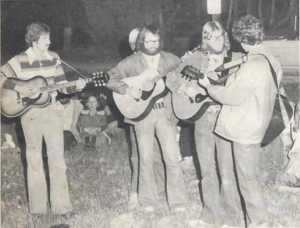
Glorieta in the 1970s was the place to meet Southern Baptist leadership, and we knew they were passionate about developing our generation as a missions force. Our elders likely were more pivotal in mission work than we were, having a vision for what we students could become in the next few decades.

Baptist Student Union helped us mature on our college campuses. We college students came from Southern Baptist churches where we mainly had sung on choir trips to Hawaii or Mexico. BSU sent us out to witness on campus—quite terrifying, but we did it.

Photo provided by the Glorieta Staff Alumni Facebook Group.

Some students—particularly older guys who were known on campus—witnessed in dorms and went room-to-room in men’s dorms. They would tell us of witnessing to their professors and which professors at our state schools were open to the gospel. These students in leadership went on to Southwestern Baptist Theological Seminary and became BSU directors or pastors.

We memorized Scripture that we kept in our pockets on cards, so we could study the verses any time we had a free moment. Some students were able to memorize whole chapters of the Bible. We used tracts like “Have You Heard of the Four Spiritual Laws?” We loved the cross forming a literal bridge between the opposing cliffs of God and man.

We sang songs at Noon Day meetings to which churches brought us Frito pie or burgers for lunch. We had a worship and teaching hour, getting out right before 1 p.m. classes. When we convened for BSU conventions or at Glorieta, we knew the entire Sing and Celebrate songbook.

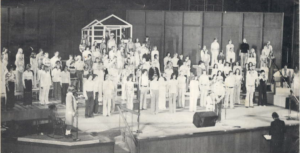
New music and musicals were debuted at Glorieta, and students could join the Glorieta choir for worship and performances. Great singers from various campuses could read the new music and thrilled us all with the new songs. We saw slides of students on mission as the choir sang.

Our emotions ran high, and we were on our feet singing, unless asked to sit down for preaching.

Glorieta was a place to see people from other schools and celebrate being together. Those of us called to missions felt we were with our true family of like-minded souls. We thought any student would have been crazy not to want to join the Baptist family, marry a Baptist spouse, and live on mission for Christ—even in a church or missions-oriented vocation.

We didn’t know how special those days were at the time, but we carried back to our daily lives, to our campuses and churches what we experienced at Glorieta. We still remember it.

Revival at Glorieta

Photo provided by the Glorieta Staff Alumni Facebook Group.

I remember the doors of the worship hall flung open to New Mexico breeze and sun, while fans twirled over our heads. Pastors like John Bisagno called us to build lives upon Christ, on missions and Christian services.

Missionaries challenged us to apply for post-college mission support positions with Journeymen and US-2. We saw videos on the lives and work of missionaries, and I walked forward to pursue that call.

Singers like Cynthia Clawson and lyricists like Regan Courtney brought us such beauty in music. Like at Asbury today, we felt like we were praising God in heaven, and we never wanted to leave. If there had not been buses waiting to carry us back to Oklahoma and Texas, if the cafeteria food had not run out, we still would have been there.

But there is a time to go to class, graduate and live daily life on mission for Christ. Music and preaching will only carry one so far. A million repetitious choruses cannot make Jesus any more precious than he is. The Spirit can be a still, small voice, not a howl.

Yet, revival is to be treasured.

Its memory soothes us in the difficult and mundane times of life. It provides a standard of wonder, total acceptance of God in us, and commitment. It leads me to ask: “Have I lost my first love? Am I backslidden?” Revival days are a tutor, a measure of growth.

Believers do not grow past our need for revival, though we grow in our ability and desire to be the church in the world.

I still long for Glorieta—to be young, to have life and calling lie before me open and new. We older people long forheaven now. How ironic.

The revivals of college tore that glory veil between here and heaven a bit. They let us look in and see praise. We now know praise and want it.

Ruth Cook is an educator assistant for an English-as-a-Second-Language class and is a longtime Texas Baptist. The views expressed are those solely of the author.

Disclosure: Cook is a long-time reader and supporter of the Baptist Standard. Publication of this article is not in consideration of that support.


Voices: The Bible is the book by and for immigrants

The Bible is a book for immigrants and was written by immigrants inspired by God.

The people who penned the Bible initially were called “Hebrews,” a name first given to Abraham. He was called a “Hebrew” because he crossed the Euphrates River to go from Mesopotamia to Palestine.

The word “Hebrew” was used to refer to the nation of Israel during the time of the Old Testament. It was derived from a word meaning “cross over or pass over” and was used to mean “a wanderer, a nomad or a person on the move.”

“Hebrew” also has been used in modern times to refer to “a refugee, an exile, the one who lost a home.” In other words, a Hebrew is an immigrant in the sense that he or she has crossed a border.

Immigrants then and now

In the Bible, there are various types of immigrants, and they share similar characteristics with today’s immigrants. Abraham became a first-generation immigrant to pursue his vision and overcame many adversities to fulfill it.

Isaac was a second-generation immigrant who honored his parents and loved his wife. He was faithful to his role, but he also was timid and passive.

Jacob, a third-generation immigrant, was an aggressive individual and established a nation on the foundation of the first and second generations.

In addition, there were Joseph, who experienced forced immigration; Moses, who grew up an adoptee and liberated his nation from slavery; Ruth, who immigrated through interracial marriage; Naomi, who went back to her own country by reverse-immigration; Ezra, who was a second-generation immigrant committed to the recovery of national identity; Nehemiah, who gave up on personal well-being for the restoration of his country; Ezekiel, who lived as a voice of conscience among immigrants; and Daniel, who was an international student and later became a government official.

Studying all these people and their characteristics and lifestyles, we see ourselves living as immigrants in America today.

God and immigrants

God loves and uses immigrants. The immigrant of immigrants is Jesus himself. He left his home in heaven and came to this world. He became the lowest among immigrants, lived for those who have no power and no one to protect them,and died for them. He ascended to heaven to give an everlasting dream to the immigrants striving to grasp an ephemeraldream.

It is clear evidence of God’s love for immigrants that he sent his only Son as an immigrant. Through persecution, hesent believers—emigrants—throughout Asia Minor and Europe, and the gospel was spread to the ends of the Earth.

The Bible for immigrants

The Bible teaches immigrants the reasons and methods for the practice and propagation of God’s love.

The Bible teaches how to live a successful life as immigrants. All the immigrants in the Bible shared the same nature and experienced the same vicissitudes of life. They experienced hurt and healing, disappointment and encouragement.

The immigrants of the Bible experienced failures from time to time, but eventually they lived a life that fulfilled God’s plans. Following God’s guidance, they lived to fulfill his will, which means their immigrant life was a success.

Through Bible study, we also learn how to participate in bringing God’s kingdom on Earth.

The Bible is not a boring book of history. It is not a tedious book of doctrines. It is not an irrelevant book to the immigrant life. The Bible is the word of God and a manual for the life of immigrants.

In the Bible is the visa we must have to enter heaven, which is the promise of God. The Bible is a passport we must possess as we travel on this earth. The Bible is the book by and for immigrants.

Jonathan Kim is associate dean and professor of Christian education in Dallas Baptist University’s Crowley College of Christian Faith. The views expressed are those of the author.


Voices: Four ways the church can respond to trauma

The church is the beautiful, multifaceted body of Christ, made up of imperfect people impacted and often harmed by imperfect people. We as God’s people declare all humans are created in the image of God—reflecting his character to see the world through eyes of love.

Our Creator designated human beings as those who can choose, love and embrace those around us. Trauma has touched each and every person with whom we interact—especially in light of COVID-19. When we refuse to discuss trauma and impactful events in the church, we refuse to accept vital parts of the people we claim to love.

In fear of offending others, we often refuse to speak against injustice. In addition, we continue to allow stigmas—often misunderstood “disgraces” associated with trauma—to continue and grow.

How can we as the church acknowledge what has occurred in the lives of our congregants in ways that honor both God and the people he loves?

Immerse ourselves in prayer.

We acknowledge that no matter the circumstances, we cannot completely understand the perspective of the one who has been harmed, because each person’s story is different. However, we serve a God who fully knows and understands each person’s story—and he cares deeply and irrevocably for each one (1 Peter 5:7).

With this in mind, we must pray to have ears to hear and eyes to see the injustice and pain that surrounds us—even if the reality is painful to accept. We must pray for hearts that empathize with the people around us—fellow humans created in the image of God.

We must pray for an understanding to believe survivors of trauma, even if it means dispelling our own desires to save face or protect perpetrators at the expense of the one who has been harmed. We must pray for wisdom to act in love and understanding, dedicated to showing the loving face of Christ to every person.

Talk about trauma in and with our congregations.

Knowing our congregations is essential to discussing and responding to trauma. We do not need to wait for trauma to occur to bring it up. Trauma already exists among our congregation, especially in the wake of the COVID-19 pandemic. It consists of more than statistics. We cannot ignore it or pretend it does not exist.

Talking about trauma can take the form of sermons, but it also can become part of conversations with individuals or families, making space for providing resources for survivors in a central location of the church, or providing time for congregants to share their testimonies during worship services.

As leadership begins to create this space for acknowledging the presence of trauma in the church, the congregation begins to normalize their experiences, helping our congregants feel like they are not alone or isolated in what has occurred in their lives.

Utilize trauma-based language in honoring and precise ways.

As we begin—or continue—to discuss trauma, we must become mindful of how we utilize words such as “trauma” or “trigger.”

For example, instead of using the phrase, “That was traumatizing,” to describe a sports defeat or a minor embarrassment, we can teach congregants that trauma occurs when someone experiences actual or perceived exposure to death, serious injury or violence. This redefinition will help members of the congregation name hard events that have occurred in ways that will help with processing and recovery.

In addition, we need to avoid the urge to “pray away” the harmful event or its effects, as well as the desire to keep all consequences within the church. While we absolutely must pray for healing for ourselves and those around us, we must remember trauma can have severe emotional, mental and spiritual effects that can require outside intervention, such as medication, therapy or legal action.

Discussing trauma openly with our congregations builds a basis of trust that opens gateways to communication about difficult topics that can be spiritually responsive and ethically responsible.

Continually to educate ourselves about experiences that differ from our own.

As we embark on this journey of destigmatizing trauma in our congregations, we must read widely. The Center for Church and Community Impact provides a list of resources for trauma here.

We can attend trainings and events that illuminate different perspectives. We should seek constant feedback from our congregates to find out if there are topics that need to be addressed from the pulpit or in small groups.

All of these actions can be steppingstones for creating spaces in our ministries and congregations for survivors, friends and family members to process events, share their stories and create resilient community that comes together in a unified body that honors Christ and each other.

Beth Ann McCormick is a student at Baylor University’s George W. Truett Theological Seminary and Diana R. Garland School of Social Work and a social work intern with The Center for Church and Community Impact.


Voices: You can do more for foster care than you may think

It was 11 p.m. on a Saturday night. A scared but vivacious 3-year-old showed up on the front porch two hours earlier with her lovey, a coloring book and the clothes on her back. What she lacked in the way of possessions was made up for with garbled words and extra sass.

The Child Protective Services investigator and a case worker walked through the placement paperwork, looked around the house, promised to check-in the next day and left.

There was bath time, a snack, a cup of water and probably five different reassurances before K-Bear finally fell asleep that night. Then the questions came.

“What if she wakes up afraid? What if she has nightmares? What if she tries to walk out the front door?”

Then the questions became more personal.

“What if I’m not good at this? What if I can’t provide what she needs? Will I ever sleep soundly again? Did I hear you right, God?”

The foster care journey

My journey with foster care started as a youth 15 years ago. Involvement ranged from providing child care at trainings, to loving foster families and eventually to becoming a certified respite provider.

I took the jump January 2022. After coffee with a fellow foster mama, I called a home developer and started the process to license my home. Just two months later, I was licensed. A few days later, I was a mom to three.

Really, my journey started much earlier than this. My journey began in my home, growing up, as we included “the least of these” in family gatherings.

Sometimes it was recovering addicts or alcoholics at the dinner table. Sometimes it was people spending the weekend with us who didn’t have family or who had burned the bridge of every family member they did have.

Sometimes it was people far from home, beginning a new life, participating in our holidays. It was always someone from somewhere who had experienced something life-altering.

Answering the “why” questions

“Why is a single person willingly giving up her freedom for those kids? What is she thinking? Is she crazy? How is the ‘three kids thing’ working or going to work? What about all the laundry?”

I’m sure you can imagine the questions. And some of the questions you wouldn’t dare to imagine.

Why? Because it is stepping out in faith and living in obedience to a calling. Because there is no excuse for running from a call to the ministry of people. Because lessons from the Old and New Testaments suggest God will win, and avoiding his plan only causes delay.

Why? Because it all boils down to two questions: Does this align with the heart and character of God? Is this offering my life as a living sacrifice before the Lord?

Why? Because James 1:27 says, “Pure and genuine religion in the sight of God the Father means caring for orphans and widows in their distress and refusing to let the world corrupt you.”

Why? Maybe the question should really be: Why not?

We all are called to do something

You might be sitting there thinking: “I am not called to that.”

Maybe you aren’t. You answer to God alone in terms of your calling.

But if you feel a nudging, if you feel like you have an opinion, you probably are called to do something. If you can’t foster, you can pray; you can support a foster parent; you can take the steps to provide respite care; you can love a foster family; you can advocate; you can become a surrogate grandparent, aunt or uncle. You can do something.

Why foster care matters

In June, I sat with my son at kids’ camp as he asked questions about following Jesus. In August, we baptized him. In October, on the couch in my living room, my son helped my middle daughter find Galatians 2:20.

We talked about what it means to be crucified with Christ, and my daughter said, “I want to follow Jesus.”

We baptized her the next week, because much like the lesson of Philip and the Ethiopian in Acts 8, she couldn’t wait a minute longer.

“But do you want to know why foster care is worth it? Because it’s gospel work. And living for Jesus is always, always worth it” (Jaimie Finn, Foster the Family).

Abby Manes is the children’s and family minister at First Baptist Church in Muleshoe. She is the proud [foster] mom of three and spends her time chasing kids, investing in her church and the surrounding community, and drinking good coffee. The views expressed are those of the author.


Voices: Helpful ministry to special-needs families

The church knows we need to be sensitive to special needs and open to special-needs ministry, but we don’t know how. We tend to be scared to touch it, because we don’t want to say or do the wrong thing.

I wasn’t that different. During more than 10 years in kids’ ministry, I tried to be accommodating to kids with special needs. However, I didn’t do anything to reach out to and love on those kids and their parents.

May 18, 2022—the day my son was born—did not go any way I expected. Most “birth” days don’t if we’re honest.

However, being told my son likely had Down syndrome just moments after he was born and then being swept away quickly to the neonatal intensive care unit for breathing and sugar issues was far from what I had imagined. We knew NICU was a possibility, but a Down syndrome diagnosis? No.

When things changed

The year leading up to our son’s birth was challenging. My depression was at its all-time worst. We had a move to Alaska from Texas on the horizon, and my pregnancy culminated in gestational hypertension and pre-eclampsia.

Hearing “Down syndrome” in the recovery room was shocking. The honest first thing we cried out was, “Why us, God?”

There was deep pain and questioning: “Did I cause this?”

No, I didn’t. Down syndrome is a genetic deformation that occurs by happenstance at the moment of conception. You can read more about Down syndrome at the National Down Syndrome Society website.

We worried: “I will likely have to bury my son.”

Historically, people with Down syndrome have had shorter life expectancies than the average person.

Mix of emotions

There was a wave of grief as the life I envisioned for my son quickly faded away. It was extremely humbling and heavy.

“You were handed an early preview of all the trials your child would face the day he was born. Most parents don’t get that,” my counselor said.

I battled grief, anger with God, guilt for being upset at the diagnosis, worry about what was happening in the NICU. In the midst of this, we had to tell our family and worried friends who hadn’t heard anything from us. We grieved right alongside being brave and becoming advocates.

Never had I felt such a swish-swash of emotions: moments of great joy together with deep grief, moments of gratitude for our beautiful full-of-life son and also anger and questioning, moments feeling angry God “chose” me and also deeply humbled and honored that God chose me.

I struggled with feeling all those things, particularly the negative things, but I finally came to a place where it’s OK to feel all of it.

Still processing

Eight months later, I still go back-and-forth. I grieve when I see my friends’ kids who were born around the same time reach milestones my son hasn’t or is far from reaching.

I grieve when I see others putting together nurseries and taking newborn pictures in their homes—things we didn’t get to do due to moving and then a NICU stay, things we dreamed of doing that felt taken away.

I know these things are superficial, of this earth and shouldn’t bother me, but they do. It’s very much a part of the grieving process, something I am sure I will navigate on and off for the rest of my life.

Actions that help

We are so blessed to have such a great family, friends and church family who supported us during this time.

With a child in the NICU, we couldn’t be swarmed with people. Just getting family in the NICU to see our son maxed out our visitor limit.

After I was discharged but our son was still there, we spent our time going back-and-forth to the hospital. When we weren’t at the hospital, we were home sleeping.

People who gave us gas money, gift cards for quick meals, or accommodated our schedule to have dinner with us close to the hospital were the biggest blessings.

The people who didn’t try to find the words, but just listened to us and let us process were so helpful. Those who held us and supported us in our grief were so special. Those who connected us with other parents of Down syndrome kids or local and national resources were so helpful.

I am thankful for the Baylor Scott and White Hospital in downtown Dallas for delivering our baby and lovingly caring for all of us in those early days of his life.

Special needs ministry

Ministering to parents of special needs is a necessity in the church. Ministering to each family will be different. We are one of thousands of stories. There is so much involved I never knew or understood. I hope and pray I can continue to shed light on the ways the church can minister to this special population.

To get a glimpse into what it is like, we can start by educating ourselves on what special needs is and isn’t. Then, we can walk alongside families with special needs. For some, they know before the baby is born; others learn at birth. Either way it is equally challenging.

Learning your child has special needs can be a crisis of faith, a deep moment of questioning, and if still pregnant, a reason some consider terminating the pregnancy. This is where the church can step in to be a support, a resource, a refuge and a place of hope.

If you have specific questions about how to minister to or support families with special needs, I would be happy to help.

Ashley Myers is a wife, special needs mom and former children’s minister. She has a deep love of Texas Baptists, the church and helping families experience faith at home. She and her family now live in Alaska. You can follow their journey and the upcoming launch of her new ministry, The Abiding Family, on Facebook and Instagram: @the.abiding.family. The views expressed are those of the author.


Voices: Acknowledge, don’t minimize trauma

Hurt. Assault. Violence. Disaster. Loss. Grief. Death. Trigger. Trauma.

What is our initial reaction to each of these words?

The word “trauma” carries a lot of baggage in the form of warnings, assumptions and stereotypes. Each of us has experienced events in our lives that have left scars characterized by fear, harm or a myriad of other costs to our health and wellbeing.

We often have assumptions when others tell us of their trauma. We may be tempted to think others are overreacting or exaggerating, that “it couldn’t have been that bad” or “they’re just not thinking clearly.” Perhaps we have minimized the accounts of others to avoid acknowledging the depth to which they have been affected.

We try to hurry others along in their healing process with the words, “Just get over it,” so we can be comforted and protected with the false message, “Everything is OK,” diminishing others’ dignity and worth as they hear, “I am not worthy to be heard and seen as I am.”

Maybe we have heard similar messages from others when trying to share our own stories.

Maybe we have imposed these messages upon ourselves.

How Jesus addressed trauma

In contrast to the human inclination for self-preservation and the Western ideal of efficiency, Jesus interacts intentionally and slowly with those in his path, with care for the created imago dei behind their presenting pain.

“Come to me, all you who are weary and burdened,” Jesus invites in Matthew 11:28.

Jesus does not brush aside the pain of the experiences in the lives of those around him. Rather, he acknowledges the bone-crushing weariness and the heaviness of the load many carry.

“And I will give you rest,” he said.

Note the absence of quick, easy healing, acceptability to others, or life free from flashbacks or costs.

“I will give you rest,” Christ promises—a rest that acknowledges the entirety of the burden that seems to encompass the one desperately seeking such relief, a rest that sees and loves the whole person beneath the load.

“Take up my yoke … because I am lowly and humble in heart, and you will find rest for your souls. For my yoke is easy, and my burden is light,” Jesus added (Matthew 11:29-30).

Jesus continually refuses to allow the stigmas and stereotypes of the Judeo-Greco-Roman world to define his interactions with others. Whoever his audience or whatever his ministry, Jesus reinforced his narrative that each person is worthy of being heard and seen and loved, no matter how “difficult” their past.

He brings to the conversation no more stipulations, no more burdens, no more heavy loads, but rather humility and rest. He approaches us with a posture of humility (Philippians 2:5-7) and invites us to approach others in the same way. He does not hurry us toward minimization of our symptoms; He embraces us in his healing arms.

How do we address trauma?

Many of us would not hesitate to declare that everyone with whom we interact is created in the image of God and is deeply cared for by Christ. Yet how do our words and actions reflect this belief?

As Christ-followers—even as persons walking through life together—we need to listen to each unique story we encounter. However, the stories themselves do not make up the whole of the person.

To move beyond the assumption people can be known only by what has happened to them, we must take up the attitude of humility Christ exhibits to every marginalized or hurting person in his path.

In much the same way, we must examine our assumptions and biases and ask ourselves: “Do we present the same invitation as Christ does—for others to bring all of themselves into our churches, our practices, our lives, without judgment? Are we committed to changing the stereotypes surrounding trauma so people, indeed, can lay their burdens at the feet of Christ?”

Rather than desensitizing ourselves to the harms of this world, do we engage in practices that re-sensitize us to the pain others feel?

Do we actively avoid slang terms such as “trauma” and “trigger?”

Educating ourselves on the true definitions of such words and using them appropriately to describe the experiences of others or ourselves is a key step in presenting ourselves as humble listeners dedicated to creating truly safe spaces for everyone to process past hurts and future hopes in a beautiful, messy swirl of experiences.

Trauma is a burden we all bear. By acknowledging its presence in all our lives, perhaps we can work toward a society free of judgment and stereotypes.

With the lightness of Christ’s burden solidifying our steps, may we consider our reactions to these words: Trauma. Love. Healing. Hope.

Beth Ann McCormick is a student at Baylor University’s George W. Truett Theological Seminary and Diana R. Garland School of Social Work and a social work intern with The Center for Church and Community Impact.


Voices: Bridging generational views of grace

Ministry is a context sport. The apostle Paul knew this. He wrote, “I have become all things to all people so that by all means possible I might save some” to convey this to his Corinthian audience (1 Corinthian 9:22).

Paul refers to himself as a “slave to everyone”—the Jews, those under the law, those not having the law, the weak—all “for the sake of the gospel.”

In gospel ministry, context matters. Paul knew the gospel intersects various cultural, ethnic and generational narratives differently. He learned that exploring those narrative dynamics positioned him best to bring the gospel to all types of people. As a result, Paul set up churches in a variety of cultural contexts along his missionary journeys.

When it comes to young adult ministry, context often is overlooked, misunderstood or underdeveloped in favor of “practicality” and “doing something.” When consulting with pastors and church staff about developing young adult ministries, one of the most challenging conversations involves getting them to understand that exploring context is indeed “doing something.”

Looking before you leap is not procrastination; it’s strategic. Listening with an ear to understand is not passive; it’s active. Understanding to whom you will minister is not abstract; it’s concrete.

Grace’s significance to older adults

One of the ways exploring context has helped my ministry to young adults over the last decade is centered on the core concept of grace. Grace is an indispensable part of the gospel message we’ve heard from pulpits for decades. But, I contend, the conversation around grace is not always the same in every context.

Take the song “Amazing Grace.” It was written at a time when nothing in life came without hard work or persistent, determined effort. The writer of this classic hymn did not enjoy the conveniences we have today.

His peers would have emphasized if you want something—anything—out of life, you have to work for it. Nothing came for free. This shaped how his generation saw the world and how the gospel intersected that world.

To that audience, the soteriological—salvific—value of grace indeed is amazing. That Christ Jesus would pay the cost or, better, do the work for us to have the greatest gift of eternal life, while everything else of far less value comes through the grit and grime of a hard day’s work—that’s amazing!

The focus on the sacrificial death of Christ lies at the forefront of the spiritual conversation of most Boomers. For them, the gospel—the good news—is Christ gives us the greatest gift without our need to break our backs to receive it.

Grace’s significance to younger adults

As technology has advanced and changed society, we no longer get everything we need from the sweat of our brow. We can decide on dinner and have it delivered while sitting on the couch binge-watching shows.

People and technology are doing things for us all the time. “Grace,” at least to some degree, is ordinary. To imagine someone paying the cost or doing the work is increasingly less extraordinary. It still matters to the next generations, but it’s simply not as captivating as it is for Boomers.

Grace for the next generation is a statement of personal value, not effort. For them, grace enforces and protects the value of all people regardless of race, creed or any other social category.

The most beautiful thing about Jesus to the next generation is not the radical way he died, but the radically inclusive way he chose to live as he interfaced with people living on the edge of Israelite society. It’s the obvious way his love for people cut against the grain of his society.

It’s amazing to the next generations that Jesus said, “The kingdom of God is at hand” to both the religious elites and those marginalized, maligned and dismissed by the religious elites—those told they were cursed by God for their sin or their parents’ sin and were destined for hell with no hope of recourse.

The gospel—the good news—from Jesus the King was the kingdom was opening its doors to those socio-religious outcasts, too. They were not forgotten or dismissed. Jesus loved them, too, and he proved it by demonstrating love and grace in the way he lived.

Grace communicates value for Millennials and Generation Z and moves the life of Jesus to the forefront of their understanding of the gospel.

The grace of the gospel welcomes all to the kingdom of heaven with equal value, regardless of heritage, history or social status. What an amazing gift!

A complete understanding of grace

To older and younger generational contexts, I say, “Yes.” The complete gospel understanding of God’s grace is celebrated in Jesus’ life and death. And yet, where there should be synergy around the generational implications of God’s grace, there is tension.

In true Romans 14 fashion, we often are too busy questioning other’s salvation and neglect exploring ways the expansive gospel of grace can intersect a narrative unlike our own. The product typically is division. In our time, this division is realized in unnecessary church hurt, deconstruction and general distrust of church institutions.

If we want to minister well to young adults, we need to allow contextual shifts like this to challenge us. For Paul, the gospel was big enough to intersect the contexts of all people, and he chose to “enslave” himself to understand those contexts for the gospel’s sake.

May Paul be a clear example for us to take practical and strategic action to discover the heartbeat of the next generation in order to bring God’s beautiful, comprehensive and complete love to them.

Antwuan Malone is the executive director of Elevate.ya and currently serves as the young adult pastor of Bent Tree Bible Church. His ministry is built around creating and supporting discipleship environments for young adults. The views expressed are those of the author.


Voices: Let’s cancel conference culture

Passion. Shepherds Conference. Urbana. Sing! Innumerable others. In recent decades, American Christianity has been awash with conferences and similar events.

Despite their differences, what these conferences generally have in common is they draw huge crowds, bring in top speakers and worship leaders, have excellent production values, and regularly repeat. If you’re an American Christian, have some money to spare and want to attend a Christian conference, you have countless options.

And that’s just national and international conferences. Include regional and local conferences, and you have even more. I call this massive proliferation of conferences “conference culture,” and it’s something Christians need to oppose.

I am not against conferences per se. I’m attending a church leadership conference myself in February. But conference culture has become a problem for American Christianity and needs to be challenged.

Undermining the local church

This proliferation of conferences in recent decades has had the (mostly unintentional) effect of working against the local church. How can I say that, especially since so many Christian conferences encourage local church involvement and are about the church?

Again, this effect mostly has not been intentional. Nevertheless, conferences—especially the big ones—usually have production values and star power most local churches never can match. Conferences can bring the best speakers and the best musicians to put on the best show for attendants, giving them immense sensory and emotional stimulation with brilliant spectacle.

Christians will spend hundreds of dollars, travel hundreds of miles and carve out an inconveniently large chunk of time to attend a big conference. I know of few Christians who would make similar efforts just to attend a little country church one weekend. Why?

Because most local churches can’t provide the kind of preaching you witness at Shepherds Conference, the kind of music you hear at Sing! or the kind of show you experience at Passion. Big Christian conferences can make the local church look boring, mundane, unimpressive and worse.

Most American Christians never would say outright we think big conferences or similar events are more God-glorifying and more spiritually edifying than ordinary local church worship. But we don’t need to say it with our words; we already say it with our actions.

God hasn’t instituted conferences. God has instituted the church (Matthew 16:18). Conference culture is symptomatic of a widespread desire for sensory and emotional spectacle most local churches never can hope to provide. Furthermore, trying to produce this kind of spectacle in Christian worship is problematic biblically in and of itself.

God’s glory and human weakness

“God has chosen what is foolish in the world to shame the wise, and God has chosen what is weak in the world to shame the strong. God has chosen what is insignificant and despised in the world—what is viewed as nothing—to bring to nothing what is viewed as something, so that no one may boast in his presence” (1 Corinthians 1:27-29).

“When I came to you, brothers and sisters … I did not come with brilliance of speech or wisdom. I decided to know nothing among you except Jesus Christ and him crucified. I came to you in weakness, in fear and in much trembling. My speech and my preaching were not with persuasive words of wisdom but with a demonstration of the Spirit’s power, so that your faith might not be based on human wisdom but on God’s power” (1 Corinthians 2:1-5).

“But he said to me, ‘My grace is sufficient for you, for my power is perfected in weakness.’ Therefore, I will most gladly boast all the more about my weaknesses, so that Christ’s power may reside in me. So, I take pleasure in weaknesses, insults, hardships, persecutions and in difficulties, for the sake of Christ. For when I am weak, then I am strong” (2 Corinthians 12:9-10).

These passages and others—such as Matthew 5:11; Mark 8:24; 1 Corinthians 4:6-13; 2 Corinthians 2:14-6:13, 10:1-12:8—speak for themselves. God has chosen to reveal his power and glory through human weakness, particularly through the cross of Jesus Christ.

Why would we think we are doing the most to glorify God and edify believers by emphasizing human abilities like great speaking, skillful music and impressive production values?

Yes, we should work hard, do our best and use the gifts God has given us. But it is dangerously easy to think we’re glorifying God when we’re really just glorifying ourselves.

Practical steps we can take

The most immediate and obvious step we can take to challenge conference culture is simply having fewer conferences. Let’s shut some down. You may think you have no power to end conferences, but you can choose not to go. Stop giving them your money and time.

But, as I said above, I’m not against conferences per se. They can be beneficial. Conferences are at their best when they focus on substance and equipping attendees. Don’t worry about the production values and the “show.” Don’t let others’ fame be a key factor in determining which conferences you attend—or in how you plan your conference. Focus on solid teaching or training.

Local churches also need to avoid trying to emulate or compete with big conferences. Don’t put too many resources into “production values” for your worship services. Lower the volume so your musicians in front don’t drown out the singing of the congregation.

If you’re a preacher or teacher, don’t worry too much about your appearance and delivery. You want to be presentable and competent, but your primary focus should be on studying, explaining and applying the biblical text. Jesus doesn’t need your pithy quotes or dynamic stage presence.

In short, don’t try to impress people. Yes, sing and play your instruments well. Yes, make sure your enunciation and volume when speaking is solid. But don’t fall into the trap of thinking you’re glorifying God by really just glorifying yourself.

God has not chosen to manifest his glory through impressive shows of human ability. God has chosen to manifest his glory through the cross of Christ.

Joshua Sharp is the pastor of Trinity Baptist Church in Orange, and a graduate of Southwest Baptist University in Bolivar, Mo., and Baylor University’s Truett Theological Seminary in Waco. The views expressed are those of the author.