HPU: Leading and learning at Beach Reach

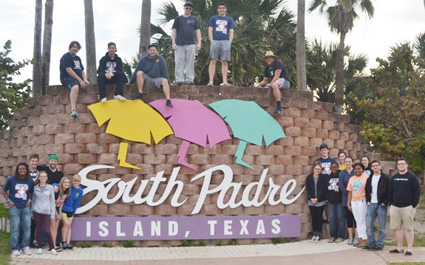
This year’s spring break marked my third time to be involved in Beach Reach, but little did I know how different this year would be and what it would mean for me.

kim lilley garner130Kim GarnerAs campus intern, this is the first time I have been in charge of planning and leading a full mission trip on my own—and without my director there. We had so many struggles finding drivers, getting payments together and having people drop out. It was such a stressful week, and I worried about everything.

I found myself slowly losing passion for a ministry that was so special to me. I prayed that I could prepare myself for what was about to happen at South Padre Island. 

When we arrived, I saw the many different things a leader has to take care of, and I really learned to appreciate what my director does for every trip. But the first night out on the vans was awesome. I spent a few hours on the vans and had some awesome conversations. I continued on to a popular club where I had some great conversations and provided leadership for the students as they ministered.

hpu beachreach425We had some amazing times throughout the week, and I was able to help my students process the things that they were seeing and experiencing. I heard their stories and celebrated with them as we saw salvations and recommitments on our van.

There was such joy in my students as they shared great conversations and such hurt as they discussed the times they were rejected. I learned that praying specific prayers over the people we met led to amazing results. I also learned the greatest joy from this trip was seeing the passion and joy in my students. It was so rewarding to hear their stories and see how God worked through them. I saw the results of the training we had done. 

Even though I ministered differently this year than before, I still had the opportunity to have great conversations and make connections with spring breakers. I feel that I learned and grew more as a leader than I ever did as a student. Beach Reach was incredible. I saw such growth and life change. It was a blessing. 

Kim Garner is serving with Go Now Missions as a campus ministry intern at Howard Payne University.


Community college students serve Mission Arlington

Students representing the Baptist Student Ministries at Mountain View College in Dallas and Collin College in Plano served at Mission Arlington, adopting as their theme: “Working together to make a life better.” During their time in Arlington, the two student groups came together and showed God’s love through a variety of projects and by meeting physical needs. 

jourdan pollock mbc130Jourdan PollockOne day, student delivered bread to some mobile homes and an apartment complex near Mission Arlington. While making deliveries, the students were encouraged to ask the residents if there were any needs that they had or any prayer concerns.

Once they finished delivering bread and returned to the mission, students collected the items peoples said they needed—clothes, shoes, toys and furniture—and immediately delivered them. Students were so excited to be able to hear about needs and meet them within an hour. 

In Romans 12, the Apostle Paul describes how we all have our different functions, yet we are members of one body, and that is the body of Christ.

students dallas pollockselfie425Through their experience working with Mission Arlington, students could see how they all have different personalities, but our focus and goal is to share Christ.

Even though we are all different, we all have a purpose. And as a member of the body of Christ, we all should have the same goal of sharing the gospel with all those around us.

Jourdan Pollock, a graduate of Midwestern State University, is serving through Go Now Missions with the Baptist Student Ministry at Mountain View College in Dallas.


Letters: ‘Science cannot contradict the Bible’

I applaud the Baptist Standard for publishing the views of both sides of contemporary issues. I doubt any of the staff agree with a recent letter’s author, who takes umbrage with the Baptist General Convention of Texas statement regarding gender identification. 

That God created us male and female is timeless truth. Unambiguous. Not subject to redefinition. The author in protest cites “scientific evidences” to the contrary as the basis for asserting the reality of transsexual gender(s). 

I am not a physician. I am a man of science and a man of faith. My high school biology teacher was also a man of faith and a coach, Steve Gregg. Fifty years ago, he explained to us in private true science cannot contradict the Bible, since both have God as their author and Creator. Science that fundamentally disputes Scripture is no science. It is confusion, which is the state of so-called transsexuals. 

Gender is identifiable by the presence or absence of the Y-chromosome in the DNA. Not by psychology nor by “data.” Any assertions to the contrary are hogwash. 

By the way, “doctrine” based on Scripture that contradicts sound science is not truth but dogma. Another topic for another day.

Maurice Harding

Seadrift

Return to prayer and fasting

Excellent news coming from the Texas Woman’s University Baptist Student Ministry. 

The basic disciplines of prayer and fasting have become lost in so many of our program- and music-driven churches and ministries today. God’s presence and spiritual power will become evident in our churches when we return to prayer and fasting. 

Thank you, TWU Baptist Student Ministry, for reminding us of this all-important aspect of our discipleship.  

Tim Robinson 

Whitesboro

Science, the Bible and sex

“Gender is identifiable by the presence or absence of the Y-chromosome in the DNA. Not by psychology nor by “data.” Any assertions to the contrary are hogwash.”

I will repeat back to you the headline of this letter (above): “Science cannot contradict the Bible.” This is exactly what Maurice Harding’s statement does. Faulty pop science claims the presence or absence of the Y-chromosome determines sex (not gender, by the way). The Bible doesn’t use genetics as the sole determinant of sex; it uses the genitals. And sex follows changes to the genitals.

A woman with the complete form of Androgen Insensitivity Syndrome would be XY, female-typical external genitals, and testes in her abdomen rather than ovaries and uterus. The Bible would consider her a barren woman. Not a man, as this rule would dictate. 

Someone who is XY and born with ambiguous genitals would be considered a eunuch by the Bible. Not a man as this rule would dictate. 

Someone who is XX and born with ambiguous genitals would be considered a eunuch by the Bible. Not a woman as this rule dictates.

My karyotype is 46,XY/45,X. Some of my cells are XY; some are just X. So by this rule, I’d be part man and part woman. Yet I suppose this “science”—since it’s clearly not based on the Bible, it can’t be doctrine—only allows for male and female. 

The Bible allows for male, female, and other (eunuch). “For there are eunuchs who were born that way from their mother’s womb” (Matthew 19:12).

Lianne Simon

Atlanta, Ga.

Transgender: ‘Know the full story’

I was born with one testis and one ovary that later in life became malignant with ovarian cancer. While being treated at the Mayo Clinic, I encountered another person with the same condition. 

I’ve never said God made a mistake when I was born. People are born with many variations of their body structures. 

In response to Maurice Harding’s letter (above), you better start looking up intersex conditions. There are at least 30 or 40 such variations. I have two friends who are XXY and one who has AIS—androgen insensitively syndrome. In her case, she is XY with a female body structure. Her cellular structure cannot absorb androgens (testosterone), hence the female body structure. 

Your world is doing much harm to children who are born with these issues. 

Please keep in mind that many transgender people do have an intersex condition. In fact, about 1.7 percent of children have one form of intersex conditions. Most go though life and never know. 

It was common practice to do sex-change surgery to babies if their male sex organs failed to develop. In fact, the practice is still being done in many areas even today. I know of one such adult who had surgery imposed on him as a child. He almost went insane before he had surgery to change him back to male.  

Don’t present yourself as an expert unless you know the full story and the science behind all this.

David Micheletti

Cohasset, Min.


Down Home: Grandkids, snowmen and a busy weekend

We made history early this month. For the first time, both our grandchildren and both their mothers spent a long weekend under our roof.

Ezra, our 4-year-old grandson who lives in Buda, has visited Joanna and me many times. But this was the first opportunity for 3-month-old Eleanor, who lives in Nashville, to come see us.

We rolled out the red carpet—or, more appropriately for a 4-year-old boy, the white snow.

I probably won’t mention this when Eleanor is old enough to understand, but Ezra was far more excited about seeing snow for the first time than about meeting his baby cousin. 

A little boy just doesn’t stop

Little boys are like that. If you can’t or won’t play, he questions your value. Well, that’s not right. A little boy doesn’t stop to consider worth. Actually, a little boy just doesn’t stop.

That’s fine with me, at least as long as I don’t stop long enough to consider the implications of our 54-year age span. Ezra goes to bed revving his little engine faster than mine runs all day. How can someone that small never stop running and talking—at the same time?

Ezra and I have a wonderful relationship. That’s because I know my job. Where he’s concerned, I’m the purveyor of play, the concierge of comedy, the meister of mirth, the gadfly of games, the raconteur of rasslin’. In Ezraworld, I exist for his great fun.

And I’m good with that. Because when he’s having fun, so am I. 

Ready to play in the snow

Before Ezra and Lindsay arrived, I pulled out my coat, cap and gloves, so I’d be ready to play in the snow as soon as he sprung free of his carseat.

Ezra lives 18.47 miles south of the Texas Capitol. Folks don’t get much snow that far down. In fact, Ezra had not seen snow until he arrived in North Texas for his visit with Marvo (and Jody, and Aunt Molly and Eleanor). 

We hit the white stuff almost immediately. For the record, Ezra generates far more energy than I. But never underestimate the assets of age—wiliness, experience and cunning—and a pretty good arm. I won our snowball fight by about 85 snowballs to three.

Fortunately for Ezra—but not so much for the 6.7 million other souls in the Dallas-Fort Worth area—the temperature remained cold that night. That meant plenty of snow for Day 2. That’s when we built three snowmen. Or, judging by their height, snowchildren. 

Constructing snowmen

Jody supplied carrots for noses and raisins for eyes. Ezra fetched sticks for arms and hair. And as long as we stuck to the moist almost-ready-to-melt snow, we rolled it up into passable snowhumans. 

By Day 3, just about all the other snow melted. But our little snowpeople hung in there. Eyeless and noseless, but with stick arms and stick hair. And what appeared to be world-class snow-scoliosis.

Of course, I’d love to tell you Ezra charmed his new cousin by singing “If You’re Happy and You Know It” or “There’s Power in the Blood,” two of his favorite songs. But Ezra never slowed down that long, and Eleanor probably wouldn’t have noticed, anyway. A boy doesn’t have time for playing with babies when he’s got basketball, Chutes ’n’ Ladders, Batman Uno, video games on a cell phone, football, Hungry Hungry Hippos and wrestling.

For her part, Eleanor charmed her great-grandparents, great-aunts and great-uncle, grandparents, aunt and mama by cooing and smiling and generally exuding 11 pounds of cuteness. 

Snowmen’s demise

By Sunday afternoon, when Ezra and his mama packed to leave, we crossed the front yard to their car. He walked over and looked down on the tiny pile of carrots, raisins and sticks, the remaining residue of our snowfolks.

“Our snowmen died, Marvo,” he called out.

“I know, Ezra,” I replied. “It’s warmer. I’m sorry.”

“They’re in heaven now,” he surmised.

I guess they wouldn’t last long if they went the other direction.


Kathy Hillman: Deep roots … living legacy

So then, just as you received Christ Jesus as Lord, continue to live your lives in him, rooted and built up in him, strengthened in the faith as you were taught and overflowing with thankfulness. (Colossians 2:6-7)

kathy hillman130Kathy HillmanWanted: High school, college and seminary students to enter Texas Baptists’ essay and sermon contests on Baptist distinctives. Entries should clearly demonstrate understanding of distinctives chosen and their biblical background. Scholarship awards include $2,000 for first place, $1,000 for second and $500 for third. For rules and deadlines click here.

Winners will be invited to present their sermons and essays at the 2015 Baptist General Convention of Texas annual meeting. The convention will focus on Baptist distinctives organized around the theme “Deep Roots … Living Legacy.”

People often ask why I am a Baptist. Many assume I was born that way. Faye Watson enrolled me in cradle roll as soon I came home from the hospital. My first outing was to a Woman’s Missionary Union circle meeting. Growing up, I participated in every aspect of First Baptist Church in Eldorado. 

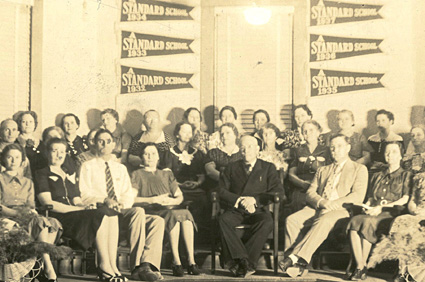
hillman btu fbcatlanta1938 425Baptist Training Union group at First Baptist Church in Atlanta, Texas, 1938. (Photograph courtesy of the Southern Baptist Historical Library and Archives)But while I was born into a Baptist family, I am not part of the Baptist family today because of my roots. I choose to be Baptist because I have prayed, studied and determined I am Baptist by belief. 

Baylor classmate Hollis Browning tells of growing up at First Baptist Church in Plainview, where he learned Baptist distinctives firsthand. When he was a teen, his longtime Texas Baptist pastor grandfather Bill Mason and grandmother Lillian joined the Brownings for worship on a Lord’s Supper Sunday. As the bread passed down their pew, Grandmother Mason took the wafer, but her husband did not. When the cups came, again she participated while he did not.

After church, Hollis took his mother aside. Why, he asked, did his grandmother take the Lord’s Supper when his grandfather did not, especially as a pastor? Shouldn’t they have done the same thing? 

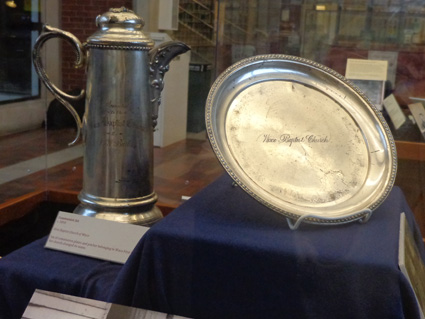
hillman fbcwaco communionset425First Baptist Church Waco communion set dating from 1830. (Kathy Hillman photo)Billie Claire Browning indicated her parents had differed as long as she could remember. Then she wisely explained their actions illustrated several Baptist beliefs. Both understood only those who were born again and baptized by immersion should take the Lord’s Supper. Both agreed individuals read and interpret Scripture for themselves with God’s guidance. However, Rev. Mason believed he should participate in the Lord’s Supper only in the church where he was a member. His wife interpreted the Bible to mean the ordinance was open to all baptized believers, even if they were not members of that congregation. Most importantly, each honored the other’s decision.

I learned the meaning of being Baptist growing up through junior high and high school in Training Union. I still recall Baptist distinctives using one of several common acrostics.

B – Biblical Authority

A – Autonomy of the Local Church

P – Priesthood of the Believer

T – Two Symbolic Ordinances: Believer’s Baptism by Immersion and the Lord’s Supper

I – Individual Soul Liberty

S – Saved Church Members

T – Two Offices of the Local Church

S – Separation of Church and State

In 1994, the BGCT formed the Baptist Distinctives Committee, which developed a representative list of Baptist beliefs. In addition to most of the acrostic, they include congregational church government, deity and lordship of Jesus Christ, evangelism and missions, religious freedom, salvation only by grace through faith, security of the believer and voluntary cooperation among churches.

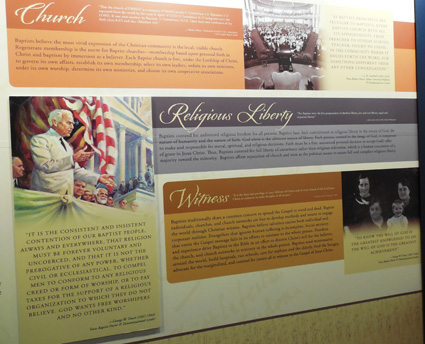
hillman distinctives425Display on the Baptist Distinctives Wall in the Texas Baptist Historical Museum in Independence. (Photo by museum director Phillip Hassell)Our Baptist roots include individuals who suffered and died for the freedom of all people to believe and worship according to their convictions. One Baptist founder, Thomas Helwys, died for his faith in an English prison. Others were harassed or tortured. In the colonies, Baptists were imprisoned, beaten, pelted and accused of child abuse because they rejected infant baptism. Yet Roger Williams founded Rhode Island on the principles of religious liberty and separation of church and state. Baptist John Leland played a major role in the inclusion of the religious liberty clauses in the Bill of Rights.

Pastor and educator J.M. Carroll wrote in his 1923 history: “Texas Baptists have a priceless heritage. Their fathers carved out of the Texas wilderness a home of tolerance, of liberty of conscience and freedom of speech. Let us prize this legacy and hand it down stainless and unsullied to those who shall take up our work when we have laid it down.”

May we tap deep into our roots in living our distinctively Baptist legacy of faith and freedom and pass it on for generations to come.

Kathy Hillman is president of the Baptist General Convention of Texas. She also is director of Baptist collections, library advancement and the Keston Center for Religion, Politics and Society at Baylor University.


Right or Wrong? Complaining

Our church members complain about everything and everyone. Their gripes eclipse the core values of the gospel—peace, joy, love and hope. How can we get back on track?

The issue of griping and complaining in church is a problem that has existed since the first century. This condition reflects our sinful nature in pointed and illuminating ways. While this is an old and continuing problem, 21st century technology and social media have helped give rise to a culture of complaining unparalleled in church history. The problem is ferocious and nearly universal. Yet although the issue is significant and unpleasant, it is not hopeless.

Twelve-step programs such as Alcoholics Anonymous learned years ago the first step to overcoming a problem is to admit one exists. Churches and individual members must admit they have a problem with griping and complaining. They must recognize and admit this behavior is in opposition to the gospel. Too often, the church ignores or dismisses such behavior as something other than the grievous sin it is.

Fruit of the Spirit

According to Galatians 5:22, the fruit of the spirit includes peace, patience, kindness, goodness, faithfulness, gentleness and self-control. Griping and complaining are in direct conflict with these fruits.

The Apostle James warns believers of the dangers into which their tongues can get them. He warns we cannot use the same tongue to praise God and curse people. Jesus’ commands to love one another, even our enemies, and to pray for them cannot exist in tandem with complaining about them. These attitudes and actions are evil, and we must confront them.

Having admitted the problem, the next stage is to repent. Those guilty must confess their sin, seek forgiveness from God and in the power of the Holy Spirit stop what they have been doing. Confession and forgiveness also must include the people harmed by the griping and complaining. Observing the Greatest Commandment allows for no less.

This step is difficult, to say the least. Griping and complaining have become so central to our lives, they have become our nature. The good news of the gospel is our nature can change. There is perhaps no greater example of a new creation in Christ than a person who stops griping and complaining. This change is a marvelous testimony to the power of the Holy Spirit.

Committing to change

Third, the repentant must commit to continuing the change through the power of Christ. Much as an alcoholic struggles with alcohol every day, people soon will realize their struggle with griping and complaining will be a constant ordeal. Only by committing daily to a change in their lifestyle will such a change become a pattern of their life.

This change must start with you. Admit and repent of your own griping and complaining, and commit to change. Stop giving explicit approval by joining in with the complaint. Stop giving implicit approval even by listening. Make it clear you will not participate in or accept griping and complaining. Lead by example. You will be surprised how quickly a change can occur.

Van Christian, pastor

First Baptist Church

Comanche, Texas

If you have a comment about this column or wish to ask a question for a future column, contact Bill Tillman, consulting ethicist for “Right or Wrong?” at btillman150@gmail.com.


Guest editorial: Private school vouchers—the forbidden fruit

In the beginning, temptation appeared as a fruit. Today, it appears as a voucher. As tempting as it may be for private religious schools to pluck the low-hanging fruit of “free” public money, the cost is too great. I say this as a pastor. I say this as a Christian school leader. I say this with certainty.

Has someone bothered to ask faith-based schools if they should take the money? In Florida, 82 percent of students receiving voucher money attended a religious school, according to U.S. News & World Report (Aug. 28, 2014). 

kyle henderson130Kyle HendersonWhat will it mean for hiring employees at the religious school? Will this public money be used to tell the school who they can and can’t hire? Look at incidents around the country where religious schools are being taken to court for releasing employees who undermine the core ethical stances. The courts are telling them which parts of their school qualify as faith-based. 

Strings attached

Vouchers come with government strings attached.

I have been a pastor more than 30 years. I have been the pastor of a 150-year-old Baptist church in East Texas 18 years. We operate a distinctively Christian grade school averaging 75 students. Our students have thrived, going on to high academic success. 

I know how tempting it could be to take voucher money. I know the burden on families who scrimp and save to send their kids to our school. I have bought lots of cookie dough, sponsored walk-a-thons and attended fundraisers. I also know the freedom of operating a school that is able to talk openly about Christ, a place where prayer is a part of each class, where sharing Christian testimony is encouraged, and where chapel and worship are a regular part of the school.

Payouts seek to fill in for faith

These government payouts seek to fill in for faith. They whisper from the shadows they are the answer to the problems of funding a Christian school. 

God does not need vouchers.

Vouchers and all their versions, including “school-choice options,” rightly come with responsibilities and obligations to the government. But Jesus told us we cannot serve two masters. These vouchers are either a grab to control faith-based schools or an irresponsible, unaccountable disbursement of public funds. Either the government will start exerting control over faith-based schools, or it will send money to schools not required to meet any standards. 

The only viable choice for a faith-based school is to reject the funds.

Faith is strong and alive in America because of the freedom of religion and the separation of church and state. In the places where this is not true, the church is an empty shell. Depending on the state for funds is a death sentence for free religion and vibrant faith.

There are, however, some faith-based schools ready to receive the funds. I don’t want tax dollars diverted to them any more than I want them diverted to my school. In North Carolina’s voucher program, 8 percent of the public money is diverted to a single school, the Greensboro Islamic Academy, according to North Carolina Policy Watch. Louisiana’s voucher system only passed the state legislature when an Islamic school’s request for funds was withdrawn. Where public funds are diverted to faith-based schools, all faiths will have access to the funds.

Bearing the cost

I prefer the system where those who love faith bear the cost of that faith. We don’t need vouchers to solve the problems of education in the state of Texas. We need legislators who are courageous enough to help public schools thrive, to return full funding to Texas schools and even to increase it. 

I am part of Pastors for Texas Children because we are mobilizing all over the state to fight for children. We fight for freedom of religion and against a private view of education that draws money away from already-struggling schools.

Kyle Henderson is pastor of First Baptist Church in Athens, Texas. His column was distributed by Baptist News Global.


Editorial: ‘National church’ is a bad idea for everybody

If you love opinion polls—or if you just enjoy sampling the psyches of your fellow Americans—your time has come. Welcome to the 2016 presidential campaign.

Across the next 20 months, political candidates will hold their collective fingers aloft to test the electoral winds. So, we’ll be treated to a slew of surveys, a cornucopia of canvasses and a raft of research. Most of what we learn will be predictable. Some will be fascinating. And a bit will be downright scary.

knox newEditor Marv KnoxScary stuff already surfaced in a study administered by the Public Policy Polling research firm.

The survey asked Republican primary voters, “Would you support or oppose establishing Christianity as the national religion?” The results  came down almost 2 to 1 in favor, with 57 percent of respondents indicating they support the idea, 30 percent saying they oppose it and 13 percent unsure.

Thank God for the First Amendment: “Congress shall make no law respecting an establishment of religion or prohibiting the free exercise thereof.”

Party affiliation of poll participants or pollsters is not the issue. Whatever their background, a sizable group of Americans wants to do away with the First Amendment in favor of a “national religion.” Religious liberty is skating on the thinnest ice in 224 years.

A secular, religiously neutral state

Despite what historical revisionists say, the United States’ founders did not seek to create a “Christian nation.” In fact, they explicitly fashioned a secular, religiously neutral state. Article VI, paragraph 3 of the U.S. Constitution states, “… no religious test shall ever be required as a qualification to any office or public trust under the United States.” Moreover, freedom of religion is the first guarantee in the First Amendment, prohibiting government from establishing religion and ensuring free exercise of all faiths.

To be sure, religious pilgrims settled the New World. Many of them fled persecution and journeyed to America for religious freedom—their religious freedom. Consequently, some of them established theocratic colonies, which affirmed the majority faith and disenfranchised, if not outright persecuted, followers of other faiths. Baptist Roger Williams secured the brightest colonial beachhead for religious liberty. He chartered Rhode Island as a safe haven for people of all faiths and no faith.

Guarantee of religious liberty for all

By the time the founders established the United States, they mirrored Williams and Rhode Island, resolving to create a secular republic that guarantees religious liberty for all people. Many, probably most, held tightly to personal faith. But they learned from state-sponsored, monarchy-administered religious wars and religious persecution in Europe. They also recognized the toxic trend toward religious repression in the colonies and realized it must be eradicated for the new nation to flourish.

Although the Constitution does not mention God, the United States enjoyed divine blessing. People of all religious beliefs from all over the world arrived on these shores, and faith flourished. 

Faith is almost impossible to quantify. But one set of statistics illustrates the sharp difference between faith-vitality in the United States and flaccid faith in countries where a “national religion” is established. About 40 percent of U.S. citizens regularly attend church, in contrast to piddling attendance in European countries where churches receive state supportincluding, among others, the United Kingdom (12 percent), Greece (27 percent), Denmark (3 percent), Finland (5 percent), France (12 percent) and Italy (31 percent). In Germany, where the government collects taxes for both groups, less than 4 percent of Protestants and 13 percent of Catholics attend church, even on holy days. 

Why would Christians want to defy faith legacy, national history and geo-theological trends to establish a “national religion”? 

Threatened by religious plurality

Obviously, many Christians feel threatened by the United States’ increasing religious plurality. The Public Religion Research Institute has released its American Values Atlas, which details the nation’s faith communities. The atlas reveals the United States no longer is majority-Protestant. Only 45 percent of Americans are Protestant, and only 32 percent are white Protestant. 

Catholics account for 23 percent of the U.S. population, followed closely by the unaffiliated (22 percent). Then come Mormons and Jews (2 percent each), Jehovah’s Witnesses, Orthodox Christians, Muslims, Buddhists, Hindus and others (1 percent each).

On top of this, the government’s often-clumsy approach to religion—from local school boards to the Justice Department—leaves many Christians worried. Sometimes, it sounds as if they’re worried about the erosion of religious liberty. Other times, it sounds more like they’re worried about losing their privileged status. 

Still, establishing a “national religion”—even your own—is a bad idea. No matter your religion. No matter your party.

As Religion News Service columnist Tom Ehrich asked, “If the U.S. is a Christian nation, whose Christianity do we follow?” He points to more than 1,500 Christian denominations in the nation. They range from liberal to conservative; from Roman Catholic to Orthodox to Protestant to nondenominational; from small, old-fashioned community congregations to hip mega contemporary churches.

A Faustian bargain

Bringing the question closer to home, think about Texas.

The American Values Atlas shows white evangelical Protestants—mostly conservative, but all varieties—are practically in a tie, at 19 percent of the population, with Hispanic Catholics (18 percent) and the unaffiliated (18 percent). And guess what? Hispanic Catholics and the unchurched are increasing, while the white evangelical Protestants are declining. 

If Baptists were to defy our denominational legacy and usurp the Constitution to back a state church, it would be a Faustian bargain—a deal with the devil—we’d surely regret.


2nd Opinion: Unfazed by outage, continuing in power

At the conclusion of worship recently, the benediction was a choir/congregational singing of Malotte’s “The Lord’s Prayer.” As we approached the ending, with about 15 bars to go, our organist played a particularly stirring chord as choir and congregation sang fortissimo, “… and deliver us from evil.” Suddenly, the lights went out, and the organ could be heard no longer. We plunged into darkness. Somewhere, in a closet in a hallway, a fuse had blown and a breaker had thrown.

lynn robbins130Lyn RobbinsWe were not, however, plunged into silence, for the song went on without a hitch. Choir and congregation joined to finish the piece a capella. The irony of singing, “… for Thine is the kingdom and the power …” while the power was out was lost on no one.

About a dozen symbolic interpretations flooded everyone’s mind, I am sure. You can’t turn out the power of the church. … The blood will never lose its power. … The power of the Holy Spirit is eternal. … And you shall receive power.

What went through my mind was perhaps simpler than that. I was proud, in a proper, holy way. We were unfazed. We did not need to see our newly refurbished sanctuary, much less our hymnbooks or hear our expensive organ in order to sing the right words in four-part harmony. Since the song is a prayer, I sang it, as I always do, with my eyes closed. I will confess to having been tempted to open them to see the reactions, but I resisted. Eyes closed and head bowed, I sang to the end with my brothers and sisters.

I love our sanctuary and organ, and I am not suggesting we routinely turn them off. 

I am so glad the power in our worship service does not depend on a fuse box.

But I am so glad our prayer needs nothing more than our voices lifted to God. I am so glad we can join together and make it through to the end with only each other to rely on as God receives our prayer. I am so glad the power in our worship service does not depend on a fuse box.

For Thine is the kingdom, and the power, and the glory forever. Amen.

Lyn Robbins is a blogger, author of In the Court of the Master and senior general attorney for Burlington Northern Sante Fe. He lives in Fort Worth, Texas, where he is a member of Broadway Baptist Church.


UTD: From pocket change to real sacrifice

Raising money for Go Now Missions is a part of Baptist Student Ministry culture. Each year, we set a goal and raise money to help send students on trips across the world to participate in various mission projects.

kinsey cline130Kinsey ClineWe do all sorts of fund-raisers—sometimes involving crazy activities—to reach our goal. We hold fund-raisers at local restaurants. We do boys versus girls or small-group competitions—often with prizes, often involving food. We’ve sponsored bake sales. And each Wednesday night, we pass around a jar in which people can drop donations.

Once each semester, we hold a Wednesday night worship gathering set aside to focus on missions. This spring, we invited Robert Hooker to speak about his experience as a missionary—specifically relying on the sacrificial giving of others to support his ministry.

We have noticed that while the fund-raisers help us collect some money, it really is not enough to meet our goal. The jar receives pocket change, but it’s not sacrificial giving. Robert challenged the students to consider how they could give sacrificially, and he gave them some practical examples. He suggested they give up one meal a week and give the money they would have spent to missions. He urged them to use their talents to raise money. He suggested they live more simply in order to give more generously.

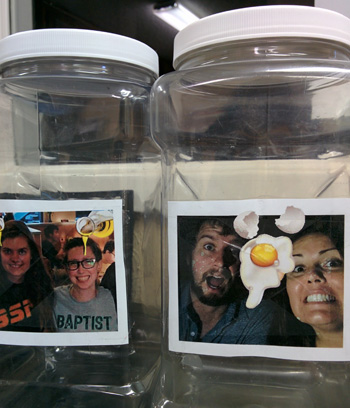
gonow collection350This month, we held a competition to “make a cake” on the heads of the losing staff members—our director and part-time intern versus the two campus missionary interns. Students put money into appropriately labeled jars. The “winning” team had the ingredients for baking a cake poured over their heads. Before Missions Night, we had raised probably around $100. The night Robert spoke, they gave around $300. The next week, $1,300 was placed in those jars—all from just 50 students present at Wednesday night worship! 

We don’t expect that $1,300 will be donated weekly from now on—although, if that is what God chooses to do here, we won’t complain! But we know that the message Robert presented was taken to heart. Several of our students have told us about their decisions to stop eating out as often so they can give more to Go Now. Some have built it into their budgets. Some have used the money they have made from part-time jobs or other opportunities to support missions instead of using the money for themselves. 

We are seeing a shift from missions support coming from pocket change to true sacrificial giving. Our students are seeing the biblical basis for supporting missionaries and the eternal impact their money can have when it is used to spread the gospel.

Kinsey Cline, a graduate of the University of Texas at Dallas, is serving with Go Now Missions as a campus missionary intern at her alma mater’s Baptist Student Ministry.


Richard Ray: Snapshot visit can evaluate church’s strengths and weaknesses

The Bivocational/Small Church Association has the privilege to serve our churches in many unique ways. One of the ways we serve is to make a snapshot visit to a church to see and hear the needs within that congregation. This visit helps us understand the heart of the congregation and the community it serves. 

richard ray130Richard RayWithin this snapshot visit, we can help the congregation implement several useful resources that may benefit the church. For example, we can assist a church in:

• Restructuring their constitution and bylaws to reflect their mission. 

• Developing job descriptions for each staff position, whether they be paid or volunteer.

• Providing background checks along with student and children’s safety policies.

• Developing a database for both personnel and finances.

• Deacon/elder training.

• Sunday school development, evangelism and outreach.

• Minister search.

These are just a few of the resources your Bivocational/Small Church Association can provide. It is a joy to visit a church that has the heart of God at its center. 

Moses tells the children of Israel in Deuteronomy 4:4, “but all of you who held fast to the Lord your God are still alive today.” I believe a church cannot die if that church holds fast to the Lord our God. However, just as the children of Israel needed assistance in living and serving our Lord, we, too, as the church need assistance in living and serving our Lord. 

We as your Bivocational/Small Church Association want to assist you, the church, in holding fast to the Lord and the mission he has given you. 

We want to be an encouragement as well as a resource to your church. Please contact us if you are in need of someone to come and share a word of encouragement to your congregation by sharing with them that they are not dead, they are not alone and they are not forgotten, but rather they have been empowered to do the work of the Lord and to do it well. 

To schedule a snapshot visit or to have someone come to share a word of encouragement, please contact me by clicking here.  

Remember, God has called you to serve him, but God has not called you to serve alone. Let us be your advocate, your resource and your prayer partner as you fulfill your calling. Until next time, please visit our website

Richard Ray is executive director of the Bivocational/Small Church Association and director of missions for the Tri-Rivers Baptist Area. You can reach him at brother_ray@juno.com.


In Touch: Hosting Texas Baptists Camp managers

Hello, Texas Baptists. It was our pleasure to host the Texas Baptists Camp managers in your Baptist Building. For information on Texas Baptists encampments, contact Susan Ater. She does an excellent job with our camps, and we are grateful for her work.

hardage david130David HardageWe also were able to host an intentional interim training conference at your Baptist Building. Karl Fickling heads up that initiative. For more information on intentional interim training, contact Karl.  

Recently, I spent Sunday morning at New Sunset Community Church in Killeen. It was a wonderful morning of worship, and I’m grateful to have been invited to be part of their service.

If you are looking for a good read, check out Pastor Kevin Moore’s book Holy Rebellion. He answers the question: “Can rebellion be holy?”

Hollas Hoffman, one of our oil patch chaplains, is featured in a Washington Times article. We are proud of his work. 

Our communications department has started a new outreach effort for churches. Get great church communication advice from the Texas Baptists Comm Shop. Visit the site for helpful blog posts.

Another successful Executive Board meeting has come and gone. Thanks to everyone who braved the weather and made the trek to Dallas. During Monday evening’s program, I made a presentation of our organization’s reset. It is after years of prayer and planning this reset is being put into effect. 

Thanks for your love and support.

David Hardage is executive director of the Baptist General Convention of Texas Executive Board.