Maciel: Love—and pray for—one another

“This is my commandment, that you love one another as I have loved you. Greater love has no one than this, that someone lay down his life for his friends” (John 15:12-13).

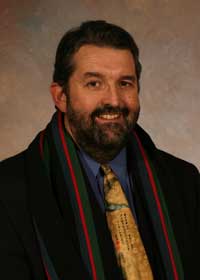
rene maciel headshot130René MacielI love February. This month gives me a chance to use my love language. I am a gift giver, and it is a joy for me to buy a gift for my wife, daughters and son-in-law. I know I don’t always have to buy something; it could be a note or a planned evening, or I could cook a meal. It doesn’t have to be a special occasion; it could be on the spur of the moment. Sometimes it is just being there, being present, being involved.

I can think of no greater way to give to Texas Baptist work and be involved than to give myself in prayer. Scripture tells us to love one another just like God loves us.

February is a great time for us to love one another by praying for the many ways Texas Baptists are reaching out and doing ministry throughout our state. Pray for our churches as they seek to share the gospel in their communities. Pray for the pastors as they strive to preach the gospel and lead a strong and healthy ministry. Pray for the many Texas Baptist churches that are seeking a shepherd to come and lead their congregations.

Something very important to me: Pray for the many Hispanic congregations reaching out to the great number of Hispanic families across our state who need the hope of Jesus. My dad was a pastor of a Texas Baptist Hispanic congregation 28 years, and he loved the church and always was trying to reach the neighborhood around his church.

texas baptist voices right120Texas Baptists, I ask you to show no greater love than to lay down your life in prayer from Feb. 1 through March 1. This is 30 days to pray for the amazing work God has given Texas Baptists. What a wonderful way to show your love and care for our convention by giving the gift of prayer for 30 days.

Maybe you can ask God to bless the work of the churches in your association. Pray for a list of pastors or ministers. Pray for the mission work going on throughout our state. Pray for your neighbors and the outreach your church has to love our neighbors. Pray for the many ethnic groups and languages that have been open to us as Texas Baptists. Pray for our executive director, David Hardage, his health and safety, and the strategic decisions he makes daily.

Texas Baptists, I am asking you to pray—pray for 30 days. Commit yourself and your church to prayer, to loving one another, to surrendering your lives in prayer for Texas Baptist work.

Loving One Another: Feb. 1-March 1—30 days of prayer. Take this month to show your love, his love, through prayer.

I would love to hear from you if you plan to take up this prayer challenge. Please email me at rene.maciel@bua.edu.

René Maciel is president of the Baptist General Convention of Texas and president of Baptist University of the Américas in San Antonio.


Letters: God and Allah, Wheaton, politics and religion, carrots

Similar yet divergent

Christian and Muslim views on God/Allah are similar in some ways and divergent in others.

Muslims and Christians both agree God/Allah is one in essence, he is the Creator of the universe and of people, he is transcendent, he knows all about us and wants us to follow his ways, and salvation from hell and entrance into heaven are possible.

They disagree as to his character. For Christians, God is love, immanent and knowable. For Muslims, Allah is power, never immanent or knowable. These disagreements are irreconcilable. 

David King

Marshall


‘Lose/lose for all concerned’

As a Wheaton College alumnus from the 1950s, I’ve been following the coverage of Larycia Hawkins since the media reported her statement and the college began the process of terminating her.

It’s as a classmate said—the whole situation is a lose/lose for all concerned. She has the First Amendment right to express her views and possibly inject them into her classroom lectures. To put them in “writing” in my opinion violates not only what the Bible teaches, but also the school’s statement of faith, which she has signed each year she has taught there.

Even though some of the faculty support her, I’m confident the faculty board will not recommend she continue to teach.

I watched the similar thing develop in the ’60s, when a Bible prof didn’t like what a highly respected science prof taught regarding creation and evolution.The president, after asking for a letter from the science prof detailing his position, backed his viewpoint, which caused the Bible prof to resign.

Burt Mixter

Wheaton, Ill.


Politicians and images of faith

One of the wise sayings is that when political figures and religious figures occupy the same bed, we get the worst of both worlds. This likely has never been more true than this election cycle. According to the polls, Sen. Ted Cruz and show person Donald Trump are the leading contenders among evangelical voters.

The editor recently quotedrecently quoted a moderate Republican figure who said, “Cruz is a stranger to most of what would generally be considered Christian virtues: humility, mercy, compassion, and grace.” We could say the same for Trump.

A few weeks ago, the president of Liberty University, Jerry Falwell Jr., announced he was in favor of arming the students and linked that necessity to Islamic extremism. At the beginning of his campaign for the GOP nomination, Cruz announced his candidacy at Liberty.

More recently, waving a Bible like a fire-and-brimstone preacher, Trump spoke at Liberty and said what he had learned from “Two Corinthians.”

The next day, amid fanfare, Trump was joined by former governor, vice presidential candidate, Fox News figure, and darling of the religious right, Sarah Palin. You may remember Palin was an avid supporter of Ted Cruz in 2012. Meanwhile, Palin’s oldest son was being arrested and charged with domestic violence, interfering with a call for help, and possessing a gun while intoxicated. Instead of condemning her son’s despicable actions, Palin blamed the current president.

Are these really the images of our faith Christians want to give the world?

Carl Hess

Ozark, Ala.


What to do with candidates’ carrots

Perhaps the American Christian church has forgotten or maybe simply overlooked two key places in our Scriptures for understanding who Jesus Christ is.

The Apostle Paul, in his letter to the Philippians (Philippians 2:5-11), recites a hymn of the early church in praise of Christ, and John records his vision of heavenly hosts praising Christ (Revelation 5). In both places, Christ is worthy of such lofty praise, even bowing every knee, not because he was a “military victor or a political titan,” but because he was a servant obedient to death, the Lamb who was slain.

My goodness! That’s a far cry from who we laud in our day, a far cry from our bowing to military, political, athletic and celebrity heroes—yea, even our business moguls.

We don’t seem to notice it is this servant obedient to death, this Lamb who was slain, whose name we invoke as we wonder what evangelical Christians—or any Christians, for that matter—should do with candidates’ carrots.

Eric Black

Covington


Guest editorial: Addicted to fear

Americans these days are addicted to fear. It’s a natural emotional response, but the overarching message of the Bible is, “Fear not.”

Read it at Baptist News Global.


SSadSadly, Christians are among the leading addicts to fear. – See more at: https://baptistnews.com/opinion/columns/item/30863-addicted-to-fear)#sthash.KLLAjvdH.dpuf
Sadly, Christians are among the leading addicts to fear. – See more at: https://baptistnews.com/opinion/columns/item/30863-addicted-to-fear)#sthash.KLLAjvdH.dpuf


UT-Rio Grande Valley: Start with prayer

alexandra granda130Alexandra GrandaBaptist Student Ministries from all over Texas gathered recently to be part of the annual prayer retreat, Abide. It was an incredible experience to begin the semester in the presence of God through prayer.

Student leaders from BSMs all over Texas planned and organized activities to encourage prayer. We offered stations where college students were able to talk to God and engage with other new college students. The prayer stations were very specific and meaningful. There were stations dedicated for forgiveness, for the unreached, for current missionaries, for family members in need and more. 

Abide 450During the retreat, we held a sunrise worship service near a nice bonfire. It was a chilly morning, and early birds who woke up were able to see the sun come up over the hills in the campsite. 

During the retreat, I was reminded through the word of God to be steady in my time with him. Since my job is ministry, sometimes I can forget this key to my spiritual life. We reviewed Ephesians 6, the armor of God. “Be strong in the Lord and in his mighty power” (Ephesians 6:10 NLT).

This was my third time to attend Abide, and it was as good and refreshing to my soul as it was the first time. I was able to meet new students who are praying to go on missions. I was able to see other students I have met over years. I was encouraged to hear new stories of what God is doing over the state of Texas. I can’t be more thankful for the opportunity to come together in prayer with my brothers and sisters from other BSMs.

Alexandra Granda is serving this semester as a campus missionary intern at the Baptist Student Ministry at the University of Texas-Rio Grande Valley.


Oregon: Making friends, giving God glory

Sometimes in the midst of busyness, it’s easy for me to focus on schedules instead of people. From graduating at Dallas Baptist University a month ago to living in Oregon now, it seems like my life has been going nonstop. But recently, the Lord reminded me how to slow down, seek him and simply love people.

Riley Price 130Riley Price I landed at Portland International Airport on a Saturday afternoon. The next morning, I FaceTimed with my church in Texas, and we prayed over the ministry here—specifically, that people in this physically and spiritually dark place would be touched by the light of Christ.

That night I saw our prayer answered in such a humbling way. My supervisor got a call from a friend who was having a rough night, and the conversation ended in us picking her up from her apartment to spend the night with us. When she got in our car and immediately started asking if I could stay with her for a few weeks, I knew I had made a great friend. I got to be her roommate that night.

We spent almost all day Monday with our friend, volunteering at a local nonprofit and attending house church in her apartment community that evening. Through several conversations with her, I learned about hardships from her past—family issues, homelessness and mental illness. Despite everything she had struggled through, she kept telling me she trusted the Lord to take care of her. Our friend focused on God’s faithfulness to provide her with a place to live. She told me, “If he could work that out, what do I have to be scared of?” I think we should all have faith like that.

She told me a lot of people just push her aside, but how great a blessing it was when God sent my supervisor into her life. Two weeks in, and I have seen the power of selfless relationships for the sake of the gospel. The Lord is using something as simple as friendship to spread his glory.

Riley Price, a recent Dallas Baptist University graduate, is serving with Go Now Missions as a semester missionary in Beaverton, Ore.


René Maciel: DBU, ETBU ‘do a wonderful job’

Count your blessings! We have many students who come through our Texas Baptist universities who are called and prepare for ministry. Many go on to a Texas Baptist seminary or Christian ministry program and then into a Texas Baptist church. Texas Baptist universities prepare so many of our pastors and ministers. And your Cooperative Program giving supports all our 28 institutions and provides needed help for many students to receive scholarships and aid as they attend our universities.

rene maciel headshot130René MacielHere are two more of our Texas Baptist schools that do a wonderful job educating and preparing many for ministry and other vocations. I am grateful I have a chance to relate to these universities at different times throughout the year and thankful for the wonderful programs and schools Texas Baptists can count as a blessing.

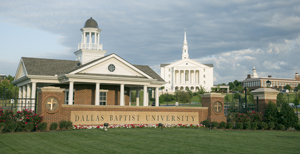
Dallas Baptist University began in 1898 in Decatur as Decatur Baptist College, often considered the oldest continuously operated junior college west of the Mississippi River. Dallas Baptists were interested in starting a Baptist college in Dallas to serve the Metroplex’s growing population, so in 1965 it moved with 945 students to a 200-acre site in southwest Dallas and was renamed Dallas Baptist College. It became a four-year institution for the 1967-68 academic year.

DBUA former U.S. Cabinet member and chief of staff to President Lyndon B. Johnson, Marvin Watson, became president in 1979 and led the college toward university status by adding the first graduate programs. DBC became Dallas Baptist University in 1985, but it endured extreme financial hardship.

The university hovered on the brink of closure, but it was saved through the support of the Dallas Baptist Association, the Baptist General Convention of Texas, and devoted faculty and staff. History credits Fred White, a former Texas Baptist pastor who served in various administrative posts during DBC’s first 20 years in Dallas, with championing the survival of DBC.

texas baptist voices right120In 1988, Gary Cook’s presidency re-energized the school. By 1992, the debt was totally eliminated, and 92 more acres were added. Enrollment reached 5,319 by the fall of 2015. Among those are 588 international students representing 62 countries. DBU provides 72 undergraduate majors, 28 master’s programs and two doctoral degrees. Cook is now the school’s first chancellor as trustees search for the next president.

East Texas Baptist University traces its beginning to the College of Marshall, which started as a two-year institution in 1917 with 374 students. The campaign to create the college was led by William Thomas Tardy, pastor of First Baptist Church in Marshall. He acquired land, and the BGCT assumed control of the college. In 1944, trustees asked the state convention to elevate the college to four-year status, and the name was changed to East Texas Baptist College. In 1984, it became East Texas Baptist University.

ETBU entrance 300ETBU’s current enrollment is 1,308, and it offers more than 40 programs of study and graduate studies in business, counseling, education, Christian studies and religion. J. Blair Blackburn became its 13th president last June, after serving at DBU 20 years—13 as executive vice president.

ETBU’s Great Commission Center deploys students, faculty and staff into mission endeavors through Beach Reach on South Padre Island, at Mission Marshall, and with Hope Springs Water, to repair water wells and offer hygiene clinics in Belize. Its nursing students have a 100 percent pass rate on the national exam, and teacher education graduates boasted a 97 percent state licensure exam pass rate for 2013-14.

Please keep these universities in your prayers and make plans to find out more about them at our BGCT annual meeting, Nov. 13-15.

René Maciel is president of the Baptist General Convention of Texas and president of Baptist University of the Américas in San Antonio.


2nd Opinion: What I’ve learned from two decades in the gospel ministry

Recently, I was startled to realize I had hit an important milestone—the 20th anniversary of my ordination to gospel ministry. As I’ve reflected on that 1995 August night in Biloxi, Miss., I’ve tried to recall some of the things I’ve learned since then. These are not necessarily the most important things I’ve learned—many of those, I’m sure, are subconscious. But these are 20 things I’ve learned in 20 years of ministry:

russellmooreheadsho 180Russell Moore1. When it comes to preaching, Sunday school was more important to me than seminary. I value Greek and Hebrew and everything else, but absorbing the stories and phrases and teachings of Scripture as a child was more important. If I had to choose between the two, I’d choose Sunday school.

2. At my ordination, an elderly deacon referenced the Bible and my wife, saying, “Son, don’t ever get in the pulpit with any other book than that one, and don’t ever get into bed with any other woman but her.” Wise counsel. Another way of putting it: “I keep a close watch on this heart of mine; I keep my eyes wide open all the time. I keep the ends out for the tie that binds; Because you’re mine, I walk the line.”

3. Most of my regrets are failures to be kind or merciful. What haunts me most are not sermons that could have been preached better or ministries I could have led better, but rather people I loved who needed more mercy than I could or would give, or people I gave up on too soon. If I could advise my younger self, I would say, “Err on the side of kindness and mercy.”

4. I cannot overestimate the blessing of old friendships. I desperately need the people who knew me before I was “Dr. Moore.” They are the ones who can knock me down when I get prideful and remind me who I am and what God has called me to when I get down and depressed. As life goes on and ministry gets more frantic, it’s easy to let those friendships grow dormant, and more time elapses between phone calls or visits. Don’t let that happen.

Mentoring matters

5. There is no ministry without mentoring. I keep pictures around everywhere of mentors in my life—those who took chances on me at a young age and who taught me what I know. Most of what I learned from these men and women happened in nonprogrammed times, when these mentors would hardly have known they were “mentoring.” At the same time, I look around at the protégés God has given me in ministry—many of whom I still get to serve with in various ways as colleagues now. Mentoring takes a lot of time, and sometimes emotional energy, but it is worth it.

6. Personal counseling has been as important as study. I’m, by nature, more prophetic than priestly. I don’t particularly like one-on-one counseling. I’d much rather preach a sermon or write an article than sit with a bickering couple about who sent what text messages to whom. But I often found myself with a weekly load of personal counseling. I gained insights into struggles I’ve never had, wounds I’ve never thought of, temptations I’ve never experienced. It helped me, I think, pray better but also preach better and write better. It’s what I miss most about both being a pastor in a church and being dean at Southern Baptist Theological Seminary.

7. Bible study is easy for me; prayer is hard. I’ve found that, like Israel in the desert, God often has to make me hunger to the point I know I do not live by bread alone and must ask for the bread I do live by.

8. Nothing can reach me at the most primal spiritual level like hymns I’ve known my whole life. New songs can teach me much, but “Just As I Am” can reduce me to tears of gratitude. Losing a hymnody that connects generations may be one of our greatest losses as a church.

Adultery isn’t about sex

9. Of all the families I’ve counseled through the wreckage of adultery, I don’t know of one where the issue was about sex. Usually, it’s about the guilty parties trying to recapture the excitement of high school or college dating and the hormonal rush that comes with it. Our cultural definitions—often mediated through music—of what “love” is and should feel like contribute to this.

10. Most of the theological errors I find in myself or in others are rooted in putting an “either/or” where biblically there’s a “both/and”—and vice-versa.

11. It’s important to tell the difference between a Simon Magus who needs to be rebuked (Acts 8:18-23) and an Apollos who just needs more patient instruction (Acts 18:25-26), between the Philippian Christians who need gentle reminders and Galatian heretics who must be repudiated decisively.

12. We are to be separate from sin, never separate from sinners. It is far easier to do the reverse. And the charge, “He eats with tax collectors and sinners” still works. Courage means not fearing those who will seek to intimidate you from following Christ toward those who are sick and in need of a physician.

13. The Scripture calls us to judge those on the inside, who bear the name of brother, and not those on the outside (1 Corinthians 5:9-12). Doing the reverse can make for a much easier ministry—as a hack.

Criticism happens, no matter what

14. You can’t avoid criticism. Decide ahead of time what sorts of criticism you would want remembered at your graveside. When that sort of criticism comes, take time to thank God for it. Make sure the criticism comes the way it does for Jesus—in stereo (Luke 7:33-34).

15. Cultural Christianity is a great comfort for some people. These are people who don’t have a strong doctrine of hell. If there is no judgment, then nominal Christianity is great, since it prompts people to behave and live good lives. If there is a hell (and I agree with Jesus that there is) then cultural, nominal Christianity is worse than secularism or hedonism or atheism or paganism because it says, “You shall not surely die” (Genesis 3:4) but pretends those words are coming from Jesus himself. This leads to death and to taking the Lord’s name in vain—all at the same time.

16. Most of the things I considered cul-de-sacs in my ministry turned out to be, in light of later years, no such things. God was using friendships made, books read, conversations had, jobs held, catastrophes experienced in ways I never could have predicted. And those are just the things I know about.

17. I can’t think of one thing I worried about early in ministry that ever turned out to be a worry later on. For instance, I agonized for long sleepless nights when first called to ministry about my fear of talking in front of people. You would think this realization would make it easier to “be anxious for nothing,” but I still must struggle to trust God.

18. My worst sermons were targeted first at the intellect or the will. My best sermons were targeted first at the imagination (“Behold, the Lamb of God, who takes away the sin of the world”).

19. I keep notes of encouragement that have come through over the years—from everyone from my wife to random strangers. My Bible is filled with these, and some of them are even framed. This ought to, and sadly doesn’t as much as it should, remind me not to assume encouragement and appreciation but to express it. Sometimes, I think I don’t because I fear it will sound awkward. But it’s never once been awkward for me to receive it, and I should remember that.

20. When I preached every week at a church in Louisville, Ky., I would end every service with the same benediction: “In the beginning was the Word, and the Word was with God and the Word was God. He was in the beginning with God. All things were made through him, and without him was not anything made that was made. In him was life, and the life was the light of men. The light shines in the darkness, and the darkness has not overcome it. And the Word became flesh and dwelt among us, and we have seen his glory, glory as of the only Son of the Father, full of grace and truth” (John 1:1-5, 14). I read that passage because I believe it sums up the whole of the Bible. But more than that, I read it because I needed to hear those words, aloud, every single week. My life depends on them.

Russell Moore is president of the Southern Baptist Convention’s Ethics & Religious Liberty Commission. This article appeared on his blogsite.



Guest editorial: Christian-Muslim dialogue must recognize ‘harsh realities’

The Syrian refugee crisis is one of the great humanitarian tests of our era. Christians worldwide have responded in some of the most beautiful and ugly ways imaginable to this crisis.

van GorderChristian van GorderThere is no place for Islamophobic fear among Christians, but one also must look at this crisis within its larger context. How we respond to this crisis—both humanely and firmly—will dramatically define the advance of healthy Christian-Muslim interactions.

Traditional crisis relief responses have focused on providing refugees immediate and temporary protection, shelter, food and medical care as close to the homes of the refugees as possible. This rules out aiding refugees for the long-term in Scandinavia or North America. Fellow Muslims in the Gulf States and other nations must be expected to aid their own co-religionists.

Laws intended to ensure refugees adapt and assimilate to European cultural norms and expectations should not be branded as Islamophobic. Justice—not charity—is required, but the financial constraints and civic harmony of various European nations should not be disregarded as irrelevant. Many secular Europeans are learning first-hand how important religion is to those who have arrived into their midst.

In addition, some Muslims are taught their faith makes them morally superior to those who are helping them. They believe Islam is the true and best way and, as such, assimilation cannot include any compromises of faith or any recognition that secularists are not bankrupt religiously and, in some ways, morally. Native Americans four centuries ago learned what can happen when zealots who feel they are superior enter your lands as guests.

North Americans have been fortunate most émigrés have come to this land and felt compelled largely to adapt and adjust to local cultural expectations. This also has been the case for moderate Turkish guest workers in Germany who, for decades, largely have adapted themselves to their new homeland.

But what happens when clerics—as happens in France, Belgium and Great Britain—mock their new homes as places of godlessness and arrogantly expect Europeans to adapt to their demands instead of visa-versa? We are seeing the clear answer to this question in places like Cologne, Germany.

Historically, Muslim and Christian interactions have gone sour when religion and politics become synonymous with each other. Centuries of despotism in many Muslim lands have conditioned citizens from those lands to subjugate their own politics on the altar of expediency. In our modern post-colonial era, there is a clear revitalization of political Islam that evokes the foundations of early Islam built as it was on establishing an earthly state.

Further, religious minorities in each of the 55 Muslim-majority nations are suffering new waves of religious persecution and intolerance: Yazidis are enslaved in Iraq, Coptic Christians are marginalized in Egypt and beheaded in Libya, the Baha’i are hunted down in Iran, and evangelicals and pentecostals are forbidden to share their faith with Muslim neighbors openly in many nations. Even “bright spots” like Indonesia, Senegal and Malaysia have seen persecutions against their Christian minority communities.

Future Muslim and Christian dialogue must advance with these harsh realities front and center. For too long, interfaith discussions have been wistfully theoretical and idealistically theological in our secure contexts of air-conditioned comfort while ignoring the cold, hard facts of horrific and brutal religious persecution worldwide.  

A. Christian van Gorder is associate professor of world religions and Islamic studies in the Baylor University Religion Department. He earned his doctorate from Queen’s University in Belfast, Northern Ireland.


Analysis: Do Muslims worship ‘our’ God?

Do Christians and Muslims worship the same God?

That question has generated passionate debate for ages. And those debates increased in frequency after a professor at Wheaton College claimed God and Allah are one and the same.

knox newMarv KNoxLarycia Hawkins, a tenured associate professor of political science at the highly regarded evangelical liberal arts school near Chicago, set off the latest divinity dispute shortly before Christmas.

She announced via Facebook she would wear a hijab, the traditional Islamic headscarf, during Advent as a symbol of her solidarity with Muslims. More pointedly, she called Muslims “people of the book” who “worship the same God” as Christians.

Her comments flew around the globe on social media and landed in international headlines. She attracted both criticism and acclaim. Wheaton placed her on leave and later initiated proceedings to terminate her tenure and fire her if administrators determine she violated the college’s statement of faith.

Hawkins’ case created controversy in two spheres.

The first is the nature of academic freedom in a faith-based school. Among many issues, it pits the unbridled search for truth against the generally affirmed doctrines of a faith community. It asks whether professors can push the limits of traditional orthodoxy and prompt their students to question conventional wisdom. It tests the tension between historic belief and open inquiry.

The second sphere is more approachable for regular Christians outside academia. It repeats the not-so-simple question Hawkins raised: Do Christians and Muslims worship the same God?

Devout Christians answer the question differently, with some saying yes and others saying no. They take three basic approaches to reach their conclusions. Those approaches and their answers are:

Historical — yes

The historical approach traces the question all the way back to the first encounter between God and Abraham, when God promised: “I will make you into a great nation, and I will bless you; I will make your name great, and you will be a blessing. I will bless those who bless you, and whoever curses you I will curse; and all peoples on earth will be blessed through you” (Genesis 12:2-3).

Advocates of the historical approach note God Almighty, Lord and Creator of the universe, intervened in human history by speaking directly to Abraham. Jews, Christians and Muslims all point to that moment and that God—whom Jews call YHWH, Christians name God the Father, and Muslims designate Allah—as the genesis of their faith.

So, since all three faiths assign their start to a relationship one person, Abraham, had with the divine being, they say Jews, Christians and Muslims all worship that same God.

Many missionaries who minister to Muslims favor this position. It provides them with broad common ground. They find this starting point—the Lord talking to Abraham—enables them to begin open and trusting conversations. Those discussions inevitably lead to Jesus, and the missionaries build off Muslims’ reverence for the “same” God to support the divinity of Jesus.

Theological — no

The traditional Christian view, particularly for Protestants and especially for evangelicals, grounds its understanding of God in the Trinity. God is fully revealed only in three persons—Father, Son and Holy Spirit. This position maintains Muslims do not worship the same God as Christians, because anyone who doesn’t accept the divinity of Jesus does not understand the Christian revelation of God.

Acknowledging the historical common denominator but affirming the Trinity, SMU theology professor William Abraham told a Truett Seminary audience: “Christians and Muslims believe in the same God. They do not worship the same God.” He cited the missions imperative of this approach: “Coming to terms with the Christian identity of God is not philosophical nitpicking. Expounding the identity of the Triune God calls for joyous sharing and celebration of the gospel with the Muslim world.”

Many traditionally evangelistic Christians follow this same line of reasoning when they witness to Mormons and Jehovah’s Witnesses. Those groups claim to follow Jesus, but their understanding of Jesus and of his incarnation is far from classic Trinitarianism. This logic also would apply to Jews, who definitely share Christians’ reverence for the God of Abraham but do not believe Jesus is divine.

While many Christians who take this approach respect Muslims and Jews, and possibly Mormons and Jehovah’s Witnesses, they feel bound to insist the distinctiveness of Jesus divides the religions.

Philosophical — yes

People who seek to step outside their faith tradition and apply logic to the question take a philosophical approach. They point out all monotheistic faiths—such as Christianity, Judaism and Islam—believe in only one God. Monotheists describe that one God differently, due to language, culture and experience, but they insist only one God exists. Therefore, they’re all worshipping the God, but by different names.

Believers in one God arrive at that conclusion from a variety of paths—affirming sacred texts, reasoning the existence of God based upon nature, trusting basic intuition or leaning into divine personal revelation. Advocates of this approach stress these people all bow down before the one true God who created the universe and is Lord over all creation because that is the only God who exists.

They also cite their position to accommodate for variables that make enormous difference in everyone’s life. Individuals born in 1970 to families of the dominant faith groups in Fort Worth, Mecca, Tel Aviv and New Delhi almost certainly would grow up to become Christian, Muslim, Jewish and Hindu. Advocates insist a just and loving God would not punish people because of where they were born, the beliefs of their families or their opportunity to know about, much less seriously consider, another faith.

The vast majority of Baptists affirm the Trinity and consequently maintain Muslims and Jews, however close their origins, do not worship the God who is expressed as Father, Son and Holy Spirit. But this is a complex issue, and we live in a complex and pluralistic world. So, the question will remain before us—probably until Jesus comes back.

For more information, see …

“Christian college puts professor who wore hijab on leave” — CNNCNN

“Wheaton College recommends terminating tenured professor over ‘same God’ comments — Christianity Today

Larycia Hawkins’ academic biography — Wheaton College websiteWheaton College website

Here’s what evangelical experts on missions and Muslims think of Wheaton’s ‘same God’ debate — Christianity Today Christianity Today


Moldova: Gaining new perspective

Going into the mission, I did not know what to expect. I knew we would be working with orphans and giving them shoes, but this mission was so much more than that. God used this mission to open my heart to what he calls us all to do—bring others to Christ.

moldova shoes 300Students serving through Go Now Missions join other CERI volunteers in putting warm new shoes on the feet of orphans in Moldova.I went into this trip feeling as though God would use me to make a great impact on children in need, but God surprised me and used the orphans of Moldova to have a huge impact on me. In working with these children, I encountered incredible joy and sadness. Some of the kids were ecstatic, while others were in despair. Seeing the light some of these children had, even in the conditions they were living in, opened my eyes to what true faith looks like. These kids represented the Christ-like joy we all should present in a world of temptations and corruption. The kids who expressed sadness showed how much living in these bad conditions was taking a toll on them. They seemed to represent people who are losing hope and letting their struggles overcome them. Serving in this mission, God allowed me to see just how much people in this world are faced with and how blind I was to these things before.

Living as a middle-class citizen in America, it is easy to live the typical American life of going to school, getting a degree, having a job and starting a family. Not that this is necessarily a bad way of life, but it’s not a life of giving yourself to Christ. This trip taught me God calls everyone to radically abandon themselves to him, because alone we are dead, but he lives in us and gives us life.

moldova CERI 300Children in Moldova proudly display the shoes delivered by CERI volunteers.I was on the path of the American Dream. I wanted to help other people and grow in my relationship with Christ, but I was holding back. I was not giving all of myself to God. I was playing it safe. I was focusing solely on my own spiritual growth, rather than sharing the Good News of Christ with those who have little or no relationship with him. After serving the orphans, working alongside CERI and studying Scripture more, God changed my life around.

Now I strive to live a life of abandoning myself to Christ. I want to live a missional life wherever I am, because there is need everywhere. I want to use my college degree to serve those who need their physical and spiritual needs met. I want to show others the grace of God. I ultimately want to live a life serving God and following his will for my life. God used this trip to help me grow more than I ever imagined. I am so thankful for the things God constantly is doing in my life and the blessings he has given me in order to use to serve those around me.

Hannah Willhoite, a student at the University of Mary Hardin-Baylor, served through Go Now Missions with CERI (Children’s Emergency Relief International) in Moldova.


Jamaica: Building faith while building houses

I am convinced God has a sense of humor. He takes the most entertaining situations and uses them to build his character in us.

CooperJosiah David CooperOur first experience in Jamaica was a three-hour bus ride from Montego Bay to Harmons. Many in our group were very apprehensive of the narrow roads and steep exposure, and we trusted the experience and ability of the driver. Life is sometimes like that bus ride—exciting in the beginning, but as we get into the twists, blind turns and hills of life, we realize our need for dependence upon God to guide us safely to our destination. By the end of the ride, we are grateful to have arrived where our rest awaits.

We spent our week pouring ourselves into service for the people of Harmons. Alongside other teams and the Jamaicans, we dug pits, mixed concrete, hauled marl (mudstone), sang songs, told jokes and built relationships.

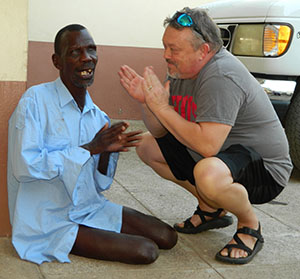
One afternoon, we visited an infirmary. Patients included the homeless, the aged, the maimed, the lame and the mentally ill. We were blessed to reach out to them in love, reading Scripture to them, talking with them, and giving them value that they otherwise would not have as outcasts of society.

One pastor and I went around singing psalms, hymns and spiritual songs, bringing light to the darkness of the infirmary. We met some beautiful souls who, though weak in body are strong in spirit. One lady, bent with age was seated outside with two of our girls, and as they held her hands and painted her nails, the pastor and I sang praises to Jesus.

As we finished the song, her frail form came to life as she raised both hands and shouted “Hallelujah!” Suddenly, it became so clear to me that the faith of these people is their source of life.

singing 300Missions volunteers join a Jamaican in singing praise to God.This point was driven home as our visit came to a close. The joint teams had gathered around a lone man who was singing hymns. The man was mostly blind, and as we sang “Amazing Grace” with him, the beauty of faith was perfected as he sang, “was blind, but now I see.”

I realized, as I spoke and served with these people, that they understand this world is not their home, that the trials and hardship of this life is not their final destination. I became almost jealous of their faith in God, because they realize their need for him far greater than the average believer in America. They know what it is to trust God for their daily bread, something to which our privileged American lifestyle is hard pressed to relate. They hold on to this hope, and share it eagerly with their brothers and sisters.

Of course, not everyone shares this hope. There is much despair from the poverty that abounds in the small communities for lack of industry and consequent unemployment. Pray that those who don’t know Jesus will receive hope from the faith of the Jamaican Christians. Pray for the pastors who teach the grace made available by the cross. Finally, pray for the staff of the ministries in Jamaica that God will continue to be the source of their strength and shine his light through them.

I was challenged significantly by the faith and love I experienced in Jamaica. I know God sent me on this trip for a reason, and feel that the experience He has shown me is only the tip of the iceberg. Given the opportunity to return, would I? “Ya, mon!”

Josiah David Cooper, a student at Texas A&M-Commerce, served in Jamaica with Go Now Missions.


Editorial: Should U.S. Christians seek ‘protection’?

Should U.S. Christians succumb to temptations Jesus clearly rejected?

Put another way: Should American Christians desire to be “protected”?

knox newMarv KnoxThat’s what presidential candidate Donald Trump promised during a speech at Liberty University Jan. 18. “We’re going to protect Christianity,” he told his audience. He described Christians as maintaining a 70 percent to 75 percent majority in America, adding, “some people say even more, the power we have.” And he called for Americans to ban together around Christianity, just as his host school has done.

To begin with, Trump’s premise—Christians in this nation need to be protected—is suspect.

Although some Christians claim recent government mandates impose upon their conscience, the courts have been siding with free conscience and giving Christians a break. Also, even though white Christians’ societal dominance has eroded (and race seems to be part of this equation), every presidential candidate up to and including Bernie Sanders, a secular Jew, is courting them. Just because Christianity—particularly the Protestant/evangelical branch—has lost some of its cultural caché doesn’t mean Christians need to be protected.

But even if Trump were correct, should Christians bargain for protection?

This was a central issue in two of the three temptations Jesus faced when he began his ministry. He had to answer: What kind of Messiah would he be? If he patterned himself after centuries of expectation and contemporary wisdom, he would be a military victor and a political titan. Of course, he rejected those notions.

In one temptation, the devil led Jesus to the pinnacle of the temple in Jerusalem and told him to jump (Luke 4:9-12). Satan quoted Psalm 91:1-2, reminding Jesus that God the Father had promised to send angels to protect him from all harm. Jesus countered with Deuteronomy 6:16, spurning the temptation to seek security.

Of course, Jesus is divine, and Christians are not. But if we seek to follow him closely and accept the name that means “little Christs,” then we should pattern our lives after his and make decisions as he would make them. So, trading our loyalty for “protection,” should be outside the bounds of acceptable Christian behavior.

When you think about it, however, Trump’s promise of protection even more closely mirrors another temptation Jesus faced (Luke 4:5-8). The devil took Jesus to a high place and “showed him all the kingdoms of the world.” Satan told him: “I will give you all this domain and its glory, for it has been handed over to me, and I give it to whomever I wish. Therefore, if you worship before me, it shall be yours.” Jesus repudiated that temptation, quoting Deuteronomy 6:13 and 10:20, a command that echoes from Moses to this day: “You shall worship the Lord your God and serve him only.”

This temptation represents Trump’s deeper pitch: You want a place at the table? You want a seat of power? Support me, and I will give it to you.

Trump, as is his style, said it most bluntly. But others have and will suggest it more subtly. “Vote for me, and all your wildest dreams will come true.” “Vote for me, and I’ll make sure you stay on top of all the ‘others.’”

If we hold fast to our faith, we will respond as Jesus, who rejected a deal with the devil.

Editor’s Note: This editorial was modified Jan. 21 to correct a quote in the third paragraph. That quote was changed from “I’m going to protect Christians” to “We’re going to protect Christianity” and to add the context of his call for the majority of Americans to ban together around Christianity.