Discovery Weekend: Learning to trust and obey

Last July, I felt the Holy Spirit nudging my heart, as if to say: “You’re going to serve me overseas next summer, daughter.” A few months passed, and the Go Now Missions office released its 2016 positions list. Through prayer, time, and more prayer, I found myself at Discovery Weekend on a few weeks ago with an open, curious heart and ears ready to hear God’s voice.

About 200 students who had applied for Go Now Missions gathered together at Discovery Weekend to slow down and tune into the Holy Spirit. Every student is placed into a group with whom they spend their entire weekend, processing and growing with one another.

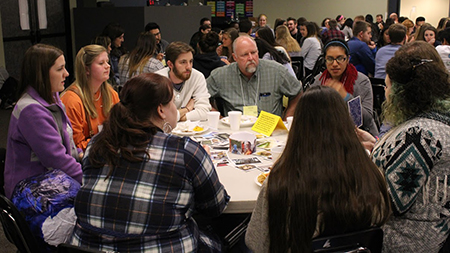
Discovery weekend 450Students participate in a “getting to know you” session during Discovery Weekend.My group bonded quicker than any of us expected. Around 11:30 p.m. Saturday, we found ourselves rejoicing that God consistently and swiftly unites those who know him. It didn’t take long for us all to open up about our lives and what God was teaching us in our many walks of life. When those transparent relationships were formed, we were able to encourage one another as we all began to decipher what the will of God could be for our time with Go Now Missions.

As part of the weekend event, we attended a Missions Fair where most Go Now Missions partners were represented. Workers who previously had been on a mission trip to serve that ministry site or who currently serving in that area staffed booths. I came into Discovery Weekend feeling very sure about all three trips I previously had expressed preference toward, and the Lord began to shift some of my thinking during this fair. God reminded me I shouldn’t pick a trip simply because I think it lines up with my gifts. The Lord wants my obedience, even if he were to call me to something wildly out of my comfort zone. After all, wouldn’t God then receive all the glory in my apparent weakness?

Discovery Weekend was a blessing in that it taught me to trust Jesus deeper and more wholly. There never will be a time when I can control every detail of my life, but knowing I have a loving Father who is sovereign calms every fear. While participating in this phenomenal event, we sang songs in different languages, and we were reminded of God’s heart for the nations and how the Lord always equips his followers. We were charged not only to share the gospel with those we came into contact with, but also our very lives. Jesus gave up everything for men who rebuked him. This summer and until God’s kingdom comes in fullness, I want to give up everything for the Lord, sharing my life with those he places in my path. I am thankful to Go Now Missions for providing this opportunity to share the abundant love God mercifully has given to me.

Nicole Faulkenberry, a student at Dallas Baptist University, will serve in Germany during the summer with Go Now Missions.


Guest editorial: Church leadership lessons from Disney World

Churches have a lot to learn—about welcoming and engaging guests—from Walt Disney World.

Read it at Baptist News Global.


Gun-free campuses

Let’s publish a list of the campuses that ban guns so the next Virginia Tech mentally deranged mass killer will know where to go.

Has no one noticed that the mentally deranged or Islamic terrorists always pick a gun-free killing zone?

We can now refer to some campuses as institutes of lower learning.

Fred Rosenbaum

Gainesville


Plan now to attend the Bivocational/Smaller Church Conference

Registration for the 30th annual Bivocational/Smaller Church Conference now is open. Click here to register or view the full conference schedule. This year’s conference will be held at Dallas Baptist University, July 15–16.

richard ray130Richard RayOn opening night, you will be lifted up and encouraged with music from the Hubbard Family. Their musical talents will amaze you, and their love for the Lord will inspire you. That night, you also will hear the true-life testimony of Terry Caffey about the brutal Texas murder that destroyed his family and about his journey to restored faith and forgiveness.

Saturday, you will have the opportunity to be equipped with many breakout sessions featuring wonderful instructors teaching on subjects to edify the small church and its ministers. Sessions include “Biblical Interpretation of the Old and New Testament,” “How to Reach Youth for Christ,” “From Text to Sermon,” “How to Minister to Young Adults” (college students, young professionals, singles and married couples), “Small Church/Big Worship,” “Launching a Children’s Program and Certificate of Ministry Program.” Lunch is provided, along with entertainment from Christian humorist Lyndy Phillips.

texas baptist voices right120The conference theme is “With God, All Things are Possible.” As this is true for the large church, it also is true for the small church.

So often, small churches do not think they have the resources or the ability to fulfill the vision God has given them. Nothing could be further from the truth, and the truth I am referring to is the truth found in God’s word: “For with God nothing will be impossible” (Luke 1:37). This Scripture applies to churches of all sizes and to all those serving the Lord in ministry.

I encourage you to attend this year’s Bivocational/Small Church Conference and learn firsthand through testimony, worship and breakout sessions all things are possible with God. This conference will not only equip you to do the impossible, but it will inspire you to trust God in all things.

We are here to serve you as you serve the Lord. Remember, the Lord has called you to serve, but he has not called you to serve alone. Visit our website for more information on how the Bivocational/Small Church Association can minister and serve you. For more information, contact me at brother_ray@juno.com.

Richard Ray is executive director of the Bivocational/Small Church Association and director of missions for Tri-Rivers Baptist Area.


BGCT president: Unity in the body of Christ

Growing up in my Hispanic home helped me handle many conversations and issues dealing with unity.

rene maciel headshot130René MacielMy mom and dad both were great cooks, and they both had their ways of preparing food. Food was our way to gather and enjoy family. So, my parents always were preparing meals—enchiladas, posolé, tamales and, of course, rice and beans. As mom and dad would tag-team on preparing these great meals, they also would disagree on the ingredients or how it was to be cooked. So they would argue, or maybe fight sometimes. They both had their ways of preparing that food, and they both wanted their way.

In spite of those disagreements, they were married 59 years and loved each other deeply. They were such a great example for me to understand sometimes you may have disagreements and even fight over differences, but even through those differences, we can also love one another and carry on a relationship.

texas baptist voices right120They taught me a life lesson: Even through differences, we must remain faithful to the body of Christ. The Apostle Paul asked, “Is Christ divided?” Many times, churches and individuals struggle through differences to the point they are divided. They no longer have a connection, a partnership. They pull away. That pulling away only damages the uniqueness we have in Christ.

Jesus even prayed for us that we would be one, so the world would recognize Christ in us: “My prayer is not for them alone. I pray also for those who will believe in me through their message, that all of them may be one, Father, just as you are in me and I am in you. May they also be in us so that the world may believe that you have sent me. I have given them the glory that you gave me, that they may be one as we are one—I in them and you in me—so that they may be brought to complete unity. Then the world will know that you sent me and have loved them even as you have loved me” (John 17:20-23).

We are called to live in unity and to be cooperative. Again, I know we will have differences, yet we still are joined in the great commission of sharing the gospel with the world around us. The early church came together and had everything in common.

The idea of the Cooperative Program unified budget, created in 1925, was to work toward a common goal of sharing the gospel with every person on the planet.As Texas Baptists, we have a great work to do. Let it begin with our kingdom-mindedness, our call to be one.

My prayer for our convention is that we will be unified in sharing the gospel of Jesus Christ. May we not let our differences damage or hurt our credibility among unbelievers.

Thank you taking these last 30 days to pray for our convention. God has given us a great work, and it begins with prayer—for church leaders, our state leadership, our churches, our neighbors and our unity.

We are the body of Christ. Pray for unity.

René Maciel is president of the Baptist General Convention of Texas and president of Baptist University of the Américas in San Antonio.


2nd Opinion: Take a deep breath—over and over

I have three children. They are teenagers now, but I remember when each was an infant, and they were crying—or screaming. I really wished they could talk so they could just tell me what was wrong.

terri springer 130Terri SpringerAs time passed and they started talking, I realized they still weren’t all that accurate in their ability to pinpoint their need. “I’m hungry” might actually mean, “That candy bar looks good, and I want you to let me have it.” “I have to go to the bathroom” might translate to, “I’m bored sitting here having to be quiet during worship.”

I’ve come to realize I have the same problem with my body. While my body might be letting me know it needs water, my mind decides eating something crunchy is the answer. I know when I exercise regularly, my body rewards me with clearer thinking, more energy and stronger emotional resiliency, yet my mind helps me come up with a long list of things to do instead of exercising. Many adults are no better at identifying their true physical needs and being honest about their desires than a toddler.

One reason for this is most of us never have made a strong mind/body connection. As a part of my coaching continuing education, I recently completed a course called “Mind Body Mindfulness for Coaching,” led by Rebecca McLean and Roger Jahnke.  The course gave coaches tools and concepts to help clients strengthen the connection between body, mind and spirit.

This is something I have come to understand gradually. Even though I grew up going to church, I don’t remember being taught that our body—how we feel about our body and listening to our body—is important to our faith development, because God created us as a whole. For some reason, the church’s tendency has been to value the mind and the spirit and devalue or ignore the body. Or even vilify the body, making us feel the need to distance ourselves from our physical cues

A few years ago, I went to the doctor. As he was writing my prescription, he casually mentioned if I would rest a few days, my body would heal just fine without the prescription. He told me our bodies often are completely capable of healing without taking medicine if we rest. But the problem is we don’t want to take the time to let our body heal. We don’t want our busy schedule interrupted.

Strengthening the connection between our mind and body can be extremely beneficial to our physical health, our stress levels and our connection to our creator. And as Jahnke says, “There’s no co-pay!”

Today, let’s think about one aspect of the mind-body connection—breathing. Most people know breathing deeply has numerous benefits, and we know most of us are shallow breathers. Why the disconnect? What if we thought of our breathing as a spiritual practice we carry with us throughout the day—a practice that has physical, emotional, mental and spiritual benefits? Do you see the mind-spirit-body connection? Also, it’s something you are going to do all day anyway, so why not do it in a way that has profound positive ramifications.

Physical benefits of breathing deeply (the short list):

Mobilizes the immune system

Lowers blood pressure

Increases effectiveness of oxygen and nutrition to the cells and tissues

Mental/emotional benefits of breathing deeply:

Increases brain oxygen for clearer thinking

Calms anxiety and reduces the effects of physical and mental-emotional tension and stress

Spiritual benefits of breathing deeply:

The Greek work for for breath, pneuma (like pneumonia) is the word used for “Spirit” in the bible. When we are aware of our breathing, we become aware of the holiness of our breath, of the Spirit within. Paying attention to our breathing, slowing down, breathing deeper makes us more aware of God’s presence and more connected to the Spirit of God within us.

There are many suggestions on deep breathing. Basically, it comes down to this: Try to think about your breathing occasionally throughout the day. Make sure you are breathing deeply enough that not only does your chest expand, but your stomach moves out too. Every once in awhile, stop what you are doing for just a few seconds and take the time to sit or stand up straight, take a few deep breaths and try to clear your mind of distractions and preoccupations. You can obtain smart-phone apps that serve as an occasional reminder.

God breathed the breath of life in us. I pray we all would make the connection between our breath and the life God desires for us.

Terri Springer is a coach with the Center for Healthy Churches.


Editorial: De-tune the religious liberty dog whistle

The Princess Bride, one of the most delightful movies of my daughters’ childhood, contains numerous quotable lines and snippets of dialog.

knox newMarv KnoxOver and over when villain Vizzini’s schemes fail, he exclaims, “Inconceivable!”

Finally, hero Inigo Montoya replies: “You keep using that word. I do not think it means what you think it means.”

Inigo’s response comes to mind several times a week. That’s when presidential candidates, pollsters and political whipper-uppers say the term “religious liberty.”

It does not mean what they think it means.

Over the past couple of years, “religious liberty” has become what is known in political parlance as a dog whistle.

You know how a dog whistle works: It sounds on a frequency only dogs can hear, and they come running. Likewise, a political dog whistle sends a coded message intended to fetch a cultivated constituency. The word or term sounds innocuous and blows right past normal listeners. But to the targeted group, it means something entirely different, and that meaning motivates them powerfully.

Take, for example, “states’ rights.” Constitutionally, it refers to guarantees in the Tenth Amendment, which reserves for the states all powers not delegated to the federal government. But to opponents of civil rights, “states’ rights” was a dog whistle calling them to support segregation.

To agitate and motivate

Unfortunately, “religious liberty” has become a dog whistle to agitate and motivate conservative Christians who fear losing absolute majority control over the United States. In their ears, it has been deconstructed from its common meaning and inspires them to support candidates and causes who wish to redefine religious liberty to the detriment of all people, Christians included.

Historically, theologically and constitutionally, religious liberty has meant guaranteeing people of all faiths and no faith the absolute right to follow the dictates of their consciences. Baptists, who began their faith journey as a persecuted religious minority a little more than 400 years ago, have been stalwart champions of true, broad religious liberty.

Our forebears embraced religious liberty early and championed it courageously. Many suffered ostracism and persecution for practicing and holding to their Baptist beliefs—refusing to baptize their infants, resisting registration as ministers and throwing off other religious shackles. Some languished in prison, and others died there.

But Baptists refused to horde religious liberty for themselves. Roger Williams founded Rhode Island Colony to guarantee religious liberty for not only Baptists, but also other Christians, people he called “Turks” and we call Muslims, and atheists and other freethinkers. One hundred fifty years later, a Baptist pastor named John Leland helped secure absolute religious liberty for all Americans by convincing James Madison to write it as the first freedom guaranteed in the First Amendment: “Congress shall make no law respecting an establishment of religion, or prohibiting the free exercise thereof … .”

First freedom twisted

Unfortunately, the First Amendment’s first freedom has been twisted of late, particularly by those who attempted to turn the law of the land to favor conservative Christianity.

Brent Walker, executive director of the Baptist Joint Committee for Religious Liberty, illustrated this upside-down treatment of religious liberty in a sobering assessment of the legacy of the late Supreme Court Justice Antonin Scalia.

“Justice Scalia’s thinking on the two clauses in the First Amendment that protect religious liberty—no establishment, that government can’t try to help religion; free exercise, that government shouldn’t try to hurt religion—he watered both of those down and pretty much deferred to the will of the majority rather than upholding the rights of the minority as many of us think the First Amendment was intended to do,” Walker told radio host Welton Gaddy.

Scalia “led the charge” in 1990’s Employment Division v. Smith “that pretty much gutted the protections in the free exercise clause,” Walker said. And regarding the First Amendment’s “no establishment” clause, Scalia “never saw an establishment case that he really liked.”

Consequently, the clause prohibiting government from establishing or propping up religion has been eroded, while the clause guaranteeing all religions the right to exercise their faith freely has been unraveled.

Such a perspective might have been expected from Scalia, a devout Roman Catholic, whose faith looks favorably upon hundreds of years of church-state collusion. But it is unconscionable for Baptists, other free-church Christians and people of other faiths, who inherently should recognize the danger of knocking down what Thomas Jefferson described as the “wall of separation” between church and state.

Faith & freedom

To be authentic, faith must be free. And for faith to be free, government should butt out.

(Isn’t it ironic the people who claim to distrust government are happy to allow government to regulate faiths with which they do not agree and also to turn to government to help them with their causes? Don’t they know what government supports, government will control?)

Now, politicians who prey on fear are using the religious liberty dog whistle to call out to people frightened by the increase of Muslims in their communities. They’re sounding the whistle to people who think the world will be better if they have the opportunity to promote their version of religion by posting the Ten Commandments on public property. They’re sounding the signal to Christians who despise people with different opinions and believe public officials should be able to ignore the law they have sworn to uphold when they don’t agree with how it is interpreted.

The list could go on and on, but the ideas would remain the same. If “religious liberty” isn’t good news for all people of all faiths, it isn’t good news. If “religious liberty” aids and abets one faith or one branch of one faith, it’s not liberty.

Baptists and others of goodwill should shout down the dog whistle of “religious liberty” when it agitates people to discriminate against others, to think less of others, to hate or despise others.

“Religious liberty” does not mean what people who use it for a dog whistle think it means.


Editorial: Criminal exonerations and ending capital punishment

Here’s your good news/bad news situation for the week: A record number of wrongfully convicted prison inmates were exonerated last year, and Texas led the nation.

knox newMarv KnoxGood news: Innocent people—149 of them nationwide and 54 in Texas—went free.

Bad news: They suffered an average of 14½ years in prison for crimes they did not commit.

Worse news: The persistence of this problem continues to belie the morality of capital punishment.

The University of Michigan Law School’s National Registry of Exonerations documents the cases of false justice. They include:

A record 58 exonerations for homicide cases—more than two-thirds of whom were racial or ethnic minorities, and half who were African-American.

27 convictions based on false confessions, more than 80 percent of which involved homicide cases. Most of the victim defendants were under age 18, mentally handicapped or both.

65 cases of official misconduct, including three-quarters of all the homicide exonerations.

75 exonerations for cases in which no crime ever occurred. Most of those were drug cases, but six were murder cases, and 14 others were violent felonies.

42 drug cases in Harris County, home of Houston.

The National Registry of Exonerations has recorded more than 1,700 exonerations in the past 27 years, according to the Texas Tribune.

We can be grateful conviction integrity units and the Innocence Project are seeking to overturn erroneous convictions. These groups work tirelessly and continuously to obtain justice for people who have been convicted wrongfully.

Still, the fact remains: Every year, more people are exonerated for crimes they did not commit. According to the National Registry of Exonerations, the rate of exonerations has about doubled in four years—from around 70 in 2011 to 149 last year.

Part of the reason for the growth is increased attention. Another is improved investigative techniques. But the escalation raises a vital question: How many people across the United States are in jail or prison because they have been convicted wrongfully?

Even more pressing: How many of them are on Death Row?

Most distressing: How many have been executed?

Last year, 40 percent of exonerations were bestowed upon people convicted of homicide. Many states—Texas leading them—execute killers.

Of course, many crimes—especially murders—send chills down our spines and revulse us to the core. We can’t help yearn for justice, and we often crave revenge.

But with the prevalence of wrongful convictions, how can we call ourselves civilized, much less Christian, and tolerate continued practice of capital punishment? Every time we execute someone who did not commit the crime, we as a society convict ourselves of the same crime for which we demand others pay the ultimate price.

Let’s say it once again: It’s time to kill the death penalty.


2nd Opinion: Beatles, brains, beauty of Christ

Sunday evening, Feb. 9, 1964, 7 p.m. CST, CBS Network, “The Ed Sullivan Show”— a snapshot in time 52 years ago that shook American culture in every direction imaginable. The Beatles. And I was there!

Not in Sullivan’s studio, but tucked safely inside middle-class suburbia, Dallas. As a third grader, chatting with my parents and best friend, my dad asked me to adjust the aluminum foil-tipped rabbit ears on our 13-inch, black-and-white Philco TV to get ready for something we knew not what.

When the show was over, my friend, Eddie, and I looked at each other curiously—we just knew! Eddie repeated the classic ’60s mantra “Neat!” over and over. Even my parents liked it. Weeks later, my mates and I strummed our cardboard guitars under the carport, wearing Beatles wigs from Motts Five & Dime and lip-synching to friend Ricky’s 45 “I Saw Her Standing There” spinning on a “high-fidelity” record player. With tiny speakers straining to project the raucous music, the neighborhood girls came to watch in droves—as fun as it gets! But when older guys on the block started a garage band with real instruments, that was that. “There are places I’ll remember, all my life….”


What music does …

But this isn’t about the frenzy of Beatlemania, or a baby boomer’s nostalgia run amok, nor even a diatribe about sex, drugs and rock ’n’ roll as if preaching on a Haight-Ashbury street corner. Instead, it’s about what music does to the brain and how lives and destinies are set in motion as a result.

From the musical ditties of the heretic Arius teaching his followers Scripture, to Gregorian chants, to the Baroque, Classic and Romantic eras, on up to the 20th/21st centuries’ multitude of musical -isms, everybody loves a good tune. And if you’ve ever wondered why, it’s because your brain essentially is hardwired for the mystery of music itself. A divinely bestowed gift, music somehow transports us to sensory places we’ve never been, to musical worlds musicians so easily conjure up for us. But how does it all work?

Well, a lot of thinking has gone into this. Daniel J. Levitin’s fascinating read This Is Your Brain on Music: The Science of a Human Obsession relates to us how music is far more than melody, harmony, meter and key. Tone, pitch, rhythm, tempo, contour, timbre, loudness, spatial location and reverberation must be accounted for to explain music’s sweeping, transgenerational hold on the human psyche. Yet the brain puts all these components together for us as “neurosonic mappings” arrive from the eardrum. Every part of our brain and ears work together to create a musically coherent representation, even incorporating the emotional responses we feel as we hear some wistful song by a favorite artist.

At bottom, it’s your brain making you like the music of the Beatles or Debussy, Queen or Prince, Porter Wagner or Smokey Robinson, Tony Bennett or Van Halen, George Beverly Shea or Skillet, Duran Duran or Kanye West, Taylor Swift or Shrillex. You get the picture.


Compelled to one or the other

And it’s fascinating to think about how our immaterial aspects somehow network with our material brains, in turn compelling us, it seems, to like one musical genre or particular instrument’s timbre over another, one artist’s voice or particular song better than another. (Compare “Norwegian Wood” to “Maxwell’s Silver Hammer”!) Nobody can explain this in toto, not even Levitin. But there’s a spiritual connection somewhere, worthy of investigation.

What’s the point? Precisely this: The world changed that night 52 years ago. Saddened by JFK’s assassination three months earlier, the timely arrival of John, Paul, George and Ringo charmed and spell-bound the nation, something sociologists say the American people sorely needed. But the four young performers never could have guessed the sway they’d wield on Western culture as musical futures began unfolding rapidly.

A missionary friend once asked what it was like to watch the Beatles that night. I answered, “A paradigm shift took place, one greater than 9/11.” He was surprised, but I really meant it. Not equal to what open violence against the West can do; rather, in terms of reaching the minds and hearts of generations to come with messages so often antithetical to Christian faith.


Game changers

Simply put, the Beatles were game changers, and the scores of musical genres and sub-genres soon to be birthed provide ample evidence. And worldview changers to boot, as the youth of the mid- to late ’60s pursued freedom, hope, happiness, change and revolution, all based on the faulty activism of a throng of influencers (yes, hippies!) with little concern for the Christian teachings many held so dear.

Think of it this way: Since our brains are so geared toward the love of music, what better means was there at the time than to unleash a veritable suite of worldviewish stuff upon the world, accompanied by sounds that delighted and mesmerized even as the lyrics led us astray with soul-breaching wisdom, so-called?

And the pragmatic endgame? Young people today who don’t even know who Jesus is, living and dying by the lyrics their clever cultural idols set to music, their brains oblivious to the claims of the Way, the Truth and the Life upon their existence. “Just give us a song to live by, not some religious message we hate to hear!” The Apostle Paul was right—transforming our minds is key to everything. For too many, though, music is their god.

Remember the Fab Four serenading us with “All you need is love”? Well, guys, you were on to something there, but if your collective genius had been inspired to voice what true love is, if your matchless talents had chronicled the riches God’s children possess in Christ, the beauties inherent to knowing him supremely, you’d have forged your path “across the universe” in ways far more enduring.

Hal Ostrander is adjunct professor of religion and philosophy at Wayland Baptist University, San Antonio.


Guest editorial: Beware sharks in sheep’s clothing

One never can know the heart of another person.

But I can’t help but wonder whether Rod Aycox, owner of a national chain of car-title loan stores, saw the tragic shooting of nine men and women at Emanuel African Methodist Episcopal Church in Charleston last June as an opportunity to buy off his most effective critics.

How else can one explain the announcement, in the wake of the murders, he was donating $1 million to organizations that promote and protect civil rights—after years of making a fortune ripping off low-income people of color?


Used to buying influence

Aycox and his peers in the low-dollar, outrageously high-cost loan industry are used to buying influence, throwing money around and paying to keep dissenters quiet so they can expand their businesses and their bank accounts. Over the past decade, car-title lenders have made more than $9 million in state campaign contributions and have hired hundreds of lobbyists as they work to fight off states’ efforts to rein in exorbitant interest rates and predatory practices.

The wheel-greasing has paid off in states around the country. Car-title loans are an increasingly big business. While federal regulatory efforts are under way to rein in the worst abuses of both car-title and more traditional payday lending, the industry and the Aycoxes of the world are not going quietly. They are revamping their loans to look different and to work the same way—that is, to trap the borrower in a cycle of debt. They are cozying up to nonprofits, civil rights groups, churches and others that long have connected payday and car-title lending to the biblical prohibition against usury.

This recognition of payday and car-title lending for what it is—preying on our brothers and sisters in contravention of God’s commandments—cuts across denominational lines. There is no tension between conservative and liberal doctrine. Christians who tend to favor free-market economic models as a manifestation of God’s will recognize these loans are not honest, just as do those whose biblical interpretations take them in other directions.

That’s why religious communities from across the spectrum consistently have condemned high-cost lending as predatory and an exploitation of the poor.


Faith for Just Lending

The National Baptist Convention, USA, the nation’s largest African-American religious group, has joined forces with eight major religious denominations and institutions to create the Faith for Just Lending coalition and to call for an end to predatory payday lending.

Leading organizations in the civil rights community, such as the National Council of La Raza and the NAACP, also are fighting to stop the worst abuses of payday and car title lenders.

The public relations statement announcing the $1 million donation said the money would go “to support a number of local and national organizations including the Emanuel African Methodist Episcopal Church, the Anti-Defamation League, the Conference of National Black Churches, the Council on American-Islamic Relations, the Martin Luther King, Jr. International Chapel at Morehouse College, the NAACP, the National Action Network, the National Council of La Raza, the National Urban League and the Rainbow PUSH Coalition.”

It quotes Aycox as saying after the killings: “In a time like this, we have offered our prayers, but we know we have to do more—we have to take action and speak out.”


Fight for right and justice

Aycox’s donations to the NAACP and La Raza must not lessen their commitment to fight for what is right and just. And the other groups taking money from Aycox may not realize his donations are extracted from the blood, sweat and hard work of those who are deceived into a debt trap.

I hope those groups will look into donations with a practiced eye and a sense of great humility. I hope they will not allow the possibilities to glorify God offered by these donations to blind them to the real purpose behind and the real pain from which those dollars have sprung.

I have great faith that none of these groups will allow themselves to be bought off and co-opted for a few dollars and some change. Our communities cannot afford it.

Be vigilant, brothers and sisters. We must not allow our work together to be turned back by economic predators—wolves, or in this case, loan sharks—in sheep’s clothing.

Willie Gable Jr. is chairman of the board of the National Baptist Convention Housing and Economic Development Commission. Religion News Service distributed his column.


BGCT president: “He Leadeth Me”

I grew up singing the hymns. And so many times, I catch myself humming or singing those old hymns. They are a constant reminder of God’s hand in my life.

rene maciel headshot130René MacielHere is one I have sung and used as a sermon, and I have drawn upon its lyrics several times in my work and walk with God:

He leadeth me! He leadeth me!

By his own hand he leadeth me;

His faithful follower I would be,

For by his hand he leadeth me.

As I think about the many leaders and pastors throughout our convention, I am reminded I need God every hour to lead and guide me as I serve him. In spite of all leaders may encounter and struggle through, they must remain faithful. They must be willing to serve others for Jesus’ sake. Sometimes that service may be difficult, and it may seem small, but God does use those small things to prepare us for larger things. As leaders, we must remain faithful to God’s call; as Joshua says, be strong and courageous, don’t be discouraged. A leader’s faithfulness will see him or her through the small and the big.

texas baptist voices right120A leader also must have a distinct call from God. I believe without a shadow of doubt God called me to leave Baylor University’s Truett Seminary to come and serve at Baptist University of the Américas. There are many church leaders in our convention who have been called by God to go to a new place, a difficult place, a place only God could send them. You have to ask the question, “Are you called?” It’s something we all have to speak to God about.

Many times, we use our own wisdom or the judgment of the others to make a move or seek a position. Romans 12:2 says: “Do not conform to the thoughts and ideas of this world, but be transformed by the renewing of your mind. Then you will be able to test and approve what God’s will is—his good, pleasing and perfect will.”

Finally, a leader must have the word of God as his or her source of power and strength. A verse I memorized my freshman year at Hardin-Simmons University, Joshua 1:8, says: “This book of the law shall not depart from your mouth, but you shall meditate on it day and night, so that you may be careful to do according to all that is written in it. For then you will make your way prosperous, and then you will have good success.”

God’s word has been a constant guide and instruction as I have served here at BUA. It has to be a constant “go to” in all leadership matters, our work, our home and our walk with God. Then, our way will be prosperous and strong and healthy, then we will be successful in following after our true leader.

I am grateful for the opportunity God has given me to serve here at BUA and to serve the convention. I take great pride in my role at BUA, and I am honored to be serving the Texas Baptist convention.

These are two great tasks, but I want to ask you to continue to pray the rest of this month for our convention leaders, pastors and ministers throughout the state. Pray God leads them as they lead others.

His faithful follower I would be,

For by his hand he leadeth me.

René Maciel is president of the Baptist General Convention of Texas and president of Baptist University of the Américas in San Antonio.


In Touch: Killeen, San Marcos, Baylor, San Juan, golf, representatives

Hello, Texas Baptists. It’s been a very busy season. I had a great time preaching at New Sunset Community Church in Killeen. And I so enjoyed speaking to pastors from Bluebonnet Baptist Association at Calvary Baptist Church in San Marcos, as well as to students in several ministry guidance classes at Baylor University.  Then I was with First Baptist Church in Stephenville for their “I Love My Church” banquet. Now on to San Juan, Puerto Rico, for the Baptist state executive directors’ fellowship meeting.

david hardage 130David HardageDon’t forget to register for the 2016 Texas Baptist Golf Classic set for April 25 at the Dallas Athletic Club. For the past two years, more than 200 pastors and staff have enjoyed a great day of golf and fellowship. The tournament is filling up fast, but there’s still time to register to play or to be a sponsor—click here.

texas baptist voices right120I am pleased to welcome two former pastors, John Nguyen and Dowell Loftis, to our Texas Baptist staff as part-time representatives for Area 8, which encompasses counties as far north as Grayson and Fannin and as far south as Leon. The duo will work together to build relationships with pastors, key church leaders and directors of missions for Dallas area associations. They will also be available to fill pulpits and preach on behalf of Texas Baptists. So, be sure and call on them soon.

David Hardage is executive director of the Baptist General Convention of Texas Executive Board.