Voices: Whom Would Jesus Take Out?

The Washington Post reported on August 9, 2017 that Robert Jeffress, pastor of First Baptist Dallas, declared that President Trump had the biblical authority to “take out” North Korean leader Kim Jong Un.

Leaning exclusively on a vague understanding of Romans 13, Jeffress argued that the passage “gives the government … the authority to do whatever, whether it’s assassination, capital punishment or evil punishment to quell the actions of evildoers.”
Mitch RandallMitch RandallHere is what the passage actually states: “Let every person be subject to the governing authorities; for there is no authority except from God, and those authorities that exist have been instituted by God … For rulers are not a terror to good conduct, but to bad … But if you do what is wrong, you should be afraid, for the authority does not bear the sword in vain! It is the servant of God to execute wrath on the wrongdoer.” (Romans 13:1–4 NRSV).

A clear warning

Now, let’s be very clear, this passage was not written to the governing authorities but to those Roman Christians living under their authority.  Paul was not creating a “How To” manual for emperors and presidents. He was, however, encouraging Christians living under an oppressive regime to act with integrity and grace.

Paul’s warning is clear: Christians should honor the authority of governing leaders while at the same time understand there will be consequences for unruly and unlawful behavior. Paul never makes the argument that emperors should kill but simply acknowledges the reality they do when given a purpose to do so. 

Jeffress misses the mark in his argument when he neglects to consider other passages of Scripture, even those close to Romans 13. Immediately preceding it, Paul wrote, “Beloved, never avenge yourselves, but leave room for the wrath of God; for it is written, ‘Vengeance is mine, I will repay, says the Lord.’ No, ‘if your enemies are hungry, feed them; if they are thirsty, give them something to drink; for by doing this you will heap burning coals on their heads.’ Do not be overcome by evil, but overcome evil with good” (Romans 12:19–21).

When pastors and theologians fail to consider the entire Bible to make an argument about doctrine, then we fail to be objective and thoughtful practitioners of the Bible.  When Christians fall short in measuring our theology against the teaching and life of Jesus, then we can be found guilty of using the Bible for our own objectives. 

Picking and choosing

Back in 2000, the Southern Baptist Convention decided to eliminate one important sentence within the section on the Bible from their confession of faith. In that section in 1963, the sentence read, “The criterion by which the Bible is to be interpreted is Jesus Christ.” Now, only conjecture is left to determine why this sentence was eliminated from the SBC’s confession of faith, but we might now be witnessing the damage it is causing.

When Jesus is taken out of the equation when we read, interpret and apply the Bible to important situations, then anyone is left to pick and choose passages of Scripture that fit their preconceived ideals. When those preconceived ideals merge with political agendas, then the stage is set for what we have seen unfold with Jeffress’ claims.

Without Jesus to guide our thoughts and conclusions, we can make arguments for war against those we dislike and instill oppressive laws against those who worship differently than us. If we insert Jesus back into the equation, then we Christians must ask ourselves, “Whom would Jesus take out?” 

Emperors, kings and dictators have been trying to answer this question for over 2,000 years. When church and state have worked to together to eliminate common enemies with the sword, the only thing to suffer has been the gospel itself. 

If only we had Jesus saying something about what we should do with our swords when faced by an enemy? Ah, yes, how quickly we forget. 

On the night of his betrayal, as soldiers came to arrest him and Peter drew his sword to strike, Jesus said, “Put your sword back into its place; for all who take the sword will perish by the sword” (Matthew 26:52). 

Now, there is an idea!

I think I will go with Jesus on this one.

Mitch Randall is the pastor of NorthHaven Church in Norman, Oklahoma.



Voices: Colin Kaepernick and the hypocrisy of image

Thirty-two teams in the league, with each team carrying about two quarterbacks, and a quarterback who has led his team to a Super Bowl cannot get job.

Dante WrightDante WrightThere has been chatter among the NFL and its fans about the reason for Colin Kaepernick’s inability to find work in the NFL, even as a backup quarterback. Back in May, Giants owner John Mara said, “All my years being in the league, I never received more emotional mail from people than I did about that issue.” His quote suggests that the issue of Kaepernick’s patriotism and activism is the reason for his unemployment.

Other reasons have emerged that state he’d be a distraction, he doesn’t care about football, he doesn’t want to play football, he’s not a good player, and he hasn’t expressed that he actually wants to play.

Everyone has a reason for his scarlet letter.

Who needs to change?

The most recent reason for Kaepernick’s unemployment is from Michael Vick, who states that Colin Kaepernick will not get a job until Kaepernick changes his image, starting with cutting his hair. If anyone knows about changing one’s image, it is Vick, who, after being a successful quarterback, found himself in the federal penitentiary for running a dogfighting ring.

Vick was given a second chance to play in the NFL. Vick meant well, but his advice does not reflect the reason for Kaepernick’s league-wide blackballing. In fact, it is not Kaepernick that needs an image change, but the league itself.

What is it about Kaepernick’s image that needs to change? He has no criminal record and no record of drug or domestic abuse. He is not out partying all night, and he is level-headed and to himself. In other professions, this would be a laudable person to have as an employee and representative. So, what is it that makes his image undesirable?

‘A willingness to risk’

Kaepernick is a rebel rouser . . .

. . . for the right reasons, calling our attention to the bigotry and hypocrisy of our nation. In doing so, he questions what patriotism is by protesting — peacefully I might add — the national anthem.

He holds camps for disenfranchised youth of color, teaching them their rights, and he is outspoken and knowledgeable about the pain in black communities. He has opted to use his platform, as Muhammed Ali did in the past, to not only raise awareness but to be an activist.

This is the image everyone wants him to change.

Why not just be a football player? they say. However, Kaepernick got it right. Our positions of power and privilege are to be used to transform society. There must be a willingness to risk it all for what is hard yet right. In fact, we must be willing to take the righteous path even if that path leads us away from the things we love.

The NFL’s image

While Kaepernick’s image is being questioned, it is interesting to me that the NFL’s image is not. They are a league that insists on signing players who have a history of domestic abuse, among other problems, and while these crimes certainly create problems and distractions for teams and fans, they are not deal breakers for players receiving sizable paychecks.

They are not hurdles too high for players and teams to jump over, but an outspoken black activist is a deal breaker. He is too much of a distraction. He takes away from the joy of the game, while these other issues are mere stains. What hypocrisy!

As the league overlooks abuses against humanity, they blackball someone who calls attention to them and wants to transform them. While the NFL boasts of paid patriotism, it neglects to see that the atrocities committed against women by their players and against sex slaves by their fans and employees during the Super Bowl are in direct contradiction to the patriotic fervor they espouse.

The bottom line is that Kaepernick hurts their bottom line and shines a light on the nation and the NFL’s tarnished image.

Dante Wright is pastor of Sweet Home Baptist Church—known as the Pinnacle of Praise—in Round Rock.


Voices: Living in Two Worlds

“Maybe in a perfect world, but that’s not the world we live in.”

I’ve heard some version of this statement several times in the last week, in various contexts. I think the nexus for the last time was a discussion about my and my wife’s shopping habits.

Jake RaabeJake RaabeWe have serious problems with Walmart that keep us from shopping there unless absolutely necessary. Instead, we frequent our town’s farmers market. Our Christian convictions lead us to believe that buying locally and directly from farmers is more socially responsible and environmentally sustainable, so that’s what we try to do.

This is, of course, significantly more expensive than buying from Walmart and means we typically have to make less go further. We don’t “proselytize” for farmers markets, but if we’re asked about our shopping habits, we don’t mince words about the damage we think that mega-chains like (especially) Walmart are doing to both society and the environment. (Fear not, Texans: HEB is actually a pretty great company and a fantastic alternative to Walmart).

The conversation usually moves to “but Walmart is cheaper, so that’s where people will always go” (even if the low prices are due to employing sweatshop workers in third-world countries).

In contemporary American society, the dollar is king. We make economic decisions based on what gets us the most for the least in return. But then again, Christians are citizens of Americans secondarily; we are first citizens of the kingdom of God, and in the kingdom of God, proper treatment of other humans is more important than paying less money for a pair of shoes.

See, Christians live in two worlds: the world that is, and the world that will be. Jesus’ incarnation, life, death and resurrection have changed the world in a profound way. Because of Christ’s work, we are free to die to ourselves, to live a new, changed Christ-centered life.

The kingdom of God is here in part, and we should live accordingly. We should live according to the standards of God’s kingdom: the love of our enemies, the respect for all people, the self-discipline of Christian discipleship. God rules the world, all of it, and those of us that are citizens of God’s kingdom should live accordingly.

At the same time, God’s kingdom is not here on earth in the same way that it one day will be. Paul tells us that “the whole creation has been groaning as in the pains of childbirth right up to the present time.” The world, in other words, is waiting to be completely and totally redeemed at the time of Christ’s return.

Not only the world, says Paul, but “we ourselves, who have the firstfruits of the Spirit, groan inwardly as we wait eagerly for our adoption to sonship, the redemption of our bodies.” We too recognize that we live in a world fundamentally changed by the work of Christ but one still waiting for its complete redemption when Christ returns.

The kingdom of God is both here and yet-to-come. It is both in our midst and something we look forward to in expectant hope.

The people I talked to this week didn’t understand why my wife and I paid more for our groceries. In American society, saving money is a high cultural value. In the kingdom of God, respect for persons and compassion are higher values. Because we live as citizens of God’s kingdom, we live by a different set of values than the culture around us. God’s kingdom teaches us that people are more important than saving money, so we spend our money at places where we know that no product sold involves abuse or exploitation.

Remember: Christians live in two worlds. Though we may exist for now in a world that doesn’t mirror God’s intentions for creation as it should, we derive our values from the world-that-will-be.

“That’s just the way things are” isn’t an excuse for Christians. We don’t live according to the way things are; we live according to the way things will be.

Jake Raabe is a student at Baylor University’s George W. Truett Theological Seminary in Waco, Texas and a writer. Follow him on his Facebook page.


Commentary: What is wrong with white Christians?

(RNS) — What is wrong with white Christians?

This isn’t meant to simply be a provocative question. A new survey from The Washington Post and the Kaiser Family Foundation offers the latest dispiriting news about the troubling state of white Christianity.

Christians, the study found, are more than twice as likely to blame a person’s poverty on individual failings than Americans who are atheist or have no specific religious affiliation. White evangelical Christians, who voted overwhelmingly for President Trump and continue to be some of his most steadfast supporters, are especially wedded to this worldview. Half of white Catholics also cited lack of effort — read: laziness — rather than difficult circumstances as the primary reason why people are poor. Less than a third of African-American Christians agree.

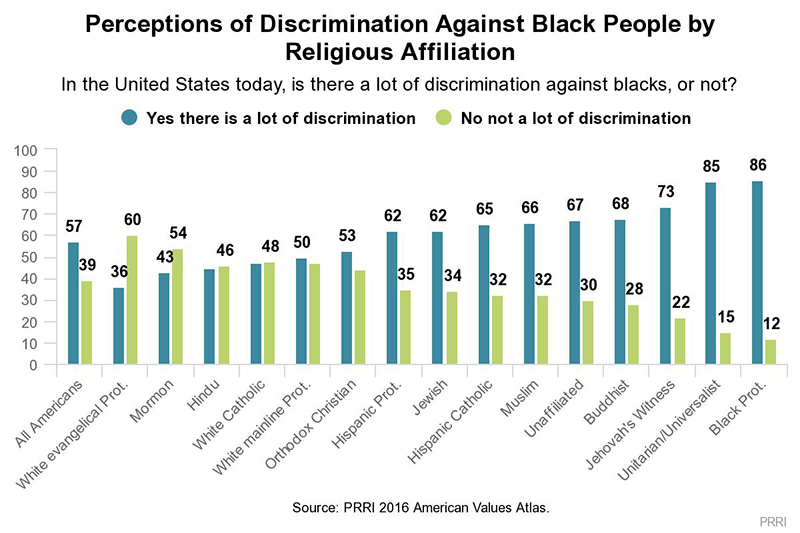
White Christians are also oblivious or in denial when it comes to the reality of racism and discrimination, according to data from the Public Religion Research Institute. Pernicious stereotypes about race and poverty, of course, are two sides of the same coin. While 57 percent of Americans acknowledge significant levels of racism against black people, PRRI found, those numbers were dramatically different for white Christians. Only 36 percent of white evangelicals and 47 percent of white Catholics reported perceiving discrimination against African-Americans. Partisan affiliation has the most significant influence on these attitudes about race and poverty, but religious identity is also a key factor.

PRRI 2016 American Values Atlas“Perceptions of Discrimination Against Black People by Religious Affiliation.” Graphic courtesy of PRRI

There are complex theological, cultural and political reasons behind these numbers that scholars can dissect with academic detachment. But at a fundamental level, there is a crisis at the heart of white Christianity. The dark-skinned Jesus who preached justice to those in the shadow of an empire would likely not recognize many of his nominal followers today.

Too many white Christians sacrifice the gospel’s radical solidarity with the poor and oppressed with comfortable, self-serving ideologies. Prosperity gospel preachers affirm the cult of consumerism and individualism. Evangelicals rally behind political leaders who make a holy trinity out of tax cuts for the wealthy, attacks on social safety nets and anti-government propaganda. A majority of the descendants of white Catholic immigrants once feared and loathed in this country voted for a president who ran on an explicitly nativist message.

In this upside-down world, white Christians can justify taking away health care coverage from struggling families and blindly worship the false idol of “trickle-down” economic theories that Pope Francis has rightly called a “crude” and “naïve” fantasy. Climate change that already displaces the most vulnerable around the world is denied or blithely dismissed as liberal hyperventilating.

A strain of American Christianity has always been interwoven with a secular creed of “rugged individualism.” Work hard and sacrifice, the dogma goes, and you will reap rewards both material and spiritual. Growing up, Donald Trump imbibed the sugary, self-help messages of his pastor, Norman Vincent Peale, author of the best-selling book “The Power of Positive Thinking.”

A forerunner to later prosperity preachers, Peale preached a convenient gospel that the ambitious found alluring. The wealthy deserved to be rich. Individuals create their own destiny. There is no room in this narcissistic religion of the self for a sober analysis of social sin. It’s one thing to acknowledge personal moral failings as inherent to the human condition. It takes a cognitive leap from the personal to the systemic to understand how institutions and structures also must be redeemed. “When I feed the poor, they call me a saint,” the late Brazilian Bishop Dom Hélder Câmara once said. “When I ask why the poor are hungry, they call me a communist.”

Structures and institutions are sinful when they perpetuate inequality and injustice. “People aren’t poor because they are sinners,” Noel Castellanos of the Christian Community Development Association tweeted recently. “Often people are poor because they are sinned against.”

The fact that child poverty in the U.S. is dramatically higher in the United States than in most industrialized countries has nothing to do with morally deficient children and can’t exclusively be blamed on the flaws of their parents. Personal responsibility matters and culture can influence decisions, but specific policy and political decisions play a far greater role. Before 1965, when President Lyndon Johnson signed Medicare into law, less than half of people over 65 had health insurance and 35 percent lived in poverty. In the program’s first year, more than 19 million people over 65 enrolled and poverty among older and disabled Americans decreased by nearly two-thirds.

Churches and pastors need not become sociologists or partisan cheerleaders to begin waking up white Christian America. The Hebrew prophets and Jesus stood on the side of the powerless. Those under the yoke of Pharaoh found God’s favor. If Christianity doesn’t challenge the status quo and recover its prophetic edge, the Rev. Martin Luther King reminded us, it will become an “irrelevant social club.” White Christians have much to repent for, but the work of reparation and seeking justice can begin now.

John Gehring is Catholic program director at Faith in Public Life and author of “The Francis Effect: A Radical Pope’s Challenge to the American Catholic Church.” Religion News Service published his column.


Ken Hall: ‘We are best when we act as a movement of God’

Ken Hall was the president of Buckner International from 1994 to 2012. He was also the president of the Baptist General Convention of Texas from 2003 to 2004. From deep in the heart of one Texan, he shares his background and thoughts on church and ministry. To suggest a Baptist General Convention of Texas-affiliated leader to be featured in this column, or to apply to be featured yourself, click here.

Background

Where did you grow up?

Louisiana.

Ministry

How did you come to faith in Christ?

I was raised by wonderful Christian parents who were active in Ingleside Baptist Church in Shreveport, La. The local church was a huge part of my life. As a teenager, I made my profession of faith.

Why did you feel called into ministry?

In college, I began to feel that God wanted me to serve the local church. At first I interpreted the call to be as a music minister, but as I became more engaged, the calling to pastoral ministry came into focus. Serving the local church has been a big part of my understanding of my calling. Whether at Buckner, Baylor or my various pastorates, the local church has been my anchor.

In addition to your most-noted position, where else did you serve in ministry?

Trinity Baptist Church, Tyler; Riverside Baptist Church, Stephenville; Eastwood Baptist Church, Gatesville; Crestview Baptist Church, Midland; First Baptist Church, Longview; and Baylor University.

When did you leave your most-noted position and/or retire from full-time ministry?

I retired from Buckner International in 2012.

How have you occupied yourself since then?

After a brief six months of failing miserably at retirement, I was asked by Baylor University to serve as senior vice president of university development and strategic initiatives. I served in that role for two years, until the fall of 2014.

Where do you live now, and where do you go to church?

Linda and I live in Longview and are active in First Baptist Church Longview.

What was your favorite or most joyful aspect of ministry? Why?

I loved the relational aspect of Christian ministry. It is a blessing to be a part of the lives of people who are serving the Lord together. The very best friendships are those that are formed around a joint sense of calling to serve the community or ministry in which you are engaged. Whether it was the church or the institutional ministry I was called to serve, the relationships with fellow Jesus followers made the journey worthwhile.

What element of ministry do you wish you could have changed?

I am sure most preachers later in life wish they could change what they preached as a young preacher. I am no different. My sermons were less about Jesus and often about me. If I could do it over, I would be more transparent and less judgmental. I wouldn’t preach for outcomes but preach to impart truth in a spirit of compassion. I would be more sensitive to the issues that people in the pew are facing rather than choosing sermons that reflect my preconceived ideas.

How did your perspective on ministry change?

I am far less sure of myself and my biases than I was as a young pastor. I have had the privilege of traveling throughout the world. Christian expression is very different in various countries and cultures. For too long I preached a “gospel” that was centered in American structures and biases.

I long for the day when, as Baptists, we primarily promote the unique aspects of soul competency that tear down barriers rather than build walls of separation.

About Baptists

What were the key issues facing Baptists during the heart of your ministry?

When I first started out in ministry, we were in the later stages of the civil rights movement. Too many of our churches were on the wrong side of that issue.

Later, the denominational controversies over the control of the SBC, BGCT and even local associations took our attention away from the main thing. Rather than finding a way to cooperate, we found ways to criticize one another. We devised plans to destroy those we disagreed with and, in turn, we destroyed our credibility.

I was a guilty party in the midst of the battles. My actions and the actions of many of my generation left a big mess for the generation after us. I pray that new leadership and the emerging leadership will study our history and not repeat our mistakes.

What would you change about the Baptist denomination—state, nation or local?

The movement called Baptist is one of the great gifts to God’s kingdom. I love the Baptist emphasis on soul competency, transformational redemption and grace-centered relationships. Our heritage is one that must be treasured, taught and remembered.

Too often in our history, we have focused on our differences rather than the truths that unite us. We get distracted by issues that Satan puts in our paths to keep us from presenting the message of the cross. We are best when we act as a movement of God and not a denomination that needs to be preserved.

The truths we espouse are not items that can be quantified by structure, hierarchy or pronouncements. We preach Jesus and his grace. We believe that all people can come to Jesus without preconditions and receive his salvation. We teach that no man or tradition stands between us and God. As believers, we Baptists practice a faith that is local in its expression and can be manifested throughout the world as we work together.

If we worried less about surviving and more about setting out on the journey that lies before us, we would be stronger. Continually tweaking our structure and systems will not make us stronger. Learning to be cooperative, being collaborative and remembering what it really means to be a Baptist will be the way to face our future.

About Ken

Who were/are your mentors, and how did/do they influence you?

James Garrett was the pastor of Trinity Baptist Church in Tyler. I served as minster of music and youth under his leadership for four years. He loved me, used me, guided me, chastised me and endorsed me. Brother Garrett was my father in the ministry.

My seminary professor, Scott Tatum, taught me how to prepare a sermon and to live the sermon during the week. He is a pastor’s pastor. I owe a large part of my ministry to him.

Presnall Wood, former editor of the Baptist Standard, taught me how to administer an organization. As a pastor and institutional head, he never lost his focus to serve the local church. Presnall always told the truth in love.

Who is your favorite Bible character, other than Jesus? Why?

The apostle John is my favorite character at the moment. I am teaching the gospel of John in our Sunday School class at First Baptist in Longview. John was a man who knew how to adapt to the world he lived in. From the youngest of the original disciples to the last of the Apostles to die, he kept adapting himself so that he could share Jesus. He learned how to serve many different kinds of people over the decades of active ministry. As a former pastor, I want to be like John and continue to find a way to serve the people the Lord allows me to know.

To read more “Deep in the Hearts of Texans” columns, click here.


Letters: Immigration reform

We lived in the Middle East as IMB missionaries for almost 30 years. During the civil war in Lebanon (1975-1991), many of our national friends came to the U.S. as refugees. Now there are millions more refugees from Syria and Iraq and many more people living in poverty in Central and South American who are desperate to come to the U.S. It should be obvious that we cannot accommodate all these people and millions more who want to fulfill their “American dream”. As Christians we want to show love and compassion, but it has to be limited. We cannot throw our arms opened wide to the whole world. It would be much better for us to go to them and tell them about Jesus and teach them the Bible. Families ought to be kept together when possible, but when people come into the U.S. illegally, that is a privilege and not a right. Our system needs fixing but it cannot be unlimited no matter how compassionate we may be.

David King
Marshall, Texas


Commentary: Christian, did the news out of Charlottesville make you sick in your soul? It should

Racist protests are not morally equivalent to counter-protests on behalf of racial equality and civil rights. They never have been and never will be. No matter what anybody — including the “leader of the free world” — claims.

Did the news of violent, deadly protests by white supremacists in Charlottesville, Va., make you sick in your soul? I hope so.

  • Not only because one person was killed and others were injured grievously by a racist bigot who rammed his car down a narrow street.
  • Not only because angry white people assembled at night, carrying torches in a gathering reminiscent of Ku Klux Klan rallies designed to frighten, threaten, intimidate and demean people of color, particularly African-Americans, as well as Jews.
  • Not only because racist nationalists marched through Charlottesville’s streets, shouting, “Blood and soil” and “White lives matter.”

But also because …

Read the full article in The Dallas Morning News.

Marv Knox, former editor of the Baptist Standard, is the field coordinator for Fellowship Southwest. He wrote this column for The Dallas Morning News.


Why the Middle East?

In John’s Gospel, we read about the Samaritan woman’s encounter with Jesus. Most of what’s focused on is how Jesus rescued her from sexual sin, and rightfully so. But have you ever stopped to think about why Samaria? Why that woman?

I spent the summer in the Middle East and met a friend who drew me back to this story over and over again. She was beautiful and kind, eclipsing all the generosity the region is known for. One evening, she invited two friends and me to iftar, the evening breaking of fast during Ramadan.

After eating we sat around playing with her toddler brother and chatting. I asked her what her greatest dream in life was, and the answer was more eye opening than I could have anticipated. She talked about traveling and getting her master’s degree. Her eyes shone as she smiled and spoke of her dreams.

But then it was like a switch flipped. She said she would get married in the next few years, and children would bring happiness. My heart broke a little. Her eyes and face had faded back to normal as she spoke of marriage. She had these beautiful dreams for her life, but she was struggling to reconcile them with her identity as a Muslim and the duties that come with it. She could not find peace in who she was and what she desired out of life. 

As I prepared for this mission trip, I constantly was asked, ‘Why the Middle East?’ Of course, it was easy to say, “Well, God said ‘go,” so I’m going.” But at the end of the summer, my answer has changed a bit.

My conversation with my Muslim friend was not super-spiritual or gospel-oriented in its intention, but I realized the depth and reality of her lostness. She was made in the image of the Creator to worship and glorify God, and her identity will never be at peace apart from him. The reality of the lostness of the Middle East was undeniable, and after looking at it straight in the face, there was no way I could ignore it.  

When Jesus went to Samaria, he probably got the same kind of question: Why Samaria? Respectable people, especially Jews, never went to Samaria. But when Jesus spoke to the woman at the well, he never let her sin define her. He looked full into the face of her sin and offered salvation. He understood that she, and all of Samaria, was lost, and the only remedy was himself.

So, why the Middle East? Why Muslims? Because they are lost. My friend was my woman at the well. She was the first time I truly understood the depth of lostness and the urgency for the gospel, for her and the Middle East. So that is why I went, and it is why I will return: They are lost. 

Madi is a University of Houston student who spent the summer serving in the Middle East with Go Now Missions. Her last name is withheld for security reasons.


Voices: God’s Still Small Voice

Recently, while sitting on a porch with a calming stream babbling by in the San Juan Mountains of Colorado, I was suddenly filled with anxiety and fear. It was early in the morning and no one else was up. The air was clean and cold, but the stillness of the moment did not translate to my heart.

The reason for this anxiety and fear was not clear. It seemed to creep up on me out of nowhere. My heart was in a battle of faith, a battle to believe God is bigger than my fears and my anxiety. The passage of Scripture I was reading in that moment was Psalm 29.

This Psalm calls us to worship the Lord, to ascribe glory to his name because he is on the throne. As I was sitting on this porch in the cool of the morning, watching this stream rush by below me, I read verses 3 and 4: “The voice of the Lord is over the waters; the God of glory thunders, the Lord, over many waters. The voice of the Lord is powerful; the voice of the Lord is full of majesty.”

The Lord is on the throne. He is Lord over these waters and he is Lord over my heart. He is Lord over this fear and anxiety, which seems to dominate so much of my life. My heart needs to hear the voice of the Lord, the voice of this majestic and glorious King. His voice calms these fears and holds back this anxiety.

What Elijah heard

As I was thinking about the Lord, as I was ascribing glory to His name and longing to hear His voice, my mind turned to the prophet Elijah and his struggle with fear and anxiety in 1 Kings 19:9–18.

Elijah has defeated the prophets of Baal, and now he is fleeing from the wrath of Queen Jezebel. We see him struggle with fear and anxiety, with exhaustion and depression. He feels alone and abandoned, and he is searching for God and the voice of God.

He comes to a cave and lodges in it when the word of the Lord comes to him, calling him to come and stand in God’s presence. Elijah comes out to hear God, to be in the presence of God, to stand before the Lord.

A great and strong wind tears by breaking the mountain in pieces, but the Lord is not in the wind. After the wind, an earthquake shakes the mountain, but the Lord is not in the earthquake. After the earthquake comes a fire burning down the side of this mountain, but the Lord is not in the fire.

Finally, after the wind, after the earthquake, after the fire, there comes the sound of a low whisper, and there is the voice and presence of God.

Elijah gives his list of grievances. He tells the Lord what is causing him so much fear and anxiety, and God reassures Elijah he is not alone. God has seven thousand who have not bowed the knee to Baal, and God will call others through Elijah to help these people persevere. God speaks to Elijah in the low whisper, in a still small voice.

The low whisper of God

On that porch in the early morning, I thought I needed the wind, the earthquake, the fire to calm my fearful heart. The truth is, many times the powerful voice of the Lord does not come in a shout; it comes in a whisper.

The calming voice and presence of the Lord is not found in the noise; it is found in the quiet. The Lord speaks to us in a low whisper, and the tragedy is, much of the time we cannot hear his voice because our ears are full with the clanging of the world around us and the fear within us.

We hear the voice of the Lord when we are quiet. Step away from the wind, earthquakes, and fires of this world and prepare yourself for the low whisper your heart needs.

Fear and anxiety can be overwhelming, and they are multiplied by the busyness and noise of our world. Our hearts weren’t made to be plugged in and only busy. We were also made to rest in the presence of God.

Quiet your heart and open your ears to hear the still small voice of God. You may be in the middle of the wind, earthquake or fire, but the low whisper is coming.

Don’t miss it.

Zac Harrel is pastor of First Baptist Church in Gustine, Texas.


Voices: In Defense of Small Towns

In the first chapter of the Gospel of Mark, Jesus’ story begins just like one of our modern American tales of “making it big.”

An unknown boy from a nowhere town has a big dream, so he risks it all to leave the security of home in search of something better. He meets some scrappy, endearing, and perhaps a little dopy, friends along the way, and when they get to the big city, Capernaum in this case, the kid gets his shot in the limelight, overcomes adversity, and triumphs to the amazement and admiration of all.

Then, at the height of his fame, our hero makes a foolish decision. He gets into a fight with his best friend, and the whole thing threatens to collapse.

In Mark 1:37, Peter tracks Jesus down, all alone and outside of town. He says to Jesus, “Everyone is looking for you! You’re the talk of the town! We’ve really got something going here! Come on back so we can set up shop and make this miracle business work for us! I’ve even got a guy working on a Jesus bobblehead. Here, let me show you the mock-up.”

But Jesus isn’t buying it, or selling, as it were. He replies, “Let’s go somewhere else—to the nearby villages—so I can preach there also. That is why I have come.” It looks like Jesus is wasting his opportunity.  As soon as he gets some brand recognition in Hollywood, he throws it all away to do community theater out in the sticks.

But is it really such a tragedy to use your God-given gifts in service to small communities?

Know Thy Neighbor

I don’t think so. There’s a widespread myth in our culture that bigger is better, and you’re better off starving in the city than surviving in the country. And I use the word “surviving” intentionally. Life in rural communities is hard.

Those who don’t inherit family land or businesses often struggle to find gainful employment. Services and entertainment in small communities are often hard to come by, and the definitions of growth and success are different in places with limited capital and small markets.

But in exchange for sacrifices in luxury and opportunity, I’ve found that small towns offer a truer form of community: People know their neighbors. (Whether they like them or not is an entirely different matter.)

We care for one another and are genuinely invested in one another’s well-being. The faith life of small communities benefits from this intimacy of knowledge among neighbors. It’s harder to keep secrets and easier to hold one another accountable.

The Christian fellowship that comes naturally in small churches must be intentionally sought in larger contexts. These and other gifts await those who are willing to set down roots and forego some metropolitan conveniences.

Where Community Comes Naturally

Too often though, the draw of the bright lights has proven disastrous to small towns. Visit any rural high school and utter the question, “How do you like living here?” and you’ll inevitably hear students respond that they can’t wait to “get out of this town.” Implicit in their response is the desire to move to the city.

Now, to be fair, the same response may be common in urban high schools, but I expect that few of those urban students want to move to little towns and stake their livelihoods on the price of wheat.

And that social dynamic has generally resulted in small communities being drained of all their best and brightest, with only those who lack the means to escape being left behind. Over the course of a few decades, this has resulted in deeper impoverishment and greater struggle in rural communities, which is further compounded by the fact that small towns pour so much of their community resources into young people with little return. Meanwhile, cities feed on the lives and dreams of these young people the same as they do on the commodities imported by the same rural communities.

I don’t mean to imply that small towns are any better or more virtuous than large cities. Both are inhabited by human people with all their faults and failures, but small towns carry an undeserved bad reputation in our society. Some days I wonder why my millennial peers—for all their talk of community, concern for sustainability and appreciation for minimalism—are unwilling to invest their lives in a place where these things come naturally and are simply a way of life.

Perhaps it’s because it’s hard to come home.

The Haven of Small Communities

When Jesus went back to his hometown in Mark 6, the people didn’t accept him, and their lack of faith even curbed his divine power. That’s not a ringing endorsement of small towns. But even so, in the verses that immediately follow Jesus’ rejection in Nazareth, he carries on “teaching from village to village” and sends out his disciples two by two into the small towns.

Perhaps more of Jesus’ modern disciples will join me in the haven of small communities where the hurry and excess of the city are less tempting and where community life is natural and necessary.

Chris McLain is the pastor of First Baptist Church in Crowell, Texas.


Second Opinion: I’m a black pastor. Here’s why I’m staying in the Southern Baptist Convention

Lawrence Ware’s recent New York Times op-ed, “Why I’m Leaving The Southern Baptist Convention,” raised questions about race and the future of the country’s largest Protestant denomination, which claims more than 15 million members. As a black pastor and the author of the SBC’s recent “Alt-Right Resolution,” many have asked me about my commitment to the convention.

I almost left the SBC 11 years ago, but I remain committed to the larger cause. Even when we do not fit well together, when we don’t understand each other and when we struggle to like each other, we need each other.

Cornerstone Baptist Church, where I pastor in Arlington, Tex., has been greatly helped by the SBC since we decided to join the SBC 33 years ago. The SBC needs pastors like me and multicultural congregations like the one I pastor to accomplish our shared mission to evangelize the entire world for Christ.

Believe me, there are plenty of things in the SBC that make me uncomfortable, and I don’t always …

Read the full article in The Washington Post.

William Dwight McKissic Sr. is the senior pastor of Cornerstone Baptist Church in Arlington.


Commentary: Anti-immigrant bill runs contrary to my values as a Christian and an American

WASHINGTON (RNS) — Last week saw another attempt by the White House and some in Congress to hurt our country’s most vulnerable people.

The Reforming American Immigration for Strong Employment Act — or the RAISE Act — introduced by Sens. Tom Cotton, R-Ark., and David Perdue, R-Ga., seeks to separate families and commodify the worth of individuals by moving the U.S. to a so-called “merit-based” immigration system.

This is completely contrary to my values as a Christian and an American who fully believes we must welcome — not turn away — our neighbors, and we must prioritize the unity of each family.

Undoubtedly, we need to reform and modernize our immigration system, which keeps families separated for far too long. But this proposal takes us in the opposite direction, exacerbating the harm inflicted on families and members of our communities by our current immigration system.

We saw the consequences of these policies play out last week, when 39 of our brothers and sisters in San Antonio were trapped inside a sweltering semitrailer. Banging against the trailer walls and taking turns gasping for air, these men, women and children begged for their lives, praying for a miracle.

Ten of these souls died brutal, inhumane deaths.

My faith teaches me that their lives were no less dignified nor cherished than my life or the lives of my fellow Americans. More than two dozen other individuals suffered serious injuries, stuffed shoulder-to-shoulder in that truck among the dying.

These mothers, fathers, brothers, sisters, and adult sons and daughters, risked everything in hopes of a better life here in America. All were victims of a broken immigration system — and all were ill-served by government officials who seek to score cheap political points by slamming the door on people seeking a better life.

This administration and some members of Congress have touted what can only be described as hateful rhetoric regarding immigrants and refugees, intentionally stoking fears to appeal to our basest instincts rather than our best values.

For Christians, our faith tradition decisively calls us not into fear, but into love. Matthew 22:39 calls us to love our neighbors as ourselves, and Romans 12:13 tells us in no uncertain terms to extend hospitality to strangers.

We need government officials at all levels to be honest about the real cause of these tragedies — including an inaccessible legal immigration system so strict that it denies individuals the God-given desire to be with their family members. A system that only allows in people who have certain education levels, work history, English-language ability, high-paying job offers, or past achievements is not a humane or lasting solution.

For decades, our government has increased fencing, walls, deportation forces, detention centers, and enforcement strategies, but our lawmakers have refused to modernize our visa system or address the status of our undocumented community members who have no line to stand in. We have made legal immigration nearly impossible, we have criminalized undocumented immigration, and we have turned a blind eye to the deadly consequences. And now Senators Cotton and Purdue want to take us even further down this immoral path.

Many divisions are being inflamed by President Trump’s proposed border wall and Congress’ complicity in providing him the funding to make it a reality.

Increases in the deportation force, detention regime, and border militarization will never serve to fix our immigration system. Neither will making legal immigration nearly impossible for people to access in a timely way. These policies have failed for decades, serving only to cause our immigrant neighbors to live in constant fear.

Congress should reject the RAISE Act, cut funding for deportation, detention, and border militarization, and invest in addressing the root causes of migration: making our legal system more accessible, including for families seeking to be reunited, and helping people be able to sustainably and safely live in their home countries.

For our nation and our world, we pray that Congress will demonstrate moral courage and reject the RAISE Act, instead enacting immigration reform that recognizes the dignity of each person and family, creates a way for immigrants to pursue legal status and citizenship, and addresses the root causes of migration.

It is high time for our nation’s immigration policies to reflect the welcoming virtues of love and hospitality.

John L. McCullough is president and CEO of global humanitarian agency Church World Service. Religion News Service published his column.