Guest Editorial: Keeping Jesus Right-Side Up

A few days ago, an unexpected wave of emotion swept over me as I was preparing to leave the pastor’s study of First Baptist Church for the final time as the senior pastor. With an open Bible, an inquiring mind, and a listening ear, I have spent countless hours in this room over the past 12 years. This room has served well as a place reflection at times and a place of refuge at others, It is a place where I have offered fervent prayers and a place where I have heard gut-wrenching confessions. It is a place where I have shared generous encouragement and a place where I have uttered occasional rebuke.

Barry Howard This is the same study where I have prepared sermons, offered counsel, planned memorial services, prepared for baby dedications, brain-stormed with key leaders, and conferred with my trusted colleagues. This is the same study where I have laughed at times and cried at times. These walls framed treasure memories and have witnessed countless secrets.

With the last of my personal belongings in hand, when I reached the door, I looked back to make sure I had not left anything behind. While scanning the room, I saw it. “JESUS” was upside down. So, my last act upon departing the pastor’s study on Friday was to turn “JESUS” right side up again.

Among the many plaques, trinkets, and gifts given to me across the past 12 years is a sign made of two colors of wood that highlight the name, “JESUS.” Rather than being inscribed or engraved, “JESUS” is revealed by the strategic arrangement of the contrast in wood and color.

I’m not really sure how “JESUS” got turned upside down in the first place. A member of the housekeeping staff could have inadvertently flipped the sign while dusting. I could have overturned “JESUS” in my packing frenzy. Or one of the children visiting my study last week could have reversed the upright position of “JESUS” while playing with him.

My realignment of “JESUS” became rather parabolic for my final weekend. I realized again how easy it is, despite our best intentions, for the church to turn “JESUS” upside down, misrepresenting Jesus to our community.

We turn Jesus upside down when we minimize our faith as mere formulaic transaction. We turn Jesus upside down when we buy into consumerist Christianity. We turn Jesus upside down when we try to label Jesus as a Democrat or Republican. We turn Jesus upside down when we operate the church as a religious institution. We turn Jesus upside down when we exclude people who are unlike us. We turn Jesus upside down when we veer toward the extremes of legalism on the right or liberalism on the left.

We turn Jesus upside down when we contentiously frame worship as contemporary or traditional. We turn Jesus upside down when we take his words and teachings out of context to affirm our own presuppositions. We turn Jesus upside down when we preach partisan politics from the pulpit. We turn Jesus upside down when there is a huge disparity between our words and actions. We turn Jesus upside down when we confess his Lordship but we neglect worship. We turn Jesus upside when we avoid addressing tough topics and tough issues allowing injustice and untruth to go unchallenged.

To maximize our impact and influence in the community, it is imperative for the church to keep “JESUS” right side up, from the pastor’s study to the pew. We turn Jesus right side up when we faithfully share the love of God in word and deed. We illustrate Jesus right side up when we invest time and resources in “the least of these,” the disadvantaged and underserved in our city and around the world. We proclaim Jesus right side up when we “make more space for grace.” We exemplify Jesus right side up when we leverage our diversity within the body of Christ. We present Jesus right side up when we perceive other churches to be our colleagues, not our competitors. We portray Jesus right side up when we open the doors of our church more widely than ever before, recognizing that many disconnected individuals need to walk alongside us before determining to join us on this journey of faith. We embody Jesus right side up when we confront racism and courageously contend for the equality. We preach Jesus right side up when we refuse to give up on anyone, even those we perceive to be the most hopeless and hardcore of sinners.

And so, as I prepare to transition into a new season of ministry, my final action upon departing the pastor’s study is to turn “JESUS” right side up. And our challenge is to keep turning Jesus right side up in a world where far too often the message of Jesus is turned upside down.

Barry Howard was pastor of First Baptist Church in Pensacola, Fla., and is a leadership coach for the Center for Healthy Churches, where this article was originally published.


Commentary: Religious liberty for all

WASHINGTON (RNS) — A recent survey found only 2 percent of evangelical Christians indicated that the Bill of Rights made America great, although more than half said they highly value the freedom of religion and less than half said they appreciate America’s Christian roots.

Curtis Freeman 200Curtis FreemanThis lack of enthusiasm stands in sharp contrast to earlier generations. The overwhelming number of evangelical Christians during the formative period of our constitutional democracy regarded the freedoms enshrined in the Bill of Rights to be essential for making America great. The Constitution and the Bill of Rights created the environment for the United States to become a Beulah Land where religious dissenters of all sorts flourished because it ensured that liberty was for all.

Evangelical Christians have not lost their mind, but they have clearly lost their memory. If our fragile democracy is to survive this social amnesia, it is important for all Americans to recover our collective memory by learning anew the important stories of the forgotten tradition of religious dissent and the ways it shaped American democracy, and more importantly how dissent ensures democracy’s vitality.

When the U.S. Constitution was proposed in 1787, Article VI declared in the strongest possible language that “no religious test shall ever be required as a qualification to any office or public trust.” This was the only reference to religion in the entire text, but an important one. It reflected the fact that the conviction of religious liberty in England was forged in the fires of one religious test after another.

Religious dissenters, who included anyone not in good standing with the Church of England, were excluded by law from holding public office, attending university or serving in the military. In the event that a dissenter was elected to public office, there was a provision for an exception, as long as dissenting Christians received Communion in the Church of England within a year. Daniel Defoe sharply criticized the “occasional conformity” of dissenters who engaged in this dubious practice to qualify for the privilege of employment or public office, saying they were mortgaging their consciences and playing a game of Bo-peep with the Almighty.

The application of religious tests to exclude dissenters was something the Framers wanted to explicitly prohibit. But even the constitutional provision against religious tests was not sufficient for John Leland and the Baptists of Virginia. For Leland, true liberty was more than toleration, which presupposes preeminence of one and indulgence of others. Genuine liberty, he argued, must apply equally to “Jews, Turks, Pagans and Christians.” Liberty must be for all or it is not liberty at all.

To secure this liberty, Leland met with James Madison, who was preparing to run for the Constitutional Congress of 1788. Leland protested that the Constitution had no provision for religious liberty. Madison agreed, but he stated that if elected he would work to secure religious liberty as he had done in Virginia. Leland and the Baptists agreed to support Madison, who was elected by a large margin. Virginia passed the Constitution in June 1789, and Madison went on to write the Bill of Rights, which was approved in 1791. The First Amendment made good on his promise to religious dissenters, declaring that “Congress shall make no law respecting an establishment of religion, or prohibiting the free exercise thereof.”

Evangelical Christians in the founding of our republic understood something worth remembering. The flourishing of their communities depended on the extension of religious freedom, not only to minority Protestant dissenters like themselves, but to all — Protestants, Catholics, Jews, Muslims, and people of all faiths or none at all.

Evangelical Christians are not alone in suffering from a severe case of historical amnesia. It is a condition afflicting many Americans who have no memory of the inclusive vision in the Bill of Rights.

Even more importantly we are in danger of losing the recognition of, and capacity for, living with fundamental religious differences, which is a foundational condition to the basic political tolerance on which American democracy depends. Religious pluralism is a legacy of religious liberty. Both were crucial in the formation of American democracy, and both remain essential for its flourishing today.

We must not allow a misremembering of history to change religious liberty into a presumed privilege of a religious majority (real or assumed) or to become a tool of exclusion used against religious minorities (no matter how different from us they may be). To do so turns our founding principles on their heads. It was just such a bad idea that called for the creation of the lively experiment that became America. Let’s celebrate and defend religious liberty for all, and make America great again.

Curtis W. Freeman, research professor of theology at Duke Divinity School and director of the Baptist House of Studies, is the author of the new book Undomesticated Dissent: Democracy and the Public Virtue of Religious Nonconformity from Baylor University Press. 


Commentary: White supremacy at odds with Scripture; time to actively reach across racial divides

The staff of the Christian Life Commission condemns the hateful and violent ideology and actions put on display by white supremacists in Charlottesville, Va. …  We also call Texas Baptists to address the less inflammatory aspects of racial division and rhetoric persistent in our culture.

The people who marched in Charlottesville proclaiming messages of white supremacy and hate toward non-whites are speaking against the truth of God as revealed through Jesus Christ and recorded in Scripture.

The Bible says:

  • All people are created in the image of God (Genesis 1:27);
  • In Christ, all persons, no matter their differences, are viewed by God as of equal value. (Galatians 3:27-28);
  • The Great Commandment says to love one’s neighbor as oneself, and Jesus told the story of the Good Samaritan to illustrate that our neighbor is anyone in need, no matter what one’s ethnic or national identity (Luke 10:25-37); and
  • People who pursue righteousness and kindness will find life, prosperity, and honor (Proverbs 21:21).

These core principles of Scripture dictate a Christian response to racial hatred. Each Christ follower has a responsibility to bridge the racial gap in the United States. We are responsible because this divide has seeped into our churches and infected how we think about our brothers and sisters in Christ who do not share our skin color, our culture, our language.

Micah 6:8 is the verse that drives the Christian Life Commission in its work. The verse begins with two questions: What is good? What does the Lord require of you? The answer to both questions is the same —

  • Do justice
  • Love kindness
  • Walk humbly with your God

This is good. This is what God requires of his people. Each of these commands begins with an action verb; we must actively pursue what is good.

It is time we actively seek friendships with those of other races. That we listen and seek to understand what life is like for those who are different from us. That we worship together. That we work together to address community needs. That we pray with one another. That we be honest with one another. But, most importantly, that we show love toward each other.

The Christian Life Commission helps Texas Baptists apply their faith to life through Ethics, Public Policy and Community Ministry. The Bible serves as the foundation for the CLC’s work. As the CLC addresses various ethical and policy issues, it does not speak for Texas Baptists. Rather, the CLC speaks to Texas Baptists and to others about issues as determined by its 18 commissioners. 


David Currie: ‘Doing what I was gifted to do for Baptists’

David Currie was the executive director of Texas Baptists Committed  22 years. From deep in the heart of one Texan, he shares his background and thoughts on church and ministry. To suggest a Baptist General Convention of Texas-affiliated leader to be featured in this column, or to apply to be featured yourself, click here.

Background

Where did you grow up?

The small town of Paint Rock, Texas. I had a high school graduation class of five, all boys. My great-grandfather, David Blount Currie, came to Paint Rock in 1879. He and his two brothers are buried there, as are my grandfather and father, but the first Currie to come to Texas was Robert Morrison Currie, who founded the First Baptist Church in La Vernia and was the first moderator of the San Antonio Baptist Association.

How did you come to faith in Christ?

My family, all the Curries, and there were many back then, never missed church. I felt the urge to express faith at age 8. A friend followed me that day and six other kids the next Sunday. I was baptized in the Concho River on Uncle Bill’s place by James Golden.

Why did you feel called into ministry?

I started feeling the call in junior high, and it got stronger the summer before my senior year in high school. Final confirmation came the summer I graduated at Lake Brownwood encampment with great help from Ferris Akins, pastor for First Baptist Church of Ballinger, a wonderful man.

In addition to your most-noted position, where else did you serve in ministry?

I was youth minister at First Baptist Church of Gorman, then served with Foy Valentine at the Southern Baptist Christian Life Commission and as pastor of First Baptist Church Mason.

When did you leave your most-noted position and/or retire from full-time ministry?

Fall of 2009.

How have you occupied yourself since then?

I have always identified myself first as a rancher, then a minister, and now as a developer and custom homebuilder and Sunday School teacher, but God and I argued through my love for the dirt in Concho County long ago and reached a peace about it. I’ve had a wonderful life doing what I was gifted to do for Baptists and living 45 minutes from my ranch.

Where do you live now, and where do you go to church?

I live on 325 acres south of San Angelo (great deer hunting) and teach young professionals in Sunday School at Southland Baptist Church in San Angelo.

Ministry

What was your favorite or most joyful aspect of ministry? Why?

The people I got to know though the years of leading Texas Baptists Committed, some wonderful pastors and especially laypersons.

What part of ministry delivered the greatest heartache or headache?

Phil Strickland and I used to lament the lack of courage of so many during the most important battle in Southern Baptist life. It was quite depressing to see so many just ignore the evil that was the fundamentalist movement in the SBC. What they did to our seminaries and other institutions is truly tragic.

What would you tell the young you, just starting out in ministry?

TBC used to host young ministers’ retreats, and I would tell the young pastors that their first job was to love the people, not change them or the church. Love the people, be honest with them, be honest about your own struggles and together, with the lay leadership, a church can be changed and made more effective.

What do you wish more laypeople knew about ministry or, specifically, your ministry?

I don’t think many realized that we were not trying to control Texas Baptists like the fundamentalists were. We worked to save the BGCT so it could be inclusive; the SBC takeover was about taking control in order to be exclusive. That is a huge difference in motivation. I wish more lay people had realized what the takeover was really about.

About Baptists

What were the key issues facing Baptists during the heart of your ministry?

Were Texas Baptists going to stay real Baptists? I’m still not sure.

What would you change about the Baptist denomination—state, nation or local?

The SBC is no longer a Baptist denomination except in name, so obviously I’d change it back to a Baptist group. I would want our state denominations and local churches to respect each other more and Baptist principles like local church autonomy more. I was heartbroken by the action taken by the convention last fall, but I won’t comment further. I’d like to work with Fellowship Southwest as a volunteer in my “golden years” if they don’t think I’m too conservative! Maybe there is a place for me there.

About David

Who were/are your mentors, and how did/do they influence you?

First was my mother, Mary Jim, a remarkable, opinionated woman of grit and courage. She had great sayings like “You have to live in the real world” and “I hate dumbness,” among others. My parents influenced me by being so loving and supportive of me.

Nat Tracy, a professor at Howard Payne who retired the year I graduated in 1975, is the major influence on my theology with his teachings on what Christianity means to God. He taught me God’s character is unconditional love, acceptance and forgiveness. I quote something from him every Sunday. Please read his book, finished by Gary Manning, titled The Search for Authentic Christianity.

James Shields from Howard Payne taught me what you do comes out of who you are and you have to be before you can do.

Boo Heflin, Bobby Adams, Yandell Woodfin and so many other professors at Southwestern Seminary made the Bible come alive for me and taught me to think for myself and encouraged me in so many ways. Losing that seminary was a tremendous loss to the kingdom of God.

Foy Valentine taught me to learn the difference between making noise and getting something done.

Phil Strickland, my best friend and personal hero, taught me that you can get a lot done if you don’t mind who gets the credit. Phil was actually co-executive director of TBC. We talked constantly for 20 years and loved each other deeply.

I have been blessed with two wonderful friends in Gary Elliston and Jimmy Heerwald, both of whom I met the day I checked into the athletic dorm at Howard Payne in 1971. That’s a long time.

I have been wonderfully blessed with other, wonderful friend/mentors, like the late Ira Peak, Jr., the late Phil Lineberger, the late John Petty, Sam McCutchen, Floyd Craig, David Sapp, Doug Ezell, Charles Wade, Bill Bruster, Ron Cook, Charlie Johnson, George Mason, and so many more. If friends make you wealthy, I’m sure rich.

Other than the Bible, name some of your favorite books or authors, and explain why.

I have been greatly influenced by the writings of Frederick Buechner, Robert Farrar Capon, John Claypool (who was a personal friend), Wendell Berry, Will Campbell (also a friend) and M. Scott Peck. And I love reading John Graves.

What is your favorite Bible verse or passage?

Galatians 5:1.

Name something about you that would surprise people who know you well.

I wonder if people are ready for this. My hair is straight as a needle, so I curl the front of it with a curling iron every morning so it doesn’t fall into my eyes!

To read more “Deep in the Hearts of Texans” columns, click here.


Analysis: Future Shock

Watching my grandkids laugh, explore and have fun, I shake my head and wonder where this culture of ours will take them. Do we realize how fast the future is rushing to meet our posterity, and us? In the days ahead, the contours of civilization likely will radically alter, sacred and secular alike, and in ways staggering to think about.

Consider the past: In 1790, 90 percent of people worked on farms; 1870, 50 percent; today, less than 1 percent. In 1900, 90 percent of the population was rural; today 90 percent is urban. Folks worked 60 hours a week over six days with a life expectancy of 47 years. Three percent of homes had electricity, and 15 percent had flush toilets.

Only one in five households owned a horse, and an eighth-grade education was the norm with college graduates numbering a scant 7 percent. Halfway through 2017, it’s hard to fathom the scale of change we’ve undergone and harder still to grasp what’s yet to take place.

Just look at computing

In 1965, Gordon Moore, Intel’s co-founder, predicted transistors on circuits would double roughly every two years. His estimate has held true, but he couldn’t have foreseen 2017 as the 10th anniversary of the iPhone. Now we can contact anyone around the world instantly – from our pockets!

Remarkably, smart phone circuitry is 150 million times more powerful than the computer NASA used to navigate Apollo 11 safely to the moon in July 1969. At the time, NASA computers stored only a megabyte of memory each, were car-sized, and cost $3.5 million apiece.

If the trend continues

Today there’s no stopping things! Forgive the technicality, but the development of carbon-based transistors in hand with quantum/nano-biological computing will take what’s listed below and advance things to ever higher levels:

  • computer processing power;
  • miniaturization/nanotechnology;
  • merging all computing/communication devices;
  • wearable technology;
  • virtual reality/holographic entertainment;
  • genetic engineering/implanted bionics for purposes of human enhancement—quite provocative; and
  • job displacement by robots, the most negative.

If the trend continues, artificial intelligence (AI) could emerge exponentially, with no turning back! Processing power exceeding the human brain may suddenly slap an unsuspecting public in the face. The brightest minds in the industry are alleging that one day, hopefully soon, machines and robots will simulate human intelligence successfully, solving challenges previously reserved only for conscious thinking.

Weak and strong AI

There are three waves of weak AI. The first solves problems very fast and works very well in video games, Excel sheets, TurboTax, etc. The second is where machines seem to learn via millions of pieces of data – Siri, Cortana, Watson, AlphaGo, Microsoft’s Tay, Twitter, Chatbox and self-driving cars. But none of these can explain the “why” of things.

Whether third-wave, weak AI is achievable is an open question. Because humans can abstract things based on small amounts of data, third-wave AI tries for the same, operating on minimal information.

The stuff of sci-fi for now, strong AI is what cognitive science is really striving for – machines that function with human-like minds, crossing the threshold into self-awareness/consciousness. Eventually downloading human consciousness to a computer is part of the game plan as well.

Who’s charting our future?

Some of the smartest and wealthiest people in Silicon Valley, the venture techno-capitalists, are teaming up to invest billions to make strong AI happen. Even Google and NASA are cooperating to this end.

Sanctioning the likes of Ray Kurzweil’s think-tank, Singularity University, and Zoltan Istvan’s Transhumanist Party, futurist investors are siding, paradoxically, with an inelegant duo – a hyper-optimistic form of scientism (only science can get at truth) and a transhumanist vision striving to achieve omnipotence (as if achieving divinity).

One dissenting voice, Elon Musk, warns his colleagues’ optimism about AI isn’t justified: “If our intelligence is exceeded, it’s unlikely we’ll remain in charge of the planet.” Bill Gates himself comments about AI, “I don’t understand why some people are not concerned.”

What is lacking

Coming too fast, Christians must begin thinking soundly about the implications of futurity – ASAP! Most techno-futurists assume as true the rationale lying behind philosophical naturalism, which popularizes the universe as a closed system into which nothing god-like can intervene to impose its will.

“In the beginning,” only particles and impersonal laws of physics reigned, and human beings are just bio-chemical machines without souls. Put crassly, we’re meat machines. Christians, of course, recognize immediately how short-sighted this is.

It doesn’t mean, however, believers won’t be influenced or charmed by futurist agendas. Some will! While we know futurists lack an adequately Christian sense of reality, their impact on society may well create a sense of uneasiness about our next cultural steps as followers of Christ.

A google of questions

So, how far will God allow things to go? Theologizing about techno-futures is imperative if we’re to remain comprehensively Christian throughout. Responding to bizarre worlds in the making is paramount. The choices we’ll make individually when faced with techno-options unavailable to earlier generations will be weighty. The church must push for answers to questions raised by the techno-future, however alarming:

Will Christians:

  • hold fast to their soulish/spiritish identities as made in God’s image;
  • be remade in the techno-futurist image, succumbing to the idea that knowledge and experience are nothing more than biochemical brain activity;
  • play fast and loose with free will as naturalists do;
  • lose their sense of morality, beauty, love, humor, creativity etc., opting for the pragmatic only;
  • become further habituated, depressed and isolated by increasing tech abuse/addiction;
  • deem various kinds of work as subhuman, preferring robots to take them over;
  • indulge in expensive enhancement, transhumanizing themselves through proven drugs, bionic devices, and DNA manipulation, especially teens falling behind and facing peer pressure?

Brief conclusion

Answering questions related to “future shock” comes down to the worldview on the table, with profound implications about how individual lives and corporate society should conduct themselves considering the techno-futurist demands coming our way.

Too few Christians and church traditions ask the question, “Just because we can, should we?” The simple answer is no, but the issues require sophisticated reasoning. According to Scripture, what you see in the mirror is a uniquely ensouled eternal being, created in God’s image and likeness and more than sufficient for the purposes he grants us.

Hal Ostrander is online professor of religion and philosophy at Wayland Baptist University. Daryl Smith is former adjunct professor of religion at Dallas Baptist University and currently an information technology corporate manager.


Voices: Whom Would Jesus Take Out?

The Washington Post reported on August 9, 2017 that Robert Jeffress, pastor of First Baptist Dallas, declared that President Trump had the biblical authority to “take out” North Korean leader Kim Jong Un.

Leaning exclusively on a vague understanding of Romans 13, Jeffress argued that the passage “gives the government … the authority to do whatever, whether it’s assassination, capital punishment or evil punishment to quell the actions of evildoers.”

Mitch RandallMitch RandallHere is what the passage actually states: “Let every person be subject to the governing authorities; for there is no authority except from God, and those authorities that exist have been instituted by God … For rulers are not a terror to good conduct, but to bad … But if you do what is wrong, you should be afraid, for the authority does not bear the sword in vain! It is the servant of God to execute wrath on the wrongdoer.” (Romans 13:1–4 NRSV).

A clear warning

Now, let’s be very clear, this passage was not written to the governing authorities but to those Roman Christians living under their authority.  Paul was not creating a “How To” manual for emperors and presidents. He was, however, encouraging Christians living under an oppressive regime to act with integrity and grace.

Paul’s warning is clear: Christians should honor the authority of governing leaders while at the same time understand there will be consequences for unruly and unlawful behavior. Paul never makes the argument that emperors should kill but simply acknowledges the reality they do when given a purpose to do so. 

Jeffress misses the mark in his argument when he neglects to consider other passages of Scripture, even those close to Romans 13. Immediately preceding it, Paul wrote, “Beloved, never avenge yourselves, but leave room for the wrath of God; for it is written, ‘Vengeance is mine, I will repay, says the Lord.’ No, ‘if your enemies are hungry, feed them; if they are thirsty, give them something to drink; for by doing this you will heap burning coals on their heads.’ Do not be overcome by evil, but overcome evil with good” (Romans 12:19–21).

When pastors and theologians fail to consider the entire Bible to make an argument about doctrine, then we fail to be objective and thoughtful practitioners of the Bible.  When Christians fall short in measuring our theology against the teaching and life of Jesus, then we can be found guilty of using the Bible for our own objectives. 

Picking and choosing

Back in 2000, the Southern Baptist Convention decided to eliminate one important sentence within the section on the Bible from their confession of faith. In that section in 1963, the sentence read, “The criterion by which the Bible is to be interpreted is Jesus Christ.” Now, only conjecture is left to determine why this sentence was eliminated from the SBC’s confession of faith, but we might now be witnessing the damage it is causing.

When Jesus is taken out of the equation when we read, interpret and apply the Bible to important situations, then anyone is left to pick and choose passages of Scripture that fit their preconceived ideals. When those preconceived ideals merge with political agendas, then the stage is set for what we have seen unfold with Jeffress’ claims.

Without Jesus to guide our thoughts and conclusions, we can make arguments for war against those we dislike and instill oppressive laws against those who worship differently than us. If we insert Jesus back into the equation, then we Christians must ask ourselves, “Whom would Jesus take out?” 

Emperors, kings and dictators have been trying to answer this question for over 2,000 years. When church and state have worked to together to eliminate common enemies with the sword, the only thing to suffer has been the gospel itself. 

If only we had Jesus saying something about what we should do with our swords when faced by an enemy? Ah, yes, how quickly we forget. 

On the night of his betrayal, as soldiers came to arrest him and Peter drew his sword to strike, Jesus said, “Put your sword back into its place; for all who take the sword will perish by the sword” (Matthew 26:52). 

Now, there is an idea!

I think I will go with Jesus on this one.

Mitch Randall is the pastor of NorthHaven Church in Norman, Oklahoma.


Voices: Colin Kaepernick and the hypocrisy of image

Thirty-two teams in the league, with each team carrying about two quarterbacks, and a quarterback who has led his team to a Super Bowl cannot get job.

Dante WrightDante WrightThere has been chatter among the NFL and its fans about the reason for Colin Kaepernick’s inability to find work in the NFL, even as a backup quarterback. Back in May, Giants owner John Mara said, “All my years being in the league, I never received more emotional mail from people than I did about that issue.” His quote suggests that the issue of Kaepernick’s patriotism and activism is the reason for his unemployment.

Other reasons have emerged that state he’d be a distraction, he doesn’t care about football, he doesn’t want to play football, he’s not a good player, and he hasn’t expressed that he actually wants to play.

Everyone has a reason for his scarlet letter.

Who needs to change?

The most recent reason for Kaepernick’s unemployment is from Michael Vick, who states that Colin Kaepernick will not get a job until Kaepernick changes his image, starting with cutting his hair. If anyone knows about changing one’s image, it is Vick, who, after being a successful quarterback, found himself in the federal penitentiary for running a dogfighting ring.

Vick was given a second chance to play in the NFL. Vick meant well, but his advice does not reflect the reason for Kaepernick’s league-wide blackballing. In fact, it is not Kaepernick that needs an image change, but the league itself.

What is it about Kaepernick’s image that needs to change? He has no criminal record and no record of drug or domestic abuse. He is not out partying all night, and he is level-headed and to himself. In other professions, this would be a laudable person to have as an employee and representative. So, what is it that makes his image undesirable?

‘A willingness to risk’

Kaepernick is a rebel rouser . . .

. . . for the right reasons, calling our attention to the bigotry and hypocrisy of our nation. In doing so, he questions what patriotism is by protesting — peacefully I might add — the national anthem.

He holds camps for disenfranchised youth of color, teaching them their rights, and he is outspoken and knowledgeable about the pain in black communities. He has opted to use his platform, as Muhammed Ali did in the past, to not only raise awareness but to be an activist.

This is the image everyone wants him to change.

Why not just be a football player? they say. However, Kaepernick got it right. Our positions of power and privilege are to be used to transform society. There must be a willingness to risk it all for what is hard yet right. In fact, we must be willing to take the righteous path even if that path leads us away from the things we love.

The NFL’s image

While Kaepernick’s image is being questioned, it is interesting to me that the NFL’s image is not. They are a league that insists on signing players who have a history of domestic abuse, among other problems, and while these crimes certainly create problems and distractions for teams and fans, they are not deal breakers for players receiving sizable paychecks.

They are not hurdles too high for players and teams to jump over, but an outspoken black activist is a deal breaker. He is too much of a distraction. He takes away from the joy of the game, while these other issues are mere stains. What hypocrisy!

As the league overlooks abuses against humanity, they blackball someone who calls attention to them and wants to transform them. While the NFL boasts of paid patriotism, it neglects to see that the atrocities committed against women by their players and against sex slaves by their fans and employees during the Super Bowl are in direct contradiction to the patriotic fervor they espouse.

The bottom line is that Kaepernick hurts their bottom line and shines a light on the nation and the NFL’s tarnished image.

Dante Wright is pastor of Sweet Home Baptist Church—known as the Pinnacle of Praise—in Round Rock.


Voices: Living in Two Worlds

“Maybe in a perfect world, but that’s not the world we live in.”

I’ve heard some version of this statement several times in the last week, in various contexts. I think the nexus for the last time was a discussion about my and my wife’s shopping habits.

Jake RaabeJake RaabeWe have serious problems with Walmart that keep us from shopping there unless absolutely necessary. Instead, we frequent our town’s farmers market. Our Christian convictions lead us to believe that buying locally and directly from farmers is more socially responsible and environmentally sustainable, so that’s what we try to do.

This is, of course, significantly more expensive than buying from Walmart and means we typically have to make less go further. We don’t “proselytize” for farmers markets, but if we’re asked about our shopping habits, we don’t mince words about the damage we think that mega-chains like (especially) Walmart are doing to both society and the environment. (Fear not, Texans: HEB is actually a pretty great company and a fantastic alternative to Walmart).

The conversation usually moves to “but Walmart is cheaper, so that’s where people will always go” (even if the low prices are due to employing sweatshop workers in third-world countries).

In contemporary American society, the dollar is king. We make economic decisions based on what gets us the most for the least in return. But then again, Christians are citizens of Americans secondarily; we are first citizens of the kingdom of God, and in the kingdom of God, proper treatment of other humans is more important than paying less money for a pair of shoes.

See, Christians live in two worlds: the world that is, and the world that will be. Jesus’ incarnation, life, death and resurrection have changed the world in a profound way. Because of Christ’s work, we are free to die to ourselves, to live a new, changed Christ-centered life.

The kingdom of God is here in part, and we should live accordingly. We should live according to the standards of God’s kingdom: the love of our enemies, the respect for all people, the self-discipline of Christian discipleship. God rules the world, all of it, and those of us that are citizens of God’s kingdom should live accordingly.

At the same time, God’s kingdom is not here on earth in the same way that it one day will be. Paul tells us that “the whole creation has been groaning as in the pains of childbirth right up to the present time.” The world, in other words, is waiting to be completely and totally redeemed at the time of Christ’s return.

Not only the world, says Paul, but “we ourselves, who have the firstfruits of the Spirit, groan inwardly as we wait eagerly for our adoption to sonship, the redemption of our bodies.” We too recognize that we live in a world fundamentally changed by the work of Christ but one still waiting for its complete redemption when Christ returns.

The kingdom of God is both here and yet-to-come. It is both in our midst and something we look forward to in expectant hope.

The people I talked to this week didn’t understand why my wife and I paid more for our groceries. In American society, saving money is a high cultural value. In the kingdom of God, respect for persons and compassion are higher values. Because we live as citizens of God’s kingdom, we live by a different set of values than the culture around us. God’s kingdom teaches us that people are more important than saving money, so we spend our money at places where we know that no product sold involves abuse or exploitation.

Remember: Christians live in two worlds. Though we may exist for now in a world that doesn’t mirror God’s intentions for creation as it should, we derive our values from the world-that-will-be.

“That’s just the way things are” isn’t an excuse for Christians. We don’t live according to the way things are; we live according to the way things will be.

Jake Raabe is a student at Baylor University’s George W. Truett Theological Seminary in Waco, Texas and a writer. Follow him on his Facebook page.


Commentary: What is wrong with white Christians?

(RNS) — What is wrong with white Christians?

This isn’t meant to simply be a provocative question. A new survey from The Washington Post and the Kaiser Family Foundation offers the latest dispiriting news about the troubling state of white Christianity.

Christians, the study found, are more than twice as likely to blame a person’s poverty on individual failings than Americans who are atheist or have no specific religious affiliation. White evangelical Christians, who voted overwhelmingly for President Trump and continue to be some of his most steadfast supporters, are especially wedded to this worldview. Half of white Catholics also cited lack of effort — read: laziness — rather than difficult circumstances as the primary reason why people are poor. Less than a third of African-American Christians agree.

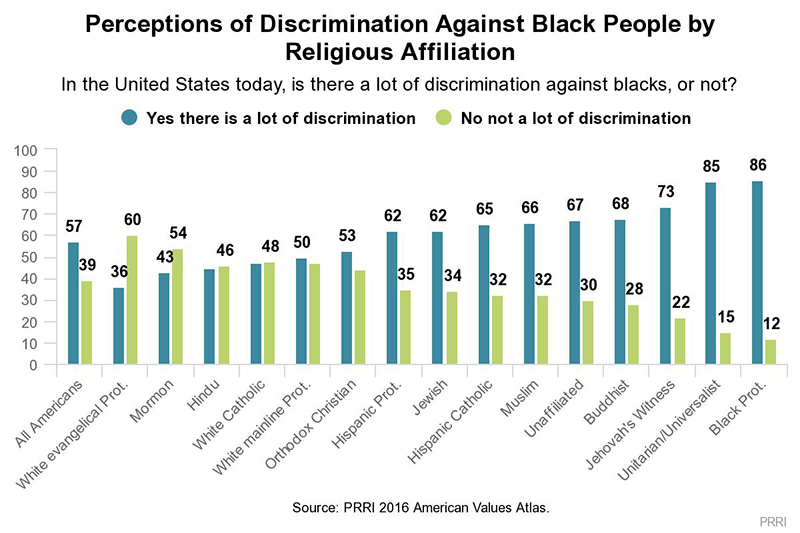
White Christians are also oblivious or in denial when it comes to the reality of racism and discrimination, according to data from the Public Religion Research Institute. Pernicious stereotypes about race and poverty, of course, are two sides of the same coin. While 57 percent of Americans acknowledge significant levels of racism against black people, PRRI found, those numbers were dramatically different for white Christians. Only 36 percent of white evangelicals and 47 percent of white Catholics reported perceiving discrimination against African-Americans. Partisan affiliation has the most significant influence on these attitudes about race and poverty, but religious identity is also a key factor.

PRRI 2016 American Values Atlas“Perceptions of Discrimination Against Black People by Religious Affiliation.” Graphic courtesy of PRRI

There are complex theological, cultural and political reasons behind these numbers that scholars can dissect with academic detachment. But at a fundamental level, there is a crisis at the heart of white Christianity. The dark-skinned Jesus who preached justice to those in the shadow of an empire would likely not recognize many of his nominal followers today.

Too many white Christians sacrifice the gospel’s radical solidarity with the poor and oppressed with comfortable, self-serving ideologies. Prosperity gospel preachers affirm the cult of consumerism and individualism. Evangelicals rally behind political leaders who make a holy trinity out of tax cuts for the wealthy, attacks on social safety nets and anti-government propaganda. A majority of the descendants of white Catholic immigrants once feared and loathed in this country voted for a president who ran on an explicitly nativist message.

In this upside-down world, white Christians can justify taking away health care coverage from struggling families and blindly worship the false idol of “trickle-down” economic theories that Pope Francis has rightly called a “crude” and “naïve” fantasy. Climate change that already displaces the most vulnerable around the world is denied or blithely dismissed as liberal hyperventilating.

A strain of American Christianity has always been interwoven with a secular creed of “rugged individualism.” Work hard and sacrifice, the dogma goes, and you will reap rewards both material and spiritual. Growing up, Donald Trump imbibed the sugary, self-help messages of his pastor, Norman Vincent Peale, author of the best-selling book “The Power of Positive Thinking.”

A forerunner to later prosperity preachers, Peale preached a convenient gospel that the ambitious found alluring. The wealthy deserved to be rich. Individuals create their own destiny. There is no room in this narcissistic religion of the self for a sober analysis of social sin. It’s one thing to acknowledge personal moral failings as inherent to the human condition. It takes a cognitive leap from the personal to the systemic to understand how institutions and structures also must be redeemed. “When I feed the poor, they call me a saint,” the late Brazilian Bishop Dom Hélder Câmara once said. “When I ask why the poor are hungry, they call me a communist.”

Structures and institutions are sinful when they perpetuate inequality and injustice. “People aren’t poor because they are sinners,” Noel Castellanos of the Christian Community Development Association tweeted recently. “Often people are poor because they are sinned against.”

The fact that child poverty in the U.S. is dramatically higher in the United States than in most industrialized countries has nothing to do with morally deficient children and can’t exclusively be blamed on the flaws of their parents. Personal responsibility matters and culture can influence decisions, but specific policy and political decisions play a far greater role. Before 1965, when President Lyndon Johnson signed Medicare into law, less than half of people over 65 had health insurance and 35 percent lived in poverty. In the program’s first year, more than 19 million people over 65 enrolled and poverty among older and disabled Americans decreased by nearly two-thirds.

Churches and pastors need not become sociologists or partisan cheerleaders to begin waking up white Christian America. The Hebrew prophets and Jesus stood on the side of the powerless. Those under the yoke of Pharaoh found God’s favor. If Christianity doesn’t challenge the status quo and recover its prophetic edge, the Rev. Martin Luther King reminded us, it will become an “irrelevant social club.” White Christians have much to repent for, but the work of reparation and seeking justice can begin now.

John Gehring is Catholic program director at Faith in Public Life and author of “The Francis Effect: A Radical Pope’s Challenge to the American Catholic Church.” Religion News Service published his column.


Ken Hall: ‘We are best when we act as a movement of God’

Ken Hall was the president of Buckner International from 1994 to 2012. He was also the president of the Baptist General Convention of Texas from 2003 to 2004. From deep in the heart of one Texan, he shares his background and thoughts on church and ministry. To suggest a Baptist General Convention of Texas-affiliated leader to be featured in this column, or to apply to be featured yourself, click here.

Background

Where did you grow up?

Louisiana.

Ministry

How did you come to faith in Christ?

I was raised by wonderful Christian parents who were active in Ingleside Baptist Church in Shreveport, La. The local church was a huge part of my life. As a teenager, I made my profession of faith.

Why did you feel called into ministry?

In college, I began to feel that God wanted me to serve the local church. At first I interpreted the call to be as a music minister, but as I became more engaged, the calling to pastoral ministry came into focus. Serving the local church has been a big part of my understanding of my calling. Whether at Buckner, Baylor or my various pastorates, the local church has been my anchor.

In addition to your most-noted position, where else did you serve in ministry?

Trinity Baptist Church, Tyler; Riverside Baptist Church, Stephenville; Eastwood Baptist Church, Gatesville; Crestview Baptist Church, Midland; First Baptist Church, Longview; and Baylor University.

When did you leave your most-noted position and/or retire from full-time ministry?

I retired from Buckner International in 2012.

How have you occupied yourself since then?

After a brief six months of failing miserably at retirement, I was asked by Baylor University to serve as senior vice president of university development and strategic initiatives. I served in that role for two years, until the fall of 2014.

Where do you live now, and where do you go to church?

Linda and I live in Longview and are active in First Baptist Church Longview.

What was your favorite or most joyful aspect of ministry? Why?

I loved the relational aspect of Christian ministry. It is a blessing to be a part of the lives of people who are serving the Lord together. The very best friendships are those that are formed around a joint sense of calling to serve the community or ministry in which you are engaged. Whether it was the church or the institutional ministry I was called to serve, the relationships with fellow Jesus followers made the journey worthwhile.

What element of ministry do you wish you could have changed?

I am sure most preachers later in life wish they could change what they preached as a young preacher. I am no different. My sermons were less about Jesus and often about me. If I could do it over, I would be more transparent and less judgmental. I wouldn’t preach for outcomes but preach to impart truth in a spirit of compassion. I would be more sensitive to the issues that people in the pew are facing rather than choosing sermons that reflect my preconceived ideas.

How did your perspective on ministry change?

I am far less sure of myself and my biases than I was as a young pastor. I have had the privilege of traveling throughout the world. Christian expression is very different in various countries and cultures. For too long I preached a “gospel” that was centered in American structures and biases.

I long for the day when, as Baptists, we primarily promote the unique aspects of soul competency that tear down barriers rather than build walls of separation.

About Baptists

What were the key issues facing Baptists during the heart of your ministry?

When I first started out in ministry, we were in the later stages of the civil rights movement. Too many of our churches were on the wrong side of that issue.

Later, the denominational controversies over the control of the SBC, BGCT and even local associations took our attention away from the main thing. Rather than finding a way to cooperate, we found ways to criticize one another. We devised plans to destroy those we disagreed with and, in turn, we destroyed our credibility.

I was a guilty party in the midst of the battles. My actions and the actions of many of my generation left a big mess for the generation after us. I pray that new leadership and the emerging leadership will study our history and not repeat our mistakes.

What would you change about the Baptist denomination—state, nation or local?

The movement called Baptist is one of the great gifts to God’s kingdom. I love the Baptist emphasis on soul competency, transformational redemption and grace-centered relationships. Our heritage is one that must be treasured, taught and remembered.

Too often in our history, we have focused on our differences rather than the truths that unite us. We get distracted by issues that Satan puts in our paths to keep us from presenting the message of the cross. We are best when we act as a movement of God and not a denomination that needs to be preserved.

The truths we espouse are not items that can be quantified by structure, hierarchy or pronouncements. We preach Jesus and his grace. We believe that all people can come to Jesus without preconditions and receive his salvation. We teach that no man or tradition stands between us and God. As believers, we Baptists practice a faith that is local in its expression and can be manifested throughout the world as we work together.

If we worried less about surviving and more about setting out on the journey that lies before us, we would be stronger. Continually tweaking our structure and systems will not make us stronger. Learning to be cooperative, being collaborative and remembering what it really means to be a Baptist will be the way to face our future.

About Ken

Who were/are your mentors, and how did/do they influence you?

James Garrett was the pastor of Trinity Baptist Church in Tyler. I served as minster of music and youth under his leadership for four years. He loved me, used me, guided me, chastised me and endorsed me. Brother Garrett was my father in the ministry.

My seminary professor, Scott Tatum, taught me how to prepare a sermon and to live the sermon during the week. He is a pastor’s pastor. I owe a large part of my ministry to him.

Presnall Wood, former editor of the Baptist Standard, taught me how to administer an organization. As a pastor and institutional head, he never lost his focus to serve the local church. Presnall always told the truth in love.

Who is your favorite Bible character, other than Jesus? Why?

The apostle John is my favorite character at the moment. I am teaching the gospel of John in our Sunday School class at First Baptist in Longview. John was a man who knew how to adapt to the world he lived in. From the youngest of the original disciples to the last of the Apostles to die, he kept adapting himself so that he could share Jesus. He learned how to serve many different kinds of people over the decades of active ministry. As a former pastor, I want to be like John and continue to find a way to serve the people the Lord allows me to know.

To read more “Deep in the Hearts of Texans” columns, click here.


Letters: Immigration reform

We lived in the Middle East as IMB missionaries for almost 30 years. During the civil war in Lebanon (1975-1991), many of our national friends came to the U.S. as refugees. Now there are millions more refugees from Syria and Iraq and many more people living in poverty in Central and South American who are desperate to come to the U.S. It should be obvious that we cannot accommodate all these people and millions more who want to fulfill their “American dream”. As Christians we want to show love and compassion, but it has to be limited. We cannot throw our arms opened wide to the whole world. It would be much better for us to go to them and tell them about Jesus and teach them the Bible. Families ought to be kept together when possible, but when people come into the U.S. illegally, that is a privilege and not a right. Our system needs fixing but it cannot be unlimited no matter how compassionate we may be.

David King
Marshall, Texas


Commentary: Christian, did the news out of Charlottesville make you sick in your soul? It should

Racist protests are not morally equivalent to counter-protests on behalf of racial equality and civil rights. They never have been and never will be. No matter what anybody — including the “leader of the free world” — claims.

Did the news of violent, deadly protests by white supremacists in Charlottesville, Va., make you sick in your soul? I hope so.

  • Not only because one person was killed and others were injured grievously by a racist bigot who rammed his car down a narrow street.
  • Not only because angry white people assembled at night, carrying torches in a gathering reminiscent of Ku Klux Klan rallies designed to frighten, threaten, intimidate and demean people of color, particularly African-Americans, as well as Jews.
  • Not only because racist nationalists marched through Charlottesville’s streets, shouting, “Blood and soil” and “White lives matter.”

But also because …

Read the full article in The Dallas Morning News.

Marv Knox, former editor of the Baptist Standard, is the field coordinator for Fellowship Southwest. He wrote this column for The Dallas Morning News.