Commentary: Reclaiming enthusiasm

Ready for a vocabulary lesson?

Stagnant. Boring. Aimless. Tired. Tepid.

What do these words describe? You? Your minister? Your church? Your Sunday School class? Your career? All too often, I hear ministers and parishioners alike using such words to describe all of the above. Far too many of God’s people and God’s churches find themselves with a shortage of passion and energy for the journey before them.

Many churches seem to be going in circles, without energy and lacking a sense of missional direction. Ministers talk about burnout and seem to have lost their focus. A sense of calling and passion has slipped away. Laypersons show up without preparing to worship. Life at the church becomes predictable. New ideas and suggestions meet with practiced indifference. Is it any wonder that eventually parishioners talk about their pastor, and ministers describe their congregation using such words?

Do you know how we got our word “enthusiasm”? It comes from the Greek, and is a blend of two words, one being en (in) and the other theos (God). Enthusiasm, as originally defined, means having God within us. Of course, over time, enthusiasm came to mean “any rapturous inspiration like that caused by a god.” Today, we are more likely to use this word to describe our feelings about a favorite athletic team or hobby than to describe what God is doing in and through us.

Perhaps it is time we revisit this word and reflect on its origins. The truth that God within us sparks enthusiasm and ardor is both biblical and healthy. When faith is healthy, it begins within and is passionate, heartfelt, spontaneous and authentic. It is less concerned with meeting the expectations of others and more concerned with giving witness to the One who gives us purpose and direction. It is when our religious practice flows out of guilt or meaningless repetition or thoughtless habit that it is thin, shallow and unable to hold up to the demands of life in the 21st century.

When our life in Christ flows out of a personal relationship that defines everything about us and gives us a center to build the rest of life around, enthusiasm is inevitable. Christ as the organizing center of all of life not only holds life together, it gives life meaning beyond the ups and downs of circumstances. Without that deep indwelling of the Holy Spirit in our congregation and the individuals who make up the congregation, we are prone to become like the shallow soil of the parable of the sower . . . unable to root deeply and endure the inevitable dry season.

Individuals can be enthusiastic, but so can congregations. When the body of Christ is “en theos,” that is, when local church life is grounded in God’s presence rather than ritual or personality or practice, then healthy enthusiasm becomes a defining trait of God’s people. The healthiest churches I know are not clergy-focused or program-focused or doctrine-focused. They are Christ-focused. Whether it be acts of worship or mission endeavors or teaching opportunities or fellowship events or outreach efforts, the persistent emotion underneath them all is a deep and authentic enthusiasm.

Emerson had it right: “Nothing great was ever achieved without enthusiasm.”

When God’s people are filled with the character and spirit of Christ, then great things are possible. Check your vocabulary, and let’s see if we can inject some new words into our conversations: passion, energy, enthusiasm, meaning, purpose. Those words describe the kind of church and church leader our world needs today.

Dr. William “Bill” Wilson is the director and founder of The Center for Healthy Churches, where this article originally appeared.


Voices: On the value of charity, or why government aid is necessary

From the onset, let me say this: I’m a big believer in nonprofits.

I’ve spent my adult life teaching my students that the Christian life is a radical life, one characterized by grace, abundance and self-giving. There is no substitute for the little way of love.

For the Christian, the person is not a number or a set of attributes, but a person, loved by God, with intricate and needs bound up with their own story.

There is no replacing this with a one-size-fits-all approach, for care for persons means time, attention and empathy. When Christians exercise charity toward those who are hurt, it is not in some abstract way, but in ways which pay attention to the contours of the wound.

The parable of the Good Samaritan is, among other things, about this kind of attention: that the Samaritan does not treat the wounded traveler as an object, but a subject, with particular needs who needs very particular kinds of healing.

Who cares?

I bring all of this up because rumors are surfacing again about cutting Social Security and other social welfare programs, backed (again) by the routine claim that caring for others should be the job of nonprofits, the work of charity, and not the work of government.

Putting aside the questions about financial solvency, I want to address this basic complaint by forecasting where I’m going to end: that Christians—and Baptists, in particular—should affirm the place of government aid.

In other words, there are good reasons that Christians of all people should affirm that government aid is a good and right thing.

Who gives?

Every nonprofit is built on one premise: we give to the things we care about.

Whether you care for orphans or the homeless or preserving the Barrier reef, there is a nonprofit for you to give to. We do not, as a general rule, provide voluntary aid to those we are not moved by love to aid.

And nonprofits know this: all of our lives are sheltered in one way or another from those things we don’t wish to see, and it is the goal of nonprofits to make us care about those things. It’s a dirty trick when the SPCA confronts me with images of abused pets in the middle of my TV show, because now I am confronted with a choice: to care or not care — not knowing is now impossible!

We all give money voluntarily to those things we care about. And some things draw out of us more care than others; some wounds we want to attend to more than others. For there are some wounds which we look at and call self-inflicted, or trivial or (worst of all) not wounds. To put it bluntly: everyone loves to help children, but addicts are on their own.

Ministries to the hungry abound, but ministries to gambling addiction, sex workers and the HIV-positive are fewer. Christians are not immune from this: we give to those things we care about. And there remain things which Christians do not care about, in part from lack of exposure, and, in part, from lack of charity.

Whatever the cause, the wounds of the world remain with this basic problem: we give charitably to the things we care about.

Who loves?

This, I suggest, is a major reason why Christians should affirm government aid: being made to care for things that we did not voluntarily give to invites us to see the value of a need independent of whether we care about that need.

Government aid serves as an accidental teacher, calling our attention to those wounds beyond the scope of our voluntary attention, wounds which are in need of binding up nonetheless. To say that we need no teacher other than the impulses of our heart in our giving is to arrogantly assume that our choice is sovereign and that our obligations extend only to things which I can see and want to care for.

Government aid, though given in ways which fail the measure of love, exceed the limits of our attention and natural affection. The two must work hand-in-hand: deep love with scope of care, attention with breadth, natural affinity with needs we have no time for.

For those beyond our scope of natural affection are the children of God as well. For the Christian, our money is God’s, ordered toward the good that is God and meant for the benefit of God’s creation.

It matters little in God’s economy whether I think their need is worthy, but that God already has declared it worthy. All that is required now is that I am given the eyes to see what God already has, and perhaps it is government aid for those beyond my scope of concern that provides that catalyst.

Myles Werntz is assistant professor of Christian ethics and practical theology and the T.B. Maston Chair of Christian Ethics at Hardin-Simmons University’s Logsdon Seminary in Abilene. Email him at Myles.Werntz@hsutx.edu.


Voices: The hope in our holiness

Throughout the Old Testament, we see the concern for the holiness of God’s people over and over as God calls Israel to repentance and renewal of their covenant commitment. “You shall be holy, for I the Lord your God am holy” (Leviticus 19:2).

This emphasis continues throughout the New Testament: “Blessed are the pure in heart, for they shall see God” (Matthew 5:8). From the Sermon on the Mount to the rest of the teaching ministry of Jesus through the epistles, especially the letters of Paul and Peter, we see the importance of holiness for the life of the believer.

The fruit of progressive holiness shows the work of the Holy Spirit in our lives, and, without this fruit, we should examine our hearts.

More than behavior

Much of the discussion surrounding holiness in the church seems to be more focused on morality. We are wrong to equate holiness with morality; they are not the same thing.

In fact, when we distill holiness down to morality, we miss the point and become more like the Pharisees than like Jesus. Holiness is much more than just right action. Holiness is a heart issue; it is a transformation of our whole life.

How do we grow in holiness?

This question is often answered with ways to change our behavior. There is a place for replacing habits that lead us into temptation and sin with habits that lead us to righteousness, such as Paul’s call to present ourselves as instruments of righteousness in Romans 6, but this is not all there is to growing in holiness.

In fact, there is something more essential to this process.

Grow in the hope of the gospel

In 1 John 3:3, we are told, “And everyone who thus hopes in him purifies himself as he is pure.” Here, the hope John is calling us to is the hope of the return of Christ and what that means for us as children of God. We are children of God because of the love the Father has given to us in Jesus and our faith in him.

We can try to change our behavior all we want, but, if our hearts and our lives are not anchored to the hope of redemption and restoration found in Christ alone, we will not grow in holiness. We may become more moral or fit a contextual standard for behavior, but we will not be holy. Holiness is built on the foundation of gospel hope.

To grow in holiness is to grow in hope.

In Romans 8:30, Paul is writing to give confidence in the process of sanctification. “And those whom he predestined he also called, and those whom he called he also justified, and those whom he justified he also glorified.” Through the transforming power of the Holy Spirit, God is leading us to glory, to the day promised in 1 John 3, where we will see Jesus as he is. This is our hope, and our confidence in this hope helps us to be pure as he is pure.

To grow in hope is to continually come back to the faithful promises of God over and over again and to remind ourselves what God has done in order to prepare for what God will do.

We grow in hope when we remember and proclaim the faithfulness of God.

We grow in hope when we obey Psalm 139 and tell the coming generations “the glorious deeds of the Lord, and his might, and the wonders that he has done.”

We grow in hope by pointing our hearts forward to the New Heavens and the New Earth promised in Revelation 21:4, where “he will wipe away every tear from their eyes, and death shall be no more, neither shall there be mourning, nor crying, nor pain anymore, for the former things have passed away.”

Holiness is not optional. It is a command. We cannot grow in holiness by seeking to only change our behavior. We grow in holiness when we build our lives on the hope of the gospel. We become holy as he is holy when we look back to what God has done, open our eyes to see what God is doing and hold on to the promises of what God will do when Jesus returns.

Do you want to grow in holiness?

Grow in the hope of the gospel.

Zac Harrel is pastor of First Baptist Church in Gustine, Texas.


Voices: Much more than this

The clouds of war gathered.

The king was ready for battle.

He had organized his troops, assembled his military staff, appointed generals and captains.

The army was well-trained—300,000 soldiers who knew how to fight.

He also paid 100,000 more experienced troops from Israel.

King Amaziah is not a well-known figure in the Bible. We read very little about him. What we do read is a decidedly mixed verdict on his character. The chronicler of the Old Testament kings writes that Amaziah obeyed God, “but not with a perfect heart” (2 Chronicles 25:2).

Amaziah wanted to do what was right. He wanted to honor God. He wanted to please him. He had a serious blind spot.

Amaziah was an ethical corner-cutter. He was a rationalizer. He was a justifier of his moral accommodations.

This king found an excuse when he thought he needed one.

Victory over his enemies, the Edomites, was the paramount thing.

When “a man of God” challenged his reasoning, Amaziah got defensive.

He tells Amaziah he should not have paid soldiers from Israel to join him in battle.

This is wrong. Why?

“The Lord is not with Israel” (2 Chronicles 25:7).

Israel was a spiritually compromised nation at this time in its history.

Send them back, the man told the king. If Amaziah didn’t, he and his army would be defeated, no matter how well-organized and determined and hard-fighting they were. No matter how righteous their cause or how evil the enemy.

This was a bridge too far.

“But . . .”

The king was a practical man.

‘Whatever it takes’

“But what about all that silver I paid to hire the army of Israel?” (v. 9).

Amaziah had made a strategic decision and it cost him to do it. He had invested his resources. He felt this was the right thing to do. He was convinced the paid alliance would bring him victory—and this, after all, is what mattered.

Why does God get in our way and frustrate our best-laid plans with all this confusing and inconvenient morality?

Wouldn’t it be better to keep it simple?

We’re right. They’re wrong.

We must defeat them for the sake of all that is good and noble and just.

Whatever it takes, let’s do it. The stakes are way too high not to. After all, if we don’t we’ll lose. And losing is the greatest sin.

The man of God answered King Amaziah.

Emphatic in his pronouncement, clear in his judgment, certain of this truth and profound in his meaning, the prophet told the king, “The Lord is able to give thee much more than this” (v. 9).

More than this? More than victory? What could be more than winning?

‘Divine compensations’

Honesty.

A clear conscience.

Decency.

Integrity.

Morality.

An unblemished character, perseverance in what’s good and right, principles strong and intact—even if we lose in this world.

Pleasing God, not with half a heart but a whole one. A Christian witness to the faith we claim to believe.

What is mere silver to God? What is mere military—or political—victory? Compared to obeying God and doing the right thing?

Are not these divine compensations of far greater worth?

There are times when the choice before us is not what we’d ever want or expect. Still we must choose.

There are questions:

How much do we compromise? How much do we surrender? How much do we accommodate? How much do we excuse and ignore, or rationalize?

How far do we go before we’ve gone too far? Where do we draw the line before it’s rubbed out of recognition by our greed and ambition, made faint and finally indistinguishable by our pride and self-righteousness?

The ends—just, good and at any cost—render the means irrelevant.

We employ carnal, sub-Christian weapons and don’t even know it. Soon we’re accepting levels of immorality that violate nearly every divine commandment we claim to revere and embrace.

The irony is tragic.

A ‘cautionary example’

King Amaziah heeded the prophet’s warning. They were angry with his decision, but he sent the soldiers home.

He went on to win.

Amaziah was a very modern kind of guy, more practical than principled. We may profit from his cautionary example.

Let us resist the temptation to sell our spiritual birthright for a bowl of unsavory worldly stew.

It’s not worth it.

The Almighty God who reigns supreme over men and nations is able to give us much more than this.

Jack Wyman, a former preacher, pastor, community leader and politician, is the Director of Advancement & Donor Relations for Haggai International.


Jim Turnbo: ‘We need each other’

Since 2013, Jim Turnbo has served as the associational missionary for the Bowie Baptist Association in Texarkana, Texas. From deep in the heart of one Texan, he shares his background and thoughts on church and ministry. To suggest a Baptist General Convention of Texas-affiliated leader to be featured in this column, or to apply to be featured yourself, click here.

Background

Where else have you worked, and what were your positions?

I served for 23 years as pastor of congregations in Texas, Louisiana and Nebraska before serving with the North American Mission Board in New Mexico as a church planting catalyst from 2008–2012.

Where did you grow up?

I was born and raised in Houston, Texas.

How did you come to faith in Christ?

Interesting story. I was raised in the Mormon church, attending with my grandparents. When my mom and stepdad trusted Christ, they said I could spend weekends with my grandparents and remain a Mormon, but, when I was home, “We worship as a family.”

That decision placed me in a position to hear God’s word for the first time. Two years later, when I was 15, I embraced the gospel, trusting my life to Jesus Christ.

Where were you educated, and what degrees did you receive?

I received a Bachelor of Arts in Christian ministry from East Texas Baptist University in Marshall, Texas (1987); the Master of Divinity from Southwestern Baptist Theological Seminary (1991); and the Doctor of Ministry from Midwestern Baptist Theological Seminary, Kansas City, Missouri (2006).

Ministry/Profession

Why do you feel called to your particular vocation?

Since 1996, I knew that my ministry calling would eventually turn to serving the church by serving pastors and ministry leaders. As a young pastor, the Lord blessed me through directors of mission and convention leaders. They encouraged me when I was down, sharpened me for greater influence and provided correction when I occasionally veered off course. I believe pastors and ministry leaders need such a confidant and coach.

As my pastoral ministry progressed, I found opportunities to consult with neighboring congregations through the association and state conventions. Through these experiences, God confirmed my call, which he fulfilled in 2008 when NAMB appointed Karen and me for service in New Mexico.

Please tell us about your association—where it’s located, the key focus of its work and ministry, etc.

Our association is in deep East Texas, bordering Oklahoma and Arkansas. Most of our congregations are rural or small-town, the exception being our population center in Texarkana.

Our association exists to help churches find and fill their place in God’s kingdom plan. We do this in three ways.

First, we foster connections with pastors and church leaders. In my experience, an association has little influence with congregations if their leaders doubt the missionary’s support for them. I tell our pastors, “You are my mission field.”

Second, we work to strengthen member congregations. Through our ministry support team, we provide customized coaching, helping congregations to identify and overcome ministry obstacles and orient themselves for effective ministry in a changing cultural landscape.

Third, we network congregations for cooperative ministry, realizing that many ministry needs are best met through a collaborative response. These include church planting, ministry training, and BSM.

What do you like best about leading your association? Why?

The people.

I love working with the faithful men and women who serve the Lord through his church. I love investing in them, helping them to grow personally and in their ministry effectiveness.

One reason, I suppose, is that everything I do in preparation for my work with them sharpens me as well. Even more so, though, is that they bless me. Our relationships are mutual, so that they stretch me as a man of God even as I seek to stretch them.

What aspect(s) of associational ministry and/or its mission do you wish more people understood?

There is always a tension between church autonomy and cooperation. When I started in ministry, I believe it was easier to maintain this balance. Today, however, as institutions fall out of favor and Baptist practice becomes more diverse, I find churches become silos unto themselves. Cooperation, when it occurs, is driven largely by pastors and staff, based on their affinity and preference.

That said, I wish more people knew this: we need each other. We cannot limit our cooperation to narrow affinity groups. Our younger staff and elder staff need each other. Our Calvinists and Traditionalists need one another (Yes, you really do). Our small and bivocational staff need our fully funded and larger church leaders.

And, as the nearest level of Baptist cooperation to the church, I believe we are best positioned to facilitate these relationships and leverage them for the Lord’s purposes.

How has your association and its mission changed since you began your career?

When I began in ministry, back in the middle ’80s, the association was the branch office for all things Baptist. The agenda for my predecessors, therefore, was largely set by denominational calendars and emphases.

Today, advances in communication being what they are, denominational entities relate directly to member congregations. With little need for the branch office, the Bowie Association needed to redefine itself.

In the process, we concluded that our proximity to partnering churches and ability to walk with them through matters over time was our greatest asset. So now, the agenda is set primarily by the needs of cooperating churches and those of our rapidly changing mission field.

How do you expect your association and/or its mission to change in the next 10 to 20 years?

Sometimes I feel as if our area is the last remaining vestige of the Bible Belt, with cultural Christianity still dominant. But I know that, even in deep East Texas, the culture is increasingly post-Christian. I expect this trend to continue at an increasing pace.

As it does, churches locked into traditional ministry models will experience declines in membership, giving and ministry strength. Many will close. As a generation of generous givers ages and a younger generation emerges, which many congregations have difficulty reaching, even healthy congregations will experience financial stress. As a result, many ministry roles currently fully funded will become bivocational or volunteer.

Still, I see the best days for our churches ahead of us, provided we help them to prepare for ministry in the new reality. This will involve developing more homegrown leaders to serve in ministries formerly led by vocational staff. It will involve helping our strongest congregations to better read our communities and adjust their ministries accordingly. And it will involve planting new congregations more suited to our developing mission field and leveraging the resources of declining congregations through replanting.

In this, I don’t really see our mission changing but our tactics certainly will, along with our community.

Name the three most significant challenges and/or influences facing your association.

  • Changes in our community, from Bible-Belt to post-Christian.
  • Leading our association to reflect the increasing diversity of our communities.
  • Maintaining financial strength when so many congregations struggle.

What one aspect of your job gives you the greatest joy or fulfillment?

That would be seeing God work through the people I have helped to disciple. That God would use me to sharpen any one of his servants for his purpose is humbling but most gratifying.

About Baptists

What are the key issues—opportunities and/or challenges—facing Baptist churches?

One would be their response to the increasingly secular, post-Christian society. Most congregations I observe expect a return to the good ol’ days when, if you preached God’s word well enough, you loved God’s people and had an attractive enough ministry to the people around you, the church would grow.

That worked when cultural Christianity held influence and even unbelievers respected Scripture as God’s word. But, today, congregations must learn the worldviews of the peoples around them, building bridges of connection with them, then employ fresh disciple-making models for shepherding their relationship with Christ.

What IMB missionaries do overseas, and what I learned to do as a cross-cultural missionary in New Mexico, every church must now do. Unfortunately, few to date are equipped for this.

A related challenge of great significance is our failure with disciple-making. I’m not sure when, but at some point in the past couple of generations, many congregations stopped growing disciples.

It’s not that they stopped having Sunday School or Bible study but that these activities no longer developed people spiritually in a way that they practiced and passed along what they learned. I’m encouraged by some movement in this area, a move to more scripture-focused and relational discipleship. I pray this continues.

What are the key issues facing Baptists as a people or denomination?

I believe it is our increasing fragmentation. As the culture becomes more antagonistic toward our core values, rather than draw more closely together around the gospel, many Baptists are increasingly isolating themselves with those who think precisely as they do. So, the Calvinist guys meet one place, the Traditionalists in another, the politically right-leaning Baptists here, and the others meet there.

Don’t misunderstand me. I believe there are convictions we cannot compromise, for in doing so we destroy our witness. I believe in a strong confessional foundation. And I don’t oppose affinity-based networks.

But when I was a missionary serving in places an hour or more away from others in my brand of Christianity, I discovered God’s people can’t afford to turn against one another. It’s essential that we stand firm on our defining convictions while fighting the urge to elevate tertiary matters as parameters for cooperation.

What would you change about the Baptist denomination—state, nation or local?

I believe we are so concerned with our statistical decline, we seek quick solutions in sleek programs or fresh, broad initiatives. When these prove ineffective, we try even more of the same. The problem is that Christianity is a grassroots movement. It doesn’t flow from top down but from the bottom up.

While I appreciate the many tools made available to me through our denominational entities, I’m concerned that we are dispensing masses of spiritual information without the relational work to embed these truths into people’s lives.

So, I don’t need another book, curriculum line or campaign. I need a man of God who will walk with me through these truths. I need to be that for the church leaders I serve. And our leaders need to be that for their churches.

About Jim

Who were/are your mentors, and how did/do they influence you?

Byron Banta was my pastor while in college. He went on to plant a church in Arizona, but, in our time together, he modeled for me the spiritual walk of a godly pastor. We remain in touch.

Dr. Donald Potts was my major professor at ETBU, but we remained close until his death. He taught me the nuts and bolts of pastoral ministry, helping me become a well-rounded pastor.

Dr. Stan Albright was my supervisor with NAMB. Stan is the most effective ministry leader I ever served with. Rather than pick himself up on the backs of his team, he elevated his team for greater ministry influence. He taught me more about being a servant leader than anyone I have ever served with and remains an influence on my life today.

Other than the Bible, name some of your favorite books or authors, and explain why.

God totally reoriented my walk with him through Henry Blackaby’s “Experiencing God.” Through Henry, I discovered the relationship between the Lord’s work in my life and his kingdom purposes.

Though I disagree with the author on many points, Richard Foster’s “Celebration of Discipline” showed me how, through the classic spiritual exercises, I place myself in a position for the Lord to do his work in my soul. Foster’s chapters on meditation and simplicity are especially meaningful to me.

What is your favorite Bible verse or passage? Why?

“Remember your leaders, those who spoke to you the word of God. Consider the outcome of their way of life, and imitate their faith” (Hebrews 13:7 ESV).

This verse reminds me that, as a teacher of God’s word, I am to live by it in a manner that God’s people can see the outcome and follow the example. That’s humbling, convicting and a bit scary. But the text says God’s people should be able to follow my example and, in doing so, grow in the Lord.

Who is your favorite Bible character, other than Jesus? Why?

Barnabas. His testimony as described in Scripture most fits my calling.

When Paul was saved and the apostles too afraid of him, Barnabas brought him in. Later, when Barnabas saw God’s work at Antioch, he brought Paul to serve beside him there. Finally, when they departed for their missionary tour, as Paul’s ministry grew, Barnabas stepped aside and let Paul take the senior role.

When we look back, we think of Paul as the great missionary of the New Testament. But God worked through Barnabas in shaping Paul, and Paul carried on that practice in Timothy, Aquila, Priscila and others.

Name something about you that would surprise people who know you well.

I am a “closet introvert.” Most people perceive me as extroverted, friendly and at ease preaching, speaking and working with teams, but that has taken time. My natural inclination is to push back from the crowd or sit quietly among them.

If you could get one “do over” in your career, what would it be, and why?

There was a church I served as pastor that I left too soon. A staff relationship had soured. It was my first time supervising a full-time minister, and our relationship was not going well.

My first do-over would be in better coaching and serving my colleague rather than supervising him in a business sense.

My second would be in better managing my frustration, not letting it cloud my sense of how blessed I was in serving this particular congregation. I should not have resigned when I did.

Write and answer a question you wish we had asked.

Tell us about your family.

My wife of 32 years is Karen. She looks after senior adults and has a special interest in our ministry spouses. Our daughter, Lizz, 27, and her husband, Shane, live in Silsbee, Texas, with our grandson, Auden. Lizz is an event planner with a love for VBS. Lydia, 23, is a kindergarten teacher in Beaumont, Texas. Our son James, 17, is a senior at Hooks High School. His career goals include becoming the next Stephen Kendrick.



Commentary: Why Paige Patterson’s apology may not be enough

(RNS) — In just two weeks, Paige Patterson has done what none could have predicted: He’s given America’s largest Protestant denomination two black eyes.

The first injury was inflicted when his comments about spousal abuse and women went viral. The statements, which span decades, include objectifying a 16-year-old girl in a sermon, saying “everyone should own at least one” woman, and advising abused women to return home and “be submissive in every way.”

The second injury came when Patterson responded to the controversy by standing stalwart and claiming he had nothing for which to apologize. For 13 days, he folded his arms while Southern Baptists were thrown into chaos. For 13 days, he dismissed reporters’ questions and shrugged off his critics. For 13 days, he ignored a cavalcade of women—including 3,000 from his own denomination—who practically begged him to make amends for his dangerous comments.

On Thursday (May 10), however, Patterson released a three-paragraph statement apologizing that his comments “lacked clarity” and “wounded” some women. While I do not doubt the sincerity of his statement, I’m troubled by its substance. After all, the statement was part-apology and part-excuse. Patterson claimed the matter could be attributed to a “failure to be as thoughtful and careful in my extemporaneous expression as I should have been.”

In theological terms, Patterson sees his comments as a snafu rather than a sin. But the advice he offered to victims of domestic abuse and the ways in which he has spoken about women in general is neither a mere mistake nor the result of carelessness. It is wrong and contradicts the Bible’s unambiguous teachings on violence and marriage.

While any apology is arguably better than none, it’s doubtful that such a statement will placate his fiercest critics, who will likely see this as far too little, far too late. It will take more than a tepid apology to ease the pain caused by these types of statements, which have emboldened men for decades to mistreat countless women. You cannot untangle that legacy in just three paragraphs.

We have seen this movie before. From Hollywood actors to prominent pastors, the pattern is all too familiar. The film opens with a scene in which a celebrated leader is accused of misbehavior. Rather than apologize, the leader circles the wagons. The community is scandalized at mounting accusations, but rather than attempt to heal the harm, the leader responds with denials, silence and conspiracy theories. But then reporters begin sniffing and more evidence inevitably surfaces. When it becomes clear that he’s been caught red-handed and the neighbors know, the leader offers a forced apology in hopes that the rest of us will forget the matter.

Move along, folks, there’s nothing to see here.

But Southern Baptists cannot move on. Because their denomination has been unexpectedly thrust into a larger cultural conversation about the mistreatment of women and institutions’ failures to protect them from powerful men who misbehave. Their commitment to the safety and dignity of women has now been called into question.

After such a failure of leadership and failure of judgment, it’s up to Patterson to right the ship. Will he withdraw from delivering the coveted keynote at the Southern Baptist Convention in June, knowing that his speaking will be a distraction and make matters worse? And what of Southwestern Baptist Theological Seminary? The school’s enrollment has declined dramatically under Patterson’s leadership, and he has now become so toxic that his presence will make it even more difficult for them to attract incoming students.

In either case, it will take a much heavier dose of humility for Patterson to step aside in service to the institutions and people he claims to love.

The views expressed in this commentary do not necessarily reflect those of Religion News Service or the Baptist Standard.


Commentary: Is Jerusalem embassy part of God’s grand plan? Why some evangelicals love Israel

(RNS) — On Monday (May 14), the Trump administration unveiled its new Jerusalem embassy. Many American evangelicals cheered because they understood the United States’ recognition of Jerusalem as the “once and eternal” capital of Israel as a fulfillment of biblical prophecy.

Trump chose two evangelical ministers to offer prayers at the dedication of the embassy. Robert Jeffress, pastor of the First Baptist Church of Dallas, delivered the invocation. John Hagee, pastor of Cornerstone Church in San Antonio, gave the benediction.

Both clergymen adhere to dispensationalism, a theology informed by a literal reading of biblical prophecy. Most Americans have never heard the term “dispensationalism,” but they might have been exposed to this view of history through the popular “Left Behind” novels published in the 1990s and 2000s by Christian authors Jerry Jenkins and Tim LaHaye.

Dispensationalists believe Israel will play an important role in end-times prophecy. They teach that the return of the Jews to their homeland will be a sign that the end of the world is near. In most dispensationalist schemes, Jesus Christ will one day descend from heaven to the Mount Olives in Jerusalem, lead an army that will defeat the forces of the Antichrist at the Battle of Armageddon and establish a 1,000-year reign on the earth.

Pastor Robert Jeffress preaches at First Baptist Church of Dallas. (Photo by Luke Edmonson / Courtesy of First Baptist Church of Dallas via RNS)

Robert Jeffress studied at Dallas Theological Seminary, the most important bastion of 20th-century dispensationalist thought. In 1970, author Hal Lindsey, a graduate of the seminary, brought dispensationalism into the American mainstream with the publication of his best-selling “The Late Great Planet Earth.” Jeffress has written his own books on biblical prophecy informed by this view of the Bible.

In 2006, Hagee formed Christians United for Israel, an organization of evangelicals committed to defending dispensationalist views of Israel’s place in biblical prophecy.

Both Jeffress and Hagee are also supporters of the idea that America was founded as, and continues to be, a Christian nation. They believe that the United States plays a special role in God’s plan for the ages.

The fact that the most powerful nation in the world has used its influence to restore Jerusalem to its rightful place in history provides dispensationalists like Jeffress and Hagee with clear evidence that America is on the side of the angels. Jeffress likes to quote God’s call of Abraham in Genesis 12: “Go from your country, your people and your father’s household to the land I will show you. I will make you into a great nation, and I will bless you. … I will bless those who bless you, and whoever curses you I will curse.”

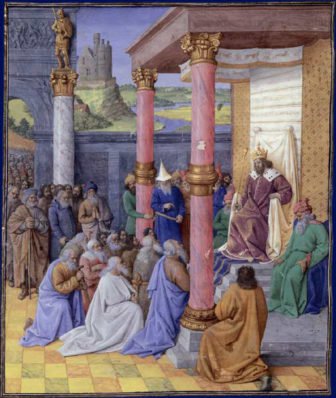
For some of these dispensationalist evangelicals, Donald Trump, as the leader of a nation who has “blessed” Israel, is God’s man for such a time as this. Trump not only has the right policies on abortion and religious liberty, but he may even be a new King Cyrus.

This is a depiction of the biblical character Emperor Cyrus the Great of Persia, by Jean Fouquet, created circa 1470. (Image courtesy of Creative Commons via RNS)

In the Old Testament, Cyrus was the Persian king who released the Israelites from captivity and allowed them to return to Israel, the promised land where they rebuilt the walls of the city and the Jewish temple. Several evangelical leaders who have compared Trump to King Cyrus see the president as the politician who released American Christians from the captivity of what they perceive to be the anti-evangelical Obama administration. In a sermon on the morning of the 2017 presidential inauguration, Jeffress even praised Trump as a great builder of walls.

But other have applied the King Cyrus metaphor to Trump’s Israel policy. For example, Mike Evans, the founder of the Friends of Zion Heritage Center in Jerusalem and a staunch Trump supporter, was ecstatic last December when he learned about Trump’s decision to move the embassy to Jerusalem. Evans told the Christian Broadcasting Network that when he next saw Trump in the Oval Office he would say to him: “Cyrus, you’re Cyrus. Because you have done something historic and prophetic.”

Because of Trump’s actions, dispensationalists believe the blessing of God will come upon America. The Jerusalem decision reinforces the idea that America is a Christian nation. This decision makes America great in the eyes of God. It also makes Trump great in the eyes of those American evangelicals who visit the White House regularly to consult with the president, the flatterers and sycophants whom I have called the “court evangelicals.”

Jeffress, Evans and other court evangelicals claim that they were influential in Trump’s decision to move the Israel embassy. If this is true, we can say with certainty that United States policy in the Middle East is now heavily influenced by dispensational theology.

John Fea teaches American history at Messiah College in Mechanicsburg, Pa. He is the author of the forthcoming “Believe Me: The Evangelical Road to Donald Trump.” The views expressed in this commentary do not necessarily reflect those of Religion News Service or the Baptist Standard.


Letters: Jerusalem embassy

Re: Voices: Is the US embassy’s move to Jerusalem a prophetic sign?

Outstanding explanation of various Baptist eschatological views. The main problem is not a belief in the return of Christ, but with biblical/historical interpretation issues. Most Baptists do not understand the term “Apocalyptic Literature” as it relates to interpreting the Book of Revelation, some OT use of apocalyptic texts and several inter-biblical Jewish texts that help explain its characteristics.

Dispensationalists exchange intended symbolic/figurative readings for their own recent literal interpretations by Darby and Scofield and reinforced by inserting recent political/religious events and people to arrive at these bizarre conclusions. Sad to say most of these people know nothing of the literary and historical background to the interpretation of these biblical texts.

Art Allen
Kempner, Texas


Bryan Houser: Look at the potential of associational ministry

Since 2006, Bryan Houser has served as the missions coordinator of the Amarillo Area Baptist Association in Amarillo, Texas. From deep in the heart of one Texan, he shares his background and thoughts on church and ministry. To suggest a Baptist General Convention of Texas-affiliated leader to be featured in this column, or to apply to be featured yourself, click here.

Background

Where else have you worked, and what were your positions?

I served as an International Mission Board missionary in Southern Africa (Botswana and Namibia) from 1984–2000, and I also served as minister of missions at Shiloh Terrace Baptist Church in Dallas for six years.

I pastored at Dial Baptist Church, up near Bugtussle and Honey Grove, Texas.

Where did you grow up?

In Kenya, where my parents were IMB (FMB at the time) missionaries

How did you come to faith in Christ?

I realized at an early age that I needed Christ as my Savior, mainly through the strong Christian influence of my parents and the myriad of “uncles and aunts” missionaries who impacted my life. I accepted Christ at ten years of age.

Where were you educated, and what degrees did you receive?

Bachelor of Arts from Baylor, and a Master of Divinity from Southwestern Seminary

Ministry/Profession

Why do you feel called to your particular vocation?

It’s a huge privilege to be able to use my calling to missions to help churches focus their energies on fulfilling the Great Commission. I appreciate being able to use past experiences from overseas and in the local church to continue making an impact in assisting churches multiply their kingdom effectiveness.

Please tell us about your association—where it’s located, the key focus of its work and ministry, etc.

The AABA is pretty much in the heart of the Texas Panhandle, covering approximately seven counties, with the city of Amarillo roughly in the middle, and reaching to the New Mexico border. All the Texans who go to Colorado to ski drive through our area and help the economy, thank you.

Our focus is: 1) church starting 2) church health 3) leadership development and 4) cooperative ministries, such as the Hope Welcome Center, a hospitality center for families visiting local incarceration facilities, and the High Plains Retreat Center.

Amarillo has the highest percentage of resettled refugees of any city in Texas, so there is a need for ministries and new churches aimed at a diverse population.

What do you like best about leading your association? Why?

I like the wide variety of ministry that it involves. Even assisting churches in the middle of difficult transitions is something I count a privilege. And West Texas people are the best!

What aspect(s) of associational ministry and/or its mission do you wish more people understood?

I think every ministry has to recreate itself on a constant basis in order to maintain a level of relevance, and the association is no different. New generations of leaders and church members either understand that the association is a wonderful cooperative tool to enhance church ministry … or they don’t.

I wish that more leaders would actively look at the potential of associational ministry and base their views on personal experience rather than word-of-mouth.

How do you expect your association and/or its mission to change in the next 10 to 20 years?

We will change demographically to reflect the changes of our communities. We will also change generationally as new leaders take their place; that is already happening and will accelerate in the next few years.

While I can wish for more new leaders to have a vision for associational effectiveness, I am very grateful for some excellent (and younger) leaders who are already making a positive impact.

Name the three most significant challenges and/or influences facing your association.

  1. The very nature of cooperative work is increasingly difficult across all walks of life as society seems to become more polarized; that is something which has a detrimental effect on Baptists who claim that we are champions of cooperation.
  2. Many churches are facing financial hardship due to declining membership, and this directly impacts the association.
  3. All Baptists (and evangelicals in general) are struggling to reach younger generations. Since the association is a reflection of what’s happening in our churches, this is a major concern.

About Baptists

What are the key issues—opportunities and/or challenges—facing Baptist churches?

Pretty much the same as listed for the challenges facing the association: cooperation, declining attendance and generational challenges.

Many “solutions” from the past are not adequate to answer the problems of our culture and climate today, yet many of our church members think those older methods hold the key to returning to the good old days. That often makes it difficult for church leaders to engage their members in looking and planning for the present and future in a radically changed and sometimes hostile culture.

What are the key issues facing Baptists as a people or denomination?

Quite honestly, whether we are even a denomination anymore is open to question; we seem more a collection of fiefdoms still bound by a few relics from the past which we think bring unity.

In reality, if there is no way to engender more unity of purpose and belief, it is difficult to be optimistic about “Baptists as a denomination” because there will be multiple Baptist denominations. However, there is still some really excellent cooperative work that is being done in missions and ministry, and I regret seeing that work sacrificed on the altar of increasing competition for scarce funds.

I believe a key issue is becoming the identification of our culture as hostile to the gospel and the subsequent circling of the wagons to keep said culture out of “our” churches. Jesus lived in a culture that was hostile to his message, yet he consistently engaged his own culture and remained involved in it, only occasionally withdrawing for spiritual nourishment.

Given the pursuit into the realm of partisan politics which we see many Baptists and other evangelical leaders exhibiting, I tend to join the skepticism of the younger generations in their views of these leaders. Unfortunately, that tarnishes the whole denomination since no distinction is made by the outside world.

What would you change about the Baptist denomination—state, nation or local?

You didn’t ask me to write a book here, so there’s not enough space.

About Bryan

Who were/are your mentors, and how did/do they influence you?

Primarily early in life, my long-lasting mentors were the “aunts and uncles” I was raised around, our missionary family in East Africa.

While it’s trendy today to say that early missionary methods were not very enlightened (and sometimes they were not), that was a different time and era, and I believe some of the strength of the African church today can be attributed to the hard work of those early missionaries (and the Holy Spirit, of course).

Plus, by and large, they identified in language and culture with the local people in a way that is rarely seen today. Seeing that influence impacted my life for the better.

Current mentors include pastors and some laypeople that I have the huge privilege of serving with and who continue to enrich my life. I can’t mention them all, but Charles Davenport was here before the pilgrims and knows more about Texas Baptist churches than anyone alive. I’m sure he will be the Area 1 congregational strategist long after I have gone to heaven, but, fortunately, I can still beat him at golf.

Charles Lee Williamson and Richard Faling taught me a lot about local church ministry.

Howie Batson and Robby Barrett from FBC Amarillo are models of excellence in ministry, as well as Bill Brian, a member there.

Really, every pastor in the Amarillo Association is a mentor in one way or the other.

John Thielepape, the DOM at the Parker Association, is one of my mentors, but he doesn’t know it. Many of my DOM colleagues fill that role as well.

And my parents, who have long service in Baptist life, continue as mentors in many ways. Mom has been Mrs. WMU (no, not the official title) and Dad still serves as a DOM in the Bosque Association.

Other than the Bible, name some of your favorite books or authors, and explain why.

This is already getting too long so I’m going to pass on this, but I enjoy reading books that deal with the church relating to our changing culture. And Clive Cussler.

What is your favorite Bible verse or passage? Why?

Micah 6:8: “He has shown you, O man, what is good; And what does the LORD require of you but to do justly, to love mercy, and to walk humbly with your God?”

Why? Because that’s all that matters.

Who is your favorite Bible character, other than Jesus? Why?

David, because of his sheer humanity and failings … and greatness in God’s eyes. If God would use someone as enormously imperfect as David, there is hope for all of us.

Name something about you that would surprise people who know you well.

It probably would not surprise anyone, but my heart has never left Africa, and I return there at every opportunity. I have been privileged to have friends who own a large ranch in Namibia, which is an incredibly beautiful wilderness area with a lot of wild game. I go there because the solitude and sometimes savagery of nature feed my soul.

If you could get one “do over” in your career, what would it be, and why?

I would have pursued my passion for flying. I think it would have been useful and fun.

Write and answer a question you wish we had asked.

I wish you had asked about my beautiful and brilliant daughters: Myra is a professor at Ouachita Baptist University, and Jason, her husband, also teaches there and works for the Alliance of Baptists. Heather is a veterinarian near Bremerton, Washington. Alicia is finishing a master’s degree at the University of Pittsburgh. It’s tough to get together.


Commentary: Revisiting Baylor’s list: What does an effective preacher look like?

(RNS) — Last week a list was published by Baylor University’s Truett Theological Seminary, announcing the “12 most effective preachers in the English-speaking world.”

It is just over 20 years since Baylor carried out a similar survey; W. Hulitt Gloer, director of Baylor’s Kyle Lake Center for Effective Preaching, commented on the differences between the two surveys. “Of great interest,” he said, “is the diversity represented in the new survey, especially with regards to ethnicity and ministry,” pointing out that the new list includes three African-Americans, and is divided between eight pastors and four academics.

But as the results were publicized, social media lit up with reactions that ranged from outrage and despair, to ridicule and scorn. Like me, many people were struck forcibly by the list’s lack of diversity.

The problem is not with the individuals named, each of whom is a distinguished preacher, and some are also leading homiletics scholars and authors. I have personally met four of them, and found them to be impressive people both in and out of the pulpit; a little online research reveals that the rest are equally outstanding. The problem, rather, is that the list as a whole creates a biased and anachronistic impression of what an effective preacher looks like.

First of all, unlike the church population as a whole, this list of preachers is predominantly white.

Secondly, although the list claims to represent “the English-speaking world,” the names are drawn exclusively from the U.S.

Some critics were quick to point out that all those named are mid-to-late career, implying that young people are not effective preachers. But perhaps the most glaring anomaly of all is that, among the 12 preachers on the list, only one is a woman.

Members of “Nevertheless She Preached,” a group founded to promote women in the pulpit, were among those critics. “While the survey indeed names some effective preachers, the results include only one woman, no women of color, and zero LGBTQ preachers. Yikes!” they wrote on their website, and published a list of their own.

On the face of it, then, the subtext of Baylor’s list is that if you aspire to become an effective preacher, you would be best advised to be American, white and male. In a climate more attuned than ever to the need to break down the narrow confines of patriarchy, how could this study produce such a one-sided perspective?

To be fair to Baylor, their intent was not to award the “Oscars” of preaching, but to identify what constitutes excellence in preaching, and how best to improve their teaching of homiletics. The study had two stages: In 2016 a survey was carried out to update the seven criteria for effective preaching. After that, scholars and practitioners from two associations were asked to nominate the preachers who best fulfilled those criteria. Nearly 800 nominations were made, from which the final list was selected.

The criteria agreed upon were more concerned with the quality of the preacher’s art than with their fame or popularity. In 2001, when Time magazine proposed that T.D. Jakes might be “the next Billy Graham,” its assessment was based on the preacher’s drawing power; Jakes and Graham, it said, were the only two preachers who could fill the 79,000-seat Georgia Dome.

The Baylor survey, however, was based on such matters as the skillful and scholarly use of Scripture, the sermon’s form and structure, and clarity of delivery. Its purpose, according to Gloer, was “that we may continually be becoming more effective,” specifically in the task of teaching the next generation of preachers.

Nevertheless, the Baylor list does function as a kind of prize—or at least, that is how it is perceived now that it has been publicized. CNN likened it to the NBA Dream Team, the Grammys, and the Oscars, accolades that not only celebrate excellence in their field, but serve to reinforce the success of those who hold the awards and who to a certain extent set the stage for others who will follow in their footsteps.

The 12 preachers on the 1996 list were given the “Baylor Great Preachers” award, and invited to preach on campus during the following year. This clearly both celebrated and promoted the ministry of those 12 preachers, but the side effect of this kind of exercise is to create subliminal expectations for the next generation.

To present the public face of effective preaching as predominantly white, male and American is a failure in two ways. Not only does it fail to register highly effective preachers who do not conform to this identity, it also projects an image of what an effective preacher looks like. And, if you are Asian, black, Latino, or a young woman of any ethnicity, and this image overwhelmingly does not look like you, that in itself makes it harder to hear the call to the pulpit.

I question the usefulness, then, of widely publicizing a list that creates such an anachronistic picture. It may have been wiser for Baylor to keep their results in-house, to ask themselves in what ways their survey was flawed enough to produce such an unbalanced result, and to begin to address those anomalies. As a friend of mine wrote on social media, “if you researched your list and it turned up only one woman out of twelve, you would think ‘We’d better not publish this. It’s clearly rubbish.’”

In the end, despite the merits of each individual on this list, it is hard to ignore the implication that it would be unusual for someone other than a white American male to become an outstanding preacher. And that, rather than promoting effective preaching, is more likely to prove profoundly ineffective for inspiring the next generation of preachers.

The Rev. Maggi Dawn is dean of Marquand Chapel and associate professor of theology and literature at Yale Divinity School. The views expressed in this commentary do not necessarily reflect those of Religion News Service or the Baptist Standard.


Commentary: When your church building is simply ‘too much’

One of the most common conversations I have with churches of all sizes is one I’ve come to call “too much church / not enough people.” These churches have physical plants built for a time when the congregation’s membership was far larger than it is now. The current congregation rattles around in a building with way too much space and is mildly depressed by their situation.

As membership declined over the years, the building – once an asset for an expanding ministry – has turned into a liability that threatens to drown the congregation in maintenance costs.

Building maintenance is deferred from year to year and the building becomes increasingly in need of repair. The deteriorating physical plant – and the resulting impression visitors take away from their first visit – quickly becomes an elephant in the room that everyone knows needs to be addressed but everyone is scared to name. Some of the churches tell me they are “one broken furnace” away from a financial emergency … and possible closure.

All options look like negative ones. The church can try mounting a capital campaign, but the leaders sense that repairing the building won’t generate the needed buy-in by the congregation. They can let go of essential personnel or programming to meet the mounting building costs, only to see the congregation continue to shrink. Or they can simply let the building fall down around them, knowing that option most often leads toward the church’s death.

One of the reasons it is so hard to deal with these issues is that it’s lonely work. The pastor and lay leaders in the church don’t have anyone with whom to talk or ask for advice. They don’t feel they have the skill sets they need. They don’t see any models or templates out there in the wider church for how to proceed. Declining staff levels in regional and national headquarters means there’s often no one to come to their aid from their denomination.

My long-time colleague Deborah Wright and I have been working with the Presbyterian Foundation to develop a better model: building a collaborative learning community made up of pastors, all of whom share the “too much church / not enough people” dilemma, and working with them to crowd source one another.

We’ve brought together pastors from around the country to ask them to tell us about the particular issues and options with which they are wrestling and the tools they need to do this work faithfully. We listen to the questions they have, including the ones they don’t quite yet know how to form. We invite them to tell stories of successes and failure as they experiment in their particular contexts.

The group has already identified several different ways their churches are making faithful decisions:

  • Developing “tentmaking buildings,” in which space is rented to other churches or non-profits who share the congregation’s mission goals
  • Becoming a “building-less church,” selling their property and using the resulting assets to support new forms of missional groups within their membership
  • Developing a “ministry/worship center,” in which several other congregations nest in their facilities and share worship space
  • Coming to the conclusion that it is time for them to become a legacy church, to bring their ministry to a close, and to work with others to make remaining assets available to develop newer forms of Christian community, dying well in resurrection hope
  • Enabling their pastor to become “bi-vocational in place” by developing a second use of the buildings that provides the pastor a supplemental income stream
  • Working with developers to build on unused portions of the property or to take down the current buildings and build an entirely new facility that includes space for the congregation (often to build senior or low cost/mixed income housing)
  • Turning their church into a community center in which the worshiping community still has a stake

What if you were to start a similar collaborative learning community to address these issues in your own context? Starting the conversation is not that difficult. Think about other churches near you whom you sense may also be wrestling with these issues. It can be a cluster of churches in your own denomination, or it may be an ecumenical table you gather. It may be a local conversation, or it can be a regional or national one – especially with the availability of inexpensive or free videoconferencing services. Invite other pastors to join you in a conversation.

Get together. Tell your stories. Help each other form important questions. Share resources you’ve already discovered. Make a list of the additional resources you need. Generate a list of leaders (other clergy, judicatory staffs, non-profit managers, developers or real estate agents) you want to contact to ask about the resources they may have already developed or the insights they have to share.

Those of us who are consultants and coaches with the Center for Healthy Churches think of ourselves – first and foremost – as a collaborative learning community, helping one another listen for how the Spirit is leading Christ’s church into the future. We also believe that whatever the Spirit is saying to the American church today, it is bubbling up from below in communities like these. We know how important it is to have a supportive community of friends and colleagues with whom to share this discernment. We would be honored to work with you as you figure out how to create a community of your own.

This article first appeared on the Center for Healthy Churches’ blog.

A native of Mississippi, Jim Kitchens has served Presbyterian churches in California and Tennessee for almost 35 years. He loves helping congregations prayerfully discern how the Spirit calls them to adapt to changing cultural contexts. Jim is the author of The Postmodern Parish published by the Alban Institute. He is a consultant for CHC and the coordinator for CHC-West.


Commentary: Cheers and caution for President Trump’s new faith-based initiative

(RNS) — In the 2000 presidential campaign, Republican George W. Bush and Democrat Al Gore each pledged to establish an office in the White House through which the federal government would acknowledge and support the social services faith groups were providing in local communities.

Sixteen years later, after the Bush and Obama administrations blazed a trail marked by both success and controversy, President Trump came to power without a plan for the faith office.

The shuttered White House faith office reflected two broader trends in the Trump administration: A lackadaisical presidential transition that was slow to fill appointed posts in the government, and a lack of interest in the State Department’s Office of Religion and Global Affairs.

Without these formal channels through which the administration could engage with and understand religion’s place in domestic and world affairs, Trump relied on an unofficial cadre of evangelical campaign loyalists.

This kept him in touch with a key political constituency, but also gave the appearance of favoritism toward one religious group and indifference (if not outright hostility) toward others.

Now, 16 months into his presidency, Trump appears poised to finally establish a faith office of his own.

As part of his National Day of Prayer observance, the president announced an executive order Thursday (May 3) creating a new White House Faith and Opportunity Initiative.

I applaud the broad outline of President Trump’s faith initiative. Better late than never. But implementation will be key. This has to be done right.

The new office’s legitimacy rests on how sensitively and inclusively it engages diverse faith communities and negotiates the complex legal and political dynamics it will face.

President Trump speaks during a National Day of Prayer event in the Rose Garden of the White House on May 3, 2018, in Washington. (RNS photo by Adelle M. Banks)

The order flows somewhat from the framework of the two previous administrations’ faith offices. That is a good thing, as it demands a more structured way for the White House and the bureaucracy to communicate with faith groups and advise one another on matters involving religion.

This initiative appropriately invites religious, community, and nonprofit leaders to advise the government and equip partners on issues including poverty, addiction, criminal justice, and marriage and family life. All this is welcome and needed.

There are a few pitfalls Trump must avoid to ensure the initiative’s success.

First is the matter of staffing. There is a natural tendency for presidents to transition campaign advisers and staffers into related federal jobs. This is not a bad thing in itself, as campaigns provide staffers education, engagement, and experience that will benefit them as administration officials.

But in Trump’s case especially, it will be important not to create a jobs program for his evangelical political supporters. This office needs professional staff with expertise, sensitivity, and strong ecumenical and interfaith impulses.

A second concern is inclusion. This only works in a legally secular and religiously plural society if it is diverse and inclusive. To put it mildly, Trump has struggled with religious inclusion and neutrality in his rhetoric and in his governing.

Acknowledging and supporting the public-spirited work minority faith groups are doing would give the president a chance to right a wrong.

But the perennially contentious issue of religious freedom will be the initiative’s most fraught concern.

Since its inception in 2001, the White House faith office has grappled with difficult religious-liberty questions. Under Bush, a key debate concerned whether groups receiving federal funding could discriminate in hiring. Under Obama, the Affordable Care Act’s contraceptive coverage mandate created high-stakes legal battles, largely bypassing staff in the faith office who should have been consulted in developing accommodations for employers with religious objections to artificial contraception.

Today, religious-liberty clashes are even more contentious, as combatants imagine an intractable war between LGBT rights and traditional religious beliefs. There is little Trump’s new faith office can do to make things better, and much it could do to make things worse.

This latest faith initiative includes a more robust focus on religious liberty, formalizing conduits in every agency between faith groups and the Justice Department.

But there are already courts with jurisdiction to hear religious-liberty cases and no shortage of well-funded interest groups to provide legal counsel.

It will not be helpful for Trump’s faith office to function as a complaint hotline eager to intervene on behalf of socially conservative religious groups, many of which are inclined to see themselves as victims.

The courts have upheld religious freedom, and will continue to protect the rights of Americans to act in accordance with their beliefs about marriage and sexuality.

As the only nationally elected public official, the president has a duty to all Americans, many of whom have competing conceptions of religious freedom.

A formal evangelical office staffed by campaign surrogates and focused on a narrow policy agenda would be a disaster.

I have often disapproved of how Trump, as a candidate and as president, engaged with religion. I have to hope he implements his faith initiative with wisdom and goodwill.

If there’s going to be a White House Faith and Opportunity Initiative, we all need it to be a success.

Jacob Lupfer, a frequent commentator on religion and politics, is a writer and consultant in Baltimore. His website is www.jacoblupfer.com. Follow him on Twitter at @jlupf. The views expressed in this commentary do not necessarily represent those of Religion News Service or the Baptist Standard.