Commentary: It’s 2018. Why can’t we attend the SBC convention remotely?

As a young pastor, only a few years out of Southwestern Baptist Theological Seminary, I was excited to accept the call to serve a small church in Durant, Oklahoma. The church had been a strong, mission engaged church that was giving 25% of all undesignated offerings through the Cooperative Program. This church was an area leader supporting the cooperative mission causes of the Southern Baptist Convention, giving sacrificially for many decades.

In 1995, as the annual meeting of the Southern Baptist Convention approached, I discussed attending the SBC Annual Meeting in Atlanta, Georgia with our church leadership. The premise of my argument was that this church needed to have a voice since it had given tens of thousands of dollars over decades of cooperation. With such a high cooperative investment, we should have representation during the annual meeting when decisions were made by messengers of our convention. After a brief discussion, it was determined the cost of such a trip was just too high and it was not feasible.

I felt it was critical that our church have first-hand representation and a voice at the annual meeting rather than reading short meeting reports in the media. Therefore, my wife and I decided that we would personally pay for the trip. I made reservations, paid for tickets and prepared to attend.

I flew into Atlanta late on the Sunday night before the annual meeting, taking the MARTA rail system to a bus station. After making two more bus transfers, I was dropped off about one-half mile from my hotel, in a very seedy part of Atlanta. I took my luggage and walked by two strip joint bars to reach my hotel. No doubt, I could have been an easy target for a criminal while carrying my luggage in the darkness of night. Although the hotel was 45 minutes by bus from the convention center, the cost was all our personal budget would allow. Thankfully, as I walked to the bus stop the next morning, several men were carpooling to the annual meeting and offered me a ride.

Upon my return home, I took a Wednesday night service and reported to our church on the significant work of our convention. That year, landmark actions were made related to race relations and more. I was glad I made the personal sacrifice to attend, in spite of the difficulties. Reporting to my church was my practice throughout the years since I was their voice at the annual meeting.

Most years since that 1995 annual meeting, I have attended the SBC annual meeting. Many times, it was a great financial strain. In the few years I have not attended, it has not been due to schedule but usually due to budget restraints.

The majority of churches across our Southern Baptist Convention do not have the budget to send representatives (messengers) to the various locations hosting our annual meeting. Most Southern Baptist Churches do not give 25% to the Cooperative Program like that church I served. Nor do most churches give like another Oklahoma church I later served which gave 30.25% through the Cooperative Program. Although it was a much larger church, the same financial discussions took place. Hundreds of thousands of dollars were given to support the SBC cooperative ministry, yet it was a strain to send their pastor or other representatives to have a voice in the process at the SBC annual meeting.

During those years, the technology was not present to allow remote, secure voting and participation. In today’s world, it is more than possible to set up locations for viewing and voting as active participants for any annual meeting, regardless of meeting location. Thousands of church members and pastors would drive across their local area to their associational office or a host church to participate in the process, if only it were available.

When we have elections for local, state or national leaders and issues, I can drive six miles from my home to cast my ballot. I can prepare and be well informed in a variety of ways through local media and web communication. There are no social or economic restrictions hindering my participation.

In my 37 years of ministry, the largest majority of pastors and churches where I have served have been unable to afford the travel, lodging and meals for attendance at the annual meeting of our convention. The time has come when our convention needs to make the necessary changes for involving churches all over our country. At present, most normative sized churches (under 175 in attendance) are restricted by distance and limited funds from having a voice in our convention business.

Every church that sacrifices to support our cooperative mission efforts through our Cooperative Program should have the opportunity to participate in the process. The day has arrived when our convention of churches needs to make it possible for the normative sized congregation to send their messengers to a local meeting place to watch convention reports, business sessions and vote on convention business.

Do you think that Southern Baptists can make it possible for every church to have a voice as active participants in our convention? My answer is a resounding “YES!” Every voice matters. I believe that the time is now. Let us value the voice of every cooperative church. We can make it happen.

Bobby Gilstrap is the executive director of the New Work Foundation. He has served as an SBC associational missionary, pastor, church starter and as a mentor, supervisor and consultant for numerous pastors and church planters. This article originally appeared on his blog.


Letters: Paige Patterson’s dismissal

RE: Commentary: The tale of two presidents at Southwestern Baptist Theological Seminary

I am a female graduate of Southwestern 2006. My impression of your article is that you may not know all of the facts surrounding Patterson’s removal and that it is more about your just not liking the man. I find your comments to be just as judgmental and intolerant of him as you accuse him of being toward others. Whether we like it or not—scripture does affirm an outline of authority in the church as well as in the home. We may not like it—but as for me personally, I would rather base my understanding of scripture on what is written rather than what I “feel.”

Your article emphasizes the word abuse quite frequently. Abuse is never okay!! But today’s cultural definition of abuse often includes something as slight as a rude comment—and while it may be offensive … it is a far cry from “abuse.”

As a Christian woman who is in full-time Christian service, I find your “ethical rhetoric” to be offensive to me. I was at Southwestern during Dr. Patterson’s tenure. He came across to me as “dogmatic and cocky” but to write a scathing article about him surrounding his dismissal is anything but “ethical.”

Rachel Greene
Morristown, Tenn.

RE: Paige Patterson no longer seminary president

And this is supposed to be a good decision? A place to live that would probably house many homeless people; continued compensation/benefits; creation of the Theologian-in-Residence.  SERIOUSLY???? WHAT about the way he has conducted himself (and his abuse of the biblical teaching regarding marriage, divorce, abuse, respect and love for one’s spouse), QUALIFIES him to reap these uncalled for BENEFITS.

This decision proves once again that no woman is worthy of respect as viewed by the eyes of those men who have the power and wield it in such a way as to denigrate every one of their own wives, daughters, nieces, aunts, mothers, students, etc.

And—they think we are too stupid to realize what it all means for all of us.

Mary Manning
Denver, Colo.


Commentary: An open letter to the SBC

Dear SBC (Southern Baptist Convention),

I spent this morning praying, asking God to please reveal Himself to the people I love, entreating Him to sift me, confessing my sins and thanking Him over and over again for His grace and mercy. I write this while on vacation, burdened again by difficult news coming from within our ranks.

I wakened with a sort of undecorated, plain grief, a kind of gray feeling that is worn out of hoping. I reprimand myself in times like these because hope is radical, and it is real, and as I spend every day reading the book of Romans in preparation for a book I’m writing, I know hope is one of the most assured and beautiful words in the Gospel. Hope does not disappoint, yes, but perhaps it’s better stated that my expectations are tired.

You already know this, but I am a woman. I am a wife to a man who empowers me and a mother to three world-challenging and world-changing adult children. I attend a large SBC church, and I am utterly grateful for the opportunities afforded me there. So my angst is not with them. Instead it’s directed toward the structures built within this denomination that have seemingly been bent toward preserving reputation and circling the wagons rather than authentic, biblical repentance when it comes to the treatment of women.

I don’t need to rehash what others have eloquently stated. But I can say this: I know I am one woman in a large denomination. I know there are many more noble and studied women in my midst. I don’t speak for all women; I simply speak for me. I also know this: I am flawed. I grew up longing to be noticed, so Jesus continues to redirect that childhood desire toward Him. While I don’t always live for an audience of One, I hope and pray that my life moves more and more toward that aspiration.

So I understand that being overlooked, unheard, dismissed, and relegated are hard for me. I have a prayer team that helps me sort through this, and they’ve been with me since before I published my first book.

When I emote online, when I write blog posts about the absolute devastation of sexual abuse (one of Satan’s greatest weapons against us all), when I speak up in cases of abuse of power within the church with its dismissal of victims and cover up of perpetrators and those who enable them, it is with this limping, this fear: that somehow my words would be about me and not about the issue. But the bigger fear which ultimately makes me click publish is this: that those who have been marginalized, dismissed, silenced, demeaned, made fun of, or called shrill would know that they are not alone.

Women make up more than half of all SBC churches. We love, serve, teach (in sometimes limited settings), pray, and help others. We see injustices and speak up. We make up a significant percentage of missionaries overseas. Yet we are often underrepresented in positions of leadership, influence, and service. While we all possess voices, many times those voices are dismissed or diminished.

Women, like men, are gifted by the Holy Spirit to serve the body of Christ. I believe we do better together rather than segregated into overly straight-jacketed roles. In Paul’s closing to Romans, he lists a significant amount of women (10)  holding various positions. He lauds them, encourages them. Consider Phoebe and Priscilla in Romans 16:1-5:

I commend to you our sister Phoebe, who is a deacon in the church in Cenchrea. Welcome her in the Lord as one who is worthy of honor among God’s people. Help her in whatever she needs, for she has been helpful to many, and especially to me. Give my greetings to Priscilla and Aquila, my co-workers in the ministry of Christ Jesus. In fact, they once risked their lives for me. I am thankful to them, and so are all the Gentile churches.Also give my greetings to the church that meets in their home.

I would love to be able to say my denomination welcomes each woman “in the Lord as one who is worthy of honor among God’s people.” But after the past several months and years, the very public stances the SBC has taken reveals more disregard, far less honor. In light of all that, it’s my ardent prayer that the SBC leadership would collectively hit their knees, continue to seek God earnestly, and open-heartedly listen to the women in their midst–as fellow image bearers of the One true God.

I would love to see the SBC become a denomination where:

  • All people felt safe in approaching their leadership about sexual assault or domestic violence, knowing that their leadership will report it to the authorities as required by law.
  • Similarly, domestic violence, sexual assault, sexual harassment would all be seen not simply as sins to be dealt with within our ranks, but crimes, best dealt with by the criminal justice system. (Romans 13 comes to mind).
  • Public statements by PR firms, carefully crafted toward reputation preservation, would be replaced by genuine repentance and a plea for forgiveness when members are harmed or wronged by leadership.
  • Women have a voice and are no longer dismissed, stereotyped, or relegated to sub-committees. Instead, they felt heard, dignified, and empowered.
  • Sexual predators are no longer given cheap and instant grace, and survivors are no longer harshly scrutinized, silenced, and callously told to forgive quickly.
  • Truth would be welcomed, no matter how difficult. (I believe our fear of ruining Christ’s reputation, or perhaps better said, mess with our bottom line, is unfounded. The world would welcome transparency and repentance far more than it tolerates our fearful coverups. For instance, if a church wrote something like “We discovered sexual misconduct, reported it, and are deeply sorry for the harm it has caused. In light of that, we are cooperating with authorities, and we’re working on solutions to provide counseling and help for the victims,” I believe many would stand and cheer. But as it is, we are deserving the world’s deeply entrenched mockery for our continued insistence on cover up, glossing over, and our unique ability to honor those (sometimes with standing ovations) who preyed on the innocent. I believe these words from Paul, though deeply sobering, are for the church today: “For, as it is written, “The name of God is blasphemed among the Gentiles because of you” (Romans 2:24).)
  • Political power is no longer curried, but viewed with a Jesus-like skepticism. That we would embrace the beautiful truth that life change happens in small places through a paradoxical weak-is-strong kingdom.
  • The Gospels would be revisited, particularly the Sermon on the Mount where we see the beautiful dynamic of the least being the greatest. That we would look again at Jesus who went out of his way to listen to and heal the masses, the hurting, the least, those living in the outskirts. May we be known as a church who loves the broken, welcomes the downtrodden, and winsomely stands against injustice–no matter how it may “harm” our reputation.
  • The SBC convention in June featured more than 12 minutes of women’s voices from the platform, though I know that the schedule has been fixed.

I love my church. I love serving within its ranks. I am grateful to have had the opportunity as a communicator to author dozens of books, pray for many on my daily prayer podcast, and speak up for the broken–all while being encouraged by the leadership of my SBC church. So my letter isn’t meant to be mean spirited or punitive. Instead, my prayer is that we can see the recent news events as a wake up call from the Lord to reevaluate our hearts, listen to those who have left the church in anguish, and seek to be people of justice and mercy in a world in extreme need of both.

Praying,

Mary DeMuth

Mary DeMuth is the author of over 30 books and is a podcaster (Pray Every Day) and international speaker. A sexual abuse survivor, she often advocates for the broken and marginalized. She makes her home in Rockwall, Texas, where her husband Patrick serves as an elder at Lake Pointe Church. Married 28 years, they have three adult children.

This article originally appeared on Mary DeMuth’s website and does not necessarily represent the views of the Baptist Standard.


Commentary: The tale of two presidents at Southwestern Baptist Theological Seminary

Southwestern Baptist Theological Seminary, a Southern Baptist Convention seminary in Fort Worth, Texas, has relieved President Paige Patterson of his responsibilities.

Patterson’s status has been in question for weeks after reports surfaced that years ago he advised an abused woman to remain with her husband and forgive him.

Although he initially stood by his actions, Patterson later issued an apology and SWBTS’s Board of Trustees scheduled a special meeting after a letter, signed by thousands of Southern Baptists, was published that condemned Patterson’s actions, comments and ideology.

On Tuesday, while SWBTS trustees were meeting, The Washington Post reported on allegations that Patterson, then serving as president at Southeastern Baptist Theological Seminary in North Carolina, told a student who had informed SBTS administrators she had been raped not to report it to the police and to forgive the alleged assailant.

Early Wednesday morning, trustees officially removed Patterson from leadership and released a statement regarding his status.

Yet, according to The Washington Post, SWBTS has provided him with a lucrative compensation package that includes housing accommodation on campus and the titles “theologian-in-residence” and “president emeritus.”

In the spring of 1994, I was on the campus of SWBTS as an aspiring student.

Growing up in very conservative churches in Oklahoma, I was astounded at the high level of education I was receiving from professors under the leadership of then president, Russell H. Dilday.

President Dilday was a well-respected leader and theologian that had a great rapport with students and admiration from the seminary faculty. Entering into my spring semester as a first-year seminary student, I was happy with my decision to attend Southwestern.

Then, everything changed when the trustees arrived on campus.

During their annual meeting, trustees gave Dilday a vote of confidence as seminary president. However, the next day those same trustees voted to fire Dilday for not offering enough support for a fundamentalist takeover of the Southern Baptist Convention.

As they voted to fire Dilday, they locked the doors of his office, escorted him to the president’s house with armed guards, and prohibited him from walking anywhere on campus. They treated him as a criminal whose crime was not being conservative enough in their eyes.

For those still confused about what the Southern Baptist’s wars were all about, you are now seeing first-hand the dark shadow moderate-conservatives, moderates and progressives saw rising from those who gained power in the Southern Baptist Convention.

Using the Bible as a tool to gain control over others, Patterson and other Southern Baptists leaders blatantly lied and misrepresented the truth about faithful Baptists in their quest for power and privilege. Nothing would stop their aspirations of reaching the highest levels of authority within the world’s largest Protestant denomination.

Once the Southern Baptist Convention was taken over by right-wing conservatives, they quickly began to put their “theological” convictions into practice.

While numerous issues were touted — such as biblical inerrancy, marriage between a man and woman, pastoral authority, and breaking down the wall of separation between church and state — the one issue that seemed to be at the forefront of the SBC’s predominately-male leadership was the submission of females to male authority.

Time and time again, Southern Baptist men passed motions and implemented policies that demeaned women and categorized them as second-class citizens in the kingdom of God.

From wives submitting to their husbands to women not being allowed to teach men, Southern Baptist leaders have waged war on women over the last four decades. In Southern Baptist seminaries, women professors have been fired and not granted tenure based merely on their gender and skewed interpretations of a few biblical texts.

Therefore, when the news broke about Patterson’s departure at Southwestern, I could not help but think back to that spring semester when I witnessed the evils of right-wing conservative theology on display.

While one of the kindest and thoughtful Christian men to ever walk on the campus of Southwestern was treated as a criminal for not being “conservative” enough, Patterson was ushered out the door with a golden parachute. Apparently, for Southern Baptist leaders, it pays well to keep the party line and keep women in their place.

As an alumnus (MDivBL, ’97) of SWBTS, I am appalled and ashamed of the actions the trustees took towards Patterson this week. While his removal as president was appropriate, the message trustees sent with the exit package they provided was crystal clear.

As far as Southern Baptist leaders are concerned, the reputation and well-being of their male leaders far outweigh the rights and lives of abused women everywhere, statements about condemning “all forms of abuse” notwithstanding.

Southern Baptists must correct this evil course they find themselves on today.

With stories like these, evil ideas and practices are warping the message of the gospel — the message of Jesus that seeks to liberate, protect and give salvation to every victim of sinful abuse.

When I read the Gospels, I am quite confident Jesus would have been ministering to the abused women and condemning the male leaders for their sinful behaviors.

For the sake of abused women everywhere — especially those suffering at the hands and oversight of Baptist leaders — I pray a groundswell of Baptists follow the words and actions of Jesus.

Faithful Baptists of all types — conservatives, moderates and progressives — need to rise up, condemn these actions, and demand equality for all people.

Baptists can no longer let misogyny be an acceptable theological practice. We must demand more from our leaders and champion an egalitarian theology that empowers all Baptists.

Mitch Randall is executive director of EthicsDaily.com. You can follow him on Twitter @rmitchrandall. This article originally appeared at EthicsDaily.com and has been reprinted with permission of the author.


Voices: Are thoughts and prayers enough?

We are only 20 weeks into 2018, and there have already been 22 school shootings in America.

Twenty-two occasions of parents across the country breathing a sigh of relief that it wasn’t their kid’s school this time while others are forced to mourn the loss of their children.

In less than six months, there have been 22 opportunities for our elected officials to offer their thoughts and prayers.

I don’t know what the victims were doing the day before, but I do know they will never get to do it again. Next year, when my boys are on the soccer field running around with their friends again, these children will still be dead. Those who survived these shootings will never be the same.

I write this as a Christian, and while I hope everyone will read it, I admit I am writing specifically to those who throw themselves at the foot of the cross alongside me.

When will it be enough?

When will we demand more of our leadership beyond their thoughts and prayers? When will we demand they put their faith into action?

As Christians, we know we live in a broken world, and we know the power of prayer. But we also know the dangers of speaking with forked tongues; because of our faith, we should know the dangerous nature of hypocrisy. James warned us in his book that faith without works is dead.

Let our faith reveal itself in our good works.

Who can blame the world for their anger at our proclamation of thoughts and prayers? We feed the hopelessness the world feels when we respond with words but without actions. With 58 dead in Las Vegas, 26 in Sutherland Springs, four in Rancho Tehama, and two in Aztec, I pray that the next time this happens, and it will happen again, we put our faith into action.

While it is unrealistic to take away people’s guns, something must be done. Let’s start by putting our faith, and words, into action.

When will we act?

Thoughts and prayers are easy; convictions and actions are difficult. I plead for the leadership of our country to stop weaponizing our faith through simple platitudes and, instead, put faith into action. I call on the church to ask itself what it will finally take for us to hold ourselves and our elected officials accountable.

Do we speak with apathy or with healing (Proverbs 12:18)?

Pastor Rick Warren notes, “What you say has a direct connection to your heart.” But he takes it one step further: “God’s warning for talkers is this: You also have to act.”

James warns us in chapter three about the power of the tongue and the dangerous temptation of speaking without thinking or out of turn. Evidence of spiritual maturity can be identified by one’s use of the tongue. Spiritual growth and maturity is not optional but can be ignored at our own peril (1 Peter 2:1–3).

Theologian Sinclair Ferguson states it plainly: “How easily the failure to master the tongue can destroy the effect of every grace that had taken years to build into our lives! Introduce poison here and we endanger everything.”

How many more children have to get shot before we refuse to allow this sort of godlessness to rule us no more? This goes beyond gun control or any single policy issue. My concern is with the witness of the church and its body.

Sin is failure to do what one knows he should do (James 4:17). Sinful actions and, more pertinent to our reflexive response of thoughts and prayers, non-actions are to be forsaken. Let us refuse to poison the grace of God no more.

Let us not love with just words or speech but also with actions and in truth.

Smith Getterman lives in Waco, Texas, with his wife and two sons. He holds a BA and MA from Baylor University and an MTS from Dallas Baptist University. You can find him on Twitter @getterman or by email at sgetterman@gmail.com.


Bill Arnold: Stewarding resources to change the world

Since 1984, Bill Arnold has served as the one and only president of the Texas Baptist Missions Foundation. From deep in the heart of one Texan, he shares his background and thoughts on leading the Foundation. To suggest a Baptist General Convention of Texas-affiliated leader to be featured in this column, or to apply to be featured yourself, click here.

Background

Where else have you worked, and what were your positions?

When you’ve been in one position for 34 years, that doesn’t allow much time to be anywhere else!

When I finished seminary, I went to Willow Meadows Church in Houston as the minister of youth. From there, I came to the Dallas Baptist Association as the director of the lay ministries division and then to the BGCT as the youth consultant in the Sunday School division, and then to the Missions Foundation.

Where did you grow up?

I grew up in Hernando, Mississippi, which was a county seat town of 1,000 in northwest Mississippi. When I was 13, we moved 25 miles north to Memphis, Tennessee. For a young teenager, it was like moving to another country!

How did you come to faith in Christ?

I was fortunate that our family was always a part of a church. In Hernando, we attended the only Baptist church in town. This was back in the time when, if the Methodist church had a revival, the other churches canceled their services, and everybody went to the revival. It was a great town for a young boy.

I do not remember when I did not know that Jesus loved me and wanted to be my Savior. The summer when I was nine, our brave pastor, Charles Skutt, took a busload (by himself!) of RAs to camp at Kittywake on the Mississippi Gulf Coast.

During the last night’s invitation, I decided that it was time for me to publically say what I had already decided about Jesus being my Savior. That was good news to everybody who hoped it would change my nine-year-old behavior, but I had to wait six months to be baptized because the church baptistry had a leak in it. When I was baptized, I stepped out of the baptistry into a washtub to drip-dry.

Where were you educated, and what degrees did you receive?

I graduated from Central High School in Memphis in a building that was built in 1909 (and is still being used). I have a Bachelor of Science in economics from Mississippi College and a Master of Arts in education from Southwestern Seminary. I am also a certified financial planner and a licensed real estate broker.

Ministry life

Why do you feel called to your particular vocation?

I felt a call to ministry when I was a senior in high school. When we moved to Memphis, we joined First Baptist Church. Soon after that, Bob Dixon came to the church as the youth minister, and, soon after that, the church built an activities building. Under Bob’s leadership, I became involved in all the aspects of the youth program. Clearly, God used those activities and my involvement to show me the plan he had for me.

As I look back on my vocational journey, it’s interesting to see how God was leading. The job I have now did not exist when I was in college or seminary, but my choice to major in economics in college helped perfectly prepare me for working with the Foundation, and my work with laymen at the Dallas Baptist Association connected me with the men who helped start the Foundation.

Please tell us about your BGCT institution—the breadth and nature of its work, including its mission, measures of scope, etc.

The Texas Baptist Missions Foundation grew out of the Mission Texas emphasis that began in 1984. This was a five-year emphasis to begin 2,000 new churches in Texas before 1990.

While the BGCT had always provided some financial help to new churches, we knew that there would not be enough money from the cooperative program and the Mary Hill Davis offering to fund the 20 to 30 million dollars that it would take to start 2,000 new churches. So, under Dr. Bill Pinson’s leadership and with days and days of volunteer help from Fred Roach, a layman, we began a fundraising effort to provide the funds that the new churches would need.

It was a pioneering effort—no other state convention had ever tried an effort like this. By the time Mission Texas was over, the Foundation had raised $22,000,000 and BGCT churches had started more than 2,000 new churches.

After Mission Texas ended, we broadened the scope of the Foundation to include raising funds for other areas of Texas Baptist life. Last year, we raised almost $5,000,000 and supported 85 different ministries in Texas and around the world.

What do you like best about leading your institution? Why?

The best thing about leading the Foundation is that I get to work with a terrific staff team and great donors.

I have always been fortunate to have a great staff: Jerry Carlisle and Steve Massey are vice presidents, John Halton is a senior consultant, Leslie Snyder is the donor relations coordinator and Rita Griffith is my administrative assistant. The Lord has really put together a great team who are committed to the Lord and to the work of the Foundation.

With regard to our donors, I like to say that we get to work with God’s choicest people. They are certainly the happiest! I’ve never worked with a sad donor, and I don’t think I ever will.

The mission statement says that “To the glory of God, we work with people who want to use their resources to change the world.” I get to be a part of a staff and a large group of donors who are all about accomplishing that mission.

What aspect(s) of your institution and/or its mission do you wish more people understood?

I wish more people understood the scope of the Foundation’s work and how we can be an effective channel to help them support whatever aspect of missions they feel led to help.

I also want people to understand that their estates are a great source of support for missions. Leaving even a tithe of one’s estate to missions can make a difference for generations to come.

Finally, I wish people understood that the money they give to missions never stops giving. For example, people who gave to the Foundation in 1985 helped start churches that are still going today—meeting every week, reaching lost people and helping them to grow in Christ.

How has your institution and its mission changed since you began your career?

When we started the Foundation, there was no model; we were working from a blank sheet of paper. That has its pluses and minuses, but it makes every day a new day. I was fortunate to have great help from Dr. Charlie McLaughlin, Dr. Bill Pinson, Fred Roach and others.

For a number of years, the staff was just me and an assistant, so there was nobody to blame for the mistakes but me. As we have broadened the number of ministries we assist and increased the number of donors that have helped us support those ministries, we have been able to add staff to keep up with the challenges of acknowledging and reporting to donors and of making sure that the gifts are spent in the way the donor intended.

Last year, we received 14,981 gifts from 4,784 donors. Our intent every year is to give away most of the money that we raise. We aren’t trying to build a corpus for the Foundation; every year we give away what we raise in accordance with the donor’s direction or guidance from the Foundation Council for undesignated money.

How do you expect your institution and/or its mission to change in the next 10 to 20 years?

The mission of the Foundation will not change, and there will never be quite enough money to meet all the needs that we see. Raising money to support those needs will always be a challenge as people’s motivation for giving changes and as they see needs from a different perspective. The challenge is to stay ahead of those changes and to present needs in a way that will encourage people to support missions.

Name the three most significant challenges and/or influences facing your institution.

  1. The proliferation of people and entities asking for support. Donors tell me that they are bombarded by mail, phone and in person by people asking them for money (as am I).
  2. The challenge of effectively telling the mission story of Texas in a way that is understandable and challenging to donors.
  3. The task of getting people to include missions in their estate plan.

What one aspect of your job gives you the greatest joy or fulfillment?

Getting to work with a great staff and incredible donors. The spiritual depth of the people with whom I work, both donors and staff, is a challenge to me every day. Our donors truly understand the joy of giving, and it’s a great privilege for me to be a part of that.

Another I’ve come to realize is that, when you look at the funds the Foundation has raised and the ministries that those funds have helped, it’s a wonderful legacy. I’m happy to have been a part of that.

About Baptists

What are the key issues facing Baptists?

We have forgotten what it means to be Baptist, and we take for granted all that we have accomplished because we worked together as Baptists. The institutions that Baptists have started, the plan for mission support through the cooperation program and our focus on the priorities of missions and evangelism have allowed Baptists to influence the world for Christ. There are those who would distract us from those priorities and make us lose our focus on the challenges that the world brings our way.

About Bill

Who were/are your mentors, and how did/do they influence you?

I’ve been fortunate that God has let my life cross the lives of some wonderful people. First of all, my mother and dad were wonderful examples of what a Christian should be. I could pick any day of their lives and say to myself “be like that.”

Bob Dixon has had a great influence on my life, beginning as a teenager and continuing today. The opportunity to work with a layman like Fred Roach, who lived his faith in the business world, was influential, as was the wonderful opportunity to learn from Bill Pinson, Charles McLaughlin, and Jim Semple.

I hope I have been as good a mentor to others as these folks were to me.

What is your favorite Bible verse or passage? Why?

The first would be Exodus 33:11 that says, “God talked to Moses, as one friend talks to another.” That is my goal to know God that well. The other is two verses that I just hold onto really tightly—Romans 8:38–39, a reminder that nothing can separate me from God’s love.

Who is your favorite Bible character, other than Jesus? Why?

Paul and Moses—they were both great fundraisers!

Name something about you that would surprise people who know you well.

Until recently, I was a member of an offshore sailboat racing team.

If you could get one “do over” in your career, what would it be, and why?

That, in my younger days, I would have asked for wisdom more earnestly than I did.

Write and answer a question you wish we had asked.

Tell us about your family.

My wife, Margaret, is the lead counselor at the middle school in Highland Park ISD. We have a daughter, Meredith Underwood, who lives in McKinney. She and her husband, Todd, have two seniors in high school, one of whom is headed for the University of Arkansas next year, the other to Collin College, and an eighth grader. Our son, Jonathan, and his wife, Beth, live in Dallas and have two boys—seven and four.



Voices: The Spirit’s help in our weakness

One of my weakest moments came a little over three years ago when I was hospitalized with a mono-like virus. I ran fever for almost a month and slept most days. None of the tests my doctor ran identified the virus or what could have caused the virus, but my doctor was convinced it was likely the effects of stress.

My mom had passed away a year before, and I never dealt with that grief. I tried to get past it by being strong on my own and instead came face-to-face with my weakness. Lying in that hospital bed, there was no doubt I was weak physically and spiritually. I needed help.

I didn’t know what to pray for, and, if I am honest, in that moment I wasn’t sure God heard my cries anyway. I had come to the end of my strength, but God had not left me alone.

By his grace, God reminded me of the helping presence of the Holy Spirit indwelling me.

The Holy Spirit intercedes for us

Paul, in Romans 8:26–30, encourages us that “likewise the Spirit helps us in our weakness.” The Holy Spirit indwells those who place their faith in Jesus, and he helps us in our weakness. How?

“For we do not know what to pray for as we ought, but the Spirit himself intercedes for us with groanings too deep for words.”

The Holy Spirit prays for us when we are weak, when we don’t know what to pray for in our moments of weakness. He prays for us with groanings too deep for words. This is the same groaning for redemption Paul tells us all of creation is groaning in verse 22, and the same groaning our bodies groan with in verse 23.

The Spirit cries out for us and through us for redemption, for restoration. The Spirit prays for us when we cannot pray for ourselves.

We are not alone. In our weakness, the Spirit is there to help us, to pray for us and to pray through us so that our greatest need and cry is always coming before our Father. The Spirit helps us by interceding for us.

The Holy Spirit prays for us according to God’s will

This is good news because the Spirit, verse 27 says, prays for us “according to the will of God.” 1 John 5:14–15 tells us, “This is the confidence that we have toward him, that if we ask anything according to his will he hears us.”

The Spirit prays for us and through us according to the will of God, and we know that he hears, and, when he hears, “we know that we have the requests that we have asked of him.”

We don’t have to be strong. We don’t have to have it all together.

There are moments, seasons, maybe even decades of our life, when we are weak. In our weakness, we may not know what to pray, or we may even feel as if our requests are not heard, but God is with us. God has given us the Holy Spirit. We can trust the Holy Spirit and his help.

He is interceding for us. He is with us and he is for us.

The Holy Spirit prays, groans, for redemption and redemption will be ours. God will complete his work in us. God will lead us home to glory. God is working all things together to make us into the image of Jesus. In our weakness, when we don’t know what to pray for, the Spirit prays for us and through us according to the will of God, and we can trust this prayer and trust God’s grace and love.

When we are weak, he is strong.

Zac Harrel is pastor of First Baptist Church in Gustine, Texas.


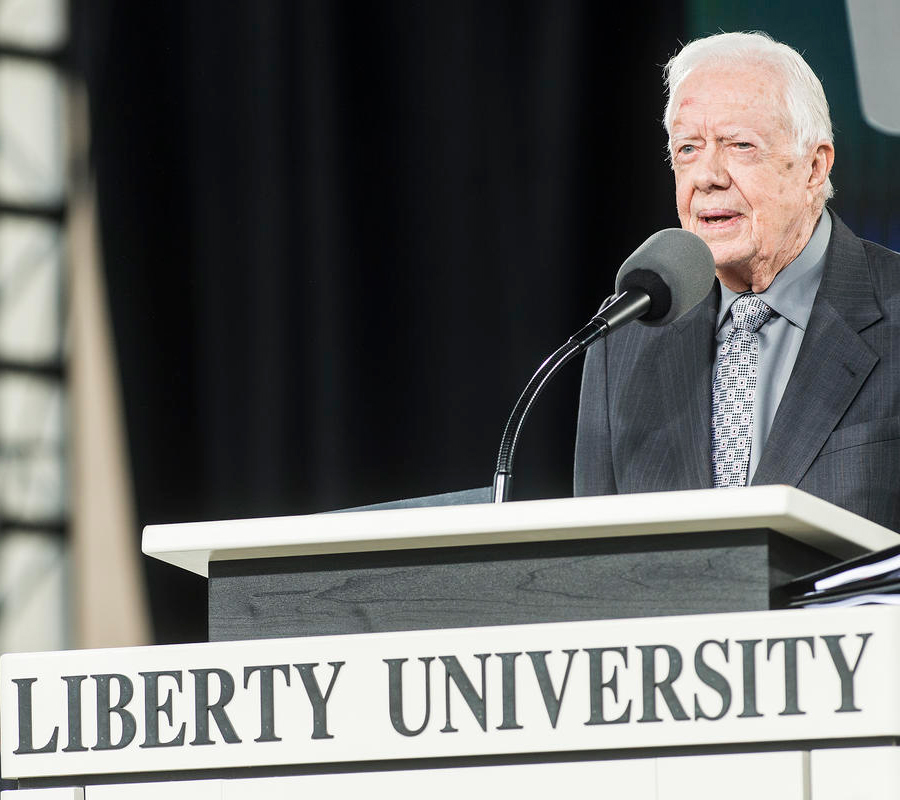
Commentary: In finding common ground, Jimmy Carter and Liberty University set good example

(RNS) — As Jimmy Carter waited to appear before a commencement crowd at Liberty University, it looked like he might be entering the lion’s den. The school, founded by Carter’s political foe, Jerry Falwell Sr., has stayed true to its socially conservative roots. Carter has been steadfastly to the left.

But Liberty President Jerry Falwell Jr. gave Carter a generous introduction, praising his kindness, warmth and humility. In a curious comment, Falwell said: “The longer I live, the more I want to know about a person and give my political support to a person. Policies are important, but candidates lie about their policies all the time to get elected.”

For his part, Carter, 93, resisted the urge to re-litigate old institutional battles. Instead, he deployed his characteristic humility and charm to emphasize his closeness with and affection for fellow Baptists and other Christians in spite of significant differences.

As he always does, Carter emphasized the plight of women and girls who experience sexism and other forms of degradation. He also spoke on themes that progressive Baptists often emphasize: wealth disparity and the threat of nuclear war. But Carter lifted up other issues that, along with sexism, conservative Baptists routinely denounce: human trafficking, discrimination and rising prison populations.

Carter’s address began and ended with standing ovations. His presence and the audience’s generosity called to mind what I viewed as one of the high points of the 2016 presidential campaign: Sen. Bernie Sanders’ visit to Liberty. That event was also a model of civility and mutual respect in spite of profound political disagreements.

Baptists haven’t always been so keen to get along. Extending into many corners of cultural and political life, the Baptist battles have been the biggest story in American religion during my lifetime. Though never “my tribe,” I have witnessed and chronicled these developments for nearly two decades. It seems Carter and Liberty might model a better way.

Former President Jimmy Carter speaks at the 45th Liberty University commencement at Williams Stadium on May 19, 2018, in Lynchburg, Va. (Lathan Goumas / The News & Advance via AP / RNS)

Thus, when Mr. Carter stood to address Liberty’s graduates and their families, it offered a judicious moment to take stock of where the Baptist battles stand.

When I was born in November 1980, Carter’s presidency was winding down in the wake of Ronald Reagan’s election. Around the world, a wave of fundamentalism was forcing scholars and policymakers to take note of religion, once thought to be on its way out.

Here in the United States, the Southern Baptist Convention was in the earliest stages of a conservative resurgence that would definitively break with mainline Protestantism. The SBC, now America’s largest Protestant denomination, would usher in a new era of leaders who would face public and private temptations concerning influence, faithfulness and proximity to political power.

In 1980, Carter was the only evangelical many elites knew. Liberty University was a fundamentalist Bible college.

Today, Carter is an international humanitarian icon. Grieved by some of the Southern Baptist Convention’s changes, Carter severed ties with the SBC in 2000. This fact was little noted in press reports on his Liberty speech, but the substance of his critique was over an SBC powered by resurgent conservatives who more rigidly specified gender roles. Carter has subsequently expounded on his egalitarian views, making women’s rights a centerpiece of his advocacy work.

In the 11 years since his father’s death, Falwell Jr. has grown Liberty’s prominence through ambitious fundraising and a massive online-degree business. Founded as independent institutions, Liberty and nearby Thomas Road Baptist Church, pastored by the Rev. Jonathan Falwell, are closely linked to the SBC through their relationships with the Southern Baptist Conservatives of Virginia, a rival state convention founded in the mid-1990s over fears that the regular one was run by liberals and heretics.

All this to say that while political officials, candidates and media trumpet Liberty’s political relevance, we still see how endless debates, competing interpretations and divergent emphases in Baptist life have little to do with national politics.

White evangelicals who think they mostly oppose Carter’s politics would do well to give him the same respect Falwell and the Liberty University crowd gave him. Likewise, progressives predisposed to hate Jerry Falwell Jr. should take note of his generosity to Democratic political leaders who visit the campus. Many more Democrats should accept the invitation to speak at Liberty.

Presidents come and go, but the Baptist battles will continue apace. As leaders and ordinary believers debate what it means to be Baptist, these two important leaders with close ties to the presidential office have shown us that politics matter less than we suppose.

Falwell and Carter offered a model of civility and generosity that all Americans, whether Baptist or not, can stand and applaud.

Jacob Lupfer, a frequent commentator on religion and politics, is a writer and consultant in Baltimore. His website is www.jacoblupfer.com. Follow him on Twitter at @jlupf. The views expressed in this commentary do not necessarily represent those of Religion News Service or the Baptist Standard.


Commentary: Reclaiming enthusiasm

Ready for a vocabulary lesson?

Stagnant. Boring. Aimless. Tired. Tepid.

What do these words describe? You? Your minister? Your church? Your Sunday School class? Your career? All too often, I hear ministers and parishioners alike using such words to describe all of the above. Far too many of God’s people and God’s churches find themselves with a shortage of passion and energy for the journey before them.

Many churches seem to be going in circles, without energy and lacking a sense of missional direction. Ministers talk about burnout and seem to have lost their focus. A sense of calling and passion has slipped away. Laypersons show up without preparing to worship. Life at the church becomes predictable. New ideas and suggestions meet with practiced indifference. Is it any wonder that eventually parishioners talk about their pastor, and ministers describe their congregation using such words?

Do you know how we got our word “enthusiasm”? It comes from the Greek, and is a blend of two words, one being en (in) and the other theos (God). Enthusiasm, as originally defined, means having God within us. Of course, over time, enthusiasm came to mean “any rapturous inspiration like that caused by a god.” Today, we are more likely to use this word to describe our feelings about a favorite athletic team or hobby than to describe what God is doing in and through us.

Perhaps it is time we revisit this word and reflect on its origins. The truth that God within us sparks enthusiasm and ardor is both biblical and healthy. When faith is healthy, it begins within and is passionate, heartfelt, spontaneous and authentic. It is less concerned with meeting the expectations of others and more concerned with giving witness to the One who gives us purpose and direction. It is when our religious practice flows out of guilt or meaningless repetition or thoughtless habit that it is thin, shallow and unable to hold up to the demands of life in the 21st century.

When our life in Christ flows out of a personal relationship that defines everything about us and gives us a center to build the rest of life around, enthusiasm is inevitable. Christ as the organizing center of all of life not only holds life together, it gives life meaning beyond the ups and downs of circumstances. Without that deep indwelling of the Holy Spirit in our congregation and the individuals who make up the congregation, we are prone to become like the shallow soil of the parable of the sower . . . unable to root deeply and endure the inevitable dry season.

Individuals can be enthusiastic, but so can congregations. When the body of Christ is “en theos,” that is, when local church life is grounded in God’s presence rather than ritual or personality or practice, then healthy enthusiasm becomes a defining trait of God’s people. The healthiest churches I know are not clergy-focused or program-focused or doctrine-focused. They are Christ-focused. Whether it be acts of worship or mission endeavors or teaching opportunities or fellowship events or outreach efforts, the persistent emotion underneath them all is a deep and authentic enthusiasm.

Emerson had it right: “Nothing great was ever achieved without enthusiasm.”

When God’s people are filled with the character and spirit of Christ, then great things are possible. Check your vocabulary, and let’s see if we can inject some new words into our conversations: passion, energy, enthusiasm, meaning, purpose. Those words describe the kind of church and church leader our world needs today.

Dr. William “Bill” Wilson is the director and founder of The Center for Healthy Churches, where this article originally appeared.


Voices: On the value of charity, or why government aid is necessary

From the onset, let me say this: I’m a big believer in nonprofits.

I’ve spent my adult life teaching my students that the Christian life is a radical life, one characterized by grace, abundance and self-giving. There is no substitute for the little way of love.

For the Christian, the person is not a number or a set of attributes, but a person, loved by God, with intricate and needs bound up with their own story.

There is no replacing this with a one-size-fits-all approach, for care for persons means time, attention and empathy. When Christians exercise charity toward those who are hurt, it is not in some abstract way, but in ways which pay attention to the contours of the wound.

The parable of the Good Samaritan is, among other things, about this kind of attention: that the Samaritan does not treat the wounded traveler as an object, but a subject, with particular needs who needs very particular kinds of healing.

Who cares?

I bring all of this up because rumors are surfacing again about cutting Social Security and other social welfare programs, backed (again) by the routine claim that caring for others should be the job of nonprofits, the work of charity, and not the work of government.

Putting aside the questions about financial solvency, I want to address this basic complaint by forecasting where I’m going to end: that Christians—and Baptists, in particular—should affirm the place of government aid.

In other words, there are good reasons that Christians of all people should affirm that government aid is a good and right thing.

Who gives?

Every nonprofit is built on one premise: we give to the things we care about.

Whether you care for orphans or the homeless or preserving the Barrier reef, there is a nonprofit for you to give to. We do not, as a general rule, provide voluntary aid to those we are not moved by love to aid.

And nonprofits know this: all of our lives are sheltered in one way or another from those things we don’t wish to see, and it is the goal of nonprofits to make us care about those things. It’s a dirty trick when the SPCA confronts me with images of abused pets in the middle of my TV show, because now I am confronted with a choice: to care or not care — not knowing is now impossible!

We all give money voluntarily to those things we care about. And some things draw out of us more care than others; some wounds we want to attend to more than others. For there are some wounds which we look at and call self-inflicted, or trivial or (worst of all) not wounds. To put it bluntly: everyone loves to help children, but addicts are on their own.

Ministries to the hungry abound, but ministries to gambling addiction, sex workers and the HIV-positive are fewer. Christians are not immune from this: we give to those things we care about. And there remain things which Christians do not care about, in part from lack of exposure, and, in part, from lack of charity.

Whatever the cause, the wounds of the world remain with this basic problem: we give charitably to the things we care about.

Who loves?

This, I suggest, is a major reason why Christians should affirm government aid: being made to care for things that we did not voluntarily give to invites us to see the value of a need independent of whether we care about that need.

Government aid serves as an accidental teacher, calling our attention to those wounds beyond the scope of our voluntary attention, wounds which are in need of binding up nonetheless. To say that we need no teacher other than the impulses of our heart in our giving is to arrogantly assume that our choice is sovereign and that our obligations extend only to things which I can see and want to care for.

Government aid, though given in ways which fail the measure of love, exceed the limits of our attention and natural affection. The two must work hand-in-hand: deep love with scope of care, attention with breadth, natural affinity with needs we have no time for.

For those beyond our scope of natural affection are the children of God as well. For the Christian, our money is God’s, ordered toward the good that is God and meant for the benefit of God’s creation.

It matters little in God’s economy whether I think their need is worthy, but that God already has declared it worthy. All that is required now is that I am given the eyes to see what God already has, and perhaps it is government aid for those beyond my scope of concern that provides that catalyst.

Myles Werntz is assistant professor of Christian ethics and practical theology and the T.B. Maston Chair of Christian Ethics at Hardin-Simmons University’s Logsdon Seminary in Abilene. Email him at Myles.Werntz@hsutx.edu.


Voices: The hope in our holiness

Throughout the Old Testament, we see the concern for the holiness of God’s people over and over as God calls Israel to repentance and renewal of their covenant commitment. “You shall be holy, for I the Lord your God am holy” (Leviticus 19:2).

This emphasis continues throughout the New Testament: “Blessed are the pure in heart, for they shall see God” (Matthew 5:8). From the Sermon on the Mount to the rest of the teaching ministry of Jesus through the epistles, especially the letters of Paul and Peter, we see the importance of holiness for the life of the believer.

The fruit of progressive holiness shows the work of the Holy Spirit in our lives, and, without this fruit, we should examine our hearts.

More than behavior

Much of the discussion surrounding holiness in the church seems to be more focused on morality. We are wrong to equate holiness with morality; they are not the same thing.

In fact, when we distill holiness down to morality, we miss the point and become more like the Pharisees than like Jesus. Holiness is much more than just right action. Holiness is a heart issue; it is a transformation of our whole life.

How do we grow in holiness?

This question is often answered with ways to change our behavior. There is a place for replacing habits that lead us into temptation and sin with habits that lead us to righteousness, such as Paul’s call to present ourselves as instruments of righteousness in Romans 6, but this is not all there is to growing in holiness.

In fact, there is something more essential to this process.

Grow in the hope of the gospel

In 1 John 3:3, we are told, “And everyone who thus hopes in him purifies himself as he is pure.” Here, the hope John is calling us to is the hope of the return of Christ and what that means for us as children of God. We are children of God because of the love the Father has given to us in Jesus and our faith in him.

We can try to change our behavior all we want, but, if our hearts and our lives are not anchored to the hope of redemption and restoration found in Christ alone, we will not grow in holiness. We may become more moral or fit a contextual standard for behavior, but we will not be holy. Holiness is built on the foundation of gospel hope.

To grow in holiness is to grow in hope.

In Romans 8:30, Paul is writing to give confidence in the process of sanctification. “And those whom he predestined he also called, and those whom he called he also justified, and those whom he justified he also glorified.” Through the transforming power of the Holy Spirit, God is leading us to glory, to the day promised in 1 John 3, where we will see Jesus as he is. This is our hope, and our confidence in this hope helps us to be pure as he is pure.

To grow in hope is to continually come back to the faithful promises of God over and over again and to remind ourselves what God has done in order to prepare for what God will do.

We grow in hope when we remember and proclaim the faithfulness of God.

We grow in hope when we obey Psalm 139 and tell the coming generations “the glorious deeds of the Lord, and his might, and the wonders that he has done.”

We grow in hope by pointing our hearts forward to the New Heavens and the New Earth promised in Revelation 21:4, where “he will wipe away every tear from their eyes, and death shall be no more, neither shall there be mourning, nor crying, nor pain anymore, for the former things have passed away.”

Holiness is not optional. It is a command. We cannot grow in holiness by seeking to only change our behavior. We grow in holiness when we build our lives on the hope of the gospel. We become holy as he is holy when we look back to what God has done, open our eyes to see what God is doing and hold on to the promises of what God will do when Jesus returns.

Do you want to grow in holiness?

Grow in the hope of the gospel.

Zac Harrel is pastor of First Baptist Church in Gustine, Texas.


Voices: Much more than this

The clouds of war gathered.

The king was ready for battle.

He had organized his troops, assembled his military staff, appointed generals and captains.

The army was well-trained—300,000 soldiers who knew how to fight.

He also paid 100,000 more experienced troops from Israel.

King Amaziah is not a well-known figure in the Bible. We read very little about him. What we do read is a decidedly mixed verdict on his character. The chronicler of the Old Testament kings writes that Amaziah obeyed God, “but not with a perfect heart” (2 Chronicles 25:2).

Amaziah wanted to do what was right. He wanted to honor God. He wanted to please him. He had a serious blind spot.

Amaziah was an ethical corner-cutter. He was a rationalizer. He was a justifier of his moral accommodations.

This king found an excuse when he thought he needed one.

Victory over his enemies, the Edomites, was the paramount thing.

When “a man of God” challenged his reasoning, Amaziah got defensive.

He tells Amaziah he should not have paid soldiers from Israel to join him in battle.

This is wrong. Why?

“The Lord is not with Israel” (2 Chronicles 25:7).

Israel was a spiritually compromised nation at this time in its history.

Send them back, the man told the king. If Amaziah didn’t, he and his army would be defeated, no matter how well-organized and determined and hard-fighting they were. No matter how righteous their cause or how evil the enemy.

This was a bridge too far.

“But . . .”

The king was a practical man.

‘Whatever it takes’

“But what about all that silver I paid to hire the army of Israel?” (v. 9).

Amaziah had made a strategic decision and it cost him to do it. He had invested his resources. He felt this was the right thing to do. He was convinced the paid alliance would bring him victory—and this, after all, is what mattered.

Why does God get in our way and frustrate our best-laid plans with all this confusing and inconvenient morality?

Wouldn’t it be better to keep it simple?

We’re right. They’re wrong.

We must defeat them for the sake of all that is good and noble and just.

Whatever it takes, let’s do it. The stakes are way too high not to. After all, if we don’t we’ll lose. And losing is the greatest sin.

The man of God answered King Amaziah.

Emphatic in his pronouncement, clear in his judgment, certain of this truth and profound in his meaning, the prophet told the king, “The Lord is able to give thee much more than this” (v. 9).

More than this? More than victory? What could be more than winning?

‘Divine compensations’

Honesty.

A clear conscience.

Decency.

Integrity.

Morality.

An unblemished character, perseverance in what’s good and right, principles strong and intact—even if we lose in this world.

Pleasing God, not with half a heart but a whole one. A Christian witness to the faith we claim to believe.

What is mere silver to God? What is mere military—or political—victory? Compared to obeying God and doing the right thing?

Are not these divine compensations of far greater worth?

There are times when the choice before us is not what we’d ever want or expect. Still we must choose.

There are questions:

How much do we compromise? How much do we surrender? How much do we accommodate? How much do we excuse and ignore, or rationalize?

How far do we go before we’ve gone too far? Where do we draw the line before it’s rubbed out of recognition by our greed and ambition, made faint and finally indistinguishable by our pride and self-righteousness?

The ends—just, good and at any cost—render the means irrelevant.

We employ carnal, sub-Christian weapons and don’t even know it. Soon we’re accepting levels of immorality that violate nearly every divine commandment we claim to revere and embrace.

The irony is tragic.

A ‘cautionary example’

King Amaziah heeded the prophet’s warning. They were angry with his decision, but he sent the soldiers home.

He went on to win.

Amaziah was a very modern kind of guy, more practical than principled. We may profit from his cautionary example.

Let us resist the temptation to sell our spiritual birthright for a bowl of unsavory worldly stew.

It’s not worth it.

The Almighty God who reigns supreme over men and nations is able to give us much more than this.

Jack Wyman, a former preacher, pastor, community leader and politician, is the Director of Advancement & Donor Relations for Haggai International.