Editorial: In an age of misdirection, what is truth?

“‘You are a king, then!’ said Pilate.

“Jesus answered, ‘You say that I am a king. In fact, the reason I was born and came into the world is to testify to the truth. Everyone on the side of truth listens to me.’

“‘What is truth?’ retorted Pilate. With this he went out again to the Jews gathered there and said, ‘I find no basis for a charge against him’” (John 18:37–38).

The above exchange between Jesus and Pilate, if read out of its biblical context and heard within the current political context, might be construed as a statement about President Trump. After all, Trump seems to be the focus of so many opinions these days.

Playing with the idea that I am making a statement about Trump, what could Jesus and Pilate’s exchange possibly be made to say about him? That he wants to be king, as a Time magazine cover suggested? That anyone who wants to know the truth will listen to Trump? Or that there’s no basis for charges against Trump?

And no, I am not attempting to infer Jesus and Trump are interchangeable in this story, though some might go that far.

While Jesus and Pilate’s exchange could spur further discussion about each of the questions posed, I am more interested here in the theological issue presented by Jesus’ reference to truth. Likewise, I am interested in calling followers of Christ to look to Jesus for truth rather than seeking truth in the back and forth of what Trump would or would not say.

How now shall we define truth?

Jesus said, “I am the way and the truth and the life” (John 14:6).

We used to understand truth without needing to define it. We used to take a person’s word for it, whatever “it” was. Now, we want to know whose truth. We want to know the context: what was said and when.

One way to understand truth — as generally defined — is through its converse: falsehood, deceit or misrepresentation. Another way of understanding truth is to consider the term as Jesus used it to define himself. By calling himself truth, Jesus indicates he exhibits God as God is without any falsehood, deceit or misrepresentation.

Ah, yes, but that means we have to take Jesus’ word for it, doesn’t it? And taking Jesus’ word for it requires a step of faith that makes a claim on our lives.

The relationship between truth and faith

The Danish philosopher Søren Kierkegaard described two aspects of truth: objective and subjective. Did I lose you at Kierkegaard? Or was it at subjective, as in subjective truth is the same as relativism: What’s true for you isn’t necessarily true for me? Hang in there.

In rough sketch, Kierkegaard understood objective truth to name those things that are scientifically verifiable. We can verify the freezing point of water and can agree water freezes at 32˚ Fahrenheit (or 0˚ Celsius). Christianity can be defended with verifiable proofs, such as the reliability of the New Testament based on archeological evidence. We can give mental assent to these verified and agreed upon facts, this objective truth.

Kierkegaard was concerned that Danish Christians agreed with certain facts about Jesus and the Bible but that such agreement made no claim on their lives. In other words, what was agreed to be true out in the world made no difference in how they lived in relation to God.

In response, Kierkegaard described subjective truth. Again in rough sketch, Kierkegaard meant by subjective truth something beyond mere agreement with facts but a person’s response to those facts. Subjective truth, then, is a person’s giving her- or himself over to the meaning or significance of the facts.

Kierkegaard would say objective truth is what is agreed to be real, and subjective truth is our relationship to it.

Don’t both objective truth and subjective truth as understood by Kierkegaard describe a Christian’s view of the Bible and Jesus’ life, death and resurrection? Doesn’t the Bible and the life and work of Jesus give us a life-animating set of facts that reach beyond this world into the mystery of eternity, calling for a relationship with the Eternal God?

To answer that last question affirmatively requires faith, defined biblically as “confidence in what we hope for and assurance about what we do not see” (Hebrews 12:1).

Where do facts and faith lead?

Going back to the news of the last week and a half concerning Trump and what he would or would not say, we might be able to agree on a certain set of facts, and we may be able to verify every one of them, but should such agreement translate into faith in Trump?

Well, I suppose answering that question requires us to define “faith,” doesn’t it? What kind of faith are we talking about? Are we talking about trusting Trump to save America or trusting Trump to save our souls?

Trump’s Evangelical base will say something like, “Of course, we don’t trust Trump to save our souls! But that doesn’t mean he can’t save America.”

Well, I suppose that line of argument means we need to define “save,” doesn’t it? What does salvation mean here?

Don’t get lost in the questions. Where I mean for this to go—whether or not we support Trump—is to call followers of Christ to pause and to think more critically about who we allow to define crucial terms and concepts.

In an age of misdirection, it is critical we know who defines truth, faith and salvation.

The Atlantic, no friend of Trump, last week accused his administration and Russian media of obscuring the truth of their July 16 news conference by omitting from their respective transcripts of the conference part or all of a significant question. The not-so-subtle insinuation made by the Atlantic writer is neither Trump nor Putin can be trusted, which may be verifiable by examining video of the conference captured by PBS and other news sources.

But does it matter?

Well, of course, it matters … to a point.

As followers of Christ, what Trump says or doesn’t say matters only with respect to how his words relate to our efforts to be the salt and light of Christ in this world.

As followers of Christ, regardless of what Trump says or doesn’t say, we must not allow what is happening with truth in the world to infect our relationship with the truth of the world, Jesus Christ.

As followers of Christ, our faith must remain not in the all-too-human personalities and systems of this world but in Jesus Christ, who reigns over this world.

As followers of Christ, we must fully engage our hearts and our minds in emulating Christ in this world — especially now when truth seems up for grabs — remembering something else Jesus said.

He said: “[A] time is coming and has now come when the true worshipers will worship the Father in the Spirit and in truth, for they are the kind of worshipers the Father seeks” (John 4:23).

Eric Black is the executive director, publisher and editor of the Baptist Standard. He can be reached at eric.black@baptiststandard.com or on Twitter at @EricBlackBSP.


Randel Trull: ‘Ministry, especially evangelism, must be much more intentional than traditional’

Since June 1999, Randel Trull has been the director of missions for the Harmony-Pittsburg Baptist Association in Pittsburg, Texas. From deep in the heart of one Texan, he shares his background and thoughts on church and ministry. To suggest a Baptist General Convention of Texas-affiliated leader to be featured in this column, or to apply to be featured yourself, click here.

Background

Where else have you worked, and what were your positions?

Immediately before becoming director of missions, I served two years as pastor of FBC Ore City. Prior to that, my family and I served as missionaries in Ecuador with the International Mission Board for 14 years.

During two of our furloughs, I served as missionary-in-residence at East Texas Baptist University. Before becoming a missionary, I served five years as a pastor in Jackson, Mississippi, and two and a half years on staff at FBC Oklahoma City.

Where did you grow up?

I grew up in Diana, Texas, just north of Longview, where our family attended First Baptist Church. My dad was the song leader and my mom was a leader in WMU. I finished high school in Daingerfield.

How did you come to faith in Christ?

At an early age, I began pestering my parents to let me make my profession of faith. Finally, when I was seven, they had our pastor come to the house where he talked to me about being born again out of John 3. I prayed to receive Christ and that was the beginning of many life changes the Lord would take me through.

Where were you educated, and what degrees did you receive?

  • East Texas Baptist College, Bachelor of Arts, 1971
  • Southwestern Baptist Theological Seminary, Master of Divinity, 1975
  • Southern Baptist Theological Seminary, Doctor of Ministry, 2006

Ministry/Profession

Why do you feel called to your particular vocation?

I wouldn’t say that I was called to be an associational worker. I was called to preach/teach the gospel and to make disciples that make disciples. I was led to serve on church staffs, to pastor, to serve as a missionary, and now to serve an association.

Each step along the way, the Lord was preparing me for the next position he wanted me to serve. It has always been about advancing the kingdom.

Please tell us about your association—where it’s located, the key focus of its work and ministry, etc.

Our office is located in Pittsburg in northeast Texas, about two hours east of Dallas, an hour north of Tyler. Our 74 churches are located in eight different counties. Our area is rural with small towns.

In the early years of my service here, the focus was on church planting. In addition to traditional churches, we have planted cowboy churches, country churches, a biker church, and ethnic churches. Lately, our focus has shifted more toward church revitalization.

What do you like best about leading your association? Why?

My greatest joy comes from hearing reports of God at work in various congregations. The flip side of that is the pain from hearing about church problems.

What aspect(s) of associational ministry and/or its mission do you wish more people understood?

I wish church members and church leaders understood that it is just as important for congregations to be active in a fellowship of churches as it is for a believer to be active in a specific local church. The kingdom functions through relationships. The kingdom is weakened to the degree that believers focus on themselves and congregations focus on themselves.

How has your association and its mission changed since you began your career?

I have already mentioned the shift from church planting to church revitalization. Other changes include:

  1. less emphasis on associational camps, and camps themselves have shifted from an emphasis on youth to an emphasis on children;
  2. a shift of financial support for BSM on community college campuses from state conventions to the association;
  3. the rise of disaster relief ministries; and
  4. the attempt to serve as a resource center for the churches. Some things never change — the challenge to keep churches focused on mission, the burden of caring for ministers and churches in time of need, and the duty to help churches through conflict and crisis.

How do you expect your association and/or its mission to change in the next 10 to 20 years?

The focus on providing resources will diminish as the ease of online resourcing increases. The ministry of the association will increasingly depend on the gifting and experience of the director of missions (or whatever he is called). His services as counselor, coach, and consultant to the churches and the pastors/staff/leaders of the congregations will be the primary “product” that the association offers.

In New Testament churches, pastors and teachers have always been supplemented by external ministers (apostles, prophets, evangelists in Ephesians 4). All congregations can benefit from the ministry of a godly man who has the perspective of an impartial outsider and the interest of a committed insider.

Name the three most significant challenges and/or influences facing your association.

  1. Church members’ declining awareness of the association’s work which leads to declining financial support — the pull for churches to cater to the consumer mentality of their members resulting in greater consumption of resources by local congregations and in fewer resources for ministries beyond the local church;
  2. the increasing difficulty of finding pastors and staff members, even musicians, for small churches;
  3. the increasing number of churches that disband after spending all their resources in a losing effort to survive, often leaving the association with the responsibility for maintaining properties that in rural areas may not be attractive to buyers.

What one aspect of your job gives you the greatest joy or fulfillment?

Serving as a sounding board and confidant for pastors, staff members and other church leaders. Everyone needs a safe person to whom we can share our dreams, fears, burdens and plans without it being used against us at a later time.

About Baptists

What are the key issues—opportunities and/or challenges—facing Baptist churches?

All Christian ministries face the challenges of an increasingly secular, what’s-in-it-for-me culture and increased competition for the discretionary time/resources/attention of individuals and families. Ministry, especially evangelism, must be much more intentional than traditional. We have the opportunity to develop more authentic disciples and churches.

What are the key issues facing Baptists as a people or denomination?

Our denominational organizations face the same problems of all aging institutions: mission drift, end-means inversion, increased bureaucracy, resistance to change and decreased innovation.

At some point, all institutions take on a life of their own and fight for their own survival. Associations are small enough that they can and should continually re-invent themselves. Such change is more difficult for larger entities.

What would you change about the Baptist denomination—state, nation or local?

If it were up to me, more of our resources would go to getting the gospel to the nations. We spend too much time and money on ourselves. Our priorities don’t correspond to those revealed in the Bible.

About Randel

Who were/are your mentors, and how did/do they influence you?

I have never had anyone that I would call a mentor, but I have benefited from the ministries of many evangelists, professors and pastors. I have learned the most from those who put up with me while the Lord was changing me, especially my wife and family, my missionary colleagues, and the members of the churches I pastored both in the states and on the mission field. They helped me move from being overly task-oriented to being more relationship-oriented.

Other than the Bible, name some of your favorite books or authors, and explain why.

Over fifty years of ministry, there are too many to mention.

What is your favorite Bible verse or passage? Why?

My life verse since high school has been and continues to be Matthew 6:33: “Seek ye first the kingdom of God and his righteousness and all these things shall be added unto you.” If I seek him first, everything else falls into place.

Who is your favorite Bible character, other than Jesus? Why?

No one comes close to Jesus.

Name something about you that would surprise people who know you well.

I can’t think of anything. I’m pretty ordinary.

If you could get one “do over” in your career, what would it be, and why?

It would be dangerous to change anything. Even my mistakes have contributed to who, what, and where I am today.


Commentary: At age 86, Pete knew someone would lead him to God

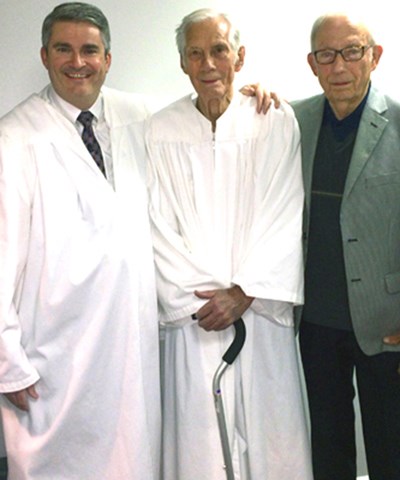
Pastor Michael Waters (left) baptized Pete Overcash (center) in March at Parkwood Baptist Church in Concord, N.C. Waters helped lead Overcash, 88, to the Lord in 2016. Pastor Darrell Coble (right) served at the church for 35 years and was pastor to Overcash’s late wife Norma.
Submitted photo. Courtesy Baptist Press.

CONCORD, N.C. (BP) — In the spring of 2016, I learned that Harvey “Pete” Overcash was in a nursing home for rehabilitation due to an accident with a garden tiller. He did not attend our church, but his wife Norma was a faithful member for more than 40 years and had recently become homebound with declining health.

Norma was a children’s Sunday School teacher while Pete showed no desire to attend church with her, but she faithfully prayed for him.

When I walked in his room, Pete smiled and told me he was happy to see me, even though we did not know each other very well. After he recounted his accident and next steps to getting well, he began to ask questions that seemed out of character for him. I sensed God was stirring and he was under conviction.

It was a Wednesday afternoon, and I needed to return to church to lead the Wednesday night prayer service. I asked Pete if I could come back the next day to answer his questions. He nodded without hesitation and said that would be fine.

I called the former pastor, Darrell Coble, who was Norma’s pastor for 35 years, and asked if he would go with me the next day since he planted the seed of the Gospel in conversations with Pete many years earlier.

I also shared with the folks at our Wednesday evening service that Pastor Coble and I were going back the next day to talk with Pete. I said, “If you have ever prayed, please join me tonight in asking God to save this man.”

The next day I pushed Pastor Coble in a wheelchair into the nursing home, since he was recovering from recent surgery. Pastor Coble asked Pete, “Do you remember when I shared the Gospel with you about 30 years ago?” Pete said he remembered but wanted nothing to do with it at the time. This time, he was ready to listen.

Pete willingly prayed to accept Christ. I could hardly believe it. Later, as we left the room Pete thanked us for the visit and asked us to come back anytime.

The follow-up visits with Pete changed my life. His countenance changed completely. He read all of the four Gospels in a matter of weeks and asked many questions about what he was reading. Pete was 86 years old when he accepted Christ and could not get enough of reading God’s Word.

Several weeks later, Pete said that before my initial visit, he knew someone was coming to see him. God had been dealing with him. He knew he needed to get right with God but needed someone to tell him. That was the day that I walked into Pete’s room. He knew God sent me to talk about his salvation.

As weeks passed, Pete was able to go home, although walking after the accident was very difficult, even with a brace and cane.

During visits to the Overcash home located in the neighborhood behind the church, Pete often expressed how much he wanted to go to church but wanted his wife to get better so she could be with him on his first day in church. Norma was grateful for the change she saw in her husband but never got well enough to attend with him.

One day Pete stopped by the church office to bring an offering. I invited him to see the sanctuary, since he had never been inside the building.

He sat on the back pew spellbound, as the sun shone through the stained glass window. “Preacher, I always wondered what it would be like to sit down in here, and it is more beautiful than I ever imagined,” he said. “If you don’t mind, could I have some time alone?”

I told him to take all the time he needed.

Several months passed and Norma’s health continued to decline until the Lord called her home in October 2017. The following Sunday, Pete attended a worship service for the first time and has continued every Sunday. In one of my recent visits to his home, Pete said, “Preacher, I really need to be baptized before I die.”

We had discussed the importance of baptism two years earlier when he prayed to trust Christ. But because of his desire to see his wife healed and attend church with her, I did not push the issue.

He had many questions, including how we would get him in and out of the baptistery. I suggested that he come to the church soon so I could show him how it works.

A few days before Palm Sunday, Pete dropped by. We walked him through several scenarios, assuring him it would be OK. Finally, he looked at me and said, “Alright, I’ll do it! When do you want me to do this?”

I explained that the church had a special Sunday night service for Palm Sunday that includes the Lord’s Supper.

I said, “Pete, it would bless those attending to see your obedience and determination to be baptized if you would consider letting us baptize you this Sunday night.” He agreed.

As we walked down the hall, Pete said, “You know, I used to think this was all a fairy tale, but as sure as I know my home is behind this church, I know I’m going to heaven when I die.”

By God’s grace, we baptized Pete Overcash on Palm Sunday evening, March 25, 2018, at age 88. I shared his story with the congregation before the baptism. When I brought him out of the water, the congregation stood to their feet clapping and shouting to the glory of God.

Our church has been inspired to never stop praying for the lost. With God all things are possible!

Michael Waters is pastor of Parkwood Baptist Church in Concord, N.C. This article first appeared in the Biblical Recorder (BRnow.org), newsjournal of the Baptist State Convention of North Carolina.


Commentary: Democrats for Life of America gather ’round a message: ‘We want our party back’

(RNS) — In a political era dominated by growing wealth inequality, resurgent white supremacy and the Party of Lincoln reduced to presidential Twitter farce, a reasonable person might ask: Where are the Democrats?

Sidelined in Congress and decimated in statehouses, today’s Democrats have lost the winning touch that gave us the New Deal, the Great Society and four decades of uninterrupted control of the House of Representatives. To get it back, they might do well to note what’s happening in Denver this weekend (July 20-22) as Democrats for Life of America convenes for what’s planned to be an annual conference.

It wouldn’t hurt Dems to make room for faith language once again. The party’s unlikely coalition of Southern Protestants, white “ethnic Catholics” and Jews has given way to a secular-led party that cannot speak the language of faith sincerely and is skeptical of religious beliefs, especially when held by white people.

And while there are many explanations for political behavior and party realignment, the parties’ elevation of abortion politics and ever more constrained and extreme views goes a long way toward understanding why the party of workers, civil rights and the common man struggles so mightily to win elections.

Democrats for Life of America has a simple message: “We want our party back.” A small but determined band of happy warriors, pro-life Democrats are some of the most interesting figures in American politics. Their continued existence in spite of marginalization by the party poses serious questions that the American political system cannot ignore.

Some of the organizers and speakers at the Democrats for Life event have, despite devoting significant portions of their careers to the party, received nothing but scorn from Democratic elites.

They advocate for what Roman Catholics and other religious people call a “consistent pro-life ethic,” emphasizing not only opposition to abortion but also support for social spending, family-friendly immigration policies and robust government guarantees of equity and access in health care and education.

In other words, the Republican Party would shun them even more.

Once tolerated, pro-life Democrats have been mostly ostracized by the Democratic Party for a generation now. What makes them interesting is that they are a massive group. The DFLA can credibly claim to speak for some 21 million people, a huge slice of the Democratic electorate.

In a 2014 report sorting Americans into various political typologies, the Pew Research Center noted the “Faith and Family Left” — some 15 percent of the U.S. population who are likelier than the general public to say that religion is important to them and that the government should do more to help the needy. As Americans become more liberal on social issues, abortion remains the exception to that trend.

And while the abortion-rights debate, like most political matters, is fundamentally about questions of law and public opinion, abortion is considered by many (though not all) to be a uniquely religious issue, and one that moral perspectives heavily inform.

There is a subset of religious Americans whose faith affirms every plank of the Democratic Party platform, but this group is vanishingly small, as some of its progressive disciples opt out of religion altogether.

But most Americans who profess a faith find that their religious commitments cut across the two parties. Democrats of faith must contend with their party’s affirmation of the sexual revolution, while religious Republicans are badly out of sync with mainstream Christian ethics on, well, almost everything else from economics and social spending to immigration and the environment.

Anyone who proclaims a consistent life ethic by opposing war, capital punishment and abortion while affirming migration, health care and social spending is going to be politically homeless in America. Both parties actively undermine your values daily. And independent candidates, while helping break the two-party duopoly, seldom campaign on the “seamless garment of life.”

Democrats forget that Rep. Nancy Pelosi was propelled to the House speakership in 2007 by the votes of moderate Democrats without whom the party could never dominate national politics.

And the great irony is that abortion-rights supporters make the most progress when there are more Democrats in elected office, even if the margin is grown by adding pro-life Democrats.

But the Democrats have decided that they would rather be pure and right than win. That’s why the party has adopted ever more extreme abortion planks, moving from “Safe, legal and rare” to something more akin to “On demand, without apology and at public expense if needed.”

Of all the Pew types, the Faith and Family Left is one of the lowest-income and least-educated. It also has the highest share of African-Americans, Hispanics and foreign-born, according to Pew.

The Democratic Party can safely assume that most pro-life Democrats will never leave. On other issues, they are the ones who need the party the most. Thus they can be taken for granted as long as our two-party system holds onto its polarized grip on American hearts and politics.

But until better political options emerge through electoral reforms, new competition and structural changes, the Democrats for Life of America remains one of the most maligned yet potentially consequential groups on the political scene. Unlike tortured religious Republicans who know in their hearts that politics have warped their faith, pro-life Democrats stand tall with an enviable, almost infectious, integrity and hope.

National Democratic leaders will happily ignore their own basket-of-deplorables gathering in Denver this weekend. That’s a shame. But with enemies like these, who needs friends?

Jacob Lupfer, a frequent commentator on religion and politics, is a writer and consultant in Baltimore. His website is www.jacoblupfer.com. Follow him on Twitter at @jlupf. The views expressed in this commentary do not necessarily represent those of Religion News Service or the Baptist Standard.


Interview: Rethinking apologetics for the black church

When Lisa Fields started college, she was a preacher’s kid who’d grown up inside of the church and never encountered opposition to her faith. That changed in her first New Testament class when she studied a textbook by Bart Ehrman, a professor of religious studies at the University of North Carolina, Chapel Hill, who argues against the inerrancy of Scripture.

“I’d been in church my whole life,” says Fields. “I was in a Christian bubble. I thought the class would be like Sunday school, I thought it was going to be an easy A, but I really struggled. Through that experience, my dad introduced me to Ravi Zacharias and that helped me start thinking critically about my faith.”

In the years since then, Fields has founded an organization called the Jude 3 Project, which uses apologetics to address the unique “intellectual struggles of Christians of African descent in the United States and abroad.” The organization offers lectures and seminars, training courses, podcast discussions, and a conversation forum called Courageous Conversations, which pairs black scholars and pastors trained in both conservative and progressive seminaries. …

CT spoke recently with Fields about the first fruits of her project and why black suburbia is one of her main areas of outreach.

Continue reading this interview at Christianity Today.


Commentary: Christians are calling for better family leave policies. That wasn’t always the case.

A prominent Christian think tank has come out fiercely in favor of better family leave policies, defending federally mandated family leave policies on theological grounds.

“Christian families can form themselves along a divine vision of work and family as holistic complements,” a report released Tuesday reads. “As citizens and culture-shapers, Christians should advocate for and develop policies and practices that protect, rather than fragment, family time.”

The report, authored by Katelyn Beaty and Rachael Anderson of the Center for Public Justice, advocates for changes on a federal scale, calling for an expansion of the Family Medical Leave Act. Pushing beyond public policy, though, the report also specifically targets gender imbalances within families.

The report follows a Senate finance subcommittee hearing last week on paid family leave, and a growing debate over the government’s role in providing resources for child care.

Continue reading this article at Vox.


Commentary: Artificial intelligence shows why atheism is unpopular

Imagine you’re the president of a European country. You’re slated to take in 50,000 refugees from the Middle East this year. Most of them are very religious, while most of your population is very secular. You want to integrate the newcomers seamlessly, minimizing the risk of economic malaise or violence, but you have limited resources. One of your advisers tells you to invest in the refugees’ education; another says providing jobs is the key; yet another insists the most important thing is giving the youth opportunities to socialize with local kids. What do you do?

Well, you make your best guess and hope the policy you chose works out. But it might not. Even a policy that yielded great results in another place or time may fail miserably in your particular country under its present circumstances. If that happens, you might find yourself wishing you could hit a giant reset button and run the whole experiment over again, this time choosing a different policy. But of course, you can’t experiment like that, not with real people.

You can, however, experiment like that with virtual people. And that’s exactly what the Modeling Religion Project does. An international team of computer scientists, philosophers, religion scholars, and others are collaborating to build computer models that they populate with thousands of virtual people, or “agents.” As the agents interact with each other and with shifting conditions in their artificial environment, their attributes and beliefs—levels of economic security, of education, of religiosity, and so on—can change. At the outset, the researchers program the agents to mimic the attributes and beliefs of a real country’s population using survey data from that country. They also “train” the model on a set of empirically validated social-science rules about how humans tend to interact under various pressures.

And then they experiment: Add in 50,000 newcomers, say, and invest heavily in education. How does the artificial society change? The model tells you. Don’t like it? Just hit that reset button and try a different policy.

Keep reading this article at The Atlantic.


Commentary: 8 ways to wound a minister

Shepherds play an important role in the biblical narrative. Shepherds appear frequently in both the Old and New Testaments, often in reference to leaders.

One of my favorite images of a shepherd is that of a caregiver. It is common for a shepherd to examine sheep for wounds as they gather in a pen or cove after a day of grazing. The shepherd cleans the wound and applies an ointment to it before bedding the sheep down for the night.

Congregational ministers are trained to be good shepherds. Identifying and binding wounds are significant parts of a minister’s job. This was certainly true for Jesus.

Instead of conducting his ministry in the temple in Jerusalem like many of his colleagues, Jesus chose to walk down dusty Palestinian roads where he could interact with people from all walks of life. He listened to their stories so he could respond to their needs with mercy and grace.

Being the good Shepherd did not prevent Jesus from being wounded. Nor does it keep today’s ministers from being wounded.

Continue reading this article at Baptist News Global.


Spain: Show the love of God

When we talk about doing missions, surely many of us think of going somewhere far from home and possibly preaching the gospel to a lot of people or having a place with a big crowd surrounding us and telling them about Jesus. If that had never crossed your mind, at least it has crossed mine. Until a few weeks ago, I had that idea about doing missions. Now I realize that it is not like that.

I couldn’t understand how God was going to use me here if I wasn’t able to talk about God with the children. If I spent my time sweeping the floor in the mornings or washing a pile of dishes, how I would reach souls if I did not preach about the gospel. I thought: “I don’t think I’m doing missions. I’m sure I’m in the wrong place.” I thought I was not contributing at all to the kingdom of God. But, how can we be missionaries if we do not understand the meaning of missions?

God has made me understand that missions is not what we do; it is who we are in Jesus Christ. It is to show the love of God in everything we do—no matter if we feel or think we are not making a big impact around us. Surely, God is working something big at that moment, and you do not even realize that.

God is love. Therefore, when we do things under his authority, everything we do will be done with love and humility. God is never wrong when he put us in the place where we are. God wants to use us where we are, and he wants us to shine that light that he has given us.

Karla Magana Gonzalez, a student at Tarrant County College, is serving in Spain with Go Now Missions.


Colorado: Gateway to family ministry

I love working with kids. I have been doing it ever since I aged over the threshold of being a kid myself. In the past, however, I’ve always thought of children’s church and Vacation Bible School as lots of fun but not super important. That’s why they let the volunteers and teenagers work it, right? Somewhere in my church life, I got the idea that children’s ministry is on the back burner, and all the focus should be on adults and youth.

I have been terribly wrong.

Since I have been in Colorado, I have spent a lot of time at children’s church, sports camps and block parties. While entertaining games and activities are important, it is the people called to children’s ministry who are vital in sharing God’s word with these kids. I know the words “called to” are intimidating, but that’s actually how it is. Whether it is your full-time job or you volunteer once a month, God has called you to play a significant role in influencing his children to follow him.

One thing I have learned this year is how important it is that kids see familiar faces and have a routine ministry experience, just like the adults.

“Wait, are you teaching this week? Yay! Miss Gracie is teaching this week!” Those words made me so happy multiple times this summer. Children want to see you today, and they want to see you again next time.

Sunday school is probably the most chaotic time of the week. Kids are not using their inside voices, we can’t find the glue, and someone needs to go potty. It’s easy to get lost in the busyness, but those few minutes of learning about God’s word and praying together go a long way. I like asking kids after church what they learned about, and I’ve found that they actually listen.

Most of the time, we get told exactly what to do in children’s ministry—read this story, sing this song, etc. But as a leader, you still have the responsibility to let the Holy Spirit guide that time. One of my favorite moments this summer was when the Sunday school teacher decided to do an interactive gospel presentation before doing whatever the curriculum guided us to do. Do you think the kids remember the video that they usually see, or the new fun activity? The classroom was absolutely chaotic, but they definitely learned something new about Jesus and his saving grace.

Through talking with our supervisors and pastors, my partner and I have learned about the church and the demographics of the population here. They told us families with young children are the most likely to reconnect with the church. This means the kids get to come, but their parents who have disconnected are coming back, too.

At some time or another, parents are faced with questions they do not know how to answer. This curiosity—along with their child’s need to share experiences with their parents—has led many families back to church. If we make children’s ministry as crucial to the church as it is to the kids, we extend that importance to the rest of the family as well.

I think that puts it into perspective. Children’s ministry is an integral part of the church as well as the gateway to family ministry.

Gracie Humphrey, a student at the University of Texas in Austin, is serving this summer in Loveland, Colo., with Go Now Missions.


Eastern Europe: Teaching English and sharing the gospel

Being surrounded by thousands of college students, I thought I was going to spend 100 percent of my time with them when I arrived in Eastern Europe. The pamphlet describing the position always talked about grabbing coffee with college students and investing time building relationships through sports and entertainment around the city. While this is the main focus of this trip, God continues to demonstrate just how powerful he is and how his love tears through spiritual barriers.

One of the ways we serve and share is through English classes offered every Tuesday and Thursday. The people who attend? Far from college students. Most who attend the English class are over the age of 40 and have pretty much settled down their lives while having years rooted in their Orthodox religion.

During one of the first weeks we got here, we held an English Intensive week, which means offering English class Monday through Thursday. During these four days a certain older gentleman was put into my group. Before this, he had had a bad reputation in groups and actually was asked to leave, but for some reason, he attended these four days of English Intensive. Once that week was over, he wanted to continue with the classes that we held twice a week and for some reason, God put him in my group again.

Once I thought about the fact that God was doing this on purpose, I tried to discern the best course of action to continue sharing the gospel with him effectively. During the English Intensive week, we would read Bible stories and talk about them, but it was difficult to get personal because there were so many people. Fortunately, this wasn’t the case after the English Intensive week ended.

In the first lesson, we focused on Genesis 1-2. He and I talked about different moral concepts, but for the most part he was closed off to talking about anything relating to spirituality. The second lesson focused on the fall of humanity, based on Genesis 3.We talked again about moral concepts and understanding of sin.

As we continued to talk and complete different lessons, his heart slowly started to open up. Around the sixth lesson, I felt the Spirit put it in my heart to ask him a question about Jesus. I really didn’t know what to say. So, when it was time for English class, I began by asking him: “What do you think about Jesus? Who is he to you?”

We proceeded to talk about Jesus for the next hour and a half, and it was something he wanted in his life. God has been hard at work in him previously and was pursuing him relentlessly.

Since then, he has gotten plugged into the local home church and is growing in his faith. Please pray for his spiritual growth.

Manuel, a student at the University of Texas at El Paso, is serving in Eastern Europe with Go Now Missions. His last name is withheld due to security concerns.


Central Asia: Victory won

Who am I? What is my purpose? Where do I come from? When will I feel satisfied? How can I know truth? These were the kind of questions I asked myself the year before my first year of college, not knowing that all these questions were about to be answered by someone greater than I—one whose existence I dedicated myself to disproof.

Now, I know who I am and who he is—the purpose of my being since the beginning of it all. My satisfaction is fed by the Truth. That is my story.

On my first week here in Central Asia, I met a good friend. Since then, we have done fun things together. We walked around town, visited coffee houses, shared meals and watched the World Cup, always sharing deep conversations and lots of laughter.

The time when I shared my story, he sat there staring in my eyes as I stared back. I could feel we both were thinking the same thing about each other, “He knows my story.”

My friend told me about a dream, in which he saw a man carrying wood on his back. Before I could tell him about the man, he told me that it was Jesus, who was telling him about the way he should follow. I had a big smile on my face followed by some chuckles. I had never heard about something like this from a person I knew. That night concluded with him telling me he knew what had to be done, but he wasn’t ready and did not know when he would be ready.

A couple of weeks later, we were hanging out for his birthday—just the two of us watching a football match. That night, he shared with me that he had been thinking about being reborn. I asked if he knew what that meant and then got to explain it in the following way: “If a football team wins the World Cup, they get to celebrate and lift up that cup at the ceremony. However, the match must first be won before they get to proclaim the victory in view of the whole world.”

I proceeded to share about the victory Christ won that ended the match already. Before I could finish, I saw a man breaking down at the sound of the news, saying the time for him to pick up that victory given to him was now.

My story seems to have been translated to a different language in order to speak answers to my friend. Both our stories speak of one who is greater than us, who holds the answers to our deepest questions and desires.

Franky, a graduate of the University of Texas at El Paso is serving in Central Asia with Go Now Missions. Franky’s last name is withheld due to security concerns.