2nd Opinion: For vision, good enough isn’t enough
Surely you have heard something described as “good enough for government work.” Or you have heard its cousin, “close enough for government work.” These phrases make us think about mediocre quality.
 George BullardWhen people think about congregational vision, do they think about mediocrity or excellence? Because becoming captivated by God’s vision is difficult, too often people work on it for a while and then say something like, “That is good enough for church work.” In doing so, they define congregational vision as sufficiently unimportant that it is fine to be mediocre.
Here are six insights that focus on congregation vision that is only “good enough.” I previously described 48 insights about congregational vision contained in the posts found here.
• When it comes to vision, good enough is never good enough, adequate is never acceptable, and mediocrity is never excellence.
During the 1980s, I worked at the national missions agency of a denomination. We worked hard at fulfilling the mission and vision embodied in the Great Commission in the spirit of the Great Commandment. We were deeply passionate about it. We always sought to do everything with excellence.
After four years, I moved to a state missional role that presented many challenges. The shock in moving from the national role to a state role was to discover the measuring rod of excellence was extremely different. What we would have considered mediocre at the national agency was seen as excellence in this state.
That gap in an understanding of excellence made it difficult to engage in leading-edge missional efforts.
• When vision is of a mediocre, business-as-usual future, then you get a mediocre, business-as-usual future.
When I pushed for excellence in my state missional engagement role, I experienced resistance in many places. The most disappointing was from other staff who did not want to work hard enough and smart enough to achieve true excellence. My staff team was criticized internally for our hard work and excellence.
The criticism was so strong that—with the permission of the CEO of the regional denominational organization—some of my team’s work went underground so we could continue achieving excellence and making kingdom progress, but it would not be as obvious to other staff.
• When vision is of a mediocre, business-as-usual future, then you get the less vital and vibrant future you projected.
One of the signs of mediocrity in the state denominational organization was in the area of work that sponsored the special missions offering that funded about half of the missional efforts. The year before I arrived, their offering raised about $777,000. Their goal, however, for the next year was only $700,000.
I questioned this. It did not appear challenging. The response was that they set their goals low so they are sure they will meet them. My thought was I had just discovered another example of mediocrity.
• When vision is of a mediocre, business-as-usual future, then less is less and more is nowhere in sight.
I was shocked one day when a colleague wanted to hold up as excellent a congregation so mediocre the possibility it might have to close down within a year or two was very high. I visited the congregation and discovered a mediocre, business-as-usual future was its goal.
• When vision is of a mediocre, business-as usual future, the congregation may be turning its back on the call of God.
What do too many congregations do when God calls them to a prophetic, innovative vision for kingdom progress? They lie down beside it and go to sleep. They declare they cannot really do what God wants them to do. They declare this is their church, and they will do what they want to do, not realizing in saying this they are spiritually insubordinate in opposing God’s leadership.
• When vision is of a mediocre, business-as-usual future, it can negatively impact the spirituality of the congregation.
If the vision of a congregation is mediocre, characterized by business as usual, then expectations of spiritual maturity among congregational participants likely are low. Cutting edge innovation in the spiritual formation, leadership development and missional engagement of congregations is not necessary if the expectations are low.
George Bullard is a strategic leadership coach for Christian leaders and organizations with The Columbia Partnership and general secretary of the North American Baptist Fellowship. This article appeared on his blogsite, “George Bullard’s Journey.”
This is the 19th in a series of posts on congregational vision. The next blog in this series is titled “Congregational vision is about expanding and deepening disciplemaking.” To see all the posts, click here.
This column first appeared on the Baptist News Global Perspectives blog. See more by clicking here.

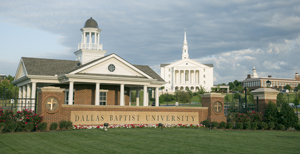 A former U.S. Cabinet member and chief of staff to President Lyndon B. Johnson, Marvin Watson, became president in 1979 and led the college toward university status by adding the first graduate programs. DBC became Dallas Baptist University in 1985, but it endured extreme financial hardship.
 In 1988, Gary Cook’s presidency re-energized the school. By 1992, the debt was totally eliminated, and 92 more acres were added. Enrollment reached 5,319 by the fall of 2015. Among those are 588 international students representing 62 countries. DBU provides 72 undergraduate majors, 28 master’s programs and two doctoral degrees. Cook is now the school’s first chancellor as trustees search for the next president.
 ETBU’s current enrollment is 1,308, and it offers more than 40 programs of study and graduate studies in business, counseling, education, Christian studies and religion. J. Blair Blackburn became its 13th president last June, after serving at DBU 20 years—13 as executive vice president.