Commentary: The tale of two presidents at Southwestern Baptist Theological Seminary

Southwestern Baptist Theological Seminary, a Southern Baptist Convention seminary in Fort Worth, Texas, has relieved President Paige Patterson of his responsibilities.

Patterson’s status has been in question for weeks after reports surfaced that years ago he advised an abused woman to remain with her husband and forgive him.

Although he initially stood by his actions, Patterson later issued an apology and SWBTS’s Board of Trustees scheduled a special meeting after a letter, signed by thousands of Southern Baptists, was published that condemned Patterson’s actions, comments and ideology.

On Tuesday, while SWBTS trustees were meeting, The Washington Post reported on allegations that Patterson, then serving as president at Southeastern Baptist Theological Seminary in North Carolina, told a student who had informed SBTS administrators she had been raped not to report it to the police and to forgive the alleged assailant.

Early Wednesday morning, trustees officially removed Patterson from leadership and released a statement regarding his status.

Yet, according to The Washington Post, SWBTS has provided him with a lucrative compensation package that includes housing accommodation on campus and the titles “theologian-in-residence” and “president emeritus.”

In the spring of 1994, I was on the campus of SWBTS as an aspiring student.

Growing up in very conservative churches in Oklahoma, I was astounded at the high level of education I was receiving from professors under the leadership of then president, Russell H. Dilday.

President Dilday was a well-respected leader and theologian that had a great rapport with students and admiration from the seminary faculty. Entering into my spring semester as a first-year seminary student, I was happy with my decision to attend Southwestern.

Then, everything changed when the trustees arrived on campus.

During their annual meeting, trustees gave Dilday a vote of confidence as seminary president. However, the next day those same trustees voted to fire Dilday for not offering enough support for a fundamentalist takeover of the Southern Baptist Convention.

As they voted to fire Dilday, they locked the doors of his office, escorted him to the president’s house with armed guards, and prohibited him from walking anywhere on campus. They treated him as a criminal whose crime was not being conservative enough in their eyes.

For those still confused about what the Southern Baptist’s wars were all about, you are now seeing first-hand the dark shadow moderate-conservatives, moderates and progressives saw rising from those who gained power in the Southern Baptist Convention.

Using the Bible as a tool to gain control over others, Patterson and other Southern Baptists leaders blatantly lied and misrepresented the truth about faithful Baptists in their quest for power and privilege. Nothing would stop their aspirations of reaching the highest levels of authority within the world’s largest Protestant denomination.

Once the Southern Baptist Convention was taken over by right-wing conservatives, they quickly began to put their “theological” convictions into practice.

While numerous issues were touted — such as biblical inerrancy, marriage between a man and woman, pastoral authority, and breaking down the wall of separation between church and state — the one issue that seemed to be at the forefront of the SBC’s predominately-male leadership was the submission of females to male authority.

Time and time again, Southern Baptist men passed motions and implemented policies that demeaned women and categorized them as second-class citizens in the kingdom of God.

From wives submitting to their husbands to women not being allowed to teach men, Southern Baptist leaders have waged war on women over the last four decades. In Southern Baptist seminaries, women professors have been fired and not granted tenure based merely on their gender and skewed interpretations of a few biblical texts.

Therefore, when the news broke about Patterson’s departure at Southwestern, I could not help but think back to that spring semester when I witnessed the evils of right-wing conservative theology on display.

While one of the kindest and thoughtful Christian men to ever walk on the campus of Southwestern was treated as a criminal for not being “conservative” enough, Patterson was ushered out the door with a golden parachute. Apparently, for Southern Baptist leaders, it pays well to keep the party line and keep women in their place.

As an alumnus (MDivBL, ’97) of SWBTS, I am appalled and ashamed of the actions the trustees took towards Patterson this week. While his removal as president was appropriate, the message trustees sent with the exit package they provided was crystal clear.

As far as Southern Baptist leaders are concerned, the reputation and well-being of their male leaders far outweigh the rights and lives of abused women everywhere, statements about condemning “all forms of abuse” notwithstanding.

Southern Baptists must correct this evil course they find themselves on today.

With stories like these, evil ideas and practices are warping the message of the gospel — the message of Jesus that seeks to liberate, protect and give salvation to every victim of sinful abuse.

When I read the Gospels, I am quite confident Jesus would have been ministering to the abused women and condemning the male leaders for their sinful behaviors.

For the sake of abused women everywhere — especially those suffering at the hands and oversight of Baptist leaders — I pray a groundswell of Baptists follow the words and actions of Jesus.

Faithful Baptists of all types — conservatives, moderates and progressives — need to rise up, condemn these actions, and demand equality for all people.

Baptists can no longer let misogyny be an acceptable theological practice. We must demand more from our leaders and champion an egalitarian theology that empowers all Baptists.

Mitch Randall is executive director of EthicsDaily.com. You can follow him on Twitter @rmitchrandall. This article originally appeared at EthicsDaily.com and has been reprinted with permission of the author.


Commentary: In finding common ground, Jimmy Carter and Liberty University set good example

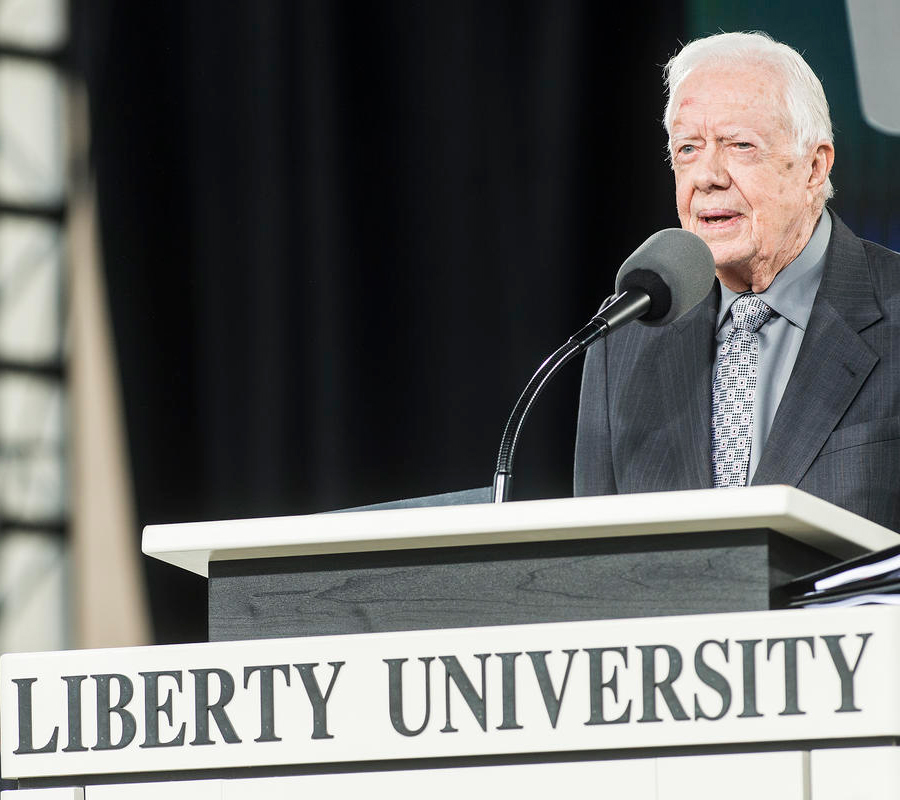
(RNS) — As Jimmy Carter waited to appear before a commencement crowd at Liberty University, it looked like he might be entering the lion’s den. The school, founded by Carter’s political foe, Jerry Falwell Sr., has stayed true to its socially conservative roots. Carter has been steadfastly to the left.

But Liberty President Jerry Falwell Jr. gave Carter a generous introduction, praising his kindness, warmth and humility. In a curious comment, Falwell said: “The longer I live, the more I want to know about a person and give my political support to a person. Policies are important, but candidates lie about their policies all the time to get elected.”

For his part, Carter, 93, resisted the urge to re-litigate old institutional battles. Instead, he deployed his characteristic humility and charm to emphasize his closeness with and affection for fellow Baptists and other Christians in spite of significant differences.

As he always does, Carter emphasized the plight of women and girls who experience sexism and other forms of degradation. He also spoke on themes that progressive Baptists often emphasize: wealth disparity and the threat of nuclear war. But Carter lifted up other issues that, along with sexism, conservative Baptists routinely denounce: human trafficking, discrimination and rising prison populations.

Carter’s address began and ended with standing ovations. His presence and the audience’s generosity called to mind what I viewed as one of the high points of the 2016 presidential campaign: Sen. Bernie Sanders’ visit to Liberty. That event was also a model of civility and mutual respect in spite of profound political disagreements.

Baptists haven’t always been so keen to get along. Extending into many corners of cultural and political life, the Baptist battles have been the biggest story in American religion during my lifetime. Though never “my tribe,” I have witnessed and chronicled these developments for nearly two decades. It seems Carter and Liberty might model a better way.

Former President Jimmy Carter speaks at the 45th Liberty University commencement at Williams Stadium on May 19, 2018, in Lynchburg, Va. (Lathan Goumas / The News & Advance via AP / RNS)

Thus, when Mr. Carter stood to address Liberty’s graduates and their families, it offered a judicious moment to take stock of where the Baptist battles stand.

When I was born in November 1980, Carter’s presidency was winding down in the wake of Ronald Reagan’s election. Around the world, a wave of fundamentalism was forcing scholars and policymakers to take note of religion, once thought to be on its way out.

Here in the United States, the Southern Baptist Convention was in the earliest stages of a conservative resurgence that would definitively break with mainline Protestantism. The SBC, now America’s largest Protestant denomination, would usher in a new era of leaders who would face public and private temptations concerning influence, faithfulness and proximity to political power.

In 1980, Carter was the only evangelical many elites knew. Liberty University was a fundamentalist Bible college.

Today, Carter is an international humanitarian icon. Grieved by some of the Southern Baptist Convention’s changes, Carter severed ties with the SBC in 2000. This fact was little noted in press reports on his Liberty speech, but the substance of his critique was over an SBC powered by resurgent conservatives who more rigidly specified gender roles. Carter has subsequently expounded on his egalitarian views, making women’s rights a centerpiece of his advocacy work.

In the 11 years since his father’s death, Falwell Jr. has grown Liberty’s prominence through ambitious fundraising and a massive online-degree business. Founded as independent institutions, Liberty and nearby Thomas Road Baptist Church, pastored by the Rev. Jonathan Falwell, are closely linked to the SBC through their relationships with the Southern Baptist Conservatives of Virginia, a rival state convention founded in the mid-1990s over fears that the regular one was run by liberals and heretics.

All this to say that while political officials, candidates and media trumpet Liberty’s political relevance, we still see how endless debates, competing interpretations and divergent emphases in Baptist life have little to do with national politics.

White evangelicals who think they mostly oppose Carter’s politics would do well to give him the same respect Falwell and the Liberty University crowd gave him. Likewise, progressives predisposed to hate Jerry Falwell Jr. should take note of his generosity to Democratic political leaders who visit the campus. Many more Democrats should accept the invitation to speak at Liberty.

Presidents come and go, but the Baptist battles will continue apace. As leaders and ordinary believers debate what it means to be Baptist, these two important leaders with close ties to the presidential office have shown us that politics matter less than we suppose.

Falwell and Carter offered a model of civility and generosity that all Americans, whether Baptist or not, can stand and applaud.

Jacob Lupfer, a frequent commentator on religion and politics, is a writer and consultant in Baltimore. His website is www.jacoblupfer.com. Follow him on Twitter at @jlupf. The views expressed in this commentary do not necessarily represent those of Religion News Service or the Baptist Standard.


Commentary: Reclaiming enthusiasm

Ready for a vocabulary lesson?

Stagnant. Boring. Aimless. Tired. Tepid.

What do these words describe? You? Your minister? Your church? Your Sunday School class? Your career? All too often, I hear ministers and parishioners alike using such words to describe all of the above. Far too many of God’s people and God’s churches find themselves with a shortage of passion and energy for the journey before them.

Many churches seem to be going in circles, without energy and lacking a sense of missional direction. Ministers talk about burnout and seem to have lost their focus. A sense of calling and passion has slipped away. Laypersons show up without preparing to worship. Life at the church becomes predictable. New ideas and suggestions meet with practiced indifference. Is it any wonder that eventually parishioners talk about their pastor, and ministers describe their congregation using such words?

Do you know how we got our word “enthusiasm”? It comes from the Greek, and is a blend of two words, one being en (in) and the other theos (God). Enthusiasm, as originally defined, means having God within us. Of course, over time, enthusiasm came to mean “any rapturous inspiration like that caused by a god.” Today, we are more likely to use this word to describe our feelings about a favorite athletic team or hobby than to describe what God is doing in and through us.

Perhaps it is time we revisit this word and reflect on its origins. The truth that God within us sparks enthusiasm and ardor is both biblical and healthy. When faith is healthy, it begins within and is passionate, heartfelt, spontaneous and authentic. It is less concerned with meeting the expectations of others and more concerned with giving witness to the One who gives us purpose and direction. It is when our religious practice flows out of guilt or meaningless repetition or thoughtless habit that it is thin, shallow and unable to hold up to the demands of life in the 21st century.

When our life in Christ flows out of a personal relationship that defines everything about us and gives us a center to build the rest of life around, enthusiasm is inevitable. Christ as the organizing center of all of life not only holds life together, it gives life meaning beyond the ups and downs of circumstances. Without that deep indwelling of the Holy Spirit in our congregation and the individuals who make up the congregation, we are prone to become like the shallow soil of the parable of the sower . . . unable to root deeply and endure the inevitable dry season.

Individuals can be enthusiastic, but so can congregations. When the body of Christ is “en theos,” that is, when local church life is grounded in God’s presence rather than ritual or personality or practice, then healthy enthusiasm becomes a defining trait of God’s people. The healthiest churches I know are not clergy-focused or program-focused or doctrine-focused. They are Christ-focused. Whether it be acts of worship or mission endeavors or teaching opportunities or fellowship events or outreach efforts, the persistent emotion underneath them all is a deep and authentic enthusiasm.

Emerson had it right: “Nothing great was ever achieved without enthusiasm.”

When God’s people are filled with the character and spirit of Christ, then great things are possible. Check your vocabulary, and let’s see if we can inject some new words into our conversations: passion, energy, enthusiasm, meaning, purpose. Those words describe the kind of church and church leader our world needs today.

Dr. William “Bill” Wilson is the director and founder of The Center for Healthy Churches, where this article originally appeared.


Commentary: Why Paige Patterson’s apology may not be enough

(RNS) — In just two weeks, Paige Patterson has done what none could have predicted: He’s given America’s largest Protestant denomination two black eyes.

The first injury was inflicted when his comments about spousal abuse and women went viral. The statements, which span decades, include objectifying a 16-year-old girl in a sermon, saying “everyone should own at least one” woman, and advising abused women to return home and “be submissive in every way.”

The second injury came when Patterson responded to the controversy by standing stalwart and claiming he had nothing for which to apologize. For 13 days, he folded his arms while Southern Baptists were thrown into chaos. For 13 days, he dismissed reporters’ questions and shrugged off his critics. For 13 days, he ignored a cavalcade of women—including 3,000 from his own denomination—who practically begged him to make amends for his dangerous comments.

On Thursday (May 10), however, Patterson released a three-paragraph statement apologizing that his comments “lacked clarity” and “wounded” some women. While I do not doubt the sincerity of his statement, I’m troubled by its substance. After all, the statement was part-apology and part-excuse. Patterson claimed the matter could be attributed to a “failure to be as thoughtful and careful in my extemporaneous expression as I should have been.”

In theological terms, Patterson sees his comments as a snafu rather than a sin. But the advice he offered to victims of domestic abuse and the ways in which he has spoken about women in general is neither a mere mistake nor the result of carelessness. It is wrong and contradicts the Bible’s unambiguous teachings on violence and marriage.

While any apology is arguably better than none, it’s doubtful that such a statement will placate his fiercest critics, who will likely see this as far too little, far too late. It will take more than a tepid apology to ease the pain caused by these types of statements, which have emboldened men for decades to mistreat countless women. You cannot untangle that legacy in just three paragraphs.

We have seen this movie before. From Hollywood actors to prominent pastors, the pattern is all too familiar. The film opens with a scene in which a celebrated leader is accused of misbehavior. Rather than apologize, the leader circles the wagons. The community is scandalized at mounting accusations, but rather than attempt to heal the harm, the leader responds with denials, silence and conspiracy theories. But then reporters begin sniffing and more evidence inevitably surfaces. When it becomes clear that he’s been caught red-handed and the neighbors know, the leader offers a forced apology in hopes that the rest of us will forget the matter.

Move along, folks, there’s nothing to see here.

But Southern Baptists cannot move on. Because their denomination has been unexpectedly thrust into a larger cultural conversation about the mistreatment of women and institutions’ failures to protect them from powerful men who misbehave. Their commitment to the safety and dignity of women has now been called into question.

After such a failure of leadership and failure of judgment, it’s up to Patterson to right the ship. Will he withdraw from delivering the coveted keynote at the Southern Baptist Convention in June, knowing that his speaking will be a distraction and make matters worse? And what of Southwestern Baptist Theological Seminary? The school’s enrollment has declined dramatically under Patterson’s leadership, and he has now become so toxic that his presence will make it even more difficult for them to attract incoming students.

In either case, it will take a much heavier dose of humility for Patterson to step aside in service to the institutions and people he claims to love.

The views expressed in this commentary do not necessarily reflect those of Religion News Service or the Baptist Standard.


Commentary: Is Jerusalem embassy part of God’s grand plan? Why some evangelicals love Israel

(RNS) — On Monday (May 14), the Trump administration unveiled its new Jerusalem embassy. Many American evangelicals cheered because they understood the United States’ recognition of Jerusalem as the “once and eternal” capital of Israel as a fulfillment of biblical prophecy.

Trump chose two evangelical ministers to offer prayers at the dedication of the embassy. Robert Jeffress, pastor of the First Baptist Church of Dallas, delivered the invocation. John Hagee, pastor of Cornerstone Church in San Antonio, gave the benediction.

Both clergymen adhere to dispensationalism, a theology informed by a literal reading of biblical prophecy. Most Americans have never heard the term “dispensationalism,” but they might have been exposed to this view of history through the popular “Left Behind” novels published in the 1990s and 2000s by Christian authors Jerry Jenkins and Tim LaHaye.

Dispensationalists believe Israel will play an important role in end-times prophecy. They teach that the return of the Jews to their homeland will be a sign that the end of the world is near. In most dispensationalist schemes, Jesus Christ will one day descend from heaven to the Mount Olives in Jerusalem, lead an army that will defeat the forces of the Antichrist at the Battle of Armageddon and establish a 1,000-year reign on the earth.

Pastor Robert Jeffress preaches at First Baptist Church of Dallas. (Photo by Luke Edmonson / Courtesy of First Baptist Church of Dallas via RNS)

Robert Jeffress studied at Dallas Theological Seminary, the most important bastion of 20th-century dispensationalist thought. In 1970, author Hal Lindsey, a graduate of the seminary, brought dispensationalism into the American mainstream with the publication of his best-selling “The Late Great Planet Earth.” Jeffress has written his own books on biblical prophecy informed by this view of the Bible.

In 2006, Hagee formed Christians United for Israel, an organization of evangelicals committed to defending dispensationalist views of Israel’s place in biblical prophecy.

Both Jeffress and Hagee are also supporters of the idea that America was founded as, and continues to be, a Christian nation. They believe that the United States plays a special role in God’s plan for the ages.

The fact that the most powerful nation in the world has used its influence to restore Jerusalem to its rightful place in history provides dispensationalists like Jeffress and Hagee with clear evidence that America is on the side of the angels. Jeffress likes to quote God’s call of Abraham in Genesis 12: “Go from your country, your people and your father’s household to the land I will show you. I will make you into a great nation, and I will bless you. … I will bless those who bless you, and whoever curses you I will curse.”

For some of these dispensationalist evangelicals, Donald Trump, as the leader of a nation who has “blessed” Israel, is God’s man for such a time as this. Trump not only has the right policies on abortion and religious liberty, but he may even be a new King Cyrus.

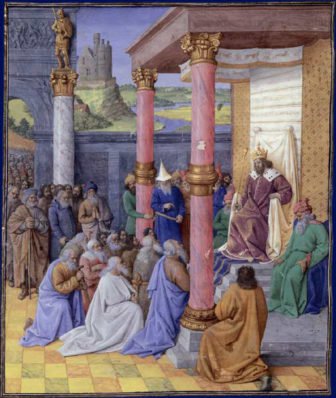
This is a depiction of the biblical character Emperor Cyrus the Great of Persia, by Jean Fouquet, created circa 1470. (Image courtesy of Creative Commons via RNS)

In the Old Testament, Cyrus was the Persian king who released the Israelites from captivity and allowed them to return to Israel, the promised land where they rebuilt the walls of the city and the Jewish temple. Several evangelical leaders who have compared Trump to King Cyrus see the president as the politician who released American Christians from the captivity of what they perceive to be the anti-evangelical Obama administration. In a sermon on the morning of the 2017 presidential inauguration, Jeffress even praised Trump as a great builder of walls.

But other have applied the King Cyrus metaphor to Trump’s Israel policy. For example, Mike Evans, the founder of the Friends of Zion Heritage Center in Jerusalem and a staunch Trump supporter, was ecstatic last December when he learned about Trump’s decision to move the embassy to Jerusalem. Evans told the Christian Broadcasting Network that when he next saw Trump in the Oval Office he would say to him: “Cyrus, you’re Cyrus. Because you have done something historic and prophetic.”

Because of Trump’s actions, dispensationalists believe the blessing of God will come upon America. The Jerusalem decision reinforces the idea that America is a Christian nation. This decision makes America great in the eyes of God. It also makes Trump great in the eyes of those American evangelicals who visit the White House regularly to consult with the president, the flatterers and sycophants whom I have called the “court evangelicals.”

Jeffress, Evans and other court evangelicals claim that they were influential in Trump’s decision to move the Israel embassy. If this is true, we can say with certainty that United States policy in the Middle East is now heavily influenced by dispensational theology.

John Fea teaches American history at Messiah College in Mechanicsburg, Pa. He is the author of the forthcoming “Believe Me: The Evangelical Road to Donald Trump.” The views expressed in this commentary do not necessarily reflect those of Religion News Service or the Baptist Standard.


Commentary: Revisiting Baylor’s list: What does an effective preacher look like?

(RNS) — Last week a list was published by Baylor University’s Truett Theological Seminary, announcing the “12 most effective preachers in the English-speaking world.”

It is just over 20 years since Baylor carried out a similar survey; W. Hulitt Gloer, director of Baylor’s Kyle Lake Center for Effective Preaching, commented on the differences between the two surveys. “Of great interest,” he said, “is the diversity represented in the new survey, especially with regards to ethnicity and ministry,” pointing out that the new list includes three African-Americans, and is divided between eight pastors and four academics.

But as the results were publicized, social media lit up with reactions that ranged from outrage and despair, to ridicule and scorn. Like me, many people were struck forcibly by the list’s lack of diversity.

The problem is not with the individuals named, each of whom is a distinguished preacher, and some are also leading homiletics scholars and authors. I have personally met four of them, and found them to be impressive people both in and out of the pulpit; a little online research reveals that the rest are equally outstanding. The problem, rather, is that the list as a whole creates a biased and anachronistic impression of what an effective preacher looks like.

First of all, unlike the church population as a whole, this list of preachers is predominantly white.

Secondly, although the list claims to represent “the English-speaking world,” the names are drawn exclusively from the U.S.

Some critics were quick to point out that all those named are mid-to-late career, implying that young people are not effective preachers. But perhaps the most glaring anomaly of all is that, among the 12 preachers on the list, only one is a woman.

Members of “Nevertheless She Preached,” a group founded to promote women in the pulpit, were among those critics. “While the survey indeed names some effective preachers, the results include only one woman, no women of color, and zero LGBTQ preachers. Yikes!” they wrote on their website, and published a list of their own.

On the face of it, then, the subtext of Baylor’s list is that if you aspire to become an effective preacher, you would be best advised to be American, white and male. In a climate more attuned than ever to the need to break down the narrow confines of patriarchy, how could this study produce such a one-sided perspective?

To be fair to Baylor, their intent was not to award the “Oscars” of preaching, but to identify what constitutes excellence in preaching, and how best to improve their teaching of homiletics. The study had two stages: In 2016 a survey was carried out to update the seven criteria for effective preaching. After that, scholars and practitioners from two associations were asked to nominate the preachers who best fulfilled those criteria. Nearly 800 nominations were made, from which the final list was selected.

The criteria agreed upon were more concerned with the quality of the preacher’s art than with their fame or popularity. In 2001, when Time magazine proposed that T.D. Jakes might be “the next Billy Graham,” its assessment was based on the preacher’s drawing power; Jakes and Graham, it said, were the only two preachers who could fill the 79,000-seat Georgia Dome.

The Baylor survey, however, was based on such matters as the skillful and scholarly use of Scripture, the sermon’s form and structure, and clarity of delivery. Its purpose, according to Gloer, was “that we may continually be becoming more effective,” specifically in the task of teaching the next generation of preachers.

Nevertheless, the Baylor list does function as a kind of prize—or at least, that is how it is perceived now that it has been publicized. CNN likened it to the NBA Dream Team, the Grammys, and the Oscars, accolades that not only celebrate excellence in their field, but serve to reinforce the success of those who hold the awards and who to a certain extent set the stage for others who will follow in their footsteps.

The 12 preachers on the 1996 list were given the “Baylor Great Preachers” award, and invited to preach on campus during the following year. This clearly both celebrated and promoted the ministry of those 12 preachers, but the side effect of this kind of exercise is to create subliminal expectations for the next generation.

To present the public face of effective preaching as predominantly white, male and American is a failure in two ways. Not only does it fail to register highly effective preachers who do not conform to this identity, it also projects an image of what an effective preacher looks like. And, if you are Asian, black, Latino, or a young woman of any ethnicity, and this image overwhelmingly does not look like you, that in itself makes it harder to hear the call to the pulpit.

I question the usefulness, then, of widely publicizing a list that creates such an anachronistic picture. It may have been wiser for Baylor to keep their results in-house, to ask themselves in what ways their survey was flawed enough to produce such an unbalanced result, and to begin to address those anomalies. As a friend of mine wrote on social media, “if you researched your list and it turned up only one woman out of twelve, you would think ‘We’d better not publish this. It’s clearly rubbish.’”

In the end, despite the merits of each individual on this list, it is hard to ignore the implication that it would be unusual for someone other than a white American male to become an outstanding preacher. And that, rather than promoting effective preaching, is more likely to prove profoundly ineffective for inspiring the next generation of preachers.

The Rev. Maggi Dawn is dean of Marquand Chapel and associate professor of theology and literature at Yale Divinity School. The views expressed in this commentary do not necessarily reflect those of Religion News Service or the Baptist Standard.


Commentary: When your church building is simply ‘too much’

One of the most common conversations I have with churches of all sizes is one I’ve come to call “too much church / not enough people.” These churches have physical plants built for a time when the congregation’s membership was far larger than it is now. The current congregation rattles around in a building with way too much space and is mildly depressed by their situation.

As membership declined over the years, the building – once an asset for an expanding ministry – has turned into a liability that threatens to drown the congregation in maintenance costs.

Building maintenance is deferred from year to year and the building becomes increasingly in need of repair. The deteriorating physical plant – and the resulting impression visitors take away from their first visit – quickly becomes an elephant in the room that everyone knows needs to be addressed but everyone is scared to name. Some of the churches tell me they are “one broken furnace” away from a financial emergency … and possible closure.

All options look like negative ones. The church can try mounting a capital campaign, but the leaders sense that repairing the building won’t generate the needed buy-in by the congregation. They can let go of essential personnel or programming to meet the mounting building costs, only to see the congregation continue to shrink. Or they can simply let the building fall down around them, knowing that option most often leads toward the church’s death.

One of the reasons it is so hard to deal with these issues is that it’s lonely work. The pastor and lay leaders in the church don’t have anyone with whom to talk or ask for advice. They don’t feel they have the skill sets they need. They don’t see any models or templates out there in the wider church for how to proceed. Declining staff levels in regional and national headquarters means there’s often no one to come to their aid from their denomination.

My long-time colleague Deborah Wright and I have been working with the Presbyterian Foundation to develop a better model: building a collaborative learning community made up of pastors, all of whom share the “too much church / not enough people” dilemma, and working with them to crowd source one another.

We’ve brought together pastors from around the country to ask them to tell us about the particular issues and options with which they are wrestling and the tools they need to do this work faithfully. We listen to the questions they have, including the ones they don’t quite yet know how to form. We invite them to tell stories of successes and failure as they experiment in their particular contexts.

The group has already identified several different ways their churches are making faithful decisions:

  • Developing “tentmaking buildings,” in which space is rented to other churches or non-profits who share the congregation’s mission goals
  • Becoming a “building-less church,” selling their property and using the resulting assets to support new forms of missional groups within their membership
  • Developing a “ministry/worship center,” in which several other congregations nest in their facilities and share worship space
  • Coming to the conclusion that it is time for them to become a legacy church, to bring their ministry to a close, and to work with others to make remaining assets available to develop newer forms of Christian community, dying well in resurrection hope
  • Enabling their pastor to become “bi-vocational in place” by developing a second use of the buildings that provides the pastor a supplemental income stream
  • Working with developers to build on unused portions of the property or to take down the current buildings and build an entirely new facility that includes space for the congregation (often to build senior or low cost/mixed income housing)
  • Turning their church into a community center in which the worshiping community still has a stake

What if you were to start a similar collaborative learning community to address these issues in your own context? Starting the conversation is not that difficult. Think about other churches near you whom you sense may also be wrestling with these issues. It can be a cluster of churches in your own denomination, or it may be an ecumenical table you gather. It may be a local conversation, or it can be a regional or national one – especially with the availability of inexpensive or free videoconferencing services. Invite other pastors to join you in a conversation.

Get together. Tell your stories. Help each other form important questions. Share resources you’ve already discovered. Make a list of the additional resources you need. Generate a list of leaders (other clergy, judicatory staffs, non-profit managers, developers or real estate agents) you want to contact to ask about the resources they may have already developed or the insights they have to share.

Those of us who are consultants and coaches with the Center for Healthy Churches think of ourselves – first and foremost – as a collaborative learning community, helping one another listen for how the Spirit is leading Christ’s church into the future. We also believe that whatever the Spirit is saying to the American church today, it is bubbling up from below in communities like these. We know how important it is to have a supportive community of friends and colleagues with whom to share this discernment. We would be honored to work with you as you figure out how to create a community of your own.

This article first appeared on the Center for Healthy Churches’ blog.

A native of Mississippi, Jim Kitchens has served Presbyterian churches in California and Tennessee for almost 35 years. He loves helping congregations prayerfully discern how the Spirit calls them to adapt to changing cultural contexts. Jim is the author of The Postmodern Parish published by the Alban Institute. He is a consultant for CHC and the coordinator for CHC-West.


Commentary: Cheers and caution for President Trump’s new faith-based initiative

(RNS) — In the 2000 presidential campaign, Republican George W. Bush and Democrat Al Gore each pledged to establish an office in the White House through which the federal government would acknowledge and support the social services faith groups were providing in local communities.

Sixteen years later, after the Bush and Obama administrations blazed a trail marked by both success and controversy, President Trump came to power without a plan for the faith office.

The shuttered White House faith office reflected two broader trends in the Trump administration: A lackadaisical presidential transition that was slow to fill appointed posts in the government, and a lack of interest in the State Department’s Office of Religion and Global Affairs.

Without these formal channels through which the administration could engage with and understand religion’s place in domestic and world affairs, Trump relied on an unofficial cadre of evangelical campaign loyalists.

This kept him in touch with a key political constituency, but also gave the appearance of favoritism toward one religious group and indifference (if not outright hostility) toward others.

Now, 16 months into his presidency, Trump appears poised to finally establish a faith office of his own.

As part of his National Day of Prayer observance, the president announced an executive order Thursday (May 3) creating a new White House Faith and Opportunity Initiative.

I applaud the broad outline of President Trump’s faith initiative. Better late than never. But implementation will be key. This has to be done right.

The new office’s legitimacy rests on how sensitively and inclusively it engages diverse faith communities and negotiates the complex legal and political dynamics it will face.

President Trump speaks during a National Day of Prayer event in the Rose Garden of the White House on May 3, 2018, in Washington. (RNS photo by Adelle M. Banks)

The order flows somewhat from the framework of the two previous administrations’ faith offices. That is a good thing, as it demands a more structured way for the White House and the bureaucracy to communicate with faith groups and advise one another on matters involving religion.

This initiative appropriately invites religious, community, and nonprofit leaders to advise the government and equip partners on issues including poverty, addiction, criminal justice, and marriage and family life. All this is welcome and needed.

There are a few pitfalls Trump must avoid to ensure the initiative’s success.

First is the matter of staffing. There is a natural tendency for presidents to transition campaign advisers and staffers into related federal jobs. This is not a bad thing in itself, as campaigns provide staffers education, engagement, and experience that will benefit them as administration officials.

But in Trump’s case especially, it will be important not to create a jobs program for his evangelical political supporters. This office needs professional staff with expertise, sensitivity, and strong ecumenical and interfaith impulses.

A second concern is inclusion. This only works in a legally secular and religiously plural society if it is diverse and inclusive. To put it mildly, Trump has struggled with religious inclusion and neutrality in his rhetoric and in his governing.

Acknowledging and supporting the public-spirited work minority faith groups are doing would give the president a chance to right a wrong.

But the perennially contentious issue of religious freedom will be the initiative’s most fraught concern.

Since its inception in 2001, the White House faith office has grappled with difficult religious-liberty questions. Under Bush, a key debate concerned whether groups receiving federal funding could discriminate in hiring. Under Obama, the Affordable Care Act’s contraceptive coverage mandate created high-stakes legal battles, largely bypassing staff in the faith office who should have been consulted in developing accommodations for employers with religious objections to artificial contraception.

Today, religious-liberty clashes are even more contentious, as combatants imagine an intractable war between LGBT rights and traditional religious beliefs. There is little Trump’s new faith office can do to make things better, and much it could do to make things worse.

This latest faith initiative includes a more robust focus on religious liberty, formalizing conduits in every agency between faith groups and the Justice Department.

But there are already courts with jurisdiction to hear religious-liberty cases and no shortage of well-funded interest groups to provide legal counsel.

It will not be helpful for Trump’s faith office to function as a complaint hotline eager to intervene on behalf of socially conservative religious groups, many of which are inclined to see themselves as victims.

The courts have upheld religious freedom, and will continue to protect the rights of Americans to act in accordance with their beliefs about marriage and sexuality.

As the only nationally elected public official, the president has a duty to all Americans, many of whom have competing conceptions of religious freedom.

A formal evangelical office staffed by campaign surrogates and focused on a narrow policy agenda would be a disaster.

I have often disapproved of how Trump, as a candidate and as president, engaged with religion. I have to hope he implements his faith initiative with wisdom and goodwill.

If there’s going to be a White House Faith and Opportunity Initiative, we all need it to be a success.

Jacob Lupfer, a frequent commentator on religion and politics, is a writer and consultant in Baltimore. His website is www.jacoblupfer.com. Follow him on Twitter at @jlupf. The views expressed in this commentary do not necessarily represent those of Religion News Service or the Baptist Standard.


Commentary: You can push for public displays of the Bible. Better yet, read it.

(RNS)—The usual adversaries are at it again in the ongoing war over the place of the Bible and Christian faith in the U.S. armed forces. On behalf of 26 military families, the Military Religious Freedom Foundation is battling with the Navy over a POW/MIA display at the naval hospital on Okinawa, Japan.

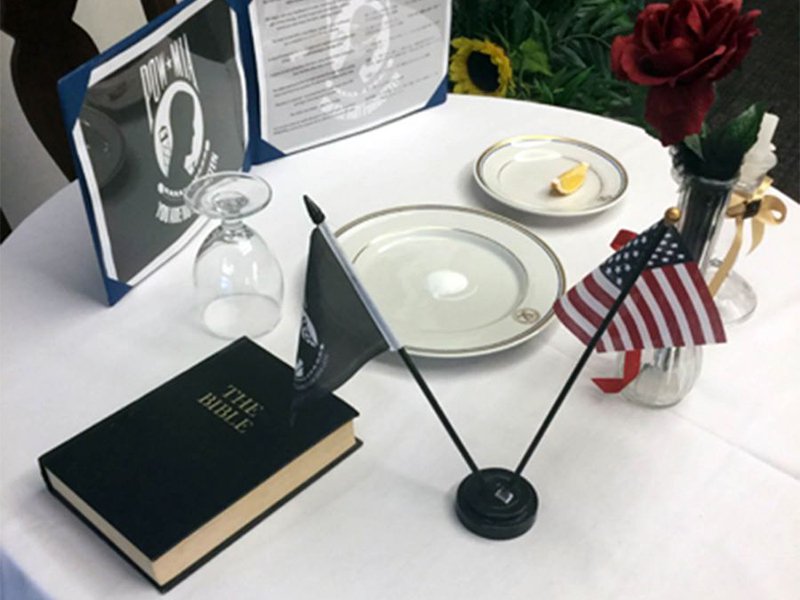
This Bible in a POW/MIA display at U.S. Naval Hospital Okinawa was the impetus for the Military Religious Freedom Foundation’s complaint with the Navy. (Photo courtesy of MRFF via RNS)

At issue: the placement of the Bible alongside the POW/MIA and American flags with a placard that says: “The Bible represents the strength gained through faith to sustain those lost from our country, founded one nation under God.” Since the Okinawa news hit the media, the MRFF says it has received complaints from 31 other U.S. military installations that have the Bible included in their “missing man” displays.

Do the Bible and faith statement in the POW/MIA displays violate the constitutional prohibition against the government promoting a religion? Or are they a harmless nod to the fortitude and comfort many soldiers derive from their country’s majority religion?

You can argue it either way—and believe me, those caught up in this drama are doing just that. But for those intent on maintaining the Bible’s prominence in American culture, the POW/MIA displays are more symbolism and sideshow than anything of substance. There’s a much bigger problem in civilian life and Americans’ homes that ought to concern them:

The fact that even though “the Good Book” is ubiquitous, with the median American home containing three copies, it is seldom read, poorly understood and, to put it charitably, inconsistently followed.

It’s fitting that the Bibles on the POW/MIA tables are closed, used as symbols or sacred objects rather than a book meant to be read for truth, wisdom and inspiration. Because closed is how the Bibles in Americans’ homes generally remain.

“Americans Are Fond of the Bible, Don’t Actually Read It.” So says a news release issued by the evangelical polling organization LifeWay Research a year ago. LifeWay finds that Americans generally have a positive view of the Bible and see it as a source of moral lessons still relevant today. But more than half admit they have spent little or no time reading it, and only 1 in 5 has read the whole book.

Our low level of Bible reading explains why Americans tend to be frightfully ignorant about the text at the center of the religion that more than two-thirds of the population claim to follow. As evangelical leader Albert Mohler notes with alarm, polling finds fewer than half of Americans can name the four gospels, and 60 percent are unable to name even five of the Ten Commandments.

Our rampant biblical illiteracy also helps explain why those most passionate about pushing the Bible in settings of dubious appropriateness (like a Navy hospital in Japan) often press their case in deeply unbiblical ways.

Mikey Weinstein, president of the group that filed the Okinawa complaint, showed me some of the correspondence he has received. Let’s just say that the writers of this vile and unprintable material demonstrate the opposite of the Jesus-style “love your enemy” teaching found between the covers of the Bible.

Like the religion of which it is part, the Bible plays a contested and complex role in American culture. Is it a symbol of national or “tribal” identity—something to be aggressively asserted in an ongoing struggle between cultures on our soil and abroad?

If yes, best to leave the Bible closed. It’s easier to thump it that way.

But if, like me, you’re convinced that the Bible actually has something valuable to say all these centuries after its composition, it’s better to have it in the open position at least occasionally—and to read what’s on its pages.

You’ll find it full of poetry, moral instruction, and stories and metaphors that help us make sense of our daily struggles. You’ll find the penetrating insights of Jesus, which remain powerfully applicable whatever our beliefs about his divine status.

“The Invisible Bestseller”—this is the apt title that religion journalist Kenneth Briggs used for his 2016 book on the fading prominence of the Bible in American life. The Bible, he finds, is in the curious position of being both “everywhere and nowhere,” frequently found in public settings and everyday households but disturbingly absent from Americans’ heads and hearts.

If you’re bothered by the fading role of the Bible, one response is to wax indignant, blame “political correctness” and push the Bible harder. This was the move made by Hiram Sasser, general counsel for the group First Liberty Institute, when he was on the Todd Starnes radio show discussing the controversy about the Bible in the POW/MIA display on Okinawa.

“(Can) you imagine if President Trump found out about this, that someone was complaining about a Bible being on a table?” Sasser said. “He’d probably put two on the table.”

He probably would. Neither would be open.

Tom Krattenmaker writes on religion in public life and directs communications at Yale Divinity School. His latest book is “Confessions of a Secular Jesus Follower.” The views expressed in this commentary do not necessarily reflect those of Religion News Service or the Baptist Standard.


Commentary: Why are so many famous and ordinary people’s lives imploding?

(RNS)—I remember the first time I watched a building implode.

I was a child and my father, who was an engineer, took me to a scheduled implosion of the largest building at the chemical company where he worked. A horn sounded and in a matter of seconds, the building crumbled on top of itself. People cheered, chatted for a few moments, and then got in their cars and drove away. Some people love to see a good implosion.

On the way home, my father explained that the implosion took weeks of planning. While the implosion appeared rapid to the onlookers who were eager to see something fall, there was an intentional weakening of the foundation through a series of strategic and sequenced explosives. Explosive devices were placed at key foundational areas in the large building. They were lit in sequence, and when the building was weakened it simply caved in on top of itself. As the structure beneath the surface failed, the building could no longer hold the immense weight and ruin was inevitable.

When the moment of implosion happens, it is fast and devastating. Though the fall may seem fast to onlookers, a ruined building—or human life—does not happen overnight.

Well-respected community leaders, coaches, and pastors seem to be imploding at epidemic levels these days. Stories of abuse, affairs, lapses in integrity, and self-destructive behaviors consuming leaders seem to fill our news feeds at a relentless and alarming pace.

While we often hear people express surprise, we should not be surprised. Just as strong buildings can fall, so can people we admire and respect. And so can we.

If there were ever a person whom people believed would be above falling, above imploding, it would be King David, who was known as “a man after God’s own heart.” David penned psalms, defeated a giant, conquered enemies, united God’s people, and received the promise from God that his throne would last forever—which was a promise kept because Jesus Christ came into our world through the lineage of David.

David was so powerful that even men around him were considered mighty: He bestowed his own greatness on those around him, “David’s mighty men.” When we read about David, we can easily feel dwarfed by his passion for God, his skillful leadership, and his bold moves for the Lord. He was a revered leader, a passionate worshipper and a brilliant artist. Yet he fell. Imploded.

The story of David’s character bankruptcy is found in chapter 11 of 2 Samuel. Instead of going to war, what kings often did in the springtime, David remained in Jerusalem. One night, he strolled on the roof of his palace and saw a beautiful woman, Bathsheba, bathing. He sent for her and slept with her. When he learned she was pregnant, he devised a plan to cover his sin, but it failed: He misused military resources to have her husband killed. The man after God’s own heart wandered from the Lord and ruined his life.

Just as demolition experts place explosives inside of buildings so they will weaken and implode, there were three explosives on the foundation of David’s life that led to his implosion, explosives that can lead to our ruin as well. They are easily hidden from those who watch us from a distance, but they threaten to destroy the foundation of our lives.

First, David was alone. He was isolated, remaining in Jerusalem while his warriors went off to battle. He sent his community away. Friends who would have held him accountable were gone. Friends who would have stopped him from pursuing Bathsheba were nowhere to be found. We can be alone in a crowd if we are surrounded only by people who won’t hold us accountable, who are impressed with us, who only validate and enable our destructive choices. A common thread in leaders who fall is their self-deception that no one understands all they are going through, that they are above the need for community. Ministry leaders can preach on community while living in isolation.

Second, David was bored. He got up from his bed looking for something, anything to satisfy him. This was the same David who years earlier, while living in a cave, woke up the dawn singing to God and found God to be his refuge. But not that night on the palace roof. The Lord, on that night, was not enough for David. He wanted something else, something else to look at, something else to conquer, something else to pursue. If we are looking at the Lord and all his greatness, we are never bored because God never bores. When we are bored, we are not looking to the Lord, and whatever else we are looking at to fulfill us is less than him and can lead to our destruction.

Third, David was prideful. When he was told that Bathsheba was Uriah’s wife, David instructed the servant to get her anyway. In his mind, David deserved whatever he desired. Pride corrupted his heart. Pride always comes before destruction, and David’s sense of entitlement, his sense that he was owed whatever he wanted, proved he was not walking in humble gratitude for all the Lord had given him.

Isolation. Boredom. Pride. If they can corrupt the heart of the man who was a man after God’s own heart, surely they can corrupt ours. They must not be taken lightly. They will ruin a life. They are not sins to be tamed in our hearts but sins that must be slain.

Eric Geiger is a senior vice president at LifeWay Christian Resources, leading the Resources Division, and the author of “How to Ruin Your Life.” The views expressed in this commentary do not necessarily represent those of Religion News Service or the Baptist Standard.


Commentary: Taking advantage of old folks

I know that is a terrible title for an article, but hopefully you will hang with me on this one.

A young pastor friend of mine recently complained of too many senior adults in his congregation. Since I am myself a senior adult, I wondered why that was a problem. It seemed to me that he was missing a great opportunity.

While it is obvious that each church has its own context, it has been my experience that senior adults have always been an incredible resource in the life and ministry of the church.

‘A huge blessing’

The church I served as pastor was located in a coastal community at the end of the interstate highway. As a result, beginning in the 90s, we had an influx of retirees to our town. It continues even now as more and more ‘boomers’ head for the coast.

Of course, we already had a wonderful cadre of older members who had been a part of the fellowship for many years. All of this has proven to be a huge blessing for our church, all because we decided to ‘take advantage of the old folks.’

When my colleague in ministry, Jim Everette, joined our staff, I suggested that he should visit every non-profit ministry in town to learn what their needs were. While we both assumed that they could all use some extra money, what we learned was that they needed help—volunteers.

‘The results were amazing’

Another thing we learned was that all these retirees moving to town were looking for ways to connect and serve in the city that was to be their new home. We learned that many of them showed up with resources, expertise and time. So, every time a newly retired person or couple showed up at our church, Jim and I would engage them to learn their gifts and interests, and then we set about to connect them with one of the ministries in our city or our church.

The results were amazing for our congregation, for our non-profit partners, and for the newly retired residents of our city. We took advantage of the old folks . . . and they loved it.

‘Something good and important’

Now that I am ‘sort of’ retired, I was looking for some place where I might be of help. One of the ministries our church supports is a ‘half-way house’ for people coming out of prison. I had always been impressed by how that non-profit was able to stretch a dollar. While having coffee one morning with their Executive Director, Frankie, I asked if there was anything he needed where I could be of help.

He said, “As a matter of fact, pastor, there is. One of our men has called on us to form a men’s group, not a prayer or Bible study group, but a men’s group, where men can talk about men’s stuff.”

I told him if that was what he needed, I would give it a try. While talking with one of the recently retired deacons in our church, I told him about the group and he volunteered to help me. We have been at it for several months now, and I am not sure who is helping whom the most.

We meet at 6 p.m. every Monday evening. A different crowd shows up each week. The residents set the agenda and my friend, Don, and I are just members of the group. We don’t lead any more than the rest of them. There is usually a topic for the evening: trust, honor, family, self-confidence, selfishness, prayer and honesty to name just a few. There has been laughter, and there have been tears. But something good and important is taking place. Friendships are being established.

‘Take advantage’

This is but one example of dozens of opportunities that exist in every community and every church for life-changing ministry. So, rather than bemoaning the fact that there are a lot of older folks in the church, take advantage of them. They are busy, but they have more time to serve than ever in their lives. They long to make connections and to make a difference. The church that pays attention to its older adults and gives them good and important ministry to do will be enriched by their work.

Finally, it is also important to celebrate their service and to let them know just how valuable they are in the community and in the church. Let them have a time and space to tell the stories of their ministry and the people they have met and the lives that have been changed.

The Bible is filled with stories of older folk whom God called upon to do amazing things. It still happens. Every minister and every church need to “take advantage of the older folks.”

They are still changing the world.

This article originally appeared at the Center for Healthy Churches. Mike Queen is a consultant for CHC, the founder of Hopeful Imagination, and a recently retired pastor.


Commentary: Barbara Bush’s old-fashioned religion

(RNS) — Barbara Bush, who died April 17 in Houston, always seemed a little old-fashioned to me. But it wasn’t until a few days ago, when news broke that the former first lady was dying, at age 92, that she seemed old.

Like other aspects of her persona, Bush had an old-fashioned sort of religious faith.

It wasn’t the old-time religion of gospel revivals, but rather the old-line faith of her Episcopal Church.

When I was a boy and Bush was first lady, she reminded me of a lot of the older women I knew in my church: They all had white hair, classic jewelry and matronly dresses. From a distance, they seemed prim and proper and, well, old-fashioned. But once you got to know them, you realized they were caring and funny.

Barbara Bush seemed to embody the virtues of womanhood promoted in 20th-century American Protestantism: loyalty, duty and family. Appearances were important, but in the end character mattered more.

In 1945, Barbara Pierce married an ambitious war veteran and Yale man. She was a U.S. senator’s daughter-in-law. Expectations for her must have been remarkably high.

The Bushes nurtured their faith and their young family in Houston’s St. Martin’s Episcopal Church, where her funeral was held.

The Rev. Russ Levenson Jr., rector at St. Martin’s, recalled the Bushes’ decades of participation in the life of the congregation: “President Bush was a very active lay leader in his early years here. But it was not uncommon to see him serving coffee on Sunday morning. Both of them taught in our Sunday school program. Both of them have been involved in our outreach ministries.”

Famous for being the wife of one president and the mother of another, she was also a distant relative of President Franklin Pierce.

But her familial intimacy with the presidency goes even deeper. Another of her sons campaigned unsuccessfully for the office. She was the matriarch of a family in which each member had to grapple with the demands of fame, media attention and public scrutiny.

That’s a tall order, and something she scarcely could have imagined even as a young wife and mother in Houston society in the 1950s, before her husband became a congressman.

Yet by all accounts, Barbara Bush met the obligations of her public and private lives with dignity and grace, sustained by her Christian faith.

In her youth, Christianity was both more ubiquitous and more private than it is today. She certainly did not have to answer reporters’ questions about how faith influenced her family or her politics.

The former first lady’s faith was evident in how she recalled her late daughter, Robin, who died of leukemia in 1953, two months before her fourth birthday. “Robin to me is a joy. She is like an angel to me, and she’s not a sadness or a sorrow,” Mrs. Bush said in 2012.

Indeed, her deep faith was a constant source of strength and inspiration for her, just as it was for all the church ladies I knew growing up.

One son, George W. Bush, famously embraced a more evangelical Protestantism, while another, Jeb, followed his wife into the Catholic Church. Barbara and George H.W. Bush never strayed from their Episcopal roots, reflecting the same loyalty and constancy that marked their 73-year marriage.

And when mourners said their final goodbye at St. Martin’s, the Episcopal Church’s funeral liturgy served as a fitting metaphor for the woman herself: traditional, dignified and wonderfully old-fashioned.

A frequent commentator on religion and politics, Jacob Lupfer is a writer and consultant in Baltimore. His website is www.jacoblupfer.com. Follow him on Twitter at @jlupf. The views expressed in this commentary do not necessarily represent those of Religion News Service or the Baptist Standard.