Analysis: The religious world changed in 1968, but not in the ways we think
August 7, 2018
In recent months I have been lecturing and teaching quite a bit on key anniversaries — on the centennial of the end of First World War, but also on that other tumultuous year, 1968.
The religious aspects of 1968 are not quite as legendary as other events and trends of that year, but they are extraordinarily significant.
Re-examining them today, what is perhaps most striking is the gulf that separates contemporary perceptions of key trends from later views. What we see at the time is very different from what later generations will recognize as the truly important developments.
That should be a powerful warning for us today. What currents or trends might we be missing?
The secular developments of 1968 have received plenty of attention in recent months: the assassinations and racial unrest in the United States; the popular youth movements around the world; violence in Paris and Mexico City; the continuing war in Vietnam; the Chinese Cultural Revolution; the first stirrings of global terrorism; and so on.
The world seemed to be in a period of grave crisis, even on an apocalyptic scale.
Each of these events, in different ways, discredited some long-accepted source of authority. Western liberal democracy encountered many critics and challenges, but so did the familiar alternative of Communism: the Czech invasion of August 1968 closed that alternative for anyone with a sense of moral decency.
But what were the religious responses? Assume you were following mainstream media through the year, what were the key stories illustrating the likely development of the world’s faiths to the crisis? The following is impressionistic, but I think it accurately reflects the tone of debate.
Commentary: How partisanship drives religious attitudes, and not the other way around
August 7, 2018
(RNS) — Which comes first, religion or politics?
On the one hand, political scientists have long held that people’s political choices are formed by their childhood faith, which, for the most part, sticks with them.
On the other, 81 percent of white evangelicals voted for Donald Trump, a thrice-married adulterer who rarely attends church.
A new book by University of Pennsylvania political scientist Michele Margolis argues that it’s political science that has it backward.
As she lays out in “From Politics to the Pews: How Partisanship and the Political Environment Shape Religious Identity,” most Americans choose a political party before choosing the religion to follow in their adulthood, if they choose a religion at all.
When young adults form their political and religious choices
“From Politics to the Pews” by Michele F. Margolis. (Image courtesy of University of Chicago Press via RNS)
“Political science sometimes assumes religiosity is a fixed and stable trait, like gender and race – things we think of for the most part as unchanging,” she said. “But there’s a whole literature out there that says it changes over time.”
The idea upends conventional thinking based on Americans’ lives of 100 years ago, when young people typically got married at age 18 and had their first child at 19. Today, young adults leave home for college. Then they take jobs. They marry later in life and have children even later.
During that transition, Margolis wrote, whatever religion they had fades into the background and they begin to form a political sensibility. Only when they’re ready to settle down and have a family does religion re-enter the picture.
“When it comes time to make religious decisions in adulthood, we have these formed partisan identities,” Margolis said.
Political choices outrank religious choices
Sharpening this political-religious split is the fact that many white Americans who end up as Democrats don’t come back to church, while Republicans tend to become more religious to better align with their political convictions. (She concedes the theory does not apply to African-Americans, who are highly religious and vote solidly for Democrats.)
“It may seem counterintuitive, if not downright implausible, that voting Democrat or Republican could change something as personal as our relationship with God,” Margolis wrote in a recent New York Times op-ed. “But over the course of our lives, political choices tend to come first, religious choices second.”
Author Michele Margolis (Courtesy photo via RNS)
Margolis’ findings are part of a growing body of evidence about the relationship between faith and politics. In their 2010 book “American Grace,” political scientists Robert Putnam and David Campbell noted the “God gap” — the most religious Americans were Republicans and the least religious were Democrats. The two found that those who say grace before digging into their meals are more likely to find a home in the Republican Party.
Sociologists Michael Hout and Claude Fischer even earlier theorized that the rise in people of no religion — the so-called nones — might be partly due to a backlash against the religious right that may have begun during George W. Bush’s presidency. (Prior to the 1970s, both parties included similar numbers of religious people.)
“People who think of themselves first as being a Democrat look out at the world and see religious people all tend to be Republican and a particular kind of Republican, and they say: ‘That’s not me. So I must not be religious,’” said Campbell, who teaches at the University of Notre Dame. “So they drop their religious affiliation because of their politics.”
Politics before religion may excuse immoral acts
The idea that people form their political opinions first may help explain recent studies showing that white evangelicals no longer frown on elected officials who commit immoral acts in their personal lives.
Famously, a 2016 PRRI/Brookings poll found that 72 percent of white evangelicals said an elected official could behave ethically even if the person has committed transgressions in his or her personal life — a 42-point jump from 2011, when only 30 percent of white evangelicals said the same.
Campbell said the nation’s political divide might foreshadow the emergence of a strong secular coalition. While secular Americans are not nearly as mobilized as white evangelicals, who have an advantage of church organizing, there are signs they may be growing.
In an online post about research he and other scholars published in the June issue of the American Journal of Political Science, Campbell concludes that the movement founded to increase the role of Christianity in the country may in fact be its undoing.
“The irony is that the Religious Right was founded to assert a greater role for religion in the public square, in opposition to ‘secular humanism,’” the post says. “Instead, it has fed the growth of secularism. The result is a likely continuation of cultural conflict in American politics.”
Yonat Shimron is an RNS National Reporter and Senior Editor. This article does not necessarily represent the views of the Baptist Standard.
Commentary: The culture wars need to make a safe space for soccer star’s conscience
August 7, 2018
(RNS) — At a women’s professional soccer game in Portland, Ore., in May, two groups were making noise from the seats: locals rooting on the hometown Portland Thorns, and another set of voices who had come out expressly to boo one player, Jaelene Hinkle, a defender for the visiting North Carolina Courage.
A few days before, Hinkle had elaborated to the Christian Broadcasting Network on the “personal reasons” that had kept her from joining last year’s U.S. women’s national team: Her Christian faith was at odds, she said, with the rainbow-splashed jerseys the team had recently adopted to celebrate LGBT Pride month.
“I just felt so convicted in my spirit that it wasn’t my job to wear this jersey,” she told CBN.
In Portland, a sign in the stands read, in rainbow letters, “Personal Reasons.”
The politicization of soccer and other sports
Jennifer Bryson, a political scientist who works for the Religious Freedom Institute in Washington (and who is a huge soccer fan), has been following the case of the rainbow jerseys since they were first adopted in June 2017. Bryson has bemoaned Hinkle’s situation and the pride-focused jerseys themselves — not to mention the NFL’s national anthem controversy — as a politicization of sports, which she calls “one of the last bastions of civility and inclusivity in America.”
Inclusivity of American sports, of course, is a somewhat recent phenomenon, but Bryson has a point that we seem to be moving backward. If nothing else, she noted, the body that governs U.S. women’s soccer violated international football’s own rules forbidding the display of political messages.
According to the International Football Association Board, whose rules have been adopted by FIFA, the international soccer governing body, “Equipment must not have any political, religious or personal slogans, statements or images.”
World soccer may be inconsistent in permitting the U.S. women’s team’s jersey, and I don’t presume to know what kinds of accommodations may have been offered to Hinkle. But Hinkle’s nasty treatment in Portland is a bigger problem for progressives who are committed to policing dissent from their political and moral orthodoxies.
The most obvious glitch is that the same enlightened white fans who harassed Hinkle for acting on her evangelical Christian faith would be aghast to see a Muslim player berated from the stands for choices she made based on her faith.
Disparate reactions to Christians and Muslims
Indeed, there was consternation in the Western press in 2011 when FIFA barred the Iranian women’s team from playing in uniforms that respected the customs of hijab or when the Canadian player Asmahan Mansour was tossed from a game in Quebec in 2007 for wearing a headscarf. Ibtihaj Muhammad, a fencer who was the first woman to represent the United States at an Olympics while wearing a hijab two years ago, has been lionized again lately as she goes on tour for her memoir, titled “Proud.”
Liberal approval of these faith-based heroes doesn’t depend on an agreement with Muslim customs regarding modesty or gender equality. It’s the struggle to be oneself that matters.
Hinkle made no public demands that the jerseys be banned. She only denied herself the hard-won honor of representing her country on the field because she feels that her obedience to God prevents her from celebrating what she believes is sinful. The celebration of LGBT pride has reached a point where even tacit rejection of the LGBT view of progress is enough to alienate someone.
It’s time to cool off the culture wars
We need to turn down the temperature in the culture wars. We need to resist the penetration of ideological polarization into matters of conscience. We should reject an insistence on consensus that subverts our national ethic of respect for minority views, and we should be suspect of the corporate machines that profit from these easy affirmations.
In the near future, sports — by which I mean a wide range of high school and college coaches and administrators — will be deciding questions of fairness in competition when it comes to transgender athletes.
This progress will be controversial enough. We’ll need to grant everyone patience to process and accommodate the coming changes. To lay the ground for future change, at a minimum, we need to honor the consciences of athletes, coaches and others who do not wish to celebrate moments like LGBT pride, if only by stepping aside when they can’t sign on.
For that kind of patience we might look to the athletes themselves, who play their hearts out beside people of all kinds as they rise to the top of their sports.
After the Supreme Court approved same-sex marriage, Jaelene Hinkle wrote on Instagram, “My heart is that as Christians we don’t begin to throw a tantrum over what has been brought into law today, but we become that much more loving.”
The tantrums are a bad look for both sides of the culture war. Let’s follow our athletes’ example and pursue both excellence and tolerance.
Jacob Lupfer, a frequent commentator on religion and politics, is a writer and consultant in Baltimore. His website is www.jacoblupfer.com. Follow him on Twitter at @jlupf. The views expressed in this commentary do not necessarily represent those of Religion News Service or The Baptist Standard.
Commentary: At age 86, Pete knew someone would lead him to God
August 7, 2018
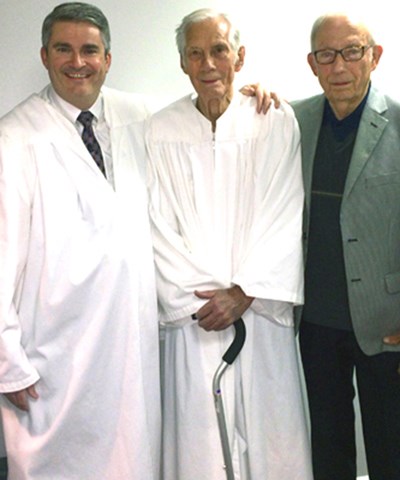
Pastor Michael Waters (left) baptized Pete Overcash (center) in March at Parkwood Baptist Church in Concord, N.C. Waters helped lead Overcash, 88, to the Lord in 2016. Pastor Darrell Coble (right) served at the church for 35 years and was pastor to Overcash’s late wife Norma. Submitted photo. Courtesy Baptist Press.
CONCORD, N.C. (BP) — In the spring of 2016, I learned that Harvey “Pete” Overcash was in a nursing home for rehabilitation due to an accident with a garden tiller. He did not attend our church, but his wife Norma was a faithful member for more than 40 years and had recently become homebound with declining health.
Norma was a children’s Sunday School teacher while Pete showed no desire to attend church with her, but she faithfully prayed for him.
When I walked in his room, Pete smiled and told me he was happy to see me, even though we did not know each other very well. After he recounted his accident and next steps to getting well, he began to ask questions that seemed out of character for him. I sensed God was stirring and he was under conviction.
It was a Wednesday afternoon, and I needed to return to church to lead the Wednesday night prayer service. I asked Pete if I could come back the next day to answer his questions. He nodded without hesitation and said that would be fine.
I called the former pastor, Darrell Coble, who was Norma’s pastor for 35 years, and asked if he would go with me the next day since he planted the seed of the Gospel in conversations with Pete many years earlier.
I also shared with the folks at our Wednesday evening service that Pastor Coble and I were going back the next day to talk with Pete. I said, “If you have ever prayed, please join me tonight in asking God to save this man.”
The next day I pushed Pastor Coble in a wheelchair into the nursing home, since he was recovering from recent surgery. Pastor Coble asked Pete, “Do you remember when I shared the Gospel with you about 30 years ago?” Pete said he remembered but wanted nothing to do with it at the time. This time, he was ready to listen.
Pete willingly prayed to accept Christ. I could hardly believe it. Later, as we left the room Pete thanked us for the visit and asked us to come back anytime.
The follow-up visits with Pete changed my life. His countenance changed completely. He read all of the four Gospels in a matter of weeks and asked many questions about what he was reading. Pete was 86 years old when he accepted Christ and could not get enough of reading God’s Word.
Several weeks later, Pete said that before my initial visit, he knew someone was coming to see him. God had been dealing with him. He knew he needed to get right with God but needed someone to tell him. That was the day that I walked into Pete’s room. He knew God sent me to talk about his salvation.
As weeks passed, Pete was able to go home, although walking after the accident was very difficult, even with a brace and cane.
During visits to the Overcash home located in the neighborhood behind the church, Pete often expressed how much he wanted to go to church but wanted his wife to get better so she could be with him on his first day in church. Norma was grateful for the change she saw in her husband but never got well enough to attend with him.
One day Pete stopped by the church office to bring an offering. I invited him to see the sanctuary, since he had never been inside the building.
He sat on the back pew spellbound, as the sun shone through the stained glass window. “Preacher, I always wondered what it would be like to sit down in here, and it is more beautiful than I ever imagined,” he said. “If you don’t mind, could I have some time alone?”
I told him to take all the time he needed.
Several months passed and Norma’s health continued to decline until the Lord called her home in October 2017. The following Sunday, Pete attended a worship service for the first time and has continued every Sunday. In one of my recent visits to his home, Pete said, “Preacher, I really need to be baptized before I die.”
We had discussed the importance of baptism two years earlier when he prayed to trust Christ. But because of his desire to see his wife healed and attend church with her, I did not push the issue.
He had many questions, including how we would get him in and out of the baptistery. I suggested that he come to the church soon so I could show him how it works.
A few days before Palm Sunday, Pete dropped by. We walked him through several scenarios, assuring him it would be OK. Finally, he looked at me and said, “Alright, I’ll do it! When do you want me to do this?”
I explained that the church had a special Sunday night service for Palm Sunday that includes the Lord’s Supper.
I said, “Pete, it would bless those attending to see your obedience and determination to be baptized if you would consider letting us baptize you this Sunday night.” He agreed.
As we walked down the hall, Pete said, “You know, I used to think this was all a fairy tale, but as sure as I know my home is behind this church, I know I’m going to heaven when I die.”
By God’s grace, we baptized Pete Overcash on Palm Sunday evening, March 25, 2018, at age 88. I shared his story with the congregation before the baptism. When I brought him out of the water, the congregation stood to their feet clapping and shouting to the glory of God.
Our church has been inspired to never stop praying for the lost. With God all things are possible!
Michael Waters is pastor of Parkwood Baptist Church in Concord, N.C. This article first appeared in the Biblical Recorder (BRnow.org), newsjournal of the Baptist State Convention of North Carolina.
Commentary: Democrats for Life of America gather ’round a message: ‘We want our party back’
August 7, 2018
(RNS) — In a political era dominated by growing wealth inequality, resurgent white supremacy and the Party of Lincoln reduced to presidential Twitter farce, a reasonable person might ask: Where are the Democrats?
Sidelined in Congress and decimated in statehouses, today’s Democrats have lost the winning touch that gave us the New Deal, the Great Society and four decades of uninterrupted control of the House of Representatives. To get it back, they might do well to note what’s happening in Denver this weekend (July 20-22) as Democrats for Life of America convenes for what’s planned to be an annual conference.
It wouldn’t hurt Dems to make room for faith language once again. The party’s unlikely coalition of Southern Protestants, white “ethnic Catholics” and Jews has given way to a secular-led party that cannot speak the language of faith sincerely and is skeptical of religious beliefs, especially when held by white people.
And while there are many explanations for political behavior and party realignment, the parties’ elevation of abortion politics and ever more constrained and extreme views goes a long way toward understanding why the party of workers, civil rights and the common man struggles so mightily to win elections.
Democrats for Life of America has a simple message: “We want our party back.” A small but determined band of happy warriors, pro-life Democrats are some of the most interesting figures in American politics. Their continued existence in spite of marginalization by the party poses serious questions that the American political system cannot ignore.
Some of the organizers and speakers at the Democrats for Life event have, despite devoting significant portions of their careers to the party, received nothing but scorn from Democratic elites.
They advocate for what Roman Catholics and other religious people call a “consistent pro-life ethic,” emphasizing not only opposition to abortion but also support for social spending, family-friendly immigration policies and robust government guarantees of equity and access in health care and education.
In other words, the Republican Party would shun them even more.
Once tolerated, pro-life Democrats have been mostly ostracized by the Democratic Party for a generation now. What makes them interesting is that they are a massive group. The DFLA can credibly claim to speak for some 21 million people, a huge slice of the Democratic electorate.
In a 2014 report sorting Americans into various political typologies, the Pew Research Center noted the “Faith and Family Left” — some 15 percent of the U.S. population who are likelier than the general public to say that religion is important to them and that the government should do more to help the needy. As Americans become more liberal on social issues, abortion remains the exception to that trend.
And while the abortion-rights debate, like most political matters, is fundamentally about questions of law and public opinion, abortion is considered by many (though not all) to be a uniquely religious issue, and one that moral perspectives heavily inform.
There is a subset of religious Americans whose faith affirms every plank of the Democratic Party platform, but this group is vanishingly small, as some of its progressive disciples opt out of religion altogether.
But most Americans who profess a faith find that their religious commitments cut across the two parties. Democrats of faith must contend with their party’s affirmation of the sexual revolution, while religious Republicans are badly out of sync with mainstream Christian ethics on, well, almost everything else from economics and social spending to immigration and the environment.
Anyone who proclaims a consistent life ethic by opposing war, capital punishment and abortion while affirming migration, health care and social spending is going to be politically homeless in America. Both parties actively undermine your values daily. And independent candidates, while helping break the two-party duopoly, seldom campaign on the “seamless garment of life.”
Democrats forget that Rep. Nancy Pelosi was propelled to the House speakership in 2007 by the votes of moderate Democrats without whom the party could never dominate national politics.
And the great irony is that abortion-rights supporters make the most progress when there are more Democrats in elected office, even if the margin is grown by adding pro-life Democrats.
But the Democrats have decided that they would rather be pure and right than win. That’s why the party has adopted ever more extreme abortion planks, moving from “Safe, legal and rare” to something more akin to “On demand, without apology and at public expense if needed.”
Of all the Pew types, the Faith and Family Left is one of the lowest-income and least-educated. It also has the highest share of African-Americans, Hispanics and foreign-born, according to Pew.
The Democratic Party can safely assume that most pro-life Democrats will never leave. On other issues, they are the ones who need the party the most. Thus they can be taken for granted as long as our two-party system holds onto its polarized grip on American hearts and politics.
But until better political options emerge through electoral reforms, new competition and structural changes, the Democrats for Life of America remains one of the most maligned yet potentially consequential groups on the political scene. Unlike tortured religious Republicans who know in their hearts that politics have warped their faith, pro-life Democrats stand tall with an enviable, almost infectious, integrity and hope.
National Democratic leaders will happily ignore their own basket-of-deplorables gathering in Denver this weekend. That’s a shame. But with enemies like these, who needs friends?
Jacob Lupfer, a frequent commentator on religion and politics, is a writer and consultant in Baltimore. His website is www.jacoblupfer.com. Follow him on Twitter at @jlupf. The views expressed in this commentary do not necessarily represent those of Religion News Service or the Baptist Standard.
Interview: Rethinking apologetics for the black church
August 7, 2018
When Lisa Fields started college, she was a preacher’s kid who’d grown up inside of the church and never encountered opposition to her faith. That changed in her first New Testament class when she studied a textbook by Bart Ehrman, a professor of religious studies at the University of North Carolina, Chapel Hill, who argues against the inerrancy of Scripture.
“I’d been in church my whole life,” says Fields. “I was in a Christian bubble. I thought the class would be like Sunday school, I thought it was going to be an easy A, but I really struggled. Through that experience, my dad introduced me to Ravi Zacharias and that helped me start thinking critically about my faith.”
In the years since then, Fields has founded an organization called the Jude 3 Project, which uses apologetics to address the unique “intellectual struggles of Christians of African descent in the United States and abroad.” The organization offers lectures and seminars, training courses, podcast discussions, and a conversation forum called Courageous Conversations, which pairs black scholars and pastors trained in both conservative and progressive seminaries. …
CT spoke recently with Fields about the first fruits of her project and why black suburbia is one of her main areas of outreach.
Commentary: Christians are calling for better family leave policies. That wasn’t always the case.
August 7, 2018
A prominent Christian think tank has come out fiercely in favor of better family leave policies, defending federally mandated family leave policies on theological grounds.
“Christian families can form themselves along a divine vision of work and family as holistic complements,” a report released Tuesday reads. “As citizens and culture-shapers, Christians should advocate for and develop policies and practices that protect, rather than fragment, family time.”
The report, authored by Katelyn Beaty and Rachael Anderson of the Center for Public Justice, advocates for changes on a federal scale, calling for an expansion of the Family Medical Leave Act. Pushing beyond public policy, though, the report also specifically targets gender imbalances within families.
The report follows a Senate finance subcommittee hearing last week on paid family leave, and a growing debate over the government’s role in providing resources for child care.
Commentary: Artificial intelligence shows why atheism is unpopular
August 7, 2018
Imagine you’re the president of a European country. You’re slated to take in 50,000 refugees from the Middle East this year. Most of them are very religious, while most of your population is very secular. You want to integrate the newcomers seamlessly, minimizing the risk of economic malaise or violence, but you have limited resources. One of your advisers tells you to invest in the refugees’ education; another says providing jobs is the key; yet another insists the most important thing is giving the youth opportunities to socialize with local kids. What do you do?
Well, you make your best guess and hope the policy you chose works out. But it might not. Even a policy that yielded great results in another place or time may fail miserably in your particular country under its present circumstances. If that happens, you might find yourself wishing you could hit a giant reset button and run the whole experiment over again, this time choosing a different policy. But of course, you can’t experiment like that, not with real people.
You can, however, experiment like that with virtual people. And that’s exactly what the Modeling Religion Project does. An international team of computer scientists, philosophers, religion scholars, and others are collaborating to build computer models that they populate with thousands of virtual people, or “agents.” As the agents interact with each other and with shifting conditions in their artificial environment, their attributes and beliefs—levels of economic security, of education, of religiosity, and so on—can change. At the outset, the researchers program the agents to mimic the attributes and beliefs of a real country’s population using survey data from that country. They also “train” the model on a set of empirically validated social-science rules about how humans tend to interact under various pressures.
And then they experiment: Add in 50,000 newcomers, say, and invest heavily in education. How does the artificial society change? The model tells you. Don’t like it? Just hit that reset button and try a different policy.
Shepherds play an important role in the biblical narrative. Shepherds appear frequently in both the Old and New Testaments, often in reference to leaders.
One of my favorite images of a shepherd is that of a caregiver. It is common for a shepherd to examine sheep for wounds as they gather in a pen or cove after a day of grazing. The shepherd cleans the wound and applies an ointment to it before bedding the sheep down for the night.
Congregational ministers are trained to be good shepherds. Identifying and binding wounds are significant parts of a minister’s job. This was certainly true for Jesus.
Instead of conducting his ministry in the temple in Jerusalem like many of his colleagues, Jesus chose to walk down dusty Palestinian roads where he could interact with people from all walks of life. He listened to their stories so he could respond to their needs with mercy and grace.
Being the good Shepherd did not prevent Jesus from being wounded. Nor does it keep today’s ministers from being wounded.
On the bookshelf in my office is a gift from a church member and former adult choir member, Frances. The ceramic plaque reads, “Singing is praying twice.” It’s an adaptation of a quotation usually attributed to St. Augustine, “One who sings prays twice.”
What does this mean? At its best singing together in worship helps us express well our praise of God, creates a space for us to offer ourselves to God and binds us to one another in community. Pastors and ministers of music and worship leaders dream that worshipers would experience the presence of God weekly. Singing well helps us pray more deeply, puts us in a place to hear the voice of God.
Churches vary widely in the assets they have to support singing. “Sustained excellence” is the way a colleague in another state recently described music ministries with strong legacies and abundant resources. But what about the many churches who continue to be faithful Sunday after Sunday but are in a musical recession or simply lack leadership or resources?
Sing anyway. There is an expectation that when we worship together we are going to sing. So, let the people sing. Take some time to figure out what your people sing and sing well.
Last fall at Wilshire Baptist Church, to celebrate the 500th anniversary of the Reformation, we planned a hymn festival for morning worship. Our theme was “Hymns We Love.” I did an informal poll of some key leaders in our church: staff, deacons, Worship and Music Committee and a few other members and asked them the question: “What hymns do you think our congregation loves and sings well?”
Based on this information we selected about a dozen hymns in a variety of styles: classic traditional hymns, gospel hymns, new hymns. Some hymns were accompanied by organ and brass, others by piano, mandolin and violin. There were a few moments the people sang without accompaniment, the voices filling the sanctuary. Simply put, it was wonderful.
What is the soundtrack of your congregation? What are their heart songs? What are the hymns that speak to the identity of your community of faith? Can you list 10 hymns or songs that make up a core playlist? This is an opportunity to get to know your people and just as important have them get to know one another. The conversation is just as important as the information.
Another way to engage your people in singing and praying twice is to invite church members to write new texts. This past spring a Wilshire member who is a writer and I led a three-session Hymn Writing Seminar. About a dozen Wilshire members met weekly to learn how to create texts for worship. Several people composed original hymns. LeAnn Hampton composed a pair of stanzas we have been singing in worship this summer as the offering is presented. We are singing this to the traditional melody of the Doxology, OLD 100TH.
Our God is making all things new, a promise that we know is true.
Through eyes of faith we long to see a love-transformed community.
A place where truth and justice reign and healing triumphs over pain,
Where all have dignity and worth and peace is passed throughout the earth.
Another hymn composed in this laboratory is “We Adore You, God, Creator,” a new text by James Steel, a member of Sanctuary Choir. We sing this to the hymn tune NETTLETON, a melody most often sung to the familiar text “Come, Thou Fount of Every Blessing.”
It is such a beautiful gift to the church when poets and writers create something new for the church. Such gifts are received with gratitude. “Sing to the Lord a new song” must surely be an imperative for every generation. Even “Amazing Grace” was a new song once upon a time.
Years ago, I served a small church in Mobile, Alabama. One Sunday evening the service was built around singing familiar gospel hymns. Following the singing the pastor asked people why they loved these particular hymns. With just a little encouragement the people began to tell their stories and they told how these hymns were woven into the fabric of their lives. The songs were part of the journey of faith and I began to realize there was much more going on in the hearts of people than simply the notes on the page. Those who sing pray twice.
Doug Haney has served as Minister of Music at Wilshire Baptist Church in Dallas, Texas since 2004. Haney coordinates a new service from CHC for churches seeking to infuse vitality, quality and vision into their worship and music ministry.
Commentary: Why has the Enneagram become so popular among Christians?
August 7, 2018
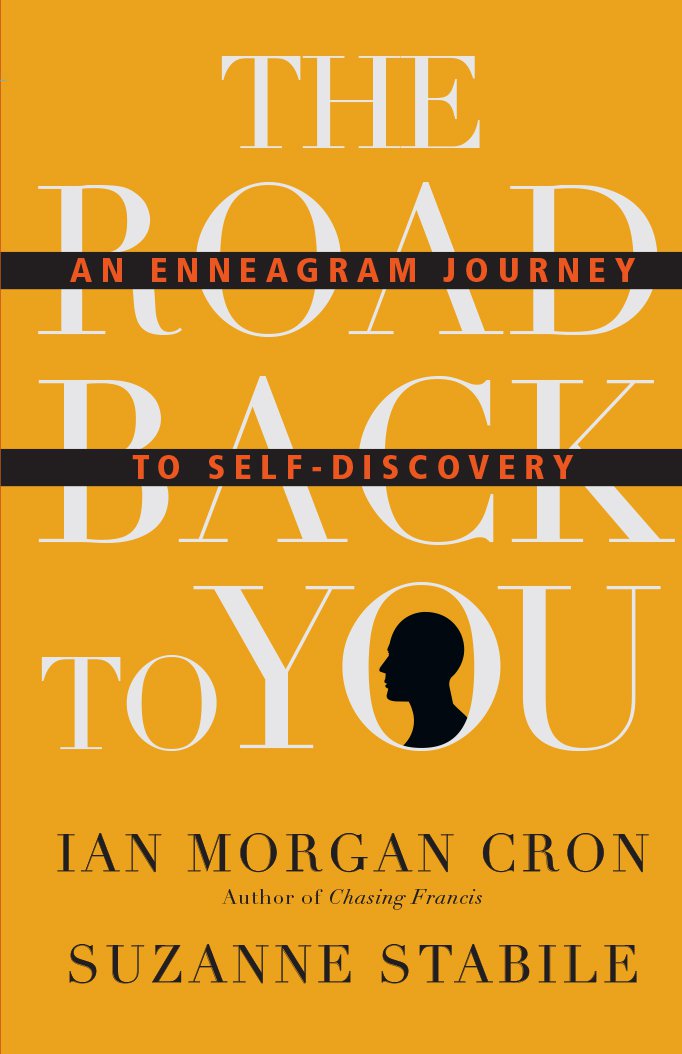
“The Road Back to You: An Enneagram Journey to Self-Discovery” (Image courtesy of InterVarsity Press via RNS)
(RNS) — “Everywhere I go, people talk about the Enneagram,” said Ian Morgan Cron, co-author with Suzanne Stabile of “The Road Back to You: An Enneagram Journey to Self-Discovery.” The book has sold more than 165,000 copies since its release in 2016 from Christian publisher InterVarsity Press. Cron has also spun off a successful podcast, Typology, which has grown to more than 300,000 downloads a month.
Full disclosure: I edited “The Road Back to You,” and I am even more fascinated by the Enneagram now than I was then. I first discovered the personality typing system some years before, when some pastor friends sat me down to explain how helpful this system had been for them in their ministry as well as in personal matters, like parenting their inscrutable teenagers.
“So it’s just a personality test?” I asked. I have since learned that referring to the Enneagram as “just” a personality test is to its aficionados like calling Beyoncé “just” a singer. It is a personality test, but it’s also so much more: a spiritual tool, a map of self-discovery and a discipline that will kick your butt with a new awareness of your shadow side.
I have become something of an evangelist for the Enneagram, which surprises me because I’m rarely a bandwagon person and because as a historian I find its provenance a bit dodgy. What we know about the Enneagram’s past is frankly sketchy. Various people have claimed it has religious roots in ancient Greece (“ennea” means “nine”), but there’s not much of a paper trail, and even flimsier evidence for claims of connections with Jewish or Sufi mysticism.
What we do know is that it surfaced in South America in the 1960s in more or less its current form of nine sacred types, each representing (in the broadest sense) a particular orientation: One is the Perfectionist, Two is the Helper, Three is the Performer and so on. Each basic type also contains a host of nuances that speak to the reality that human beings are each “fearfully and wonderfully made,” as the Psalm says. There are subtypes, “wings,” stances, triads, virtues and vices, among other subtleties.
The Enneagram didn’t burst onto the American scene right away. It started making gradual inroads in the 1970s as strictly an oral tradition, passed down from teacher to student but not recorded. Some teachers were afraid that if it were written down, the Enneagram would be trivialized and commercialized. But books began appearing in the 1980s and have recently accelerated: There are now books on how the Enneagram can help with your business, your sex life, your parenting style and of course your spiritual growth.
And yes, some trivialization has happened, but so has deep spiritual transformation, as many attest. Indeed, one of the big trends with the Enneagram now is how it is (finally) being recognized and adopted by traditional religious practitioners, Christians in particular.
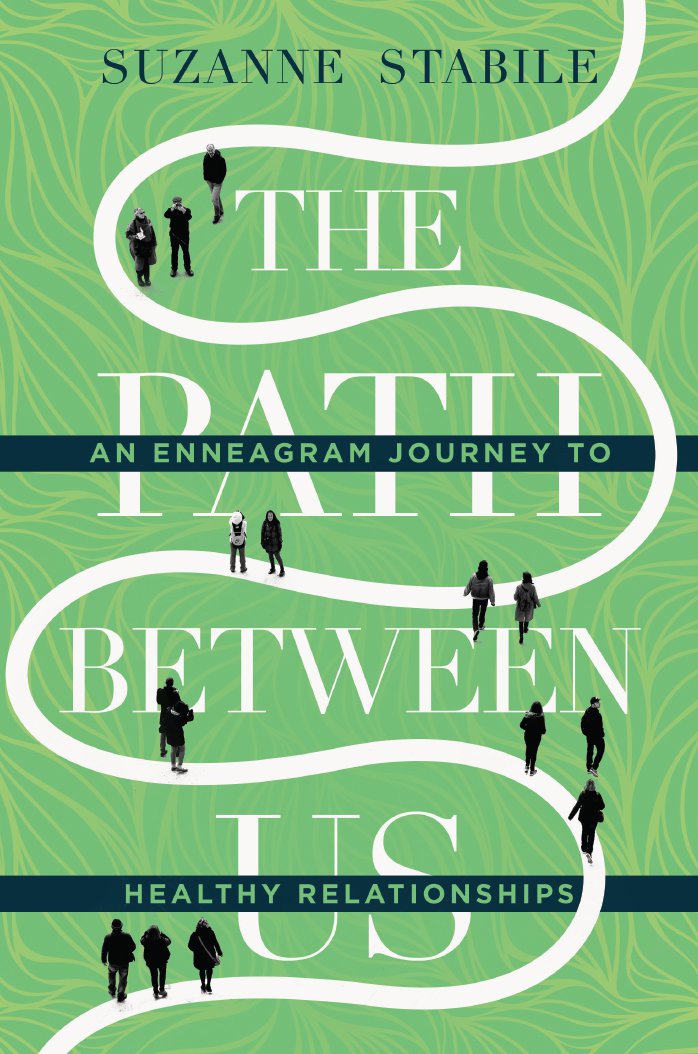
“The Path Between Us: An Enneagram Journey to Healthy Relationships” (Image courtesy of InterVarsity Press via RNS)
Rohr’s popularity has opened the door for other books on religion and the Enneagram, including not just “The Road Back to You” but also Stabile’s “The Path Between Us” and Christopher Heuertz’s “The Sacred Enneagram,” all published within the last two years.
These books, said Shegda, “are providing language that is more comfortable for the evangelical audience. People are feeling more comfortable and understanding more clearly what the Enneagram is all about.”
The religious focus will be apparent next week at the International Enneagram Association’s global conference, where several hundred Enneagram teachers and enthusiasts will gather in Cincinnati. I’ll be there too, soaking it up.
“There is going to be a session specifically about Christianity and the Enneagram, and another about the Buddhist approach to the Enneagram,” said Shegda. “So those two faith traditions will each have a formal workshop. But really, in any of the sessions you attend, there is a spiritual component.”
Also new this year is a separate “track” for programming related to personal and spiritual development.
Why the uptick in interest in the Enneagram, especially among Christians? In addition to the books from Christian presses, there are now church groups to discuss the Enneagram in many Protestant congregations: Episcopal, Methodist, Baptist and Presbyterian churches have joined Roman Catholic parishes in holding retreats and workshops on the Enneagram.
Cron said he also hears from readers and podcast listeners who are not interested in being part of a church but are still deeply interested in spiritual growth. Enter the Enneagram, which promises self-knowledge with or without traditional religious belonging. “In our world now, a lot of the institutions that helped people to understand who they were are gone, or they don’t have as much influence,” he explained.
Senior Religion News Service columnist Jana Riess is the author of many books, including “The Prayer Wheel” (2018) and “The Next Mormons: How Millennials Are Changing the LDS Church,” which will be published by Oxford University Press in March 2019. She has a PhD in American religious history from Columbia University.
The views expressed in this opinion piece do not necessarily reflect those of Religion News Service or the Baptist Standard.
Commentary: Give people the dignity the world has taken away
August 7, 2018
Before entering the hospital room I pulled the patient’s chart from the nurses’ station, so I knew I was about to enter the room of a 54-years-old male with multiple arm, shoulder, and facial fractures. I had been conditioned by my chaplain supervisor to silently repeat a phrase whenever I held the handle of a hospital room door: “When I enter this room I represent the presence of God.” It was an intimidating and ill-fitting role for a 26-year-old, like wearing someone else’s suit—someone with more gray hair and gravitas.
I entered and introduced myself as the chaplain. Bill was immobilized, his arm and shoulder in a cast and his face badly bruised and swollen. He gently turned his head to look at me.
“I can’t talk very well,” he said through clenched teeth. “They’ve wired my jaw shut.”
“I understand you took a nasty fall yesterday. What happened?”
“I don’t remember,” Bill said. “I was drunk.” His speech was difficult to understand, so I drew my chair closer to his head.
“You’re young,” he said. He suspected I was wearing someone else’s suit, too.
“I’m a seminary student,” I said. Bill looked away, his eyes wet. I assumed his pain meds were wearing off.
“You’re here to talk about God?”
“If you’d like to,” I said, “or we can talk about whatever’s on your mind.”
“I used to talk to people about God,” Bill said. “I’m a pastor.” I tried to hide my surprise.