Lessons learned on the way: Responding to perceived attack

Our men’s ministry group from First Baptist Church in West took a road trip to Hico, where we found the “Mini-Tank Battlefield.” Each of us got our own personal “mini-tank.” It functioned much like a real tank, except it had room for only one person and its only arsenal was a paintball gun.

John Crowder

Excited about spending the day with my friends and thoroughly enjoying such a unique experience, I drove my mini-tank down a little trail through the woods. As I entered a clearing, I immediately encountered a relentless barrage of paint pellets. They quickly transformed my green tank into a multicolored vehicle of shame and its driver into a bruised and battered defeated warrior.

Every seasoned leader has had a similar experience. Most leaders have been through the surprise attack scenario more than once. Ministers and church lay-leaders are not exempt. Unexpected confrontations can happen in the hallways of a church just as easily as they can on a mini-tank paintball course.

When someone confronts a leader with criticism or accusations, the attacker has the advantage of surprise. Before addressing the leader, he has had the opportunity to plan his course of action, choose his words, and perhaps even recruit his allies.

The leader, however, is not given the opportunity to prepare, but most likely will be held accountable for his or her response. To avoid making things worse with our own emotional reactions, leaders need a rational way to process a perceived attack and determine how to respond.

One approach that has proven helpful is to ask two questions. First, the leader should not settle for anything less than an honest answer to the hard question, “Is the other person right?” When we feel like we are under attack, our defenses go up and we reject anything that seems like it might cause pain. When we are in that mode, however, we might miss out on a valuable opportunity for personal growth.

Maybe there is some validity to the observations being expressed by the other person. Perhaps they can help us see something about ourselves or our organization that we might have missed without the benefit of their perspective.

It is also quite possible, however, that what they are saying is not right. We must not automatically assume that because they are upset, they must be right. We need to wrestle with the question and be willing to determine the answer to the best of our ability.

The second question should be considered independently of the first. Setting aside our evaluation of the validity of the words, we need to consider the manner in which the words were spoken or written. We must ask, “Is the person being reasonable?” Regardless of how we answered the first question, we now must look at how they are treating us and whether their behavior is reasonable. If they are remaining calm, staying focused and being fair in their choice of words, our response should be different than it will be if they are being hurtful, unfair or overly dramatic.

“Is the person right?” “Is the person being reasonable?” The key to a rational response is identifying how our answers to the two questions work together. The two questions help us separate and process very different issues. Once we have settled those issues adequately, we can see how they relate to one another, and we can determine our response. Alliteration helps here: My rational response is based on whether the person is right and reasonable.

I normally visualize this process in a grid. I am learning to picture the grid when I feel attacked or find myself in an unexpected confrontation. The grid has four quadrants that represent the possible answers to the two questions.
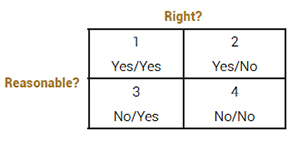
  1. If the person is right and she is being reasonable, I need to give that person my full attention. We may set up a time to discuss her concerns later so I can adequately consider them, but I should let the person know she is being heard.
  2. If the person is right, but he is not being reasonable about it, I am faced with a personal challenge. I should weigh seriously the content of the message without allowing the person to hurt my feelings or control me with his misbehavior.
  3. If the person is not right, but she is being reasonable, I need to listen attentively and respond patiently in hopes that I can help clarify her misunderstanding.
  4. If the person is not right and he is not being reasonable, I need to protect myself, and more importantly, I need to protect the church or organization that I lead. I cannot do that by being bullied, nor can I do that by giving in to the temptation to join him in his misbehavior. I need to de-escalate the situation and walk away from it. Later, with wise counsel, I can determine next steps if there need to be any.

This is too much to think about in the heat of the moment. That is precisely why we need to make sure the grid is stored in our memory bank, and we have learned the process before we need it. The more we think about it beforehandand the more we practice it, the more natural it will become. Soon, we will not even have to see the grid in our mind’s eye anymore, because we automatically will process the two questions and determine an appropriately rational response.

Remember: “A soft answer turns away wrath, but a harsh word stirs up anger” (Proverbs 15:1).

John Crowder is pastor of First Baptist Church in West, where he has served 27 years. This article first appeared in CommonCall magazine. 


Commentary: Five steps in the lost practice of lament

“Lament helps us rewrite the narrative,” Jordan Davis, assistant professor of counseling at Dallas Baptist University and a licensed professional counselor, said during a recent symposium.

“It gives us a framework for how to express the pain we are going through while also experiencing the hope that can only be given to us by a loving God,” he added.

Lament is described by Mark Vroegop, lead pastor of College Park Church in Indianapolis, as a minor key language: beautiful, but different from the melodic, upbeat sounds we may be used to.

Jordan was joined by Joan Davis, DBU professor of counseling and psychology. Together, they discussed the process and importance of biblical lament.

They offered five key steps to practice biblical lament, based on a framework outlined by Vroegop, using Psalm 13 as a template. By choosing to turn to God, lifting our complaints to him, asking questions, shifting our mindset to trust in God, and giving thanks for all he has done, we are able to process our grief and lament in a healthy way that puts us on the path to healing.

Turning

They noted C.S. Lewis wrote: “Pain insists upon being attended to. God whispers to us in our pleasures, speaks in our consciences, but shouts in our pain. It is his megaphone to rouse a deaf world.”

Lament negates silence. It is far better to be openly communicative with the Lord about our pain through prayer than to be silent and to cut off our communication with God.

It is easy to praise God when our lives are going well, but it is when we walk through the valleys that we must actively choose to turn to our Savior.

Submitting our complaints

“It is through lament that we vocalize our pain,” Joan Davis said.

Throughout the Psalms, we see David cry out to the Lord, crushed by his circumstances, his relationships and his own sin. The Lord was faithful to bend a listening ear to David every time.

In Ecclesiastes, we learn “the heart of the wise is in the house of mourning, but the heart of fools is in the house of pleasure” (Ecclesiastes 7:4).

The person who sweeps his or her troubles under the rug and naively enjoys the empty fulfillment offered by the world is a fool. The one who cries out to God in doubt, anguish or pain is wise.

Asking questions

“We have been pulled into the belief at church that it is not ‘come as you are,’ but ‘come as you’re supposed to be,’” Jordan Davis said.

“And so we get trapped in this belief that if we show any weakness, our lament may show a lack of faith, and we label that as sinful. We are to engage with God about our grief, our anger, our sadness and our doubt, but we have mislabeled those things as sins,” he continued.

We serve a Father who wants to hear his children’s questions and doubts.

“God can handle our messy thoughts and questions. They are no surprise to him,” Joan Davis said. “So have faith to ask hard questions.”

Trusting

“Yet, in our pain, we remember who Christ is and what he has done. This is the pivot,” she said. “This is when we choose to trust.”

Unlike feelings of doubt, uncertainty, anger and sadness, trust is not a feeling. Trust is a choice.

Choosing to trust in the Lord, even in our hardest trials, isn’t always easy. Like all spiritual disciplines, lament is a learned behavior. It takes great faith to lift up a prayer of lament, trusting God will listen.

There is no one more worth trusting than God, who stepped down from heaven to save us, the “man of sorrows” described in Isaiah 53, the one who can empathize with each and every one of our sufferings.

Giving thanks

When we remember who God is and all he has done for us, the pains of this world begin to grow dim. While the heartache may still linger, we find hope in the promises mentioned all throughout Scripture. We give thanks because we don’t have to go through this life alone.

“We find healing through community and allowing others to lament with us,” Jordan Davis said.

Developing a fluency in the language of loss puts us into the habit of openly expressing our feelings with our Savior.

Joan Davis concluding saying: “We can rest knowing that our mourning, our crying, our pain will one day pass away. We are not alone in our suffering. We do not lament to a God who is detached from our pain.

“Participation in the biblical practice of lament offers all individuals an effective tool for processing their suffering by placing their pain at the foot of the cross,” Joan added. “The practice of biblical lament encourages living in honest relationship with God and others with renewed hope for life going forward.

“Suffering does not have the final word. As it is told to us in Romans: ‘I consider that our present sufferings are not worth comparing with the glory that will be revealed in us,’” (Romans 8:18).

“Lament is not forever.”

Emmalie Ellis writes for the university communications department at Dallas Baptist University. Joan Davis is a licensed professional counselor and professor of counseling and psychology at Dallas Baptist University. This article is adapted from the original post.


La Luz del Evangelio a través de Nuestras Vidas

¿Qué debemos hacer como cristianos e iglesias al enfrentar tiempos oscuros de grandes cambios sociales y desafíos de vida? ¿Tendremos que recluirnos, separarnos, o atemorizarnos a causa de aquellas cosas que no son de nuestro agrado personal? ¿O tendremos la oportunidad de SER y HACER aquello lo cual Jesucristo nos llamó a vivir como luz de este mundo, haciendo una diferencia con nuestra presencia en cada sociedad y tiempo que nos toque vivir?

Emanuel Roque

Jesús le dio a sus seguidores la respuesta, hasta que el regrese a este mundo:

“Ustedes son la luz de este mundo. Una ciudad en lo alto de un cerro no puede esconderse. Ni se enciende una lámpara para ponerla bajo un cajón; antes bien, se la pone en alto para que alumbre a todos los que están en la casa. Del mismo modo, procuren ustedes que su luz brille delante de la gente, para que, viendo el bien que ustedes hacen, todos alaben a su Padre que está en el cielo”. Mateo 5:14-16

Jesús estaba declarando esta gran verdad, que se aplica en medio de la vida cotidiana y real que los rodeaba, en el contexto de su sociedad, trabajos, familias y gobierno. No era un idealismo filosófico sino una declaración de la verdad con la que estaba invitándoles a reflejar su luz y unirse a cumplir su misión. Para dar buenas soluciones y ser de influencia hay que estar interactuando activamente donde quiera que estemos. La vida ermitaña, aislada o divisiva nunca es la voluntad de Dios. Él nos llamó a vivir como cristianos en comunidad unos con otros y a la misma vez con los de este mundo, que nos rodean, para mostrar el amor de Dios como lo hizo Jesucristo. Él vino al mundo y vivió en medio nuestro para mostrar en palabra y acción el mensaje de parte de Dios. Esto es parte de la esencia de expresar lo relacional que es Dios. Hay una unidad especial entre los que comparten la fe bíblica. Pero también somos llamados a vivir en medio de la sociedad, de tal forma que otros observen nuestras vidas e interacciones con ellos para conocer más del evangelio a través de nuestra fe hablada y mostrada diariamente.

“…honren a Cristo como Señor en sus corazones. Estén siempre preparados a responder a todo el que les pida razón de la esperanza que ustedes tienen”. 1 Pedro 3:15

Esto comienza con honrar a Cristo a diario en nuestra vida completa. Su luz y esperanza debe reinar en nuestras mentes, emociones, corazones, pensamientos, y acciones. De esta manera SOMOS lo que Él desea y entonces podemos, como resultado intencional, HACER lo que nos pide en su misión.

 Jesús es la luz del mundo que brilla donde hay oscuridad. En un mundo de conflictos, dificultades y desesperación, el ser humano necesita un amor y una esperanza sobrenatural para poder vivir como Dios desea. Cuando todo era oscuridad, Dios habló y dijo “Sea la luz”. Jesús vino a este mundo para continuar ese proceso espiritualmente en los corazones humanos y en toda esfera de la vida. Dónde existen tinieblas espirituales y alejamiento de Dios, Él quiere hablar sus palabras de vida, paz y esperanza. Puede haber nubes oscuras y tormentas que quieran opacar esa realidad, pero si has creído en Jesucristo, nunca permitas que nada ni nadie interrumpa el poder de la esperanza de Dios en tu vida. El sol siempre amanece y resplandece en manera gloriosa y milagrosa en los hijos de Dios. Él promete guiarte con su luz eterna. Aún en un mundo caído, Él muestra mucha misericordia, deseando que todos escuchen la esperanza del evangelio y lleguen a conocerle.

¿Dónde hace falta claridad, sabiduría, y esperanza en tu vida personal, familiar, o en cualquier otra área, incluyendo el ministerio o la iglesia? Siendo Salvador y Señor, Jesús quiere obrar y reinar sobre todo en tu vida, para que puedas brillar desde esa posición de sometimiento a su voluntad. Confía y atrévete a entregarle todo para servir donde Él te da oportunidad. Ora pidiendo que Dios te de ojos como los de Cristo para ver el mover de su Espíritu donde El puede usarte. No dudes ni temas sino lánzate en obediencia conforme a lo que Cristo ha hecho por ti. Con lo que te ha dado en talentos y recursos sirve a otros en maneras practicas, mostrando ese amor de Cristo. Somos sus manos, pies y boca que dan esperanza y ayuda en muchas maneras al mostrar ese amor. Cuando toda una iglesia entera o un grupo de iglesias unidas lo hacen, el testimonio es poderoso. Una comunidad y ciudad puede ser impactada, no por su propio poder sino por el de su amor en el evangelio. Esto se muestra en palabras, actitudes y acciones que reflejan a Jesucristo.

Al caminar a la luz de las Escrituras podemos diariamente encontrar esperanza y paz para nuestras mentes, emociones y alma a la luz de la verdad de Dios revelada a través de la Biblia. Hay momentos que Él tiene que traer convicción para llevarnos a confesar nuestra necesidad o pecado. Debemos arrepentirnos cuando no hemos respondido en todo lo que Él desea para nuestra vida. Esto no es culpabilidad sino convicción por su gracia que nos lleva a recapacitar y ser transformados. Pero no podemos conformarnos con ser oidores, sino que debemos ser hacedores de la Palabra que Él nos da y pide.

Hay otras veces que su Espíritu esclarece, cosas que no entendemos, pero Él quiere recordarnos que debemos confiar absolutamente. Por medio de la fe cada día es un proceso nuevo de amanecer y alumbrar con nuestro vivir diario. ¡Qué bueno es poder caminar a la luz de la Palabra de Dios para no estar tropezando continuamente en la oscuridad de este mundo!

Teniendo un evangelio tan glorioso con el que Jesucristo alumbra nuestra vida para una esperanza eterna, ahora nos toca reflejar, proclamar y llevar esa luz al mundo entero. Lo hacemos cuando vivimos de acuerdo su Palabra. Cuando el testimonio cristiano se ajusta a lo que es la vida que Jesucristo mostró, reflejamos su gloria. De igual manera, cuando hablamos y compartimos las verdades gloriosas del Evangelio damos a conocer la luz de Cristo. En un mundo de tantas confusiones, distracciones, limitaciones y mentiras espirituales que alejan al ser humano de Dios, tenemos la verdad absoluta que muestra el claro camino de Dios.

Decidamos vivir a la luz gloriosa de Dios y su Palabra. Salgamos cada día con la plena seguridad que Él nos usará y brillará a través nuestro con su presencia que nos acompaña y con la Palabra que damos a otros en el evangelio. Desafiémonos a no ser una iglesia reactiva, exclusiva, o ineficaz al excluirnos de las oportunidades de mostrar la luz de Cristo a aquellos que lo necesitan a nuestro alrededor. Dejemos de calentar asientos en las iglesias o debatir tradiciones, y salgamos a amar a las personas y vidas como lo hizo Jesucristo en Palabra del evangelio y acciones consecuentes.

Dios sigue obrando en todos los tiempos y lugares preparando a mucha gente para escuchar y conocerle por medio de sus buenas noticias en el evangelio. Seamos fieles testigos, mensajeros y embajadores en el nombre de Cristo al brillar para Él y seguir cumpliendo la Gran Comisión. Vivamos ese mensaje en medio de estos tiempos para que su gloria siga siendo reflejada en nuestras vidas y puedan verla otros donde quiera que Él nos pone y envía.

Con esta clase de compromiso podremos traer la luz y esperanza de Cristo a un mundo que lo necesita desesperadamente, ahora y siempre. Si tienes a Cristo como Salvador y Señor tienes esa capacidad y claro llamamiento de brillar para Él. Sal cada día con esa seguridad de que Él te dará la oportunidad y te usará. Lleva la luz de Cristo a tu mundo, donde quiera que te encuentres.

“Pero ustedes son una familia escogida, un sacerdocio al servicio del rey, una nación santa, un pueblo adquirido por Dios. Y esto es así para que anuncien las obras maravillosas de Dios, el cual los llamó a salir de la oscuridad para entrar en su luz maravillosa. Condúzcanse bien entre los paganos. Así ellos, aunque ahora hablen contra ustedes como si ustedes fueran malhechores, verán el bien que ustedes hacen y alabarán a Dios el día en que él pida cuentas a todos”. 1 Pedro 2: 9, 12

Por Emanuel Roque, publicado el 29 de marzo 2022 en https://www.baptistpress.com/resource-library/espanol/editorial-la-luz-del-evangelio-a-traves-de-nuestras-vidas/


La importancia de plantar iglesias saludables en el contexto de discípulos vs. convertidos

Alguien dijo: un enfoque falso en la misión de la iglesia da lugar a patrones falsos a seguir y de repetir.  Esto se puede aplicar cuando se piensa que la meta de la plantación de iglesias está en tener solo “convertidos”, que al final solo llegan a ser “cristianos nominales”.

La plantación de nuevas iglesias debe de enfocar su propósito de su existencia primordialmente al mandato de Cristo de “ir y hacer discípulos”.  Si una iglesia no está enfocada al mandato de Cristo de ir y hacer discípulos, esa iglesia no es una iglesia saludable; está enferma y empieza a morir, no importa de que tamaño sea. Quizás tenga todas las apariencias externas de vida, como el continuar reuniéndose, etc., pero en un sentido práctico está enferma y posiblemente ha empezado a morir.

William Ortega

La clave de la importancia de plantar iglesias saludables está centrado en el discipulado, o mejor dicho en hacer discípulos,  y no tanto en tener solo “convertidos” o “conversos”. Nuestra misión no es ganar convertidos, es hacer discípulos.  Los convertidos son los nuevos creyentes.  Todos nosotros comenzamos como convertidos, pero muchas veces paramos ahí. ¿Cuál es la diferencia?  Los convertidos van a la iglesia, los discípulos son la iglesia.  Los convertidos están envueltos en la misión de Jesús, los discípulos están comprometidos con ella. Los convertidos escuchan la palabra de Dios, los discípulos la viven. Un “discípulo” es una persona que REFLEJA un constante crecimiento espiritual en semejanza a Cristo mismo.  O sea, tiene vida de oración y es efectivo en el evangelismo, en el discipulado y se reproduce porque actúa bajo la dirección, control y el poder del Espíritu a través de un proceso de vida.

Para plantar iglesias saludables, estas son dos áreas importantes que el plantador de iglesias puede implementar para ayudar a los nuevos seguidores de Jesús a que funcionen como discípulos que hacen discípulos, más que como creyentes nominales o convertidos solamente.

Jesús mandó a los discípulos  a desarrollar una cultura de hacer discípulos (Mat. 28:18-20), donde toda la vida del creyente se convierte en la plataforma para hacer discípulos. Creo que el indicador más definitivo en la plantación de una iglesia saludable es la presencia de una cultura de hacer discípulos que hacen discípulos. Una cultura de hacer discípulos que hacen discípulos se desarrolla cuando las iglesias ayudan a los creyentes, a ordenar su diario vivir en base al llamado del Gran Mandamiento de amar a Dios, lo cual resulta en amar a los demás (Mateo 22:34-40). Cuando la cultura de una iglesia estimula a todas las personas a ser discípulos, quien a su vez hace discípulos, la iglesia tiene el mayor potencial para el cumplimiento eficaz de la Gran Comisión de Mateo 28:18-20 y Hechos 1:8.  Con esto, nos aseguramos  de que los nuevos seguidores de Jesús vivan en  misión.

Invertir la vida y hacer que otros inviertan sus vidas en los nuevos seguidores de Jesús

Con frecuencia pensamos que el discipulado sólo significa una transferencia de información que se da en un salón de clase siguiendo un manual de discipulado. Pero este no es el caso. La información no es suficiente para tener un discipulado eficaz. Se necesita que haya una transferencia de vida de persona a persona.  Yo le llamo a esto tener un “Discipulado integral”.  El discipulado integral es un proceso por medio del cual un discípulo se invierte intencionalmente en otros creyentes en Cristo para que sean más semejantes a Él, vivan las disciplinas bíblicas y lleguen a ser discípulos reproductores.  O sea, es mucho más que enseñar, educar, capacitar, entrenar o adiestrar a otros. Es servir de ejemplo y modelar un estilo de vida Cristo céntrico. Es transformar la vida de otros con el poder del Espíritu de Dios.

Una iglesia con un proceso de discipulado integral es una iglesia que cuenta con personas comprometidas para que sirvan como discipuladores de otros, para que a la vez se produzca en esas personas que están siendo discipuladas, un “movimiento continuo, progresivo y efectivo de oración, de escudriñar las Escrituras, de compartir el evangelio, de hacer discípulos, y reproducirse en otros discípulos”.  Con un “discipulado integral” tratamos de cerrar la “puerta de atrás”, o sea, la salida de los que abandonan la iglesia porque no entraron dentro de un proceso de crecimiento, desarrollo, madurez espiritual y de obediencia en “hacer discípulos”. 

La Biblia nos enseña que la meta de la vida cristiana es llegar a ser como Jesús. Un proceso de discipulado es la plataforma para que los creyentes lleguen a ser como Jesús.  Pablo dice en Romanos 12:2, “No os conforméis a este siglo, sino trasformaos por medio de la renovación de vuestro entendimiento, para que comprobéis cual sea la buena voluntad de Dios, agradable y perfecta ” Esto significa que Dios espera ver a Su Hijo en nuestras vidas.. Pablo dice en Colosenses 2:9-10, “Porque en Él habita corporalmente toda la plenitud de la Deidad, y vosotros estáis completos en él, que es la cabeza de todo principado y potestad.”  Esto significa que cuando nosotros nos convertimos a Jesús como el Señor y Rey de nuestras vidas, nacemos de nuevo juntamente con todo lo que es necesario para crecer a la imagen de Cristo.

Todo lo que nosotros necesitamos tener en el fruto del Espíritu (Gal. 5:22-23), viene a ser nuestro en el instante que entramos a ser parte de la familia de Dios a través de nuestra fe en Jesucristo.  Nuestro segundo nacimiento es completo y eterno. Todo lo que necesitamos para ser transformados a la imagen de Dios está ya en su lugar.

Publicado el 21 de marzo 2022 en https://www.baptistpress.com/resource-library/espanol/editorial-la-importancia-de-plantar-iglesias-saludables-en-el-contexto-de-discipulos-vs-convertidos/


Comentario: La verdad …

El poeta y filósofo español del siglo 18, Ramón de Campoamor, escribió: “En este mundo traidor, nada es verdad ni es mentira, pues depende del color, del cristal con que se mira”. No me voy a detener a analizar el relativismo ni cómo casi desde que el hombre cayó, en el huerto del Edén, trató de tergiversar la verdad. Tenemos que comprender que solo hay una posibilidad, los hechos o son verdad o no lo son, y en ese caso son mentira.

Desde no hace mucho se ha hecho famosa la frase de “noticias falsas” cuando algunos medios de prensa han tratado de amoldar ciertos hechos para que sirvan a sus propios intereses. Y la justificación para tales hechos es que esa es “su verdad”, como si la verdad pudiera tener dueño. A mi modo de ver, esa no es más que una versión moderna de los versos de Campoamor y una manifestación relativista.

Pero el asunto se ha generalizado más y de cierta manera ha permeado un poco aún a ciertos sectores del mundo religioso. No quisiera que mis palabras fueran a ser ofensivas para alguien, pues mi propósito no es criticar a nadie sino exponer un fenómeno que he venido observando desde hace unos años. Cuando inicié mi ministerio en la ciudad de Albuquerque en New México a inicios de los años 90, noté que se estaba dando la tendencia de eliminar la palabra “bautista” del nombre de algunas iglesias que sin embargo mantenían su filiación con la Convención Bautista del Sur, con la Asociación y con la Convención Bautista del Sur del Estado. Tampoco pretendo analizar los motivos, las ventajas o las desventajas, de esa tendencia, sino simplemente señalar un hecho que llamó mi atención.

Al mudarme a Tennessee encontré que la palabra “bautista” aparecía indistintamente, unas veces estaba y otras no. Era algo casi natural y que no llamaba mucho la atención. Al mudarme para el suroeste de Florida y comenzar a buscar una iglesia para congregarnos, el asunto se tornó mucho más complicado, pues en esta región, al parecer, muchas congregaciones toman como segundo nombre el de “bautista” y como apellido otras palabras que van desde “apostólicas” hasta “bíblicas”, con un enorme matiz de nombres en el medio, sin estar afiliadas ni con la Convención Bautista del Sur ni con la Convención Bautista de Florida. Tal es la confusión que en más de una ocasión tuve que llamar a mis amigos que trabajan en la Convención Bautista de Florida para aclarar si esta o aquella iglesia pertenecía a nuestra Convención.

Esto que parece una broma sin importancia, crea una especie de vacío cuando estamos tratando con personas no creyentes y estamos tratando de iniciar conversaciones evangelísticas con ellas, debido al sentimiento que se ha generalizado en nuestra sociedad con las campañas y las noticias falsas, sin mencionar las promociones que muchas veces no reflejan la verdad. Y es que al parecer, como sociedad nos hemos apartado de la verdad. Y esto comienza desde los niños escolares, a veces con exageraciones y otras veces tratando de eludir la responsabilidad, sin que se les corrija y señale el daño que ellos mismos se están haciendo.

Esta misma semana, en tres ocasiones, fui el objetivo de tres intentos de fraude. Primero recibí un mensaje electrónico de una supuesta compañía de protección contra virus extendiendo mis beneficios. Solo que yo no uso a esa compañía desde hace más de quince años. Por supuesto que todo era falso para tratar de tener acceso a informaciones con las que pudieran lucrar.

Luego recibí otro email, supuestamente de la compañía que sí uso, pretendiendo prolongar mi contrato por tres años. Les seguí la corriente hasta que logré desenmascararlos y llamarles la atención por lo que estaban haciendo. Curiosamente no están ubicados en Estados Unidos y usan un sistema de robot para que sus llamadas no puedan rastrearse.

Por último recibí una llamada de una “compañía fantasma” tratando de vender un servicio que no prestan. Lo grave de estos hechos es que las personas cada día se ponen mas recelosas y desconfiadas, porque ninguno de nosotros tiene una placa de bronce atornillada en la frente que diga: “Este es cristiano y es buena gente”. Estamos presentando la única Verdad verdadera, que es Jesucristo (Juan 14:6), pero el entorno en el que nos encontramos ha hecho que las personas recelen de todo. Ya no basta con tratar de asumir una apariencia genuina, las gentes hoy demandan mucho más que eso.

Nuestro Señor Jesús dijo: “Por sus frutos los conoceréis. ¿Acaso se recogen uvas de los espinos, o higos de los abrojos? (Mateo 7:16ª) Y eso implica un modo de vida, eso requiere que la manera en que vivimos respalde lo que decimos. Y de nuevo enfrentamos un conflicto: el problema es que la gente no ve que los cristianos seamos suficientemente diferentes al resto del mundo.

Debemos tener presente que en el contexto que estamos viviendo, ya la gente no cree en nadie. Jesús declaró que Él es la verdad (Juan 14:6), pero la gente ha aprendido a desconfiar de la “verdad” del mundo, porque esa verdad es falsa. Nos toca a nosotros mostrar y proclamar que la única Verdad verdadera es Jesús, y que es a esa Verdad a la única que tenemos que representar y mostrar.

Hemos sido llamados a ser discípulos que vivan como su Maestro, mostrando la verdad de una vida transformada. Un testimonio adecuado, es más poderoso que cualquier otra cosa. Ese debe ser nuestro mensaje. Lo que decimos tiene que estar respaldado por lo que hacemos cada día y todos los días.

Publicado por Oscar J. Fernández el 15 de marzo de 2022 en https://www.baptistpress.com/resource-library/espanol/editorial-la-verdad/


Commentary: How we talk about the Civil War matters

Sen. John Kennedy, R-La., boasted during his speech at the recent CPAC gathering: “Like every other culture in the history of humanity, America caught the disease of slavery … but we beat it back.”

This sentiment is similar to what several Christian acquaintances of mine have mentioned in conversations about the Civil War over the last few years. They contend we should think of this conflict as essentially a war of liberation and that America was exceptional in fighting to secure the freedom of Black slaves.

One of these acquaintances even wondered why, given this moral crusade, the Civil War was not a more prominent part of Black History Month commemorations.

Result or motive

Let’s unpack this question.

The Civil War was intertwined with the history of race and slavery. Therefore, it indeed is important for the story of Black Americans. It led directly to the Emancipation Proclamation, and it paved the way for the Reconstruction amendments that, among other advances, made slavery illegal.

The nuances of this assertion, however, are not so much speaking to the question of what resulted from the war, but rather to the motivations for going to war. Was liberation the intent? The answer to this is complicated, and we need to remember the North and South were not even fighting with the same goals in mind.

North or South

Slavery, or more specifically, the question of its expansion, had become a key part of the growing rift between North and South in the decades prior to the war. If we look at the words of Confederate leaders, it is clear secession was motivated by a desire to preserve the South’s racial hierarchy and the freedom to own other human beings.

If our gaze is to the South, then not only was the Civil War not a war of liberation, it was in fact a war for just the opposite. For many Americans then, including many Christians, slavery was not a disease to be eradicated, but rather an economic benefit to be preserved at all costs.

But this begs the real question: What about the North? Though Abraham Lincoln personally hated and opposed slavery’s expansion into territories where its legality had not yet been decided, we know his overarching motivation for sending federal armies into the South was to preserve the Union, not liberate slaves where the practice already existed.

As late as August 1862, well into the course of the war, Lincoln famously wrote to Horace Greely and explained he would fight to preserve the Union whether this resulted in liberation or not. Neither were rank-and-file federal troops predominantly motivated by the moral cause of liberating slaves.

Emancipation figured into the war only after Lincoln’s famous proclamation. For Lincoln, as well as many soldiers, shifting the purposes of the war to include emancipation was as much a tactical move as it was a moral decision.

Responding to current calls

I have a hunch these talking points are not really about debating the fine points of the Civil War as much as they are a response to the rising calls for white Americans to reckon with the past. These calls can create cognitive dissonance for us as Christians, especially if we think of America as exceptional because of its Christian heritage.

It may ease that dissonance if slavery is thought of merely as a moral disease caught like a cold, rather than a product of collective and intentional choices. The same can be said for narratives that create the impression Civil War soldiers, the majority of whom were white, were warriors on a crusade intent on liberating Black slaves.

As we conclude Black History Month, it seems especially appropriate to consider how we talk about historical events like the Civil War. God calls us to speak honestly about the past, which is to include “warts and all” in our narratives, as a former church history professor of mine was fond of saying.

Even beyond the responsibility of truth telling, nuancing historical narratives in a way that privileges the concerns and feelings of white Americans robs our Black sisters and brothers of the honor we should be extending to them. This awareness also would be more in harmony with the spirit and original intentions of this month’s commemorations.

Who we consider matters

Rather than focusing on the motivations of white policy makers, officers or soldiers, we might highlight individuals such as Dred Scott and his family, whose efforts to secure freedom shortly before the Civil War, though unsuccessful, went all the way to the U.S. Supreme Court.

We might focus on the Black influencers who lobbied the Lincoln administration to include Black soldiers in the Union Army and then learn from the stories of the thousands of soldiers who joined the ranks when this became a reality.

We could follow the journey of Black refugees who fled Southern plantations during the war and made it to Union lines only to languish as wartime “contraband.”

We might consider other slaves forced to accompany their owners into the Confederate Army to serve not as soldiers, but as “camp servants.”

Reflection might include the multiple visits Frederick Douglass made to the White House, where he spoke his mind in meetings with President Lincoln. All of this would be just a start.

The question of how we talk about the past and how historical events are commemorated on occasions such as Black History Month matters for us as Christians. Certain narratives might assuage our dissonance but nevertheless may be misleading, romanticized or simply gloss over complexity.

Let us be discerning as we seek to do justice and walk humbly through our nation’s history.

Jared S. Burkholder is professor of history at Grace College in Winona Lake, Ind. The views expressed are those of the author.


Commentary: A ‘best friend’ during the long goodbye of Alzheimer’s

My next-door neighbor Vi lost a sister to Alzheimer’s. Realizing she was likely to suffer the disease, she took steps to forestall the effects.

She was meticulous with notetaking and routines. She looked normal to those who did not know her well. We who knew her best recognized that long “goodbye” and were saddened.

We hosted a dinner in my boyhood home right after we remodeled and updated it. Mom and her husband, my wife and me, and our dearest friend Vi. All seemed sweet and well. As Mom and her husband were driving away, Vi asked me, “Who was that woman?”

I was heartbroken to realize her friendship with my mom of almost 40 years and all the memories were lost to her. Vi was polite and sweet with her smile and presence. She was present bodily, but not “with us.”

A few days later, I saw Vi walking along the road and offered her a ride home. She reacted as though I was a stranger—perhaps a stalker, alien to her—and was afraid to approach me.

It was then I called her daughter and reported the details, with a recommendation to ensure her mother’s security. She and her husband promptly provided a secure apartment adjacent to their home, along with 24-hour caretakers.

A sweet long goodbye

Know the goodbye can be sweet. Do what you can to provide the little things the person still enjoys, especially quiet visits.

For a woman in Corpus Christi, it was milkshake. I visited a couple of times a week, bringing a milkshake or two—one for her and one for me. We would partake and talk about whatever came to her mind, and she would smile.

I recall a scene from Driving Miss Daisy. Miss Daisy was moved to a full-care home after her stroke robbed her of “the present.” Hoke, played by Morgan Freeman, visited often. He was the most welcome person in Miss Daisy’s life.

They had a rough beginning, as Miss Daisy did not want a chauffeur and did her best to run him off, but he wouldn’t be run off. After decades of his service and her now being in the vulnerable state of dementia, she looked up at him and said, “Hoke, you’re my best friend.” Imagine that.

Among the kindest, noblest services or charitable acts in life is to be that “best friend” to one who is fading. I was fortunate to be that “best friend” to my mother and dad, and among “best friends” to two uncles, helping with their hospice care at the close of their long lives. I feel blessed with joy in the memories.

I pray for all who are in the midst of “the long goodbye,” that you will surrender grief to God in prayer and find the peace of God that surpasses understanding.

And find your role as one of that person’s “best friends.” You will comfort your loved one, build a wealth of memories and find treasure in heaven.

Maurice Harding pastored three Baptist churches in Texas and was church extension director for Union Baptist Association in Houston. The views expressed are those solely of the author.


Commentary: Just courts must be free from religious discrimination

Two years ago, I was honored to join a diverse group of 75 faith leaders to express our concern that religious discrimination and bias had impermissibly corrupted the capital trial of Randy Halprin. A Jewish defendant, Halprin was scheduled to be executed by the State of Texas in October 2019 for his role in the death of Irving police officer Aubrey Hawkins.

In the months preceding Halprin’s execution date, however, Texans learned the judge who presided over his trial in 2003, Vickers Cunningham, harbored anti-Semitic views and had used appalling anti-Semitic slurs in direct reference to Halprin. Two independent sources presented sworn statements stating the judge took special pride in Halprin’s death sentence specifically because he is a Jew.

Halprin’s lawyers argued their client’s right to legal proceedings free of religious bias had been violated, and the only recourse was a new trial.

Community leaders—including more than 100 Jewish attorneys in Texas, the American Jewish Committee, and the Religious Action Center of Reform Judaism, among others—raised a loud outcry. Thankfully, the Texas Court of Criminal Appeals stayed Halprin’s execution and ordered the convicting court to consider the claim that Judge Cunningham’s bias violated Halprin’s rights to due process of law and to the free exercise of religion.

On Oct. 11, 2021, two years to the day after Halprin faced execution, Judge Lela Lawrence Mays of Dallas determined Cunningham had violated Halprin’s right to a fair trial when he failed to recuse himself for bias. Calling the facts of the case “extreme by any measure,” she recommended the Texas Court of Criminal Appeals throw out the conviction and death sentence Judge Cunningham imposed on Halprin. It is now up to our state’s highest criminal court to decide whether it will accept Judge Mays’ recommendation and grant Halprin the trial free of bias the Constitution guarantees to each of us.

Every Texan should be troubled

The circumstances of Randy Halprin’s trial should trouble every Texan. After considering the undisputed evidence, Judge Mays determined Judge Cunningham harbored deep-seated bias against Halprin because of his Jewish identity.

Religious discrimination and prejudice are wrong anywhere, but particularly in the courtroom.

As Judge Mays writes: “A judge’s religious and racial prejudices are uniquely offensive to the Constitution and the legitimacy of the criminal justice system. Even the slightest influence of racial and religious stereotypes will make a trial fundamentally unfair. A right to a trial free from a judge’s religious and racial bias secures these fundamental principles of equality and religious liberty.”

Religious liberty for all of us depends on the neutrality of anyone who possesses power to decide or influence matters of life and death. Religious liberty is so important, our Founders placed it first among the freedoms guaranteed to all Americans. Across the generations, our institutions have reaffirmed religious liberty as a core American right.

The U.S. Supreme Court has mandated our justice system punish people for what they do, not who they are. This protects me, because as a Christian, my faith is who I am. My Christianity is not a series of activities—like preaching, attending church or leading Bible study. It’s the core of who I am as a human being—who I try to be, what I believe my purpose is. It’s how I understand the world.

Defendants must be judged strictly for their actions, no matter how heinous they may be. Any erosion of this basic right to be judged fairly and neutrally threatens the freedom and safety of all citizens.

In her findings, Judge Mays writes that the testimony of witnesses led her “to conclude that inbred bias was thoroughly situated into the conscious mind of Judge Cunningham, and it is too much to ignore.”

On behalf of people of faith, I urge the good judges on the Texas Court of Criminal Appeals not to ignore Judge Mays’ recommendation of a fair trial for Randy Halprin.

Texas is better than the spewing hatred Judge Mays felt compelled to recount in her decision. Ensuring Halprin receives new legal proceedings, free of religious bias, will help us live up to our ideals—for justice, for liberty and for fairness.

Marv Knox recently retired as the leader of Fellowship Southwest, an ecumenical, interfaith ministry network based in Dallas County. He founded Fellowship Southwest after a four-decade career in Baptist journalism, including almost 20 years as editor of the Baptist Standard in Texas.


Commentary: Messengers are leading the SBC forward

(RNS)—“Since 2018, the Southern Baptist Convention has lost a series of high-profile leaders whose tenures ended due to controversy or misconduct,” began the recent Religion News Service article, “Can anyone lead the Southern Baptist Convention forward?” by Bob Smietana. But maybe the author is looking for leaders in all the wrong places.

The vast majority of Southern Baptist pastors are in towns you’ve never heard of, pastoring churches you will never spot on Outreach’s Fastest-Growing Churches list. After all, Annual Church Profile data in 2020 revealed the Southern Baptist Convention had 47,592 churches with 4,439,797 in average attendance. In other words, the typical SBC church averages 92 people on Sunday mornings.

It was these leaders—the messengers from average, no-name churches—who, as the article put it, “wrestled control of the (sex abuse task force) investigation away from the Executive Committee in a vote from the meeting floor.”

So, “Can anyone lead the Southern Baptist Convention forward?”

Yes. And they already are.

They who are leading

“They” are the guys totally content outside of the limelight who are leading the Southern Baptist Convention. “They” are not the presidents of our seminaries, but the pastors, Sunday school teachers and volunteer age-graded ministry directors who are leading the Southern Baptist Convention.

People like Mitch, a full-time employee of a telecommunications business, part-time rancher and small business owner in a no-name town who leads as a Sunday school teacher. People like Charlie, a retired teacher who leads as a children’s ministry director and heads up the church’s Vacation Bible School program. People like Cal, who leads as the longtime pastor of a small church in the middle of nowhere.

“They” are not the entity heads but are the 1,273 missionaries sent from the International Mission Board since 2018. A few we know, most we do not, but they are leading. “They” are largely not on trustee boards but lead within the 2,643 churches the North American Mission Board planted since 2018. Some in large cities, some in small. But they are all leading.

The true leaders

So, if you are asking who can lead the Southern Baptist Convention forward, look to who is already leading. The people who do not need segments on Fox News or even the occasional piece in a Baptist state newspaper are leading—right now.

You can find them on any given Sunday in America or launching a Bible study in their home in another country. And you will see them descend on Anaheim for the SBC Annual Convention in June, where, with paper ballots in hand, they will lead the Southern Baptist Convention forward. Just like they have done since 1845.

In other words, the SBC is not run by elites but, rather, by ordinary people who show up and lead. They unlock the doors on Sundays, brew the coffee, adjust the thermostat (much to the chagrin of Ms. Helen), teach a Sunday school lesson, rock a baby or preach a sermon. They go to the nations with the gospel or plant churches in hard-to-reach areas.

The true leaders of the Southern Baptist Convention are the ones leading their churches to give through the Cooperative Program to send missionaries and church planters and to train their future pastors (and more). The true leaders of the Southern Baptist Convention are reaching their communities, schools and neighbors for Jesus.

The true leaders of the Southern Baptist Convention may not have a glossy business card with a fancy title or even have a title at all, but they are leading—now.

Therefore, if you want to find the leaders of the Southern Baptist Convention, visit First Baptist Church of Anywhere and look around. While entity heads and trustees are important, the true leaders of the SBC are already leading—now, right before your eyes.

Matt Henslee is the associational mission strategist of Collin Baptist Association and president of the SBC Pastors’ Conference. The views expressed are those solely of the author.


Commentary: Supporting public school boards can be ministry

When you think of “public education advocacy,” you probably picture the Capitol building in Austin. But did you know your voice can be just as effective, if not more, by staying right where you are?

Local advocacy to and for a superintendent or school administrators is an important part of the mission of Pastors for Texas Children. You can read more about that here. But also important is advocacy to and for school board members.

Over the last several years, school board elections in Texas have become far more competitive and partisan, even though these are nonpartisan positions. Certain groups on the left and the right have sought to control our schools by funding candidates who will push their agenda through.

A 2017 Texas Monthly article about the future of school boards and city councils says:

“Whether the city council and school board elections of Texas should or shouldn’t become partisan really isn’t the question. That’s happening whether we like it or not. The question is whether partisan elections will turn our local governments into Washington-style gridlock. Will issues be chosen for the scorecard of the next election? Or will school boards be deciding whether a new school is built or the roof is repaired on an old one so that children are not forced to learn while rainwater splashed into the bucket next to their desk?”

Ministering publicly

The public comment portion of school board meetings is longer than it used to be, as more and more of the public is showing up to speak.

Just recently a group of unhappy parents organized and met prior to a board meeting to prepare their comments. Many of them had pulled their children from public schools but were still on a mission to change the course of the district. At the board meeting, they revealed their plans to unseat those board members who are up for reelection.

To be clear, there is nothing wrong with this in itself. It is part of democracy and civic engagement. But it also illustrates the tremendous pressure members of our school board face, especially in times like this when every decision they make will alienate or anger some parents.

In that same board meeting, one parent approached the microphone and said: “Hello, I am here to offer my support to you. My daughter is very happy and thriving at her school. That’s what matters to me. I believe you are doing a great job in a very difficult time, and you are receiving a lot of criticism. Just keep in mind that there are many more parents out there who are not as vocal, but who appreciate you and your leadership.”

What a great example of how your advocacy can be a ministry!

If you don’t know your school board member, make it a point to reach out. Offer him or her your prayers and a listening ear. Many of them will be facing opponents in their next election, and along with it, an increased amount of campaigning and fundraising. Many of them are not interested in contentious politics; they are interested in the work of providing our children with a high-quality education.

And we are grateful.

Cameron Vickrey is the associate director of Pastors for Texas Children, a ministry that serves Texas’ neighborhood public schools through prayer, service, and advocacy. This article is adapted and republished by permission.


Comentario: La solución permanente para los Dreamers salvaguardará el futuro de Estados Unidos

El futuro de los Dreamers de Estados Unidos–aquellos traídos a nuestro país cuando eran niños y sin estatus legal—sigue  en peligro.

El 27 de septiembre, el gobierno de Biden tomó medidas para proteger a los beneficiarios de la Acción Diferida para los Llegados en la Infancia, o DACA, de la deportación.

El Departamento de Seguridad Nacional emitió una nueva propuesta de norma para fortalecer y fortificar el programa DACA a raíz de la sentencia del juez Andrew Hanen que declaró ilegal DACA.

Aunque la norma del DHS es una buena noticia, el Congreso debe actuar para encontrar una solución permanente para los Dreamers.

Para muchos republicanos y demócratas en el Congreso, el tema de la ciudadanía es quizás abstracto. Pero como director ejecutivo de la Convención Bautista Hispana de Texas, veo de primera mano cómo un futuro esperanzador para los inmigrantes de nuestra nación se ve amenazado por fallos como este, fallos que perpetúan el fracaso continuo de nuestro gobierno para proporcionar una solución permanente para los Dreamers que ya viven y trabajan en las comunidades de Estados Unidos.

Más de 100.000 Dreamers tejanos—incluyendo muchos dentro de las congregaciones a las que sirvo—actualmente pueden vivir y trabajar legalmente en nuestro estado porque se les ha concedido la Acción Diferida para los Llegados en la Infancia.

El último fallo del Senado agrava un problema creado por una reciente decisión judicial del juez Hanen que encontró que DACA fue creado ilegalmente. Bajo el fallo del juez Hanen, los nuevos solicitantes ahora están detenidos, y mientras que los que ya tienen DACA pueden renovar por el momento, otros fallos judiciales podrían poner fin a todo el programa, dejando a muchos sin la capacidad de mantenerse a sí mismos y a sus familias, e incluso en riesgo de deportación a países de nacimiento que, en muchos casos, ni siquiera pueden recordar.

Pro-familia, pro-educación, pro-economía, pro-fe

Proporcionar una solución permanente para estos beneficiarios de DACA—y para otros traídos a los Estados Unidos cuando eran niños, pero que pueden no haber calificado o solicitado DACA todavía—es el paso más pro-familia, pro-educación, pro-economía y pro-fe que el Congreso y el presidente pueden tomar en este asunto.

Eso es porque, sin una solución legislativa permanente, todos los beneficiarios de DACA en Texas estarán en riesgo de deportación, creando un estrés increíble para estos miembros de nuestra comunidad. Si estos 100,000 trabajadores fueran realmente deportados y retirados de la economía de nuestro estado, nuestra escasez de mano de obra se exacerbaría y la economía de nuestro estado sufriría, recibiendo un golpe de alrededor de $6 mil millones al año. Las familias se enfrentarían a la posibilidad de perder a sus padres, madres, sostén de la familia y cuidadores.

Lo más probable es que el gobierno federal no dé prioridad a estas personas para su deportación, pero sí que pierdan su autorización de trabajo, lo que obligaría a las personas a estar ociosas o a trabajar de forma ilegal, a menudo en carreras por debajo de sus habilidades en sectores de nuestra economía más dispuestos a mirar hacia otro lado para emplear a alguien de forma ilegal.

Además, es casi seguro que las contribuciones fiscales disminuirían. Y, lo que es más importante, estaríamos desaprovechando el potencial de estos jóvenes, cada uno de los cuales está hecho a imagen y semejanza de Dios, con dones y talentos que están dispuestos a ofrecer por el bien de nuestras comunidades, nuestro estado y nuestra nación.

Durante años, nuestras iglesias han desafiado a nuestros estudiantes a “amar al Señor su Dios con toda su mente”. El sacrificio y el esfuerzo para criar estudiantes educados, responsables y productivos se ve obstaculizado por el fracaso de una solución legislativa para los Dreamers. Las vidas de los estudiantes que trabajan en títulos universitarios están en el limbo. Junto con sus empleadores, los que se han graduado y están trabajando se enfrentan a la inestabilidad económica debido a un futuro incierto.

Afrontar el futuro

No tienes que conocer a un Dreamer o tener uno en tu iglesia para que te afecte. La educación de la próxima generación de tejanos se verá afectada cuando perdamos a los 2,000 maestros del programa DACA. En medio de una pandemia furiosa con muchos sistemas de salud al borde, ¿quiere el país deshacerse de los más de 60,000 trabajadores de la salud elegibles para DACA?

¿Y qué hay de los 241 millones de dólares en impuestos locales y estatales que los Dreamers aportan a nuestras escuelas e infraestructuras, o los 850 millones de dólares en impuestos estatales y federales con los que los Dreamers contribuyen?

Estas cuestiones no son teóricas o estadísticas para los líderes de la iglesia en Texas. Vemos la agitación en los niños. Vemos a las familias que no pueden venir a la iglesia juntas por miedo a la deportación. Vemos la agitación en la comunidad.

Estas cifras representan a personas que son parte integral de nuestras congregaciones: miembros de la iglesia, maestros de la escuela dominical, estudiantes, empleados y líderes de la comunidad—y sí, incluso pastores formados en seminarios—que están enfrentando temores muy reales para el futuro si el Congreso no actúa.

Afortunadamente, todavía hay una solución bipartidista sobre la mesa. Los senadores Lindsey Graham y Dick Durbin han presentado un Dream Act que permitiría a estos jóvenes obtener la ciudadanía. La Cámara de Representantes ya ha aprobado una legislación que incluye estas disposiciones. Sólo necesitamos que el Senado de EE.UU. retome el proyecto de ley.

Podemos lograrlo, pero necesitamos liderazgo en el Senado de EE.UU., en particular del senador principal de Texas, John Cornyn, cuya posición como miembro de alto rango en el subcomité de inmigración del Senado y su antigüedad dentro del Senado le dan la influencia para asegurar que este proyecto de ley sea aprobado.

Si quieren fortalecer a las familias, promover la educación, mantener una economía fuerte y asimilar a los inmigrantes, aprueben una solución permanente para los Dreamers ahora.

Jesse Rincones es el director ejecutivo de la Convención Bautista Hispana de Texas y miembro de la junta directiva de Baptist Standard.

Publicado originalmente en inglés en https://baptiststandard.com/opinion/other-opinions/commentary-permanent-dreamer-solution-will-safeguard-americas-future/.


Commentary: Permanent Dreamer solution will safeguard America’s future

The future of America’s Dreamers—those brought to our country as children and without legal status—remains in jeopardy.

On Sept. 27, the Biden administration moved to protect Deferred Action for Childhood Arrivals, or DACA, recipients from deportation.

The Department of Homeland Security issued a new proposed rule to strengthen and fortify the DACA program in the wake of Judge Andrew Hanen’s ruling finding DACA illegal.

While the DHS rule is welcome news, Congress must act to find a permanent solution for Dreamers.

For many Republicans and Democrats in Congress, the issue of citizenship is perhaps an abstract one. But as the executive director of the Hispanic Baptist Convention of Texas, I see firsthand how a hopeful future for our nation’s immigrants is threatened by rulings like this, rulings that perpetuate our government’s ongoing failure to provide a permanent solution for Dreamers already living and working in America’s communities.

More than 100,000 Texan Dreamers—including many within the congregations I serve—currently are able to live and work lawfully in our state because they have been granted Deferred Action for Childhood Arrivals.

The latest Senate ruling compounds a problem created by a recent court decision from Judge Hanen finding DACA was created illegally. Under Judge Hanen’s ruling, new applicants now are halted, and while those who already have DACA can renew for the moment, further court rulings could end the entire program, leaving many without the ability to provide for themselves and their families, and even at risk of deportation to countries of birth that, in many cases, they cannot even remember.

Pro-family, pro-education, pro-economy, pro-faith

Providing a permanent solution for these DACA recipients—and for others brought to the United States as children, but who may not have qualified or applied for DACA yet—is the most pro-family, pro-education, pro-economy and pro-faith step Congress and the president can take on this issue.

That’s because, without a permanent legislative solution, all DACA recipients in Texas will be at risk of deportation, creating incredible stress for these members of our community. Were these 100,000 workers actually deported and removed from our state’s economy, our labor shortages would be exacerbated and our state’s economy would suffer, taking a hit of around $6 billion a year. Families would face the likelihood of losing fathers, mothers, breadwinners and caregivers.

The more likely scenario is the federal government would not prioritize these individuals for deportation, but they would lose their work authorization, forcing people either to be idle or to work unlawfully, often in careers beneath their skill set in sectors of our economy more willing to look the other way to employ someone unlawfully.

Furthermore, tax contributions almost certainly would decline. And, most importantly, we’d be squandering the potential of these young people, each of whom is made in God’s image with gifts and talents they are eager to offer for the good of our communities, our state and our nation.

For years, our churches have challenged our students to “love the Lord their God with all their mind.” The sacrifice and effort to raise educated, responsible and productive students is hampered by the failure of a legislative solution for Dreamers. The lives of students working on college degrees are in limbo. Along with their employers, those who have graduated and are working face economic instability due to an unsure future.

Facing the future

You don’t have to know a Dreamer or have one in your church to be affected. The education of the next generation of Texans will be affected when we lose the 2,000 teachers in the DACA program. In the middle of a raging pandemic with many healthcare systems on the brink, does the country want to get rid of the more than 60,000 DACA-eligible health care workers?

And what of the $241 million in local and state taxes Dreamers contribute to our schools and infrastructure? Or the $850 million in state and federal taxes Dreamers contribute?

These issues are not theoretical or statistical for church leaders in Texas. We see the turmoil in children. We see families who can’t come to church together for fear of deportation. We see the upheaval in the community.

These numbers represent people who are integral parts of our congregations: church members, Sunday school teachers, students, employees and community leaders—and yes, even seminary-trained pastors—who are facing very real fears for the future if Congress does not act.

Fortunately, there’s still one more bipartisan solution on the table. Senators Lindsey Graham and Dick Durbin have introduced a Dream Act that would allow these young people to earn citizenship. The House of Representatives already has passed legislation that includes these provisions. We just need the U.S. Senate to take up the bill.

We can make it happen, but we need leadership in the U.S. Senate, particularly from Texas’ senior U.S. Senator John Cornyn, whose position as the ranking member on the Senate’s immigration subcommittee and seniority within the Senate give him the influence to ensure this bill passes.

If you want to strengthen families, promote education, maintain a strong economy and assimilate immigrants, pass a permanent Dreamer solution now.

Jesse Rincones is the executive director of Convención Bautista Hispana de Texas and a member of the Baptist Standard board of directors.