Editorial: The flaws in “religious liberty” laws

“Freedom” may be the most contentious word in the American conversation. At least, it’s the most paradoxical.
knox newMarv KnoxAs the social/moral divide in our nation widens, strain on the definition of “freedom” escalates. What does it mean when “freedom” becomes the banner of groups with opposing viewpoints?

For example, are employees free to receive contraceptives as part of their health-care benefits, or are their employers free to deny those benefits, based on religious beliefs? And now that homosexual couples are free to marry, should vendors whose religious beliefs oppose homosexual behavior be free to deny their services for same-sex weddings?

Hard to have it both ways.

Increasing tension on the meaning of freedom has led to legislation, particularly at the state level. The most interesting situation recently occurred in red-state Georgia, where the Republican governor, Nathan Deal, and the Republican-dominated legislature locked horns. The lawmakers passed a “religious liberty” bill that would legalize discrimination against homosexuals, based on religious beliefs. Deal vetoed the bill, based at least in part on his religious beliefs. (At this writing, legislators were threatening a special session to override the veto.)

Bi-directional flak

Deal caught flak from both directions. Liberals accused him of only taking his stand because of pressure from big businesses, which threatened to pull out of Georgia. Conservatives likewise criticized him for cratering, as well as being a liberal. Only Deal knows the extent to which business influenced his decision. But if he is a liberal, then some of Baptists’ most revered forebears were liberals, too.

Deal, a member of First Baptist Church in Gainesville, Ga., and a graduate of Mercer University, a Baptist school, referenced his required Old Testament and New Testament classes at Mercer when he first threatened a veto: “I’m a Baptist, and I’m going to get into a little biblical philosophy …,” he said. “I think what the New Testament teaches us is that Jesus reached out to those who were considered the outcasts—the ones who did not conform to the religious society’s view of the world—and said to those of belief, ‘This is what I want you to do.’”

He illustrated by noting Jesus showed compassion on the woman at the well, a moral and religious outcast. “I think what that says is that (Jesus) says that we have a belief in forgiveness and that we do not have to discriminate unduly against anyone on the basis of our own religious beliefs.” While “it is important that we protect religious beliefs,” Deal, who described himself and his wife as “traditional marriage people,” added, “but we don’t have to discriminate against other people to do that.”

Keeping good comany

Denunciations from his fellow Baptists to the contrary, Deal stands in line with Baptist pioneers Thomas Helwys (17th century England), Roger Williams (17th century America), John Leland (18th century United States) and George Truett (20th century Texas), who championed religious liberty—not only for Baptists and other Christians, but for all people. They guided their contemporaries to seek solutions to religious challenges that respected the beliefs—and dignity—of all people.

As the prevailing culture turns further away from their beliefs and comfort zones, some Baptists and other conservative Christians are tempted to exert the last vestiges of their middle-class majoritarian power to pass “religious liberty” laws that protect their privilege.

Wrong, quadrupled

This would be wrong on four levels:

It violates the example of Jesus, who loved others and commanded his followers to do likewise.

It denies Baptist heritage, which looks out for the underdog and seeks the welfare of all people.

It’s lousy evangelism, since exclusion pushes unbelievers from Jesus.

And ultimately, it’s destructive, because power reserved for the majority won’t help Christians when they become a minority.
Editorial: What kind of president do you want?

If you could pick a single character trait you’d like to see in the next U.S. president, what quality would you choose?

How about empathy?

knox newMarv KnoxOf course, a successful president must possess a deep and diverse range of skills, virtues and aptitudes. Empathy complements them all. For example, empathy tempers wisdom, leavens experience, strengthens resolve and adds purpose to talent. Empathy creates a human-shaped template for interpreting foreign and domestic policies. It provides a clear lens for examining chaotic and confusing situations.

Empathy also rounds off the rough edges of weakness. It lends humility to inexperience, thwarts arrogance and breaks down walls of isolation, opening up possibilities for partnership and collaboration.

Americans who stress the president must protect the nation and its citizens no doubt downgrade the value of empathy. Likewise for people who want the next president to break the governmental deadlock with Congress. Ditto for those who seek international trade dominance, stronger judicial nominees, and better relationships with our foreign allies as well as states and cities.

A resilient and durable virtue

However, empathy naysayers underestimate the resilience and durability of this useful virtue. A president—or anyone, for that matter—who has the ability to empathize gains advantages in practically every area of performance.

An empathetic president is most likely to listen to others and then develop and promote useful solutions for American’s problems and challenges, whether they belong to the unemployed, small-business owners, students, professional and hourly workers, the self-employed, government workers and the rest. Empathy provides the ability to see and identify with all kinds of people and work for the common good.

Similarly, an acute sense of empathy can enable the president to provide unparalleled global leadership. Who better to work toward ceasefires, treaties, trade agreements and other international pacts than someone capable of understanding the specific needs, insecurities, goals and aspirations of people—including fellow leaders, but also ordinary citizens—from all kinds of nations and societies?

Tenacity to fix a broken system

Empathy can provide the next president the tenacity to prod our nation to fix the broken parts of our political system. A president who identifies with all Americans—Republicans and Democrats, all races and ethnicities, every religion, and each perspective and persuasion—is best equipped to push relentlessly for the common good. Empathy supplies power to stand up to special interests, even the president’s own. A president who sees human beings—individuals of all sorts—in every challenging perspective is the kind of person who can articulate shared values and passions and aspirations.

Empathy is a shared human trait, but it’s also valued explicitly by Jewish and Christian traditions. The Old Testament’s affirmation of sanctuary cities and years of jubilee implicitly affirms empathy. The prophets’ cries for social and economic justice explicitly value empathy for strangers, aliens, newcomers, the unfortunate.

Jesus embodied empathy when he proclaimed:

“The Spirit of the Lord is on me,
because he has anointed me

to proclaim good news to the poor.
He has sent me to proclaim freedom for the prisoners
and recovery of sight for the blind,
to set the oppressed free,

to proclaim the year of the Lord’s favor”

(Luke 4:18-19).

Expected norm

Jesus established empathy as the expected norm when he promised people would be judged according to how they treat “the least,” including the hungry, thirsty, strangers, naked, sick and prisoners (Matthew 25:31-46).

Responding to the question, “Who is my neighbor?” Jesus spoke his most powerful, poignant parable about empathy. The Good Samaritan—“enemy” of the Jews, despised and considered beyond redemption—is Jesus’ model neighbor. He possessed empathy. He identified with a beaten Jew. He transcended historic, religious and ethnic barriers with compassion and care. He modeled Jesus’ ideal: Empathy.

We need empathy now, more than ever. In our next president. In all our leaders.

And may empathy begin in our own lives, in our own thoughts, in our own behaviors.

We cannot expect to receive better than we give.


Editorial: Fear not—why we need Easter this year

We always need Easter, of course. But this year, we need it more than usual.

Easter provides the antidote for the perpetual, damnable, fatal human infection we call sin. Fanned to a fever by fear, we’ve rarely, if ever, been more susceptible to sin’s sickness.

For millennia, Jews and then Christians have believed all humanity suffered spiritual affliction when Adam and Eve sinned in the Garden of Eden. We contaminated our souls by choosing our own way over God’s, by exerting our own will rather than accepting God’s perfect plan. The gnawing ache we feel in the pit of our souls is the spiritual nausea that overwhelms us when we’re sin-sick and longing for the respite of redemption.

The Apostle Paul described it like this …

  • “All have sinned and fall short of the glory of God” (Romans 3:23).
  • “The wages of sin is death, but the free gift of God is eternal life in Christ Jesus our Lord” (Romans 6:23). • “But God demonstrates his own love toward us, in that while we were yet sinners, Christ died for us” (Romans 5:8).
  • “If you confess with your mouth Jesus as Lord, and believe in your heart that God raised him from the dead, you will be saved” (Romans 10:9).
  • “Therefore, having been justified by faith, we have peace with God through our Lord Jesus Christ” (Romans 5:1).
  • “There is now no condemnation for those who are in Christ Jesus” (Romans 8:1).
  • “For I am convinced that neither death, nor life, nor angels, nor principalities, nor things present, nor things to come, nor powers, nor height, nor depth, nor any other created thing, will be able to separate us from the love of God, which is in Christ Jesus our Lord” (Romans 8:38-39).

All humanity always needs Easter, because our sins need to be forgiven.

Only Jesus’ perfect sacrifice could provide atonement for all our sins. That weekend—when Jesus died on the cross, lay in the grave, descended into hell, and rose from the grave victorious over death—marked the hinge of time and all history. Our lives pivot on the crucifixion/resurrection. Our destiny is set by the personal, intimate decision to accept or reject the gift of eternal life bought with the sacrifice of Jesus’ body and blood.

Something about Easter

We also need to celebrate Easter every year, because we need to remember.

We must recall the breadth of the Father’s love and the depth of Jesus’ sacrifice that makes eternal life possible. The work and worry and joy and sorrow and struggle and euphoria of our everyday lives distract us. We need Easter to help us remember. Of course, each Sunday echoes Easter, and each time we gather at the communion table, we remember the Lord’s sacrifice. These help us focus. But something about Easter, when all Christendom remembers together, bolsters our faith.

This year, however, we especially need Easter.

On Tuesday of Holy Week, explosions in Belgium reminded us that fear and fragility mark our physical existence like a macabre tattoo. The shadow of terrorism slides across every corner of our world. Augmented as it is by the radical distortion of Islam, that shadow glides over three victims—brutalized people and their families and friends, people who fear they or their family or friends will be brutalized next, and also decent, peace-loving Muslims whose only “fault” is sharing a world religion with terrorists.

Even before bombs shredded Belgium, U.S. politicians—especially those who would be president—already had frayed our nerves. In 2016, fear is a political weapon. The people who have asked us to trust our nation’s future to their care have exploited fear for their own gain. Their use of fear is obscene; they ramp it up beyond reality in order to distort themselves into superheroes (actually it’s “superhero,” because each claims to be the only one) who can protect us from that which cannot be predicted.

Fear is not ultimate

And so, in this political year, we particularly need Easter. Easter reminds us only God’s love and Jesus’ sacrifice are ultimate. Yes, terrorism is real. So are economic hardship, class division, educational underachievement, trade imbalances and all the other real-time boogeymen people fear. We must do what we can about them, and that includes wisely choosing leaders. But those things we fear are not ultimate, much less eternal.

Easter reminds us life consumes death.

Easter reminds us good overcomes evil.

Easter reminds us God prevails over Satan.

Easter reminds us perfect love casts out fear.

Easter 2016 calls us to live everyday lives of faith and courage and, yes, even holy optimism.

This Sunday, say with the church throughout time: “Christ is risen, indeed.”

And fear not.


Editorial: What does loving this country mean?

Justifying a supporter who sucker-punched a protester at one of his rallies, Donald Trump explained, “ … he obviously loves this country, and maybe he doesn’t like seeing what’s happening to the country.”

knox newMarv KnoxTrump’s statement summons the bumper-sticker polarity of another conflict-ridden era in U.S. politics: “America. Love it or leave it.”

Both avowals of “love” for America reflect an emotion that could not be considered affection—much less love—except in the snarky, smarmy, ominously intimidating language of xenophobia that passes for patriotism in some quarters.

For “love” of country, Trump supporter John McGraw threw an elbow in the face of Rakeem Jones, who protested at a Trump rally in Fayetteville, N.C. For “love” of country, McGraw determined Jones was “not acting like an American,” he told bystanders, adding, “The next time we see him, we might have to kill him.”

Actually, Jones engaged in one of the most quintessentially American activities—freely speaking in political protest. What Jones did is so essentially American, it’s protected by the First Amendment. And the content of his protest, even if offensive, is not germane. America’s founders, whose own protests led to liberty, understood and protected political protest of all persuasions.

“Correct” isn’t permanent

The old bumper-sticker version of national devotion—“America. Love it or leave it.”—illustrates the transitory nature of correctness. The “love it or leave it” crowd just knew they were correct in supporting the Vietnam war, and those long-haired, pinko-commie demonstrators were wrong, wrong, wrong. In hindsight, Americans generally acknowledge the folly of Vietnam, and protestors who opposed the war demonstrated their love for America.

When speaking of love for country, humility and not hubris is in order. People across the political spectrum love their country, just as they feel the tug of self-righteous gravity to condemn as un-American those who disagree.

Unfortunately, most people who tout their love for America really only love the part of America that looks pretty much like them.

Let’s use Trump as an example, since he brought it up in the first place. How is sucker-punching a fellow citizen and threatening, “… we might have to kill him” actually loving America? How is dividing the nation along racial and ethnic lines actually loving America? And what about suspending the First Amendment’s religious liberty and free-speech guarantees?

Loving America …

Loving America isn’t about creating a homogenous white Protestant enclave. If that’s the America you love, you might have been comfortable in some of the New World colonies, but you started getting uncomfortable when those colonies coalesced into united states. Then the Bill of Rights sent you over the edge.

Loving America is about loving the American ideal, articulated in the second paragraph of the Declaration of Independence: “We hold these truths to be self-evident, that all men are created equal, that they are endowed by their Creator with certain unalieanable rights, that among these are life, liberty and the pursuit of happiness.”

Loving America means loving all the values protected in the First Amendment. And extending them to all Americans, not just your own tribe.

Loving America is about welcoming the world’s vagabonds, as described on the base of the Statue of Liberty: “Give me your tired, your poor, your huddled masses yearning to breathe free, the wretched refuse of your teeming shore; Send these, the homeless, tempest-tossed to me, I lift my lamp beside the golden door!”

Loving America means loving diversity—loving people of all religions and all political persuasions.

Loving America means loving her residents of every skin tone, language, class and creed.

Loving America means trusting her democratic ideal, believing the fair, ungerrymandered, unbought, uncensored will of the people guides them—all of them—toward a will, a purpose, an economy, an educational attainment that lifts all who abide in her bosom to equality, purpose and fulfillment.

Unattained ideal

Of course, loving America is an ideal never fully attained. Our foreparents who envisioned that ideal willfully set it aside. Some of them owned other human beings. For generations, they denied women full access to freedom. And yet it is the ideal—not the flawed vessels who transported it—that calls us to love America. That ideal pulled Americans forward, toward our country’s pristine image.

A heart-rending tragedy of our current political climate is the purposeful denial of our American ideal. Liberty and justice for all are at great risk.

Love for America that looks like only one kind of American is not love at all.

Greater goal

Christians, many of whom desecrate the American ideal in pursuit of a tainted “love” for Americans who look and believe as they do, face an even greater challenge. Jesus compels Christians to love America enough to place her third in their loyalty.

Jesus called Christians to love on successive levels. The Great Commandment directs us to “love the Lord your God with all your heart and with all your soul and with all your mind” and then to “love your neighbor as yourself” (Matthew 22:37, 39). Then, Jesus defined “neighbor” as someone who is your ethnic, political and religious opposite.

Jesus commanded Christians to love God first and then love our neighbor—the “other”—as much as we love ourselves. As much as we love “us”—America.

With a platform like that, Jesus couldn’t get elected dogcatcher in America in 2016. But if we claim to follow him, we must adopt his hierarchy of love as our own.


Editorial: The problem with being ‘highly religious’

So much for “buckle of the Bible Belt.” That’s how Texans often describe our state. We tend to think of ourselves as the most overtly religious of the Southern states, which comprise the most overtly religious region in the nation.

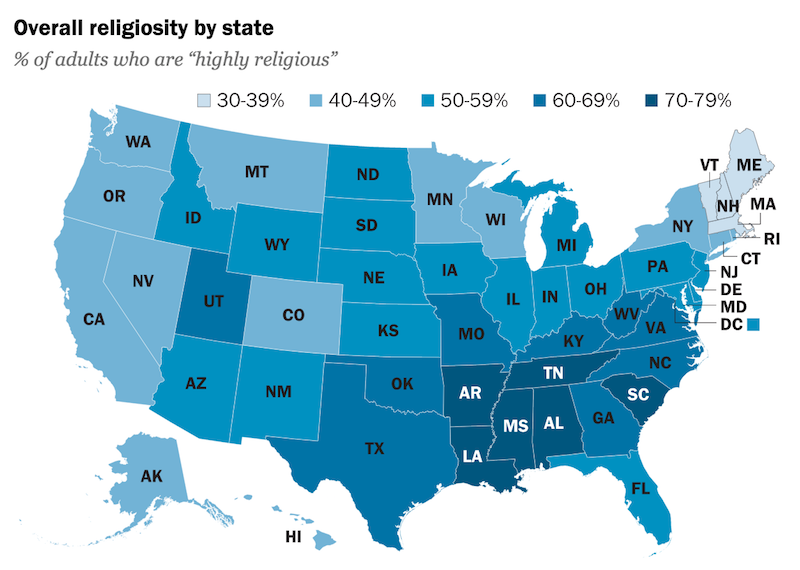
Pew Research CenterPew Research CenterBut that’s not accurate, according to a new report—“How religious is your state?”—from the Pew Research Center.

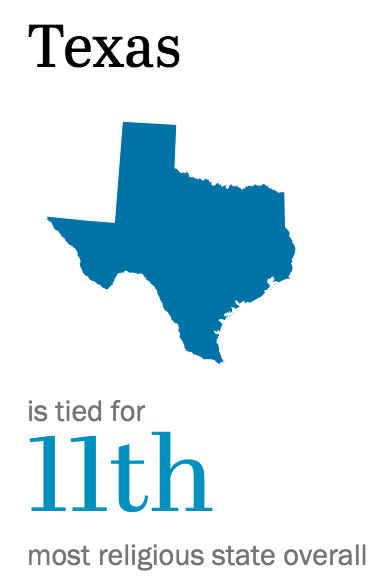
Texas tied for 11th with—gasp!—Mormon Utah. According to the Pew Center, 64 percent of adult Texans qualify as “highly religious.” The Lone Star State fell 13 points behind the Bible Belt’s co-buckles, Alabama and Mississippi. Maybe drawling makes people more religious, because 77 percent of the residents of those Deep South states are “highly religious.”

In fact, nine of the Top 10 “highly religious” states lie in Dixie. The lone exception is our northern neighbor, No. 8 Oklahoma. The Southern outlier is No. 22, Florida. But the Sunshine State’s pretty beaches and blue skies have attracted a cosmopolitan population, so it doesn’t really fit the regional demographic.

True to stereotype, the “least religious” states are in New England

Are you “highly religious”?

Pew Research CenterPew Research CenterYou may be wondering whether you, too, qualify as “highly religious.”

According to the Pew Center, the term applies to “any adult who reports at least two of four highly observant behaviors … while not reporting a low level of religious observance in any of these areas”:

  • Attending religious services at least weekly.
  • Praying at least weekly.
  • Believing in God with absolute certainty.
  • Saying religion is very important personally.

Pew also defines as “highly religious” people who report three of the behaviors and a low level on only the fourth.

Breaking down the numbers

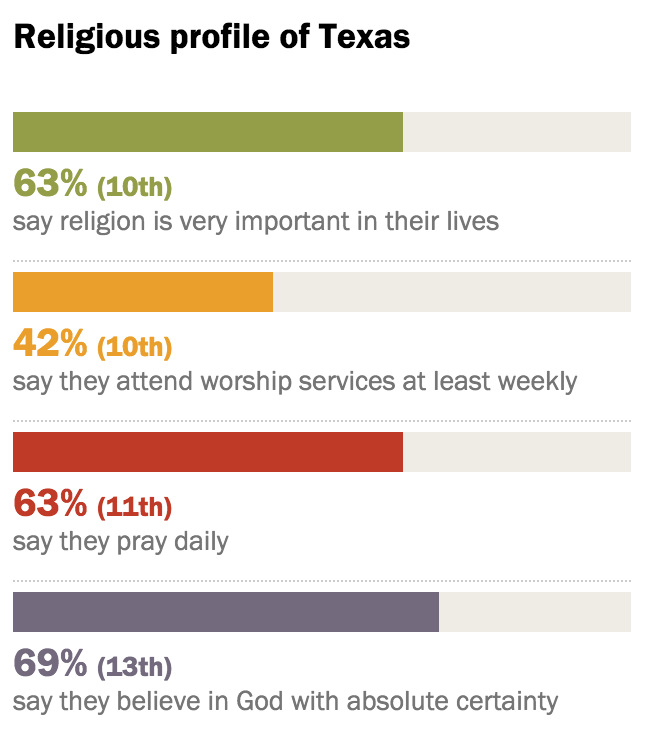
Pew Research CenterPew Research CenterWhile Texans tied for 11th overall in the “highly religious” rankings, here are the state’s rankings for the four components of the survey:

  • 63 percent (10th overall) say religion is very important in their lives.
  • 42 percent (also 10th) say they attend worship services weekly.
  • 63 percent (11th) say they pray daily.
  • 69 percent (13th) say they believe in God with absolute certainty.

Those numbers compare with Utah:

  • 58 percent (15th) say religion is very important in their lives.
  • 53 percent (1st) say they attend worship services weekly.
  • 61 percent (13th) say they pray daily.
  • 61 percent (31st) say they believe in God with absolute certainty.

Ironic, isn’t it?

Although they sit next to each other in the alphabetical listing of these United States, most folks would say, religiously speaking, Texas and Utah are quite different. Baptists and Catholics dominate Texas, but the Church of Jesus Christ of Latter-Day Saints—Mormons—is dominant in the Beehive State.

With all due respect to the Pew Religion Center—a revered and tremendously beneficial organization—the difference between Texas and Utah points to the problem of ranking states, or people, or churches, or any other group, for that matter, by how “religious” they are. Texas and Utah are conservative politically, but they’re poles apart in what they believe about Jesus, and God, for that matter.

So, saying a state—or, more importantly, a person—is “highly religious” is problematic, to say the least. We can feel good about going to church, thinking religion is important, praying and believing in God. But we know people who can check all those boxes, and yet they are mean, prejudiced, greedy, judgmental, hypocritical, vindictive and angry. They may be “highly religious,” but their behavior drives other people away from Jesus.

What about “highly faithful”?

The Pew Center may not be able to register it, but what this country and world need are people who are “highly faithful.” For Christians, they would be people who closely follow what Jesus stressed is important for his followers.

According to his inaugural sermon in the fourth chapter of the Gospel of Luke, they would:

  • Proclaim good news to the poor.
  • Declare freedom for the prisoners.
  • Help the blind recover sight.
  • Set the oppressed free.
  • Proclaim “the year of the Lord’s favor.”

And according to what Jesus taught in the 25th chapter of the Gospel of Matthew, they would:

  • Feed the hungry.
  • Give drink to the thirsty.
  • Shelter the stranger.
  • Clothe the naked.
  • Visit the prisoners.

The wrong crowd

Jesus talked about what he expected quite a bit. And being “highly religious” didn’t make his cut. In fact, the folks who received his sternest rebukes—they called themselves Pharisees back in Jesus’ day—were the most “highly religious” people around.

What Jesus wanted—what Jesus still wants—is people who are loving, compassionate, kind and redemptive. Gathering together with other believers and praying are great, but they’re not ultimate.

This makes you consider how Jesus would look at the Pew Center’s map of “highly religious” and “least religious” states. He might see people he praises and people he condemns in the unlikeliest of places.


Editorial: Fear, politics, refugees and God’s love

A new survey on Protestant Christians’ attitude toward refugees illustrates why fear-mongering presidential candidates are doing so well this year. God, save us from ourselves.

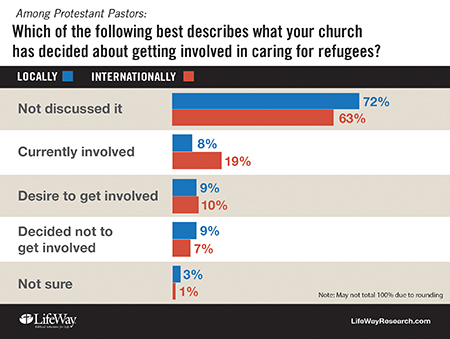
knox newMarv KnoxChurches are twice as likely to fear refugees as to help them, 1,000 Protestant pastors nationwide told LifeWay Research, the polling arm of the Southern Baptist Convention’s LifeWay Christian Resources.

No wonder some of the most successful presidential candidates in this cycle exploit voters’ disdain for global citizens unsettled by war, terrorism, persecution, and the tyrannical abuse of poverty and hunger for political purposes.

Worldwide, 20 million people are refugees, reports World Relief, which joined World Vision in commissioning the survey. Their numbers include 4 million Syrians. The United States is expected to resettle 85,000 refugees, including 10,000 from Syria, this year.

Pastors support refugees …

For their part, pastors strongly favor helping refugees, the LifeWay Research survey discovered:

 86 percent believe Christians have a mandate to “care sacrificially for refugees and foreigners.”

80 percent think caring for refugees is a privilege.

67 percent feel the United States can balance national security interests with compassion when assisting refugees.

refugeebar450Churches, not so much

But their follow-through, as well as their congregations’ attitudes, don’t align with the pastors’ professed convictions:

19 percent of U.S. Protestant churches are helping refugees overseas, the survey found.

35 percent of pastors have mentioned the Syrian refugee crisis from the pulpit.

44 percent believe their church members fear refugees coming to the United States.

9 percent of churches have decided not to help refugees locally.

7 percent have decided not to help them oversees.

Churches are more than twice as likely to help refugees overseas (19 percent) as locally (8 percent).

Pastoral endorsement for refugee support (86 percent) out-paces actual congregational support for refugees (19 percent) by more than four to one.

Although few actually do it, churches are almost four times as likely to give money to relief organizations or pray for refugees (19 percent) as sponsor refugees (5 percent).

Baptists (56 percent) lead the denominations in congregational fear of refugees, according to their pastors. They’re followed by Pentecostals (50 percent), Lutherans (33 percent) and Presbyterians (29 percent).

“It’s encouraging to see the American church understands God’s call to serve and care for refugees and foreigners, but what’s needed now is action,” Richard Stearns, president of World Vision, told LifeWay Research. “This is a test of the relevance of the church in our world.”

Fear and the ballot box

The consequence of Christians’ fear multiplies when it influences elections and public policy.

Individual congregations’ failure to help the world’s least fortunate is bad enough. But when their fear propels them to empower politicians to say the United States will not render aid, the crisis compounds. The candidates who prey on fear of others also are the candidates, according to surveys, who are doing the best among evangelicals.

The candidates look no further than election day. They’re going to conduct their polls and say what they think will bring them the most votes. But how can Christians claim to take the Bible and Jesus seriously and fail to factor Jesus’ teachings in Luke 4:14-30 and Matthew 25:31-46 into their political calculations?

Many voters—especially this year—are expressing frustration with their presidential options. So, they trade off one set of political positions for another, hold their noses and vote. But Jesus cared most for the most vulnerable, and in our world, that is refugees. All of us must take that seriously, in what we do as congregations and in how we vote.

The wages of fear

Besides care for the poor and the powerless, the New Testament teaches us to exercise the courage that springs from God through faith. “There is no fear in love. But perfect love drives out fear, because fear has to do with punishment. The one who fears is not made perfect in love” (1 John 4:18). “For the Spirit God gave us does not make us timid, but gives us power, love and discipline” (2 Timothy 1:7).

Fear is idolatry; it places the priority of security over love for God and trust in God’s love. Fear is the opposite of faith. Fear undoes love. Fear leads away from God.


Editorial: De-tune the religious liberty dog whistle

The Princess Bride, one of the most delightful movies of my daughters’ childhood, contains numerous quotable lines and snippets of dialog.

knox newMarv KnoxOver and over when villain Vizzini’s schemes fail, he exclaims, “Inconceivable!”

Finally, hero Inigo Montoya replies: “You keep using that word. I do not think it means what you think it means.”

Inigo’s response comes to mind several times a week. That’s when presidential candidates, pollsters and political whipper-uppers say the term “religious liberty.”

It does not mean what they think it means.

Over the past couple of years, “religious liberty” has become what is known in political parlance as a dog whistle.

You know how a dog whistle works: It sounds on a frequency only dogs can hear, and they come running. Likewise, a political dog whistle sends a coded message intended to fetch a cultivated constituency. The word or term sounds innocuous and blows right past normal listeners. But to the targeted group, it means something entirely different, and that meaning motivates them powerfully.

Take, for example, “states’ rights.” Constitutionally, it refers to guarantees in the Tenth Amendment, which reserves for the states all powers not delegated to the federal government. But to opponents of civil rights, “states’ rights” was a dog whistle calling them to support segregation.

To agitate and motivate

Unfortunately, “religious liberty” has become a dog whistle to agitate and motivate conservative Christians who fear losing absolute majority control over the United States. In their ears, it has been deconstructed from its common meaning and inspires them to support candidates and causes who wish to redefine religious liberty to the detriment of all people, Christians included.

Historically, theologically and constitutionally, religious liberty has meant guaranteeing people of all faiths and no faith the absolute right to follow the dictates of their consciences. Baptists, who began their faith journey as a persecuted religious minority a little more than 400 years ago, have been stalwart champions of true, broad religious liberty.

Our forebears embraced religious liberty early and championed it courageously. Many suffered ostracism and persecution for practicing and holding to their Baptist beliefs—refusing to baptize their infants, resisting registration as ministers and throwing off other religious shackles. Some languished in prison, and others died there.

But Baptists refused to horde religious liberty for themselves. Roger Williams founded Rhode Island Colony to guarantee religious liberty for not only Baptists, but also other Christians, people he called “Turks” and we call Muslims, and atheists and other freethinkers. One hundred fifty years later, a Baptist pastor named John Leland helped secure absolute religious liberty for all Americans by convincing James Madison to write it as the first freedom guaranteed in the First Amendment: “Congress shall make no law respecting an establishment of religion, or prohibiting the free exercise thereof … .”

First freedom twisted

Unfortunately, the First Amendment’s first freedom has been twisted of late, particularly by those who attempted to turn the law of the land to favor conservative Christianity.

Brent Walker, executive director of the Baptist Joint Committee for Religious Liberty, illustrated this upside-down treatment of religious liberty in a sobering assessment of the legacy of the late Supreme Court Justice Antonin Scalia.

“Justice Scalia’s thinking on the two clauses in the First Amendment that protect religious liberty—no establishment, that government can’t try to help religion; free exercise, that government shouldn’t try to hurt religion—he watered both of those down and pretty much deferred to the will of the majority rather than upholding the rights of the minority as many of us think the First Amendment was intended to do,” Walker told radio host Welton Gaddy.

Scalia “led the charge” in 1990’s Employment Division v. Smith “that pretty much gutted the protections in the free exercise clause,” Walker said. And regarding the First Amendment’s “no establishment” clause, Scalia “never saw an establishment case that he really liked.”

Consequently, the clause prohibiting government from establishing or propping up religion has been eroded, while the clause guaranteeing all religions the right to exercise their faith freely has been unraveled.

Such a perspective might have been expected from Scalia, a devout Roman Catholic, whose faith looks favorably upon hundreds of years of church-state collusion. But it is unconscionable for Baptists, other free-church Christians and people of other faiths, who inherently should recognize the danger of knocking down what Thomas Jefferson described as the “wall of separation” between church and state.

Faith & freedom

To be authentic, faith must be free. And for faith to be free, government should butt out.

(Isn’t it ironic the people who claim to distrust government are happy to allow government to regulate faiths with which they do not agree and also to turn to government to help them with their causes? Don’t they know what government supports, government will control?)

Now, politicians who prey on fear are using the religious liberty dog whistle to call out to people frightened by the increase of Muslims in their communities. They’re sounding the whistle to people who think the world will be better if they have the opportunity to promote their version of religion by posting the Ten Commandments on public property. They’re sounding the signal to Christians who despise people with different opinions and believe public officials should be able to ignore the law they have sworn to uphold when they don’t agree with how it is interpreted.

The list could go on and on, but the ideas would remain the same. If “religious liberty” isn’t good news for all people of all faiths, it isn’t good news. If “religious liberty” aids and abets one faith or one branch of one faith, it’s not liberty.

Baptists and others of goodwill should shout down the dog whistle of “religious liberty” when it agitates people to discriminate against others, to think less of others, to hate or despise others.

“Religious liberty” does not mean what people who use it for a dog whistle think it means.


Editorial: Criminal exonerations and ending capital punishment

Here’s your good news/bad news situation for the week: A record number of wrongfully convicted prison inmates were exonerated last year, and Texas led the nation.

knox newMarv KnoxGood news: Innocent people—149 of them nationwide and 54 in Texas—went free.

Bad news: They suffered an average of 14½ years in prison for crimes they did not commit.

Worse news: The persistence of this problem continues to belie the morality of capital punishment.

The University of Michigan Law School’s National Registry of Exonerations documents the cases of false justice. They include:

A record 58 exonerations for homicide cases—more than two-thirds of whom were racial or ethnic minorities, and half who were African-American.

27 convictions based on false confessions, more than 80 percent of which involved homicide cases. Most of the victim defendants were under age 18, mentally handicapped or both.

65 cases of official misconduct, including three-quarters of all the homicide exonerations.

75 exonerations for cases in which no crime ever occurred. Most of those were drug cases, but six were murder cases, and 14 others were violent felonies.

42 drug cases in Harris County, home of Houston.

The National Registry of Exonerations has recorded more than 1,700 exonerations in the past 27 years, according to the Texas Tribune.

We can be grateful conviction integrity units and the Innocence Project are seeking to overturn erroneous convictions. These groups work tirelessly and continuously to obtain justice for people who have been convicted wrongfully.

Still, the fact remains: Every year, more people are exonerated for crimes they did not commit. According to the National Registry of Exonerations, the rate of exonerations has about doubled in four years—from around 70 in 2011 to 149 last year.

Part of the reason for the growth is increased attention. Another is improved investigative techniques. But the escalation raises a vital question: How many people across the United States are in jail or prison because they have been convicted wrongfully?

Even more pressing: How many of them are on Death Row?

Most distressing: How many have been executed?

Last year, 40 percent of exonerations were bestowed upon people convicted of homicide. Many states—Texas leading them—execute killers.

Of course, many crimes—especially murders—send chills down our spines and revulse us to the core. We can’t help yearn for justice, and we often crave revenge.

But with the prevalence of wrongful convictions, how can we call ourselves civilized, much less Christian, and tolerate continued practice of capital punishment? Every time we execute someone who did not commit the crime, we as a society convict ourselves of the same crime for which we demand others pay the ultimate price.

Let’s say it once again: It’s time to kill the death penalty.


Analysis: Prayer for people who don’t want it

To paraphrase the old King James: The effectual fervent prayer of a righteous Anglican apparently availeth much. Consternation, at least.

That’s what’s been going on in the United Kingdom the past few days: Richard Dawkins, a University of Oxford professor and one of the world’s most famous atheists, suffered a stroke. The Church of England issued a prayer via Twitter for Dawkins and his family. All hell broke loose.

The Church’s official Twitter account tweeted, “Prayers for Prof Dawkins and his family.”

Commenters—apparently sympathetic to Dawkins’ atheism—accused the Church of “trolling” Dawkins. Apparently, praying for someone who doesn’t believe in God is just plain mean. And tweeting it to the whole world just adds insult to injury.


Tempest in a tweet-spot

“Sarcastic or ignorant?” tweeter Nikki Sinclaire responded.

“Top trolling there by C of E. Romans 12 v. 20,” another reader, Murdo Fraser, added. Give Fraser props for knowing enough about the Bible to stump many Sunday school regulars. We could debate whether (a) the Church actually intended to “heap burning coals on (Dawkins’) head” and (b) heaping coals is intended to bless or to curse.

The Guardian reported on the “Twitterstorm” here. Religion reporter Peter Ormerod defended the Church here.

Of course, we shouldn’t be surprised when offering prayer for an unbeliever creates a controversy. In our contentious world, Christians and non-Christians alike see slights where none are intended and infer insults where none are implied.


“Nothing controversial” in prayer?

Arun Arora, communications director for the Church’s Archbishop Council, attempted to set the record straight. “The tweet was a prayer,” he wrote on Tumblr. “Nothing controversial in that. …

“Prayer is for everyone. Some of the Twitter reaction assumed that Christians only pray for other Christians. In fact, Christians pray for all kinds of people. They pray for their friends and families. They pray for their community.

“They pray for the government (of whatever persuasion). They pray for terrorists, kidnappers, hostage takers. They pray for criminals as well as giving thanks for saints. Poets write poetry, musicians play music, Christians pray. And they love.”

Amen to Arora. Those are strong, biblical words. Jesus commanded: “You have heard that it was said, ‘Love your neighbor and hate your enemy.’ But I tell you, love your enemies and pray for those who persecute you” (Matthew 5:43-44).


Pray for “enemies”

Perhaps if more Christians followed the Church of England’s lead and prayed for our enemies—and those who act like enemies—the gospel would go forth with greater power and strength. Who knows how lives might be changed and eternity recalibrated?

This episode reminds me to wonder if Christians possess enough obedience, to say nothing of faith, to follow Jesus’ command and pray for our enemies. While I cannot speak for you, I’ll confess I rarely think about praying for my enemies, much less get on my knees to seek God’s favor for them.

Judging by what I read and hear, however, I’d guess I’m not far outside the norm. Many Christians sound and act as if their hearts’ desire is to see their enemies vanquished. If those Christians also believe in hell, isn’t that attitude contrary to the gospel?

What if, as Arora claimed, Christians made a concerted effort to pray for terrorists, kidnappers, hostage takers, criminals and even the government? What if we prayed for atheists and Muslims and Hindus and even people from the “other” political party? What might happen if we asked God to secure not only their ultimate salvation, but also their present well-being? What if we asked God to make them strong and healthy and happy?

If we truly believe in prayer and in miracles, we can concur that God has the power to do all of that, in an instant.

And if God wants to take God’s own time, then maybe the answer to our prayers begins in our own changed hearts. In our reformed attitudes. In our new relationships with people we previously called our enemy.


Editorial: A trying time—and learning opportunity—for Baylor

The most important lesson Baylor University must teach its students this year is how to respond like Jesus to shameful and embarrassing situations.

knox newMarv KnoxIn recent years, two Baylor football players have been convicted of sexual crimes. But abuse of women is not uniquely an “athletics problem.” This month, two women publicly have told their stories of sexual abuse at Baylor. One insists she did not receive the help she needed—and was promised—by the university. Federal regulations limit the information Baylor can disclose, so we only get one side of such stories. But the allegations are serious and must be handled thoroughly and compassionately.

How the Baylor administration and campus community respond to sexual abuse and gender safety will set the moral tone of the university for years to come.


Read the Standard’s ongoing coverage:

Baylor regents approve plan to address sexual violence

Recent grad says she was raped at Baylor; claims inadequate response

Baylor “family” stands with survivors of sexual violence

Baylor students plan prayer vigil for victims of sexual violence


Some Baylor supporters wish the issue would go away and prefer no media reports. Others strive to cover the problem with a patina of platitudes. Rationalization comes easy: Baylor is a Christian school; acknowledging any failure on the university’s part will harm not only the school but also “the cause of Christ.” Donor support could erode. Student recruitment could suffer. It might even hurt athletics.

Yielding to either temptation would be wrong for at least three reasons. First, it counters the teachings of Jesus to deal justly, live honestly, and protect the weak and vulnerable. Second, it violates the honor of previous victims and puts potential victims at greater risk. And third, it won’t work. Truth will surface, and if Baylor is found to be less than forthcoming, its reputation will be tarnished and redemption will require career sacrifices.

Sexual abuse study

In light of the sexual assault convictions of Baylor football defensive end Tevin Elliott and the rape conviction of defensive end Sam Ukwauchu, the university hired the Philadelphia law firm Pepper Hamilton to investigate and review the university’s policies and practices regarding sexual assault. That study should encompass the entire school, not merely athletics.

But speaking of athletics, every aspect of every Baylor sports program must be clean and exemplary. That’s a strenuous challenge, particularly in high-profile men’s programs, such as football and basketball, where the will to win can tempt coaches to overlook character flaws that would disqualify a non-athlete from admission. Due process is vital, but all athletes must be aware of consequences—zero tolerance for sexual misbehavior.

And let’s be clear: No level of sports attainment—even a national championship—is worth a single rape.

It is idealistic to suppose almost 17,000 students—most between the ages of 18 and 22—would gather in a campus community and sexual abuse never would occur. But the culture of the community must be one that overwhelmingly honors and respects individuals, and in most cases we’re talking about women. Response to victims must be compassionate, thorough and redemptive. Due process must be fair, but punishment of perpetrators must be swift, consistent and appropriate to the nature of the deed.

Back to the “Baylor Family”

Here’s a campus-culture thought: Baylor should drop its recent “Baylor Nation” hype and get back to thinking about the welfare of the “Baylor Family.” Nations accept collateral damage as a reasonable cost of attaining huge goals. Healthy families care about all their members in all situations.

Once the Pepper Hamilton study is complete and the law firm issues its report, Baylor’s board of regents must quash its inclination toward secrecy. Except for specific information restricted by federal regulations, the entire report and recommendations should be made public and easily accessible.

That report should become the catalyst to propel Baylor’s Title IX program to become the standard by which all other schools are judged. Policy must be perfect. Implementation and execution must be flawless. Baylor’s administration and regents surely want this; they must resist temptations to compromise.

Now is the time

This is a trying moment for Baylor. It also is an opportunity for Baylor to rise to its Christian ideals. They will not be reflected in sermons or open letters. They will be proven in deeds. These include providing transparency to the fullest extent allowed by law, developing the strongest anti-sexual violence culture on any campus, extending both compassion and justice to all abuse victims, and ensuring both due process and justice for all accused perpetrators.

Baylor can be certain, to borrow a phrase from a competitor’s school song: The eyes of Texas—and beyond—are upon you.

Disclosure notice: Editor Marv Knox and Managing Editor Ken Camp, who wrote the news stories related to this issue, are not Baylor University graduates. However, one of Knox’s daughters and two of Camp’s sons graduated from Baylor, as did all three of their spouses. Knox is an alumnus by choice of Baylor’s Truett Seminary. Nine of 16 Baptist Standard Publishing board members have earned degrees from Baylor.


Editorial: Why do we care what unbelievers think?

How much should Christians care what non-Christians think about them, their faith and their actions?

knox newMarv KnoxSeveral readers raised a version of that question in their response to last week’s editorial, “The ‘downward death spiral’ of hypocrisy.” The editorial called a prominent Dallas pastor, Robert Jeffress, a hypocrite for claiming to “not officially endorse” Donald Trump for president while appearing at a Trump campaign rally and calling Trump “the one leader who can reverse the downward death spiral of this nation we love so dearly.”

“Christians wonder why unbelievers think we’re all a bunch of hypocrites,” the editorial observed. It lamented the skepticism and disbelief Christians’ actions foster in unbelievers: “What’s to stop unbelievers from projecting such questionable ethics upon everything Jeffress says he believes? And … what’s to stop unbelievers from thinking all Baptists and other Christians behave that way? …

“The presidential primaries and the run-up to the general election are going to be harsher and more trying than what we’ve experienced for years and years. We’ll all be tempted to say and do things that do not reflect the Spirit of Christ. Politics isn’t worth the risk of ruining Jesus’ reputation.”

Some liked it; some, not so much

Thanks to several Facebook reposts, the editorial circulated widely and generated emails, as well. Some came from former Baptists and unbelievers, who expressed (a) surprise a Baptist editor would counter the public political expression they hear from prominent Baptists and (b) appreciation for the editorial’s call for living consistently with Jesus’ grace.

But those messages did not express a unanimous view. Several affirmed the call-’em-as-you-see-’em approach to engagement with non-Christians. Here are a couple of statements that appeared on Facebook walls:

“Why would we allow what nonbelievers may or may not say about us to influence what we do? Permitting our actions to be swayed by nonbelievers would be a sure sign of following the wrong leader.”

“Isn’t it more hypocritical if we are to allow our concern for how our actions are viewed by nonbelievers dictate our actions?”

Questions like that reflect the self-righteous, self-congratulatory condemnation of the Pharisees rather than the self-sacrificial love of Jesus.

Of course, we get it. Some Christians are so proud of holding onto “the truth” they don’t care much about souls. They’re right, and everyone else is wrong—dead wrong. And by their actions, we can tell they’re happy about it.

Smugly satisfied

In fact, far too many Christians who hold to strongly orthodox views of sin and damnation seem smugly satisfied in their assurance people who disagree with them will roast in hell.

That’s the reason the “Why do we care what heathen think?” questions are so heart-breaking. They’re antithetical to the Spirit of Jesus, who changed people by love and grace and compassion, not antagonism, judgment and condemnation.

What if …?

Have you ever stopped to think—and shuddered—about how your life would be different if just a few of your circumstances were different? What if all you knew about Christianity you heard from culture-hating Christians who step in front of public microphones today?

If Jesus were like he’s portrayed by so many Christians—Christians, mind you, Christians—on television and podcasts and in the print media today, I wouldn’t want to have anything to do with him, either.

So, that’s why I care what unbelievers think. That doesn’t require me to deny my faith. To the contrary, it requires me to live out my faith. To try as best I can—knowing I’m weak, timid and fallible—to treat people as Jesus did when he walked the earth. Jesus cared what people think; what they ultimately think. And his love redeemed them.

Jesus! what a Friend for sinners!
Jesus! Lover of my soul;
Friends may fail me, foes assail me,
He, my Savior, makes me whole. …

Jesus! I do now receive Him,
More than all in Him I find.
He hath granted me forgiveness,
I am His, and He is mine.


Analysis: Can pastors endorse political candidates?

Last week, the Baptist Standard published an editorial that criticized Robert Jeffress, pastor of First Baptist Church of Dallas, for his non-endorsement endorsement of Donald Trump.

knox newEditor Marv KnoxThe editorial did not find fault with Jeffress’ endorsement of a political candidate, but rather his blatant denial of an action he obviously took. At a campaign rally in Iowa, Jeffress said: “Although as a pastor I cannot officially endorse a candidate, I want you to know I would not be here this morning if I were not absolutely convinced that Donald Trump would make a great president of the United States. … he is the one leader who can reverse the downward death spiral of this nation we love so dearly.”

All kinds of response

As you might expect, the editorial generated considerable response in email and on Facebook. The spectrum included:

Affirmation of the editorial for pointing out Jeffress’ hypocrisy.

Criticism of the editorial for pointing out Jeffress’ hypocrisy.

Consternation at Jeffress’ support for a candidate whom many Christians find reprehensible.

Disapproval of the editorial’s assertion Jeffress’ actions damage Jesus’ reputation, along with a contrary response: “Why should Christians care what unbelievers think?” (This will be the subject of the next Baptist Standard editorial.)

Logical follow-up questions: To what degree are pastors and churches limited in political campaigns? Can pastors endorse political candidates? Those are excellent questions, which deserve answers.

A common mistake

The editorial perpetuated a broadly held misunderstanding of the Internal Revenue Code. It stated: “Jeffress and other pastors cannot ‘officially endorse’ Trump or any other politician because their churches are tax-exempt under Internal Revenue Code Section 501(c)(3). The code allows pastors and churches to address issues of public concern, but it prohibits them from endorsing candidates.”

Actually, pastors can—in certain circumstances—endorse candidates without imperiling their congregations’ tax-exempt status. But churches cannot. The IRS’ Tax Guide for Churches & Religious Organizations outlines the requirements for church tax exemption. “To qualify for tax-exempt status,” it states, “the organization must meet the following requirements:

“The organization must be organized and operated exclusively for religious, educational, scientific or other charitable purposes;

“Net earnings may not inure to the benefit of any private individual or shareholder;

“No substantial part of its activity may be attempting to influence legislation;

“The organization may not intervene in political campaigns; and

“The organization’s purposes and activities may not be illegal or violate fundamental public policy.”

When it comes to interpretation, the Internal Revenue Code is kind of like the Bible—the text is most important, but a good commentary helps. Reams have been written about those five tax-exemption qualifications. To access Tax Guide for Churches & Religious Organizations, click here. To purchase a copy of 2016 Church & Clergy Tax Guide by Richard Hammar, the pre-eminent national expert on church tax law, click here.

The IRS to Jeffress’ rescue …

When it comes to Trump’s campaign, Jeffress’ non-endorsement endorsement and First Baptist’s tax status, the fourth point is the key: “The organization may not intervene in political campaigns.”

The law is clear—churches cannot endorse candidates or raise funds for candidates’ campaigns, and pastors cannot use organizational publications or official church functions to endorse a candidate. But since pastors speak both inside and outside their churches and their publications, the rules for pastors can get a little blurry.

The IRS states: “The political campaign activity prohibition isn’t intended to restrict free expression on political matters by leaders of churches or religious organizations speaking for themselves, as individuals. …

“However, for their organizations to remain tax exempt under IRC Section 501(c)(3), religious leaders can’t make partisan comments in official organization publications or at official church functions. To avoid potential attribution of their comments outside of church functions and publications, religious leaders who speak or write in their individual capacity are encouraged to clearly indicate that their comments are personal and not intended to represent the views of the organization.”

Tax Guide for Churches & Religious Organizations provides several examples of ministerial involvement in politics. The illustration most germane to the Jeffress/Trump situation states: “Minister B is the minister of Church K, a Section 501(c)(3) organization, and is well known in the community. Three weeks before the election, he attends a press conference at Candidate V’s campaign headquarters and states that Candidate V should be re-elected. Minister B doesn’t say he is speaking on behalf of Church K. His endorsement is reported on the front page of the local newspaper and he is identified in the article as the minister of Church K. Because Minister B didn’t make the endorsement at an official church function, in an official church publication or otherwise use the church’s assets, and did not state that he was speaking as a representative of Church K, his actions didn’t constitute political campaign intervention by Church K.”

But don’t forget First Baptist and, of course, God

According to the IRS, Jeffress could have owned his Trump endorsement personally without imperiling First Baptist’s tax status. Jeffress apparently didn’t know that. So, rather than say, “I am here to endorse Trump personally” and follow by clarifying, “I’m not representing my church,” he said, “I cannot officially endorse” Trump but then proceeded to endorse Trump.

But according to the IRS example, Jeffress was good to go: He endorsed Trump at a campaign rally, not a First Baptist worship service or event. He spoke on Trump’s behalf in Iowa, not on First Baptist’s campus in Dallas. Jeffress did not claim to be speaking on behalf of his congregation. And as long as First Baptist did not pay for Jeffress’ travel or other costs related to the event, and either the Trump campaign or Jeffress personally paid, he’s OK there. So, Jeffress would be clean with the IRS.

That’s the legal issue.

A more important issue is the wisdom of backing not just Trump, but any candidate. Pastors—and particularly prominent pastors who regularly engage in popular media—make a faulty assumption when they presume citizens at large and even members of their own congregations will understand they are not speaking “for” the church. In effect, they tie their candidate to God’s coattails, and every failure of that candidate tarnishes God’s public image.

A third issue is the pastoral responsibility of endorsing a candidate whose public behavior contradicts so many tenets of the gospel.

Those final two issues must be settled by Jeffress, First Baptist’s leaders and God—not the IRS.