





“All the pain, all of the differences, all the different cultures, different approaches, and the language, all of that is there, but the love of Jesus kind of unites us in such a special way,” Pastor Victor Akhterov said, describing how Russians and Ukrainians worship together in his church.
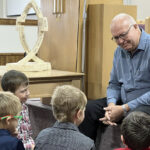
Akhterov, speaking to attendees of a Wednesday evening Bible study at First Baptist Church in Plano, Sept. 24, is a pastor of River of Life Dallas-Church, serving alongside Pastor Leonid Regheta and Pastor Vasily Dmitrievsky. All three are bivocational.
Akhterov and Regheta were born and raised in Ukraine. Dmitrievsky was born and raised in Russia. Together, they serve a church composed of Ukrainians, Russians, and people from across the former Soviet Union and elsewhere.
When the Dallas Morning News showed up at one of the church’s events after Russia’s full-scale invasion of Ukraine began in February 2022, reporters asked how Ukrainians and Russians could coexist in the same church.
“Probably because we are building bridges, not borders,” Regheta told them, referring to the posture of his church since its beginning.
‘An accidental church plant’
Regheta described River of Life Dallas-Church as “an accidental church plant.”
“I didn’t mean to plant the church. I didn’t plan to plant the church when I came to the Plano area. That was not part of my plan, my life. In fact, I resisted that. I protested that, and I call it an accidental church plant,” Regheta said.
Regheta and his wife were missionaries in Russia but were kicked out along with their four children when “Putin started making things more difficult for evangelical churches,” especially missionaries from America, which the Regheta’s were at that time, he recounted.
The Reghetas ended up in North Texas at the encouragement of his two sisters. Once settled and part of a Ukrainian community there, they were invited to a birthday party, which led to another larger gathering, followed by another even larger gathering.
Sign up for our weekly edition and get all our headlines in your inbox on Thursdays
Seeing what was happening, Regheta and his friends wondered if God was telling them they needed to do something with all these people coming together. Regheta thought the people needed to hear about Jesus but not from him since he was busy with his mission work.
Eventually, the Holy Spirit made it clear to the Reghetas they were to be the ones to start a church for this gathering.
One of the problems they faced was what kind of church to be. The gathering seemed to be equal parts Baptist, Pentecostal and “who knows what—including non-Christians,” he said.
“God, what kind of church are we supposed to have, and what does that mean? Could you make it a little more clear by sending more people of a particular denomination?” Regheta said.
Then people from Moldova, Uzbekistan, Russia and elsewhere joined the gathering in the backyard of someone’s house north of Frisco.
As the number of people continued to grow and the weather turned colder, they looked for another place to meet. A contact at the Baptist General Convention of Texas connected them to Hunters Glen Baptist Church in Plano, where River of Life-Dallas Church has met for the last 15 years.
Facing unique challenges
New challenges arose for River of Life-Dallas Church following Russia’s full-scale invasion of Ukraine in 2022. The ethnic, linguistic and national complexities of the war there found expression in the church here.
For example, some Russian families left the church in protest of the church’s support for Ukraine.
At the same time, some Ukrainians will not attend the church because the three pastors preach in Russian, which they consider “the language of the aggressor … the enemy,” Regheta explained.
Other Ukrainians carry the pain of a loved one killed in the war and are not ready to hear Russian spoken, he added.
Akhterov pointed to positive things happening in the church, citing individual Russian and Ukrainian members he sees worshipping together.
While all the pain and differences are present, “the love of Jesus kind of unites us in such a special way,” he said.
The three pastors are not new to such challenges, however. They’ve known them their entire lives.
Being a Christian in the U.S.S.R.
Leo’s story
Regheta, “a fourth-generation underground-church Christian,” said he feels he is an answer to prayers for the persecuted church and encouraged attendees to continue praying.
Growing up, Regheta and more than 150 to 200 other Christians crammed into someone’s home for worship, which was very hard to hide from neighbors informing the KGB. To avoid detection, they gathered for Sunday morning worship at 5 a.m. or after dark.
In second grade, his school teacher stood him and his cousin in front of their class and said they were stupid for believing God exists and that they would never get top grades.
Through those times, “what kept me in the church, what kept me grounded and it kept the faith in me—not just have it somewhere deep inside, but have it grow—is one simple thing, but it’s a profound thing, and that was the reality of God’s presence,” Regheta said.
When they were sick, they prayed and were healed, “and that was God being real. We had an issue and God helped us, and that was God being real. God showed himself. God manifested himself. So, I grew up with that reality of God’s presence, and it didn’t matter what my teacher was telling me or threatening to give me,” he continued.
Regheta’s family came to the United States as religious refugees in 1989.
Victor’s story
Akhterov, an ethnic Russian, had a different view of Soviet religious persecution growing up in the underground church in the eastern part of Ukraine.
“It’s actual fun. It’s not bad. … As a teenager, you’re hiding, you’re running from the police. You go to the forest to have your meeting, and you can do stuff in the forest. … The police come to the forest, and you are on the outlook, and you tell people to run, and they run. … You never rebel, you have so much fun being in church,” Akhterov said.
His father was imprisoned in Siberia twice for his faith, Akhterov then said. While in prison, his father led other prisoners to Christ. During one of Akhterov’s visits to Siberia, his father told his son he would preach the gospel to thousands of people someday.
His father’s words came true seven years later in 1992, as 22-year-old Akhterov was preaching over the radio to people across the former Soviet Union. His radio ministry continues today through Far East Broadcasting Company.
Vasily’s story
Dmitrievsky grew up believing “the church and religion is only for weak, uneducated and old people.” When his grandfather died, he started thinking about death for the first time, and death scared him.
In 1990, he went to Estonia on vacation and heard people singing songs in English about death. While Dmitrievsky was frightened of death, the people singing about it were not afraid of it.
As he continued to listen, he realized “they were singing about [the] death of Christ. They were Christians.” He was attracted to their message and wanted to know what they had that he didn’t. The singing group led him to Christ and gave him a Bible.
Dmitrievsky wanted to go to church in Penza, Russia, where he lived, “but there was no church around.” Though alone as a Christian back home, his new friends in Estonia helped him grow in his knowledge about the Bible and being a Christian. As he grew, he knew he wanted to serve God somehow.
In 1992, the first group of North American Christians came to Penza to do evangelism. From them, Dmitrievsky learned about sharing the gospel and prayer and realized he was being called to full-time ministry. He has been ministering ever since.
Ongoing ministry in Ukraine and beyond
Through World Outreach Ministries, Dmitrievsky meets practical needs of people from across the former Soviet Union now living elsewhere in Europe.
“They come to get glasses, but we also share Jesus with them, because Jesus is the one who makes bridges. He unites the people and gives them hope and love,” he said.
Regheta and Akhterov travel to Ukraine on a regular basis. As a result, “it’s useful to have three of us [pastors], so at least one of us can cover any particular Sunday,” Regheta said.
Regheta coordinates relief efforts inside Ukraine and with refugees throughout Europe through Hope International Ministries, of which he is board chair and director of mission projects.
Hope International Ministries provides summer camps for children and teenagers in 11 countries in Europe, trauma healing retreats throughout Europe to those affected by the war, and leadership training for new church members in Ukraine.
Akhterov, who continues his radio ministry in Ukraine, said when the war started, his people met and decided: “We’re not going to be the radio of sorrow. We’re going to be going through the same stuff that everybody is going through, but we’re going to be the radio of hope that can only be found in Jesus Christ.”
The radio ministry’s station in Petrovsk, “where the battle is the fiercest right now,” was hit by a bomb, causing the broadcast to stop, Akhterov said. “A few weeks later,” he continued, a young soldier brought the transmitter to their office elsewhere in Ukraine.
Asking where the soldier got it, Akhterov was stunned by the soldier’s answer, because “Petrovsk is just being bombed relentlessly.”
“You went to the tower under fire to get this piece of metal?” Akhterov asked him.
“No, no, no, friends,” the soldier responded. “This is not a piece of metal to me, because I was fighting there, and I started listening to your station, and I discovered who Jesus is, and I could not stop listening, because this was my lifeline to him.”
Wanting to do something for God, Akhterov continued, the soldier went to the tower, under fire, retrieved the transmitter and carried it to Akhterov.
To learn more about the ministries mentioned in this report, visit River of Life Dallas-Church, Hope International Ministries, Far East Broadcasting Company, and World Outreach Ministries.
Serving God Under Siege by Valentyn Syniy offers another account of ministry in Ukraine during the ongoing war with Russia.








We seek to connect God’s story and God’s people around the world. To learn more about God’s story, click here.
Send comments and feedback to Eric Black, our editor. For comments to be published, please specify “letter to the editor.” Maximum length for publication is 300 words.