




Baptists in Africa called for “all parties concerned” about religious freedom and human rights in Nigeria to “embrace peace for the good of all.”
Meanwhile, some American evangelicals—including the interim president of the Southern Baptist Convention’s Ethics and Religious Liberty Commission—endorsed a letter by a conservative group commending President Donald Trump for “placing all available Presidential action on the table to ensure that action is taken soon.”
In late October, Trump declared Nigeria a Country of Particular Concern—a designation reserved for nations that engage in or tolerate systemic, ongoing and egregious violations of religious freedom.
On social media, Trump also indicated he instructed the Department of War to prepare for possible military intervention, going into Nigeria with “guns-a-blazing.”
Multiple human rights and global religious freedom organizations long had called for Nigeria to be designated as a CPC. However, some religious leaders registered serious concern about Trump’s threat of military action.
‘Embrace peace for the good of all’
On Nov. 7, the All Africa Baptist Fellowship—a transnational regional group affiliated with the Baptist World Alliance—released a public statement expressing “great concern about the ongoing global uproar regarding the largest black nation on earth, Nigeria.”
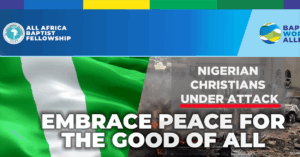 “To us in Africa and the Baptist family, the peace, stability, and prosperity of Nigeria is a blessing to the entire continent,” the AABF statement said. “We therefore appeal to all the parties concerned to embrace peace for the good of all.”
The fellowship—a network of 77 Baptist unions, conventions and associations representing 20 million Christians in 38 countries—expressed “great concern” about alleged violations of religious freedom and human rights in Nigeria.
The AABF called on “all the stakeholders to chart the paths that put a stop to the menace of religious crisis.”
Sign up for our weekly edition and get all our headlines in your inbox on Thursdays
Nigeria’s government “has the responsibility of securing the lives and properties of people of all faiths, including Christians,” the fellowship stated.
Actions must be ‘agreed upon and not imposed’
At the same time, without explicitly citing Trump’s threat of military action, the AABF stated: “The United States and Nigeria are two sovereign and independent nations.”
Therefore, the fellowship stated its belief that “any help offered to the latter be such that is mutually agreed upon and not imposed.”
The fellowship assured Nigerian Christians, particularly those who have been displaced, lost family members or suffered other severe hardship that “we stand with you in prayer.”
“To the perpetrators of this injustice, please, lay down your weapons and embrace peace,” the AABF statement urged. “Nigeria needs true peace. Africa needs stability. We are calling upon the name of Jesus Christ the giver of peace.”
Trump commended for ‘strong and decisive action’
One week after the AABF issued its statement, the CPAC Foundation and its First Freedom Movement sent a letter to the White House, thanking Trump for his “strong and decisive action” in designating Nigeria as a CPC.
“We commend your recognition of the major threat and devastation facing Christians in Nigeria from radical Islamists and a government that has taken little action to protect them, as well as your clear-eyed statements placing all available Presidential actions on the table to ensure that action is taken soon,” the letter states.
“You saw the evidence, you listened to the cries of the persecuted, and you acted.”
Calling on Nigeria to demonstrate improvement
Citing the “targeting of Christians in horrifying numbers,” the letter asserts Nigeria should remain on the U.S. Department of State’s CPC list until it demonstrates improvement in four areas:
- Increased security for Christian populations, particularly in Nigeria’s Middle Belt, “with the deployment of additional military and law enforcement units trained to be proactive in fighting militants.”
- “Ending impunity for those responsible for attacks against Christians, and ensuring that attackers are fully and quickly prosecuted.”
- “Facilitating the safe return of internally displaced persons to their homelands, and assisting in the rebuilding and security of these communities.”
- “Ceasing enforcement and initiating the repeal of the country’s Sharia blasphemy laws, releasing individuals imprisoned or detained for blasphemy-related offenses, and prosecuting mob attacks.”
While the letter focuses primarily on Nigeria, it also commends Trump for taking a “strong stance to defend all persecuted Christians against grave atrocities and serious violations of their God-given right to religious freedom.”
“While the U.S. should defend religious freedom for all people, we agree that the threat to Christians worldwide is particularly severe, that Christians are the most persecuted religious group on the planet, and that the scourge of the persecution of Christians has been ignored by too many for too long,” the letter states.
Endorsed by conservative Christian leaders
The letter originated with the CPAC Foundation—the organization behind the annual Conservative Political Action Conference. It carried the signatures of Matt Schlapp, chair of CPAC, and Mercedes Schlapp, CPAC senior fellow.
More than two dozen others endorsed the letter. They included Gary Hollingsworth, interim president of the ERLC; Samuel Rodriguez, president and CEO of the National Hispanic Christian Leadership Conference; Tony Perkins, president of the Family Research Council; and Troy Miller, president and CEO of the National Religious Broadcasters.
While the Nigerian government acknowledges violence within the nation’s borders, officials assert it is not based on religion, and they attribute it to extremist groups.
A high-ranking Nigerian official told the Baptist Standard the presence of violence in his country is perpetrated by “some extremists.” He strongly rejected the assertion Christians are targeted.
Mohammed Idris Malagi, minister of information and national orientation for Nigeria, insisted: “It is sad that this has been characterized as a religious conflict. We don’t believe that it is. It never has been a religious conflict. It actually is an extremist conflict.”







We seek to connect God’s story and God’s people around the world. To learn more about God’s story, click here.
Send comments and feedback to Eric Black, our editor. For comments to be published, please specify “letter to the editor.” Maximum length for publication is 300 words.