Gunmen kill deacon, kidnap his wife, at Haiti church

Armed gunmen attacked First Baptist Church in Port-au-Prince, Haiti, on Sept. 26, killing a 60-year-old deacon and abducting his 59-year-old wife.

Deacon Sylner Lafaille was killed and his wife Marie Marthe Laurent Lafaille was kidnapped when gunmen stormed the church building, located a few kilometers from Haiti’s National Palace.

‘Shameful, vile and unimaginable’

In a message to Everton Jackson, director of integral mission for the Baptist World Alliance, Pastor Josue Mathieu said his church had experienced “a shameful, vile and unimaginable event.”

Gunshots coming from the front gate of the church disrupted early morning worship services at First Baptist Church, he reported. Many worshippers began running or attempting to hide under pews, he continued. In the process, several sustained minor injuries.

While the most urgent matters are praying for the release of the kidnapped church member and making arrangements for her husband’s funeral, members of the congregation also must deal with the trauma of the experience, Mathieu said.

“This unspeakable event comes at a time when we are trying to get our heads above water” after dealing with COVID-19 and civil unrest, he noted.

“It’s like cold water poured into boiling water,” he continued. “The first Sunday in October is the general return to church activities, a period when we receive dozens of newly baptized believers. We now find ourselves in front of the faithful traumatized by this dark event. The difficulties are enormous! There is a great need for psychological and post-traumatic treatment.”

Calls for prayer

Mathieu asked Christians to pray for “the liberation and deliverance of the country plagued by a security crisis driven by gangs.”

Elijah Brown, general secretary of the Baptist World Alliance, likewise called for prayer soon after the attack on the Port-au-Prince church.

“Would you share and pray for this historic Baptist World Alliance church founded in 1835, for [Marie Lafaille’s] safe release, and for Haiti as they continue to respond to multiple challenges?” Brown posted on Facebook.

The “multiple challenges” in Haiti include political upheaval, civil unrest and natural disasters, as well as persistent poverty. Haitian President Jovenel Moise was assassinated on July 7 in Port-au-Prince. An earthquake measuring 7.2 on the Richter scale hit southwest Haiti on Aug. 14. Two days later, Tropical Storm Grace drenched the region, causing flash floods.

The U.S. State Department in late August issued a Level 4 travel advisory for the nation, saying, “Do not travel to Haiti due to kidnapping, crime, civil unrest and COVID-19.”

‘Wanton and senseless’

Jackson, formerly regional secretary for Caribbean Baptists, urged citizens in Haiti not to lose hope.

“The invasion of the worship service, killing of a deacon and abduction of his wife by armed bandits are testimony of the callous climate that has enveloped Haiti. Such a barbaric act is reflective of the ‘spirit of the age’ that glorifies rugged individualism at the expense of community spirit that engenders solidarity, neighbor love and a shared space of safety and security,” Jackson said.

“At a time of global displacement and disorientation, it is regrettable that a nation state which had been the subject of colonial exploitation and is faced with political unrest, natural disasters and economic woes has had to deal with such high levels of wanton and senseless killings. In the midst of turmoil and confusion, I implore the Haitian people not to give up hope and the global community to demonstrate God’s love and compassion in practical endeavors.”

Ernie Rice, a Texas Baptist missionary to Haiti, currently is stateside while his wife Sharon recovers from shoulder surgery. In an email Sunday evening, Sept. 26, Rice wrote he was “just getting word” about the killing and kidnapping in Port-au-Prince.

“Kidnapping is almost a daily occurrence” in the capital city, he noted. “As the gangs get bolder it causes commercial activity and transportation to slow down, causing an imposed famine. This causes marginally moral people to turn to violence in desperation.”

Rice, who serves now with the Universal City-based nonprofit organization Good for Haiti, began working in Haiti in 2011. Texas Baptist Men sent Rice to explore ways the missions organization could meet continuing needs after an earthquake.

For the past four years, Rice has served in Cap Destrée, Haiti, helping to provide the area with safe drinking water and working on multiple community development initiatives in partnership with a local church.

“So far, our small community far from Port(-au-Prince) is surviving,” Rice wrote, adding he plans to return to Haiti once his wife is recovered fully from her operation.

Editor’s Note: This article, originally posted at noon on Monday, Sept. 27, was updated mid-afternoon on Tuesday, Sept. 28, after additional information became available. 


Baptist pastor shot dead in Myanmar

Burmese military reportedly shot dead a Baptist pastor in the Chin state of Myanmar on Sept. 18, two days after another Baptist minister was arrested at his home.

Pastor Cung Biak Hum was attempting to help a member of his church extinguish a fire after the man’s home was set ablaze during military attacks, according to an Asia Pacific Baptists social media post.

Burmese military shelled Thantland township in Myanmar’s Chin State. (Facebook Photo / Asia Pacific Baptists)

Tom Andrews, United Nations special rapporteur, tweeted: “The murder of a Baptist minister and bombing of homes in Thantlang, Chin State, are the latest examples of the living hell being delivered by junta forces against the people of Myanmar. The world needs to pay closer attention. More importantly, the world needs to act.”

Nineteen homes in Thantlang township were destroyed during the shelling, according to Christian Solidarity Worldwide, a United Kingdom-based human rights organization focused on religious liberty and freedom of conscience.

“CSW extends our deepest condolences to the family, friends and loved ones of Pastor Cung Biak Hum, who was killed as his community and many others like it continue to suffer violence and grave human rights violations at the hands of the Myanmar army,” said Benedict Rogers, CSW senior analyst on East Asia.

“We echo calls for increased international action and reiterate the urgent need for a global arms embargo on the country as a means of pressuring the military regime to end its horrific treatment of the people of Myanmar.”

The Chin Human Rights Organization posted on its Facebook page a formal statement from the Chin Baptist Convention strongly condemning the killing of the pastor and the indiscriminate shelling of homes.

Baptist pastor in Mandaly arrested

Asia Pacific Baptists noted the attack in Thantlang and killing of Cung Biak Hum took place two days after another minister, Thian Lian Sang of Falam Baptist Church in Mandalay, was arrested in front of his home “by armed men in plain clothes.”

“At the time of the arrest, three military vehicles and about 20 armed men on three motorcycles were involved,” the Facebook post stated.

Five phones and money the family received for the funeral of the minister’s father were confiscated.

Asia Pacific Baptists called for the release of Thian Lian Sang, who was reported to be “politically neutral.” The cause of his arrest remained unknown.

After the military seized control of Myanmar in early February and declared a state of emergency, the Baptist World Alliance called on member bodies worldwide to “stand together with the global Baptist family in supporting the people of Myanmar” through prayer and advocacy.

BWA issued a statement Sept. 20 calling for “the immediate release” of Thian Lian Sang and for those involved in the killing of Cung Biak Hum to be held responsible. It also called for “the restoration of homes burned by the military.”

“With 1.7 million Baptists in Myanmar who have a continuous history of over 200 years in the country, the Myanmar Baptist family remains a key part of both Myanmar and the Baptist World Alliance family. While addressing these immediate injustices, we further call upon the military junta to do all that it can to restore religious freedom, human rights and peace through dialogue across Chin State and Myanmar as a whole,” the BWA statement read.

EDITOR’S NOTE: This article initially was published at 2 p.m. on Sept. 20. It was updated two hours later to include the statement issued by the Baptist World Alliance.


At least 14 Christians killed in Nigeria, including pastor

KADUNA, Nigeria (BP)—Militant groups have killed at least 14 Christians, including an evangelical pastor, in southern Kaduna since Sept. 11 and have kidnapped a Catholic priest, the Premium Times of Nigeria reported.

The macheted and gunshot body of Silas Yakubu Ali, senior pastor of the Evangelical Church Winning All in the Zangon Kataf Local Government Area, was found Sept. 12 after he failed to attend worship. He had been ambushed after his motorcycle ran out of fuel near Asha-Awuce about a third of a mile from his home.

The killings also include two youths who were attacked while working on a farm in Zangon Kataf, and at least 11 people, including two pregnant women, killed in an attack on Apyizhime Jim Village, the Daily Post reported. Ten of those killed in Apyizhime Village were members of a church Ali oversaw, and one was Catholic, Christian Solidary Worldwide said.

Benson Yakusak, a priest at St. Matthews Catholic Church Achuna-Sarki, also in Zangon Kataf Local Government Area, was kidnapped by armed militants, CSW reported.

CSW Founder and President Mervyn Thomas lamented the local and national governments’ inability to deter crimes, often against Christians, that are increasing in Kaduna.

“Officials have done woefully little thus far, and this has allowed impunity to thrive and enabled this violence to metastasize,” Thomas said.

“Nigeria is currently failing due to the seeming unwillingness of federal and state authorities to respond swiftly and decisively to the existential threat posed by militia violence, while peaceful political dissent or expressions of concern about democratic backsliding and insecurity meet with an unnecessary show of force.”

Religious leaders point to national emergency

Religious leaders and others have lamented ongoing violence in Nigeria, describing the country as under a national emergency. The majority Christian area of southern Kaduna is considered an epicenter of kidnappings and attacks, despite a high security presence.

Professor Chidi Odinkalu, former chair of the Nigeria Human Rights Commission, tweeted that despite the military and security presence, “entire communities are being liquidated, displaced, (and) destroyed.”

CSW referenced an analysis by Murtala A. Rufa’l, a lecturer at Usman Danfodiyo University in Sokoto, indicating that 120 armed gangs as large as 2,000 members each operate in Kaduna, Zamfara, Sokoto, Katsina, Kaduna, Kebbi and Niger states, empowered by at least 500 AK-47 rifles.

Since 2011, militants have killed more than 12,000 people, destroyed 120 villages, displaced at least 50,000 villagers and stolen more than 250,000 heads of livestock in Zamfara state alone, Rufa’l said.

The International Society for Civil Liberties & Rule of Law, an independent nonprofit that advocates for societal freedom regardless of religion, said in July that 3,462 Christians had been hacked to death by Nigerian Jihadists in a 200-day span. In addition, 3,000 Christians had been abducted and 300 churches attacked.

Boko Haram, terrorists aligned with the Islamic State, are suspected of making plans to join other terrorists already fighting in southern Kaduna, the Nigeria Security and Civilian Defense Corps said Sept. 8.

In its 2021 World Watch List, Open Doors USA ranked Nigeria as 10th among the top 50 countries where it is most dangerous for Christians. More Christians are killed there for their faith than in any other country, Open Doors has said.


Facing forward difficult for Afghans, Baylor panelists say

Many Afghans hope for a better future, but those hopes have dimmed in the past month, a panel of experts told a Baylor University webinar audience.

Facing Forward: Afghanistan After America” was the theme of the online discussion, sponsored by the Baylor Institute for the Study of Religion and the Keston Center for Religion, Politics and Society.

One panelist—Fawzia Koofi, a former member of Parliament in Kabul and former vice president of the National Assembly in Afghanistan—left Afghanistan only 24 hours before the webinar.

“My mind and heart and everything—including my family members—are still in Afghanistan,” Koofi said.

Aref Dostyar, consul general of Afghanistan to the Western United States, likewise emphasized the subject of Afghanistan’s future is neither remote nor abstract to those with ties there. He originally was scheduled to be in Kabul on Aug. 16—one day after the city fell.

“This is a very personal matter for all of us from Afghanistan,” Dostyar said. “Sometimes it’s difficult for us to get our heads around it, because it’s not just a piece of analysis. It’s not theory. It’s real life for us. Our friends are there. Our families are there. Our lives are there.”

‘Opportunities are shrinking’

Koofi observed “the opportunities are shrinking” for women and minorities to have any role in Afghanistan’s political structure.

During negotiations with the Taliban in the months prior to their seizure of power, she said, her baseline for conversations was making sure “the rights and liberties of individuals were respected.”

However, when former President Ashraf Ghani fled from Kabul, the Taliban filled the power vacuum with little opposition, Koofi noted. Now, the Taliban has little motivation to listen to voices calling for a more inclusive and representative government, she observed.

Koofi holds out little hope the Taliban acting on its own will allow women and minorities to hold strategic positions in government. However, international pressure could improve the situation, because the Taliban government “wants international recognition,” she said.

“There are countries and individuals working to give the Taliban the recognition they want, but in the meantime, we have to watch carefully their links to other militant extremist groups,” Koofi said.

Afghan women have ‘minimum expectations’

Koofi noted she faced some domestic criticism for being willing to negotiate with the Taliban to try to win concessions. Critics said the dialogue gave an appearance of legitimacy to a terrorist group, she said.

“It’s always easy to talk and exchange views with a group when you are same-minded. But with a group where there is a huge difference, to the extent that they are ready to kill another human being because of political differences, it’s not easy. But it’s important that we engage them,” she asserted.

Today, she said, women in Afghanistan have “minimum expectations” from the government—“expectations to be respected as a human being, to have the right to an education, to have the right to have a say in the future of the government—basic principles of democracy.”

‘The end of war is not the beginning of peace’

While the departure of U.S. troops from Afghanistan was the precipitating event that led to the Taliban’s abrupt rise to power, further military involvement will not solve the problems the nation faces, Dostyar asserted.

“There is no military solution to the problem in Afghanistan,” he said. “I think that seizure of power is not peace. When we say there is no military solution, that means even if you win a war, you may not be able to establish peace. The end of war is not the beginning of peace in our country.”

Dostyar urged his audience to recognize the “multi-faceted context” and complexity of Afghanistan’s multi-layered situation.

“There are definitely domestic elements to this, but to say it is just a civil war is over-simplifying the problem, the issue and the conflict in Afghanistan,” he said.

Currently, Afghanistan faces “enormous economic challenges” and “massive internal displacement” of about a half-million people, Dostyar observed.

‘The hard part is governing’

Ambassador Jonathan Addleton, former civilian representative to Southern Afghanistan and rector of Forman Christian College in Lahore, Pakistan, noted many Americans have forgotten the sacrifices and suffering of the Afghan people.

“For some reason, long wars tend to lead to short memories—even amnesia,” he said.

Addleton pointed out the Taliban has seized power, but it has yet to form a stable government.

“Winning wars, like winning elections, is the easy part. The hard part is governing. That still lies ahead,” he said.

Addleton urged an American webinar audience to recognize that the withdrawal of U.S. military does not mean the end of conflict.

“Conflict is not over just because somebody announces it,” he said.

‘This could have been avoided’

Similarly, Koofi commented, “I don’t think silencing the guns means peace.”

She insisted a conditional withdrawal of U.S. troops—rather than a “rushed” withdrawal to meet a deadline—could have provided time for negotiation and potentially prevented the collapse of the Afghan government.

“This could have been avoided,” she asserted.

Dostyar emphasized the need for global leadership at the international level. He urged Americans to recognize there still may be time to work toward a political settlement that offers a hopeful future for Afghanistan, since the Taliban has not fully formed a government yet.

“We should not give up on Afghanistan. It’s not over,” he said. “You have a partner in the Afghan people.”


Afghan evacuees turn attention to families left behind

WASHINGTON (RNS)—Mustafa was back in Afghanistan visiting his wife and daughter when the Taliban literally moved in next door. He knew they had to get out of the country immediately.

But this time, he said, he wasn’t leaving without his wife and daughter.

That harrowing journey took them two days just to get into the airport in Kabul; another two, to finally board a plane. It spanned three countries, with a stop in Qatar on their way from Afghanistan to the United States. It also meant a heartbreaking goodbye to parents, siblings and their families.

Mustafa, who asked to be identified only by his first name, still considers his family one of the lucky ones, able to flee Afghanistan before the Aug. 31 cutoff for the withdrawal of U.S. armed forces and allies from the country.

‘The mission is not complete’

Now faith-based refugee resettlement agencies are helping people like Mustafa and their families settle into their new homes in the United States and advocating for those left behind.

“We remember the thousands of lives lost in the conflict in Afghanistan, including American service members, Afghan civilians, and others. But the mission is not complete,” said Jenny Yang, senior vice president of advocacy and policy at World Relief, the evangelical Christian relief organization that assisted Mustafa when he immigrated by himself to the United States in 2017.

“The United States and the international community must do the hard work now of protecting and assisting those who cannot remain in Afghanistan safely.”

Mustafa, now 29, never wanted to leave Afghanistan, his family, his education or the small media company he founded with his brother. But after working as an interpreter and analyst for America and other international organizations, he’d received both direct and indirect threats against his life from the Taliban.

There were frequent clashes between the Afghan government and the Taliban, he said.

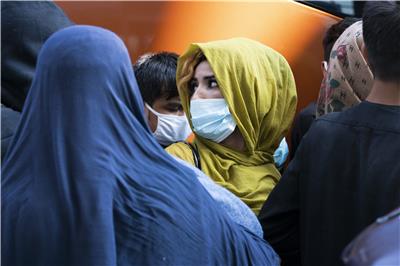
Families evacuated from Kabul, Afghanistan, wait to board a bus after they arrived at Washington Dulles International Airport, in Chantilly, Va., on Wednesday, Aug. 25, 2021. (AP Photo/Jose Luis Magana)

“All I remember in Afghanistan was war. I was born in war, raised in war, grew up in war. Part of my education was under the Taliban system a long time ago,” he said.

“When we are leaving our home in the morning, we don’t believe that we will come back alive in the evening.”

At the time, Mustafa said, the process of getting a Special Immigrant Visa, designed for Afghans employed by or on behalf of the U.S. government, was relatively quick and easy.

Not sure what to expect in the United States, he came alone in 2017, thinking his wife could join him in a few months once he had settled into the country. But the process “changed completely” after former President Donald Trump took office, Mustafa said, and her application was denied.

Forced to deal with the unexpected

He had started the process over and was visiting his wife and 1-year-old daughter in Kabul when the Taliban seized power several weeks ago. It was unexpected, he said. He never heard a single shot fired in the city.

When members of the Taliban began sheltering in front of their house, Mustafa, his wife and daughter went to stay with a friend who lived near the airport. He tried not to be afraid, he said, focusing instead on doing what he could to help his family.

He spent a day trying to get inside the airport, along with his brother and brother-in-law, who already were in the middle of the SIV process, and his father, who previously had worked with the British Embassy. But the scene outside the airport was crowded, chaotic and punctuated by gunfire meant to control the crowd, and he returned to his friend’s house that night, unable to get inside.

The next day, Mustafa made the difficult decision to part ways with his parents and siblings, telling his father he’d do all he could to get him out of Afghanistan once he had left. He couldn’t lose the chance to get his wife and daughter out of the country, he said.

When he secured emergency visas for his wife and daughter and was told they could come with him, “that was the most beautiful moment of the story,” he said.

‘There are lots of other people like my family’

Once the trio made it inside, they spent two nights sleeping in the airport before they were able to board a packed military plane bound for Qatar in the wee hours of the morning.

After waiting seven hours on a hot tarmac for transportation to a shelter in Qatar, they boarded a second flight to Washington, D.C. They slept through the 14-hour flight, exhausted after their dayslong ordeal, and arrived Aug. 21 in the U.S., he said.

On Aug. 30, as the deadline for U.S. withdrawal closed in, his brother and brother-in-law still were waiting on a phone call from the U.S. Embassy telling them to come to the airport, he said.

“There are lots of other people like my family,” he said.

Faith-based refugee resettlement organizations—many of which urged the Biden administration months ago to begin evacuating Afghan allies before its planned troop withdrawal—have continued to advocate for those like Mustafa’s family who have been left behind.

Working as advocates

World Relief has resettled about 6,300 individuals with Special Immigrant Visas in the last five years and has a lot of relationships with Afghans in the U.S., said Matthew Soerens, U.S. director of church mobilization for World Relief. Almost all have reached out to the organization in recent days “desperately concerned” for someone who is still in Afghanistan, he said.

“We are not moving past the reality that for the many who got out, who are starting to arrive, many others did not get out, including people who had pending Special Immigrant Visa applications because of their service to the U.S. military or other parts of the U.S. government. … We do not consider that acceptable,” Soerens said.

Advocates aren’t sure what the process will look like to help those people continue to flee Afghanistan, which has become more difficult since the airlift ended. But that’s something the United States and other governments need to figure out, he said.

Organizations like World Relief, which form the backbone of the U.S. refugee resettlement system, also are working to meet the needs of Afghans arriving with SIVs or on humanitarian parole. Department of Homeland Security Secretary Alejandro Mayorkas has said the United States expects to welcome 50,000 evacuated Afghans through what it is calling Operation Allies Welcome.

Many remain in third countries undergoing security vetting and screenings before they can be admitted to the U.S.

Found a ‘very welcoming place’

Coming to the U.S. in 2017 was a tough decision, Mustafa said, because, “I had to leave everything back in Afghanistan and come back and start everything from scratch in the U.S.”

But he found a “very welcoming place” in World Relief’s resettlement office in Modesto, Calif., he said.

The organization provided classes to help him learn about American culture and all the other things he needed to know about life in the United States. He remembers it helping other families to settle into and furnish housing.

Housing remains one of the biggest needs for evacuees arriving without the kind of credit history many landlords require, Soerens noted.

So far, more than 360 Afghan allies, most with SIVs, have arrived at World Relief offices across the country, he said.

The organization has been told to expect even more people to arrive with humanitarian parole status, he said. Many could have pending SIV cases. Others may be religious or ethnic minorities, women who sought education or people who served nongovernmental organizations with American affiliations.

Evacuees thoroughly vetted

Soerens said he has talked with former Homeland Security officials about the vetting process those evacuees are going through now in third countries. Officials are using the same biographic and biometric tools to vet people they normally would for the refugee resettlement process, he said. If there’s any confusion about who a person is, he or she isn’t brought to the U.S.

“We want everyone to be thoroughly vetted, and we have a great deal of confidence in the U.S. government’s ability to vet people appropriately based on a really impressive record of doing so,” he said.

Faith-based agencies are working quickly now to rebuild their capacity after years of cuts to the refugee resettlement program under President Trump. They’re also raising funds and advocating for legislation to provide the same assistance to Afghan allies that refugees normally would receive.

And churches have been quick to respond, according to Soerens. As of last week, World Relief’s Chicagoland office received 800 inquiries from people interested in volunteering to help Afghans arriving in the area. In an average month, it receives about 25.

“We’ve been really, really thankful for the just unprecedented support from churches in particular, both in terms of financial support and volunteers,” Soerens said.


Cuban Baptist pastors fined but will not face prison

Two Baptist pastors in Cuba who were detained for an extended period after nationwide protests July 11 will be fined but will not face prison sentences.

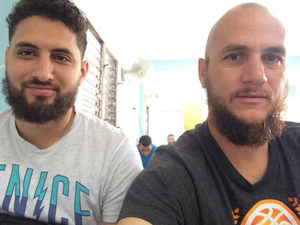
Yarian Sierrra (left) and Yeremi Blanco from the Berean Baptist Mission in Matanza were detained nearly two weeks in Cuba. (Facebook Photo via CSW)

Yéremi Blanco Ramírez and Yarian Sierra Madrigal learned Sept. 1 the Cuban government will impose a fine—but not sentence them to prison—for participating in the protests, according to Christian Solidarity Worldwide, a United Kingdom-based human rights organization focused on religious liberty.

The two Berean Baptist ministers, associated with William Carey Biblical Seminary, were released from prison in late July and placed under house arrest after being detained incommunicado nearly two weeks. The wife and child of Sierra Madrigal were evicted from their home after state security officers threatened their landlord.

Blanco Ramirez and Sierra Madrigal were among the Christian leaders who were detained following the July 11 demonstrations throughout the nation. Protestors marched under the banner “Patria y Vida” (Homeland and Life), calling on the government to allow humanitarian aid into the country and make it accessible to the general population.

Yusniel Pérez Montejo, a minister affiliated with the Eastern Baptist Convention of Cuba, also was detained in connection with the July 11 demonstrations but released prior to the two Berean Baptist pastors.

Another Protestant minister, Lorenzo Rosales Fajardo, remains in detention after more than seven weeks. He was transferred to a maximum security prison on Aug. 9, and his appeal was denied by Cuban authorities.

While expressing thanks for the release of some prisoners of conscience, a spokesperson for Christian Solidarity Worldwide said Cuban authorities must do more.

“While we welcome the fact that Pastors Blanco Ramírez and Sierra Madrigal have not been handed prison sentences, we maintain that they never should have been imprisoned or accused of anything in the first place,” said Anna-Lee Stangl, head of advocacy for CSW.

“We are also deeply concerned at the continued and unjust detention of Pastor Rosales Fajardo. We call on the Cuban authorities to drop the charges against all three men, releasing Pastor Rosales Fajardo immediately and without condition, and cancelling any fines imposed on Pastors Blanco Ramírez and Sierra Madrigal.”


More Nigerian Baptist students freed, but attacks continue

KADUNA, Nigeria (BP)—An additional 47 Nigerian Baptist school students kidnapped in July have been released, leaving captive 31 of the more than 120 originally taken, the Christian Association of Nigeria reported Aug. 28.

Bandits released 32 Bethel Baptist High School students to their parents Friday, school administrator and pastor John Hayab told the News Agency of Nigeria in Kaduna, but the reason for the release was not stated.

“The parents were advised to immediately take their wards to the hospital for medical checkup, as they were very sick and exhausted,” Vanguard News quoted Hayab. “The children looked so weak, sick and tired.”

Earlier on Aug. 22, kidnappers returned 15 Bethel students to their parents who paid ransoms, Hayab told Reuters.

Ongoing violence in Nigeria reported

Meanwhile, religious leaders have lamented ongoing violence in Nigeria, describing the country as under a “national emergency.”

Among the latest attacks, militant Fulani herdsmen killed an estimated 36 people Aug. 24 in an attack near the University of Jos in Plateau, south of Kaduna, Christian Solidarity Worldwide reported Aug. 27.

“Indigenous ethno-religious minorities are being targeted in a relentless campaign of violence which involves decimation, displacement and demographic alteration,” CSW spokesperson Kiri Kankhwende said, “and which accelerates during farming or harvesting seasons, indicating a deliberate effort to engineer starvation and complete economic disempowerment.”

In early August, Stephen Baba Panya, president of Evangelical Church Winning All, decried the killing of at least 70 people over the previous two weeks in farming communities in Plateau state and southern Kaduna.

They include at least 19 people in the Batsari Local Government Area and 26 people in Zamfara state in early July, Christian Solidarity Worldwide reported.

The killings appear to be in addition to at least 33 people killed in six days of attacks following the July 5 kidnapping at the Bethel Baptist school. In those attacks, terrorists have killed civilians and burned four churches and hundreds of nearby homes, witnesses told CSW.

An ‘existential threat to Nigeria’

Parents are reunited with released students of the Bethel Baptist High School in Damishi, Nigeria, on Sunday, July 25, 2021. Armed kidnappers in Nigeria have released 28 of the more than 120 students who were abducted at the beginning of July from the Bethel Baptist High School in the northern town of Damishi. Church officials handed those children over to their parents at the school on Sunday. (AP Photo)

In the Bethel kidnapping, the freed students comprise the second and third groups released after some 70 kidnappers abducted as many as 179 children July 5 from the school in northern Nigeria. Many initially escaped their captors or were quickly recovered within hours of the kidnapping, but about 125 remained in bondage.

A month ago, kidnappers released 28 students to parents after demanding ransoms of about $1,200 per student, but the reason for the students’ release was not disclosed.

The Bethel kidnapping was at least the fourth such abduction in Kaduna schools in the last six months as security continues to deteriorate in the region. While kidnappings originally were the mark of Boko Haram terrorists, bandits and other terrorists now are following suit for ransoms.

“The rising levels (of) violence and instability being endured by Nigerian civilians constitute a national emergency,” said Yunusa Nmadu, CEO of CSW Nigeria. “However, we are yet to see a sense of urgency and the political will on the part of the authorities to formulate and enact the effective and comprehensive security strategy that is needed to stem the kidnappings and attacks on people who are simply trying to get on with normal life as best they can.

“This situation is an existential threat to Nigeria and risks the stability of the entire region. We continue to call on the Nigerian authorities, both state and federal, to equip and direct the security forces to rescue abductees in a timely manner, including the abducted students; to protect vulnerable communities, and to restore order in Kaduna, Katsina, Zamfara and throughout the country.”


Russian Baptist urges American believers to pass the torch

DULUTH, Ga. (BP)—As a child, Peter Mitskevich attended a lot of birthday parties when there wasn’t a birthday to celebrate.

It was part of being in a Christian family in the Soviet Union, where evangelical gatherings were illegal, including Sunday School or Bible studies for children. If one were being held at a home, it was common to receive a knock at the door by the local police who suspected the children were gathered for a Bible lesson.

When questioned, adults would say the group was celebrating a child’s birthday.

Mitskevich, executive director of the Russia Baptist Union and president of Moscow Theological Seminary, recounted such stories in an interview with Baptist Press at the Georgia Baptist Missions and Ministry Center.

“When I was about 16 years old, the police came to our apartment during a Bible study,” he said. “They didn’t arrest us then but took names of everyone there. It created many problems for the apartment owner.”

Mitskevich, who also is pastor of Golgotha Baptist Church in Moscow, recalled how the fall of the former Soviet Union and Iron Curtain in the early 1990s ushered in a new era for evangelical Christians.

“There had been many churches planted in the early 20th Century, and about 2 million came to Christ,” he said. “But then Russia turned to an atheistic movement, and all the churches were destroyed. In the ‘90s we were grateful that schools could once again be established and churches planted.”

Embrace challenges to become emboldened

In his role, Mitskevich leads roughly 1,650 churches and church plants spread across 11 time zones. The geography, not to mention Russian politics, has led to challenges for church leaders. However, he encouraged his “Baptist brothers and sisters” to embrace those challenges as ways to become more emboldened in their work.

“The Lord will teach us some lessons, and we have to be faithful students and disciples to learn those lessons,” he said. “I’m grateful to the Lord I live in Russia. He’s teaching me a lot about some issues that, in another context, I would be relaxed about.”

To make his point, Mitskevich related the expectations of American mission teams who visit his, or any other, Russian Baptist church. The men are expected to be able to stand—on the spot—before everyone in attendance and give a testimony or lead a devotion on what they have been reading in the Bible the week before. At least once, Mitskevich was disappointed in the result.

“This brother came to the pulpit, and I am sorry to say, said, ‘Uh, greetings from America. Uh, greetings from my church. (Pause) Amen.’

“I expect that every man should be able to give his testimony. Do they know Christ? Do they know what they believe? We’re men. We’re responsible for that.”

Called to follow Christ

The admonishment for men to be spiritual leaders in the home goes against what Mitskevich heard as a youth. Both of his parents were Christians—his mother a physician and his father a pastor—in their village outside of Moscow. His father also served as a pastor in those times it was dangerous to be a Christian.

In his early teens, Mitskevich heard from peers and authority figures how the church was make-believe and something for old ladies. He wanted to be a nastoyashy muzhshina—a manly guy, like his friends who excelled on the hockey team.

“Here, I was at a crossroads,” he said. “I knew my parents, especially my mother, prayed for me.”

Mitskevich renewed his devotion to the church and Bible study. However, his heart didn’t yet belong to Christ. That changed when his grandfather, a man Mitskevich described as a “hero” who spent more than 10 years in prison because of his faith, asked him directly if Jesus was Lord of his life.

The moment changed everything for the youngster and led to his leading numerous churches and training future pastors today. His trip to the United States focused on visiting Baptist conventions in order to build partnerships.

Peter Mitskevich (right), executive director of the Russia Baptist Union and president of Moscow Theological Seminary, speaks with Buck Burch, missions catalyst for the Georgia Baptist Mission Board, at the Georgia Baptist Missions and Ministry Center. Mitskevich and his wife, Tatiana, were visiting the country to promote partnerships with American Baptists. (Photo courtesy of Buck Burch)

Buck Burch, missions catalyst for the Georgia Baptist Mission Board, accompanied Mitskevich to help establish relationships with Russian churches in the Atlanta area associated with the Georgia Baptist Convention. The two are close friends going back to Burch’s years as an International Mission Board missionary from 1998 to 2011.

As he has had to do in his home country, Mitskevich urged American Baptists not to be swayed by the culture.

“Do not criticize each other, but confess your weaknesses and grow spiritually. Be evangelists. Help each other. Love each other. Forgive each other,” he said.

“All of us have to be faithful in the place where we’ve been called. Be faithful to the Lord of lords and King of kings. He’s the top priority. Don’t let the state rule your life, but let the Lord rule.”

The urgency to remain committed to Christ, he added, will become a signal to those watching. In particular, it will connect with the younger generation as it did with him so many years ago.

“What will we leave for young people?” he asked. “We have to not only carry the cross, but pass along the torch of faith, like a baton.

“This is exciting. We will experience some challenges, but it is all a joy.”


Commission urges evacuation of Afghan religious minorities

A bipartisan federal commission that monitors global religious freedom called on the U.S. government to help evacuate religious minorities in Afghanistan that face persecution from the Taliban.

The U.S. Commission on International Religious Freedom issued the call Aug. 20 in response to the Taliban’s harsh imposition of Sharia law on non-Muslims. That includes the death penalty for Muslims who convert to another religion and are judged guilty of apostasy.

‘At risk from the Taliban’

“While the United States government is working around the clock to evacuate American citizens and Afghans with U.S. affiliations, Afghan religious minorities face extreme risk from the Taliban and must be part of this urgent effort,” Commissioner Frederick A. Davie said.

Most followers of religions other than Islam fled Afghanistan after the Taliban first gained control of the government and established a theocratic emirate from 1996 to 2001.

However, small groups of religious minorities remained, including Christians, Jews, Zoroastrians, Hindus, Buddhists and followers of the Baha’i faith.

Even before the recent collapse of the Afghan government when the Taliban regained control, the United Nations documented more than 8,800 civilian casualties—including more than 3,000 fatalities—last year, with the most brutal attacks directed toward religious minorities.

“The reports of the Taliban searching for religious minorities in Afghanistan are deeply troubling,” said Nadine Maenza, chair of the U.S. Commission on International Religious Freedom.

“USCIRF urges the United States government to support minority communities to help them leave and provide expedited processing to a safe location.”

In its 2021 Annual Report, issued prior to the collapse of the Afghan government, the commission recommended the U.S. State Department continue to designate the Taliban as an Entity of Particular Concern “for engaging in systemic, ongoing and egregious violations of religious liberty.”

Leaders of faith-based agencies involved in refugee resettlement likewise called on the Biden administration to do more to aid the most vulnerable Afghans.

‘Think of the prospects ahead’

Krish O’Mara Vignarajah (RNS Photo courtesy of Lutheran Immigration and Refugee Service)

Krish O’Mara Vignarajah, president of the Lutheran Immigration and Refugee Service, tweeted on Aug. 19: “We can’t tie a life-or-death humanitarian evacuation to an arbitrary timeline. Our government made a commitment, and we can’t give up until the job is done. If political will matches military might, we can still pull off the boldest evacuation in modern history.”

In an Aug. 22 news conference, President Joe Biden announced the United States and its partner nations had evacuated 28,000 people from Afghanistan. The Washington Post reported the administration is considering extending the deadline for troop withdrawal past Aug. 31 to continue evacuations.

Franklin Graham, CEO of the Samaritan’s Purse humanitarian aid organization, posted on Facebook a blistering critique of the Biden administration’s Afghan policy, which he called “a death sentence for many freedom-loving Afghans.”

“The Taliban who took over the country are Islamic extremists who have no mercy and no respect for human life,” Graham wrote. He urged Americans to “think of the prospects ahead for Christians and other minorities in the country.”

“The blood of this nation will be on the hands of the Biden/Harris administration,” he wrote.


Biden OKs new refugee funds amid criticism from aid groups

WASHINGTON (RNS)—President Joe Biden has authorized an additional $500 million to aid refugees from Afghanistan, pushing through the funds as the White House fends off suggestions it failed a moral test to aid those fleeing the war-torn country.

Biden approved the funds in a memorandum Aug. 16 to meet “unexpected urgent refugee and migration needs,” drawing the money from the United States Emergency Refugee and Migration Assistance Fund.

The memo, addressed to the U.S. secretary of state, stressed the funds were for “the purpose of meeting … (the) needs of refugees, victims of conflict, and other persons at risk as a result of the situation in Afghanistan.”

The president of Jewish refugee resettlement group HIAS (founded as the Hebrew Immigrant Aid Society), Mark Hetfield, said the move was expected and the fund exists “precisely for this type of situation”—referring to the effort to evacuate Afghans desperate to leave the country after it fell to the Taliban over the past week.

The White House did not immediately respond to questions about how the new funds will be used.

At a news conference Tuesday afternoon, White House press secretary Jen Psaki told reporters seven C-17 aircraft left Afghanistan over the past 24 hours, each carrying 700 to 800 passengers, most of them a “mix” of people from other countries and Afghans seeking a Special Immigrant Visa, or SIV, with the U.S.

Psaki also reiterated the claim that “a good chunk” of SIV applicants “did not take advantage of those visas and depart” before the Taliban took control of Kabul, as the president asserted in his Monday address on Afghanistan—although she did not specify how many.

On Monday, in response to Biden’s address, leaders of several faith-based refugee groups disputed this account, saying they spent months urging the White House to expedite the evacuation of Afghans who aided the U.S. government during its 20-year presence in the country.

“We have been in touch with countless SIV recipients who have been desperate to leave Afghanistan for months and have not been able to due to insufficient financial resources and inadequate flight accessibility through international organizations,” Krish O’Mara Vignarajah, head of Lutheran Immigration and Refugee Service, said on Monday.

Similarly, Hetfield described Biden’s assertion as a case of “blaming the victim.”

On Tuesday, faith-based groups continued their pressure on the White House to help U.S. allies and other vulnerable Afghans, including Christians and other religious minorities.

Among them, the Evangelical Immigration Roundtable sent a letter to Biden signed by leaders from World Relief, the Council for Christian Colleges and Universities, the National Association of Evangelicals, the Ethics and Religious Liberty Commission of the Southern Baptist Convention and the National Latino Evangelical Coalition.

“As Christians, we believe that each person is made with intrinsic value in the image of God, and we cannot treat any person’s life as expendable. Our government has a particular obligation to those who are now facing threats upon their lives due to their service to the United States, and to go back on our commitment to them would be a moral failing with reverberating consequences for decades to come,” the letter read in part.

Emily McFarlan Miller reported from Chicago.


Baptists begin response to Haiti earthquake

NASHVILLE (BP)—A massive earthquake that struck Haiti Aug. 14 and left more than 1,200 dead has spurred Southern Baptists to coordinate relief efforts.

“In the aftermath of the 7.2 earthquake that struck Haiti, Send Relief is working with local partners on the ground to assess needs,” the group announced on Twitter hours after the earthquake struck. “Join us in praying for the people of Haiti.”

SBC President Ed Litton retweeted the update from Send Relief, adding, “I am grieved over the dozens of lives lost due to the massive earthquake in Haiti. Will you join me in praying for the people of #Haiti [2] and for our @SendRelief teams as they begin to serve and minister to those affected?”

Send Relief President Bryant Wright echoed those comments and noted at least one other factor in the recovery effort: “The infrastructure within Haiti makes this very challenging.”

Saturday’s epicenter was located on the country’s southwestern peninsula. The last time Haiti experienced a quake on this scale was Jan. 12, 2010. That one measured 7.0 and was located closer to the capital of Port-au-Prince, a densely populated area. More than 100,000 fatalities were attributed to the 2010 quake, but some Haitian authorities place the number of dead at three times that amount.

To compound the situation on the ground, the country remains unsettled after the July 7 assassination of President Jovenel Moîse and was bracing for heavy rain from Tropical Storm Grace.

Soon after the 2010 earthquake, Roland Norris and his wife Mary helped found Baptists4Haiti. Over the years, Norris has organized mission teams to the country as the organization has maintained a consistent presence through a mission house as well as another house located on three acres.

Since 2019, civil and political unrest has prevented mission teams from traveling to Haiti, but in that time the group has broadened its reach to other areas such as Belize and the Bahamas, resulting in a name change to Look to the Nations.

Eight full-time employees remain in Haiti, however. Norris, a member of First Baptist Church in St. Mary’s, Ga., told Baptist Press Sunday night while those staff felt the earthquake, they were 100 miles away from its epicenter and personally escaped its destruction. However, several have family in the affected areas who experienced severe damage to their homes.

When praying for the Haitian people, Norris urged Southern Baptists to consider the trauma experienced by those who lived through the 2010 earthquake and have now experienced another just as powerful.

“One of my guys told me that he’s not going to sleep inside for a long time after this,” he said. “In 2010, hundreds of thousands of lives were lost, and this one was strong enough to remind them of that. Pray for peace for those who are living with that mental pain.”

Instability from the presidential assassination adds to that stress, Norris said, adding he is praying a peacekeeping force such as the United Nations can enter the situation and bring a measure of peace.

“From what I understand, gang activity is also becoming more common in areas so that people are unable to travel freely and do what they need to do,” he said. “If this could end, it would deescalate things to where we can begin bringing teams in again.”

Jerry Chandler, the head of Haiti’s Civil Protection Agency, said at a news conference damage was concentrated in the cities of Jérémie and Les Cayes. Those areas are less populated, but also more remote for rescue and cleanup efforts. Homes, churches, hospitals and hotels are included in the more than 13,000 buildings destroyed.


In Nigeria, 28 abducted Baptist school students freed

KANO, Nigeria (AP)—Armed kidnappers in Nigeria have released 28 of the more than 120 students who were abducted at the beginning of July from the Bethel Baptist High School in the northern town of Damishi.

Church officials handed those children over to their parents at the school on Sunday. But Baptist Convention President Israel Akanji said more than 80 other children still are being held by the gunmen.

Parents of released students of the Bethel Baptist High School in Damishi, Nigeria, console each other on Sunday, July 25, 2021. Armed kidnappers in Nigeria have released 28 of the more than 120 students who were abducted at the beginning of July from the Bethel Baptist High School in the northern town of Damishi. Church officials handed those children over to their parents at the school on Sunday. (AP Photo)

So far, 34 children kidnapped from the school on July 5 either have been released or have escaped from the custody of the gunmen. It is unclear when the other children will be released. The gunmen have reportedly demanded 500,000 Naira (about $1,200) for each student.

Akanji said the church did not pay any ransoms, because it is opposed to paying criminals, but he added the church was unable to stop the children’s families from taking any actions they deem fit to secure their release.

A spokesman for the Nigerian Police, Mohammed Jalige, said security forces and civilian defense forces were on a routine rescue patrol July 12 around the forests near the village of Tsohon Gaya when they found three exhausted kidnapped victims roaming in the bush.

Two other students escaped on July 20 when they were ordered to fetch firewood from a nearby forest. Jalige said they were undergoing medical examinations.

Gunman called bandits have carried out a spate of mass abductions from schools in northern Nigeria this year, mainly seeking ransoms.

Nigerian President Muhammadu Buhari, who won election on hopes that he would tackle Nigeria’s security challenges, has not been able to do much in addressing the growing cases of mass abductions from Nigerian schools.