





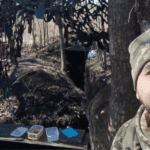
Chaplain Pavlo serves in the Territorial Defense Forces of the Armed Forces of Ukraine. Fellow chaplain Denis Gorenkov asked Pavlo about his move from theological education to military chaplaincy. They discussed topics ranging from the book of Revelation to theory of war, to justice and the conditions for peace, to truth-telling and congregational support.
The following interview has been edited for length.
When and under what circumstances did you first feel called to chaplaincy?
I did not feel specifically called to chaplaincy. Rather, I felt a responsibility to protect my family and my country, and chaplaincy became part of my military service in the Ukrainian Army.
When the war [with Russia] began, I started serving in the army as a rifleman, but after a year and a half, my battalion commander suggested I become a chaplain, because he knew I was a believer. I agreed, because there were no other candidates for this role in our battalion.
I serve where there is a need, but my true calling is teaching theological disciplines.
On Feb. 24, 2022, I was in Uzbekistan, from where we have a small seminary branch, and I was teaching students there. I knew I had to return to Ukraine and do something useful. I crossed the border on Feb. 26.
Praise God, my family had the opportunity to leave Kyiv and find a safe place in Poland, while I tried to reach Kyiv and help my colleagues. It was an extremely difficult time due to the logistical collapse in Ukraine.
The enemy who came to our land was trying to destroy everything we valued.
I felt a responsibility to protect my country and to fight for our freedom and identity. That is why I decided to go to the military recruitment office, where I was mobilized and sent to serve in the Territorial Defense Forces of the Armed Forces of Ukraine.
Sign up for our weekly edition and get all our headlines in your inbox on Thursdays
What helps you maintain inner balance in such an intense ministry?
God’s presence depends on God’s faithfulness, not on my feelings.
How did your teaching experience influence your chaplaincy?
The [book] of Revelation, regardless of one’s preferred interpretive approach, provides a broad perspective on the reality of evil in the world and God’s people’s response to it. This helps to address questions that are very important for people in the military during war.
Why do wars happen? Why is this happening to us? Why does God allow suffering, including the death of innocent people, especially children? Do truth and justice still matter in the “meat grinder” of war and international politics?
As a teacher, even when I was not directly responsible for teaching [courses on psychology and trauma work], I regularly engaged with themes of grief, loss, pain, suffering, and depression. All of this provided a solid and practical foundation for facing the challenges of war in my chaplaincy service.
Could you describe your theology of war?
I see only one just purpose of war—defense, where the use of force must be proportionate to the value and importance of what we are protecting.
Our world, created by God, is spoiled by sin. Humanity is spiritually unwell, moral values are distorted. Therefore, there will always be armed conflicts of varying frequency and intensity.
If highly moral people do not resist evil, this should also be recognized as sin.
God does not want war, but in his wisdom, he is able to accomplish his purposes even through terrible events.
Only reconciliation brings an end to war, however difficult it may be for us Ukrainians to admit this.
How do you reconcile the Christian call to peace with the reality of war?
Even the Christian call to peace has a condition. We read: “If it is possible, as far as it depends on you, live at peace with everyone” (Romans 12:18). This implies the other side must also be willing to pursue peace.
In addition, the Christian understanding of peace is grounded in the idea of justice. If justice is violated, then what remains is only an illusion of peace. This is precisely what our Lord addresses. Forgiveness and peace with God are possible through the sacrifice of Christ, who takes upon himself the sin of the world and thereby restores justice.
During armed conflict, when one side continues aggression, the establishment of both justice and peace is not possible. However, the ultimate goal of Ukrainian resistance is indeed the restoration of peace, and even reconciliation with the enemy—after the healing of the pain of our people has taken place.
What biblical texts or theological ideas help you most in making sense of war?
For me, first and foremost, it is the book of Revelation. The beast coming out of the sea (Chapter 13) and the great city Babylon, which is built upon the power of this beast (Chapter 17), in one way or another represent political (military) and economic power that rises in rebellion against God and His people.
This is a reality throughout the entire history of humanity. We are not the only ones who have encountered these terrifying, God-opposing forces. Understanding this helps one not to lose composure in the midst of wartime loss and suffering.
The “heavenly visions” (Chapters 4-5) bring me great encouragement. There we read that despite all the suffering and challenges faced by God’s people (Chapters 2-3), John sees in heaven the great God, before whose glory no one can stand.
This Holy One remains faithful to his creation, symbolized by the rainbow, and does not abandon it. He holds in his right hand the scroll sealed with seven seals. There are good reasons to see in this scroll God’s plan for the world—a plan to save it. And there is One who can open and fulfill the scroll—the Lion from the tribe of Judah.
What do you see as the mission of the church during wartime?
To speak the truth and proclaim what is right. I call this the prophetic voice of the church, which names evil as evil, darkness as darkness, and light as light.
How can the church better support military personnel and their families?
First is the recognition by the Christian community that the defense of our country is God’s work, and that my participation in the war is not a romantic personal choice but a duty.
It is also important for me that the church maintains personal contact with me—something as simple as a pastor calling to ask how I am, what is new, and mentioning me in church gatherings. This gives me the sense I have not been forgotten.
When I am on leave, it is important for me to see elements in worship that acknowledge the reality of war. This can include prayer for soldiers as a regular part of every service, as well as the selection of songs that reflect this reality.
Every Sunday during the service, my church prays for me. My name is mentioned, and prayers for protection and help are lifted up. The congregation expresses appreciation for the decision of everyone who has joined the Armed Forces of Ukraine. This encourages and supports me.
My pastor also calls me from time to time to ask how I am doing and sends financial support from the church.
Because of this, I feel I have not been forgotten. I understand my home front is secure and that if there is an urgent need, the church will respond. I also know the church is waiting for my return. Knowing this is very important to me.
What would you like Western Christians to understand about the war and the ministry of chaplains in Ukraine?
You cannot imagine how much the book of Revelation speaks about falsehood as the primary instrument of demonic powers within God’s creation. The prince of darkness and his followers do not need to do much more than spread lies. Everything else—wars, famine, death—begins to unfold on its own.
Therefore, information must be carefully verified, especially when we know where it originates.
Chaplaincy ministry is one of the rays of light shining into the darkness of the Soviet mentality that, unfortunately, still remains within modern Ukraine and its army. Please pray for military chaplaincy in Ukraine. It must be preserved at any cost.
What are your wishes for the readers of this interview?
That none of you would ever know what war is like.







We seek to connect God’s story and God’s people around the world. To learn more about God’s story, click here.
Send comments and feedback to Eric Black, our editor. For comments to be published, please specify “letter to the editor.” Maximum length for publication is 300 words.