Students challenged to look into the eyes of poverty
WACO—Enter “Darfur in Sudan” in an Internet search engine, and you’re almost certain to see photos of starving children or the skeletons of genocide victims, photographer/filmmaker David Johnson told about 150 people at Baylor University’s Poverty Summit.
|
Sonja Davidson holds Alex Chillous during a meal served at Church Under the Bridge, beneath Interstate 35. Participants in Baylor University’s Poverty Summit served the meal. (PHOTOS/Baylor Photography/Robert Rogers)
|
“You look at it and say: ‘It’s too late. It’s done. What can I do?’” Johnson said. But one reason for the Nov. 6-8 summit was to refocus the lens, he said. Johnson has traveled to Africa to make documentaries about people who find hope in the midst of poverty.
“I want to say: ‘Here are the people. Look them in the eyes.’ And I want to talk about how we can make sustainable change,” he said.
Students, faculty and the Baylor Interdisciplinary Poverty Initiative joined together to present the summit.
Johnson showed his photographs, including an image of a smiling young woman in a market. The mother of three young children is an AIDS victim who had been abused by her husband. But with the help of a $10 micro-loan, “she now has the largest stand on the street,” Johnson said. “She’s a CEO, isn’t she? She’s got pride.”
Another image was of grinning youngsters in Darfur—two groups, each pulling the end of a long rope.
“I saw them and said: ‘This is awesome. This is what I played in gym class in seventh grade. It’s tug of war,’” Johnson said.
“They said, ‘No, sir, this is tug of peace.’ And these are kids are in the midst of genocide,” he said.
“You can take lives, but you can’t kill hope until they give up.”
Johnson told his listeners not to expect fast, easy solutions.
“The solution is not just in you, but in the people you want to help,” he said. “Instead of simply donating to single mothers, mentor the next generation of males.”
Participants at the summit could choose from more than a dozen breakout sessions on topics ranging from literacy in developing countries to international missions to economics.
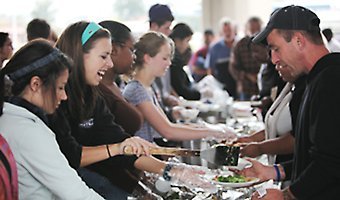
Participants in Baylor University’s Poverty Summit served breakfast at Church Under the Bridge. Many who attend the church, which meets beneath Interstate 35, are homeless. (PHOTOS/Baylor Photography/Robert Rogers)
|
Many also served Sunday breakfast to homeless people at the Church Under the Bridge in Waco.
Some who attended visited the World Hunger Relief farm in Elm Mott, operated by a Christian relief organization. At the farm, interns are trained to work with communities to develop farming techniques and educate people on how to conserve and share resources with those in need. Food raised at the farm is sold locally and given to food banks, said Matt Hess, the farm’s education director.
A session on renewable resources inspired Nathan Griswell, a Baylor University graduate student in environmental science. The son of missionaries, he grew up in Cuernavaca, Mexico, and is doing his thesis on a gravel filtration system for wastewater. His goal is that people in Latin America will be able to re-use the water in showers and toilets.
Griswell has been testing the technology in the lab, but “my project here has been mostly on statistics,” he said. “The session was helpful for practical, real-world application if I go to Latin America to teach people and build this and market it.”
In another session, students gathered in small groups to discuss how to fight poverty through such ways as public transportation or after-school programs.
They brainstormed about how to gain community and governmental support as well as how to do personal research—for example, by keeping a journal of their experiences on a city bus so they will understand pros and cons of public transportation.
“This isn’t just about picking up trash, but about what kind of trash is out there and whether there’s a better way of dealing with it,” said Tom Pope, a Baylor University graduate student in political science.
Johnson urged his listeners—whatever their approach to eliminating poverty—to take a lesson from Jesus.
Whether he met an immoral woman at a well or spotted a scorned tax collector in a tree, “Jesus hung out with them,” Johnson said. “He sat at the table with them and saw something others didn’t see.”
In the same way, “you’re going to have to spend some time with these people and love on them,” Johnson said. “Sit down with them and hear their stories.”