





SAN ANTONIO—Since its beginning, missions, evangelism, benevolence and education have remained central to the Hispanic Baptist Convention of Texas.

Two dozen churches sent 36 messengers to the first meeting of what then was called the Convencion Bautista Mexicana de Texas on May 25, 1910, in San Antonio. In his 1982 book, A History of Mexican Baptists in Texas, Josue Grijalva noted the first meeting of Convencion was characterized by reports and offerings for missions, passionate appeals to advance the gospel, emphasis on the need to care for orphan children and concern about providing educational institutions that could prepare leaders for Christian service.
In a report to El Paso Baptist Association in 1910, Convencion President C.D. Daniel said: “There are approximately 400,000 Mexicans (in Texas) now, and they are rapidly increasing, and will continue to do so until conditions more favorable to the laborers prevail in Mexico.”
The newly formed Convencion provided a mechanism for Hispanic Baptists in Texas to work cooperatively in evangelizing and ministering to that growing mission field.
It also offered a place where Hispanic Texas Baptists could meet needs—particularly the needs of vulnerable children. In the early 20th century, some Hispanic Texas Baptists supported missionary Paul C. Bell’s Bible institute in Bastrop—a refuge where orphaned children could live, study and work. In the 1940s, the Mexican Baptist Orphans’ Home was established in San Antonio, an entity that has grown to become Baptist Child & Family Services.
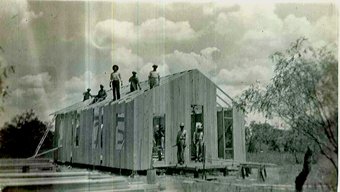
In 1938, Mexican Baptists in Texas gathered at a campground in Devine to build a Spanish-speaking church.
|
During that same decade, the educational concerns of Hispanics in Texas found two institutional expressions—Valley Baptist Academy and the Mexican Baptist Bible Institute. The institute later became Hispanic Baptist Theological Seminary and finally Baptist University of the Américas.
Today, Hispanics in Texas number 9.8 million, and more than 1,000 predominantly Hispanic congregations are affiliated with the Baptist General Convention of Texas—comprising 19 percent of the total congregations related to the Texas Baptist convention.
Sign up for our weekly edition and get all our headlines in your inbox on Thursdays
“The mission field is now all around us,” said Hispanic Baptist Convention of Texas President Victor Rodriguez, pastor of South San Filadelfia Baptist Church in San Antonio. “Many of our neighborhoods continue to change. If churches throughout our state experience changes in their communities, new Hispanic churches must continue to be a priority. This is a challenge that all Baptists must take very seriously.”

Concern for orphaned and at-risk children has characterized the Convencion since its beginning in 1910.
|
In addition to meeting the needs of Spanish-speaking first-generation immigrants and their children, Hispanic Texas Baptists also must reach out to third- and fourth-generation His-panics for whom English is the primary language but who still value their cultural heritage, he noted.
“Growing up in a Spanish-speaking church, I would tell the pastor of my church—my father—that we needed an all-English-speaking worship service. In 1980, no one could see Hispanics worshipping in an English-speaking church,” Rodriguez said. “Today, I pastor a church where we have one Spanish service and one English service.”
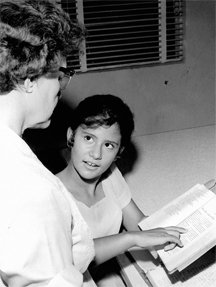
In the 1940s, San Antonio Baptist Association was instrumental in launching the Mexican Baptist Orphans’ Home, an entity that eventually grew to become Baptist Child & Family Services.
|
Grijalva expressed hope the Convencion will give renewed emphasis to evangelism. He recalled fondly the impact of revivals that involved Anglo ministers preaching in Hispanic churches and Hispanic pastors and evangelists doing the same in Anglo churches.
“You could see the hand of the Lord working in it,” he said in a recent interview. “I’d like to see another statewide revival.”
In addition to reaching the growing Hispanic population within Texas, Hispanic Baptists in the state also have the potential to make a worldwide mission impact, said Albert Reyes, president of Buckner International and former president of BUA.
Latin America—along with Africa and Asia—rapidly is becoming a center of global Christianity, he notes, quoting missiologist Phillip Jenkins. That places Hispanic Texas Baptists in a strategic position, Reyes observed.
But he also points out the key role Hispanics can play in evangelizing the predominantly Muslim Arab world.
“Hispanics in Texas are connected to the Arab world through histories that trace through Mexico, Spain and North Africa. There are approximately 21,000 Spanish words with Arabic roots,” Reyes has written.
“Since Hispanics share a common language, culture and history with the Arab world, a natural connection for sharing the gospel is in place.”
With Reyes at the helm of Buckner International, a natural connection also is in place for Hispanic Texas Baptists to express their historic concern for orphaned and at-risk children through ministry, mentoring and missions opportunities.
Hispanic Baptists in Texas continue their emphasis on educational development through involvement in the Hispanic Education Initiative—including funding scholarships for deserving students—and their support for BUA in San Antonio and its satellite Baptist Bible Institutes.
“Every time we have a commencement exercise, it is a celebration of accomplishment in individual families and in the Hispanic community,” BUA President René Maciel said. “In many of these families, these students are the first to graduate. And in the community, it’s a cause for celebration because they have accomplished what so few have. It’s exciting to be part of something like that.”









We seek to connect God’s story and God’s people around the world. To learn more about God’s story, click here.
Send comments and feedback to Eric Black, our editor. For comments to be published, please specify “letter to the editor.” Maximum length for publication is 300 words.