





Religious nationalism “cheapens” religion and exchanges genuine love of country for a blank check that justifies any action a country takes, panelists said during the Global Religious Freedom Gathering at Dallas Baptist University.
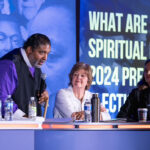
Randel Everett, director of DBU’s Center for Global Religious Freedom, moderated a panel discussion Oct. 20 on “Religious Nationalism Globally and Its Effect on Minorities.”
Panelists were Jack Goodyear, dean of the College of Humanities and Social Sciences at DBU; Anna Lee Stangl, head of advocacy for Christian Solidarity Worldwide; and Katie Frugé, director of Texas Baptists’ Christian Life Commission.
Christian nationalism—which conflates Christianity and national identity—“compromises the faith, and it compromises the gospel,” Frugé said.
“This nationalistic merging with your faith cheapens the faith. It cheapens your experience with the Holy Spirit,” she said. “Really, at the end of the day, it becomes something that’s not even a true gospel. It’s a hindrance to your spiritual health.
“So, if our goal is human flourishing as a society, the best way for that to happen is to have faithful, real, authentic relationships with our Creator. And the best way toward that is not nationalism.”
Distinction between patriotism and nationalism
Goodyear drew a distinction between healthy patriotism—loving one’s country enough to hold it accountable when it fails to live up to its ideals—and unhealthy nationalism, particularly religious nationalism.
“Nationalism would tend to justify anything your country is doing, and anybody who opposes that are the ones who are [seen as] wrong,” he said. “Healthy patriotism allows you to love your country while still calling to account your country.”
Stangl agreed true patriotism means “speaking truth into what is happening” in a country and what it is doing abroad.
That becomes problematic when national identity and religious identity are combined, she observed.
Hindu nationalists in India, Buddhist nationalists in Myanmar and Sri Lanka, and Orthodox Christian nationalists in Russia offer contemporary international examples of how religious nationalism leads to “othering” and persecution of minorities, she said.
Furthermore, the parameters for acceptable religion continually shrink, she observed.
“When you raise up one group, that group will inevitably narrow,” Stangl said.
In Russia, for instance, the Orthodox Church is linked to Vladimir Putin, but dissident Orthodox groups are not, she said. So, only one dominant group within the Orthodox Church is recognized as legitimate.
Grants permission for ‘dehumanization’
Similarly, Frugé said, the rise of Christian nationalism in the United States begs the question, “Which version of Christianity?”
Eventually, the field narrows and one dominant group prevails at the expense of all others, she observed.
“It has the dynamic of ‘us versus them,’” Frugé said. “You have to have an ‘other’ who becomes the enemy, the target of the opposition. It creates a permission structure of dehumanization—to treat others as ‘less than.’”
That approach “chips away” at the fundamental Christian idea of each person bearing the image of God and possessing inherent worth, she asserted.
“It’s an unsustainable system,” she said.
Christian nationalism often “promotes fear” of those who are different, Stangl said.
Simply “being in proximity” to people of other faiths and recognizing they do not present any danger can help dispel those fears, she noted.
Same terminology, different meanings
Panelists acknowledged the challenge of confronting religious nationalism when it uses some of the same language and terminology of traditional religion while redefining terms and reshaping identity.
“For me, sometimes it begins with a gentle conversation of just establishing our terms and what we mean,” Frugé said.
For Baptists, it means “rooting the conversation in historicity” and making it clear an insistence on religious liberty for all is “who we’ve always been,” she added.
Goodyear emphasized the importance of telling stories about religious liberty that allow individuals to “see the human element and how it impacts people” instead of simply presenting hard facts.
Churches can help promote conversations that bring together people from diverse backgrounds to “mellow extremism” and help them see the viewpoints of others, he suggested.
Stangl offered an international example of churches teaching basic democratic principles to members.
She cited the example of a pastor in an authoritarian country who taught his people the importance of voting on simple decisions affecting the congregation and abiding by the will of the majority.
The pastor intentionally was preparing church members for the time when they might have the right to vote on national matters, she said.
Stangl also emphasized the value not only in telling stories from history, but also stories about what is going on around the world.
“It’s important to be talking about what’s happening in Burma and what’s happening in Russia and then tying it to here,” she said.
“I think a lot of Christians here who may be falling in love with the idea of Christian nationalism would immediately say, ‘It’s horrible what’s happening there.’”








We seek to connect God’s story and God’s people around the world. To learn more about God’s story, click here.
Send comments and feedback to Eric Black, our editor. For comments to be published, please specify “letter to the editor.” Maximum length for publication is 300 words.