Women in ministry: Each thread matters in God’s tapestry
March 3, 2020
WACO—God uses the distinctive threads of individual lives to weave together an intricate tapestry and even takes what might be considered scraps to fashion a beautiful quilt, keynote speaker TaNikka Sheppard told the Texas Baptist Women in Ministry annual conference.
“Woven Together” was the theme of the conference, held at Baylor University’s Truett Theological Seminary.
Sheppard, president of Baptist Women of North America, exposed lies that discourage women from fulfilling their God-given potential and embracing their distinctiveness.
God makes each person a distinctive individual, she asserted. But too many women believe the false assumptions others make about them based on their gender, ethnicity or place of birth, said Sheppard,
“Just being from a context does not mean I am not unique,” she said.
Another lie women in ministry often hear comes from those who think women fall short of fitting an established mold, she asserted.
“Many women are tricked to operate as counterfeits,” Sheppard said. “They make us act as counterfeits, instead of who we really are.”
‘A work in progress’
Confronting lies can cause pain, but she encouraged God’s servants to find peace in knowing everyone is broken and in need of healing.
“We are all a work in progress,” she said.
As the healing continues, Sheppard suggested focusing on the present, not dwelling on the past or speculating about the future.
“You are where you’re supposed to be right now,” she said. “So, look at your patterns right now and figure out what you need to learn and unlearn.”
People are different, and some may see those differences as quirks. Instead of feeling shame, embrace distinctiveness, she urged.
“Just like the scraps of a quilt, you don’t throw those away, because they are usable,” Sheppard said. “Women and men of God, we need your perspective. We need your voice.”
Serving in unity
“Woven Together” was the theme of the Texas Baptist Women in Ministry conference, held at Baylor University’s Truett Theological Seminary. (Photo / Isa Torres)
The individuality of each person matters because each thread in the tapestry and each scrap of fabric in the quilt is important when they all are woven together, she noted.
“We deal with the ‘me’ because we must ultimately deal with the ‘we,’” Sheppard said. “In this interwoven tapestry, we are one.”
Rather than looking at calling as discerning God’s purpose for one’s life viewed individually, she urged her audience to ask what is God’s purpose for the world and how they can be a part of that.
Serving God in unity with others may seem difficult, but it is necessary, Sheppard insisted.
“‘Us’ are not just those who look like us and not just those who agree with us,” she said.
Every thread in the tapestry matters
Each of the pieces matters, and so individuals must believe the ministry, calling and duties of others are just as important as their own, she said.
“If we believe that, then we must pray for each other,” Sheppard asserted.
Understanding the importance of each individual thread as part of the tapestry requires people then speak up for those who have been pushed aside, she said.
“We should care about other parts of God’s tapestry because we are one,” Sheppard insisted.
Sometimes, God’s tapestry must be mended. Rather than just stitching pieces together, sometimes the artist must first deconstruct what is flawed, she noted.
“We must ask ourselves, ‘Am I willing to be deconstructed so the masterpiece can be all it is meant to be?’” she said.
Experiencing deconstruction may be uncomfortable, but it is crucial, Sheppard said.
“We are one. And in order to be a masterpiece, we must be willing to be worked,” she said. “We must be worked not until we are done, but until the masterpiece of God is finished.”
Impact of Shine Girls Conference continues to grow
March 3, 2020
SAN ANTONIO—Organizers of the inaugural Shine Girls Conference four years ago wanted to bring together Hispanic young women from around Texas, hoping to inspire them to give their lives in service to God. This year, Shine focused on how its mission has impacted the lives of girls in Texas and across the country.
Speakers highlighted God’s call to young women and testimonies provided examples of how girls are responding to that call.
“All you have to say is, ‘God, I want to serve, so put me to work,’ and God will put you to work,” said Joanna Lira, who moved from Texas to serve as a missionary in New York through Graffiti 2 Community Ministries.
After connecting with Lira and Graffiti 2 Community Ministries, La Unión Femenil Misionera de Texas offered a conference in New York modeled after Shine.
Girls from First Baptist Church in Runge who have attended the Shine Conference in Texas since its beginning— Delina Fay Morales, Stefanie Pina and Naomi Mendoza—traveled to the South Bronx to be part of it.
Lisa Morales has discipled the young women at First Baptist in Runge since they were in middle school.
“A door opened for us to lead, speak, lead worship, meet and greet these young girls who live in the South Bronx,” Morales said.
She noted how God had been preparing the girls at First Baptist in Runge for service since they first began attending Shine.
“It’s an empowering group of women and a great organization that strives to empower young girls to find their identity in Christ.”
Expanding the reach of Shine
Shine organizers also have expanded the influence of the conference by taking it to additional locations in Texas.
Considering the immigration status of many Hispanic girls in South Texas, Shine Conference Director Brenda Rincones understood if they could not pass the immigration checkpoint, then Shine should go to them.
Last November, First Baptist Church of Weslaco hosted a Shine Girls Conference. Girls and teens from 17 cities attended the event, which Rincones looks forward to continuing each year. This year, the Rio Grande Valley Shine Girls Conference will be held in McAllen.
In June, Shine will go to Lubbock and Rincones hopes the conference also can visit El Paso in the near future.
Tackling tough topics
At the Shine Conference in San Antonio this year, speakers also emphasized the importance of self-care, explaining how one must set boundaries and find support in mentors and friends. The conference also addressed issues such as bullying, peer pressure, sexual abuse, depression, anxiety and suicide.
The Shine Girls Conference provides a space for girls and teenagers to address issues like abuse, depression and suicide. (Photo provided by Shine Girls Conference)
Topics that seem too difficult for some churches to address and often go unaddressed at home find an open space at Shine, said Brenda Rincones, conference director,
Hearing other women who experienced healing after suffering abuse at home or in school certainly gives hope to young girls at Shine, she said.
Shine also emphasizes education. Through the Bea Mesquias Scholarship—a scholarship of Unión Femenil Misionera of Texas named after its current executive director and treasurer—Shine supports young women in their pursuit of higher education.
Since 2017, two young women who were the first ones to attend college in their families have received the scholarship to help cover tuition costs at Baptist University of the Américas.
Rincones reflected on the growth of the conference and the lives it has touched.
“All we’ve done is ask God to help us and God has responded,” she said. “We want to see more girls and women saved, healed, set free, equipped, empowered and released for service.”
CommonCall: Pastor to a community for four decades
March 3, 2020
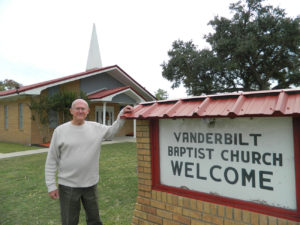
VANDERBILT—Technically, Jack Hutson has been pastor of Vanderbilt Baptist Church the past 40 years.
But ask anybody in the unincorporated Jackson County community of about 400 residents, and they will say he has spent four decades as pastor to the whole town and the Industrial Independent School District.
Colleen Sprinks Rozsypal was a member of the Presbyterian Church in Vanderbilt until it finally disbanded a few years ago. Her husband grew up in the Catholic Church. But a common denominator marked every major event in the lives of their family—hospital stays due to car wrecks or illness, births, weddings and funerals.
“Jack and Katrina Hutson have always been there,” she said.
In fact, one of her daughter’s even paid the Baptist pastor the highest imaginable compliment.
“She named her first dog Jack Hutson,” Rozsypal said.
Called to return to South Texas
Hutson grew up in a small church in Van Vleck, about an hour’s drive east of Vanderbilt. He served on church staffs in Bay City, Groom and Amarillo before he returned to South Texas in August 1979 to preach in view of a call at Vanderbilt Baptist Church. He received the call several weeks later—a phone call from the chair of the search committee inviting him to become the church’s pastor.
Pastor Jack Hutson wants everyone in and around his Jackson County community to know regardless whether they attend his church—or any church—they are welcome and loved. (Photo / Ken Camp)
“I would have gone to Siberia if that’s where the Lord led—and I hate the cold,” Hutson said.
Vanderbilt Baptist averaged 19 in attendance when the Hutsons arrived. On a typical Sunday in recent months, between 70 and 80 worshippers gather for worship. About 120 attended the church’s 80th anniversary celebration in November.
A week or so later, church members gathered to pack 1,000 gift boxes for Operation Christmas Child, a ministry of Samaritan’s Purse.
“Our church is known for being generous and helping people,” Hutson said.
Reaching children, ministering to families
The first summer after the Hutsons moved to Vanderbilt, Katrina reinstituted Vacation Bible School at the church after a long hiatus. More than 40 children attended that summer. Every summer since then, the church has continued to offer VBS, often drawing up to 150 children from the communities the consolidated school district serves—Vanderbilt, Lolita, Inez, LeWard, La Salle and Francitas.
As many as 88 youth attend Wednesday evening activities at the church, filling every available classroom. They include the children of parents who first met Jack Hutson when he supplemented his church income by driving a school bus.
For a time, Hutson served Vanderbilt Baptist Church bivocationally—first working at a DuPont plant in Victoria and later working as a substitute school teacher and lifeguard.
For 25 years, he also was Baptist Student Union director at Victoria College. He pointed out the church graciously allowed him the necessary time to minister to the students, including trips to student week at Glorieta Baptist Conference Center.
“The church has always done everything it could to take care of us,” he said.
Late-night calls? No problem
And local residents—regardless whether they are members of Vanderbilt Baptist Church—noted the Hutsons always have done everything possible to take care of them.
A former superintendent of the Industrial Independent School District said regarding Pastor Jack Hutson: “We’d all be so much better off if we had about a hundred Jack Hutsons.” (Photo / Ken Camp)
Jerald Jimerson—former teacher and principal and eventually superintendent of the Industrial Independent School District—recalled late-night emergencies when he knew he could drop off his daughter at the Hutsons’ house, no matter the time.
“We’d all be so much better off if we had about a hundred Jack Hutsons,” Jimerson said.
Others tell similar stories illustrating how the Hutsons’ home always was open to anyone, regardless of the hour.
“We’ve just tried to make ourselves available to whoever needs us,” Katrina Hutson said. “God always gave us the opportunities to minister.”
The Hutsons’ daughter, Holly Rose, described how her parents “poured themselves into the community” investing in the lives of neighbors across generations, she noted.
“My dad can’t go anywhere—not just in Vanderbilt but anywhere—without running into somebody he knows,” she said. “If he doesn’t know them yet, he will. When he walks into a room and sees somebody by himself, he will go speak to him. He doesn’t want anyone to feel alone.”
‘Never met a stranger’
Gary Thedford, the volunteer music director at Lolita Baptist Church who worked as a schoolteacher and principal, likewise emphasized Hutson’s outgoing personality and genuine interest in others.
“He never meets a stranger,” Thedford said. “He’s just a people person.”
Jack Hutson regularly attends Industrial Independent School District sporting events and seldom has missed any home games over the last four decades. (Photo /Ken Camp)
Hutson regularly attends school sporting events and seldom has missed any home games over the last four decades, Thedford noted.
“Going to the football games and basketball games offers great opportunities to minister to people,” Hutson explained. “When people who don’t go to church see me in the stands at a football game, at least they say, ‘If I need a minister, I know who he is.’”
Given Hutson’s people skills, Thedford marveled that a larger church in a larger city hasn’t succeeded in wooing him as their pastor.
“I’m sure he’s probably had opportunities to move to a bigger church through the years, but he’s felt a real commitment to the small church in a small community,” Thedford said.
No regrets
Hutson acknowledged he has been approached by other churches in the course of four decades. Once, he even preached in view of a call at a larger church in Oklahoma.
“It was pretty attractive, but it just didn’t feel right,” he recalled. “It’s so good right here, and it’s not like I needed to make a move. So, I told the Lord, ‘If you really want me to go, it’s going to have to be a unanimous vote.’”
When the votes were tallied at the Oklahoma church, members there overwhelmingly expressed their desire for Hutson to become their pastor—except for one vote in opposition.
“So, I came right back to Vanderbilt,” Hutson said. “I wonder sometimes if we’re doing all the other day-to-day things to be obedient to the Lord, when it comes to the big decisions, maybe God says, ‘I’m going to let you make the call this time.’ Anyway, I don’t have any regrets.”
Ministering across generations
One of the benefits of serving 40 years in the same town is ministering to multiple generations of families and seeing children who grew up in the congregation become mature Christians, he noted.
Mark James attended Vanderbilt Baptist Church as a child and a teenager. He has been a deacon and the church’s volunteer worship leader the last 10 years.
“If I wasn’t born there, it was right after that I started attending,” James said. Even during some of his early childhood years when his family lived in Houston, they spent weekends with his grandmother in Vanderbilt, he noted.
He described Hutson as a friend and mentor and as his “go-to person” when he needs spiritual guidance.
“When I get stuck reading the Bible, I can text him at 6 in the morning to ask him a question,” James said.
‘Tag-team’ funerals with other ministers
Because of the Hutsons’ long-term commitment to the community, several Vanderbilt residents and former residents noted how often families with ties to other churches—or no church—have asked him to preach loved ones’ funerals.
In the predominantly Catholic community, he often has conducted “tag-team” funerals with the local parish priest, some said.
“I have had good relationships with the priests here,” Hutson said. “We may not agree on theology, but we can still be friends.”
Hutson praises Vanderbilt Baptist Church for its willingness to make changes over time and try new approaches.
“Now, we don’t have a fog machine, and I don’t descend out of the ceiling to deliver the sermon,” he said, joking. But the church did install video screens in the sanctuary and adopt a blended worship format, he added.
“The church has never been opposed to anything that would promote the gospel,” he said. “When I have suggested things along the way, the church has never once said ‘no.’ It’s always been, ‘Let’s give it a shot.’”
At a time in life when some ministers might be ready to slow down, Hutson continues to look to the future. After a period of steady and consistent growth, Vanderbilt Baptist Church is making plans to build educational space and an activity center on donated land adjacent to its facility.
“I could retire, but I don’t know that I want to anytime soon. I’m having too much fun,” he said. “When God wants me to step aside, I’ll do it. But I’m not ready to be a greeter at Walmart just yet.”
Read more articles like this in CommonCall magazine. CommonCall explores issues important to Christians and features inspiring stories about disciples of Jesus living out their faith. An annual subscription is only $24. To subscribe to CommonCall, click here.
Primera in Abilene focuses on developing young leaders
March 3, 2020
ABILENE—Primera Iglesia Bautista of Abilene understands challenges sometimes represent opportunities for growth.
Pastor J.R. Flores arrived at the church three years ago and realized right away he had plenty of work ahead.
The church had a small group of young people, and Flores understood they needed mentoring.
In the last three years, many of those young people have grown to become key leaders in the church—including Juanito Villarreal, son of the deacon who first contacted Flores about the Abilene pastorate, and Art Flores, the pastor’s son. Villarreal is worship leader and youth pastor at Primera, and Art Flores serves as missions pastor.
Investing in the future
The church has a small membership compared to most other congregations in the area, and the same goes for its resources, the pastor said. But the congregation is making an impact on young leaders who fit the profile of the population churches soon may need to reach.
Pastor J.R. Flores (center), along with his son and missions pastor Art Flores (left) and Juanito Villarreal (right), the youth pastor, serve together at PIB Abilene. Together they hope to remain faithful with what God has given them. (Photo by Isa Torres)
In 2018, the U.S. Census reported the Abilene metropolitan area included about 37,000 Hispanics. That number is projected to be 44,000 this year, an increase of almost 17 percent.
In comparison, the Anglo population in the Abilene area is expected to have decreased by about 1 percent during that same period.
Changes in population demand changes in the ways churches approach families, Flores said.
Years ago, families only needed one source of income and had time to go to church together, but now families need multiple income sources, he noted.
“Oftentimes, I find kids who used to be in the youth group but are now working,” said Villarreal, who also is president of Compañerismo Sinai, the regional Hispanic fellowship.
In addition to the challenges of time availability and resources, Villarreal said, the church also must learn how to interact with people from a different background, including those who grew up outside the church and its influence.
After arriving at Primera in Abilene, Flores soon grew to understand these challenges determine the road a church must take. He also sees more room for Primera and other churches to grow.
“We understand the time constraints on people’s schedules, but we want to disciple our church to reach those close to them,” Flores said.
Making disciples by example
The best way to disciple believers in a church the size of Primera is by setting an example, Art Flores said.
That is precisely what the pastor has done along with his son and Villarreal—set an example of faithfulness in the midst of challenges.
With the lack of musicians participating in Sunday worship services, leaders in the congregation provided space and resources for young people to collaborate on Sundays, Villarreal said
Now the church has plenty of people ready to participate, if needed, Flores said, adding that he hopes the example they set will lay the foundation for others.
When the church van needed repairs and young teenagers in the youth group needed a ride to church, Villarreal and his wife used their car to provide them with transportation.
A church with more resources might not have a hard time responding to simple challenges like that, but Villarreal and his wife knew they needed to set the example and be a consistent presence in the lives of the youth.
Working together
“We learned to work together with what we have,” Flores said.
While the church has invested in its young leaders, it could not have succeeded without the support of older members, Villarreal noted. Because of their commitment, now the church can grow through younger generations.
“What God has done in the church is only the beginning of where God is taking Primera,” Flores said.
Flores firmly believes ministers should work themselves out of a job. Discipling and empowering other leaders pushes churches forward and facilitates the participation of members when they lack a pastor, he said.
Villarreal, who grew up in Primera, notes the example Flores sets. He hopes to disciple his youth group the same way, so that they may grow more spiritually and serve others.
As much growth as Primera in Abilene may need, Flores hopes other churches in the area will grow, as well. None of them working alone can reach all the people of Abilene, he said.
“That is why we need to work together, because we are reaching a generation of people who grew up outside of the church,” Villarreal said. “Now there’s a disconnection between the ones who try to reach out and the ones they are trying to reach.”
Budgets and programs will not enable churches to make that connection, but faithfulness and cooperation will, Villarreal observed.
But the church cannot wait until it has all it needs to act, the ministers at Primera agreed. A church must demonstrate faithfulness with what it already has,
“There is a need to work together with other churches, because we could certainly accomplish more together,” Flores said. “Right now, we want to be faithful with what God gave us and hope God will bless us.”
Baylor regents approve final phase of Tidwell renovation
March 3, 2020
WACO—Baylor University regents at their February meeting approved the final phase and total project budget of $21.2 million for the restoration of Tidwell Bible Building.
The renovation will preserve the limestone carvings depicting scenes from the Old and New Testaments and the stained glass windows in Miller Chapel. It also adds a prayer chapel that will provide a view of campus from the top floors of Tidwell, accessible by elevator for the first time in the building’s history.
Construction on the 57,000-square-foot facility is expected to begin in late 2020, with a reopening anticipated in 2022.
“Nearly every student takes a core course in religion and history in Tidwell Bible Building, so its much-needed restoration has been one of our top capital priorities,” said Board Chair Jerry K. Clements. “The project includes critical renovations to improve infrastructure while expanding and modernizing the learning environment. But just as important to all of us at Baylor is the careful preservation of the architectural significance of this truly historic and sacred building for future generations.”
President makes quarterly report to regents
President Linda Livingstone presented her quarterly report to the board, including updates on Baylor’s Illuminate strategic plan and the Give Light fund-raising campaign. She reported that the Give Light campaign has raised $841.3 million to date. Additionally, seven new endowed chairs have been created as part of the Baylor Academic Challenge, established as part of the university’s $100 million gift from last year.
Livingstone discussed Baylor 175, the university’s year-long celebration of its 175th anniversary. The observance began Feb. 1, the date of Baylor’s founding by the Republic of Texas in 1845, with activities continuing for the rest of the year.
“We are humbled to be the caretakers of such a remarkable legacy at Baylor,” Livingstone said. “The vision of our founders to establish a university that is ‘fully susceptible of enlargement and development to meet the needs of all ages to come’ calls us to build on our 175-year history and pursue even higher goals for the university’s impact on Texas and the world.”
Livingstone updated the board on the results of a research partnership between Baylor University and the Texas Business Journals that provide insights from nearly 600 Texas business leaders on the state’s business landscape and the role of higher education in preparing the workforce and partnering to find solutions to industry challenges.
Among the findings President Livingstone shared: More than seven in 10 respondents believe that it is important to the state’s future competitiveness to have more research universities, while eight in 10 either agree or strongly agree that a university research experience better prepares students for the workforce.
“Education is the backbone of our economy. As the business landscape grows and adapts to changing technologies, resource availability, regulations and worldwide competition, higher education must be nimble in the ways it prepares graduates to contribute to the future of a wide range of industries,” Livingstone said.
“As Baylor invests in a growing research enterprise and the pursuit of the highest level of research excellence through designation as a Research 1 university, and particularly in our role as a Christian research university, it is vital that we ask important questions about innovation, future challenges and the ways research partnerships address tomorrow’s needs.”
The president also discussed the overall climate for Baylor faculty, staff and students and the university’s ongoing work to provide a “safe, loving and caring community” for all members of the campus community.
Board approves new regents
The board approved new student, faculty and Baptist General Convention of Texas regents for the upcoming academic year, with terms beginning June 1.
Sher Isada, a junior University Scholar from Euless, will serve a two-year term on the board. She will serve her first year as a non-voting student regent, while current student regent Cassidy Parshall, a senior Baylor Business Fellow and finance major from Colleyville, will serve her second year as a voting member of the board.
Regents also approved Sara L. Dolan, associate professor of psychology and neuroscience and director of the graduate program in clinical psychology at Baylor, to serve a three-year term as faculty regent.
Michael Evans, pastor of Bethlehem Baptist Church in Mansfield and president of the BGCT, was approved by the board to serve a three-year term as a BGCT-elected Regent. Additionally, Dennis R. Wiles, pastor of First Baptist Church of Arlington, was re-appointed to the board to another three-year term as a BGCT-elected regent.
BGCT president urges seminary students to ‘move forward’
March 3, 2020
FORT WORTH—Michael Evans, president of the Baptist General Convention of Texas, exhorted students at Southwestern Baptist Theological Seminary to “move forward with victory in mind.”
Evans, senior pastor of Bethlehem Baptist Church in Mansfield, spoke in a Feb. 20 seminary chapel service, preaching from Deuteronomy 20:1-4.
In that passage, God assured the Israelites of their future victory in the Promised Land, Evans noted. He encouraged his listeners to face the world today with the same assurance.
Evans recalled a recent conversation he had with a student at another seminary who asked him, “In this time of chaos and confusion and division, what would you say to us seminarians who are in such despair as it concerns spreading the gospel?”
Evans smiled and replied: “Are you kidding me? This is our time. We are uniquely placed to boldly go before men and women and to proclaim the gospel of our Lord and Savior Jesus Christ. Perk up. Get ready. Put your armor on. Because it is time to go and fight the good fight of faith.”
Evans told the seminary chapel audience, “Those of us who have been called to serve our Lord and Savior Jesus Christ, you need to get your armor ready, because we are going out to war.”
‘Compassionately confront the world’
Christians today are called to “compassionately confront the world,” he asserted.
“If we keep silent in the face of injustice, we then become complacent,” he said. “If we keep silent in the midst of immoral behavior, we then lose our moral direction. If we keep silent and fail to establish rules in our families, our relationships will rot, our communities will crumble, our churches will become meaningless meeting places and mere museums. … We dare confront the world.”
Such confrontation, Evans explained, means first and foremost seeing all human beings as “prospects for salvation.” He further encouraged the chapel audience to live by faith, not by sight, which he termed as living with a “sanctified mind.”
“A sanctified mind is a transformed mind,” he said. “You rebuke negative opinions of yourself when you have a sanctified mind. Self-criticism is not what defines you. Failure does not defeat you.
“… There ought to be people in here who can say, ‘Because of the experience that I’ve had with God myself when I found myself in impossible situations and in impossible places, all I know is that my God can make a way.’”
Evans concluded that God “goes with you to fight for you against your enemies to give you the victory.”
“He’s not there just to hold your hand,” Evans said. “He’s not there just to be your big buddy. He is there to help you to conquer whatever it is you’re dealing with in your daily lives. … Whatever it is that you need God to do on your behalf, if he’s assigned you to it, it may look tough, but it’s already done.”
“How do you know?” Evans asked.
“(Christ) fixed it on a hill called Calvary on an old, rugged cross, when they put nails in his hands and rivets in his feet. He died for us,” he said. “There’s mighty good news in that, because when he died for us, in that was our salvation. And then early Sunday morning, when he got up with all power of heaven and earth in his hands, we were able to inherit that power—overcoming power, making-it-through power, salvific power, deliverance power.”
“Ladies and gentlemen, move forward with victory on your mind.”
TBM extends EVP partnership in Israel
March 3, 2020
DALLAS—The Texas Baptist Men board of directors voted to extend the missions organization’s partnership with the Emergency Volunteers Project in Israel for another two years.
“What the world needs now is hope,” Albert Reyes of Buckner International told TBM. (Photo / Rand Jenkins)
The board also heard reports from varied ministries that described how TBM volunteers offered “help, hope and healing to a hurting world” in 2019 and learned about additional projects scheduled this year.
“What the world needs now is hope,” keynote speaker Albert Reyes, president and chief executive officer of Buckner International, told the board and other guests at a Feb. 21 banquet.
Ministries that meet human need and ministries that focus on evangelism and discipleship are two sides of the same coin, Reyes said.
God’s people bring the hope of Christ to hopeless people when they show love, offer peace to those who are troubled and demonstrate God’s concern for justice by seeking to set right what is wrong, he stressed.
‘Let’s go to work’
Several TBM ministry leaders echoed the same theme when they made project recommendations and presented reports: “Changing the world is hard. Let’s get to work.”
Two years ago, TBM entered an initial partnership with EVP, a nonprofit organization that offers assistance in Israel during natural or manmade disasters, to provide cross-training in large-scale emergency food service and other facets of disaster relief.
TBM built and outfitted a mobile food-service unit in Israel, and then trained Israel-based personnel to use it. Based on that model, the Israelis built additional units.
Dee Dee Wint, vice president of the TBM water ministry, described a recent project in Ghana. (Photo / Ken Camp)
All the equipment will be housed in a disaster relief center TBM will help construct in Israel, along with bunkhouses to provide lodging for volunteers.
Dee Dee Wint, vice president for TBM water ministry, reported more than 12,000 people gained access to clean drinking water and heard the gospel in 2019, thanks to TBM.
In early March, a TBM water team will journey to Uganda, to work in a camp where 2.2 million refugees from South Sudan and Congo are housed. Currently, wells rated for 500 people are expected to serve 2,000 people. TBM volunteers will train locals how to drill and maintain wells.
Dwain Carter, state disaster relief director, reported TBM workers contributed more than 50,000 volunteer hours in times of disaster, served 47,000 meals, distributed more than 7,500 boxes and recorded 52 professions of faith in Christ.
In other reports, the board learned:
TBM exceeded its $4.22 million budget in 2019 by 13.76 percent. The 2020 budget is $4,519,010.
More than 4,500 men and boys were involved in Royal Ambassadors ministries last year. At RA summer camps, which drew 3,669 campers, 311 boys made spiritual commitments, including 168 who made professions of faith in Christ.
Joe Detterman, who was named a national Joel W. Phillips Outstanding Achievement Award in Disaster Relief recipient by the Southern Baptist Convention’s North American Mission Board, receives a plaque from TBM Executive Director Mickey Lenamon and Dwain Carter, state disaster relief director. (Photo / Rand Jenkins)
Ralph Rogers of Amarillo and Gary Smith of McKinney received the Robert E. Dixon Service Award for longtime service to TBM.
TBM honored two employees—Janice Clary for 10 years of service and Alicia Enriquez for five years of service. TBM also recognized Joe Detterman, who had been named a national Joel W. Phillips Outstanding Achievement Award in Disaster Relief recipient by the Southern Baptist Convention’s North American Mission Board, and Tim Smith, who was named to the RA Legion of Honor.
Former deans and provost criticize plan to close Logsdon
March 3, 2020
ABILENE—Two former deans of the Logsdon School of Theology and Logsdon Seminary and a former chief academic officer at Hardin-Simmons University took the administration and trustees to task for approving a plan to close the seminary and scale back the remaining undergraduate religion program.
Both Vernon Davis, dean from 1998 to 2003, and Don Williford, dean from 2011 to 2017, insisted the trustee actions appear contrary to the original intent of the donors who established Logsdon School of Theology and Logsdon Seminary.
Current leaders of the university have “been derelict in their stewardship of the resources provided to sustain the School of Theology” and have “betrayed the trust” of donors, Davis said.
Williford asserted the plan to relocate the Logsdon School of Theology under the Cynthia Ann Parker College of Liberal Arts represents a reversal of actions taken by a previous administration and board that “could be interpreted as an inappropriate use of the Logsdon Endowment and borders on a violation of official trust.”
Ron Smith, former executive vice president and provost at HSU, asserted recent actions “may just be the first step in a series of moves that will sacrifice the integrity of the university on the altar of expediency, or perhaps as more recent news seems to indicate, the altar of moral, spiritual and intellectual malfeasance.”
The Baptist Standard attempted to contact HSU President Eric Bruntmyer for a response and for answers to several additional questions.
A Feb. 20 email from Jacob Brandt, director for university marketing at HSU, stated: “We have received your questions. At this time, we are not doing any additional responses. However, HSU plans to send out some additional information this week.”
Williford, who served 23 years on the Logsdon School of Theology faculty, released a Feb. 17 letter to the HSU trustees and administration in which he disputed some assertions Bruntmyer made to alumni and others.
Established ‘to train young ministers’
The 14-page letter detailed the historical development of the Logsdon School of Theology and the desire of the original donors to fund a program to train ministers.
Logsdon Seminary chapel (Photo by John Whitten)
Williford described how Coreen Logsdon made a $3 million gift in 1982 to HSU in honor of her late husband Charles to build the Logsdon School of Theology facility and Logsdon Chapel. A $50,000 per year gift from the Logsdon family also provided for graduate assistants for the Logsdon faculty, he noted. A final gift from the Logsdon estate established the Charles W. and Koreen Logsdon Endowment Fund.
Net income from the endowment fund “was intended to help train young ministers,” Williford insisted.
“The closing of Logsdon Seminary and moving of Logsdon School of Theology under the College of Liberal Arts with only a BA or BBS degree in but one disciplinary focus strike at the heart of the central task of preparing young ministers,” he wrote.
“Although the university administrations have interpreted this statement, ‘to train young ministers’ in different ways—to use the Logsdon Endowment funds for student scholarships, in support of the salaries and benefits of Logsdon faculty, or support of other costs directly tied to Logsdon programs—the funds were always dedicated to that essential effort.”
Williford refutes president’s assertions
Williford asserted Bruntmyer’s public announcement “indicated an inaccurate separation between the Logsdon School of Theology and Logsdon Seminary.” The Logsdon School of Theology has served as the “parent structure” under which all non-seminary religion programs and the seminary degree programs resided, with the same dean serving over both.
“The Logsdon Endowment Funds were, from the outset and continuing to the present time, devoted to the ‘parent’ Logsdon School of Theology,” Williford stated.
“Therefore, the claim that Logsdon School of Theology funds were ‘being redirected’ to Logsdon Seminary is patently untrue. The Logsdon Endowment Funds have from the outset belonged to the parent Logsdon School of Theology under which Logsdon Seminary and the non-seminary Logsdon School of Theology programs were housed.
“Likewise, the claim that Logsdon Seminary ‘lacked appropriate funding from the very beginning’ is not true. Hardin-Simmons was not using funds designated only for the Logsdon School of Theology as denoting the non-seminary programs to cover $600,000 of the annual cost of funding the seminary. Both Logsdon Seminary and the non-seminary (Logsdon School of Theology) were and are entitled to share the Logsdon Endowment Funds. Since the Logsdon Endowment was provided ‘to help train young ministers,’ consideration of allotment of the endowment funds should be based on the number of students enrolled in non-seminary programs compared to the number of students enrolled in the seminary programs.”
Second dean corroborates donor intent
When the Baptist Standard contacted Davis, the second dean of the Logsdon School of Theology, he corroborated Williford’s account, based on his conversations with Coreen Logsdon and her second husband, Lee Hemphill, as well as conversations with former HSU President Jesse Fletcher and with H.K. Neely, the first dean of the Logsdon School of Theology.
“I have grieved and been deeply troubled by the decision of the university leadership to close Logsdon School of Theology and Seminary,” Davis said. “It was my privilege to work to bring to birth the program of graduate studies in ministry preparation. Building a faculty of gifted scholars who were committed to providing excellence in education for ministry was the highlight of my own ministry.
“To see the dismantling of the vision of the Logsdons and those who have given their lives to bring it to reality is painful. To think of the loss to Hardin-Simmons and the cause of Baptists in Texas and far beyond is shocking.
“In my opinion, the current leadership of the university has been derelict in their stewardship of the resources provided to sustain the school of theology and has betrayed the trust of the Logsdons and countless people who have given themselves to bring their dream to fruition.”
Former provost critiques ‘margin by major’
Likewise, Smith referred to Williford’s letter as a “thorough, factually accurate and carefully considered assessment of the principal issues raised by the recent actions” of the university’s president and board of trustees.
Smith questioned “the extent to which the claimed ‘financial crisis’ may be the result of mismanagement by the current administration, along with an attempt by the administration and certain trustees to justify the shifting of funds away from the Logsdon endowment to meet other needs rather than honor the intent of the donor.”
Eric Bruntmyer, president of Hardin-Simmons University, addressed the Baptist General Convention of Texas Executive Board. (Photo / Ken Camp)
“In my former role as executive vice president and provost of the university, and later during two terms as president of the faculty, I could confidently declare that the integrity of the university was not for sale, not to anybody and not for any price. But now it appears that I may no longer be able to make such a statement,” he said.
Smith took issue with the “margin by major” Bruntmyer told the Baptist General Convention of Texas Executive Board his administration used to assess the financial sustainability of university programs.
That approach can be useful in operations where both costs and the product prices are variable, Smith said. However, it is “entirely unsuited” to a university setting where across-the-board tuition is fixed for all majors, but the cost of instruction varies widely from one discipline to another, he asserted.
Furthermore, if all nonprofitable majors were eliminated, a school could lose its university status, he noted. So, most universities recognize their “profit centers”—including majors that generate revenue—enable them to continue to operate “cost centers” that don’t generate a profit but are “essential to the enterprise” of the university, he said.
“Given the distinctive history and purpose of this university, and the endowment resources available, it seems clear to me that both the Logsdon School of Theology and Logsdon Seminary more than satisfy the criteria for status as an essential component and must be allowed to continue,” Smith said.
‘Inconceivable’ that seminary could create financial crisis
Williford blamed Logsdon Seminary’s declining enrollment in part on the university administration’s decision to eliminate the seminary’s director of recruitment and student services position and partly on the closing of off-campus sites in Lubbock, Dallas-Fort Worth, Corpus Christi and McAllen.
He also noted several university administrations prohibited deans of the Logsdon School of Theology from initiating development efforts on behalf of the seminary, saying it could conflict with university development efforts.
Pointing out Logsdon Seminary already had reduced the size of its faculty through retirements and required cutbacks, Williford insisted the seminary should require “far less financial support than it did five to 10 years ago.”
He also pointed to “several significant endowments which were and should continue to be available to the seminary and non-seminary programs alike” in the Logsdon School of Theology.
“Considering the faculty reductions, which have primarily impacted Logsdon Seminary and endowment incomes which rightfully provide funding to both seminary and non-seminary programs, along with income from tuition income generated by both entities, it seems inconceivable that Logsdon Seminary should be creating such a financial crisis for Hardin-Simmons University,” Williford wrote.
He also questioned whether an “extremely generic” Christian Studies major could adequately replace existing undergraduate degree programs in Biblical Studies, Ministry, Theological Studies and Worship Ministry.
‘Theological/political reasons’ cited
Williford also asserted there is “strong evidence to indicate that theological/political reasons played a much larger part in the decision” than Bruntmyer indicated.
He insisted Bruntmyer accused the Logsdon faculty of being “liberal” and addressed that in a meeting of the entire HSU faculty and in other settings. Williford also asserted Bruntmyer mentioned a meeting he and several trustees attended with BGCT Executive Director David Hardage and three West Texas pastors, whom Williford mentioned by name.
Bruntmyer did not respond to requests to confirm or deny the meeting. Two of the three pastors declined comment, and the other never replied to email inquiries.
Hardage acknowledged some Texas Baptist church leaders had voiced concerns about certain theological positions held by some on the Logsdon faculty, but closing the seminary was not the expressed desire of anyone in any conversation he heard.
“For several years, numerous church leaders from all over the state began expressing concerns about some theological positions at Logsdon, and those concerns were shared with leaders of both the seminary and the university privately and in small group settings. Certainly, others from Texas and beyond did not share those concerns,” Hardage said.
“However, as I understand it, a full theological discussion regarding Logsdon was not a part of the HSU board of trustees decision to close the seminary. Apparently, the stark, negative financial realities facing the seminary negated the need for such a discussion.
“Personally, I was never a part of any conversation with anyone who wanted Logsdon to close and was surprised when I heard the news. I continue to pray for all those whose lives and families have been impacted by the decision to close the seminary. I also continue to pray for and believe in university leadership and hope for a very bright future for HSU.”
Texas Baptists pass 1,000 mark in chaplain endorsements
March 3, 2020
DALLAS—Texas Baptists’ chaplaincy relations program, in partnership with the Baptist General Association of Virginia, passed the 1,000 mark in chaplain endorsement during a Feb. 16 endorsement ceremony.
Texas Baptist leaders celebrated the achievement the next day at the Baptist General Convention of Texas Executive Board meeting.
“This is a milestone for us, and we’re looking to continue to grow,” said Jim Brown, associate endorser of chaplaincy relations. “We have endorsed 1,000 chaplains to serve in a variety of areas. It’s an exciting time to be a part of this and it’s a wonderful ministry.”
To date, Texas Baptists and Virginia Baptists have endorsed 1,011 chaplains, including 51 last year.
Texas Baptists’ chaplaincy relations program began in 2002, under the leadership of Bobby Smith. In 2017, Texas Baptists’ partnered with Virginia Baptists to offer additional training and networking opportunities for chaplains in both states.
‘Pastors without walls’
Currently, there are more than 675 active Texas Baptists chaplains. Brown noted 38 percent of the chaplains work in healthcare, and military chaplaincy accounts for an additional 32 percent.
Texas Baptists are the fifth largest endorser of the United States military chaplaincy, Brown reported. Endorsed chaplains also work in prisons, crisis response, lifestyle, marketplace and public safety spheres.
In addition to serving in Texas, the chaplains also work in 41 other states and six foreign countries. The chaplaincy relations team also works with Baptist entities in other countries to establish training programs and provide support.
Brown described the valuable work the chaplains are doing around the world.
“Our chaplains are out there serving the world. They are around the world, serving our soldiers. Many of them are in your communities, right here in Texas, serving in your hospitals, your correctional facilities, even some businesses,” Brown said. “They are literally pastors without walls.”
BGCT Executive Board elects Ward Hayes as CFO
March 3, 2020
DALLAS—The Baptist General Convention of Texas Executive Board unanimously elected Ward Hayes, a Stephenville pastor and certified public accountant with more than two decades of banking experience, as Texas Baptists’ treasurer and chief financial officer.
Hayes, pastor of Valley Grove Baptist Church in Stephenville since 2013, has served as chair of the BGCT Executive Board. Vice Chair Donna Burney from First Woodway Baptist Church in Waco now assumes the board chairmanship.
Members of the search committee who nominated Ward Hayes—along with BGCT Executive Director David Hardage—commended Jim Reed, controller and assistant treasurer, and thanked him for his work. Reed has been acting treasurer since Jill Larsen resigned last summer to become CFO of VisitDallas.
Background in business and ministry
“I believe business and ministry go hand in hand,” Ward told the board, noting that good business practices make ministry possible.
The Baptist General Convention of Texas Executive Board unanimously elected Ward Hayes, a Stephenville pastor and certified public accountant with extensive banking experience, as Texas Baptists’ treasurer and chief financial officer.
Hayes, who grew up on a cotton farm and ranch in Rotan, earned his undergraduate degree in accounting from West Texas State University (now West Texas A&M). After answering the call to pastoral ministry years later, he earned a Master of Divinity degree and a Doctor of Ministry degree from Hardin-Simmons University’s Logsdon Seminary.
Early in his career, he spent two years with National Bank Examiners in Amarillo and three years at a regional public accounting firm focused primarily on audits.
Hayes continued to practice public accounting during his tenure as vice president of First National Bank of Rotan from 1993 to 2003. His duties there in senior management included serving as controller, regulatory liaison, handling investment and loan portfolios, and personnel. He served on the bank’s board of directors more than 23 years.
Ward Hayes chairs a BGCT Executive Board meeting. (Photo / Ken Camp)
Hayes was ordained to the gospel ministry in 2003 at Trinity Baptist Church in Sweetwater, where he served as senior pastor more than 10 years and oversaw four building programs.
He served on the board of trustees for Hendrick Medical Center in Abilene for nine years, including terms as board secretary, first vice chair and chair.
In addition to his most recent service as BGCT Executive Board chairman, in his previous years on the board he was on the finance committee, serving as its chair, along with serving on the personnel committee and executive committee.
He and his wife Jenna have three adult children—Tate, Mackensey and Hanna.
Executive Board creates Response Council
The board also voted to create an Executive Board Response Council to address critical issues that demand a response from the BGCT or action—such as provisionally determining if a church is in “harmonious fellowship” with the convention between annual meetings or regularly scheduled board meetings.
“Texas Baptists need the ability to respond to emergency events promptly and biblically to present a positive witness,” the rationale presented to the board stated.
The Response Council will have “provisional authority” to determine whether a church is in “harmonious fellowship” with the BGCT, with the understanding those decisions will be presented to and final decisions will be made by the Executive Board at its next meeting.
Members of the council are the executive director, associate executive director and CFO/treasurer of the BGCT; chair and vice chair of the Executive Board; and president, first vice president and second vice president of the BGCT. Additional staff may be included on a need-to-know basis, and legal counsel may be included as needed.
The executive director, in consultation with the Executive Board chair, will call the Response Council together when a situation arises requiring its action. Attendance of a two-thirds majority of its members is required for the council to act.
In other business, the board:
Approved a new map and configuration of sectors from which Executive Board members are elected. The revised sectors reflect growth in urban areas and population decline in some rural areas of the state. Board members from sectors with changes will be allowed to complete their current terms, with sector adjustment accomplished by attrition.
Authorized $552,000 in allocations from the J.K. Wadley Endowment earnings, with $150,000 earmarked for collegiate ministries building maintenance, $150,000 for campus ministry interns, $102,000 for a multicultural missionary, $100,000 for the MinistrySafe child protection program and $50,000 for Western heritage ministries.
Elected Mark Lindsey from First Baptist Church in Big Spring to fill a vacancy on the Executive Board.
Approved Mario A. Ramos from Crossroads Baptist Church in San Antonio to the Baptist Foundation of Texas of San Antonio board of trustees and Steve Vernon from First Baptist Church in Belton to the Valley Baptist Missions/Education Center board of trustees.
Adopted a certified resolution granting the executive director, associate executive director, treasurer/CFO or any interim serving in those roles authority to sign checks and other legal documents as necessary to conduct the business, work and mission of the BGCT.
Approved a resolution congratulating Executive Board staff leadership for receiving a 2019 Top Workplace, National Standard award presented by the Dallas Morning News.
HSU president addresses BGCT Executive Board
March 3, 2020
DALLAS—Hardin-Simmons University trustees made the hard decision to close Logsdon Seminary and direct endowment earnings back to undergraduate programs in the Logsdon School of Theology because the university could not “keep two financially weak programs going,” President Eric Bruntmyer told Texas Baptist leaders.
The trustee vote came after the HSU administration spent four years carefully examining all university programs to determine their financial sustainability, Bruntmyer told the Baptist General Convention of Texas Executive Board on Feb. 17.
The same day Bruntmyer addressed Texas Baptists’ board, the dean of Logsdon School of Theology and its seminary released a statement saying the trustee decision to close the seminary “seems incompatible with the mission and heritage of the university.”
When Bruntmyer arrived as president at HSU in June 2016, he said the university lacked good measurement tools to assess the financial health of individual programs. The administration developed “margin by major” metric assessments, he explained.
“We looked at each and every single program on campus to find out if they were healthy and sustainable. … You have to make money to pay the bills. Faculty and staff don’t work for free,” he said.
Through that analysis, it became clear Logsdon Seminary and the Logsdon School of Theology were among the university’s most low-performing programs, he reported.
The trustee board’s Logsdon Seminary Committee and Finance and Audit Committee discussed the matter twice in overlapping meetings, and then the university’s administration talked with faculty and staff at the seminary and Logsdon School of Theology to explore ways to improve their financial condition, he said.
Trustees considered three tough questions
Bruntmyer said he asked the board of trustees last October to consider three pointed questions:
Are Logsdon School of Theology and/or Logsdon Seminary financially sustainable programs?
Will it be possible for Logsdon School of Theology and/or Logsdon Seminary to become financially sustainable programs?
Are the Logsdon School of Theology and Seminary programs essential to the mission of the university?
“We had some really good frank discussions about what we were doing and how we could do it differently,” he said.
In response to the suggestion of raising tuition, if tuition costs were raised to a level that would make the program sustainable, it would be so expensive no students would choose to study at the seminary, he noted.
About 300 students would be needed to make the programs financially viable, Bruntmyer said. He told the Executive Board 40 to 45 undergraduates are pursuing majors in the Logsdon School of Theology, and the program has experienced a steady decline in recent years.
About 90 students are enrolled in seminary graduate classes at its two campuses in San Antonio and Abilene, but those numbers do not represent full-time equivalency, he said. The number of graduate students grew at the seminary’s San Antonio campus but declined at the main campus in Abilene, he added.
‘Had to decide to do one or the other’
Bruntmyer told the Executive Board he talked to the Logsdon dean about the possibility of pursuing a waiver from the Association of Theological Schools accrediting agency to offer fully online programs.
Eric Bruntmyer, president of Hardin-Simmons University, addressed the Baptist General Convention of Texas Executive Board. (Photo / Ken Camp)
The seminary made the internal decision to offer “face-to-face” residential theological education, he said.
Bruntmyer traced the financial history of Logsdon Seminary, pointing to its inability to achieve financial sustainability.
“The seminary was never properly funded,” he said.
He displayed a series of detailed charts to the BGCT Executive Board with specific financial information. The Baptist Standard requested but did not receive copies of the slides that were projected in the board meeting.
“That information was meant specifically for that audience, and reflects a great deal of proprietary information about HSU’s current and historical financial situation. Consequently, we will not be providing any of those presentation materials to members of the media or outside audiences,” Jacob Brandt, director of university marketing at HSU, wrote in an email.
Over the years, endowment income increasingly was shifted from the Logsdon School of Theology to cover seminary deficits, he reported.
“Net profit was not enough to cover both, and the board had to decide to do one or the other,” the seminary or the undergraduate Logsdon School of Theology, he said.
In the last academic year, combined losses from the Logsdon School of Theology and Logsdon Seminary totaled $1.26 million. In 2018, Logsdon Seminary relied on $1.5 million in endowment to cover expenses, transferred from the School of Theology,
‘Purely a financial reason’
After considerable discussion and debate, the board voted to begin the process of closing Logsdon Seminary, providing a “teach-out” program for current students and providing full-time seminary faculty a one-year contract.
“I will tell you, as I said in the (Feb. 12) letter, there were theological discussions,” Bruntmyer said to the BGCT Executive Board. “I will also tell you I stood up and said: ‘If we want to have a theological discussion, let’s bring all the theologians in the room and let’s have a big discussion about this. But at the end of the day, I still have to deal with a financial deficit. Whatever you decide on, I still have to deal with a financial deficit, and this will not matter one bit what we argue about.’ So, when I say it was purely a financial reason, it was.”
As he mentioned in his Feb. 12 public statement, Bruntmyer raised the possibility of “a freestanding seminary in San Antonio,” but he added alumni who expressed an interest said they did not have sufficient funds to create a sustainable seminary there.
“And unfortunately in 2004, we didn’t have that kind of money, either,” he said.
In response to questions, concerns and allegations raised on social media that Texas Baptists were responsible for Logsdon’s closing, Bruntmyer noted most of the emails, calls and texts he had received acknowledged the board of trustees did what had to be done.
“You really can’t get out and wage a war that supports the closing of a seminary. No one can get behind that. No one can get excited about closing a seminary,” he said. “One of the things I told the board was this: ‘I did not want to be the president who stood before you and had to close the seminary. I wanted it to grow. I want it to exist. It simply can’t happen.”
Hardage ‘not involved in those discussions’
BGCT Executive Director David Hardage also addressed the rumors that had circulated—specifically those who accused him of using his influence to convince HSU trustees to close Logsdon Seminary.
When Bruntmyer called him on Feb. 7 to tell him about the board’s action, Hardage said he was taken by surprise, but he understood how difficult it must have been.
“I was not, Texas Baptists were not, involved in those discussions and that decision,” he said, adding that the convention elects board members to study, deliberate and vote on matters affecting the institutions.
“Somebody has accused me of trying to influence board members,” Hardage said.
Disputing that notion, he told the Executive Board he “couldn’t name for you a single member of the Hardin-Simmons board tonight” without prompting.
“We have committees who name those boards. We trust them to do their work,” he said.
Schools related to the BGCT receive funding for students receiving ministerial scholarships based on enrollment, he noted.
Looking at the larger issue of theological education and the challenges seminaries face, Hardage noted, “Online education is taking its toll on residential theological education.”
He also pointed out an increasing number of Texas Baptist universities and other institutions offer a variety of master’s degrees, and many pastor search committees do not look exclusively at ministers who hold a Master of Divinity degree.
Hardage also challenged churches to be more intentional about calling out students to be open to God’s call to full-time vocational Christian ministry.
Dean Bob Ellis: ‘It breaks my heart’
Earlier in the day, Bob Ellis, dean of the Logsdon School of Theology and Logsdon Seminary, released a statement expressing his sorrow that HSU “will be closing the seminary and letting the faculty go, as well as marginalizing Logsdon’s undergraduate program and releasing one of their faculty.”
“It appears that Logsdon will be left with three full-time faculty after the next year,” he said.
Ellis praised the vision that guided Logsdon since its creation.
“At Logsdon we are rooted in the kind of theological education that is distinctively Baptist, growing out of our commitments to the priesthood of believers, religious liberty and freedom of conscience. We are a school deeply committed to preparing servant leaders for the church with an academically challenging theological education centered on Christ, committed to the authority of Scripture, and guided by the Holy Spirit,” he said. “Our goal is to prepare ministers who are characterized by humility, compassion, courage, and creativity, as they carry the Gospel of grace into a broken world.”
The news that the seminary is closing “breaks my heart,” Ellis said, adding that his service at Logsdon “has been the greatest privilege of my ministry career.”
‘Disappointed in my university’
“I’m deeply grateful to my alma mater, HSU, for giving me this opportunity. But now, I am deeply disappointed in my university for closing the seminary. It breaks my heart, and it will deprive Texas churches of a uniquely gifted resource for preparing ministers,” he said.
“A natural question is why the seminary was closed. Conversations leading up to the trustee meeting in which the closure vote occurred certainly involved finances, theology and Baptist politics. These factors deserve careful examination with the help of various persons who have insights into the process.”
Ellis acknowledged the financial challenges HSU faces and the “difficult choices” that must be made.
“But the choice to close the seminary, when other things could have been done, seems incompatible with the mission and heritage of the university and the dreams of the very generous donors whose significant endowments undergird Logsdon,” he said.
“Logsdon Seminary is a gift to the university, the faculty, the students and the church. And now the gift is being lost.”
HSU cuts faculty and programs to address $4 million deficit
March 3, 2020
ABILENE—A week after its board of trustees meeting, Hardin-Simmons University announced at least 17 faculty cuts due to the elimination of multiple programs to address a more than $4 million operating deficit.
A news release distributed at 4:45 p.m. on Friday, Feb. 14, stated the university is eliminating 11 graduate degree programs, five undergraduate majors, four undergraduate minors and two certificate programs.
“During this week, we have been working hard to communicate the specific actions that must be taken to implement the board’s decisions, making sure that we are complying with all applicable legal and accreditation standards, and to provide individual notification to those on campus most directly affected,” the release stated.
“We are now able to release additional information about the board’s decisions, information that puts the closing of Logsdon Seminary into the context of The Way Forward, a larger financial plan to close our operating deficit by more than $4 million.”
The university is being reorganized into five colleges and schools: the Cynthia Ann Parker College of Liberal Arts, the Holland School of Science and Mathematics, the Kelley College of Business and Professional Studies, the College of Health Professions and the Patty Hanks Shelton School of Nursing.
Impact on Logsdon School of Theology noted
The Logsdon School of Theology will become part of the Cynthia Ann Parker College of Liberal and Fine Arts, which also will include the School of Music, the Department of Counseling and Human Development, and the Department of Fine Arts.
Graduate programs HSU is closing include those leading to the following degrees: Doctor of Ministry, Master of Arts in Family Ministry, Master of Arts in Religion, Master of Divinity and Master of Music in Church Music, along with six others in education and music.
“There will be 17 faculty reductions associated with the program closings, as well as some additional reductions in faculty to reduce costs in several remaining programs. Fourteen positions have been eliminated in administration and staff through attrition, and additional reductions will be communicated as soon as we are able,” the release stated.
The Logsdon School of Theology faculty will develop Bachelor of Arts and Bachelor of Science degrees in Christian studies to replace existing majors in biblical studies, ministry, theological studies and worship ministry.
The news release ended with a statement from HSU President Eric Bruntmyer: “Before its February 2020 meeting, the board of trustees held a called meeting to discuss resolutions recently passed by the university faculty. That discussion continued at the February meeting. Though aware of the faculty’s concerns, ultimately the board’s primary discussion focused on the Way Forward financial plan.
“The board’s decisions were difficult, all of them made in continuous awareness of their direct impact on personnel and students,” Bruntmyer continued.
“The board recognizes, as do we in administration, the heavy burden that many are carrying. All of us are dedicated to walk alongside and to assist anyone affected by these campus changes. As we continue to position the university for long-term success, please join me in constant prayer for the entire HSU community.”
Biblical language minor eliminated
The undergraduate minors being eliminated include one in biblical languages, which directly affected Susan Pigott, professor of Old Testament and Hebrew.
Pigott, who began teaching in the Logsdon School of theology in fall 1993, noted she was “the first woman to teach full time in biblical studies at Logsdon.”
“This was, at the time, a rather controversial decision by the dean, H. K. Neely, because few Baptist schools allowed female professors to teach Bible. But Logsdon has always been a place that welcomes the voiceless, and I was given a voice,” she wrote in an email to the Baptist Standard.
“Over the years, I have taught many young women and men Old Testament and Hebrew,” she continued. “One of my favorite courses to teach is Old Testament Survey because it’s my opportunity to convince freshmen and sophomores that the Old Testament is exciting, dramatic, and relevant. Although I don’t convince everyone, many students leave the course with new enthusiasm for studying the Bible for themselves. Some even decide to major in Logsdon because of this experience.”
Loss of a female mentor a ‘devastating repercussion’
Pigott noted she considered the opportunity to mentor young women who felt called to ministry “one of my most important roles at Logsdon.”
“I did not have a female professor to provide such mentorship through all my years of undergraduate and graduate education—and how desperately I needed one,” she wrote. “This, for me, is the most devastating repercussion of HSU’s decision to fire me. Young women will no longer see someone like themselves teaching and ministering at the Logsdon School of Theology. They will not have a woman to confide in when they are discouraged from becoming ministers because they are female. They will miss an opportunity to learn from a trained biblical scholar who focuses on presenting overlooked stories of women in the Old Testament. So many young women feel God’s call on their lives. Eliminating the only female teaching in the School of Theology sends a message: ‘You are not valued as women.'”
Pigott said she is “deeply grieved over the loss of Logsdon Seminary” and the colleagues with whom she has worked more than 15 years. She also addressed the reorganization at HSU.
“I am grieved that the Logsdon School of Theology will be folded under Liberal Arts—the Logsdons established the School of Theology expressly as a separate entity apart from Liberal Arts,” she wrote.
“I am grieved at the loss of the Biblical Languages minor, one of the most popular minors in Logsdon. I am grieved over the loss of my dear school—the place that nurtured me, gave me the foundational tools I needed to earn an M.Div. and Ph.D., and offered a very green and frightened young woman a teaching position in Old Testament. Most of all, I am grieved for the students who will be left with only a shell of the school Logsdon once was.”
‘Leap into Action’ initiative announced
Administrators of the “Save Logsdon Seminary” Facebook Group specifically noted her job loss, pointing out it also meant the undergraduate Logsdon School of Theology also lost its only female professor.
“The dismissal of Dr. Pigott shows an outright dismissal, not only of a loyal and senior faculty member, but in our view, communicates disdain for women in theological teaching positions,” the group’s administrators wrote in a news release distributed about a half hour before the HSU press release. “This leaves us with little doubt that the closure of Logsdon was in large part, theologically motivated.”
The group announced an initiative, “Leap Into Action: 32 Days of Prayer and Advocacy.”
“Beginning on February 29, alums will host a prayer vigil, and invite everyone who is heartbroken over this situation to join us as we raise our voices and witness in prayer,” the group stated. “We pray God would bring justice out of injustice, and that light will be shed where there is darkness. We hope to host simultaneous vigils both in Abilene and San Antonio.”
The article, originally posted Friday evening, Feb. 14, was updated on Saturday evening, Feb. 15, to include remarks received from Susan Pigott.