DALLAS—The Texas Baptist Men board of directors voted to extend the missions organization’s partnership with the Emergency Volunteers Project in Israel for another two years.
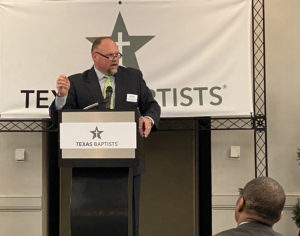
“What the world needs now is hope,” Albert Reyes of Buckner International told TBM. (Photo / Rand Jenkins)
The board also heard reports from varied ministries that described how TBM volunteers offered “help, hope and healing to a hurting world” in 2019 and learned about additional projects scheduled this year.
“What the world needs now is hope,” keynote speaker Albert Reyes, president and chief executive officer of Buckner International, told the board and other guests at a Feb. 21 banquet.
Ministries that meet human need and ministries that focus on evangelism and discipleship are two sides of the same coin, Reyes said.
God’s people bring the hope of Christ to hopeless people when they show love, offer peace to those who are troubled and demonstrate God’s concern for justice by seeking to set right what is wrong, he stressed.
‘Let’s go to work’
Several TBM ministry leaders echoed the same theme when they made project recommendations and presented reports: “Changing the world is hard. Let’s get to work.”
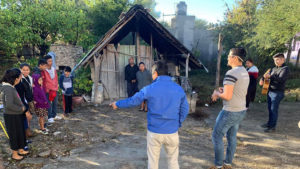
Two years ago, TBM entered an initial partnership with EVP, a nonprofit organization that offers assistance in Israel during natural or manmade disasters, to provide cross-training in large-scale emergency food service and other facets of disaster relief.
TBM built and outfitted a mobile food-service unit in Israel, and then trained Israel-based personnel to use it. Based on that model, the Israelis built additional units.
Dee Dee Wint, vice president of the TBM water ministry, described a recent project in Ghana. (Photo / Ken Camp)
All the equipment will be housed in a disaster relief center TBM will help construct in Israel, along with bunkhouses to provide lodging for volunteers.
Dee Dee Wint, vice president for TBM water ministry, reported more than 12,000 people gained access to clean drinking water and heard the gospel in 2019, thanks to TBM.
In early March, a TBM water team will journey to Uganda, to work in a camp where 2.2 million refugees from South Sudan and Congo are housed. Currently, wells rated for 500 people are expected to serve 2,000 people. TBM volunteers will train locals how to drill and maintain wells.
Dwain Carter, state disaster relief director, reported TBM workers contributed more than 50,000 volunteer hours in times of disaster, served 47,000 meals, distributed more than 7,500 boxes and recorded 52 professions of faith in Christ.
In other reports, the board learned:
TBM exceeded its $4.22 million budget in 2019 by 13.76 percent. The 2020 budget is $4,519,010.
More than 4,500 men and boys were involved in Royal Ambassadors ministries last year. At RA summer camps, which drew 3,669 campers, 311 boys made spiritual commitments, including 168 who made professions of faith in Christ.
Joe Detterman, who was named a national Joel W. Phillips Outstanding Achievement Award in Disaster Relief recipient by the Southern Baptist Convention’s North American Mission Board, receives a plaque from TBM Executive Director Mickey Lenamon and Dwain Carter, state disaster relief director. (Photo / Rand Jenkins)
Ralph Rogers of Amarillo and Gary Smith of McKinney received the Robert E. Dixon Service Award for longtime service to TBM.
TBM honored two employees—Janice Clary for 10 years of service and Alicia Enriquez for five years of service. TBM also recognized Joe Detterman, who had been named a national Joel W. Phillips Outstanding Achievement Award in Disaster Relief recipient by the Southern Baptist Convention’s North American Mission Board, and Tim Smith, who was named to the RA Legion of Honor.
Former deans and provost criticize plan to close Logsdon
February 24, 2020
ABILENE—Two former deans of the Logsdon School of Theology and Logsdon Seminary and a former chief academic officer at Hardin-Simmons University took the administration and trustees to task for approving a plan to close the seminary and scale back the remaining undergraduate religion program.
Both Vernon Davis, dean from 1998 to 2003, and Don Williford, dean from 2011 to 2017, insisted the trustee actions appear contrary to the original intent of the donors who established Logsdon School of Theology and Logsdon Seminary.
Current leaders of the university have “been derelict in their stewardship of the resources provided to sustain the School of Theology” and have “betrayed the trust” of donors, Davis said.
Williford asserted the plan to relocate the Logsdon School of Theology under the Cynthia Ann Parker College of Liberal Arts represents a reversal of actions taken by a previous administration and board that “could be interpreted as an inappropriate use of the Logsdon Endowment and borders on a violation of official trust.”
Ron Smith, former executive vice president and provost at HSU, asserted recent actions “may just be the first step in a series of moves that will sacrifice the integrity of the university on the altar of expediency, or perhaps as more recent news seems to indicate, the altar of moral, spiritual and intellectual malfeasance.”
The Baptist Standard attempted to contact HSU President Eric Bruntmyer for a response and for answers to several additional questions.
A Feb. 20 email from Jacob Brandt, director for university marketing at HSU, stated: “We have received your questions. At this time, we are not doing any additional responses. However, HSU plans to send out some additional information this week.”
Williford, who served 23 years on the Logsdon School of Theology faculty, released a Feb. 17 letter to the HSU trustees and administration in which he disputed some assertions Bruntmyer made to alumni and others.
Established ‘to train young ministers’
The 14-page letter detailed the historical development of the Logsdon School of Theology and the desire of the original donors to fund a program to train ministers.
Logsdon Seminary chapel (Photo by John Whitten)
Williford described how Coreen Logsdon made a $3 million gift in 1982 to HSU in honor of her late husband Charles to build the Logsdon School of Theology facility and Logsdon Chapel. A $50,000 per year gift from the Logsdon family also provided for graduate assistants for the Logsdon faculty, he noted. A final gift from the Logsdon estate established the Charles W. and Koreen Logsdon Endowment Fund.
Net income from the endowment fund “was intended to help train young ministers,” Williford insisted.
“The closing of Logsdon Seminary and moving of Logsdon School of Theology under the College of Liberal Arts with only a BA or BBS degree in but one disciplinary focus strike at the heart of the central task of preparing young ministers,” he wrote.
“Although the university administrations have interpreted this statement, ‘to train young ministers’ in different ways—to use the Logsdon Endowment funds for student scholarships, in support of the salaries and benefits of Logsdon faculty, or support of other costs directly tied to Logsdon programs—the funds were always dedicated to that essential effort.”
Williford refutes president’s assertions
Williford asserted Bruntmyer’s public announcement “indicated an inaccurate separation between the Logsdon School of Theology and Logsdon Seminary.” The Logsdon School of Theology has served as the “parent structure” under which all non-seminary religion programs and the seminary degree programs resided, with the same dean serving over both.
“The Logsdon Endowment Funds were, from the outset and continuing to the present time, devoted to the ‘parent’ Logsdon School of Theology,” Williford stated.
“Therefore, the claim that Logsdon School of Theology funds were ‘being redirected’ to Logsdon Seminary is patently untrue. The Logsdon Endowment Funds have from the outset belonged to the parent Logsdon School of Theology under which Logsdon Seminary and the non-seminary Logsdon School of Theology programs were housed.
“Likewise, the claim that Logsdon Seminary ‘lacked appropriate funding from the very beginning’ is not true. Hardin-Simmons was not using funds designated only for the Logsdon School of Theology as denoting the non-seminary programs to cover $600,000 of the annual cost of funding the seminary. Both Logsdon Seminary and the non-seminary (Logsdon School of Theology) were and are entitled to share the Logsdon Endowment Funds. Since the Logsdon Endowment was provided ‘to help train young ministers,’ consideration of allotment of the endowment funds should be based on the number of students enrolled in non-seminary programs compared to the number of students enrolled in the seminary programs.”
Second dean corroborates donor intent
When the Baptist Standard contacted Davis, the second dean of the Logsdon School of Theology, he corroborated Williford’s account, based on his conversations with Coreen Logsdon and her second husband, Lee Hemphill, as well as conversations with former HSU President Jesse Fletcher and with H.K. Neely, the first dean of the Logsdon School of Theology.
“I have grieved and been deeply troubled by the decision of the university leadership to close Logsdon School of Theology and Seminary,” Davis said. “It was my privilege to work to bring to birth the program of graduate studies in ministry preparation. Building a faculty of gifted scholars who were committed to providing excellence in education for ministry was the highlight of my own ministry.
“To see the dismantling of the vision of the Logsdons and those who have given their lives to bring it to reality is painful. To think of the loss to Hardin-Simmons and the cause of Baptists in Texas and far beyond is shocking.
“In my opinion, the current leadership of the university has been derelict in their stewardship of the resources provided to sustain the school of theology and has betrayed the trust of the Logsdons and countless people who have given themselves to bring their dream to fruition.”
Former provost critiques ‘margin by major’
Likewise, Smith referred to Williford’s letter as a “thorough, factually accurate and carefully considered assessment of the principal issues raised by the recent actions” of the university’s president and board of trustees.
Smith questioned “the extent to which the claimed ‘financial crisis’ may be the result of mismanagement by the current administration, along with an attempt by the administration and certain trustees to justify the shifting of funds away from the Logsdon endowment to meet other needs rather than honor the intent of the donor.”
Eric Bruntmyer, president of Hardin-Simmons University, addressed the Baptist General Convention of Texas Executive Board. (Photo / Ken Camp)
“In my former role as executive vice president and provost of the university, and later during two terms as president of the faculty, I could confidently declare that the integrity of the university was not for sale, not to anybody and not for any price. But now it appears that I may no longer be able to make such a statement,” he said.
Smith took issue with the “margin by major” Bruntmyer told the Baptist General Convention of Texas Executive Board his administration used to assess the financial sustainability of university programs.
That approach can be useful in operations where both costs and the product prices are variable, Smith said. However, it is “entirely unsuited” to a university setting where across-the-board tuition is fixed for all majors, but the cost of instruction varies widely from one discipline to another, he asserted.
Furthermore, if all nonprofitable majors were eliminated, a school could lose its university status, he noted. So, most universities recognize their “profit centers”—including majors that generate revenue—enable them to continue to operate “cost centers” that don’t generate a profit but are “essential to the enterprise” of the university, he said.
“Given the distinctive history and purpose of this university, and the endowment resources available, it seems clear to me that both the Logsdon School of Theology and Logsdon Seminary more than satisfy the criteria for status as an essential component and must be allowed to continue,” Smith said.
‘Inconceivable’ that seminary could create financial crisis
Williford blamed Logsdon Seminary’s declining enrollment in part on the university administration’s decision to eliminate the seminary’s director of recruitment and student services position and partly on the closing of off-campus sites in Lubbock, Dallas-Fort Worth, Corpus Christi and McAllen.
He also noted several university administrations prohibited deans of the Logsdon School of Theology from initiating development efforts on behalf of the seminary, saying it could conflict with university development efforts.
Pointing out Logsdon Seminary already had reduced the size of its faculty through retirements and required cutbacks, Williford insisted the seminary should require “far less financial support than it did five to 10 years ago.”
He also pointed to “several significant endowments which were and should continue to be available to the seminary and non-seminary programs alike” in the Logsdon School of Theology.
“Considering the faculty reductions, which have primarily impacted Logsdon Seminary and endowment incomes which rightfully provide funding to both seminary and non-seminary programs, along with income from tuition income generated by both entities, it seems inconceivable that Logsdon Seminary should be creating such a financial crisis for Hardin-Simmons University,” Williford wrote.
He also questioned whether an “extremely generic” Christian Studies major could adequately replace existing undergraduate degree programs in Biblical Studies, Ministry, Theological Studies and Worship Ministry.
‘Theological/political reasons’ cited
Williford also asserted there is “strong evidence to indicate that theological/political reasons played a much larger part in the decision” than Bruntmyer indicated.
He insisted Bruntmyer accused the Logsdon faculty of being “liberal” and addressed that in a meeting of the entire HSU faculty and in other settings. Williford also asserted Bruntmyer mentioned a meeting he and several trustees attended with BGCT Executive Director David Hardage and three West Texas pastors, whom Williford mentioned by name.
Bruntmyer did not respond to requests to confirm or deny the meeting. Two of the three pastors declined comment, and the other never replied to email inquiries.
Hardage acknowledged some Texas Baptist church leaders had voiced concerns about certain theological positions held by some on the Logsdon faculty, but closing the seminary was not the expressed desire of anyone in any conversation he heard.
“For several years, numerous church leaders from all over the state began expressing concerns about some theological positions at Logsdon, and those concerns were shared with leaders of both the seminary and the university privately and in small group settings. Certainly, others from Texas and beyond did not share those concerns,” Hardage said.
“However, as I understand it, a full theological discussion regarding Logsdon was not a part of the HSU board of trustees decision to close the seminary. Apparently, the stark, negative financial realities facing the seminary negated the need for such a discussion.
“Personally, I was never a part of any conversation with anyone who wanted Logsdon to close and was surprised when I heard the news. I continue to pray for all those whose lives and families have been impacted by the decision to close the seminary. I also continue to pray for and believe in university leadership and hope for a very bright future for HSU.”
Texas Baptists pass 1,000 mark in chaplain endorsements
February 24, 2020
DALLAS—Texas Baptists’ chaplaincy relations program, in partnership with the Baptist General Association of Virginia, passed the 1,000 mark in chaplain endorsement during a Feb. 16 endorsement ceremony.
Texas Baptist leaders celebrated the achievement the next day at the Baptist General Convention of Texas Executive Board meeting.
“This is a milestone for us, and we’re looking to continue to grow,” said Jim Brown, associate endorser of chaplaincy relations. “We have endorsed 1,000 chaplains to serve in a variety of areas. It’s an exciting time to be a part of this and it’s a wonderful ministry.”
To date, Texas Baptists and Virginia Baptists have endorsed 1,011 chaplains, including 51 last year.
Texas Baptists’ chaplaincy relations program began in 2002, under the leadership of Bobby Smith. In 2017, Texas Baptists’ partnered with Virginia Baptists to offer additional training and networking opportunities for chaplains in both states.
‘Pastors without walls’
Currently, there are more than 675 active Texas Baptists chaplains. Brown noted 38 percent of the chaplains work in healthcare, and military chaplaincy accounts for an additional 32 percent.
Texas Baptists are the fifth largest endorser of the United States military chaplaincy, Brown reported. Endorsed chaplains also work in prisons, crisis response, lifestyle, marketplace and public safety spheres.
In addition to serving in Texas, the chaplains also work in 41 other states and six foreign countries. The chaplaincy relations team also works with Baptist entities in other countries to establish training programs and provide support.
Brown described the valuable work the chaplains are doing around the world.
“Our chaplains are out there serving the world. They are around the world, serving our soldiers. Many of them are in your communities, right here in Texas, serving in your hospitals, your correctional facilities, even some businesses,” Brown said. “They are literally pastors without walls.”
BGCT Executive Board elects Ward Hayes as CFO
February 24, 2020
DALLAS—The Baptist General Convention of Texas Executive Board unanimously elected Ward Hayes, a Stephenville pastor and certified public accountant with more than two decades of banking experience, as Texas Baptists’ treasurer and chief financial officer.
Hayes, pastor of Valley Grove Baptist Church in Stephenville since 2013, has served as chair of the BGCT Executive Board. Vice Chair Donna Burney from First Woodway Baptist Church in Waco now assumes the board chairmanship.
Members of the search committee who nominated Ward Hayes—along with BGCT Executive Director David Hardage—commended Jim Reed, controller and assistant treasurer, and thanked him for his work. Reed has been acting treasurer since Jill Larsen resigned last summer to become CFO of VisitDallas.
Background in business and ministry
“I believe business and ministry go hand in hand,” Ward told the board, noting that good business practices make ministry possible.
The Baptist General Convention of Texas Executive Board unanimously elected Ward Hayes, a Stephenville pastor and certified public accountant with extensive banking experience, as Texas Baptists’ treasurer and chief financial officer.
Hayes, who grew up on a cotton farm and ranch in Rotan, earned his undergraduate degree in accounting from West Texas State University (now West Texas A&M). After answering the call to pastoral ministry years later, he earned a Master of Divinity degree and a Doctor of Ministry degree from Hardin-Simmons University’s Logsdon Seminary.
Early in his career, he spent two years with National Bank Examiners in Amarillo and three years at a regional public accounting firm focused primarily on audits.
Hayes continued to practice public accounting during his tenure as vice president of First National Bank of Rotan from 1993 to 2003. His duties there in senior management included serving as controller, regulatory liaison, handling investment and loan portfolios, and personnel. He served on the bank’s board of directors more than 23 years.
Ward Hayes chairs a BGCT Executive Board meeting. (Photo / Ken Camp)
Hayes was ordained to the gospel ministry in 2003 at Trinity Baptist Church in Sweetwater, where he served as senior pastor more than 10 years and oversaw four building programs.
He served on the board of trustees for Hendrick Medical Center in Abilene for nine years, including terms as board secretary, first vice chair and chair.
In addition to his most recent service as BGCT Executive Board chairman, in his previous years on the board he was on the finance committee, serving as its chair, along with serving on the personnel committee and executive committee.
He and his wife Jenna have three adult children—Tate, Mackensey and Hanna.
Executive Board creates Response Council
The board also voted to create an Executive Board Response Council to address critical issues that demand a response from the BGCT or action—such as provisionally determining if a church is in “harmonious fellowship” with the convention between annual meetings or regularly scheduled board meetings.
“Texas Baptists need the ability to respond to emergency events promptly and biblically to present a positive witness,” the rationale presented to the board stated.
The Response Council will have “provisional authority” to determine whether a church is in “harmonious fellowship” with the BGCT, with the understanding those decisions will be presented to and final decisions will be made by the Executive Board at its next meeting.
Members of the council are the executive director, associate executive director and CFO/treasurer of the BGCT; chair and vice chair of the Executive Board; and president, first vice president and second vice president of the BGCT. Additional staff may be included on a need-to-know basis, and legal counsel may be included as needed.
The executive director, in consultation with the Executive Board chair, will call the Response Council together when a situation arises requiring its action. Attendance of a two-thirds majority of its members is required for the council to act.
In other business, the board:
Approved a new map and configuration of sectors from which Executive Board members are elected. The revised sectors reflect growth in urban areas and population decline in some rural areas of the state. Board members from sectors with changes will be allowed to complete their current terms, with sector adjustment accomplished by attrition.
Authorized $552,000 in allocations from the J.K. Wadley Endowment earnings, with $150,000 earmarked for collegiate ministries building maintenance, $150,000 for campus ministry interns, $102,000 for a multicultural missionary, $100,000 for the MinistrySafe child protection program and $50,000 for Western heritage ministries.
Elected Mark Lindsey from First Baptist Church in Big Spring to fill a vacancy on the Executive Board.
Approved Mario A. Ramos from Crossroads Baptist Church in San Antonio to the Baptist Foundation of Texas of San Antonio board of trustees and Steve Vernon from First Baptist Church in Belton to the Valley Baptist Missions/Education Center board of trustees.
Adopted a certified resolution granting the executive director, associate executive director, treasurer/CFO or any interim serving in those roles authority to sign checks and other legal documents as necessary to conduct the business, work and mission of the BGCT.
Approved a resolution congratulating Executive Board staff leadership for receiving a 2019 Top Workplace, National Standard award presented by the Dallas Morning News.
HSU president addresses BGCT Executive Board
February 24, 2020
DALLAS—Hardin-Simmons University trustees made the hard decision to close Logsdon Seminary and direct endowment earnings back to undergraduate programs in the Logsdon School of Theology because the university could not “keep two financially weak programs going,” President Eric Bruntmyer told Texas Baptist leaders.
The trustee vote came after the HSU administration spent four years carefully examining all university programs to determine their financial sustainability, Bruntmyer told the Baptist General Convention of Texas Executive Board on Feb. 17.
The same day Bruntmyer addressed Texas Baptists’ board, the dean of Logsdon School of Theology and its seminary released a statement saying the trustee decision to close the seminary “seems incompatible with the mission and heritage of the university.”
When Bruntmyer arrived as president at HSU in June 2016, he said the university lacked good measurement tools to assess the financial health of individual programs. The administration developed “margin by major” metric assessments, he explained.
“We looked at each and every single program on campus to find out if they were healthy and sustainable. … You have to make money to pay the bills. Faculty and staff don’t work for free,” he said.
Through that analysis, it became clear Logsdon Seminary and the Logsdon School of Theology were among the university’s most low-performing programs, he reported.
The trustee board’s Logsdon Seminary Committee and Finance and Audit Committee discussed the matter twice in overlapping meetings, and then the university’s administration talked with faculty and staff at the seminary and Logsdon School of Theology to explore ways to improve their financial condition, he said.
Trustees considered three tough questions
Bruntmyer said he asked the board of trustees last October to consider three pointed questions:
Are Logsdon School of Theology and/or Logsdon Seminary financially sustainable programs?
Will it be possible for Logsdon School of Theology and/or Logsdon Seminary to become financially sustainable programs?
Are the Logsdon School of Theology and Seminary programs essential to the mission of the university?
“We had some really good frank discussions about what we were doing and how we could do it differently,” he said.
In response to the suggestion of raising tuition, if tuition costs were raised to a level that would make the program sustainable, it would be so expensive no students would choose to study at the seminary, he noted.
About 300 students would be needed to make the programs financially viable, Bruntmyer said. He told the Executive Board 40 to 45 undergraduates are pursuing majors in the Logsdon School of Theology, and the program has experienced a steady decline in recent years.
About 90 students are enrolled in seminary graduate classes at its two campuses in San Antonio and Abilene, but those numbers do not represent full-time equivalency, he said. The number of graduate students grew at the seminary’s San Antonio campus but declined at the main campus in Abilene, he added.
‘Had to decide to do one or the other’
Bruntmyer told the Executive Board he talked to the Logsdon dean about the possibility of pursuing a waiver from the Association of Theological Schools accrediting agency to offer fully online programs.
Eric Bruntmyer, president of Hardin-Simmons University, addressed the Baptist General Convention of Texas Executive Board. (Photo / Ken Camp)
The seminary made the internal decision to offer “face-to-face” residential theological education, he said.
Bruntmyer traced the financial history of Logsdon Seminary, pointing to its inability to achieve financial sustainability.
“The seminary was never properly funded,” he said.
He displayed a series of detailed charts to the BGCT Executive Board with specific financial information. The Baptist Standard requested but did not receive copies of the slides that were projected in the board meeting.
“That information was meant specifically for that audience, and reflects a great deal of proprietary information about HSU’s current and historical financial situation. Consequently, we will not be providing any of those presentation materials to members of the media or outside audiences,” Jacob Brandt, director of university marketing at HSU, wrote in an email.
Over the years, endowment income increasingly was shifted from the Logsdon School of Theology to cover seminary deficits, he reported.
“Net profit was not enough to cover both, and the board had to decide to do one or the other,” the seminary or the undergraduate Logsdon School of Theology, he said.
In the last academic year, combined losses from the Logsdon School of Theology and Logsdon Seminary totaled $1.26 million. In 2018, Logsdon Seminary relied on $1.5 million in endowment to cover expenses, transferred from the School of Theology,
‘Purely a financial reason’
After considerable discussion and debate, the board voted to begin the process of closing Logsdon Seminary, providing a “teach-out” program for current students and providing full-time seminary faculty a one-year contract.
“I will tell you, as I said in the (Feb. 12) letter, there were theological discussions,” Bruntmyer said to the BGCT Executive Board. “I will also tell you I stood up and said: ‘If we want to have a theological discussion, let’s bring all the theologians in the room and let’s have a big discussion about this. But at the end of the day, I still have to deal with a financial deficit. Whatever you decide on, I still have to deal with a financial deficit, and this will not matter one bit what we argue about.’ So, when I say it was purely a financial reason, it was.”
As he mentioned in his Feb. 12 public statement, Bruntmyer raised the possibility of “a freestanding seminary in San Antonio,” but he added alumni who expressed an interest said they did not have sufficient funds to create a sustainable seminary there.
“And unfortunately in 2004, we didn’t have that kind of money, either,” he said.
In response to questions, concerns and allegations raised on social media that Texas Baptists were responsible for Logsdon’s closing, Bruntmyer noted most of the emails, calls and texts he had received acknowledged the board of trustees did what had to be done.
“You really can’t get out and wage a war that supports the closing of a seminary. No one can get behind that. No one can get excited about closing a seminary,” he said. “One of the things I told the board was this: ‘I did not want to be the president who stood before you and had to close the seminary. I wanted it to grow. I want it to exist. It simply can’t happen.”
Hardage ‘not involved in those discussions’
BGCT Executive Director David Hardage also addressed the rumors that had circulated—specifically those who accused him of using his influence to convince HSU trustees to close Logsdon Seminary.
When Bruntmyer called him on Feb. 7 to tell him about the board’s action, Hardage said he was taken by surprise, but he understood how difficult it must have been.
“I was not, Texas Baptists were not, involved in those discussions and that decision,” he said, adding that the convention elects board members to study, deliberate and vote on matters affecting the institutions.
“Somebody has accused me of trying to influence board members,” Hardage said.
Disputing that notion, he told the Executive Board he “couldn’t name for you a single member of the Hardin-Simmons board tonight” without prompting.
“We have committees who name those boards. We trust them to do their work,” he said.
Schools related to the BGCT receive funding for students receiving ministerial scholarships based on enrollment, he noted.
Looking at the larger issue of theological education and the challenges seminaries face, Hardage noted, “Online education is taking its toll on residential theological education.”
He also pointed out an increasing number of Texas Baptist universities and other institutions offer a variety of master’s degrees, and many pastor search committees do not look exclusively at ministers who hold a Master of Divinity degree.
Hardage also challenged churches to be more intentional about calling out students to be open to God’s call to full-time vocational Christian ministry.
Dean Bob Ellis: ‘It breaks my heart’
Earlier in the day, Bob Ellis, dean of the Logsdon School of Theology and Logsdon Seminary, released a statement expressing his sorrow that HSU “will be closing the seminary and letting the faculty go, as well as marginalizing Logsdon’s undergraduate program and releasing one of their faculty.”
“It appears that Logsdon will be left with three full-time faculty after the next year,” he said.
Ellis praised the vision that guided Logsdon since its creation.
“At Logsdon we are rooted in the kind of theological education that is distinctively Baptist, growing out of our commitments to the priesthood of believers, religious liberty and freedom of conscience. We are a school deeply committed to preparing servant leaders for the church with an academically challenging theological education centered on Christ, committed to the authority of Scripture, and guided by the Holy Spirit,” he said. “Our goal is to prepare ministers who are characterized by humility, compassion, courage, and creativity, as they carry the Gospel of grace into a broken world.”
The news that the seminary is closing “breaks my heart,” Ellis said, adding that his service at Logsdon “has been the greatest privilege of my ministry career.”
‘Disappointed in my university’
“I’m deeply grateful to my alma mater, HSU, for giving me this opportunity. But now, I am deeply disappointed in my university for closing the seminary. It breaks my heart, and it will deprive Texas churches of a uniquely gifted resource for preparing ministers,” he said.
“A natural question is why the seminary was closed. Conversations leading up to the trustee meeting in which the closure vote occurred certainly involved finances, theology and Baptist politics. These factors deserve careful examination with the help of various persons who have insights into the process.”
Ellis acknowledged the financial challenges HSU faces and the “difficult choices” that must be made.
“But the choice to close the seminary, when other things could have been done, seems incompatible with the mission and heritage of the university and the dreams of the very generous donors whose significant endowments undergird Logsdon,” he said.
“Logsdon Seminary is a gift to the university, the faculty, the students and the church. And now the gift is being lost.”
HSU cuts faculty and programs to address $4 million deficit
February 24, 2020
ABILENE—A week after its board of trustees meeting, Hardin-Simmons University announced at least 17 faculty cuts due to the elimination of multiple programs to address a more than $4 million operating deficit.
A news release distributed at 4:45 p.m. on Friday, Feb. 14, stated the university is eliminating 11 graduate degree programs, five undergraduate majors, four undergraduate minors and two certificate programs.
“During this week, we have been working hard to communicate the specific actions that must be taken to implement the board’s decisions, making sure that we are complying with all applicable legal and accreditation standards, and to provide individual notification to those on campus most directly affected,” the release stated.
“We are now able to release additional information about the board’s decisions, information that puts the closing of Logsdon Seminary into the context of The Way Forward, a larger financial plan to close our operating deficit by more than $4 million.”
The university is being reorganized into five colleges and schools: the Cynthia Ann Parker College of Liberal Arts, the Holland School of Science and Mathematics, the Kelley College of Business and Professional Studies, the College of Health Professions and the Patty Hanks Shelton School of Nursing.
Impact on Logsdon School of Theology noted
The Logsdon School of Theology will become part of the Cynthia Ann Parker College of Liberal and Fine Arts, which also will include the School of Music, the Department of Counseling and Human Development, and the Department of Fine Arts.
Graduate programs HSU is closing include those leading to the following degrees: Doctor of Ministry, Master of Arts in Family Ministry, Master of Arts in Religion, Master of Divinity and Master of Music in Church Music, along with six others in education and music.
“There will be 17 faculty reductions associated with the program closings, as well as some additional reductions in faculty to reduce costs in several remaining programs. Fourteen positions have been eliminated in administration and staff through attrition, and additional reductions will be communicated as soon as we are able,” the release stated.
The Logsdon School of Theology faculty will develop Bachelor of Arts and Bachelor of Science degrees in Christian studies to replace existing majors in biblical studies, ministry, theological studies and worship ministry.
The news release ended with a statement from HSU President Eric Bruntmyer: “Before its February 2020 meeting, the board of trustees held a called meeting to discuss resolutions recently passed by the university faculty. That discussion continued at the February meeting. Though aware of the faculty’s concerns, ultimately the board’s primary discussion focused on the Way Forward financial plan.
“The board’s decisions were difficult, all of them made in continuous awareness of their direct impact on personnel and students,” Bruntmyer continued.
“The board recognizes, as do we in administration, the heavy burden that many are carrying. All of us are dedicated to walk alongside and to assist anyone affected by these campus changes. As we continue to position the university for long-term success, please join me in constant prayer for the entire HSU community.”
Biblical language minor eliminated
The undergraduate minors being eliminated include one in biblical languages, which directly affected Susan Pigott, professor of Old Testament and Hebrew.
Pigott, who began teaching in the Logsdon School of theology in fall 1993, noted she was “the first woman to teach full time in biblical studies at Logsdon.”
“This was, at the time, a rather controversial decision by the dean, H. K. Neely, because few Baptist schools allowed female professors to teach Bible. But Logsdon has always been a place that welcomes the voiceless, and I was given a voice,” she wrote in an email to the Baptist Standard.
“Over the years, I have taught many young women and men Old Testament and Hebrew,” she continued. “One of my favorite courses to teach is Old Testament Survey because it’s my opportunity to convince freshmen and sophomores that the Old Testament is exciting, dramatic, and relevant. Although I don’t convince everyone, many students leave the course with new enthusiasm for studying the Bible for themselves. Some even decide to major in Logsdon because of this experience.”
Loss of a female mentor a ‘devastating repercussion’
Pigott noted she considered the opportunity to mentor young women who felt called to ministry “one of my most important roles at Logsdon.”
“I did not have a female professor to provide such mentorship through all my years of undergraduate and graduate education—and how desperately I needed one,” she wrote. “This, for me, is the most devastating repercussion of HSU’s decision to fire me. Young women will no longer see someone like themselves teaching and ministering at the Logsdon School of Theology. They will not have a woman to confide in when they are discouraged from becoming ministers because they are female. They will miss an opportunity to learn from a trained biblical scholar who focuses on presenting overlooked stories of women in the Old Testament. So many young women feel God’s call on their lives. Eliminating the only female teaching in the School of Theology sends a message: ‘You are not valued as women.'”
Pigott said she is “deeply grieved over the loss of Logsdon Seminary” and the colleagues with whom she has worked more than 15 years. She also addressed the reorganization at HSU.
“I am grieved that the Logsdon School of Theology will be folded under Liberal Arts—the Logsdons established the School of Theology expressly as a separate entity apart from Liberal Arts,” she wrote.
“I am grieved at the loss of the Biblical Languages minor, one of the most popular minors in Logsdon. I am grieved over the loss of my dear school—the place that nurtured me, gave me the foundational tools I needed to earn an M.Div. and Ph.D., and offered a very green and frightened young woman a teaching position in Old Testament. Most of all, I am grieved for the students who will be left with only a shell of the school Logsdon once was.”
‘Leap into Action’ initiative announced
Administrators of the “Save Logsdon Seminary” Facebook Group specifically noted her job loss, pointing out it also meant the undergraduate Logsdon School of Theology also lost its only female professor.
“The dismissal of Dr. Pigott shows an outright dismissal, not only of a loyal and senior faculty member, but in our view, communicates disdain for women in theological teaching positions,” the group’s administrators wrote in a news release distributed about a half hour before the HSU press release. “This leaves us with little doubt that the closure of Logsdon was in large part, theologically motivated.”
The group announced an initiative, “Leap Into Action: 32 Days of Prayer and Advocacy.”
“Beginning on February 29, alums will host a prayer vigil, and invite everyone who is heartbroken over this situation to join us as we raise our voices and witness in prayer,” the group stated. “We pray God would bring justice out of injustice, and that light will be shed where there is darkness. We hope to host simultaneous vigils both in Abilene and San Antonio.”
The article, originally posted Friday evening, Feb. 14, was updated on Saturday evening, Feb. 15, to include remarks received from Susan Pigott.
Albert Reyes still running toward his Father’s voice
February 24, 2020
Helping discouraged families find hope keeps Albert Reyes motivated as he enters his second decade as president of Buckner International.
He thinks about couples like Serapio and Marta Hernandez and their daughter Amanda.
When Serapio lost his job after 17 years, he knew he had to find another way to provide for his family. So, he and Marta started making and selling piñatas to a broker who turned around and sold them for a significantly higher price.
Serapio chopped reeds from the Trinity River bottom to use in creating the piñata skeletons, and then he, his wife and their children spent long hours covering them with brightly colored paper.
“Get used to making piñatas,” Marta told Amanda. “This is going to be your life.”
But staff at the Buckner Family Hope Center at Bachman Lake—where Marta already had benefited from parenting classes—helped the Hernandez family discover another way of life. They learned how to develop a business plan, create a website and market their piñatas directly.
Soon, the couple doubled their income. In time, Serapio found another job, and the piñata-making business provided much-needed supplemental income to help the family improve their housing situation.
Now Amanda attends a program that allows her to earn an associate degree at the same time she is working toward her high school diploma. She dreams of being the first college graduate in her family and becoming an elementary schoolteacher.
When families discover hope, whole neighborhoods—whole communities—change for the better, Reyes noted.
“We’re transforming communities, one family at a time,” he said.
Applying a lesson learned
Albert Reyes, president and CEO of Buckner International, believes Christians earn credibility through incarnational ministry—“showing up” to bring peace, healing and justice to people who are hurting. (Buckner Photo)
As a child, Reyes learned an important lesson from his father, a U.S. Marine. When his father called, young Albert was told to come running toward the sound of his voice as fast as possible, saying, “Yes, sir,” each step of the way.
So, when the boy made his profession of faith in Christ at age 9, he applied what he had learned about obedience to his new relationship to God.
“When my heavenly Father calls, I start moving toward his voice. And my answer is ‘yes’ before I even know what he’s asking,” Reyes said.
To fulfill God’s calling on his life, Reyes wanted to begin preparation for ministry at seminary immediately after he graduated from high school. His pastor patiently explained seminary was a graduate school, and he needed to attend college first. So, Reyes earned a bachelor’s degree in business administration at Angelo State University before going on to seminary.
He served three churches as pastor before accepting the call to become president of Baptist University of the Américas in San Antonio. He also was elected to a term as president of the Baptist General Convention of Texas.
‘Signed up to be a servant’
At BUA, he led the school to earn accreditation and certification, to achieve a record on-campus enrollment, and to secure its first multi-million-dollar gift. Then he received a call from Buckner.
Albert Reyes visits a classroom at a primary school in Bungoma, Kenya. The school is run by Buckner Kenya, the organization’s affiliated Non-Governmental Organization. (Buckner photo by Mark Sandlin)
Ken Hall wanted to ensure the organization that had greatly expanded during his time as CEO and president would have a smooth transition when he retired. He asked Reyes to consider accepting the presidency of Buckner Children and Family Services, with the understanding he would succeed Hall as president—and later CEO—of the parent organization within a few years.
As he prayed about it, Reyes felt a sense of “accomplishment and release” regarding BUA and excitement about the challenges Buckner offered.
“I signed up to be a servant, not the Master. I never got that confused,” Reyes said. “So, when the Master says, ‘Stop doing this and start doing that,’ get excited about ‘this’ and don’t worry about ‘that.’”
Reyes became president of Buckner Children and Family Services in 2007, president of Buckner International in 2010 and CEO in 2012.
‘God never wastes an experience’
At Buckner, Reyes knew he would face challenges in succeeding “a longtime successful president,” but he was determined “to lead according to how God shaped me.”
“Early on as a youngster, I figured I might be good at organizing things,” Reyes said, based on his experience working in his family’s business.
In retrospect, he saw how God used his varied experiences—in business, as a pastor and as president of an educational institution—to prepare him for his new role at Buckner.
“God never wastes an experience. It’s to prepare you for what you know not of,” he said.
Establish a ‘culture of excellence’
Reyes committed to build on the foundation that had been laid the previous two decades, while adapting to new contexts and continuing to improve processes.
Rodney Henry, chair of the Buckner International board, believes Reyes brought the right set of skills to the organization at just the right time in its history.
“How he thinks about things—understanding the organization and taking a process-oriented approach—has been very valuable,” Henry said.
Reyes helped Buckner carefully examine its varied programs, evaluate their effectiveness and make necessary adjustments, he noted. In the process, he demonstrated both the clear-eyed view of a business administrator and the compassionate heart of a pastor, Henry added.
“He established a culture of excellence,” Henry said. “Albert has stressed that we need to concentrate on doing what we do well, do it with excellence and do it in a way that is sustainable.”
Intervene before there is a crisis
Both Henry and Reyes point to Buckner’s development of Family Hope Centers—first piloted under Ken Hall’s leadership in Guatemala in 2008 as a Community Transformation Center—as perhaps the organization’s most significant contribution in the past decade.
Children from one of Buckner’s Family Hope Centers in Santo Domingo, Dominican Republic, greet Albert Reyes. (Buckner photo by Mark Sandlin)
“So much effort through the years has been focused on responding to crisis. The Family Hope Center model intervenes before the kids and the families are at a point of crisis,” Henry said.
Through its long-established programs of adoption and foster care, Buckner continues to respond to abused or neglected children who are unable to continue to live with their families of origin.
However, the Family Hope Center model focuses on building family strengths and helping families reach their God-given potential.
“We’re helping families stay strong and keeping kids in the families where God put them,” Reyes said.
In addition to providing family assistance and sponsoring community events, the centers offer parenting classes, adult education courses, programs to teach financial empowerment and initiatives devoted to spiritual enrichment.
“The secret sauce is family coaching,” Reyes said.
The family coach is a Buckner social worker who meets with a family to evaluate their situation and help them set their own goals based on protective factors—knowledge of parenting and child development, nurturing and attachment, social and emotional competence, resilience and social connections—and spiritual development.
Count the cost
“I asked my staff, ‘What does it cost to keep a family whole?’ It costs $2,000 for one coach to serve one family for one year,” Reyes said.
In comparison, “the cost of doing nothing” is conservatively estimated at $54,000 per year, based on data from Child Protective Services—a ratio of $1 spent on prevention compared to $27 spent on protection, he added.
“But really, how can you quantify the trauma on a child?” he asked. “This is about getting to the root of the issue before it becomes an issue.”
Spiritual development happens naturally, he added. Buckner is not an evangelistic organization or missions society. But because of the nature of the work it does—offering hope and healing to hurting families—the people whose lives are touched begin to ask spiritual questions, Reyes said. He noted about 1,000 people every year come to faith in Christ through Buckner’s programs.
“We don’t have to bring it up. They bring it up,” Reyes said.
Looking ahead, he sees Buckner continuing its emphasis on strengthening families.
“Communities are made up of families. … The smallest building block in human society is the family. God designed the family. … The family is the core,” he said.
Be a model and a resource
In the days ahead, Reyes wants Buckner to “stay in that space and create a model that people will want to imitate” to build strong families.
“To think that Buckner has to be everywhere there is need is prideful and a bit arrogant,” he said. Instead, he hopes Buckner personnel can share what they have learned, consult with other agencies around the world and equip them to strengthen families.
Buckner already is making a significant impact among like-minded service providers. Reyes serves as an officer on the board of the Christian Alliance for Orphans, a coalition of more than 200 organizations devoted to care for vulnerable children.
Jedd Medefind, president of the alliance, praised Reyes for the “rich and godly wisdom” he brings to his coalition’s governing board.
“He is a great listener,” Medefind said. “He thinks before he speaks, and when he does speak, others listen.”
Often, agencies either focus exclusively on protecting children or on restoring and strengthening families, Medefind noted. Under Reyes’ leadership, Buckner has led the way in doing both effectively and set an example for others, he observed.
“It’s a rare combination,” he said.
South Dallas church cares for the whole person
February 24, 2020
DALLAS—Dennis Winston, bivocational pastor of Beckley Community Church in Dallas, understands people need food—and much more.
“I want our church to be a caring church, not just a church that provides food,” Winston said.
Since he has a full-time job, Winston does not accept a salary from the church, allowing the congregation to use that money to buy food for people in need. When funds are short, the pastor supplements the food pantry from his own resources.
At first, the South Dallas Texas Baptist congregation provided about 75 families with turkeys for Thanksgiving and Christmas. Winston realized the depth of need in his community when he went into their home to deliver the turkeys.
“We learned that there were people in our area that didn’t know what they were going to do for the holidays,” he said. “There was no food in the refrigerator. No money to buy… anything.”
Winston recalled one mother who benefited from the church’s food-distribution ministry. She said: “When Thanksgiving and Christmas came around, I didn’t know what we were going to do. You came just in time. Our refrigerator was empty. But your church gave us food. We are thankful.”
The church’s ministry to families in need grew into a twice-a-month food distribution center that serves between 300 to 400 people, and the number continues to increase.
‘Bring them food … show them the love of Jesus
“God impressed upon me to feed those less fortunate,” said Winston, who has been pastor of Beckley Community Church three years.
“God impressed upon me to feed those less fortunate,” said Winston, who has been pastor of Beckley Community Church three years. Churches around the state help support the church’s programs to help people in need through their gifts to the Texas Baptist Hunger Offering.
Churches around the state help support its programs to help people in need through their gifts to the Texas Baptist Hunger Offering.
Through prayer, planning, promotion and persistence, the congregation of about 75 people has transformed a simple food pantry into one that ministers to the whole person.
“Most important, people need to know Jesus,” he said. “By helping to meet their food needs, we can tell them about a loving Savior and how they can have eternal life. … We bring them food, and then we show them the love of Christ.”
God prepared the pastor
Winston believes God had a plan for his life. Before he answered God’s call to ministry, he worked in management, which he sees now as a way God prepared him to serve others more effectively.
“My experience in management and leadership helped me get a clear picture of life,” Winston said. “A lot of people do not have knowledge of resources out there. For example, they need a place to live. … (They want to know:) ‘How can I receive a GED? How can I apply for a job? How do I fill out a resumé?’ There are many components to this problem. We try to minister to the whole person.”
Winston orders food online, including meats, canned vegetables, breads, rice, beans and other staples. When funds allow, he purchases fresh vegetables and fruits.
“Technology is so important today,” Winston said. “With a full-time job, my time is limited. I use a computer to order the twice-a-month food, put orders in the computer, print out forms and audit the delivery. My previous work was God-given. This employment equipped me to be able to handle this food pantry.”
‘We just want to help those who need us’
In addition to the food pantry, the church provides backpacks to students. Last fall, Beckley Community Church gave away between 75 and 100 backpacks.
“Some of our organizations only give to certain ZIP Codes,” Winston said. “We are not concerned with where you live. We just want to help those who need us.”
Through his community involvement and work with Dallas Baptist Association, Winston learns where there are people who need help, as well as resources available to them. He welcomes each opportunity to meet needs in Christ’s name and point people to God.
“When people come to pick up the food, I introduce myself. Then I say: ‘God has blessed us. Please worship with us. There are no problems that God can’t handle. This food is not from us … but from God.’”
This is part of an ongoing series about how Christians respond to hunger and poverty. Substantive coverage of significant issues facing Texas Baptists is made possible in part by a grant from the Prichard Family Foundation.
Carolyn Tomlin writes for the Christian market and teaches the Boot Camp for Christian Writers.
War and peace not abstract or distant issues, ethicist insists
February 24, 2020
BROWNWOOD—When it comes to matters of war and peace, no American Christian is “off the hook,” a Baptist ethicist told an audience at Howard Payne University.
And any attempt to distance the church from that responsibility is both bad theology and poor pastoral ministry to returning combat veterans, said Myles Werntz, who holds the T.B. Maston Chair of Christian Ethics at Hardin-Simmons University’s Logsdon Seminary.
“To tell one who has engaged in violence professionally that they have acted in a realm removed from us is to condemn them to never being able to come home. Treating war as a special case sounds like we are being deferential, but it is ultimately consigning the soldier to a place apart from the rest of us,” said Werntz, associate professor of Christian ethics and practical theology at Logsdon.
Wertnz delivered the 13th annual Currie Strickland Distinguished Lectures in Christian Ethics at Howard Payne University, Feb. 6-7, speaking on “War and the Christian Life.”
Responsible for national actions
“A church is always a church of somewhere,” Werntz said. “It does not exist in thin air or in eternity, but in and through the world in which God brings it into being.”
So, the church in the United States should recognize Americans are responsible for the actions of their government and are involved in military conflict even if they never serve in the armed forces, he asserted.
“In a representative democracy, what is done abroad, even without our awareness, is that which we enable, both through our representativeness, our taxes, our support and our continued presence as Americans,” he said.
“America has been involved in official military conflict internationally for 93 percent of the years in its existence, and so simply as a matter of history, to be an American is to be those whose way of life is intertwined with America’s wars.”
Sibling conflict, not something ‘out there’
For Christians, questions surrounding violence cannot be viewed abstractly, he insisted. Beginning with Cain and Abel, the Bible emphasizes “the ones we fight are disavowed siblings” rather than strangers, Werntz asserted.
“Theologically, this should give us the most pause when we reach for war, for war encourages us to consider that there is an ‘us’ and a ‘them,’ when by Scripture’s own lights, the ones we kill are our brothers,” he said.
Military conflict is not something that happens “out there,” apart from the everyday lives of Christian civilians who are not engaged in combat, he insisted.
“War is not something the church gets to disavow, because it is always caught up with the killing which its nation performs against its own siblings,” Werntz said.
‘It never ends’
Wars fought overseas and domestic forms of violence differ by degree rather than by kind, he added.
“The violence which extends outward is always learned first at home, in our habits, in the systems which we swim in uncritically and unexamined, in the forms of violence which we willingly accept as necessary for our way of life to continue,” Werntz said.
War promises more than it can deliver, demanding sacrifice that gives nothing that is not in danger of being lost in the future, he asserted.
“The sacrifice of the soldier is only as good as the next soldier behind them, also willing to die in this perpetual search for a lasting peace. It never ends,” he said. “There is always another fight to win, another deeper sacrifice to make, of time, life, principles—in the hopes that if we fight harder and offer more of ourselves in the service of winning, it will be worth it. But it never ends.”
Peacemaking and the kingdom of God
For Christians, peacemaking means engaging the right way in a violent world, not retreating from it, he asserted.
“The same binding of a culture together in responsibility and guilt provides avenues for us to infiltrate a culture with peace,” Werntz said.
Christian peacemaking involves living as a citizen of the kingdom of God and bearing witness to the kingdom of God in the present world, he asserted.
“It is as cosmic as beating swords into plowshares and as small as waiting to worship until you have made peace with your enemy,” Werntz said. “Biblical peacemaking is not only about refraining from hitting back against your enemy, but creating a new world in which from top to bottom—from the way we eat to the way we worship to the way we argue with other nations—we are embodying this peace which is Jesus.”
The practice of Christian peacemaking has taken different forms at different times, and faithfulness to the peace of Christ can be costly, he warned.
“If you are a Christian, part of your call to Christ is to faithfulness to Jesus, and that may not end well for you,” he said. “Sometimes, we call those suckers, and sometimes we celebrate them as martyrs and saints.”
What does Christian peacemaking look like?
Werntz outlined four dimensions of biblical peacemaking:
The Christoform dimension. Biblical peacemaking looks like Jesus. So, biblical peacemaking pays attention “both to the way of Jesus, as well as to the person of Jesus,” he said. It involves “healing wounds which sin creates in us over and over again,” and it seeks to restore what is broken.
The material dimension. “To be peacemakers is to consider that, scripturally, peace is not something which exists beyond the world, but something which has come into the world in the person of Jesus, in a way which troubles all of that world which would rather have quiet than peace, a peace which is deeply material,” he said. That involves relational work and economic justice, he added. “If you want peace, it means that the fundamental architecture of our moral imagination as to what is mine and what I should do to maintain my way of life must change,” he insisted. “For Scripture, the way to peace materially means making sure everyone has what they need to live, and for the Christian, being willing to give it away and trust God.”
The liturgical dimension. “Worship is not simply a thing we do to feel a certain way, but it is quite literally how we become the peace of God in the world. It is how we are shaped and trained,” he said.
The habitual dimension. Biblical peacemaking is not responding reactively to violence, but proactively living out the kingdom of God as people who embody the kind of world Christ describes in the Sermon on the Mount.
“The vision of peacemaking which Scripture lays out for us is not a guarantee of any kind that what we do will not lead to further violence, or that by our actions, another violence will not crop up. This is the world racked by sin, and as Christians, we are called to peace not as the world gives, not one which is bound up with who can fight best or first, but to be the firstfruits of God’s own peace,” Werntz concluded.
“And so, let us join together and mirror for the world the true peace which is God, by going forth into the world in the image of Christ, attending to the practices which make for peace, and inviting the world into the peace of the kingdom of God which is already in the world and which the world has not overcome.”
Burleson Hispanic congregation focuses on missions
February 24, 2020
BURLESON—The histories of First Baptist Church of Burleson and the community it serves are intertwined. The congregation is writing a new chapter in that history now, as it seeks to minister among the city’s fast-growing Hispanic population.
First Baptist Church en Español started three years ago, when First Baptist’s Hispanic mission joined as a part of the established congregation.
“For a while, we were the only Hispanic congregation in the area,” Pastor Jonathan Colón said.
Working within the structure of a long-established church provided the Hispanic congregation the resources, framework and space to thrive, he noted.
Burleson’s First Baptist Church en Español will minister in five countries this year. (Photo courtesy of First Baptist Church en Español)
Because of what First Baptist Church was able to provide, First Baptist Church en Español was able to concentrate immediately on missions and evangelism.
“We simply were able to focus on the things we needed to focus on,” Colón said.
This year, First Baptist Church Burleson en Español will minister in five countries, he noted.
Investing in the future
The decision to bring the Hispanic congregation into First Baptist Church took a lot of time and consideration, said Christopher Cass, executive pastor. Even so, he remembered clearly seeing how the church needed to invest in that ministry soon after he first came to Burleson three years ago.
Now First Baptist Church counts the Hispanic congregation as its most successful ministry, and that means the church must invest in it, Cass said.
“That may be financial, but it may also be resource and equipping, or the English-speaking congregation volunteering more in the Hispanic congregation,” Cass said. “The focus of church plants and leadership development may also have to focus in that area.”
Joining together and working cooperatively has been a blessing, Cass and Colón agreed.
“We gained a lot by realizing we could do more (together) than we could as independent congregations,” Colón said. “So, we let go of the preoccupations that were not important and focused on the important vision we both had.”
Setting the benchmark for service
After three years, the church still encounters some unforeseen situations in terms of the interaction between the two congregations, Cass acknowledged. When that occurs, the church most focus on its mission—serving God, proclaiming the gospel and reaching others for Christ, he said.
Cass cited the example of a recent conference the church offered in which the session in Spanish attracted the largest number of attendees. So, church leaders decided the Spanish-language session needed the largest room, even though that came as a shock to some.
Churches must adapt and make changes as necessary because society constantly is changing, Colón said.
“We live in a world that changes continuously,” he said. “In that world the church serves as a hospital for those who need it. We are not a country club.
“God is moving in our church, and we see it growing. Now we are looking to involve people in the English-speaking congregation in the work we do locally and overseas.”
That is one of the benefits First Baptist Church has received through its relationship with First Baptist Church en Español, Cass said. Church leaders continually encourage members of the English-speaking congregation to engage with the Spanish-language congregation and “learn from them,” he added.
“They set a benchmark of service,” he said.
HSU president: Seminary closing ‘solely a financial decision’
February 24, 2020
ABILENE—Closing Logsdon Seminary was “solely a financial decision” reached after an extended period of analysis, discussion and prayer, Hardin-Simmons University President Eric Bruntmyer wrote in a Feb. 12 letter to the “HSU Family.”
The letter, sent Wednesday afternoon, provided historical background and a timeline leading up to the Feb. 7 vote by the university’s board of trustees to close the Abilene and San Antonio branches of the seminary, once current students have completed their degrees.
The university’s initial announcement of that decision prompted strong reactions and expressions of concern from many alumni and other Texas Baptists.
A follow-up statement from the seminary on Feb. 8 clarified the decision affected only the seminary, and HSU would continue to offer undergraduate religion programs through its Logsdon School of Theology, but many other questions remained unanswered.
‘Theological issues’ discussed
The Feb. 12 letter addressed many of the concerns expressed publicly in the aftermath of the trustees’ action and answered some—but not all—of the questions raised.
On social media, some critics of the Feb. 7 decision had compared it to the “fundamentalist takeover” of the Southern Baptist Convention. Kyle Tubbs, president of the Logsdon Alumni council, asserted “a small, but very influential, fundamentalist group” carried out a campaign to undermine support for the seminary by accusing its professors of liberalism.
In his Feb.12 letter, Bruntmyer wrote: “While theological issues did come up in our discussions, this was solely a financial decision.”
His letter did not offer any explanation about the nature of the “theological issues” that were discussed.
Instead, it pointed to the university’s history, noting as early as its second decade, “courses and programs were updated and added,” and that pattern continued through successive administrations over the course of more than a century.
Underfunded from the beginning
In 1983, a gift from the Charles and Koreen Logsdon family—the largest in the university’s history up to that time—enabled Hardin-Simmons to establish the Logsdon School of Theology. Then in 2004, the university’s trustees voted to create what became Logsdon Seminary.
(Photo / Stephen Stookey / facebook.com/photo.php?fbid=10219517681239850)
“From the very beginning, the seminary lacked appropriate funding,” Bruntmyer wrote. “In faith, Hardin-Simmons University believed that seminary graduates could affect even more lives, and therefore HSU took on the financial burden to fund the work of Logsdon Seminary.”
Over the course of 15 years, Logsdon Seminary graduated more than 400 students, he noted.
“The Baptist General Convention of Texas and others have partnered to fund some of this training for our students. Endowment income of $31,000 per year was designated by donors which provided some assistance in covering the $600,000 annual costs of funding the seminary,” Bruntmyer wrote.
“To cover the remaining cost, funds designated for the Logsdon School of Theology were consistently moved over to the Logsdon Seminary in order to cover the deficits that occurred from the initial and continual lack of funding.”
Serious financial analysis in the last four years
Four years ago, the HSU administration began a serious analysis of the university’s financial situation and “created metrics to identify low-performing programs,” he continued. “In this process, the Seminary and School of Theology were identified as low-performing programs.”
While the letter did not stipulate the exact nature of the metrics or offer any specific definition of “low-performing programs,” it noted enrollment numbers in both Logsdon Seminary and the Logsdon School of Theology “have continued to decline.”
Unlike some areas of the university that began offering online courses, the nature of the seminary’s accreditation through the Association of Theological Schools did not allow fully online programs without a waiver, the letter stated.
“Logsdon Seminary and Logsdon School of Theology can request a waiver of this policy but have historically chosen not to,” Bruntmyer wrote.
A year ago, the board of trustees’ Logsdon Seminary committee and its Finance and Audit Committee “discussed the seriousness of the financial situation” of both the seminary and the Logsdon School of Theology, the letter stated.
Discussed ‘pathways to improve the financial situation’
“It was after these meetings that administration sat down with faculty and staff of both the Seminary and the School of Theology to discuss once again the pathways to improve the financial situation” of both, the letter continued. During the fall semester, the board of trustees met in a workshop setting to discuss the matter.
“After much prayer, sharing of information and discussion, the seriousness of the financial situation of the School of Theology and Seminary was fully understood by the board,” Bruntmyer wrote.
“Last week after additional prayer, deliberation and decisions, it was determined that the funds initially given for the Logsdon School of Theology that had been used to cover the deficits of Logsdon Seminary would be directed back to the Logsdon School of Theology. These funds which had been originally given as endowments for our Bible department and religion department (that became Logsdon School of Theology) would again be used to support the university’s mission of Christian education for all of our undergraduate students.”
The letter explained current seminary students would be provided a “teach-out” program to allow them to complete their degrees, full-time faculty would be provided a one-year contract, and then the seminary would close once students graduated.
Seminary ‘not singled out’
“Logsdon Seminary was not singled out in addressing the university’s operational challenges,” the letter stated. “All programs were analyzed as part of a process known as The Way Forward, HSU’s recently approved strategic financial plan. Additional graduate and undergraduate programs outside the seminary will be teaching-out our students and then closing once all have graduated.”
The letter did not stipulate which other university programs would be closed, nor did it provide any specific comparisons with other cost centers at HSU.
“Hardin-Simmons University has been entrusted with the stewardship of significant financial and physical assets that position it well for long-term excellence, but each year it can spend only the income produced by the financial assets, not the assets themselves. The university is facing immediate short-term operational challenges that it is having to address now to preserve its assets for future generations of students, offering the programs they want in a cost-effective way,” Bruntmyer wrote.
“Logsdon Seminary has been a life-changing experience for many. It has been a 15-year mission of faith. It produced 400-plus graduates that have positively impacted the world for Christ. However, it is imperative that HSU continues to prioritize its programs as good stewards of our financial resources.”
The letter acknowledged the sorrow of faculty, staff, students and alumni, noting it had been “expressed through emails, texts, phone calls, social media and in-person conversations with the administrators and trustees.”
Possibility of seminary in San Antonio raised
“I want to assure you that the actions to close Logsdon Seminary do not diminish the great sacrifice that HSU, our donors, faculty and staff have made to provide a quality, seminary education to so many,” the letter continued. “The lives of our students and alumni around the globe are the living embodiment of seeds planted by our Logsdon Seminary faculty and staff. The impact will carry on for generations to come.
“And while some would disagree with the decision and others fully support it, there is no doubt that there is a deep love for Hardin-Simmons University, the Logsdon School of Theology and the Logsdon Seminary amongst our global family.
“There is a need for seminary level education in Texas. A group of individuals have begun to consider the possibility of a freestanding seminary separate and apart from Hardin-Simmons University and located in San Antonio. If there are institutions, churches and individuals that are interested in taking this path or another path, Hardin-Simmons University stands ready to assist with any consultation and assistance.”
Lilly grant to benefit Center for Financial Health
February 24, 2020
The Baptist General Convention of Texas will receive $1 million from Lilly Endowment Inc. to continue the expansion of the Center for Financial Health, a ministry dedicated to promoting the financial health of pastors.
With this grant, the center will provide more wide-scale financial training for Baptist pastors and ministers across Texas, as well as continue to provide matching grants to pastors facing economic challenges.
Financial literacy education also will be increasingly accessible through the employment of local educational partners around the state to allow for more pastors to have access to these resources. Tammy Tervooren, director of the Center for Financial Health, said the grant will be distributed over three years.
The BGCT Executive Board voted to use investment funds to match the funds as part of a continued effort to assist pastors in times of financial hardship and to seek additional ways to address economic challenges that pastors may face.
“Through the Lilly Endowment’s grant and our matching dollars, the BGCT is demonstrating practical compassion to our ministers by offering financial counseling and resources,” explained Craig Christina, BGCT associate executive director.
“The Good Samaritan did not just see the need, he stopped and helped the wounded traveler with strategic resources. We do not want our ministers to be wounded travelers, but to be financially healthy and secure as they join the Lord’s mission of seeking and saving the lost.”
Promoting financial literacy
The Center for Financial Health was created in 2017 after receiving an initial implementation grant from the Lilly Endowment and was designed to meet the need for financial literacy and support for pastors around Texas.
The BGCT has served 116 pastors thus far and awarded more than $455,000 as direct aid to pastors and ministers facing economic challenges, Tervooren said.
To support financial literacy, the center has recruited a network of more than 80 financial counselors across the state to provide personal financial counseling for pastors.
The Center for Financial Health also developed online resources, including videos on retirement savings and personal and church budgeting, for struggling pastors.
With the new grant, the center seeks to create an increasingly personal approach to financial literacy that will be easily accessible to pastors around Texas by empowering local Baptist organizations to educate their church leadership.
“We’ve seen the positive and long-lasting impact financial guidance and financial literacy can have on pastors and ministers personally and on their churches,” Tervooren said. “The next three years will give us the opportunity to expand our work and bring it to scale.
“We are looking forward to continuing offering direct aid to ministerial leaders and partnering with associations, compañerismos and pastor groups to bring personal and church financial literacy to more pastors and church leaders across the state.”
In 2020, the center will partner with Baptist Credit Union to offer low-interest loans of up to $5,000 to pastoral leaders, as well as continuing to offer matching grants up to $2,500 to ministerial leaders.
For grant eligibility and requirements, ministers, and church leaders can visit the Center for Financial Health website by clicking here. The center is accepting applications for 2020 grantees.