TBM expects ‘a month’s worth of work’ after hurricane
September 2, 2020
ORANGE—Ryan Chandler has a long road ahead of him. He may have been more than 300 miles away when Hurricane Laura hit, but he sees its impact daily.
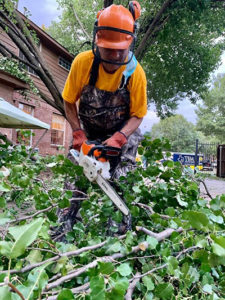
Although his home sustained damage, Pastor Ryan Chandler remains thankful—particularly for the work of TBM volunteers serving in his community. (TBM Photo / Rand Jenkins)
Chandler, the pastor of Trinity Baptist Church in Orange, doesn’t even have to leave home. The storm toppled trees around his house, including one that punctured his roof. He doesn’t have electricity yet, and his ceiling leaks.
“It hurts you emotionally,” he said. “We cried a little bit, but we realized how fortunate we were. It could have been much worse.”
The first wave of help came when area residents returned to their homes after mandatory evacuations. Among them was church member and TBM volunteer Rocky Mize. He rallied a few other TBM volunteers who grabbed their chainsaws and went to work. One of their first stops was their pastor’s house.
“As soon as they heard I had a tree in my house, they said: ‘We’re on the way. We’re coming. We’ll be there first chance we get,’” Chandler recalled.
Though Texas did not take the brunt of the hurricane’s force, Southeast Texas was affected significantly. Electricity remains out in many places. Fuel is scarce. Some cities still do not have clean water. People are searching for help.
“As we drive around, Orange is littered with trees all over the place,” Chandler said. “It’s amazing that had they fallen five feet this way or another way, it could have been much, much worse.”
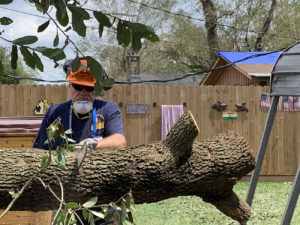
TBM chainsaw crews are working in Orange and the surrounding area. (TBM Photo / Rand Jenkins)
Four TBM chainsaw teams, four assessor teams, a food-service team, a shower/laundry team, an incident management team and chaplains are serving in and around Orange.
“The days ahead will be challenging,” TBM Chief Executive Officer Mickey Lenamon said. “But these are the kinds of days in which God calls TBM to serve. Volunteers will lift spirits as they lift limbs. They will help people do what they could not do on their own. And at each house, God will work in small moments to transform lives.”
The need is so great, TBM is opening an additional site at East Texas Baptist Encampment in Newton County that will allow teams to serve a wider area.
“We have a month’s worth of work here,” TBM Interim Director of Disaster Relief David Wells said.
Within a few days after Hurricane Laura hit Southeast Texas, TBM chainsaw crews already had 265 work orders in the Orange area. (TBM Photo / Rand Jenkins)
“After a few days, we have 265 work orders just in Orange. That typically doesn’t happen until later in this process. TBM volunteers are working hard. Their spirit is strong, and they’re ready to serve the Lord.”
By Sept. 2, parts of Orange had limited access to electricity, powered by generators. Grocery stores began reopening.
Chandler expressed thanks to TBM teams who continue helping his church members, as well as helping him connect with people in the community. Those meetings lay the groundwork for future outreach. By first meeting needs, people across the region are more receptive to hearing the gospel.
“Our main purpose is not just to come cut the trees,” Mize told a radio station. “We come to share the message of Jesus with people. We come to offer help and healing.”
To support TBM disaster relief financially, give online at TBMTX.org/donate or mail a check to Texas Baptist Men, 5351 Catron Drive, Dallas 75227.
Records reveal R.C. Buckner was a slaveholder
September 2, 2020
DALLAS—Buckner International recently learned 160-year-old records show its long-revered namesake founder, R.C. Buckner, was a slaveholder.
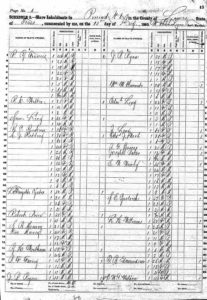
The 1860 “slave schedule” for Lamar County revealed Buckner—who was pastor of First Baptist Church in Paris at the time—as the owner of an enslaved 16-year-old Black female.
Albert Reyes, president and CEO of Buckner International, sent an email and video to staff last week acknowledging the discovery, and the organization issued a public statement Sept. 2.
“We cannot vindicate history, nor can we vindicate those who lived it. Slavery in America was one of the vilest sins ever perpetuated against humanity. It was wrong, and those who owned other human beings cannot and should not be given a pass. We owe it to enslaved people of the past and their descendants to openly acknowledge this evil,” Reyes stated.
‘Painful’ history acknowledged
The revelation about “Father Buckner,” as he was known for generations, came as a surprise and as a reminder “that history is indeed painful at times,” he acknowledged.
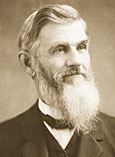
R.C. Buckner
“For many of us who have revered R.C. Buckner, it is a reminder that Jesus Christ is the only person in human history who lived a faultless life,” Reyes stated. “Scripture tells us to ‘fix our eyes on Jesus, the author and perfecter of our faith.’ Our Buckner mission statement admonishes us ‘to follow the example of Jesus in serving vulnerable children, families, and senior adults.’
“And while we are disappointed with R.C. Buckner’s human failure, we nonetheless remember the impact of this ministry throughout 14 decades, and we rejoice for those whose lives have been changed.”
Buckner International leaders first learned about the Lamar County “slave schedule” when Editor Brian Kaylor of Word & Way, a Missouri-based Baptist news organization, brought it to their attention.
Kaylor told the Baptist Standard he first began accessing online slaveholding records when he was researching his own church’s history—a search that revealed several of its pastors had been slaveholders. After discovering the online tools, available through services used by genealogical researchers, he said he “randomly” entered the names of individuals related to Baptist institutions on occasion.
“On a whim,” Kaylor said, he searched for information related to R.C. Buckner after Buckner International’s board of trustees issued a statement in July denouncing “racism in all its forms” and affirming the organization’s “commitment to racial reconciliation.”
Historians investigate
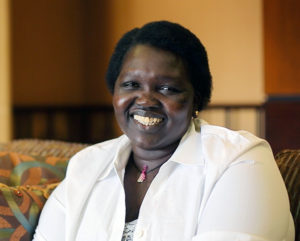
In his email to employees, Reyes noted Buckner’s executive leaders contacted three Baptist historians—Estelle Owens, retired history professor at Wayland Baptist University; Alan Lefever, director of the Texas Baptist Historical Collection; and Karen Bullock with the B.H. Carroll Theological Institute and Buckner biographer—to verify the information Kaylor presented.
Owens “conducted extensive research on this issue to confirm the veracity of this document and to understand any context that might explain this surprising information,” Reyes wrote.
“She spent most of three weeks tracking down records and talking with county officials in Kentucky and Lamar County. She visited with librarians and searched scores of online documents,” he continued. “At the end of her work, Dr. Owens concluded that there is nothing to dispute the 1860 slave schedule, and there is no explanation in the historical record.”
Lefever, who serves on a 26-member commission appointed two months ago to study Baylor University’s historical links to slavery, noted “records indicate that many prominent Baptist leaders in the 19th century owned slaves,” Reyes wrote.
Bullock, who wrote her doctoral dissertation on R.C. Buckner, said “while doing her research, she had heard rumors of this (slave ownership), but she was never able to uncover any evidence,” Reyes wrote. “Her work was conducted long before online resources were available.”
Buckner known as social reformer
Based on what is known about Buckner’s generally progressive attitude toward African Americans, Reyes said, Bullock offered three possible explanations regarding the newly uncovered evidence:
The enslaved female was given to R.C. and Vienna Buckner by her family and then freed.
The Buckners took the girl into their home when they arrived in Paris in 1860 so that they could free her.
They did, in fact, own an enslaved Black female for domestic housework.
“Dr. Bullock points out that records show that the Buckners had previously freed slaves they inherited from family members,” Reyes wrote.
In a May 2013 Baptist history column Bullock wrote for CommonCall magazine, she noted Texas Baptists referred to Buckner as “Sir Great Heart,” not only for his philanthropic work, but also for his pioneering leadership as a social reformer—including the area of race relations.
“Buckner served as president of the Baptist General Convention of Texas 20 consecutive years, becoming a respected national voice for the wounded and powerless,” she wrote.
In his public statement, Reyes noted Buckner founded the first Black high school in North Texas, the first orphanage in Texas for African American children and the first Black Baptist association in Texas.
“On his 86th birthday in 1919, the Dallas Express, the oldest and largest Black-owned newspaper in the South, reported that African American friends from across the southwest went to Buckner Orphans Home ‘to do honor to Father R.C. Buckner,’” he stated.
‘Forward Together’
Even so, “those who owned slaves cannot and should not be given a pass,” Reyes wrote in his email to staff. “It was wrong, and we owe it to slaves of the past and their descendants to be honest and truthful.”
Buckner held a town hall meeting Aug. 31 to discuss the matter and the new organizational initiative, Forward Together: A Plan of Action for Racial Equality, designed to “advance open conversations and actions in response to racial tensions in America” and their impact on Buckner’s staff, its ministry and those the organization serves.
“Today, our workforce is comprised of nearly 67 percent non-white staff. We serve an equally diverse population of children and families. And yet we must press on, knowing that numbers alone do not define equality,” Reyes stated.
He quoted Martin Luther King Jr.: “If you can’t fly, then run. If you can’t run, then walk. If you can’t walk, then crawl. But whatever you do, you have to keep moving forward.”
Charges against former Village Church employee dismissed
September 2, 2020
A district court granted the Dallas County District Attorney’s office motion to dismiss criminal charges against Matthew Tonne, a former employee of The Village Church in Flower Mound, for an alleged sex offense due to “lack of probable cause.”
Tonne, a former associate children’s minister at the Dallas-area megachurch, had been accused of indecency with a child involving sexual contact. The Dallas County grand jury indicted Tonne in January 2019 for an offense that allegedly occurred in 2012 at a Kids Camp at Mount Lebanon Retreat and Conference Center in Cedar Hill.
A motion to dismiss granted Aug. 27 by the 265th Judicial District Court noted the case had been “thoroughly investigated” by the Cedar Hill Police Department and the Dallas County District Attorney’s office. The motion stated the individual who filed the complaint “cannot and has not positively identified” Tonne as the offender.
“At the time this case was presented to the Dallas County Grand Jury, the complainant could not and did not positively identify defendant as the person who committed this offense. Despite that fact, the Grand Jury indicted the case,” the motion stated.
“Upon further investigation by the Dallas County District Attorney’s Office, the fact remains that the complainant cannot and has not positively identified defendant as the person who committed this offense.
“The Dallas County District Attorney’s Office therefore moves to dismiss this case in the interest of justice because there was at the time of presentment, and there is at the time of this motion to dismiss, a lack of probable cause to believe the defendant committed this offense.”
Church posts online update
An Aug. 31 notice on The Village Church’s website titled “Update on 2012 Kids Camp Case” stated: “In 2018, we informed you of a criminal investigation involving one of our former employees, Matt Tonne. Last week, the Dallas County District Attorney’s Office moved to dismiss the criminal charges, and that motion was granted by the court. … We continue to pray for all involved.”
The online notice also included links to the church’s “Care Department” resources, including a hotline to text or call and information on obtaining a counseling referral.
The update on the website did not provide any information about a lawsuit against the church by a woman who alleged Tonne sexually assaulted her when she was 12 years old.
In a legal response filed Aug. 23, 2019, in Dallas County Court, the church asserted it was not liable for damages and challenged the plaintiff’s claim of more than $1 million in damages, citing provisions in the Texas Civil Practices and Remedies Code, as well as the Texas Charitable Immunity Act.
The attorney of record who was representing the church in the civil action did not respond to an email from the Baptist Standard within 24 hours. The Standard attempted to contact the church by phone, but a recording said offices are closed.
Religion News Service quoted J. Mitchell Little, one of the lawyers representing the woman who accused Tonne, as saying the district attorney did not speak to his client before dismissing the charges.
“Our client and her family are shocked and disgusted at the Dallas County District Attorney’s sudden decision to dismiss this case without so much as consulting her or even picking up the telephone to talk with her before they decided to dismiss it,” he told RNS.
He added the lawsuit against The Village Church is moving forward, and he expects a jury trial in 2021.
EDITOR’S NOTE: The last three paragraphs were added Sept. 2 after the article originally was posted the previous day.
Missionaries’ impact on family felt across generations
September 2, 2020
SUGAR LAND—Missionaries who served in China around the time of legendary Baptist missionary Lottie Moon’s death indirectly became responsible for several generations of Baptist preachers and lay leaders in Mexico.
When he was growing up in Mexico, Federico “Fred” Chow of Sugar Land could not remember meeting another child his age who wasn’t Catholic, other than at the Baptist church he and his family attended.
“One day I asked my grandmother, ‘Why are we Baptists?’” he recalled.
His grandmother Margarita Pangtay Chow told him about how his great-grandfather owned a mine in northern Mexico until the time of the Mexican Revolution. When Pancho Villa and his forces began to stir up animosity toward Chinese immigrants in Mexico, Chow’s great-grandfather Alajandro Pangtay moved his family back to Canton, China.
“Going to school there, the missionaries were very nice to me,” Chow’s grandmother told him. “They taught me good things. They taught me about the Bible.”
Consequently, when the family eventually returned to Mexico in the 1920s, they sought out Baptist missionaries and the churches those missionaries had helped to start.
“It shows how missionaries have an impact, even if the result of their work is not seen until years later,” Chow said.
Likewise, Chow’s great-uncle and grandmother on the other side of his family were deeply influenced by a Baptist pastor and his wife in Tampico who showed them kindness and offered them protection after both of their parents died.
Impact felt across generations
The impact of Baptist missionaries and national Baptist ministers continued from one generation to the next in his family, Chow said.
In particular, the history of Primera Iglesia Bautista in Tampico, Mexico, has been inextricably linked to his family.
Juan Ramos Castillo—one of Chow’s relatives—helped establish the church and was its pastor from about 1911 to 1920.
Decades later, Ernesto Aguilar—another member of Chow’s family—was pastor of that church from 1988 until his death in 2005. Previously, Aguilar had been pastor of Segunda Iglesia Bautista in Mexico City.
Several other members of Chow’s extended family became Baptist pastors and missionaries in Mexico and the United States:
Librado Ramos was pastor in Mexico more than four decades, serving Primera Iglesia Bautista in Mexico City until his death in 1990.
Job Ramos Lozano was pastor of Eliacim Baptist Church in Tampico until his death in 1994.
Homero Ramos was a pastor and church planter for 50 years. He was instrumental in founding Baptist churches in Matamoros, Tampico, Progreso and Mexico City. He also was pastor of Primera Iglesia Bautista in Reynosa and Emanuel Baptist Temple in McAllen.
Sergio Ramos, who served in international missions, now is pastor of The Promise Church in Dallas.
Mike Hart is minister of missions at First Baptist Church in Tulsa, Okla. He served previously as director of a Baptist academy in Blue Springs, Mo. He and his wife Kathy and their two daughters also spent several years as missionaries in the Philippines.
Oliver Martinez is pastor of Iglesia Bautista Getsemani in Fort Worth.
Susanna Chow (3rd from left), now age 82, is pictured as a child with her siblings (left to right) Federico, Jose, Guillermo, Francisco and Victoria. (Photo courtesy of Fred Chow)
Chow specifically mentioned an aunt, Susanna Chow—Margarita Pangtay Chow’s daughter—who earned her doctorate in chemical engineering in France and worked for Pemex, Mexico’s state-owned petroleum company. Today, she lives in Mexico City and is the author of more than 300 technical papers and four books, holds several patents and is the recipient of multiple international awards.
“In the latter part of her career, she focused more on quality control and quality assurance models, lecturing on the subject in different countries,” Chow said.
Those lectures soon developed into “quality of life” messages, which she used as a platform for sharing her faith in multiple venues, he noted. At age 82, she continues to travel extensively throughout Mexico presenting her Christian message.
‘Family’s commitment still going strong’
When Chow was a teenager, his parents sent him to Valley Baptist Academy in Harlingen. At the academy, he became involved with Royal Ambassadors, and he was coached and mentored by Manuel Galindo, now pastor of Olmito Baptist Church in Cameron County, with whom he remains in close contact.
Chow went on to earn a degree in petroleum engineering from Texas A&M University. He worked 30 years for Halliburton, beginning as a field engineer and working his way through the ranks to the global director’s post.
After retiring from the multinational corporation, Chow formed his own energy consulting company headquartered in Villahermosa, Mexico.
Today he divides his time between his home in Sugar Land, where he and his wife Lili are members of Grand Parkway Baptist Church in nearby Richmond, and his business in Villahermosa, where he attends Iglesia Bautista Arrebatamiento. On any given Sunday, he is attending church in one of those cities or the other.
“A hundred years after my grandmother met missionaries who were ‘very nice’ to her, my family’s commitment is still going strong,” Chow said.
TBM disaster relief meets needs after Hurricane Laura
September 2, 2020
Texas Baptist Men disaster relief volunteers are meeting needs of people impacted by Hurricane Laura and beyond.
In San Antonio, TBM’s Texans on Mission volunteers help distribute food in partnership with the Red Cross to people who evacuated their homes as a result of Hurricane Laura. (TBM Photo)
A TBM chainsaw crew from Orange is working locally, cutting and removing broken limbs and fallen trees from the storm. They will be joined by a TBM feeding team and a TBM shower/laundry unit from Belton, which is en route Aug. 28.
Two additional chainsaw teams will join the effort this weekend, one from Collin County and from Kingsland Baptist Church in Katy.
In San Antonio, TBM’s Texans on Mission volunteers are distributing boxes of food in partnership with the Red Cross to people who evacuated as a result of Hurricane Laura.
“Hurricane Laura has changed lives all across the region,” TBM Chief Executive Officer Mickey Lenamon said.
“Our volunteers are delivering help, hope and healing to the hurting. Whether we’re cutting down a tree or providing a meal, we want people to know God loves them.”
To support TBM disaster relief financially, give online at TBMTX.org/donate or mail a check to Texas Baptist Men, 5351 Catron Drive, Dallas 75227.
Mount Lebanon marks ministry milestone during pandemic
September 2, 2020
CEDAR HILL—Mount Lebanon Retreat and Conference Center has made a spiritual impact in the lives of campers for nearly 75 years. But this year’s summer camp season has been unlike any previous year in the retreat center’s history.
In a typical summer, Mount Lebanon hosts 10 weeks of camp with a total of about 8,500 campers on the 500-acre campground near Cedar Hill, south of Dallas.
“Because of the worsening COVID-19 numbers, we only held two weeks of summer camp this year with a combined attendance of only 847,” said Camp Director Roger Jackson.
The greatest challenge caused by this year’s drastically reduced numbers is what Jackson describes as “opportunity costs.”
“For many children and youth, this may have been their only chance to attend a Christian summer camp,” he said. “The group or cohort they would have been a part of will definitely change.
“It’s a real financial crisis for all of our Texas camps,” he added. “We’ll have to depend on reserve funds and unrestricted accounts just to continue to stay open.”
Bright spots during a tough time
While many “life-changing, life-altering Spirit-led moments in a Christian camp environment were greatly missed this summer,” Jackson said there still are significant bright spots as Mount Lebanon prepares to mark its 75th anniversary this fall.
Most notably, the campers who did attend camp this summer were able to experience the personal spiritual growth, training and fellowship that has been at the heart of Mount Lebanon’s ministry over the decades.
“We are glad that camp still happened this year and so grateful for everyone who worked so hard to make it happen,” said Shera Clowdus of First Baptist Church in Benbrook. “Even with the COVID changes, our kids still had a great time. Our church is so thankful for this camp and for the staff who put their heart and soul into giving them the best experience possible.”
“This is a gift to our kids this year. It’s such a blessing,” agreed Melva Shubert of First Baptist Church of Round Rock. “We knew if any camp could make this happen, Mount Lebanon would jump through the hoops to make this week possible.”
WMU leaders leave living legacy
Throughout Mount Lebanon’s history, the camp has stood as a living tribute to the vision and generosity of dedicated Baptist leaders from the 1940s.
Mount Lebanon Christian Camp and Retreat Center, which has been welcoming campers since the 1940s, will mark its 75th year of ministry this fall. Woman’s Missionary Union leaders in Dallas Baptist Association were instrumental in helping obtain the campground’s 500 acres in 1945. (WMU photo by Pam Henderson)
Chief among those Baptist visionaries were Gladys Moore, who served at the time as Woman’s Missionary Union president for Dallas Baptist Association, and Tom and Pauline Patton, members of Calvary Baptist Church of Oak Cliff, Texas.
“It’s an interesting story how Gladys Moore approached the Pattons about giving land for the expanding camping ministry of the boys and girls missions in the Dallas Baptist Association and Tom was receptive to the idea,” Jackson said.
“I feel like God had already shaped his heart to give to this. He just needed the opportunity and the WMU leadership presented him the opportunity to give this land to the work. Almost immediately, Tom felt called to do this.”
Following Moore’s visit to the Pattons in August 1945, Dallas Baptist Association leaders voted three months later to accept the gift of about 500 acres to be developed into an associational camp for children and youth. By the summer of 1948, the first WMU-related camps were held on the property with 850 campers registered.
Years later, Patton told Mrs. Moore, “Of all the things I have done, the land given for Mount Lebanon is the greatest blessing. I know thousands of lives have been changed because of it.”
“There’s no question that the WMU made a significant effort to get the land for Mount Lebanon,” Jackson reflected. “Without their persistent efforts, this may not have happened. We’ve continued a relationship with WMU through all these years. They continue to have missions camp even to this day.”
Mission remains unchanged
Over the years, Mount Lebanon has grown into one of the largest Christian camp facilities in Texas. Jackson, who joined the camp staff in 1982 and became camp director in 2004, said Mount Lebanon typically hosts about 30,000 people a year for summer camps and retreats and conferences throughout the year.
Mount Lebanon Camp has been serving campers from throughout the Dallas-Fort Worth area since the 1940s. The camp’s facilities have grown over the years to include a large worship center, dining hall, motel, 15 lodges, nine bunkhouses and a variety of recreational facilities. (WMU photo by Pam Henderson)
Today’s facilities include a large worship center, dining hall, motel, 15 lodges, nine bunkhouses and a variety of recreational facilities ranging from high and low ropes courses to swimming pools and volleyball courts.
Amid this year’s financial setbacks, the Texas Baptist Missions Foundation came alongside Mount Lebanon and the 26 other Texas Baptist camps to help raise much-needed financial support. The foundation launched a Camp Relief Fund campaign and matching fund to help camps stay open and continue to reach children and youth for Christ. Camp leaders also are inviting area churches and individuals to contribute to support the camp during this challenging time.
Despite the overwhelming impact of a global pandemic, Jackson said summer camp remains “a special kind of venue that’s of interest to a lot of people.”
Affirming that Mount Lebanon’s primary mission remains unchanged, he concluded: “We have 500 beautiful wooded acres here so everyone that comes here can have a sense of being away, getting quiet and have a place to draw close to God. … It’s a time where young adults and children can make professions of faith and grow in their spiritual walk.”
Ministries prepare for Hurricane Laura
September 2, 2020
Texas Baptist Men placed all its disaster relief volunteers on standby and Buckner International ministries evacuated personnel and clients from Beaumont in preparation for Hurricane Laura.
From Galveston to southwest Louisiana, about a half-million residents were ordered to evacuate as Hurricane Laura intensified. It was expected to make landfall late Aug. 26 or early Aug. 27, possibly as a Category 4 storm that could cause a catastrophic storm surge.
TBM disaster relief volunteers in Dallas loaded water and prepared a mobile kitchen to deploy to Southeast Texas as Hurricane Laura threatened the Gulf Coast. (TBM Photo)
All TBM disaster relief units and 5,300 volunteers have been placed on standby, including rapid response teams who are prepared to be serving within 24 hours after the storm hits.
Mud-out crews are preparing to clean out and disinfect any flooded homes, and chainsaw teams will remove fallen trees and broken limbs that present danger to residents.
Other volunteers will provide emergency food service, chaplaincy and access to showers and laundry equipment.
“Hurricane Laura is a significant storm poised to cause significant damage,” said Mickey Lenamon, TBM chief executive officer. “Our volunteers are packed and ready to serve as soon as we can. Together, TBM volunteers will deliver help, hope and healing in the hardest days of people’s lives. Please pray for everyone who will be affected by the storm as well as those who will respond to needs.”
Buckner evacuates from Beaumont
Staff at Buckner Children and Family Services and Buckner’s Calder Woods senior living facility began evacuation in the Beaumont area following a mandatory order issued by Jefferson County officials Aug. 24.
Evacuating people during the COVID-19 pandemic posed additional hurdles, Buckner President Albert Reyes acknowledged.
“But our team was well prepared from past hurricanes and the work we have done the past six months mitigating risks from the pandemic,” Reyes said. “I’m proud of our teams’ response and would ask for prayers this week for Buckner and for everyone affected by these storms.”
Buckner staff started monitoring the storms a week earlier when the tropical storms Laura and Marco caused meteorologists to predict the unprecedented possibility of two hurricanes simultaneously in the Gulf of Mexico. While Marco eventually weakened, Laura continued to build momentum.
Children and foster families relocate to Camp Buckner
Early Aug. 25, a caravan of cars and vans containing 76 mask-wearing staff, children and families from Buckner Children and Family Services left Beaumont headed west to the safety of Camp Buckner near Burnet. The group included 18 Buckner employees and their families, along with 17 children from the assessment center and foster families.
“The children in the care of Buckner are already processing through many issues that impacted them earlier in life. When you compound that trauma with additional large-scale crises like a hurricane and global pandemic, a greater uncertainty emerges as their worlds keep changing,” said Henry Jackson, senior vice president of Buckner Children and Family Services.
Camp Buckner employs a licensed counselor, who will work with the displaced children and staff to help alleviate the additional stress and fear from the storm and travel.
“Our amazing staff in Beaumont and at Camp Buckner are certainly rising to the challenge to provide a calm and caring response while providing for the children’s physical, emotional and psychological needs,” Jackson said. “I am extremely proud of our Children and Family Services professionals who continuously provide a sense of normalcy for vulnerable children and let them know they do not have to carry the extra burden themselves.”
Calder Woods residents go to Houston, Austin and Dallas
At the same time, Calder Woods associates in full personal protection equipment worked all morning to assist 68 health care residents as they safely boarded an assortment of ambulances and charter buses bound for Parkway Place in Houston, Buckner Villas in Austin and Ventana by Buckner in Dallas. More than two dozen associates evacuated to provide care for the residents.
“The team across all of Buckner Retirement Services continues to stand firm against the many challenges we have faced this year,” said Charlie Wilson, senior vice president of Buckner Retirement Services. “In the midst of the COVID-19 pandemic, we are now evacuating Calder Woods in Beaumont to three of our sister campuses, where they will be protected and cared for by our associates. These dedicated associates are true heroes, resilient in their dedication to serving seniors.”
In addition to the impact of Laura on Buckner’s work in Texas, staff affiliated with Buckner Dominicana in the Dominican Republic report they are assessing the storm’s damage on the island, where 12 people were reported killed.
Dexton Shores, senior executive director who oversees Buckner’s international ministries, said most of the storm damage hit the island opposite of where Buckner has operations.
This is not the first time Baptist Children and Family Services and Buckner Retirement Services staff and clients have been forced to evacuate the Beaumont campuses, Reyes said. Previous evacuations occurred in 2008 due to Hurricane Ike and 2005 due to Hurricane Rita. Buckner Children and Family Services also evacuated in 2017 due to Hurricane Harvey.
“At the beginning of the year, we were making plans to celebrate the 50th anniversary of our work in Southeast Texas, but 2020 had other plans,” Reyes said. “In many ways, the COVID-19 pandemic and now the hurricane evacuation are symbolic of the flexibility and resilience of our amazing teams and how they continue to care for vulnerable children, families and seniors regardless of the extenuating circumstances.”
Compiled from reports by Texas Baptist Men and Buckner International.
Save HSU representatives meet with university leaders
September 2, 2020
More than six months after Hardin-Simmons University trustees voted to close Logsdon Seminary, top university administrators and several trustees met with two representatives of the Save Hardin-Simmons group.
Laura Moore of Abilene, chair of the HSU board of trustees, facilitated the mid-August meeting. Participants included Eric Bruntmyer, HSU president; Chris McNair, provost and chief academic officer; and Jodie McGaughey, vice president for finance; as well as Drue Pounds of Colleyville, chair of the board’s finance committee; several other trustees; and additional senior-level members of the HSU administration.
“As always, our goal is to affirm the relationship Hardin-Simmons University has with its alumni, friends, benefactors and others in the community. Our goal was the same for this recent meeting,” university officials stated in an Aug. 25 email.
Kyle Tubbs, president of the Logsdon Alumni Council, and Rob Sellers, retired professor of theology and missions at the seminary, represented Save Hardin-Simmons, a group initially formed on social media as Save Logsdon Seminary.
“The idea for the meeting was first floated as just between the president and me. I have been requesting a meeting with him since February,” Tubbs said. “It then grew to a meeting between the president, board chair and me.”
When it expanded later to include other members of the university administration and trustees, Sellers offered to attend and provide the perspective of a former faculty member who was not currently under contract with the university or bound by a nondisclosure agreement, Tubbs said.
“I was grateful for such a growing audience in the room,” he said. “It provided an opportunity to ask questions directly to individuals who made the recent decisions to close Logsdon and those who created and changed the narrative around Logsdon’s closing. It also provided the opportunity for more ears to listen to the truth.”
Tubbs focused on different views about Logsdon
Tubbs noted his presentation focused on assertions made by HSU administration that have been contradicted by former administrators, faculty and staff.
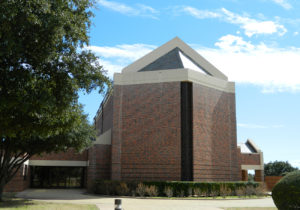
The Logsdon School of Theology on the Hardin-Simmons University campus. (Photo / Ken Camp)
Bruntmyer wrote in a Feb. 12 letter to the “HSU Family” that closing Logsdon Seminary was “solely a financial decision.” A Feb. 14 news release from HSU explained the plan to close the seminary was part of a larger reorganization implemented to address a more than $4 million operating deficit at the university.
Three days later, Bruntmyer told the Baptist General Convention of Texas Executive Board that HSU trustees decided to close Logsdon Seminary and direct endowment earnings to the school’s undergraduate religion programs because the university could not afford to “keep two financially weak programs going.”
“The seminary was never properly funded,” Bruntmyer told the BGCT Executive Board.
However, Don Williford, former dean of Logsdon Seminary, disputed that assertion, insisting that earnings from several endowments should have been sufficient.
“Considering the faculty reductions, which have primarily impacted Logsdon Seminary and endowment incomes which rightfully provide funding to both seminary and non-seminary programs, along with income from tuition income generated by both entities, it seems inconceivable that Logsdon Seminary should be creating such a financial crisis for Hardin-Simmons University,” Williford wrote in his Feb. 17 response to Bruntmyer.
Williford, Sellers and some other former faculty also asserted HSU surrendered to outside pressure from influential individuals who raised questions about the theological positions of some Logsdon Seminary professors.
Tubbs noted he was surprised to hear an HSU administrator at the mid-August meeting say Logsdon Seminary would need 1,000 students to be viable.
By way of comparison, Baylor University’s Truett Seminary fall enrollment for the current semester stood at 334 students as of Aug. 18—269 in master’s degree programs, 54 in the Doctor of Ministry degree program, seven in the Ph.D. in preaching program and four non-degree-seeking students.
HSU offered a clarification in an Aug. 25 email: “Based on the current seminary education delivery model, there is no specific number of students that would have provided financial sustainability for Logsdon Seminary. Increasing the number of students at the current tuition and discount rate would continue to increase costs as well. A large number was stated in the context of attempting to communicate this during the meeting, and focusing on the specific number misses the point. The Hardin-Simmons University board of trustees made decisions that have positioned and will continue to position the university for long-term success and growth.”
Group urges HSU to release documents
Tubbs insisted he and his group “just want the truth”—about motives for closing Logsdon Seminary and about the financial situation at HSU.
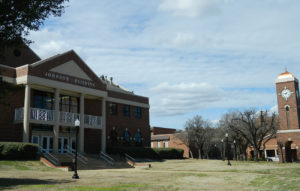
The Johnson Building on the Hardin-Simmons University campus. (Photo / Ken Camp)
“We have asked for a forensic audit of university finances, for minutes from trustee meetings to be released, and for the university financial plan to be made public,” he said. “We want to see how and why decisions were made.”
The university responded by stating, “HSU completes proper third-party financial auditing each year, provides regular documentation and reporting to our accreditors and regulatory agencies, and is therefore appropriately accountable in all respects to those with authority over the university.”
University officials voiced hope for the future, saying, “We appreciate the concern and love for Hardin-Simmons University and look forward to a long and bright future of providing education enlightened by Christian faith and values.”
Tubbs expressed appreciation to the trustee board chair, whom he said “worked as a gracious bridge-builder throughout this process” and voiced hope for cooperation in the future.
“I believe change, unity and progress can happen if we join with the trustees and work for a better future for HSU,” he said. “That being said, the truth of the recent past and present will need to be dealt with honestly and with transparency to move HSU to a healthy place.”
CommonCall: Deliberately diverse
September 2, 2020
ARLINGTON—Fielder Church in Arlington isn’t heaven, but Erin Benton believes the resemblance is greater now than when she and her family joined the congregation 15 years ago.
At that time, the church was about 97 percent Anglo. Gary Smith, then pastor of Fielder Church, recognized the demographics of Arlington had changed, and the congregation no longer reflected its community. He began efforts to make the church staff more racially and ethnically diverse and to lead the congregation toward intentional diversity.
Not long before Erin Benton and her husband Luke arrived at Fielder Church, Jason Paredes joined the church staff as pastor of a mission to reach the city’s growing Spanish-speaking population.
Time of transition
Then in early 2014, Fielder Church overwhelmingly approved a transition plan leading up to their longtime pastor’s retirement in two-and-a-half years and called Paredes as senior pastor-elect.
Paredes and Smith shared preaching responsibilities. Paredes also shared with Smith plans he wanted to see the church implement, such as becoming a multisite congregation and offering bilingual services.
That’s when Smith offered Paredes an object lesson in what Leith Anderson, an evangelical pastor in Minnesota, memorably referred to as “parish poker.” Just as a poker player needs chips to enter a game, a minister begins a new pastorate with a stake roughly equivalent to the percentage of the congregation that voted to call him. As the pastor spends time with the church—visiting the sick, preaching funerals, walking with members through difficult times—he continues to earn chips.
“Gary said, ‘Let me play my chips,’” Paredes recalled. “What I wanted to do would demand a lot of resources and raise a lot of questions. He knew it would be easier for the one who had been lead pastor of 25 years than for the new pastor. So, he removed what probably would have been a roadblock for me. By the time I took the reins, the changes had been made.”
The church committed itself to making disciples and living out the gospel through generosity, sacrificial service, missional living, church planting and providing access to the gospel through multiple sites.
Currently, Fielder Church meets at three sites—in South Central Arlington, in western Grand Prairie and at South Oaks, on U.S. Highway 287 south of Interstate 20. Within the next six years, the church hopes to expand to six campuses.
Diversity by design
Fielder Church also determined it would celebrate differences and seek to become—by 2026—a congregation where no ethnic or cultural group represents more than 50 percent of the multigenerational church family.
Pastor Jason Paredes is leading Fielder Church in Arlington to reflect the ethnic and racial composition of its community. (Photo / Ken Camp)
“We’re not where we need to be, but we’re way ahead of where we were,” Paredes said.
Currently, the congregation is about two-thirds Anglo, 18 percent Hispanic and 10 percent African American, with the remainder including representatives from several Asian ethnic groups, he reported.
The non-Anglo proportion of the congregation continues to increase 1 percent to 3 percent each year, and the church tracks its progress toward increased diversity in an annual survey.
“It’s a tender balance,” Paredes acknowledged. “If we’re not careful, we can unintentionally send a message that we don’t value our white members, and that’s not the case. We don’t want to lose anybody.”
More than one-third of the staff at Fielder Church is non-Anglo, and worship planners make certain those who lead in worship each Sunday represent the congregation’s commitment to diversity.
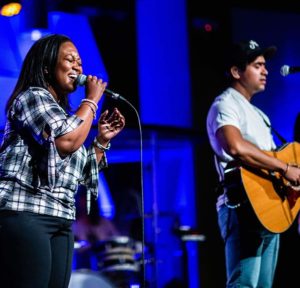
Fielder Church in Arlington seeks to model ethnic and racial diversity in its worship leadership teams. (Photo Courtesy of Fielder Church)
“The people on the platform reflect the congregation and the city,” Paredes said. “We consider it a failure if it appears monocultural when you look up on the stage.”
Music is selected that similarly reflects the cultural diversity, as well as generational preferences, and the music ministry staff writes or adapts songs to “weave together the cultures,” he said.
Fielder Church’s commitment to diversity not only shapes worship, but also affects how the congregation handles differences of opinion, Paredes noted.
“Our society is incredibly polarized. We prayed for diversity, and God answered that prayer. So, we will have polarized opinions,” he said.
Dealing with sensitive issues
Diversity in the congregation influences how the pastor approaches sensitive topics in his sermons. When George Floyd died in Minneapolis, Minn., on May 25 after a white police officer knelt on his neck for 8 minutes and 46 seconds, it sparked protests against racial injustice throughout the United States—including Tarrant County.
“If we are committed to being radically diverse, silence would have been deafening in that moment. I said, ‘We’ve got to talk about this,’” Paredes said. “We needed to deal with it head on.”
He challenged members of his congregation to recognize and repent of their prejudices and to find ways to take positive action. He announced a series of conversations his congregation plans to enter with a historically African American church.
Paredes also told his congregation he and his family would participate in a peaceful march for racial justice organized by a Black church and endorsed by city leaders.
“I was able to say to the church, ‘Our mayor has asked us to be part of it,’” he said. “I didn’t know how they would react. I didn’t know what to expect, but they came out by the hundreds. It was all ages and ethnicities. I was moved and shaken—in a good way.”
Cooperation and community service
Fielder Church developed a reputation in Arlington for community involvement through efforts such as the Serve the City events. (Photo Courtesy of Fielder Church)
Fielder Church has developed a reputation for community involvement and cooperating with other congregations in the city, such as a back-to-school backpack drive for the Arlington Independent School District.
Working with the Dallas Cowboys, the annual event has grown to involve 35 churches throughout the community. Last year, the congregations provided more than 40,000 backpacks filled with school supplies for Arlington students.
Fielder Church also has invited other congregations to join periodic Serve the City events.
“That’s when we take off a Sunday from gathering for worship to go into the community to serve,” Paredes explained.
By expanding the Serve the City events from Sunday to include the entire weekend, Fielder Church has been able to involve 15 other churches of various ethnicities in the initiative.
As Fielder Church continues its pilgrimage toward increased diversity, congregational leaders make plans but remain ready to adjust along the way as new opportunities arise.
“The truth is we fast and pray,” Paredes said. “Every step we’ve taken has been after God has opened doors, and we have stepped through them. We know God’s glory is manifested when the dividing wall of hostility is torn down by the gospel.”
‘We’re on a journey. We haven’t arrived yet.”
That vision has captivated Erin Benton, who grew up attending culturally diverse congregations overseas when her parents served as missionaries in Hong Kong.
“It’s been a wonderful gift to our family,” she said.
She is grateful her four children—ages 16, 14, 11 and 6—have the opportunity to develop friendships and enjoy fellowship with peers from different backgrounds and cultures. She hopes those opportunities continue to increase at Fielder Church.
“We’re on a journey. We haven’t arrived yet,” she said. “We know from Revelation that heaven will include every nation, tribe, people and language, all gathered around the throne and worshipping. Our hope and prayer is that our children begin to see that, and it becomes the norm.”
Read more articles like this in CommonCall magazine. CommonCall explores issues important to Christians and features inspiring stories about disciples of Jesus living out their faith. An annual subscription is only $24. To subscribe to CommonCall, click here.
Literacy Connexus helps churches adapt ESL during pandemic
September 2, 2020
Church-based English-as-a-Second-Language ministries don’t have to end because of the COVID-19 pandemic, but they must adapt and remain flexible, a statewide literacy ministry leader insists.
“We’re building an airplane while we’re flying and having to revise along the way,” said Karen Peiser, ESL workshop coordinator with Literacy Connexus and director of ESL at Southland Baptist Church in San Angelo.
Trying new approaches
Around the state, churches with ESL ministries are experimenting with new approaches—not only to teach English literacy, but also to maintain contact with students during a difficult time, she noted.
The best approach for any group depends on the specific students, Peiser noted. International students at a university likely will have ready access to online instruction and be familiar with it. Students in low-income areas that lack Internet access may need individualized coaching through mail, texts, phone calls and in-person visits conducted in a safe environment.
“We want to help churches move forward,” even in the midst of a pandemic, said Lester Meriwether, executive director of Literacy Connexus.
Granted, some aspects of literacy ministry remain on hold for the immediate future, Peiser acknowledged. The intensive TEX (Teaching English with Excellence) workshops Literacy Connexus typically schedules don’t lend themselves to social distancing, she noted.
Sharing ideas, providing resources
However, while hands-on training events are suspended temporarily, learning opportunities for literacy volunteers can continue as Literacy Connexus creates idea-sharing platforms and makes resources easily accessible, she noted.
For example, a recent entry on the Literacy Connexus website provides ESL teachers suggestions on distance learning from the Immigrant Learning Center.
Another page on the site offers a series of links to introduce ESL teachers to tools such as Zoom, Facebook Messenger, WhatsApp and TalkingPoints that can help them stay connected with students.
Amarillo church has equipped internationals for decades
September 2, 2020
AMARILLO—Ministering to internationals is nothing new for First Baptist Church in Amarillo. In fact, the current ministry’s early roots date back to soon after World War II and the Korean War.
When American servicemen came back from those conflicts, many returned home with Japanese and Korean war brides who had little or no English skills, said Sue Kelly, director of the church’s English as a Second Language ministry.
For those who settled in Amarillo, volunteers from First Baptist organized language classes to help the women navigate their new culture.
First Baptist’s International Friends ministry continues to thrive decades later. Weekly ESL classes held on Thursday mornings and Sunday afternoons often attract more than 200 students from up to 25 countries. While the coronavirus pandemic cut short this year’s spring semester, plans are under way to launch ESL fall classes next month over Zoom.
A group of young people provide special music during a Karen-language worship service. Pastor Rainbow Gold (top, center) said many of the church’s 80 families are refugees from Burma who speak very little English. In addition to attending ESL classes, he said it is important for his congregation “to have our own church and speak in our own language and preach in our own language.” (WMU photo by Pam Henderson)
The church also serves refugees and other internationals with worship services held in six languages each week—Burundi, Congolese, Karen, Laotian and Vietnamese as well as English. Additionally, a rich blend of as many as 10 languages can be heard joyfully spilling out of the international Sunday school department on any given Sunday morning.
“Amarillo really has a very high refugee population for its size,” explained Kelly, who has coordinated the International Friends ESL program more than 20 years. “We just feel like the Lord brought them here, and we want to help them feel at home, welcome them, teach them English so that they can have friends in the community and so they can get better jobs.”
Along with teaching language skills, Kelly emphasized that sharing about Christ also is an important aspect of ESL ministry. Noting that “each class starts with a Bible verse,” she said, “We try to pick a verse that kind of fits with the English, because they come for the English.
“We offer Bibles and Jesus videos in their own language, and we have a Bible story for the large group. You see people from all different countries and all different backgrounds singing the songs and saying the Bible verses and learning about Jesus.”
Kelly first became involved in ESL in 1975, the same year as the fall of Saigon at the end of the Vietnam War, which sparked an influx of refugees from Vietnam and Laos. Over the years since then, Amarillo has welcomed refugees fleeing turmoil in Bosnia, Burma, Iran, Iraq and several African countries.
‘God spared me for a better job’
Boon Vongsurith, pastor of the Laotian congregation affiliated with First Baptist Church of Amarillo, escaped from Laos to Thailand in 1975 amid religious persecution. Forty-five years later, he still treasures the Bible that he carried with him as he escaped Laos by swimming across the treacherous Mekong River. (WMU photo by Pam Henderson)
Boon Vongsurith, pastor of First Baptist’s Laotian congregation, was among those who escaped from Laos to Thailand after being held captive because of his Christian faith. Sensing God’s direction to flee the persecution of his home country, he carefully wrapped his Bible in a plastic bag before swimming into the freezing Mekong River dividing Laos and Thailand.
“The two river banks were closed and anything that moved, they would shoot one another. I prayed to God, one prayer, two parts,” Vongsurith recounted. “I said: ‘God, I know in my head I will be drowned or killed escaping from Laos to Thailand. If I die, I pray someone will find my dead body and know that I’m a believer because of the Bible with me. But if you spare me, I will serve you any place, any time.’”
More than 45 minutes later, he made it safely across the river and into Thailand.
“This Bible is very important to me,” he said, gently holding aloft the treasured Bible he has carried with him for decades.
Declaring that “God spared me for a better job,” Vongsurith said, “The Laotian ministry here is from birth to burial. … Working with Laotians is a very high honor for me, because I love my God, and I serve my own people.”
Making friends for Christ’s sake
Kelly noted the ESL program’s “International Friends” title was intentional. “We want to teach them English, but we also want to be their friends and just get to know them,” she explained.
Sue Kelly (center), director of International Friends at First Baptist Church in Amarillo, visits with participants in the ministry’s English as a Second Language program. The International Friends ESL classes often involve more than 200 students from up to 25 countries. (WMU photo by Pam Henderson)
Affirming “it’s fascinating” to build relationships with people from around the world, she added, “I just enjoy getting to know them and have been in their homes and they’ve been in my home.”
International Friends offers beginning conversation and advanced ESL training, as well as GED and citizenship classes and private tutoring. The classes are led by a team of more than 20 teachers who volunteer their time each week.
Whether in person or online, the program continues to focus on each participant gradually becoming fluent in English.
“That doesn’t always happen because of where they start,” Kelly acknowledged. “If they have grown up and lived in a war-torn country all their lives where the schools were not even operating and they never learned to read and write in their first language … and now they’re adults in a country that doesn’t speak their native language, obviously they’re not going to be fluent readers and writers and speakers.”
Even amid those challenges, she added, many of the ESL students do learn to speak English fluently while reading and writing skills often remain harder to master.
From South Sudan to Amarillo
Diana Majok and her family, war refugees from South Sudan, are among the hundreds of internationals who have been welcomed by First Baptist in Amarillo over the years.
Diana Majok, a refugee from war-torn South Sudan, relocated with her family to Amarillo in 2005. After becoming involved in First Baptist Church of Amarillo, “we found the church family was our home and our family,” she reflected. Active in both ESL and Woman’s Missionary Union, Majok facilitates a Sudanese WMU group of about 20 women. (WMU photo by Pam Henderson)
“It was a miracle the way we found First Baptist Church,” Majok recalled. She said Mary Lou Serratt, “one of my friends who I call a sister,” knocked on her door and invited her family to church on the same day they were moving in to their apartment in 2005. Serratt is a longtime leader in the international Sunday school ministry and Woman’s Missionary Union of Texas.
“Since then, we found the church family was our home and our family,” Majok affirmed. “My husband and all of us found the truth. We learned how God died for us and how he loves us and what Christianity means.
“When we were coming from our country, we just called ourselves Christians, but we didn’t know what Christianity meant,” she said. “But Jesus died for us, and he forgave us. Then we accepted Jesus Christ as our Lord and Savior.”
Noting that Pastor Howie Batson baptized her, her husband and all five of their children, Majok added, “I always remember how they found us and how they welcomed us for Christianity. … It was really beautiful. It was a blessing.”
Majok said she is especially grateful for the church’s spiritual impact in the lives of their children. Their older daughter, who was named a National Acteens Panelist in 2010, recently served two years in Africa with the Southern Baptist Convention’s International Mission Board.
Active in both ESL and WMU, Majok has served on the state level as a member of the Texas WMU board of directors. Her WMU involvement at First Baptist in Amarillo includes facilitating a Sudanese WMU group of about 20 women who save and pool their coins for missions offerings and make and send handcrafted items to a missionary in West Africa.
“It shows us how much it helps when we put our hands together and help the missionaries who are all over the world,” Majok said. “It makes you feel a part of the body of Christ as we’re doing this together.”
‘The body of Christ is stronger’
Beverly Adcock teaches a class as part of First Baptist Church of Amarillo’s International Friends ESL program. More than 20 volunteer teachers typically lead classes for refugees and other internationals on Thursday mornings and Sunday afternoons. With the spring semester ending early due to the Covid-19 crisis, teachers and students are looking forward to classes launching online this fall. (WMU photo by Pam Henderson)
As First Baptist continues to meet the needs of individuals and families throughout Amarillo, “we found that the best ministries that we do, the most successful and fruitful ministries have come upon us organically,” explained Associate Pastor Trevor Brown, who coordinates the church’s missions emphasis.
“We didn’t go looking necessarily to achieve one thing in particular, but people started arriving in our city and our church has again and again responded, because they’ve been convinced from the beginning that love of neighbor is a part of what it means to be Christians,” he reflected. “They have loved these people, not because they were from a certain place or even necessarily because they were new, but because suddenly they were our neighbors.”
Emphasizing the church’s ministry to internationals is a two-way street, he said refugees and other immigrants “teach us new things about what it means to believe and what it means to have faith in God and to trust him.”
“The body of Christ is stronger when we’re more diverse,” Brown concluded. “The more people we welcome and the more space we find to let others worship here and the more we can equip internationals to reach their friends, the more the kingdom of God grows and comes alive right here in front of us.”
Texas Baptist Men disaster relief volunteers completed work in the Rio Grande Valley after Hurricane Hanna, responded rapidly when a summer storm damaged trees in North Texas and stood ready to serve after 112 mph winds hit the Midwest.
TBM crews devoted more than 4,800 volunteer hours to help Weslaco residents recover from the effects of Hurricane Hanna. Volunteers made more than 400 contacts, completing 34 flood recovery projects and 24 chainsaw jobs.
Heavy equipment operators logged 53 hours, food-service crews prepared more than 1,300 meals, and support teams provided access to 270 showers and washed more than 150 loads of laundry. TBM volunteers also distributed 86 Bibles and recorded 43 professions of faith in Christ.
Damaging winds and hail accompanied powerful thunderstorms that rolled through North Texas on Aug. 16. By 7 a.m. the next day, TBM chainsaw crews from Collin County were working in Allen. (TBM Photo)
Damaging winds and hail accompanied powerful thunderstorms that rolled through North Texas on Aug. 16. By 7 a.m. the next day, TBM chainsaw crews from Collin County were working in Allen, removing dangerous limbs and clearing fallen trees from homes.
“The reason we are here is not to cut these trees up,” said Dwain Carter, TBM disaster relief director. “The reason we’re here is to share the love of Christ.”
The desire to bring “help, hope and healing” motivates TBM disaster relief volunteers, he added.
“The help is what you see,” Carter continued. “It’s the actual physical work, which gives the homeowner the hope that everything’s going to be OK. And when you have those two combined, then the spiritual aspect comes in. … We share the help. We give a little hope. And God comes in with the healing part of it all.”
While dealing with disasters in Texas, TBM volunteers also were placed on alert for possible deployment to the Midwest after a derecho—a widespread line of intense windstorms that left 200,000 people in Nebraska, Iowa, Illinois, Indiana, Wisconsin and Michigan without electricity.
TBM emergency food-service, chainsaw, shower/laundry, chaplaincy and incident management teams all remained on alert and prepared to respond if mobilized.
To support TBM disaster relief financially, click on TBMTX.org/donate or mail a check to Texas Baptist Men, 5351 Catron Drive, Dallas, TX 75227.


 In his email to employees, Reyes noted Buckner’s executive leaders contacted three Baptist historians—Estelle Owens, retired history professor at Wayland Baptist University; Alan Lefever, director of the Texas Baptist Historical Collection; and Karen Bullock with the B.H. Carroll Theological Institute and Buckner biographer—to verify the information Kaylor presented.