DeSoto church serves community in season of need

Pastor Oscar Epps of Community Missionary Baptist Church in Desoto always has been passionate about meeting the needs of his community.

So, when the COVID-19 pandemic left many families hurting for food and other basic needs, Epps asked the church to give generously to provide supplies for these families.

Community Missionary Baptist Church responded, launching a food drive at its two campuses in Cedar Hill and DeSoto.

“It’s our pastor’s vision that our church should work outside of the four walls,” said Deacon Stephen Jackson, director of ministries at the church. “And during the pandemic, we saw people facing real needs. There were folks that were struggling, and our church’s mission is to take care of those that are less fortunate than us.”

Sherwyn Ramey, director of Christian education at the church, is leading the food distribution. Ramey coordinated a team of volunteers to give out food boxes and present the gospel to those in need.

Members of Community Missionary Baptist Church in DeSoto load boxes of food into a car. (Dominique Crawford Photography)

The food drive, which takes place at the church’s two campuses every Saturday, distributes up to 1,200 boxes of food weekly. Each grocery box contains a variety of fresh fruits and vegetables, dry goods, dairy products and other basic necessities. Each box is designed to carry the family through the week until they can receive their next one.

In June, the church partnered with the Mint Foundation and the U.S. Department of Agriculture to provide even more food to those in need. Since this partnership began, the church estimates more than 26,000 boxes of food have been distributed.

In addition to the boxes, the church also periodically distributes heaping plates of barbecue to the families that come to receive groceries. The barbecue dinner allows church members extra time to bond with the families and share Christ’s love with them.

To Ramey, this embodies the mission of Christ as recorded in Matthew 25: “I was hungry and you fed me. … Whatever you did for one of the least of these brothers and sisters of mine, you did for me.”

Ministry continues to expand

Seeing the success of the food drive, local law enforcement asked Community Missionary Baptist Church to deliver grocery boxes to apartment complexes where the crime rate is highest.

The church leaders agreed. In July, they began distributing between 300 and 500 boxes each Wednesday.

As they saw the needs in the apartment complexes, Epps expanded the program to also distribute laundry vouchers that could be redeemed at local laundromats. He and his congregation hope that this ministry will bring light and hope into an area that is often filled with darkness.

Jackson noted that the success of the church’s food drive is due largely to the congregation’s willingness to step up and serve. From assembling the boxes, to obtaining laundry vouchers, to serving food, church members have mobilized to help their hurting community.

“They are living out the Great Commandment and Great Commission,” said Roy Cotton, who recently announced his retirement as director of Texas Baptists’ African American Ministries.

“People cannot hear the gospel message when they are hungry. The ministry of the community missionary takes on an even greater significance when so many people are adversely affected by the pandemic.

“This ministry is serving ‘the least of these’ in their communities. They are making a difference, and people are coming to Christ because of it.”


Short-term volunteers multiply TBM disaster relief efforts

ORANGE—Jason Burden knows the heartbreak a natural disaster can cause. When Hurricane Harvey hit in 2017, the pastor of First Baptist Church in Nederland and his church were on the receiving end of help after facing this disaster in their community.

Almost three years later, Burden and his church members are serving those affected by Hurricane Laura.

“We were the church when Hurricane Harvey hit us a few years ago that Texas Baptist Men came to help.” Burden said. “We want to give back to those who gave so much to us and this is just a small way of doing that.”

Burden’s group is one of several who have served in the past few weeks as TBM Texans On Mission, an effort to multiply the efforts of trained TBM disaster relief volunteers by supplementing their work with volunteers who can serve for a day or weekend.

Texans on Mission provides avenue for service

Sabrina Pinales, TBM ministry advancement coordinator who coordinates these volunteers, said the initiative is designed to help people respond to God’s call to help the hurting after disasters.

A TBM Texans on Mission volunteer team from First Baptist Church in Nederland works in the Orange area after Hurricane Laura. (TBM Photo)

“After a tornado, hurricane or flood, God’s people naturally want to help the people who have been impacted.” Pinales said. “We want to help them do that. This gives people a glimpse of what disaster relief ministry looks like and the difference it makes in people’s lives.”

About 100 Texans on Mission from across the state have ministered in Southeast Texas recently in the Orange area.

“In Orange, TBM disaster relief has received hundreds of requests for help.” Pinales said. “Trained disaster relief volunteers are doing an amazing ministry. God is working through them. Texans on Mission come alongside them to help meet more needs.”

With the rollout of Texans on Mission volunteers, people are able to serve for a few days at a time through tasks such as cleaning debris, moving scattered objects in yards and clearing out fallen tree limbs.

A volunteer from First Baptist Church in Nederland serves with TBM Texans on Mission. (TBM Photo)

Whether it’s picking up debris and limbs or praying for a family facing tragedy, volunteers are excited to serve where needed.

“There’s always a need or opportunity, and we need your help to fill it.” Pinales said.

Nathan Mahand, director of the Houston Baptist University Baptist Student Ministry, has been a trained TBM disaster relief volunteer several years. He decided to bring his BSM students with him over the Labor Day weekend to serve. Allowing his students to minister instills the principles of living a missional lifestyle, he noted.

“These experiences for students are super important,” Mahand said. “We need to be on the forefront of helping others, and this can overall help spread the gospel.”

Mahand recalled a special moment when he and the BSM were serving an older couple, the Smiths, by cleaning their yard after Hurricane Laura.

“A neighbor came over, who happened to be a veteran, and brought American flag pins, calling them hero pins, and gave them to the 14 volunteers serving.” said Mahand. Each of the HBU students pinned them to their shirts, honored by the gesture.


HSU donors accuse university of breaking trust

If Hardin-Simmons University cannot honor donors’ wishes regarding how their gifts are used, it should return the charitable gifts, according to an open letter to the university’s board of trustees.

About 70 HSU supporters—who assert their combined donations total more than $10.5 million and who say they represent more than 1,000 years of service to the university—issued the open letter to HSU trustees voicing “a common disappointment” about how their gifts have been handled.

The Sept. 21 open letter, posted on the Save HSU organization’s website, asserts the university leadership’s “The Way Forward” financial plan “is actually taking the university toward financial and spiritual bankruptcy.”

The letter calls on trustees to restore donor confidence by undertaking “a thorough review of all restricted gifts.”

In response, HSU issued this statement: “Hardin-Simmons University follows a well-established process to ensure compliance with donor intent. We greatly value the relationship with our alumni, donors and friends and understand the responsibility we have to be good stewards of the contributions entrusted to us. We will be reaching out to the mentioned donors directly about individual concerns that they may have. We certainly appreciate the time, effort and resources given by all those in the HSU family who help us continue to provide an education enlightened by Christian faith and values.”

Ongoing response to February action

The open letter to trustees marks the latest in a series of repercussions following a vote by trustees on Feb. 7 to close Logsdon Seminary and move undergraduate religion programs offered by the Logsdon School of Theology under the Cynthia Ann Parker College of Liberal and Fine Arts.

The university insisted it had to eliminate multiple programs—not only at Logsdon, but also in its schools of education and music—to address a more than $4 million operating deficit.

“Many of us have dedicated our support to programs which you have voted to close, like the Logsdon Seminary of the Logsdon School of Theology, and programs within the Irvin School of Education, and the School of Music,” the open letter to trustees states.

“The dreams we had when we made our donations to HSU cannot possibly be fulfilled, yet the university has refused to act in good faith and return our gifts, in order for them to be used as they were originally and clearly intended.”

Signatories include Jeff Sandefer of Austin, a descendant of Jefferson Davis “Prexy” Sandefer, longtime president of Simmons College. In a letter to trustees in March written on behalf of himself, his father’s widow and his sister, Sandefer had asked his family’s name be removed from all buildings and that “Prexy” Sandefer’s remains be moved from the HSU campus to “a more suitable resting place.”

Others who signed the open letter to trustees include Vernon Davis and Don Williford, former deans of the Logsdon School of Theology and Logsdon Seminary, and Ronald A. Smith, former provost and executive vice president. All three previously had been critical of decisions HSU made to close the seminary and scale back the university’s remaining religion program.

Call to ‘restore confidence’ in HSU

The letter identifies its signatories as “individuals and diverse donors who share a common disappointment concerning how the university has handled our gifts.”

The letter’s authors also presume to speak on behalf of deceased donors “who can no longer express their concerns”—Virginia Connally, who endowed a chair of missions at HSU, and Charles and Koreen Logsdon, whose bequest established the Logsdon School of Theology and Logsdon Seminary.

“HSU has broken our trust—and theirs,” the letter states.

The letter asserts donors have tried to work with HSU leaders but “have been met with stalling tactics or worse—with silence.”

Appealing to Scripture, the letter urges trustees and university administration to “serve as a godly example for students at HSU by exercising humility and wise stewardship.”

“As trustees, you have a legal, fiduciary responsibility to ensure donor gifts are used in accordance with the terms of gift documents, not in subjective ways that could undermine donor intent,” the letter states.

“You also have the power to act and restore our confidence in HSU’s future. We ask that you undertake a thorough review of all restricted gifts. If the university cannot honor our intent, please work toward solutions with donors, up to and including the return of our charitable gifts—many donated to honor the memory of our loved ones, but all given to honor the university we love.”

EDITOR”S NOTE: The 10th paragraph was edited after originally posted.  As originally written, Jeff Sandefer was mistakenly identified as the son of J.D. “Prexy” Sandefer.


BGCT Executive Board recommends $34.27 million budget

DALLAS—Messengers to Texas Baptists’ virtual annual meeting will consider a $34,266,688 total Texas 2021 budget—a decrease of $833,779 from this year’s budget.

Donna Burney of First Woodway Baptist Church in Waco chairs a meeting of the BGCT Executive Board conducted via Zoom video conference. (Photo courtesy of Texas Baptists)

The Baptist General Convention of Texas Executive Board approved the budget recommendation at its Sept. 21 meeting, conducted via Zoom video conference. The board also authorized a dollar-for-dollar match to forgive a $1 million loan to Baptist University of the Américas.

The board’s budget recommendation projects a $32 million net Texas budget—based on Cooperative Program giving and investment income—for 2021, down about $500,000 from the 2020 budget.

The recommended budget depends on $27 million in Texas Cooperative Program receipts from churches, compared to $27.5 million in the current year’s budget.

Ward Hayes, BGCT treasurer and chief financial officer/treasurer, reported $16.35 million in Texas Cooperative Program giving through July 31, compared to $16.59 million at the same time last year. Through the end of July, Texas Cooperative Program receipts were at 97.4 percent of 2020 budget requirements.

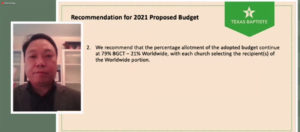
Lester Leonares from First Philippine Baptist Church in Missouri City, chair of the finance committee, presents recommendations to the BGCT Executive Board regarding the 2021 proposed budget. (Screen Capture)

The recommended 2021 budget anticipates slightly more than $5 million in investment income, comparable to the 2020 budget.

The budget proposal also anticipates more than $2.5 million in additional revenue from conference and booth fees, product sales, the Southern Baptist Convention’s North American Mission Board and other sources.

Staff salaries in the proposed budget are relatively flat but include a 9.1 percent increase in health insurance. Institutional support remains relatively flat in the recommended 2021 budget.

Messengers from Texas Baptist churches will vote on the budget proposal as part of the Nov. 16-17 annual meeting, which will be conducted virtually due to the COVID-19 pandemic.

The board also recommended continued division of undesignated receipts from affiliated churches, with 79 percent allocated for the BGCT and 21 percent for worldwide causes. Each church determines the recipient or recipients of its worldwide giving.

If approved at the annual meeting, an anticipated $1.05 million in worldwide missions initiatives and partnerships be allocated in this manner: $350,000 for missions mobilization, $210,000 for River Ministry and Mexico missions, $125,000 for Texas Partnerships, $60,000 for the Baptist World Alliance, $50,000 for intercultural international initiatives, $195,000 for Go Now Missions, $25,000 for the Hispanic Education Task Force and $35,000 for chaplaincy.

Loan forgiveness plan approved for BUA

The board also approved a proposal to forgive the $1 million loan approved three years ago for BUA in a manner that provides an incentive for the school’s fund-raising efforts.

In September 2017, the BGCT Executive Board had approved financial assistance for BUA, including a $1 million no-interest loan for five years.

BGCT Executive Director David Hardage voiced his hope that Texas Baptists will become known as “GC2” people—Christians committed equally to both the Great Commission and the Great Commandment.

The board-approved recommendation forgives $1 of the loan for every $1 BUA raises from any external source between Jan. 1, 2020, and Dec. 31, 2022.

In his address to the board, BGCT President Michael Evans reflected on the tension in the United States and anxiety related to ongoing COVID-19 pandemic. He reminded the board of Christ’s command to his followers to “love one another.”

“In the midst of chaos, we must abide in his love,” Evans said.

BGCT Executive Director David Hardage voiced his hope that Texas Baptists will become known as “GC2” people—Christians committed equally to both the Great Commission and the Great Commandment. As Texas Baptists seek to fulfill their mission and vision, he expressed his desire that they be guided by two imperatives: “Share Christ. Show love.”

In other business, the BGCT Executive Board:

  • Elected Clint Davis of First Baptist Church in Mount Pleasant as chair and Bobby Contreras of Alamo Heights Baptist Church in San Antonio as vice chair of the BGCT Executive Board for 2021.
  • Approved the allocation of $200,000 of investment income from the J.K. Wadley Mission Fund for church starts and $100,000 of income from the same source to fund campus missionary interns in 2021.
  • Elected Brandon Skaggs of First Baptist Church in Belton, Irene Gallegos of Iglesia Bautista Getsemani in Fort Worth, Raymond Sanchez of First Baptist Church in Weslaco and Ryan Buck of Immanuel Baptist Church in San Angelo to fill vacancies on the Christian Life Commission.
  • Authorized policy changes allowing BGCT employees to roll over up to 80 hours of earned and unused personal time off, an increase from the existing limit of 40 hours, and setting 6 percent of an employee’s regular base salary as the standard amount matched by the employer.
  • Approved Weaver as the accounting firm to conduct the financial audit for 2020.

The board filled vacancies on councils by electing:

  • Larry Landusky of Second Baptist Church in Lubbock, Ann Bradshaw of Tallowood Baptist Church in Houston, Don Allen of Sugar Creek Baptist Church in Sugar Land, Grady Tyroch of First Baptist Church in Temple, Robert Power of First Baptist Church in Richardson, David Lake of South Spring Baptist Church in Tyler, Jim Newman of First Baptist Church in Frisco and JoAnn Botts of First Baptist Church in Plano to the Texas Baptists’ Missions Foundation Council.
  • Bart Howell of Eagles View Baptist Church in Fort Worth, Bryan Pinson of First Baptist Church in Midland, Chad Bertrand of South Park Baptist Church in Austin, Chad Mason of Calvary Baptist Church in McAllen, Edgardo Martinez of First Baptist Church in El Paso, Jeff Covington of Oakwood Baptist Church in New Braunfels, Nancy Jackson of The Woodlands Baptist Church in The Woodlands and Robert Watson of First Baptist Church in Tyler to the Missions Funding Council.
  • Jeff W. Smith of Park Cities Baptist Church in Dallas and Jimmy Garcia of First Baptist Church in Duncanville to the Baptist Distinctives Council.
  • Linda Templin of First Baptist Church in Arlington and John Wheat of Trinity Baptist Church in Kerrville to the Baptist Student Ministry Council.
  • Ronny Marriott of First Baptist Church in Burleson and Craig Curry of First Baptist Church in Plano to the Theological Education Council.
  • Megan Maxwell of The Woodlands Baptist Church in The Woodlands, Nataly Mora of Park Lane Drive Baptist Church in Waco and Larry Soape of First Baptist Church in San Antonio to the BaptistWay Press Advisory Council.
  • Larry J. Sanders of Keller Springs Baptist Church in Carrollton to the Cultural Engagement Council.
  • Darin Wood of First Baptist Church in Midland to the Great Commission Team’s Evangelism Strategic Planning Council.
  • George Will Bearden of First Baptist Church in San Antonio, Rochelle Binion of Agape Baptist Church in Fort Worth, Garry Patterson of Berean Baptist Church in San Antonio, Judy Collins of The Crossing Baptist Church in Mesquite, David Kirk of First Baptist Church in San Antonio and Elmo Johnson of Rose of Sharon Baptist Church in Houston to the Chaplaincy Endorsement Council. The board also elected as out-of-state representatives to the same council Robert Pipkin of First Baptist Church in Suffolk, Va.; Sara Hester of First Baptist Church in Oneonta, Ala.; Richard Brown of Bonsack Baptist Church in Roanoke, Va.; Clint Calvert of Emmanuel Baptist Church in Rochester, Minn.; and Kristen Curtis of First Baptist Church in Farmville, Va.


El Paso church ministers to at-risk teens and families

EL PASO—Hugo Garcia believes when he was called to become pastor of Cornerstone Fellowship Baptist Church, God also commissioned him to develop a Christian program for teens in East Central El Paso.

“Most of my ministry has been to work with teens, especially those at-risk,” Garcia said. “I understand their frustrations, needs, hopes and dreams.”

Many of the youth come from low-income families. Parents work in low-paying jobs. Problems in the neighborhood include drugs and alcohol abuse, unemployment, homelessness, families struggling to pay their rent and buy food for their children.

But rather than focusing on problems, Garcia sees opportunities—to meet basic human needs, to tell people God loves them, and to provide personal and church growth.

“One of the opportunities is feeding hungry people,” Garcia said. “When people come to us that are without food, we feed them. Statistics show that 1 out of 4 children go to bed hungry in normal times. Since the COVID-19 pandemic started, the numbers have increased.”

Garcia remembers taking a box of food to a family in need several years ago.

“I opened the refrigerator to put some food inside, and there was not even a bottle of ketchup —nothing,” he recalled.

“The family had a 9-year-old daughter named Ashley. This young girl started attending our church because we met a need for her family. … Today, Ashley is now 24 and an active young adult in our church and is helping other youth. God had a plan, and I’m so glad we could be a part of that plan.”

‘The church is there as a witness of God’s care’

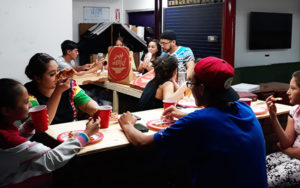
Pizza is a favorite food for teens at the weekly meal provided by Cornerstone Fellowship Baptist Church in El Paso. (Photo courtesy of Pastor Hugo Garcia)

Cornerstone Fellowship’s ministry provides food boxes to families in need every week. The Texas Baptist Hunger Offering provides about half of the cost of a weekly meal for teens, which also features a youth Bible study. So far, four young people have made professions of faith in Christ directly as a result of the teen meal and Bible study.

“Food brings them here, and we have opportunities to teach personal growth from a Christian viewpoint. Our church serves food that teens like—especially pizza,” Garcia said.

Parents—including some with no other connections to Cornerstone Fellowship—encourage their teens to attend. Some parents attend the church when their busy work schedules allow. During the COVID-19 pandemic, the church has provided a place of comfort and strength for anxious parents, Garcia noted.

“Many of the adults in our area are classified as essential workers during this crisis. They work in the hospitals, food industry and other places where workers must go to work to keep their jobs,” he said. “This means they attend the Sunday night service. They fear the virus themselves, but also are afraid of bringing it home to their families. During this time, the church is there as a witness of God’s care for them.”

Cornerstone Fellowship Baptist Church could be considered a re-start church. Several years ago, the church merged with another declining church. At that time, about 150 teens attended. The Cornerstone group had a different vision—a different methodology and wanted to develop a more effective discipleship program of growth.

As part of the fresh re-start, Cornerstone started providing the weekly food boxes for families. Families who receive food are encouraged to submit prayer requests, and a church prayer team meets regularly to study the Bible, share testimonies and sing hymns.

El Paso Baptist Association fills the food boxes for families with rice and beans, as well as locally grown strawberries, lettuce, celery and other seasonal produce. Presently, 65 families—270 individuals—receive food. When food is distributed, lines often stretch for blocks. Many are at-risk households. Cornerstone Fellowship views the list of recipients as prospects for additional ministry and evangelism.

“We hope to reach these people and get them involved in our church,” Garcia said. “It’s another opportunity to reach families.”

At this point in the pandemic, Cornerstone Fellowship meets in three worship services each Sunday to help maintain social distancing.

The church leases a building it shares with the owner, who operates a business. During the pandemic, offerings have been down, Garcia noted. The church has developed a plan to ask 300 individuals to pledge $15 per month to enable the church to meet its rent payments.

Next year, Cornerstone Fellowship hopes to move to a new facility that will include Sunday school space for a children’s department.

Through it all, Garcia said he trusts in the promise of a favorite Scripture verse: “Call to me and I will answer you and tell you great and unsearchable things you do not know (Jeremiah 33:3).”

Carolyn Tomlin writes for the Christian market and teaches the Boot Camp for Christian Writers.   


Young minister loses license over political endorsement

A 21-year-old minister from Arlington who endorsed Joe Biden for president on social media said the pastor of the church where he completed a year-long pastoral internship told him his license to the gospel ministry would “not be renewed.”

Faith Memorial Baptist Church in Archer City—a congregation uniquely aligned with the Southern Baptists of Texas Convention—licensed David Bumgardner to the ministry on July 19.

Bumgardner, a student at Southwestern Baptist Theological Seminary’s Scarborough College, delivered his farewell sermon to the church on Sept. 6 after completing his internship as assistant minister.

Three days later, he posted a brief essay on his personal Facebook page identifying President Donald Trump as “a threat to the flourishing of my neighbors … to national security … (and) to national unity,” and accusing Trump of “stoking the fires of civil and racial unrest.”

Consequently, Bumgardner—who identifies himself as a Republican—endorsed Biden, while stipulating he did not endorse everything in the Democratic Party platform.

“I am voting for Joe Biden to get the most egotistical, hypocritical, divisive, deranged, and dangerous man to ever hold presidential office out of the Oval” Office, he wrote. “I am voting for Joe Biden because he will bring back decency to the White House.”

Social media firestorm erupts

The post prompted a flurry of critical responses who accused him of “supporting murderers” and obviously not being a “Biblical Christian.”

“If you vote for Biden/Harris you should not be trusted, respected, a minister, or a leader,” one individual who is not a member of the church wrote.

On Twitter, a respondent characterized Bumgardner’s position as “the spiritual dead-end of evangelical effeminate morality.”

A far-right religious website, reformationcharlotte.org, that published an article about Bumgardner’s Facebook post wrote, “If someone who claims to be a Christian and has studied the Bible for a considerable amount of time actually believes this way, there is no way around it; this person has not been regenerated by the Holy Spirit and has no business preaching or leading a church.”

“I was flooded with notifications and messages. I was called a baby-killer, cop-killer, race-baiter, unqualified minister, pedophile and fake Christian, despite the fact that my classical, conservative, orthodox and evangelical theological convictions have not changed.” Bumgardner said.

He added he had been “harassed and slandered by some of my peers on campus,” but he also voiced gratitude to other fellow students and young ministers who defended and supported him.

Licensed to ministry with an expiration date

Bumgardner soon learned from Avery Sprey, pastor of Faith Memorial Baptist Church, his license to the ministry would not be renewed.

An agreement Bumgardner had signed prior to his licensing stated if the church or its pastor believed his words or actions warranted it, they reserved the right either to renew the license or allow it to expire at the end of the year. It further stipulated Bumgardner would seek to maintain Christlike character, grow in demonstrating the fruit of the Holy Spirit and not waver doctrinally.

While the church voted to license Bumgardner to the ministry, the agreement was a private document between the pastor and intern.

Both Sprey and Bumgardner acknowledged some previous social media posts had been topics of discussion and concern.

Sprey said he had wanted the church to license Bumgardner to the ministry earlier, but he first wanted to ensure Bumgardner demonstrated the necessary wisdom and maturity.

“When I saw perceived growth, I wanted to honor that,” Sprey explained.

However, because of his continued concern about Bumgardner’s social media presence, he developed the agreement that included the clause regarding expiration or renewal of the license. Both Bumgardner and Sprey conceded the agreement rendered it more akin to a “learner’s permit” than a license.

“I made a mistake. If you have to put an expiration date on a license, you probably shouldn’t issue it in the first place,” Sprey said. “I’m new at this and learning the hard way.”

Posts ‘do not promote gospel unity’

After Bumgardner posted his endorsement, Sprey went to the former intern’s home to discuss the matter with him and to let Bumgardner know he was considering not renewing his license to the ministry.

“I couldn’t care less about his political views,” Sprey said. “My concern is that his social media posts cause discord among brothers and do not promote gospel unity.”

Bumgardner pressed Sprey to exercise church discipline against one individual who regularly attends but is not a member of Faith Memorial Baptist Church. He pointed to what he considered racist social media posts by that individual.

“Church discipline is not for those outside the church,” said Sprey, who has served Faith Memorial as part of the SBTC’s church revitalization program.

He noted he had spent a long time seeking to help the church establish clear membership policies necessary before church discipline is possible.

Decision to make the issue public

Once Bumgardner learned Sprey decided to allow his ministry license to expire, he chose to make the issue a matter of public record.

“I love the members of the church and its pastor dearly. I am forever in their debt. I am deeply grieved that this issue could not be resolved,” he said.

“Unfortunately, my license is inextricably linked to my qualifications and credentials as a Christian minister. It affects my standing in the ministerial community. It also affects my ability to be hired by a local church.”

Bumgardner acknowledged his social media posts have been “provocative” but did not consider them “overtly wicked or sinful.” However, he acknowledged his shortcomings.

“I am painfully aware of my faults. I am the most sinful person I know,” he said. “I have always wrestled with pride, bridling my tongue, making unhelpful sarcastic remarks, using unwholesome speech, harboring bitterness, clinging to resentment and epitomizing hypocrisy. I also find it difficult to speak kindly of my theological, ideological and personal ‘enemies.’ My pastor was aware of this, and it was something we had repeatedly addressed during the licensing process,” he said.

However, Bumgardner said, he believes he has “grown” during his time as a pastoral intern and wants to continue to grow as a Christian and a minister.

“I have committed too many sins to name. But endorsing Joe Biden is not one of them,” he said.

Licensed to do what?

Sprey insisted the way in which Bumgardner presented his opinions on social media—not the opinions themselves—merited the discontinuance of his ministerial license. Bumgardner characterized that position as “disingenuous.”

“I have heard one thing from the pastor yet something entirely different from the members,” he said, noting some of them questioned the validity of his call to ministry on the basis of the political endorsement.

After the fact, Bumgardner wondered whether he and the pastor had any right to enter into an agreement regarding the conditional nature of his ministerial license without bringing the matter before the church.

“Faith Memorial Baptist did not license me to endorse their preferred political candidate through their preferred method, channel or avenue. They licensed me to preach the gospel,” he said.

Revoking—or failing to renew—a minister’s license over political rather than theological or moral grounds sets a dangerous precedent, he asserted.

“The simple fact of the matter is that churches should not disown ministers over politics,” he said.

Surrenders license to the ministry

Rather than demanding the church take action, however, Bumgardner stated: “I hereby voluntarily surrender my license to gospel ministry and all the rights and privileges pertaining thereto. I remain open to the possibility of reconciliation with the church so long as proper action is taken against the offending member.

“In the meantime, I will continue my ministry of public theology and itinerant preaching. I have already begun the process of transferring my membership to another Southern Baptist church where my political views and personal expressions will not be as problematic.”

Sprey expressed his regret over the situation but emphasized his responsibility to maintain gospel-centered unity in the church.

However, Bumgardner insisted, the church’s political leanings—not issues central to the gospel—led to the relinquishment of his ministerial license.

“Had I endorsed Donald Trump or kept my views to myself, I am sure I would still be a licensed Christian minister on the pathway to formal ordination,” he said.


In-person WMU project cancelled but home will be built

The COVID-19 pandemic forced Woman’s Missionary Union of Texas and Buckner International to cancel its in-person Women’s Build missions project in the Rio Grande Valley, but a qualified family in Peñitas still will gain a new home.

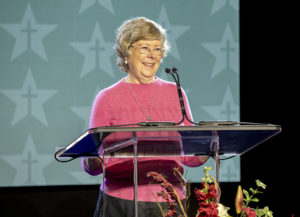
Tamiko Jones

Texas WMU Executive Director-Treasurer Tamiko Jones announced the “revision” of the annual project on Sept. 9. This year’s event—originally scheduled for Oct. 18-27—would have been the 10th consecutive year for the hands-on construction project.

Each year, Buckner identifies a family that earns enough points to qualify for a home by participating in the local Buckner Family Hope Center classes about managing finances, parenting and job skills, along with volunteering to help others. Texas WMU volunteers typically work alongside members of the family to construct their home.

“We all know that 2020 has been full of challenges, and these challenges have caused us and our partners to re-evaluate how we do missions in the midst of a pandemic,” Jones said.

“After staying in communication with our build partner, Buckner International, I learned today that due to our build community being a hot spot for the pandemic, and all of the uncertainty and necessary restrictions for a construction site that come with that fact, they cannot allow in-person mission trips this fall.”

She noted the decision was made to protect the safety of all involved, as well as those in communities where mission trip participants would have returned.

‘The home will still be built’

“The home will still be built—just not by our WMU of Texas family this year, but by the family who shall inhabit the home,” Jones emphasized.

Texas WMU is working with Buckner to enable the family in Peñitas to build their own home, with construction materials and other assistance provided through the Mary Hill Davis Offering for Texas Missions.

“We will get to witness their process and possibly interact with the family virtually,” Jones said. “So, in essence, we are developing a virtual missions experience.”

Texas WMU will contact mission teams that already had paid their deposits to provide a refund.

“In my conversation with our friends at Buckner, one theme was evident—none of this has caught God by surprise,” Jones said. “While we are sad not to be able to make that trek down to the Valley this October, we look forward to the day when we return, and oh, what a reunion and celebration that shall be!”


Pandemic impact on enrollment less than expected

In spite of dire predictions, COVID-19 generally had a less-severe-than-anticipated impact on fall enrollment at most Texas Baptist universities.

Five Texas Baptist universities—Baylor University, Houston Baptist University, East Texas Baptist University, the University of Mary Hardin-Baylor and Howard Payne University—along with Stark College reported higher overall enrollment in fall 2020 than in fall 2019.

Three schools—Baylor, HBU and ETBU—posted record total enrollments. Baylor, ETBU and DBU also recorded increased freshman enrollment, with Baylor and DBU reporting the largest classes of incoming first-year students in their history.

Those achievements run contrary to bleak national forecasts regarding college and university enrollment in the midst of a global pandemic.

Surveys of college-bound high school students in March and April prompted at least one higher education research and marketing company to predict four-year colleges would face up to a 20 percent loss in fall enrollment.

In a nationwide PulsePoint survey of college and university presidents in May conducted for the American Council on Education, two-thirds (65 percent) named fall enrollment as their most pressing issue.

Baylor, HBU defy expectations

Defying those fears and predictions, Baylor enrolled 19,297 students this fall, including 14,399 undergraduate students. Total enrollment in fall 2019 was 18,033.

Livingstone 200
Linda Livingstone

Baylor reported 3,731 freshmen enrolled, surpassing the record 3,625 first-year enrollment in 2014. It also is the most diverse freshman class in Baylor history, with minority enrollment increasing to 38 percent.

“Even in the face of many unknowns and uncertainties due to the COVID-19 pandemic, the tremendous interest in a Baylor University education from prospective students and their families as well as from our continuing students never wavered,” President Linda Livingstone said. “This is a true testament to the incredible efforts of hundreds of staff and faculty at Baylor.”

HBU reported 3,975 total enrollment, marking eight consecutive years of record-setting enrollment numbers.

It included the highest undergraduate enrollment at the HBU campus for the second consecutive year and the highest online enrollment for the fourth consecutive year, according to James Steen, vice president for enrollment management.

With 647 enrolled, HBU marked its second-largest freshman class in history, behind last year’s record-setting 706 enrollment, Steen reported. The university also enrolled 160 transfer students.

ETBU sets record; Enrollment up at UMHB and HPU

ETBU posted 1,714 total enrollment, an 8 percent increase over fall 2019, marking the highest recorded enrollment in the school’s 108-year history. Enrollment in the university’s graduate programs increased 22 percent, and first-time freshman enrollment increased 17 percent over fall 2019.

In spite of uncertainties related to the worldwide COVID-19 pandemic, East Texas Baptist University is celebrating its highest recorded student enrollment in the university’s 108-year history with 1,714 total students, reflecting an 8 percent increase over fall 2019, and an 84 percent undergraduate retention rate—3 percent higher than the five-year average. (ETBU Photo)

“We celebrate the provision of a resilient and dedicated faculty and staff, faithful donors, supportive alumni and strong enrollment in the midst of the global pandemic,” ETBU President Blair Blackburn said.

ETBU also reported an 84 percent undergraduate retention rate—3 percent higher than its five-year average.

“ETBU’s success is the result of faithful men and women not allowing the circumstances of the pandemic to hinder them from being faithful in obeying God’s call of shaping students called by him to the Hill,” said Jeremy Johnston, vice president for admissions.

The University of Mary Hardin-Baylor reported 3,876 total enrollment, up from 3,846 in fall 2019. UMHB experienced a drop in incoming freshman enrollment—741 this semester, compared to 868 in fall 2019.

Howard Payne University recorded 1,061 students—its highest overall enrollment since 2016, according to Kyle Mize, assistant vice president for communications. Fall 2019 total enrollment was 1,031.

While first-year student enrollment numbers are down slightly from the same time last year, retention at HPU is up, he added.

Stark College, BUA feel COVID-19 impact

At Stark College, 182 students registered for the fall term, compared to 175 students in fall 2019. All fall classes at Stark College are being offered online or via Zoom teleconference.

The school’s entry-level certificate program enrolled 93 students, compared to 105 last fall.

Stark College’s student population is 55 percent Hispanic, 22 percent Black, 2 percent Asian and 3 percent two or more races. Given the disproportionate impact of COVID-19 on minority groups, the school has faced significant challenges, President Tony Celelli said.

“Thirty-four students were personally affected by the virus either by contracting the disease, lost their job, or lost wages,” Celelli said. “Additionally, another 26 students felt the sting of the virus by a family member who contracted COVID-19, lost their job, or lost wages. Unfortunately, seven students lost family members due to COVID-19. Our hearts are heavy with the loss experienced by Stark’s nontraditional students.”

Baptist University of the Américas reported a 17.2 percent decrease in its total enrollment, compared to fall 2019. However, freshman enrollment increased 7.1 percent.

The number of single students living on-campus at BUA dropped 50 percent compared to this time one year ago.

“Most of our students are now taking classes online. They have remained with their families, but they are continuing their education at BUA,” said Gabriel Cortés, chief of staff at BUA.

Ups and downs at Wayland, DBU, HSU

Wayland Baptist University reported increased enrollment—1,166 students this semester, compared to 1,156 last year—at its Plainview campus. The total included 979 undergraduates and 187 graduate students.

However, the university reported decreased enrollment at its external campuses—2,178 in fall 2020 compared to 2,930 in fall 2019.

Dallas Baptist University reported 4,247 total enrollment for fall 2020—a 5.3 percent decrease from 4,487 in fall 2019.

However, DBU enrolled its largest-ever class of incoming first-year students at 618—a 7.85 percent increase over 573 the previous fall semester.

DBU also recorded 2,419 traditional-age students on campus, the largest number in the school’s history. The school’s overall retention rate of traditional-age students was almost 90 percent. The university retained 75.58 percent from its freshman class to its sophomore class, compared to last year’s 71.62 percent retention rate.

eric bruntmyer 200
Eric Bruntmyer

Hardin-Simmons University reported 2,128 total enrollment for fall 2020, down from 2,324 in fall 2019. New undergraduate student enrollment is 527, compared to 581.

However, new graduate student enrollment showed an increase—183 this semester, compared to 179 in fall 2019.

HSU officials reported increased enrollment in several new programs in business, science and health.

“At HSU, we are blessed to have our students back on campus together. We are all working to prioritize everyone’s safety and health while continuing to provide an education enlightened by Christian faith and values. With support from our faculty, staff and students, HSU is very optimistic about this year and beyond,” President Eric Bruntmyer said.


Baylor and Southwestern sue foundation tied to Patterson

WASHINGTON (RNS)—Baylor University and Southwestern Baptist Theological Seminary have sued a charitable foundation they say is trying to misuse millions of dollars in assets.

The two Baptist institutions filed suit Sept. 8 against the Texas-based Harold E. Riley Foundation and its board of trustees.

According to the lawsuit, the foundation was set up in 2002 by Riley, a wealthy businessman who died in 2017, for the benefit of the two schools. The schools were granted the freedom to name a majority of the foundation’s board and the foundation’s stated charitable purpose was to provide support for the schools.

Changes in governance and charitable purpose alleged

In 2018, that changed, according to the suit.

The lawsuit alleges the foundation’s board of trustees rewrote its bylaws—without notifying Baylor or Southwestern—and changed the charitable purpose of the foundation. As part of the changes, the two schools were also stripped of their ability to name board members, removing the foundation’s only beneficiaries from any governance role.

The changes were made without input from either school, according to the lawsuit. Baylor and Southwestern also claim the meetings where the changes were made were invalid.

Southwestern Baptist Theological Seminary trustee chairman Kevin Ueckert (left) addresses trustees at a special called meeting at the Fort Worth campus May 22, 2018. The board met to discuss the controversy surrounding Paige Patterson (right), then president of the seminary. (Photo by Adam Covington/SWBTS via BP)

According to the suit, the changes to the foundation were made a few days after Paige Patterson, former president of Southwestern, was fired by the seminary’s board. Foundation President Mike C. Hughes, who served as vice president for advancement at Southwestern under Patterson, is named as a defendant in the suit.

Complicating matters, the foundation’s offices are located on the campus of Southwestern and its board members include people with close ties to Patterson.

The seminary sees the changes at the foundation as part of a pattern to undermine support for the school after Patterson’s departure.

“This is but the latest in a two-year pattern of attempts to divert support away from the seminary to other causes. We have sought relief with heavy hearts but firm resolve to expose and stop ongoing efforts to cause harm to our students and generous ministry partners,” Colby T. Adams, vice president of strategic initiatives at Southwestern, told Religion News Service in an email.

In a statement provided to Baptist Press through a spokesperson, Patterson denied wrongdoing, writing: “To the many friends of the Pattersons, my wife and I have been loyal and answered questions where we could. We are not a part of any plan to usurp anyone’s power or authority, no matter what allegations may arise. To the contrary, we have actually sought to assist Southwestern in a helpful and Christlike way, without regard to their treatment of us. We rest our case with the Lord God.”

Suit alleges improper action by foundation board

The suit alleges the board sold off more than 700,000 shares in Citizens Inc., the company founded by Riley, but shared only a fraction of those proceeds with the schools.

Before the changes in 2018, a spokesman for Baylor said, the school had received $1.125 million from the foundation. Since 2018, it has received $250,000.

Board members also are accused of attempting to appoint foundation board members and their friends to paid positions on the board of Citizens Inc., in violation of the foundation’s own rules, according to the suit.

According to a separate lawsuit filed in Colorado, the foundation has the right to appoint a majority of members to Citizens’ board of directors because it owns Class B stock in the company.

Earlier this year, according to the suit, the foundation board attempted to name Patterson and Hughes to the Citizens board. The foundation board also attempted to name three others to the Citizens board, all with ties to Patterson: David August Boto, a former vice president of the Southern Baptist Convention Executive Committee; Charles Hott; and J. Clinton Pugh.

That Colorado lawsuit claims other board members of Citizens, who include former Oklahoma Gov. Frank Keating, “sought to impede Plaintiff’s voting rights and made up procedural requirements to wrongfully delay the five New Class B Directors’ appointments.”

Citizens Inc. did not immediately respond to a request for comment.

In an interview with Baptist Press, Boto called the claims “absurd.”

“The entire (foundation) board is committed to supporting the ongoing work of both (Southwestern and Baylor) for as long as possible, as well as possible,” Boto said. “That was what Harold Riley wanted. We’ll stay true to that assignment.”

Schools want foundation returned to its founding purpose

Both Baylor and Southwestern say they want the foundation to return to its original purpose.

(Southwestern Baptist Theological Seminary Photo)

Adam W. Greenway, president of Southwestern Baptist Theological Seminary, said Harold Riley and his family were longtime supporters of the school. He said the suit aims to ensure the foundation serves Riley’s intentions as a donor.

“We have recently become aware of inappropriate manipulation related to board governance and apparent misapplication of funds by self-appointed rogue leadership of the foundation established in Mr. Riley’s name,” Greenway said in a statement.

“We believe these individuals are attempting to undermine and overturn Mr. Riley’s expressed directives and are in violation of their fiduciary duties.”

(Baylor University Photo)

Baylor President Linda A. Livingstone said Riley was a generous donor to the school and provided scholarships to students at Baylor’s Hankamer School of Business as well as support for Baylor’s library and athletic program. Riley also supported Truett Theological Seminary at Baylor.

“It is frankly disheartening to have discovered that Mr. Riley’s legacy and the educational funding for future generations of Christian leaders appear to have been misused for purposes other than those identified by Mr. Riley,” Livingstone said in a statement.

Under the lawsuit, the two schools seek the removal of the foundation’s current trustees and a freezing of the foundation’s assets until the foundation’s original charitable purpose is restored.

“It is the strong desire of both Southwestern Seminary and Baylor University that this matter be resolved without the necessity of a trial,” Greenway said in a statement. “It is our further hope that we can settle this issue in the spirit of Christian charity by returning direction and control of the foundation to its beneficiaries and restoring the member status of both Southwestern and Baylor.”

EDITOR’S NOTE: This developing story first was published Sept. 9.  It was updated the next morning to include additional information from Baptist Press, news service of the SBC Executive Committee.


TBM volunteers see God at work after hurricane

ORANGE—For years, Orange County Judge Carl Thibodeaux played a vital role in Texas Baptist Men disaster relief by submitting names of people who need help after significant storms. Following Hurricane Laura, that list included his own for the first time.

The Thibodeaux family has been through every major storm to hit Orange in the past 27 years. Some years, their property fared better than others. But every year, they have volunteered their time and energy to helping rebuild their community.

“This is the first time I’ve had to ask for help after a storm—and we’ve been through many,” he said. “I simply can’t do this work.”

His home is one of many that 40 TBM disaster relief teams with about 150 volunteers are responding to in the wake of widespread needs in Southeast Texas and Louisiana after Hurricane Laura.

Hurricane Laura caused extensive damage in Southeast Texas. TBM chainsaw crews have received 475 requests for help just in the area around Orange. (TBM Photo)

TBM received more than 475 requests for chainsaw help in Orange, Deweyville and Newton County. A laundry team is washing truckloads of clothes. A feeding team is providing 7,000 meals a day in Lake Charles, La. Each act of ministry is provided for free.

The work of TBM disaster relief was multiplied during Labor Day weekend as TBM’s Texans on Mission volunteers serve for a day at a time, allowing more people to receive the help they need.

“The needs after Hurricane Laura are immense,” TBM Chief Executive Officer Mickey Lenamon said. “TBM volunteers from across the state have come together to deliver help, hope and healing to hurting people.

“It takes all of us working together to minister to people in their most difficult days. Thank you for praying for everyone affected by the storm as well as those who are responding to needs.”

Widespread needs, individualized responses

As vast as the needs are, volunteers are careful to give each home the attention it needs. They visit with homeowners, encourage them and often pray with them. When a chainsaw team finishes work at a house, they present a Bible signed by the team to the homeowner.

TBM volunteers have logged 572 heavy equipment hours in Southeast Texas through Labor Day, and they still are hard at work. (TBM Photo)

At one home, the Orange County TBM chainsaw team removed a tree that split in half as a result of the hurricane’s winds. As leaders visited with the homeowner, they learned this particular tree was their son’s “prayer tree.”

The 9-year-old boy has an anxiety disorder, so the family dedicated a spot for their son as a retreat where he could relieve his anxiety. When he felt anxious, the boy would climb up in the tree, sit on a branch next to a cross he carved in the trunk, and he would pray.

TBM Texans on Mission volunteers from area churches joined trained TBM disaster relief volunteers in serving their communities on Labor Day weekend. (TBM Photo)

The chainsaw team realized the importance of this tree and the significant role it plays in one family’s life. While the tree had to be removed, the volunteers cut chunks of the tree for the family to use as a reminder of the tree.

“As we do this work, every time we see God moving, and every time it’s humbling, it’s emotional,” Mize continued. “When we talked to the family about this tree and its role in their son’s life, she broke down, I broke down, the whole team broke down. We serve a mighty God.”

Unbeknownst to the family, a member of the chainsaw team took a slice of the tree home and is carving crosses out of their prayer tree for the entire family.

‘They need to know someone cares about them’

God is using the acts of radical service and support to transform lives. Nearly 30 people have made a profession of faith in Christ as a result of TBM ministry after Hurricane Laura. TBM is connecting those people with local churches to disciple them.

“Ministering to a family is about more than cutting down trees or providing a meal,” said David Wells, interim director of TBM disaster relief. “Many of these people have had their lives turned upside down. They need encouragement. They need someone to listen to them. They need to know someone cares about them.”

At Thibodeaux’s home, some TBM volunteers were visiting with him when he spotted a hummingbird at the one feeder that survived the hurricane.

“I’ve heard they are coming back after the storm. This brings me hope,” Thibodeaux said. “This morning, I prayed that God would send people to help me and my wife clean up all this debris. And now, your team is here, and you get to see our hummingbirds.”

To support TBM disaster relief financially, give online at TBMTX.org/donate or mail a check to Texas Baptist Men, 5351 Catron Drive, Dallas 75227.


Texas Baptists offer weekly workshops online

Workshops that typically would have been offered during the Baptist General Convention of Texas annual meeting will be offered in a weekly online format Tuesdays at 2 p.m., beginning Sept. 8.

With the annual meeting moving online due to the COVID-19 pandemic, BGCT leaders decided to offer workshops to churches in advance of the meeting. The Zoom webinars will include live question and answer sessions each week. Registration is required for each workshop individually.

A workshop on “Children’s Ministry and Missions: The Complete Ministry for Children Includes Missions” is scheduled Sept. 8. Presenters will include Diane Lane, retired children’s discipleship specialist for Texas Baptists; Jonathan Brown, children’s minister at First Baptist Church in Temple; and Joanna Jespersen, minister to children and families at Shiloh Terrace Baptist Church in Dallas. To register, click here.

Preston Cave, mission and discipleship coordinator for Texas Baptist Men, will present a workshop on “The Why and Where of Missions” on Sept. 15. The workshop will deal with reasons to be involved in missions and where missions should be lived out. To register, click here.

Chad Selph, pastor of First Baptist Church in Allen, and several leaders from International Commission, including President Brent Edwards, will lead a workshop entitled “Equipped to Evangelize” on Sept. 22. To register for the workshop, click here.

A workshop on “Fulfilling the Great Commission through MAP” led by David Miranda, director of Texas Baptists’ Urban Missions and MAP (Missionary Adoption Program), and Josue Valerio, director of missions for Texas Baptists, will be offered Sept. 29. Others involved in the workshop include Milton Monte, Junta de Missões Nacionais Brazil;  Joseph Fornah, Baptist Convention of Sierra Leone; Luiguii Olortegui, Església Evangèlica Baptista de Roses; Danilo Antunes, Texas Baptists’ Ministry Grid; Pepe Flores, Baptist Convention of Peru; Thong Lun, Greater Houston Burmese Christian Fellowship; and Larry Mayberry, Queens Church in New York. To register for the workshop, click here.

Tamiko Jones, executive director/treasurer of Woman’s Missionary Union of Texas, will be joined by Julie Forrester, executive director of Christian Woman’s Job Corps of Greater Arlington, to discuss “WMU of Texas: Partners in Missions” in an Oct. 6 workshop. They will discuss the legacy of Texas WMU and the ways the organization can walk alongside and engage in local missions, establish partners for missions and empower others for worldwide missions. To register for the workshop, click here.

David Scott, director of Bounce Student Disaster Recovery, will lead a workshop on “Bounce: Mobilizing your students for life transformation” on Oct. 13. Carlos Montoya, associate pastor of Fielder Church South Oaks Campus in Arlington, will join Scott to discuss short-term mission experiences for students and the role the events can play in transforming lives. To register for the workshop, click here.

Israel Loachamin, pastor and director of La Puerta ministries at First Baptist Church in Waco, will join Josue Valerio to discuss “The Church and Community Transformation” in an Oct. 20 workshop. To register for the workshop, click here.

Vanessa Lerma, River Ministry missionary along the Rio Grande Valley, and Mario Alberto Gonzalez, director of Texas Baptists’ River Ministry/Mexico Missions, will present the final workshop, “Ministry Along the Border,” on Nov. 3. To register for the workshop, click here.

Recordings will be available after the event on Texas Baptists’ annual meeting page at txb.org/am.


Truett names director of Theology, Ecology and Food Justice

WACO—Baylor University’s Truett Theological Seminary named adjunct professor Jennifer Howell as the inaugural director of the Theology, Ecology and Food Justice Program.

The program, which is expected to begin in fall 2021, is a grant-funded initiative by World Hunger Relief Inc. and the Baugh Family Foundation.

The Theology, Ecology, and Food Justice Program will offer a holistic approach to educating students, ministers and community leaders on the church’s role in matters related to ecology, sustainability and food justice, seminary leaders said.

Program initiatives will include:

  • Seminary courses hosted at the World Hunger Relief farm exploring theological principles, biblical passages and best practices related to ecology, creation care and food justice in conversation with leading scholars and practitioners
  • The opportunity for seminary students to complete their mentorship or field education at the World Hunger Relief Farm, between Waco and Elm Mott.
  • Research and advocacy for creation care
  • Collaboration with other organizations to address larger systemic issues related to ecology, food justice and faith formation
  • Engagement opportunities for pastors and community leaders

“I think there has been confusion—particularly in Protestant circles—about the relationship between creation and our faith. We tend to think of those as separate things,” Howell said. “But if you look at the Bible and the story of creation, you see that God invites us into a relationship with God, with our neighbors and even with the land itself.

“The hope in doing this program is to re-orient students’ understandings about creation and help them understand that how we care for creation, how we live in and as part of creation, is itself a theological issue.”

Howell holds a bachelor’s degree in English literature from Texas A&M University; a Master of Divinity degree from Duke Divinity School; and a Ph.D. in theology from Baylor University. Her dissertation focused on German theologian/author Dietrich Bonhoeffer’s understanding of the doctrine of creation.

Since 2017, she has taught courses as an adjunct professor in Christian theology at Truett Seminary and the Baylor Honors College.

“Dr. Howell has a well-established network, both here on campus and beyond, of individuals who are engaged in conversations about ecology, agrarianism and food justice,” said Dennis Tucker, associate dean for academic affairs and professor of Christian Scriptures at Truett Seminary, who helped secure the grant for the program and chaired the search committee for the inaugural director.

Howell has a “passion for this work at the intersection of the church and creation,” he added.

“She understands ecology and food justice as biblical and theological issues that should be central to the life of the church,” Tucker said.

Strong partnerships key to program

Strong partnerships between Truett, World Hunger Relief and the Baylor Collaborative on Hunger and Poverty will be key for the program. In addition to the courses and retreats being held at the World Hunger Relief farm, the three partners will work together on research and initiatives related to theology, ecology and food justice.

Jeremy Everett

“I am thrilled for the Baylor Collaborative on Hunger and Poverty to partner with Truett Seminary and World Hunger Relief Inc. to launch the new Theology, Ecology and Food Justice Program,” said Jeremy Everett, executive director of the Baylor Collaborative on Hunger and Poverty.

“As people of faith, we are called to provide food for the hungry and to do so in ways that honor God’s creation. This program, under the leadership of Dr. Jenny Howell, will breathe life into that calling both practically—making healthy food available for children in families living in impoverished communities in the Greater Waco area—and educationally, teaching students how to replicate similar faith-informed food justice initiatives around the world.”

Jonathan Grant, executive director of World Hunger Relief Inc., expressed gratitude to the Baugh Foundation for providing the seed money to bring Truett’s Theology, Ecology and Food Justice program to life.

Grant voiced confidence Howell’s leadership will guide Truett Seminary and World Hunger Relief “into a new era of forward-thinking theological vision that includes collaborative partnerships with institutions, foundations, churches and other farms that will strengthen and nourish the work of both entities, while together creating a thriving site of Christian hospitality, community and healing relief for the world.”

Truett 300Over the next year, Howell will work to develop the curriculum and programming for the initiative, with opportunities available to students beginning in the fall of 2021, while also exploring funding for the program’s future.

“Creation care and neighbor care are part and parcel of Christian thought and discipleship; human flourishing and ethics are among the signature initiatives of Baylor University’s strategic academic plan Illuminate,” said Todd D. Still, dean of Truett Seminary.

“That (future) ministers, congregations and faith-based organizations will be able to join the psalmist in declaring more robustly that ‘The earth is the LORD’s and everything in it, the world and all who live in it…’ and will become increasingly committed to being an answer to the prayer that our Lord taught us to pray—‘Give us this day our daily bread’—is a source of encouragement and hope in a season when we stand in need of both.”