Lawmaker calls redistricting exodus an act of faith

(RNS)—Rep. James Talarico, a seminarian who has joined dozens of other Democratic state legislators in leaving Texas to oppose mid-decade redistricting efforts, said he views their protests as an act of faith, reflecting both his personal beliefs and his faith in democracy.

Talarico, a student at Austin Presbyterian Theological Seminary in Texas, discussed the protest in an Aug. 5 webinar Tuesday co-sponsored by the Center for American Progress Action Fund and Interfaith Alliance.

“Democracy is a lot more than just a constitution. It’s a covenant,” he said in speaking against the redistricting plan, which Republicans are pursuing in hopes of helping their party retain control of the U.S. House in the midterms.

“Donald Trump and (Gov.) Greg Abbott and my Republican colleagues back in Texas are attempting to break that sacred promise with every suppressed vote, with every gerrymandered district.”

Rep. James Talarico (right) participates in an Aug. 5 webinar with Guthrie Graves-Fitzsimmons, vice president of the Interfaith Alliance. (Screen capture image)

Talarico spoke to the webinar, which was planned before the protest began, from a nondescript conference room in an Illinois hotel and did not share his exact location due to what he called “security concerns.”

The state representative told Guthrie Graves-Fitzsimmons, a senior fellow of the fund and a vice president of the Interfaith Alliance, he was asked to lead his colleagues in an interfaith prayer before boarding a plane departing Texas to begin their protests.

“We don’t just have Christians in our caucus. We have Jews and Muslims. We have atheists and agnostics,” he said. “But we joined together hand in hand and said a prayer to the power of love and its ability to give us strength and peace and comfort as we embark on this journey on behalf of our constituents and the people of Texas.”

Talarico, the grandson of a Baptist minister in South Texas, said he hopes their prayers will help the protesting lawmakers to withstand reactions from Texas and nationwide.

Governor blasts ‘derelict Democrats’

Att. Gen. Ken Paxton issued a statement Aug. 5 ordering the Democratic legislators to return to the House by the end of the week, saying, “If you don’t show up to work, you get fired.”

Similarly, Abbott posted on social media: “House Democrats fled Texas and their duty to the people who elected them. Hardworking Texans would be fired if they didn’t show up for their jobs. These derelict Democrats should face the same consequences.”

Asked how he would respond to majority Democrat states redistricting to counter the proposed shift in Texas, Talarico said it is a “tricky, strategic and moral question about how blue states should respond to this type of cheating.”

He noted that redistricting typically occurs at the start of each decade to align the population with new Census statistics for fair political representation. Talarico said it is wrong for either Republicans or Democrats to seek to draw district lines that protect their political parties, and he said doing so can negatively affect progress on education, housing and health care.

“But what’s happening in Texas right now is at a whole ’nother level, because they are attempting to redraw those Texas maps in the middle of the decade, because Donald Trump has requested that they give him five more seats in Congress,” Talarico said.

“It’s a little reminiscent of when the president called the Georgia secretary of state and asked him to give him 11,000 votes. Thankfully, Georgia Republicans said, ‘No, sir.’ Texas Republicans said, ‘How about Thursday?’”

Talarico said the “deeply racist” redistricting plan is “breaking apart minority-majority districts,” and would diminish the voting power of people in communities of color.

‘Not a decision we made lightly’

The state GOP legislators’ action prompted their Democratic counterparts to take the unusual action of leaving the state to try to prevent or delay the plans. He likewise said other states’ Democratic leaders may need to take unusual actions of their own.

“My hope is that by threatening retaliation, by maybe even, in some cases, moving forward with retaliation, with blue state power grabs, that that can convince my Texas Republican colleagues and maybe even the president to walk back from the brink,” he said, “not because they feel it’s morally right, but because they’re worried that they’re going to end up losing more seats as a result of this mutually assured destruction. That is my prayer.”

Asked about what acts of faith he is taking while he is out of state, Talarico said he is opening and closing each day in prayer.

“We are facing personal and financial, political and legal consequences, which we knew when we walked into this,” he said, noting that he and his fellow legislators get paid $600 a month and have left behind obligations such as day jobs, young children and aging parents. “It was not a decision we made lightly.”

Talarico added dozens of legislators also are contemplating attending a church’s worship service together on Sunday.

“I think we’re still trying to figure out where that will be and what that will look like,” Talarico said, noting that it could be a logistical challenge for any church that might be selected.

“We don’t want to be a nuisance. But we do want to make sure that we’re engaged in the spiritual aspect of the struggle, because it’s not just a political struggle, it is a spiritual struggle. And we need to shield ourselves and be ready for the fight ahead.”

Talarico has been outspoken in his criticism of Christian nationalism and a recently passed bill mandating the posting of the Ten Commandments in Texas public school classrooms.


Ray Gann mastered mass feeding but found more

WHITESBORO—After 20 years with Texans on Mission’s state mass feeding unit, Ray Gann, 71, has retired as the unit’s leader.

Gann tried again this year to deploy as the unit’s leader—or “blue cap” as on-site leaders are known, setting them apart from the “yellow cap” volunteer workers—but realized he no longer could spare the time away from home.

Gary Finley is the current Blue Cap for the unit, and he said Gann “was around when this unit was transitioning from pots and burners to tilt skillets to become the efficient unit we have today.”

Gann, a member of First Baptist Church in Whitesboro, didn’t want to do mass feeding when state disaster relief leaders first assigned him to the team in 2005.

He recently had returned from working in Mexico after Hurricane Emily and made close friends on that first deployment.

When Hurricane Katrina hit New Orleans in August 2005, “I thought I was going to go … with the same group of people that we went into Mexico with,” Gann said.

Leaders of Texans on Mission—then known as Texas Baptist Men—“looked at me, saw a young guy that was healthy and said, ‘No, you’re going with these guys over here, the state feeding unit.’”

Four hurricanes in one year

In Gann’s first year as a yellow cap volunteer, he served after four hurricanes—Emily, Katrina, Rita and Wilma.

Disaster relief workers (left to right) Travis Maynard, Ray Gann and Albert Fuller discuss the feeding operation in Clear Lake after Hurricane Ike hit Galveston in 2008. Gann said this photo shows a confused yellow cap (himself) with two blue caps, even though Fuller functioned as a yellow cap on this deployment. Gann said Maynard got him involved in disaster relief, and Fuller taught Gann how to do the work. (Texans on Mission Photo)

Eventually, he became a “line chief,” directing the work of a specific component of the unit. Next, he advanced to “chief cook,” overseeing the entire cooking process. About 13 years ago, Gann became the unit’s blue cap.

Gann made his mark early.

“Many of the recipes that are used throughout the nation were developed and perfected by Ray Gann,” Finley said.

Mass feeding is unlike home or restaurant cooking. The Texans on Mission state unit can prepare, cook and package 10,000 meals for lunch and 10,000 more for dinner. That volume involves ordering the needed food in the correct quantity.

It’s done not only with the full quantity in mind, but with the cooking machines and transporting containers in mind, as well.

Do the math

In short, it takes math. And Gann did the math that produced the recipes for mass feeding.

The food cooked by the mass feeding unit is transported to disaster victims and volunteers in insulated containers—Cambros—that keep the food warm and sealed.

Gann used pitchers of water to determine that each Cambro held nine gallons. “And then I began to write recipes about how to fill up a Cambro,” he said.

Ray Gann served as chief cook on the feeding unit in 2008 when Hurricane Dolly hit. (Texans on Mission Photo)

The math work continues in determining how much food to order and how many Cambros will be needed to deliver the needed meals. The math is important, because the process involves lots of food that costs lots of money.

“Twenty thousand meals a day at $3.25 per meal is $65,000 a day,” Gann said.

But mass feeding is more than math.

It takes “35 to 40 really hardy people working to run the whole thing,” Gann said. And working with the yellow caps became the center of Gann’s role as blue cap.

“The worst kind of blue cap in the world is a blue cap who is so involved in the process he doesn’t pay any attention to his people,” Gann said. “He’s worried about production, those numbers, what reports look like.”

‘Being a servant leader’

But as a leader grows spiritually, he looks to the “bigger picture” and sees “God’s involved in people.”

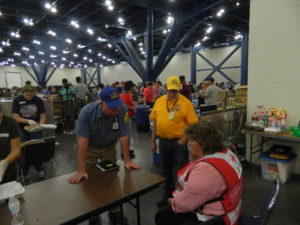
Ray Gann, on-site coordinator for the Texas Baptist Men disaster relief volunteers at Houston’s George R. Brown Convention Center, consults with an American Red Cross official immediately following Hurricane Harvey. (Photo / Ken Camp)

“I started out doing disasters thinking I was going to save the world, you know. I’m going to go cook for all these people,” Gann said.

“But the bigger picture is that God’s working on changing us, and as a blue cap I learned what being a servant leader is because that’s what a blue cap is.

“What we do is make sure that the yellow caps are successful. One of the things that I learned was my ministry was not the meals that I was cooking and sending out. It was the people I was working with. My ministry was my volunteers.”

You can hear Gann’s commitment to yellow caps in the words of his successor as blue cap for the state feeding unit.

“Ray took me under his wing in 2013 because he knew that, as with all of us, this day [retirement] would someday come,” Finley said. “He always tried to help newcomers understand the art of mass feeding.

“He knew that ministry should never be dependent upon one person, so he took every opportunity to share his knowledge with others.

“His encouragement and innovation will be sorely missed.”

Learned to be led by the Holy Spirit

Gann said he understood early that God had called him to serve his kingdom through Texans on Mission.

“By the school of hard knocks, I learned that I had to be led by the Spirit and not by my flesh, that this lifetime is the only time we get to operate in faith. And to the degree we learn to trust God and walk by faith in him has eternal consequences,” he said.

His “life verse” is Hebrews 11:6. It says: “And without faith it is impossible to please God, because anyone who comes to him must believe that he exists and that he rewards those who earnestly seek him” (NIV).

It’s easy to fall into the trap of thinking, “We are all going to go out and cook all this food, and God is going to be pleased with us,” Gann said.

“But you can’t do it in your own strength and energy. You have to operate in faith, and faith in this case is not my faith for salvation. This is the faith to get through the day, faith to trust that he’s going to fix the problem that’s insurmountable.”

In retiring as blue cap, Gann thinks about the future.

“The word of God teaches that one day we will come to face Jesus Christ to be judged for rewards based on what we did by faith in him,” he said. “I believe that at that moment of receiving our reward from Jesus Christ, I will realize, to my regret, that I could have done more for his glory.

“This is what has motivated me over recent years and still does. Now that circumstances of life have caused me to retire from active deployment, … the question of ‘what more’ is God calling me into is on my mind now, and I know that he has more for me.

“This is the challenge that God the Father lays down before all of us. What has he called you to be involved in, and will you answer his call to do more in Christ Jesus, for his glory, because it matters more than we realize here on this side of eternity.”


Late-summer camp offers respite for Hill Country kids

LEAKEY—Kids from Trinity Baptist Church in Kerrville received a much-needed time of fun and rest following last month’s devastating floods in their area.

Leaders took a group of third through fifth graders to Alto Frio Baptist Encampment in Leakey on July 21-24—helping these young campers to start taking the first steps towards hope and healing in the aftermath of devastation.
“It was definitely a camp after a crisis, but our church really pulled together to rally around us in prayer,” said children’s minister Kellee Parish.

“The church made prayer cards for the campers, and the counselors received so many encouraging texts throughout the week. Prayer is so vital, and it’s how we are able to keep moving during this time.”

In response to the tragedy at nearby Camp Mystic, organizers of Alto Frio Camp immediately began taking extra precautions to ensure the safety and peace of mind of campers and their families.

Leaders at Alto Frio had already postponed the July 14 start of a youth camp with 500 students to ensure road conditions would allow churches enough time to arrive safely. To help streamline communication, camp organizers also began posting updates on their social media pages to include the condition of the Frio River along with the camp’s emergency response plans.

Opportunity for kids to ‘experience normalcy’

Trinity Baptist Pastor John Wheat said he was confident in the policies and procedures Alto Frio had provided.

“Even during a time of tragedy, there is still a great opportunity to help kids grow in their faith at camp,” Wheat said. “I visited the kids at Alto Frio, and I got to see kids having a blast during worship and trusting the camp experience.

“It was a great opportunity for the kids to learn about trusting God and their leaders. It was exciting as a pastor to see that kids were experiencing normalcy, though there was a tragedy in our community, and that families were able to take a leap of faith and trust the camp experience.”

Parish noted their group only had a couple of visitors who chose not to send their children to camp, but she acknowledged a few other churches dropped out for various reasons.

“Before camp, we had a parent meeting, but surprisingly we didn’t receive a lot of questions from parents,” she said. “Most parents understood that Alto Frio was located on a different river, and we would be taking extra precautions to safeguard the children we were being entrusted with at camp.

‘Good to see kids just being kids’

The church booked its week at camp before knowing a ministry called Xtreme Obedience, which exhibits the obedience skills of dogs, would be there, Parish said.

“It was good timing to have the dogs at the camp because they were almost like therapy dogs and provided a calming presence for the kids,” she said. “It brought a sense of normalcy to camp and helped the kids to have a chance to get away and get back to some normalcy. It was good to see kids laugh and have fun once again. … It was so good to see kids just being kids.”

Although there was a thunderstorm during camp that made some of the campers a little nervous, Parish said in the Lord’s timing and provision, having Xtreme Obedience and its dogs at the campsite reminded them God was in control even during the storms of life.

“I’m so grateful that parents allowed their kids to go to camp,” Parish said. “As a leader, it can be a daunting task taking kids to camp after a crisis, but it definitely makes you more aware of your surroundings and the kids you have been entrusted with.”

‘Supernatural place of safety, comfort and peace’

Keith Smith, pastor of South Sub Church in Littleton, Colo., was the camp speaker and also saw first-hand how the campers and counselors were benefiting from being at camp.

“I went into the week praying for the kids and leaders since they had experienced so much tragedy and trauma from the flood.” Smith said. “I was also aware of what that some of the kids had experienced because of the trauma from school shooting in Uvalde in May 2022. That’s a lot of trauma for kids so young.

“A personal prayer that I wrote in my own journal was, ‘Would you send your Spirit to descend on the camp? Make it a supernatural place of safety, comfort and peace.’”

The camp theme was “GLOW”—an acronym for grace, love, obedience and worship, taken from Ephesians 5:8.

“Throughout the week I never sensed anything different than any of the other 18 years I had preached at the camp,” Smith said. “It was like God did indeed create a safe place for the kids. One night there was rolling thunder and some lightning throughout the night. The next morning the kids seemed as if nothing had transpired.

“The adult leaders are the heroes. They gave up their physical and emotional energy when they probably had very little left by the end of the week.”

Although their time at Alto Frio helped provide a week of relief for the campers, Parish acknowledged that it is a long road ahead for Kerrville.

“We are in this for the long haul,” she said. “Our community is now out of the media and the limelight, but our community is still dealing with the devasting effects of this tragedy. Many people are dealing with PTSD. … This camp provided an opportunity for kids to just be kids and begin to return to a sense of normalcy, but we definitely covet your prayers.”


Hill Country churches mobilize to minister after flood

Texas Baptists churches in the Hill Country continue mobilizing members to aid in relief and recovery efforts after the flooding of the Guadalupe River.

Using their mission center as a headquarters for their response efforts, First Baptist Church in Marble Falls has led in flood recovery for Burnet and Llano counties, mobilizing a network of local pastoral teams to act as chaplains as volunteers serve families and offer counseling services.

‘Deeply invested in the community’

Tucker Edwards, family discipleship pastor at First Baptist in Marble Falls, said each morning, volunteers come to the mission center to receive training for the mud-out process, as well as emotional and spiritual training to offer support while serving families.

Five days after the flood, the church hosted a community-wide night of prayer and worship with more than 300 in attendance.

“We had a lot of our congregation and people that I’d never seen before fill up a lot of our worship space and our staff put together a full hour of prayer and worship,” Edwards said.

“We set up our entire counseling team to be [in the] back [of the worship center] and there were people that were counseled throughout [the evening].”

“We’re deeply invested in the community, and the community is deeply invested in us, and so our heart is to always respond not only with the immediate needs, … but we realize that the greatest need, even beyond that, is the ministry of presence and to be with the people and to show them the love of God in the midst of the tragedy and heartache that they’re going through,” Edwards said.

‘Readily available to just love on people’

Alamo Heights Baptist Church in San Antonio opened its building on the mornings of July 7 and 8 to provide counseling for the community. Alamo Heights and Northside Independent School District counselors provided services, as well as the Alamo Heights Fire and Police Critical Incident Stress Management team.

“It’s a team effort, knowing that this would just be kind of an immediate response, but it would also provide an opportunity to build relationships,” said Bobby Contreras, pastor of Alamo Heights.

Contreras said providing counseling was “the best way that we knew how to respond immediately” as he started receiving text messages from community members who were affected by the flooding of the Guadalupe River.

“We knew we weren’t going to be a part of the immediate search efforts, but our goal has always been to, whether it’s on campus or within our home here in the Alamo Heights community, that we just want to be readily available to just love on people … [and in this case] to be in communication and connecting with people that we knew who were in that area, affected,” Contreras said.

Helping with search and rescue efforts

First Baptist Church in Boerne responded by mobilizing members to aid in search and rescue efforts in Center Point with the volunteer fire department, setting up a volunteer portal.

“We started telling people how we could help. We mobilized about 250 people Sunday to go out to the river banks and aid in the search and recovery efforts,” said Chad Mason, missions and evangelism pastor at First Baptist in Boerne.

“At the end of [the day], they said that they had received an overwhelming number of volunteers … somewhere between 1,500 and 2,000.”

Even after military resources became available and local authorities “asked for no more volunteers,” Mason said, the calls still poured in from other churches and organizations from around the country wanting to volunteer.

“So, we’ve been working really hard to try to build a coalition of churches here in Kendall County that are responding,” he said.

“A lot of the conversations right now are [surrounding] training and developing the right people so that as volunteer opportunities emerge in the coming weeks, we’ll be prepared to meet and to work in the long-term recovery effort.”

‘Opportunity to give grace to others’

First Baptist Church in Center Point partnered with the volunteer fire department by volunteering with the volunteer fire department’s donation center.

Pastor Mike Watson said he and his church members helped unload, organize and distribute donated supplies to families in need. Supplies include toiletries, canned goods, gasoline, tools and even “unusual donations” such as ropes requested by the fire department, he said.

As his church stepped up to volunteer in relief efforts, Watson said his eyes were opened to how compassionate his congregation really is.

“We’re a small church, but I found out through this [that] we’re a compassionate church, and I think sometimes hard things happen so that we know just how compassionate we are,” Watson said. “It’s an opportunity to give grace to others … [and it] speaks [to] people who will go out of their way to help total strangers.”

Open doors to share the gospel

Matt Travis, pastor of Comfort Baptist Church in Comfort, said, “God is using [our church] in a support role.”

While helping coordinate incoming support for relief efforts, the church hosted “a church from San Antonio that set up in our parking lot to just provide barbecue” for the community, Travis said. The church also hosted a food truck “from another state in order to serve breakfast each day.”

Comfort Baptist supported people financially by providing Visa gift cards to those who don’t want to disclose specific needs. The church also raised funds to provide scholarships for people needing equipment rental for area cleanup.

Those ministries “open[ed] the door for us to be able to share the gospel with people,” Travis said.

“Baptists all over have been very faithful. Our phone has been ringing off the hook with people saying: ‘We want to help. How can we help? What is the best way for us to help?’” Travis said. “So, we are very thankful for Texas Baptists, and Baptists from all over the U.S., who have stepped in to help.”

Texas Baptists Counseling Services Director Olga Harris said she is “looking for ways to lock arms with our local churches to provide grief support” for those affected.

Harris’ department offers counseling resources for Texas Baptists ministers and their families. Services include no-cost consultations and referrals, and financial assistance based on certain criteria is available.

To initiate a request, visit txb.org/counseling or contact Olga Harris at counselingservices@texasbaptists.org.


WMU serves Brownsville with back-to-school block party

BROWNSVILLE—Woman’s Missionary Union of Texas, in partnership with Send Relief, a collaboration between the International Mission Board and the North American Mission Board, and Texans on Mission, hosted a weekend-long Serve Brownsville back-to-school block party.

Several families with children received backpacks, school supplies, hygiene kits provided by Texans on Mission, and nearly 900 new pairs of shoes donated by Buckner International.

The goal was to give away 4,000 backpacks and school supply kits including pencils, pens, composition notebooks, binders and folders, according to Texas WMU officials.

Texas WMU and the ministry partners responded to the need in Brownsville, where the poverty rate of 24.9 percent is more than double the national average.

Brownsville Independent School District has an enrollment of more than 37,000 students, and volunteers planned to serve at least 10 percent of students in need.

More than 25 volunteers assisted in handing out backpacks and supplies, sharing mental and physical health resources and ministering to children and families with words of encouragement, bracelets and fun activities.

Serving along the border

Vanessa Lerma and her husband, Osvaldo, serve along the U.S./Mexico border with Send Relief as missionaries. Together, they work in the ministry center in Laredo and spent months coordinating the block party in Brownsville.

With the assistance of Texas WMU, Send Relief, Texans on Mission and partner churches in the area, Lerma and Osvaldo worked to ensure each family was provided backpacks, school supplies, shoes, and a gospel message—that Jesus loves them.

“Being along the border, life, in some families, is transitional,” Vanessa said. “There is … insecurity as it relates to the needs of the family and supplying for them. It is always something of concern for the family in how to supply for their children. Our heart is to meet those needs and see how the Lord impacts their lives and transforms their lives.

“As we are ministering and loving and being the hands and feet of Jesus and doing that through back to school, it is a way to do ministry and be able to reach the community for Christ.”

Her husband added: “I think prayer and the church’s desire to reach out to the community to know that the answer is in the gospel, and we have that treasure.

“The idea is to help those who do not have the necessary school supplies. The statistics show that more than 75 percent of students are economically disadvantaged.”

Teri Ussery, Texas WMU adult/young adult missional lifestyle strategist, said it took teamwork to put together the event.

“Our first connection was to partner with Vanessa, and we kind of started the ball rolling,” Ussery said.

“Osvaldo brought Send Relief and Texans on Mission joined the cause to see what they could do down here. So, we really came together as a team and prayed about what kind of ministry God wanted us to do down here.”

Volunteers also included students from Baylor University’s Louise Herrington School of Nursing.

Nursing the neighborhood

Arabella Hernandez, a nursing student at Baylor set to graduate in 2026, decided to spend a weekend volunteering in her hometown with Texas WMU.

The block party at Primera Iglesia Bautista Mexicana was an opportunity for Hernandez to prepare for her post-graduate dream—to give back to her community.

On Saturday, the team of volunteers met to host another block party for back-to-school at Iglesia Bautista Horeb.

“I’m from the valley, so once I graduate, I’m planning on staying in the valley. And my end goal is … go to med-surg (medical surgery) for a year, and then after that, I’ll try and do hospice,” Hernandez said.

The distance learning program allows Hernandez to stay home and help her community once she graduates. Participating with Texas WMU gave Hernandez a chance to meet parents and children whom she hopes to serve in other ways in the future.

“The reason why I want to stay is to give back to my community. A lot of people leave for school from here and don’t come back. I think it is important to keep people from our area here, because they understand the community best, and they understand the hardships the community faces,” Hernandez said, adding that the community is in great need.

“There are not enough nurses, not enough doctors and a lot of patients. All of the hospitals here are underserved. On top of that, with the recent immigration issues that we are having, there are also a lot of patients who are scared to get care in the first place, because they are afraid it will lead to their deportation.”

Felicity Adjetey, a Baylor nursing student graduating next spring, participated in the back-to-school party to offer support to those affected by current immigration issues.

“Something was calling for me to come and help out and bring good to the community. It has been great. We have volunteered and made donations and helped with community health—just trying to spread good information,” Adjetey said.

Looking up and looking out for those needing Jesus

Ryan Welch, Texans on Mission’s missions and discipleship coordinator, led the morning devotion for the volunteers’ rally. Welch preached from Luke 19 about Jesus meeting Zacchaeus, the chief tax collector and focused on the moment Jesus looked up and insisted Zacchaeus come down and stay at his place.

“Today, we will have opportunities to serve the gospel. But sometimes it takes us pausing and looking up at others,” Welch said. “And notice Zacchaeus was seeking Jesus. Today, there will be people that are seeking Jesus. But we have to stop and look up.”

Months beforehand, Welch met with Texas WMU, Send Relief, and local pastors to coordinate the back-to-school block party.

“We helped provide hygiene kits that will go into the backpacks and they are hygiene kits for kids,” Welch said.

“We also helped with a couple of the block party stations that include our bracelets. We have these gospel bracelets … so children will be able to create some for themselves. We also have our messages of hope where kids can create or draw a picture on packing paper.”

The packing paper is “used after disasters and given to families in need who are packing belongings.”

Welch added disaster relief after the recent Hill Country floods are an example of what Texans on Mission is about, and the partnership with Texas WMU to serve Brownsville is part of their mission.

“When there is a need, and we can respond, we say yes,” Welch said.


Fellowship Southwest leaders oppose redistricting effort

Leaders of Fellowship Southwest voiced opposition to the congressional redistricting effort in the special session of the Texas Legislature, calling it a “partisan power grab.”

Gov. Greg Abbott included redistricting in his July 9 call for a special session, citing “constitutional concerns raised by the U.S. Department of Justice.”

In a July 7 letter to Abbott and Texas Attorney General Ken Paxton, Harmeet K. Dhillon and Michael E. Gates from the Civil Rights Division of the Justice Department stated their office’s position that several Texas congressional districts “constitute unconstitutional gerrymanders.” They insisted Texas needed to rectify “race-based considerations” in Districts 9, 18, 29 and 33.

President Donald Trump told reporters a “simple redrawing” of the congressional map in Texas would allow Republicans to gain five seats in the U.S. House of Representatives.

Rep. Todd Hunter, R-Corpus Christi, filed HB 4 and its associated map of proposed new congressional districts.

‘Waste of time, taxpayer dollars and political will’

Critics of the plan—including officials with Fellowship Southwest—assert it essentially will deny representation to some predominantly non-Anglo areas of the state.

The proposed redistricting plan “does nothing for the people of Texas,” said Stephen Reeves, executive director of Fellowship Southwest. “It is merely a thinly disguised partisan power grab.

“In service to the powerful in Washington, further gerrymandering our state only compounds the marginalization and weakens the votes of millions of minority Texans.”

In the Fellowship Southwest Aug. 2 email newsletter, Reeves called redistricting at this point “a waste of time, taxpayer dollars, and political will.”

‘Repudiation of … righteousness and justice’

He insisted “faithful people of goodwill” should “forcefully oppose this effort and fight for a democracy where every vote is equally respected, and each community has a fair shot at electing a representative of their choice.”

John Ogletree, a Houston pastor and chair of the Fellowship Southwest board, stated, “The effort to redraw congressional lines targeting Black and Hispanic districts is a repudiation of the founding principles of this country, as well as a repudiation of the standard of righteousness and justice found throughout the word of God.”

Ogletree, founding pastor of First Metropolitan Church in Houston, asserted “the governor and state legislature will face divine retribution” for their actions.

He quoted Isaiah 10:1-2, which pronounces judgment on “those who make unjust laws, to deprive the poor of their rights and withhold justice from the oppressed of my people.”

‘Silencing the voices of people’

Prior to an Aug. 1 public hearing on the redistricting plan, Fellowship Southwest released testimony Anyra Cano, the organization’s director of programs and outreach, planned to present.

“These changes are not about justice or fair representation,” Cano stated in her prepared testimony.

“They are about imposing power and control, at the cost of silencing the voices of people who have already been pushed to the margins for far too long—the voices of Texans who work tirelessly every day, pay taxes, contribute to their communities, and trust you to represent them in decisions that affect their lives.”

Cano, an equipping pastor at Iglesia Bautista Victoria en Cristo in Fort Worth, insisted the proposed changes would “disenfranchise our community by replacing their chosen representative with one they did not elect.”

‘Steal their voice, their vote and their dignity’

In her prepared remarks, Cano noted the Texas Legislature in its regular session approved legislation mandating the display of the Ten Commandments in every public school classroom.

“If we are going to display that message, we should take note that those very same commandments tell not to make or worship idols, this includes the idols of politics and power,” she stated.

Cano also pointed to the commandment against stealing, saying, “Redistricting lines that silence communities would steal their voice, their vote and their dignity.”

Congressional district maps should “reflect the people of Texas, not just those in power,” she asserted.

“God calls us to love our neighbors, to speak for those who cannot speak for themselves, and to care for the marginalized, not to silence those with whom we disagree,” she stated.

Fellowship Southwest describes itself as “a faith-based organization that catalyzes and amplifies the work of Christians as they practice compassion and pursue justice.” Several Baptist churches in Texas, Oklahoma, and Arizona are listed on its website as supporting churches.


Baylor BSM approved for $1.3 million challenge grant

Texas Baptist Missions Foundation officials announced they met the fundraising requirements of a $1.3 million Mabee Foundation Challenge Grant toward construction of a new Baptist Student Ministry building at Baylor University.

“This milestone could not have been reached without faithful partners in the gospel,” said Eric Wyatt, vice president of the Texas Baptist Missions Foundation.

Baptist General Convention of Texas Executive Director Julio Guarneri and Baylor University President Linda Livingstone sign the documents to transfer ownership of a parcel of land where the new Baylor Baptist Student Ministry facility will be built. (Texas Baptists Photo)

When the Mabee Foundation awarded the challenge grant in July 2024, it required that an additional $2.447 million—the remainder of the capital campaign—be given or pledged within the next 12 months.

The funds were raised and validated “over a week ahead of the deadline,” said Jerry Carlisle, president of the Texas Baptist Missions foundation.

Once construction begins on the new BSM building, the funds will be distributed to the mission foundation, officials said.

“God continually made it clear to our team that he was working in the hearts of his people to provide for his purposes. We are grateful,” Carlisle said.

While the $7 million campaign to build the new BSM building has been completed, the missions foundation will continue raising funds for an endowment to support the Baylor BSM, Wyatt said.

“As we move forward toward the beginning of construction this fall, the Mabee Foundation grant deadline isn’t the end—a very important milestone, but not the finish line. We continue our efforts to raise $2 million for an endowment to support this new building and ministry,” he said.

Headquartered in Midland, the J.E. and L.E. Mabee Foundation has helped fund new construction and building renovations for nonprofit organizations since 1948. It funds projects in Texas, Oklahoma, New Mexico, Arkansas, Missouri and Kansas.


Academic freedom topic of latest public letter to Baylor

A public letter focused on academic freedom marked the latest development in an ongoing controversy surrounding Baylor University’s decision to accept and later rescind a research grant.

“The University’s handling of this matter raises grave concerns regarding the University’s commitment to academic freedom, rigorous inquiry, and publication—concerns that drive at the heart of the character and nature of what it means to be a university, in general, and what it means to be Baylor University, in particular,” the online letter states.

As of 1 p.m. on July 29, 250 members of the “Baylor Family” had signed the letter, including former faculty and staff, along with Baylor alumni and others.

The controversy surrounds Baylor’s decision to accept and later rescind a grant from the Eula Mae and John Baugh Foundation to study “disenfranchisement and exclusion of LGBTQIA+ individuals and women” in churches.

‘Apply an ideological litmus test’

Unlike previous public letters that center on issues of LGBTQ inclusion, the latest letter voices opposition to Baylor’s “decision to apply an ideological litmus test to the types of inquiry, ideas, teaching, research, and publication that Baylor University and its faculty pursue.”

“We believe the University’s handling of this matter is contrary to the University’s long-held policy on academic freedom and, if not corrected promptly, represents a dangerous development for the present and future of Baylor University,” the letter states.

The letter specifically called on Baylor University to make public statements:

  • Reaffirming its commitment to the “unfettered study, research, inquiry, and publication” of research “without regard to ideological bent.”
  • Offering assurance “that no faculty or administrator will be prohibited from conducting research, inquiry, teaching, or publication on any subject, including subjects regarding the experience of women and LGBTQIA+ people in church settings.”

“Baylor University’s response to pressure from external groups and certain internal factions criticizing the University for a research project—Courage at the Margins—is at odds with the University’s stated commitment to academic freedom, including Baylor’s Academic Freedom Policy that affirms the value of liberty and dissenting perspectives,” the letter states.

Activities inconsistent with institutional policies

When contacted for reaction to the latest online letter, a Baylor spokesperson directed attention to a July 9 public statement from university President Linda Livingstone that said Baylor’s “concerns did not center on the research itself, but rather on the activities that followed as part of the grant.”

“Specifically, the work extended into advocacy for perspectives on human sexuality that are inconsistent with Baylor’s institutional policies, including our Statement on Human Sexuality,” the earlier statement from Baylor said.

“We will continue to support our faculty and researchers in pursuing meaningful scholarship, while ensuring that such work aligns with our institutional processes.”

The latest online letter specifically took issue with the July 9 statement from the university.

“The fact that the University’s message to the Baylor community suggests that research and publication activities at Baylor University must ‘align’ with the institution’s views and beliefs, if true, would be a stark new restriction on academic freedom prohibited by existing University policy and protections for academic freedom,” the letter states.

One in a series of public letters

The latest public letter marks at least the fourth such correspondence centered on Baylor’s response to the Baugh Foundation grant.

The first letter—endorsed by more than 60 church leaders—voiced support for Baylor’s decision to rescind the grant.

That letter commended Baylor for its “commitment to hold together theological conviction and compassionate presence,” and it applauded President Linda Livingstone for speaking “with clarity and conviction, rooted in love and guided by wisdom.”

“In a polarized culture, Baylor’s decision demonstrates moral courage, affirming biblical orthodoxy while cultivating a campus environment where every student is treated with dignity, care and grace,” the letter stated.

Less than a week later, a group of 25 pastors sent their own letter to the Baptist Standard, similarly expressing support for “the wise return of the Baugh grant.”

“We fully agree that any grant that advocates for perspectives on human sexuality that are counter to biblical sexual ethics should be declined or returned,” the letter stated.

A third letter—posted online—opposed Baylor’s decision to return the grant, asserting the denial of funding for research “exhibits indifference and disregard for the well-being of LGBTQ+ individuals and women in our churches.”

“When the Church becomes complicit in the very systems that cause trauma, we cease to be the Body of Christ and become instead an instrument of harm,” the “public pastoral letter” to Baylor stated.

When asked to comment on the “public pastoral letter,” Baylor University provided the following statement: “It is Baylor’s longstanding practice not to respond to online petitions or open letters. We always appreciate the different viewpoints represented across the 150,000-plus members of the Baylor Family—students, faculty, staff and alumni—as well as from others on issues of importance.”


Hunt residents literally keep eyes on the cross

HUNT—Weeks after the deadly July 4 Guadalupe River flood, its survivors still live with memories of danger, fear, confusion, loss—and faith. Will and Ann Britt awoke that morning just in time.

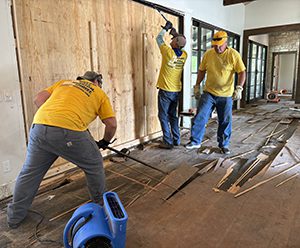
Texans on Mission volunteers arrived to rip out ruined wooden flooring, remove appliances and cut away sheetrock in preparation for Will and Ann Britt to rebuild their home. (Photo / Ferrell Foster)

Two weeks later, Texans on Mission volunteers arrived to rip out ruined wooden flooring, remove appliances and cut away sheetrock in preparation for the Britts to rebuild their home. The Britts told what happened.

While darkness still reigned outside, Will got out of bed in their first-floor bedroom and walked to the living room, checking the weather app on his phone. When he looked at the glass front door, he saw flood waters already head-high beyond the door.

He turned to run and get his wife when the front door exploded open, and water rushed through and smashed out of the broad, glass back door.

If he had not acted so quickly, Will would have been swept out of his home and into the raging river.

“We were awake all night, because the storm was so loud,” Ann said. But she didn’t make it to the front door that morning, as Will grabbed her in retreat from the water and up the nearby stairs.

“I just had my puppy dog and had Will’s hand, and we just ran around the corner and came up here,” she said, standing in the room that became their waiting room in the midst of the flood.

‘OK, Lord, you’ve got us … in your arms’

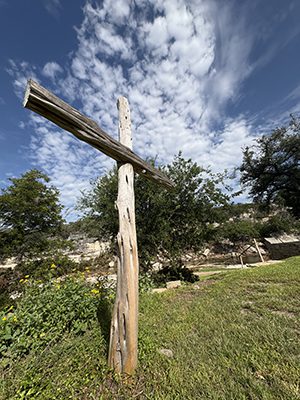
From upstairs, they watched the waters outside rise. A 10-feet tall cross stood outside their window, and by the time the Britts got to the second floor, water had risen to just below the horizontal bar of the cross.

Raging floodwaters knocked down trees, but a 10-foot tall cross remained standing on the property of Will and Ann Britt. (Photo / Ferrell Foster)

In the darkness punctuated by lightning, they continued to watch, pacing from one window to another and praying.

“I mean, literally, I hit those steps (to the second floor), and I just started praising [God],” Ann said. Once upstairs, she made “a little warpath” in prayer back and forth across the room

The cross outside the window held up while the water swept away trees. Just as the water neared the top of the cross, it stopped rising.

“When we saw the arms [of the cross], we thought: ‘OK, Lord, you’ve got us. … You’ve got us in your arms.’”

Thankfulness overtook the Britts, because 18 people from their family usually spent July 4 at the house. They had delayed the family get-together awaiting the birth of the newest family member.

“They all were going to be here, so every bed would have been full,” Ann said. “We were here by ourselves, thank the Lord.”

‘Grief is just overwhelming’

As she spoke two weeks later in front of the window above the cross, Ann’s thoughts turned to Camp Mystic. The Britts’ home is just up river from the camp, and the cross is planted at the edge of their property line with Camp Mystic.

The loss of so many girls’ lives has “affected all of us at home here,” she said. “The grief is just overwhelming. … And the Eastlands are very good friends of ours.”

Camp Director Rick Eastland died in the flood.

The Britts thankfulness their family did not come for the holiday and they made it upstairs in time is mixed with the grief that so many people in Kerr County are grappling with in the aftermath.

A testament to God’s love and mercy

Day after day, funerals, often multiple funerals in one day, became part of the community experience. But the Britts, literally and spiritually, kept their eyes on the cross.

A large cedar tree on their property had fallen, and “a good friend made a cross out of it and just put it in the ground without a lot of direction from us, because we didn’t really know where to put it,” Ann said.

“So, it landed right there,” she said, pointing out the window. “It is the most perfect place. because the sun rises over here, over the bluffs,” Ann said, pivoting to the east. “And it’s the first thing that the sun shines on. You can see it from every room in our downstairs.”

In the evening, the cross is “the last thing that the sun shines on” as it sets behind another bluff. “So, it was the perfect, perfect placement of that cross.”

And during the storm, it seemed to be in the perfect place, as well.

“The cross stayed standing, and it’s just such a testament to [God’s] love and his grace and mercy for us and his protection.”

There is another testament to God on their property. The sign at the property’s entrance gives its name, “Rock House.”

Underneath is a portion of Psalm 18:2, “The Lord is my rock.”


Camp Fusion cultivates culture of connection, service

While many teenagers struggle to fit in and find their place in the world, adolescent immigrants or refugees face particular challenges.

Each summer, hundreds of those teens make their way to Latham Springs Camp & Retreat Center in Aquilla not only to have fun and fellowship at Camp Fusion, but also to address those issues.

“What makes Camp Fusion different is the cultures that are present,” said Lauren De La Calzada, who began attending Camp Fusion in 2012, soon after she finished the 6th grade. Since 2018, she has worked at the camp’s recreation team.

“This camp is specifically created for these youth who are coming from first- and second-generation families who have a very specific childhood where they bridge the gap between parents’ ways, adjusting to American culture and discovering what God has to say about my culture.”

Laruen’s sister-in-law Rachel has attended Camp Fusion since 2010 and started serving in 2015.

“I did a couple of years as a counselor and moved on to rec team,” Rachel said. “I think it is something so beautiful. These kids have come from church backgrounds where it is primarily their own cultures. I think it’s important to share these cultures.”

A day at Camp Fusion

In its 15th year, Camp Fusion, a Texas Baptists camp, gives Asian, African, Haitian and Brazilian teenagers from 6th through 12th grade a chance to embrace their unique cultural experience and the truth about what God has to say about them. The teens who share similar challenges can connect with others just like them.

The days are filled with devotionals, evening worship, three meals a day, and the true camp experience of swimming in the lake, playing sports and participating in competitions.

Teens spending time together near the snack shop at Camp Fusion. (Photo / Kendall Lyons)

Evening worship this year featured “The Agape Youth Band,” a group of seven young people who are part of the music and youth ministry at Agape Community Fellowship Church in Fort Worth.

Voltaire Cacal, a Filipino-American pastor and dean of international students and senior director of formal language programs at Dallas Theological Seminary, spoke each evening.

Preaching from Ephesians 2:11-22, Cacan reminded the teens: “You are not a stranger to God. You are family.”

“The gospel does not flatten your culture. It redeems it. In Christ, your background becomes a bridge, not a barrier,” Cacal said.

Danny Aguinaldo, assistant director, attended Camp Fusion in 2010, and committed his life to Christ there two years later. He took on a leadership role in 2014 with the rec team and later was promoted to his current post.

“Going to Camp Fusion created this community where I got to be around more Asians and Africans and it really helped me in my walk and in figuring out who I am and what I label myself with. In 2012, I came to Christ at Camp Fusion. I was 19,” Aguinaldo said.

From a vision to a mission

Since 2008, Mark Heavener has served in the office of Intercultural Ministries at Texas Baptists. His work involves connecting with churches with roots from Asia, Africa and the Middle East, covering 80 different language groups and more than 350 congregations among Texas Baptists.

“I worked under the founder of the office, Patty Lane. We knew each other beforehand while I completed my seminary degree in cross-cultural ministries. I had a focus and a heart for intercultural America during seminary,” Heavener said.

In 2003, intercultural pastors requested something for the youth in their churches.

“Before that, two different camps … Asian camp and African youth camp … were rolled out from that need in 2003. So, the two camps were developed. In 2009, I worked to see if we can bring the two camps together. And after doing a few events … in 2010, we moved towards fusing the two camps together, hence the name Camp Fusion,” Heavener said.

Training the next generation

“This camp is not for camp’s sake. One of the larger needs among intercultural churches is leadership development for the second gen, the ones born here—needing a space and place to grow in spiritual formation as well as leadership gifts.”

Heavener and his team work with a variety of campers who deal with a generational gap within their home and life and ongoing tension between their cultural identity and American life.

“There is a generational gap between those who came as immigrants, the first gen and those born here, and then the intersection with American culture. Then there’s a convergence of all that, and in the middle is the chaos that these kids are living in bicultural lives,” Heavener said.

Camp Fusion offers Asian and African teens an opportunity to learn how to embrace their identity and find out Jesus welcomes them. Throughout the camp experience, kids see leaders who look like them, striving to serve the Lord and one another.

Training starts with teens who are interested in leading workshops and groups, followed by the development of other kids who are interested in following their footsteps.

The goal is to create the next generation of church leaders

“In the broader American culture, they are pushed to the fringes because of being immigrants or refugees or just different. And identity is always a big issue, predominant issue,” Heavener added.

“So, spiritual formation with a leadership development component is then funneled into the development of the camp. Every year, the cycle repeats.”

When the teens return to their homes and their churches, parents and pastors take notice. The kids appear more confident, get involved in their church, and share their Camp Fusion experience.

Testimony from teens

Lily, who’s on her way to 11th grade at the end of summer, chose to spend a few days at Camp Fusion. The time she has spent with other teens in workshops covering topics like dating has impacted her.

“In the workshop I was in, ‘dating isn’t that deep,’ I learned that if you jump into dating without knowing yourself, then you leave others to define who you are,” Lily said.

Nathan just graduated from high school and started his third year in camp. This was his first year serving in leadership.

“It is a different point of view. I love to see all the kids happy and energetic,” Nathan said. “Throughout training and preparing for my volunteering, it brought me closer to God … the opportunity to pray and ask God what his plan is for me.”

The diversity of Camp Fusion

Linda Howell, intercultural specialist for Texas Baptists, works with Heavener to make sure Camp Fusion maintains strong representation from the many intercultural churches within the BGCT.

“We have a very diverse population. This (Camp Fusion) is the place where they get to be themselves,” Howell said. “They talk through deep issues within the church and what they are going through and get to meet new kids who have similar struggles.”

This year, 525 people attended, with teens from 35 churches representing 17 cultures.

Camp Fusion included kids who are Brazilian, Burmese, Cambodian, Central African, Filipino, Ghanaian, Haitian, Ivorian, Kachin, Karen, Kenyan, Korena, Lao, Lisu, Nigerian and Vietnamese.


Pastor marks 60 years at his one and only church

HICO (BP)—It was 1965, and Carroll Shelby introduced the Mustang GT 350. President Johnson signed Medicare and the Voting Rights Acts into law. And Bob Ray became the pastor of Fairy Baptist Church in Hamilton County, a role he still holds today.

The church will celebrate its pastor’s 60th anniversary Aug. 31.

Ray, 84, originally from Lawrence, Kan., credits his wife Rosalind for helping him recognize his call to ministry.

Bob Ray, pictured with his late wife Rosalind, has served Fairy Baptist Church since 1965. (Photo / Ken Camp)

“Rosalind was an absolutely wonderful partner who felt called to be a pastor’s wife,” he said. “She surrendered to the call before I did, and she used to get a little aggravated with me because I didn’t see it yet.”

Rosalind died last year from pancreatic cancer.

When they agreed on God’s call on his life, Bob Ray announced it to First Southern Baptist Church of Lawrence when he was 24.

He and Rosalind soon moved to Fort Worth where he enrolled at Southwestern Baptist Theological Seminary.

The young ministry student put his bachelor’s degree in business administration to use, finding work as a production control manager at a local manufacturing facility while tending to his seminary studies.

The plant employed several seminary students who made Ray aware of supply preaching opportunities at nearby churches. A classmate recommended the young preacher to a church about 90 miles away that was without a pastor.

“They weren’t looking for much, and they didn’t get much,” Ray said.

Generations of people in the Fairy congregation would disagree.

Serving bivocationally before the term was coined

Ray had no intention of filling the role for 60 years, and serving bivocationally for his entire ministry was certainly not part of the plan.

“I’d never even heard the word,” he said. “People talked about part-time pastors, but the term ‘bivocational’ was not coined until after I started, and people began to realize there is no such thing as ‘part-time ministry.’”

God’s desire was different than Ray’s, however. Churches called with offers throughout the years, but he and Rosalind never had peace with accepting any of them.

As they prayed about opportunities to serve elsewhere, they came to experience a deep peace and contentment in a call to plant roots in Fairy, an unincorporated community near Hico.

Ray continued to work in manufacturing until making a move to the Baptist General Convention of Texas from 2001 until his retirement at the end of 2007. As the director of BGCT’s Bivocational and Small Church Department, he was able to serve pastors like himself.

Having a job he loved and working with people “who needed Jesus really bad” led him to appreciate the opportunity to work in two careers.

“I got to minister a lot in my secular work,” he said.

Challenges and rewards

Of course, he also experienced the challenges of working multiple jobs. Managing time and ensuring family is not neglected are the two biggest challenges Ray identifies. He worked hard to learn to manage time well, and he again credits Rosalind for making sure the family did not resent time devoted to ministry.

“The Lord blessed me with Rosalind. I couldn’t have had a better partner. All three of our boys are saved. All of our grandchildren know the Lord. And the great-grandchildren old enough to understand the gospel have trusted Jesus,” Ray said.

While their community has changed greatly over the last 60 years, Ray and the church have worked tirelessly to reach out.

“People are more isolated now. They shut themselves in,” he said.

He and the church have used direct mail, social media, livestreaming and presence in the community to overcome the isolation.

Advice for other pastors

Ray offers two pieces of advice for pastors.

First, he explains that pastors who serve bivocationally must not believe they have to land a fully funded position to be fulfilled in ministry.

“Rejoice where the Lord has put you until he moves you somewhere else,” he said.

Next, he shares a bit of advice he learned years ago about love and leadership.

“Pastors must learn their people by spending time with them. Pastors must love their people,” he said. “Only after they have loved and learned their people will pastors be able to lead their people.”

“If you’re always looking for the next church, you’re never going to fall in love with your people,” he said. “Rosalind and I just fell in love with our folks. If you love them, they’ll let you lead.”

Sixty years in, he says he has no plans to retire, because he likes preaching but loves pastoring.

William Dooley is a teacher, campus ministry leader and pastor. He is the chairman of the board of directors of the national Bivocational and Small Church Leadership Network.


Granddaughter joins grandmother in providing flood relief

Sometimes, people just need a little reminder to go. For Danielle Cisco of Fort Worth, that reminder came when her grandparents stopped by unexpectedly with a graduation gift.

What began as a quick visit became an invitation to a life-changing week of disaster relief work alongside her grandmother, Debby Cisco, in flood-impacted San Angelo.

Debby and her husband, longtime volunteers with Texans on Mission, hadn’t planned on recruiting anyone that day. But as they chatted with Danielle, the words on the T-shirt Debby wore sparked something in Danielle. They read, “Here I am, send me.”

“I was just sitting on my couch doing nothing,” recalled Danielle, who graduated from Trinity Christian Academy in Willow Park.

“I tried hard to find a job (this summer) but couldn’t find a thing,” Danielle noted. “If I had found a job, though, I would not have spontaneously left on this deployment.”

Danielle said “yes” immediately.

“It’s a dream for a grandmother to take her granddaughter on a mission trip,” Debby said. “Watching others pour into her this week has made my heart swell.”

‘Not afraid to get her hands dirty’

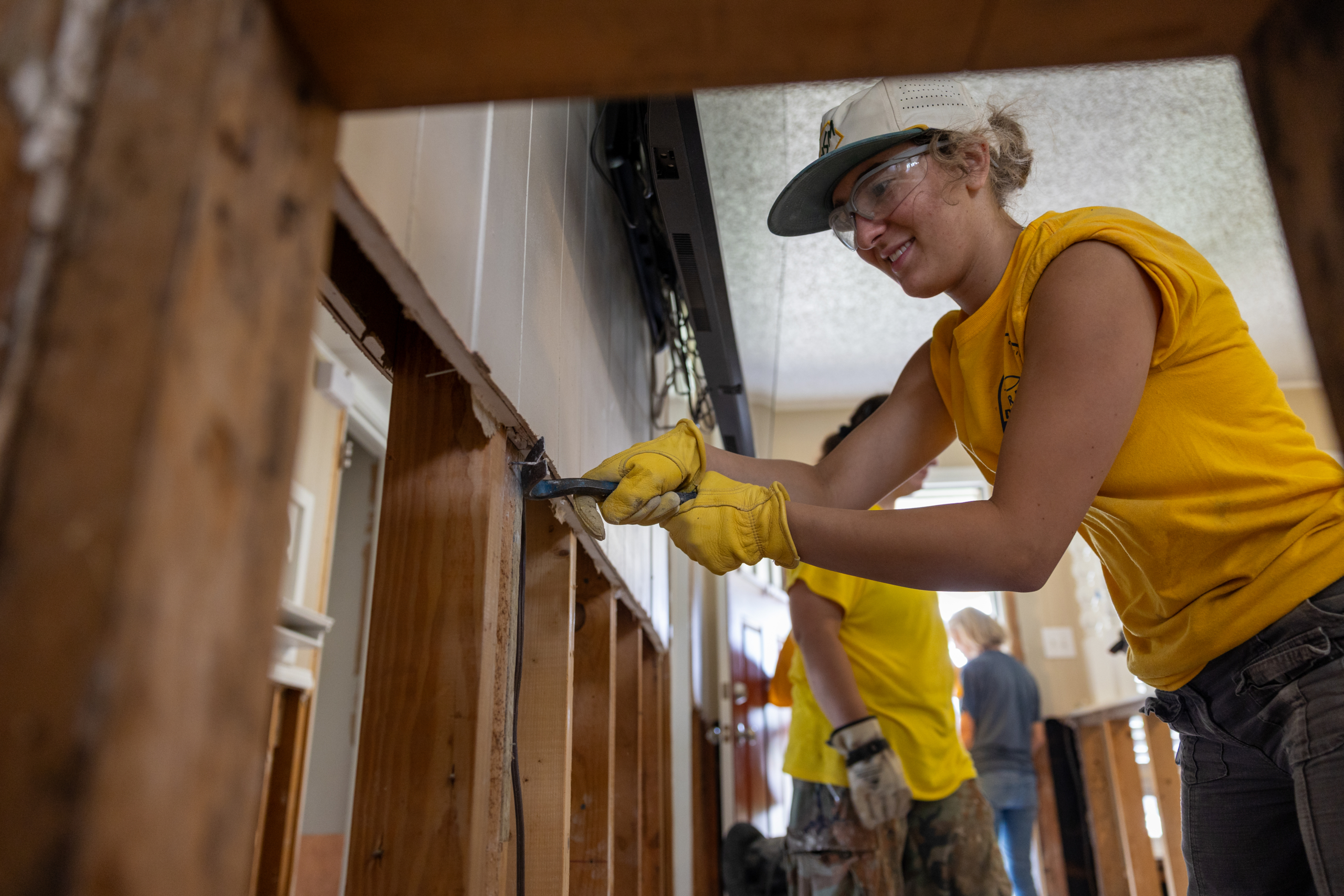
Danielle Cisco helps with tear out in a San Angelo home struck by recent flooding. (Texans on Mission Photo / Tim Miller)

It was Danielle’s first deployment with Texans on Mission. Over the course of their time in San Angelo, someone handed Danielle a saw. She quickly—and proudly—became known as “the cutter girl,” tackling deconstruction work like sawing through walls and tearing up moldy flooring.

“I never thought learning how to use a circular saw would be part of my work as a disciple, but here we are,” Danielle said.

More importantly, she connected with residents—praying, listening and bringing light to people facing devastation.

One woman, Carla, was especially moved, Danielle said. “She kept calling us angels, but really, we’re just normal, dirty people trying to do God’s work.”

Debby watched her granddaughter with pride: “She’s not afraid to get her hands dirty. I’m just proud of her for her heart for Jesus.”