Hunt residents literally keep eyes on the cross

HUNT—Weeks after the deadly July 4 Guadalupe River flood, its survivors still live with memories of danger, fear, confusion, loss—and faith. Will and Ann Britt awoke that morning just in time.
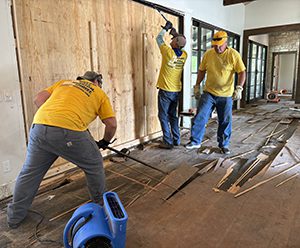
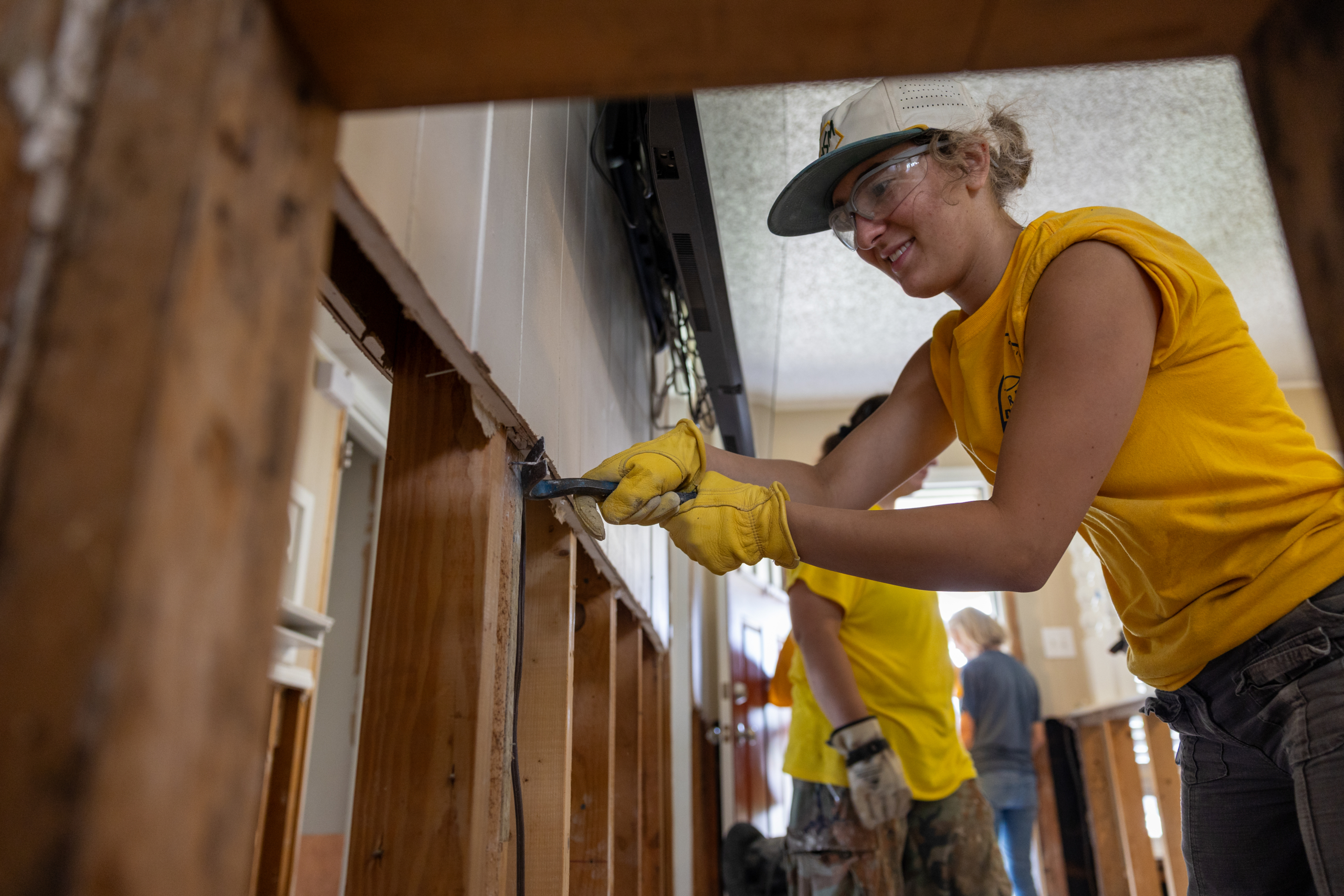
Texans on Mission volunteers arrived to rip out ruined wooden flooring, remove appliances and cut away sheetrock in preparation for Will and Ann Britt to rebuild their home. (Photo / Ferrell Foster)

Two weeks later, Texans on Mission volunteers arrived to rip out ruined wooden flooring, remove appliances and cut away sheetrock in preparation for the Britts to rebuild their home. The Britts told what happened.

While darkness still reigned outside, Will got out of bed in their first-floor bedroom and walked to the living room, checking the weather app on his phone. When he looked at the glass front door, he saw flood waters already head-high beyond the door.

He turned to run and get his wife when the front door exploded open, and water rushed through and smashed out of the broad, glass back door.

If he had not acted so quickly, Will would have been swept out of his home and into the raging river.

“We were awake all night, because the storm was so loud,” Ann said. But she didn’t make it to the front door that morning, as Will grabbed her in retreat from the water and up the nearby stairs.

“I just had my puppy dog and had Will’s hand, and we just ran around the corner and came up here,” she said, standing in the room that became their waiting room in the midst of the flood.

‘OK, Lord, you’ve got us … in your arms’

From upstairs, they watched the waters outside rise. A 10-feet tall cross stood outside their window, and by the time the Britts got to the second floor, water had risen to just below the horizontal bar of the cross.
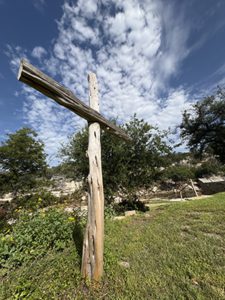
Raging floodwaters knocked down trees, but a 10-foot tall cross remained standing on the property of Will and Ann Britt. (Photo / Ferrell Foster)

In the darkness punctuated by lightning, they continued to watch, pacing from one window to another and praying.

“I mean, literally, I hit those steps (to the second floor), and I just started praising [God],” Ann said. Once upstairs, she made “a little warpath” in prayer back and forth across the room

The cross outside the window held up while the water swept away trees. Just as the water neared the top of the cross, it stopped rising.

“When we saw the arms [of the cross], we thought: ‘OK, Lord, you’ve got us. … You’ve got us in your arms.’”

Thankfulness overtook the Britts, because 18 people from their family usually spent July 4 at the house. They had delayed the family get-together awaiting the birth of the newest family member.

“They all were going to be here, so every bed would have been full,” Ann said. “We were here by ourselves, thank the Lord.”

‘Grief is just overwhelming’

As she spoke two weeks later in front of the window above the cross, Ann’s thoughts turned to Camp Mystic. The Britts’ home is just up river from the camp, and the cross is planted at the edge of their property line with Camp Mystic.

The loss of so many girls’ lives has “affected all of us at home here,” she said. “The grief is just overwhelming. … And the Eastlands are very good friends of ours.”

Camp Director Rick Eastland died in the flood.

The Britts thankfulness their family did not come for the holiday and they made it upstairs in time is mixed with the grief that so many people in Kerr County are grappling with in the aftermath.

A testament to God’s love and mercy

Day after day, funerals, often multiple funerals in one day, became part of the community experience. But the Britts, literally and spiritually, kept their eyes on the cross.

A large cedar tree on their property had fallen, and “a good friend made a cross out of it and just put it in the ground without a lot of direction from us, because we didn’t really know where to put it,” Ann said.

“So, it landed right there,” she said, pointing out the window. “It is the most perfect place. because the sun rises over here, over the bluffs,” Ann said, pivoting to the east. “And it’s the first thing that the sun shines on. You can see it from every room in our downstairs.”

In the evening, the cross is “the last thing that the sun shines on” as it sets behind another bluff. “So, it was the perfect, perfect placement of that cross.”

And during the storm, it seemed to be in the perfect place, as well.

“The cross stayed standing, and it’s just such a testament to [God’s] love and his grace and mercy for us and his protection.”

There is another testament to God on their property. The sign at the property’s entrance gives its name, “Rock House.”

Underneath is a portion of Psalm 18:2, “The Lord is my rock.”


Camp Fusion cultivates culture of connection, service

While many teenagers struggle to fit in and find their place in the world, adolescent immigrants or refugees face particular challenges.

Each summer, hundreds of those teens make their way to Latham Springs Camp & Retreat Center in Aquilla not only to have fun and fellowship at Camp Fusion, but also to address those issues.

“What makes Camp Fusion different is the cultures that are present,” said Lauren De La Calzada, who began attending Camp Fusion in 2012, soon after she finished the 6th grade. Since 2018, she has worked at the camp’s recreation team.

“This camp is specifically created for these youth who are coming from first- and second-generation families who have a very specific childhood where they bridge the gap between parents’ ways, adjusting to American culture and discovering what God has to say about my culture.”

Laruen’s sister-in-law Rachel has attended Camp Fusion since 2010 and started serving in 2015.

“I did a couple of years as a counselor and moved on to rec team,” Rachel said. “I think it is something so beautiful. These kids have come from church backgrounds where it is primarily their own cultures. I think it’s important to share these cultures.”

A day at Camp Fusion

In its 15th year, Camp Fusion, a Texas Baptists camp, gives Asian, African, Haitian and Brazilian teenagers from 6th through 12th grade a chance to embrace their unique cultural experience and the truth about what God has to say about them. The teens who share similar challenges can connect with others just like them.

The days are filled with devotionals, evening worship, three meals a day, and the true camp experience of swimming in the lake, playing sports and participating in competitions.

Teens spending time together near the snack shop at Camp Fusion. (Photo / Kendall Lyons)

Evening worship this year featured “The Agape Youth Band,” a group of seven young people who are part of the music and youth ministry at Agape Community Fellowship Church in Fort Worth.

Voltaire Cacal, a Filipino-American pastor and dean of international students and senior director of formal language programs at Dallas Theological Seminary, spoke each evening.

Preaching from Ephesians 2:11-22, Cacan reminded the teens: “You are not a stranger to God. You are family.”

“The gospel does not flatten your culture. It redeems it. In Christ, your background becomes a bridge, not a barrier,” Cacal said.

Danny Aguinaldo, assistant director, attended Camp Fusion in 2010, and committed his life to Christ there two years later. He took on a leadership role in 2014 with the rec team and later was promoted to his current post.

“Going to Camp Fusion created this community where I got to be around more Asians and Africans and it really helped me in my walk and in figuring out who I am and what I label myself with. In 2012, I came to Christ at Camp Fusion. I was 19,” Aguinaldo said.

From a vision to a mission

Since 2008, Mark Heavener has served in the office of Intercultural Ministries at Texas Baptists. His work involves connecting with churches with roots from Asia, Africa and the Middle East, covering 80 different language groups and more than 350 congregations among Texas Baptists.

“I worked under the founder of the office, Patty Lane. We knew each other beforehand while I completed my seminary degree in cross-cultural ministries. I had a focus and a heart for intercultural America during seminary,” Heavener said.

In 2003, intercultural pastors requested something for the youth in their churches.

“Before that, two different camps … Asian camp and African youth camp … were rolled out from that need in 2003. So, the two camps were developed. In 2009, I worked to see if we can bring the two camps together. And after doing a few events … in 2010, we moved towards fusing the two camps together, hence the name Camp Fusion,” Heavener said.

Training the next generation

“This camp is not for camp’s sake. One of the larger needs among intercultural churches is leadership development for the second gen, the ones born here—needing a space and place to grow in spiritual formation as well as leadership gifts.”

Heavener and his team work with a variety of campers who deal with a generational gap within their home and life and ongoing tension between their cultural identity and American life.

“There is a generational gap between those who came as immigrants, the first gen and those born here, and then the intersection with American culture. Then there’s a convergence of all that, and in the middle is the chaos that these kids are living in bicultural lives,” Heavener said.

Camp Fusion offers Asian and African teens an opportunity to learn how to embrace their identity and find out Jesus welcomes them. Throughout the camp experience, kids see leaders who look like them, striving to serve the Lord and one another.

Training starts with teens who are interested in leading workshops and groups, followed by the development of other kids who are interested in following their footsteps.

The goal is to create the next generation of church leaders

“In the broader American culture, they are pushed to the fringes because of being immigrants or refugees or just different. And identity is always a big issue, predominant issue,” Heavener added.

“So, spiritual formation with a leadership development component is then funneled into the development of the camp. Every year, the cycle repeats.”

When the teens return to their homes and their churches, parents and pastors take notice. The kids appear more confident, get involved in their church, and share their Camp Fusion experience.

Testimony from teens

Lily, who’s on her way to 11th grade at the end of summer, chose to spend a few days at Camp Fusion. The time she has spent with other teens in workshops covering topics like dating has impacted her.

“In the workshop I was in, ‘dating isn’t that deep,’ I learned that if you jump into dating without knowing yourself, then you leave others to define who you are,” Lily said.

Nathan just graduated from high school and started his third year in camp. This was his first year serving in leadership.

“It is a different point of view. I love to see all the kids happy and energetic,” Nathan said. “Throughout training and preparing for my volunteering, it brought me closer to God … the opportunity to pray and ask God what his plan is for me.”

The diversity of Camp Fusion

Linda Howell, intercultural specialist for Texas Baptists, works with Heavener to make sure Camp Fusion maintains strong representation from the many intercultural churches within the BGCT.

“We have a very diverse population. This (Camp Fusion) is the place where they get to be themselves,” Howell said. “They talk through deep issues within the church and what they are going through and get to meet new kids who have similar struggles.”

This year, 525 people attended, with teens from 35 churches representing 17 cultures.

Camp Fusion included kids who are Brazilian, Burmese, Cambodian, Central African, Filipino, Ghanaian, Haitian, Ivorian, Kachin, Karen, Kenyan, Korena, Lao, Lisu, Nigerian and Vietnamese.


Pastor marks 60 years at his one and only church

HICO (BP)—It was 1965, and Carroll Shelby introduced the Mustang GT 350. President Johnson signed Medicare and the Voting Rights Acts into law. And Bob Ray became the pastor of Fairy Baptist Church in Hamilton County, a role he still holds today.

The church will celebrate its pastor’s 60th anniversary Aug. 31.

Ray, 84, originally from Lawrence, Kan., credits his wife Rosalind for helping him recognize his call to ministry.

Bob Ray, pictured with his late wife Rosalind, has served Fairy Baptist Church since 1965. (Photo / Ken Camp)

“Rosalind was an absolutely wonderful partner who felt called to be a pastor’s wife,” he said. “She surrendered to the call before I did, and she used to get a little aggravated with me because I didn’t see it yet.”

Rosalind died last year from pancreatic cancer.

When they agreed on God’s call on his life, Bob Ray announced it to First Southern Baptist Church of Lawrence when he was 24.

He and Rosalind soon moved to Fort Worth where he enrolled at Southwestern Baptist Theological Seminary.

The young ministry student put his bachelor’s degree in business administration to use, finding work as a production control manager at a local manufacturing facility while tending to his seminary studies.

The plant employed several seminary students who made Ray aware of supply preaching opportunities at nearby churches. A classmate recommended the young preacher to a church about 90 miles away that was without a pastor.

“They weren’t looking for much, and they didn’t get much,” Ray said.

Generations of people in the Fairy congregation would disagree.

Serving bivocationally before the term was coined

Ray had no intention of filling the role for 60 years, and serving bivocationally for his entire ministry was certainly not part of the plan.

“I’d never even heard the word,” he said. “People talked about part-time pastors, but the term ‘bivocational’ was not coined until after I started, and people began to realize there is no such thing as ‘part-time ministry.’”

God’s desire was different than Ray’s, however. Churches called with offers throughout the years, but he and Rosalind never had peace with accepting any of them.

As they prayed about opportunities to serve elsewhere, they came to experience a deep peace and contentment in a call to plant roots in Fairy, an unincorporated community near Hico.

Ray continued to work in manufacturing until making a move to the Baptist General Convention of Texas from 2001 until his retirement at the end of 2007. As the director of BGCT’s Bivocational and Small Church Department, he was able to serve pastors like himself.

Having a job he loved and working with people “who needed Jesus really bad” led him to appreciate the opportunity to work in two careers.

“I got to minister a lot in my secular work,” he said.

Challenges and rewards

Of course, he also experienced the challenges of working multiple jobs. Managing time and ensuring family is not neglected are the two biggest challenges Ray identifies. He worked hard to learn to manage time well, and he again credits Rosalind for making sure the family did not resent time devoted to ministry.

“The Lord blessed me with Rosalind. I couldn’t have had a better partner. All three of our boys are saved. All of our grandchildren know the Lord. And the great-grandchildren old enough to understand the gospel have trusted Jesus,” Ray said.

While their community has changed greatly over the last 60 years, Ray and the church have worked tirelessly to reach out.

“People are more isolated now. They shut themselves in,” he said.

He and the church have used direct mail, social media, livestreaming and presence in the community to overcome the isolation.

Advice for other pastors

Ray offers two pieces of advice for pastors.

First, he explains that pastors who serve bivocationally must not believe they have to land a fully funded position to be fulfilled in ministry.

“Rejoice where the Lord has put you until he moves you somewhere else,” he said.

Next, he shares a bit of advice he learned years ago about love and leadership.

“Pastors must learn their people by spending time with them. Pastors must love their people,” he said. “Only after they have loved and learned their people will pastors be able to lead their people.”

“If you’re always looking for the next church, you’re never going to fall in love with your people,” he said. “Rosalind and I just fell in love with our folks. If you love them, they’ll let you lead.”

Sixty years in, he says he has no plans to retire, because he likes preaching but loves pastoring.

William Dooley is a teacher, campus ministry leader and pastor. He is the chairman of the board of directors of the national Bivocational and Small Church Leadership Network.


Granddaughter joins grandmother in providing flood relief

Sometimes, people just need a little reminder to go. For Danielle Cisco of Fort Worth, that reminder came when her grandparents stopped by unexpectedly with a graduation gift.

What began as a quick visit became an invitation to a life-changing week of disaster relief work alongside her grandmother, Debby Cisco, in flood-impacted San Angelo.

Debby and her husband, longtime volunteers with Texans on Mission, hadn’t planned on recruiting anyone that day. But as they chatted with Danielle, the words on the T-shirt Debby wore sparked something in Danielle. They read, “Here I am, send me.”

“I was just sitting on my couch doing nothing,” recalled Danielle, who graduated from Trinity Christian Academy in Willow Park.

“I tried hard to find a job (this summer) but couldn’t find a thing,” Danielle noted. “If I had found a job, though, I would not have spontaneously left on this deployment.”

Danielle said “yes” immediately.

“It’s a dream for a grandmother to take her granddaughter on a mission trip,” Debby said. “Watching others pour into her this week has made my heart swell.”

‘Not afraid to get her hands dirty’

Danielle Cisco helps with tear out in a San Angelo home struck by recent flooding. (Texans on Mission Photo / Tim Miller)

It was Danielle’s first deployment with Texans on Mission. Over the course of their time in San Angelo, someone handed Danielle a saw. She quickly—and proudly—became known as “the cutter girl,” tackling deconstruction work like sawing through walls and tearing up moldy flooring.

“I never thought learning how to use a circular saw would be part of my work as a disciple, but here we are,” Danielle said.

More importantly, she connected with residents—praying, listening and bringing light to people facing devastation.

One woman, Carla, was especially moved, Danielle said. “She kept calling us angels, but really, we’re just normal, dirty people trying to do God’s work.”

Debby watched her granddaughter with pride: “She’s not afraid to get her hands dirty. I’m just proud of her for her heart for Jesus.”


Llano girls step up to support others after flood

LLANO—Jenny Patrick’s daughters—ages 10, 11 and 13—love to set up a lemonade stand on their front porch during the summer. This summer, they recruited other girls, enlisted moms to do some baking and set up a stand at Llano High School.

They did it to help the people of nearby Kerr County, which suffered from the deadly July 4 flooding of the Guadalupe River. The girls raised $4,095 for the Texans on Mission’s disaster relief effort.

“We learned about Texas on Mission through Nathan Buchanan, who came to speak at our church,” said Patrick, a member of First Baptist Church in Llano. “It just kind of got the wheels spinning about how we can help Texans on Mission” respond to the flood.

‘So many hurting and suffering families’

Eleven-year-old Ramsey Patrick said she “wanted to help with the lemonade stand because I knew there were so many hurting and suffering families out there.”

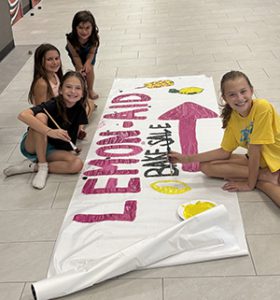
Girls in Llano set up a lemonade stand at Llano High School to help benefit Kerr County residents affected by the July 4 floods. They raised $4,095 for Texans on Mission’s disaster relief effort. (Courtesy Photo)

Doing the project meant “I was doing something good for the community and showing some compassion for the families in pain,” she added. “I am very grateful for having the opportunity to help them.”

Ben March, senior donor relations officer with Texans on Mission, said: “I had the chance to speak with Jenny Patrick after Texans on Mission received this special gift. What these girls did, with support from their church and families, is inspiring. They are learning early in life the great responsibility and joy that Christians have in coming to the aid of hurting people.”

Buchanan, who spoke at First Baptist after the flood, is Texans on Mission volunteer coordinator. He had been scheduled earlier to speak at the church, but after the flood he was able to tell what the missions organization was doing about an hour’s drive away in Kerr County, as Christians in Llano and the nation prayed and awaited news about the victims.

The message “really opened up an opportunity for us to brainstorm about how we could help with flood victims,” Patrick said.

“So, we decided to take something that our girls love to do just on a normal day, which is the lemonade stand, and really escalate it to a bigger scale to help out the flood victims.”

Involved the whole community

It became the “LEMON-‘AID’ Stand & Bake Sale” on July 14 at Llano High School, where Patrick is a counselor.

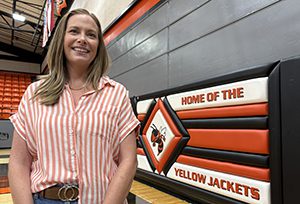
Jenny Patrick is a counselor at Llano High School, where her daughters were instrumental in leading a lemonade stand and bake sale as a fundraising effort for Texans on Mission disaster relief. (Photo / Ferrell Foster)

What began as a family effort, then a church one, eventually involved the whole community. “We’re a part of a small community,” and the school often becomes the focal point for local efforts.

The Patrick girls’ regular lemonade stands are normally a means to “get them away from the TV” and start interacting with neighbors, their mother said. The special event enabled them to involve other girls and church members.

Twelve girls spearheaded the effort, with their seven moms supporting.

The girls “definitely wanted a hand in all of it,” Patrick said. “They wanted to help count … and help deposit the money.”

And they had never handled so much money. “It was $4,095, … and so it was big for our town. It was a big amount for them (the girls). It’s an amount that they don’t ever have in their hands or their pockets in their own lemonade stands,” she said.

“It was a great lesson for them. On a normal lemonade stand day, people might drop off 50 cents or a dollar”

Neighbors eager to ‘show up and help’

The girls learned their community and church “will show up and help,” Patrick added.

The girls did not charge for the lemonade or baked goods. Instead, they just asked people to donate for the cause.

“I would say anywhere from $20 to $50 was a typical amount that someone would come and give,” Patrick said. “And so we didn’t have a lot of ones.”

It also was great for the “older members” of the church to see the “younger youth in their church really stepping up to the plate.”

Llano is about 60 miles from Kerrville and about 80 miles from Camp Mystic. They are not “right next door,” but the people of Llano regularly travel to Kerrville for sporting events and to shop, Patrick said.

“The flood, in general, has just been hard on us … not only because we’re close, but we also have daughters,” she said, referencing the deaths of more than 20 girls at Camp Mystic.

“It’s just really touched our hearts, and I want to teach my children service and how to serve their church and how to serve their community.”

A spiritual exercise

The Lemon-Aid effort became a spiritual exercise, as well.

“The lemonade was prayed over; the baked items were prayed over,” Patrick said.

What happened along the river is “such a tragedy.”

“At the same time I think God’s using us together to help each other,” she said.

“I think that’s what Texas is known for, but also that’s what Christians are known for,” she added.

So, this has been a great time to not just “teach our kids about service” but to help them “see how the church can come together to help others,” she said.

This is not Patrick’s first connection with Texans on Mission. Her grandfather, the late Eugene Bennett, served with Texas Baptist Men, the former name of Texans on Mission.

“He built churches all around Texas with Texas Baptist Men,” So, when Buchanan spoke at First Baptist, “I recognized the group and the name, and it was just something special to my heart.”


Community volunteers multiply Texans on Mission ministry

HUNT—Things can change quickly in disaster relief. Because of this, Texans on Mission trains its volunteers to be flexible—to expect the unexpected.

So when 13 new volunteers showed up to serve in Hunt, the Texans on Mission flood recovery team from Marble Falls welcomed them aboard, and the new recruits went to work.

Evan Everett, leader of the Texans on Mission Marble Falls unit, gives direction to a volunteer. (Texans on Mission Photo)

“We started out with eight of us total, and we ended up with 21,” said Evan Everett, leader of the Texans on Mission Marble Falls unit. “It was pretty neat, though, because a lot of the volunteers … that came later, probably about half of them were not believers.”

The reinforcements are called “day volunteers.” They are not trained in disaster relief, but when paired with trained Texans on Mission volunteers, they provide extra hands for the work.

On Saturday, July 19, those extra workers also had the opportunity to hear about having a relationship with Christ.

“We had the opportunity to be able to just share with them about Christ,” Everett said. “Some of them were Hindu. Some of them were searching (spiritually).”

But the Marble Falls team worked side-by-side with new arrivals and shared their motivation for working—to serve people in Christ’s name.

God provides people with the right skills

Paul Henry, Texans on Mission incident commander, saw God at work in bringing the unexpected day volunteers.

“God brought people with skills and talents that they (the Marble Falls team) needed in that particular job that they were doing,” Henry said.

And God also brought “the opportunity to share the gospel” within the workers and not just with the homeowners.

The extra workers allowed the team to complete the mud-out work faster and opened the door for more service in the large home on the north fork of the Guadalupe River, upstream and west from Kerrville.

The homeowners already had secured materials to begin the rebuilding process and asked the Texans on Mission volunteers if they could help, Everett said.

“And so, we made quick work of the basement, and made quick work of the rebuild. And a lot of the rest of our day was just getting stuff back inside that was outside,” he said. “It just ended up that it was great that we had them.”

The homeowners needed help sorting through items that had been removed from the house—some being kept and some being discarded. The volunteers went through everything, and the homeowners directed the items to the proper place.

“If we hadn’t had the volunteers, we wouldn’t have been able to do that in a timely fashion,” Everett said. “It would have taken a long time.”

Day volunteers’ presence offers ministry opportunity

Trained Texans on Mission volunteers “provided the leadership and the expertise to allow the whole team to go in and do serious mud-outs,” Henry said. “They can cut the sheetrock, get the insulation out, get the floor up, they can power wash, they can spray, they can do the whole job, and they can work with large numbers.”

The day volunteers provided “an incredible amount of manpower,” Henry said, but there are limitations. For instance, some of the people who joined the Marble Falls group had physical limitations. “That’s why we had some of them in the kitchen washing dishes, because that was something they could do.”

Others in the group brought needed skills.

“These volunteers bring skills like contractors, they’re landscapers,” Henry said.

They also brought resources to the Hunt site, including a dump trailer the entire team loaded with limbs.

The fact that some of the day volunteers in Hunt were not Christians provided a special opportunity. Henry called it a “built-in ministry where they’re working side-by-side with people they can share the gospel and live the testimony out before them.”


Strong reactions to Baylor grant decision continue

Baylor University’s announced receipt of a grant for the study of “disenfranchisement and exclusion of LGBTQIA+ individuals and women” in the churches and its subsequent decision to return the grant continue to prompt strong reactions.

Less than a week after more than 60 church leaders endorsed an open letter of support for Baylor’s decision to rescind the grant, a group of 25 pastors produced their own open letter similarly expressing support for “the wise return of the Baugh grant.”

That second letter—sent to the Baptist Standard by John Durham, pastor of Highland Baptist Church in Waco—was published online July 18.

Four ministers who endorsed the previous letter—Durham, Jeff Warren from Park Cities Baptist Church in Dallas, Jim Heiligman from First Baptist Church in Bryan and Chris Johnson from First Baptist Church in San Antonio—signed it, along with 21 others.

“We fully agree that any grant that advocates for perspectives on human sexuality that are counter to biblical sexual ethics should be declined or returned. Right decisions are usually easy; righteous decisions are usually costly,” the brief letter states.

“We applaud this decision that Baylor has made and stand beside President [Linda] Livingstone’s leadership and wisdom in this matter.”

Public pastoral letter posted online

The same day that letter was posted online, Mary Alice Birdwhistell, pastor of Faith Baptist Church in Georgetown, Ky., contacted the Baptist Standard to announce a “public pastoral letter” to Baylor.

That online letter opposed the university’s decision to “return the renewal of an existing grant from the Eula Mae and John Baugh Foundation that would have funded research on trauma-informed practices for people marginalized by the church, including LGBTQIA+ individuals and women.”

Birdwhistell stated the initial group who signed the letter represented more than 100 “pastors and faith leaders from across the country with ties to Baylor University.” Of the pastors in that group, 90 percent are Baylor alumni, she wrote.

By Tuesday morning, July 22, the number of individuals who signed the online letter topped 350.

‘Research like this is urgently needed’

“While another group of pastors praised Baylor for its commitment to ‘hold together theological conviction and compassionate presence,’ we firmly believe denying funding for this research exhibits indifference and disregard for the well-being of LGBTQ+ individuals and women in our congregations,” the public pastoral letter states.

“In addition, one of the most significant questions facing the Church today is how we engage LGBTQ+ people, a question that is tearing apart congregations and denominations worldwide. Research like this is urgently needed now more than ever before.”

The letter indicates those endorsing it represent “a wide array of theological, denominational, and political backgrounds,” but they “share a commitment to the spiritual care of our communities, which include LGBTQ+ individuals.”

“Over the years, we have witnessed the deep hurt, shame, condemnation, and exclusion this community has faced at the hands of the Church,” the letter states.

‘Heartbreak and hope’

The letter cites the need for “robust research” on the harm caused by religious rejection. It notes a 2020 study in Psychology of Religion and Spirituality indicating “LGBTQ+ individuals who experienced religious-based rejection were six times more likely to report high levels of depression and suicidal ideation.”

The problem particularly is acute among youth, the letter states. It points to a 2023 survey by The Trevor Project that revealed 4 out of 10 LGBTQ+ youth “seriously considered suicide in the past year, with many citing religious rejection as a key factor.”

“Our pastoral experience compels us to speak from the depths of both heartbreak and hope. We have received late-night calls from our LGBTQ+ congregants at risk of suicide, and we have officiated their funerals. We have wept with them as they shared stories of exclusion and debilitating shame,” the letter states.

“Yet, we have also witnessed their courage, fortitude, and deep faithfulness, even as we have seen the toll on their mental, physical, and emotional well-being. We have also celebrated with LGBTQ+ congregants as they have found healing and discovered their God-given gifts, witnessed their profound contributions to our faith communities, and marveled at the unique ways they reflect the image of God.”

Real lives at stake

The letter concludes with an appeal to “consider not just the institutional policies of this decision, but the real lives at stake in the Church and the world.”

“When the Church becomes complicit in the very systems that cause trauma, we cease to be the Body of Christ and become instead an instrument of harm,” the letter states. “Maya Angelou once said, ‘Do the best you can until you know better. Then when you know better, do better.’

“We have known better for quite some time. It is past time for the Church to do better. And it is past time for Baylor to do better, too. We urge you to lead with courage and compassion.”

Respond with curiosity, rather than fear

Birdwhistell noted she collaborated on the letter with Aurelia Dávila Pratt from Peace of Christ Church in Round Rock and Carol McEntyre from First Baptist Church in Greenville, S.C.

Pratt told the Baptist Standard they “felt compelled” to write the letter after the group of more than 60 church leaders publicly voiced support for Baylor’s decision to return the grant.

“A lot of us—maybe a lot more of us—see the decision differently,” she said.

As an alum of both Baylor’s Truett Theological Seminary and the Diana R. Garland School of Social Work, Pratt voiced hope the university will set an example by “instead of reacting with fear, responding with curiosity.”

‘Critically urgent’ need

She called Baylor’s decision a “troubling precedent to set” and expressed her desire for both Baylor and churches to show “concern for real people” and their pain.

McEntyre, also a graduate of both Truett Seminary and the Garland School of Social Work, expressed a similar desire in a Facebook post.

“As a pastor, I’ve listened to countless painful stories of LGBTQIA+ individuals excluded and shamed by the Church. I have seen the profound harm this causes,” she wrote.

“That’s why I was so deeply disappointed by Baylor University’s decision to return the renewal of a grant from the Baugh Foundation. This funding would have supported vital research into trauma-informed practices for people marginalized by the Church—including LGBTQIA+ individuals and women.

“This research was about healing, about responding with Christ-like compassion to those who have been hurt in the name of faith. It’s not just needed, it’s critically urgent.”

Baylor stands by its Statement on Human Sexuality

When given the opportunity to comment, Baylor University provided the following statement: “It is Baylor’s longstanding practice not to respond to online petitions or open letters. We always appreciate the different viewpoints represented across the 150,000-plus members of the Baylor Family—students, faculty, staff and alumni—as well as from others on issues of importance.”

The university offered clarification regarding whether the recent rescinded grant was a renewal or a new award.

“The Diana R. Garland School of Social Work had received research funding from the Baugh Foundation in the past, but the recently rescinded grant was not a renewal of an existing award,” the university spokesperson said.

“The previous Baugh-funded research focused on churches and institutions, and the recently rescinded grant was meant to build on earlier research findings.”

The university also reiterated a statement made in the July 9 public statement from President Linda Livingstone: “Baylor also continues to strongly uphold the principle of academic freedom. As we reviewed the details and process surrounding this grant, our concerns did not center on the research itself, but rather on the activities that followed as part of the grant.

“Specifically, the work extended into advocacy for perspectives on human sexuality that are inconsistent with Baylor’s institutional policies, including our Statement on Human Sexuality.”

CORRECTION: Date corrected for 2023 Trevor Project survey.


Texans on Mission give grieving parents baskets of blessing

One searcher after the flood in Kerr County came across personal items with the names of four children on them. Those items are being returned to those families with a special touch from Texans on Mission volunteers.

Lacy Daves, a volunteer from Kingsland Baptist Church in Katy, deployed to Kerrville as part of the Texans on Mission response to the devastating July 4 flood which has claimed at least 135 lives.

“My neighbor (in Houston) had a connection here in Kerrville who was out doing search and rescue,” Daves said. “He found some of the belongings of campers who did not make it. He picked up some of their personal items and sent a picture of the names.”

Daves made more connections as she deployed with a flood recovery team the week of July 15. She was determined to “bring these things home if the families would like to have any of the belongings back,” she said.

“Some of the ladies here knew what I was going to be doing and wanted to make it even more special,” Daves said.

Jeannie Stover, a volunteer from Taylor’s Valley Baptist Church in Temple, had made blankets for survivors of the flood, and the group had been praying God would use the blankets to help comfort someone. Then they heard about the effort of returning the children’s items.

Blankets, Bibles and recovered keepsakes

The recovered items, a blanket and a Bible signed by Texans on Mission volunteers were packaged into baskets for delivery to the children’s parents.

Texans on Mission volunteers sign Bibles they presented to heartbroken families in the Texas Hill Country. (Texans on Mission Photo by Russ Dilday)

Daves and Stover were joined in the effort by Fred Stover (Jeannie’s husband) and Gayle Romans of First Baptist Church in Farmersville. The Stovers were part of a shower/laundry unit, and Romans deployed as on-site coordinator of the Texans on Mission incident management team in Kerrville.

With the help of other volunteers, the four put together the baskets and prayed over the contents, which will be sent to the children’s parents.

“Our prayer would be that God would give them comfort and assurance and they would feel the love and the covering of Jesus as we do this for them,” Jeannie Stover said. “It comes from the bottom of our hearts.”

Fred Stover felt a deep connection to the grieving parents.

“I lost a son a little over a year ago. So, my heart feels the grief that these parents are feeling,” he said. “And when this was brought up, the girls said to me, ‘We need to get some Bibles and get them signed.’ So, I went and got the Bibles.”

He then involved the staff of Kerrville’s Trinity Baptist Church in the effort.

“I’ve gone through the entire church, the pastoral staff has prayed over these Bibles and these blankets, and we have gotten signatures from everyone,” Stover said.

Romans summed up the team’s desire for the message of the baskets by pointing to Scripture. “In Romans 15:13, it says, ‘May the God of hope fill you with all the joy and peace that you trust in him so that you may overflow with the hope by the power of the Holy Spirit.’”


Around the State: Wayland team joins sports ministry and missions in Alaska

In the tiny village of Ninilchik, Alaska—where the road ends and Cook Inlet begins—Wayland Baptist University students, Donnie Brown and Marcos Hinojos Jr., brought more than sports skills and service projects this summer. They brought joy, encouragement and the hope of the gospel. Led by Brown, director of spiritual life, and Hinojos, offensive line coach for Pioneers football, the team partnered with Alaska Missions to host a weeklong sports camp for local children in one of the state’s most remote communities. The camp combined afternoon sessions of football and basketball drills with spiritual moments. Eight children responded by placing their faith in Christ. Alaska Missions is following up with those students, connecting them with local churches to foster discipleship and growth. Wayland students experienced their own spiritual transformation through the week. Wayland has a long-standing partnership with Alaska Missions, led by Brenda Crim.

At the Baptist World Congress in Brisbane, Linda Livingstone and Elijah Brown sign a memorandum of understand to establish the BWA Program and Center at Baylor University’s Truett Seminary. (Courtesy Photo)

At the 23rd Baptist World Congress in Brisbane, Australia, Baptist World Alliance General Secretary Elijah Brown and Baylor University President Linda Livingstone signed a memorandum of understanding committing to deepening their relationship and “serve together in a shared call to pursue the mission of God out of our Baptist identity both for the church and for the world.”  For the past year, the BWA and Baylor have worked together to develop the BWA Center, which will offer clergy and lay leaders training in global Baptist history, polity, beliefs, leadership, evangelism and integral mission. Housed in Baylor University’s Truett Seminary, the center will offer academic and scholarly education, research, support and practical engagement to educate and support leaders in the global Baptist movement. The BWA received initial gifts totaling $4.5 million to launch the program, including investment by Baylor University, the Truett Dean’s Excellence Fund and a $2.5 million lead donation from Susan and Lee Bush to establish the Lampsato Endowed Chair of Baptist World Missional Engagement—the first endowed chair in the world focused on studying the BWA as a global movement and seeking to empower the BWA family with additional training and preparation.

Hardin-Simmons University has earned multiple honors from Colleges of Distinction, a national resource for guidance counselors, parents, students, and hundreds of colleges and universities across the United States. For the 11th consecutive year, HSU has been named a College of Distinction—an honor that highlights universities demonstrating excellence in undergraduate education through engaged students, excellent teaching, vibrant campus life and strong student outcomes. HSU is one of only five universities in Texas recognized this year as an Affordable College of Distinction, reflecting the university’s deep commitment to making Christ-centered education both accessible and attainable.

Stark College and Seminary hosted historian and author Beth Allison Barr of Baylor University on The Stark Difference Podcast to speak on calling, ministry and her newest book, Becoming the Pastor’s Wife.

Texans on Mission continues to respond to disaster response needs in the Hill Country after devastating flooding on July 4. The organization has established a webpage specific to this relief. Visit the page to make donations, volunteer to help with relief efforts or request assistance.


Multi-generational flood recovery team deploys

When volunteer Matt Enriquez called his 89-year-old grandfather, Ramiro Peña, to tell him he was deploying to Kerrville with the Texans on Mission flood response there, he ended the call with a surprise proposition: “Why don’t you deploy with me?”

Even more surprising? Peña, a retired surgeon from Temple, said yes.

“Matt said, ‘Come on. We’ll find something for you to do,’ and so here I am,” Peña said.

After losing his wife of 67 years a year and a half ago, Pena said, “Matt, his mother and another daughter have been trying to rescue me.

“They’ve dragged me back into enjoying living again. Originally, I was pretty depressed. My wife and I were very, very close.”

Enriquez, a member of the chainsaw team of Kingsland Baptist Church in Katy, is active with several other Texans on Mission teams around the state.

“With a young family, sometimes scheduling doesn’t work, so a lot of bluecaps have been very gracious to let me jump in and even more gracious to let me and my grandfather join today,” Enriquez said.

Despite some back pain, Peña, like his grandson, jumped in to help remove debris from a flooded home near Hunt.

He said he was “surprised with the dedication and the selflessness of the men and women that come into this type of work, and I’m moved emotionally.”

As for Enriquez, he said he is there “just to help and to try and show others Christ through me. There’s very little I can do on my own, but God works through me.

“My grandfather joining me was icing on the cake for me. It’s probably one of the most memorable times we’ve had together.”


Texans on Mission volunteers help Hill Country families

HUNT—John Vlasek stands in the middle of his home, stripped bare of furnishings, walls, ceilings and flooring. Even his rock fireplace is gone.

Giving testimony to the height and depth of the floodwaters that destroyed the house July 4, the waterline can still be seen right below the ceiling.

Surrounding him, Texans on Mission volunteers continue scraping floors and removing nails from studs. They’ve already torn out everything else and are preparing to spray a black mold preventative.

Their work is a critical step that will prepare the Vlasek family for the next phase of their disaster recovery, rebuilding.

As Vlasek stands in the room, a Texans on Mission volunteer comes over and offers a hug in a show of support and love.

“This, … all of these volunteers, it means everything to us,” Vlasek said. “I can’t believe they’re here and helping us. I don’t know what …”

Overcome with emotion, he doesn’t finish the sentence. His reaction is common among families here who survived the tragic flood that roared through the area July 4, leaving 120 people dead and more than 100 still missing.

One of Vlasek’s neighbors noted in passing, “We’re all experiencing some form of PTSD. Every time a helicopter passes by or a door slams, I jump.”

Vlasek, his wife and a son were awakened by the flood as water began entering their home. It was a shock for the area native, who says he’s “never seen the water rise this high.”

The family raced up a hill in their neighborhood to escape the waters.

Working one home over from Vlasek’s, Benny Williams serves as the “blue cap” leader for Texans on Mission’s Marble Falls Disaster Relief, swollen to 30 people from several cities.

His team is providing the mud out work for the Vlasek family and two of their neighbors.

“We have a large team, and so we split them up, and all of these houses are pretty much complete, total removal on the inside,” Williams said. “The house structure is fine, and it didn’t float off the slab or anything like that, so the houses can be rebuilt.”

In another Hunt neighborhood, Sid Riley and Nathan Buchanan canvassed a small subdivision prior to sending in day volunteers to provide mud out work in the 10 homes there. Riley is Texans in Missions day volunteers coordinator and Buchanan is overall volunteer coordinator for the organization.

HOA president David Bolduc said all of the homes in the neighborhood would need mud remediation except for one—his. It was completely swept off its foundation.

Riley said day volunteers provide “synergy” to large deployments.

“They bring a willingness to serve and learn. They are a force multiplier of our trained volunteers that in some cases quadruples our work we can perform in a given time.”

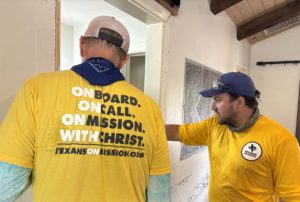
Texans on Mission volunteers clear out homes after July 4 floods in Kerr County. (Texans on Mission Photo)

He noted, “Our day volunteers often see their work as an opportunity to demonstrate to others what we have been called to do and often generates a desire to join organizations like ours.”

The work is hot, humid and muddy. The homes in the neighborhood smell like river water, and the mud is still wet. Dark brown waterlines extend past head height in most.

The deployment differs from many others. The incredible loss of life has affected most of the survivors, and there’s an air of grief among many.

And with more than 100 people still listed as missing, it is one of the few times Texans on Mission teams have had to work in an active search and recovery zone.

One team member noted that an assessor team had to wait for law enforcement to clear a home they were assessing. The authorities located and removed a body in the mud before assessors were allowed in to do their work.

Chaplains speak hope to survivors, responders

In an environment like this, Texans on Mission chaplains have never more needed. Chaplain Paul James worked with one survivor who “was very distraught because they had lost everything in the house, and everything was flooded.

“As soon as I started talking to him, … he just started weeping,” James said.

The man was “a burly guy and his two sons and his daughter-in-law were there helping him. … He was getting the support from his family that he needed, but it was an overwhelming task.

“We prayed with him and at the end of the day he was much better,” James said. “But this isn’t about us chaplains. It’s also the way that everybody here loves. It really makes my job easy as a chaplain because (survivors) look at everybody and know they really care about them, and they’re wanting to lift the burden and give them some hope.

“And so by the end of the day today, that particular family was really experiencing hope,” James said. “They were joyful and (we) got to pray with them.”

Texans on Mission’s Stacie Meeks said chaplain teams also ministered to first responders, many of whom were already physically and emotionally exhausted.

“I asked one of them, ‘How’re you doing today?’ He said he was fine, but I asked again: ‘No, seriously. How’re you doing today?’

“We talked, and I delved a little further,” she recalled. “And then he had a story to tell. He talked about how he felt insignificant.”

After Meeks inquired why, he responded that “he was wasting his time,” and his efforts “didn’t matter.”

“He said, ‘Yesterday we had a chance to really make a difference on the river. And today, not so much.’

“And I told him, ‘Your time matters. You made a difference. You’re here for a purpose. What you do matters for these people in this community.’”

Meeks said the team “encountered many, many people experiencing the same emotions. They hurt, and these people are exhausted. Now it’s day six. They’re exhausted, hot, tired.

“That’s when they need us speaking about the hope of Christ the most,” she said.


Buckner honors orphans who fled Vietnam 50 years ago

Buckner International hosted a reunion July 12 honoring Vietnamese orphans who fled Vietnam 50 years ago, arriving in Dallas after a two-month journey on June 12, 1975.

Recently, seven of the orphans from Cam Ranh with their families returned to Vietnam marking the 50th anniversary of their journey.

Representatives from Buckner International joined them on the trip to Saigon and Cam Ranh, which for some was their first time back in Vietnam.

The trip to Vietnam included a return visit to the site where Cam Ranh Christian City Orphanage once stood. While there, they distributed shoes to children in need.

During the reunion ceremony, Albert Reyes, CEO of Buckner, noted the words of James, Jesus’ half-brother, inspired founder R.C. Buckner to begin the organization.

James 1:27 says “religion that God our father accepts as pure and faultless is this: to look after orphans and widowsin their distress and to keep oneself from being polluted by the world.”

Reyes told reunion attendees that was the driving passage that he saw and from the very beginning those two groups are the “focus of our work—care for children and senior adults.”

“Your experience and your story is woven into the larger Buckner picture that now stretches all around the world,” Reyes said.

The Buckner reunion event gave the orphans a chance to reflect on five decades of impact and changes—in their home country and in themselves.

To conclude the reunion, Buckner dedicated a bench as a memorial to honor Pastor Nguyen Xuan Ha and Pastor Jim Gayle for their efforts in caring for the orphans at Cam Ranh Christian Orphanage.

The orphans’ journey, 50 years ago

During the final days of the Vietnam War, 69 Vietnamese orphans traveled across South Vietnam. The children spent two days on a broken boat on open seas until they made it to the United States and eventually were transferred to Buckner Children’s Home in Dallas on June 12, 1975. Their arrival in Dallas garnered national attention as the largest single group of refugees from Vietnam.

North Vietnamese military forces were sweeping through south Vietnam in the spring of 1975. The city of Cam Ranh began to collapse, leaving the Cam Ranh Christian City Orphanage with the difficult choice of fleeing.

Thirteen caregivers and their children fled with orphans, accompanying them as they boarded busses bound for safety.

When Saigon fell, the group made their way to the South China Sea on a leaky boat that failed two days into the voyage.

They were rescued and towed into Singapore where they waited five days without food or water before Southern Baptist missionaries intervened.

The group flew to the United States and made it to Buckner Children’s Home where about half of the children eventually were adopted.

Those who were not adopted remained on the fourth floor in the children’s home dormitory, where they were given English lessons to prepare them to enroll in Dallas Independent School District.

The group has remained close through the years.

Sam’s salvation story

Sam Schrade (Sang Nguyen) a toddler at the time, was one of the orphans. Years have passed since the day he arrived at Buckner Children’s Home.

He now runs a media company covering sports for ESPN and Fox Sports in Houston where he resides with his wife and children.

“I was able to go back for the first time in 50 years two weeks ago. My dad was an American soldier. My mom was Vietnamese … I wasn’t very wanted. They did not need me. And I was amazingly scooped up by the Cam Ranh Christian Orphanage,” Schrade said.

Schrade reflected on the trip he made back to the place he once called home. He considered how far God brought him and the rest of the orphans.

“It is hard to know how far we’ve come in life when we don’t know where we started. And for this trip, for me, it meant seeing where we started. Now I know how far we’ve come,” Schrade added.

“We were transferred here. I was three years old. The fact that Buckner facilitated Christian homes changed my life. My mom led me to Christ in fourth grade. I became a Christian and all of us in the group have a lot of gratitude,” Schrade concluded.

Buckner International Communications contributed to this story.