¿De qué hablamos cuando hablamos de misiones? ¿Qué significado tienen nuestras ofrendas dedicadas a las misiones nacionales e internacionales?
Para algunos pueden representar solamente algunos momentos de oración en el Servicio regular de la iglesia, o algunos números en el informe de las ofrendas. Pero es mucho más.
Las misiones son historias de vidas, muy personales, hombres y mujeres que son transformados por el poderoso mensaje del evangelio. Ten eso en cuenta cuando ores por las misiones o cuando presentes una ofrenda especial para las misiones.
Considera este testimonio:
Walter Craighead fue un misionero que nació en 1892 y sirvió en Paraguay desde el año 1944 hasta 1957 en la ciudad de Encarnación. En el año 1957, su último año en el campo misionero, conoció a Humberto González, de 19 años, que acababa de dejar su ciudad natal de Paraguarí para ir a estudiar y trabajar a Encarnación.
Un domingo, Humberto decidió visitar la Primera Iglesia Bautista de Encarnación, de la que Craighead era pastor. Ese día, confrontado por el mensaje del evangelio, Humberto recibió a Jesús como Señor y Salvador.
Humberto, que hoy tiene 84 años, cuenta así lo que ocurrió a continuación:
Diploma por haber completado el curso de disimulado auspiciado por la Convención Bautista del Sur (Foto gentileza de Víctor Aveiro Solé, casado con Lilia, una de las hijas).
“Era el último año de su Misión del Pastor Walter Craighead como pastor de la Iglesia, y cuando me bauticé me llamó en su oficina y me habló del curso sobre Escuela Dominical que ofrecía la convención Bautista del Sur , El Paso Texas; y yo gustoso acepté, y el Pastor Walter fue mi Profesor. Como era su último año como Pastor y después ya retornaba a los Estados unidos, tenía que terminar el curso en un año, lo cual lo he logrado”.
“Fue un día muy feliz en mi vida cuando de la mano de mi Pastor recibía el diploma que me acreditaba como un líder para la Escuela Dominical; era en el mes de diciembre de 1957”.
En esa misma iglesia, Humberto conoció a Rufina Acosta, quién dos años después se convertiría en su esposa. Junto a ella sirvieron en aquella iglesia por 26 años. Lo que Humberto aprendió con el Pr. Craighead le sirvió para apoyar a la iglesia en las cuatro ocasiones en que quedó sin pastor.
Humberto y Rufina tuvieron cinco hijos, y hoy en día tienen 15 nietos y cuatro bisnietos de los que anuncian con alegría que todos son creyentes y sirven al Señor en diferentes ministerios. Gracias a Dios, todos ellos son quienes extienden hoy en día el mensaje del evangelio a las nuevas generaciones en Paraguay.
Y, ¿sabes a quién agradece Humberto además de a Dios? A la Convención Bautista del Sur por haber enviado aquellos misioneros.
¿Dónde empezó todo? Dios llamó a un hombre que vivía en la ciudad de Albion, en los Estados Unidos, y las oraciones y ofrendas de los hermanos e iglesias le apoyaron durante el tiempo en que sirvió al Señor en Paraguay.
Hoy en día todavía hay misioneros que cuentan con el respaldo económico de nuestras ofrendas y el respaldo espiritual de nuestras oraciones.
¡Sigamos cumpliendo la Gran Comisión hasta que Cristo regrese!
CommonCall: Serve Lubbock
May 11, 2021
Jerry Ramirez admittedly finds it hard to say “no”—even to the prospect of building a community development ministry during a pandemic.
Regardless of challenges, Ramirez wants to serve Lubbock, a community he has called “home” since moving there more than two decades ago to become associate pastor of students and activities at Oakwood Baptist Church.
Jerry Ramirez
In 2007, Ramirez and his wife Lisa joined First Baptist Church in Lubbock. Shortly thereafter, when Buckner International entered into a collaborative venture with First Baptist Church, Ramirez became the congregation’s minister of missions and Buckner Initiatives.
In 2018, when the agreement with Buckner ended, Ramirez became the church’s minister of global initiatives, and he launched Serve Lubbock as a nonprofit community development ministry focused particularly on providing affordable housing.
At that point, he already was a volunteer chaplain with the Lubbock Police Department, served on the board of Lubbock Impact and had been chair of the City of Lubbock Parks and Recreation Advisory Board. He also serves on the executive board of Texas Baptist Men and Texas Christian Community Development Network.
“I don’t say ‘no’ very well,” he acknowledged.
Plans to provide transitional housing
First Baptist began the process of transferring 10 properties in the neighborhood surrounding the church campus to Serve Lubbock, including two vacant lots and “four red-tagged houses that need to be demolished,” Ramirez said.
Serve Lubbock dreams of providing transitional housing for at-risk families and individuals, charging them rent below market value until they are able to move into permanent homes.
“Change is slow, but we’ve got to begin somewhere,” Ramirez said.
He hopes to work with Habitat for Humanity and other nonprofits, allowing future homeowners to build “sweat equity” as they contribute labor to building their own homes.
“We’re working through the process,” he said, acknowledging the COVID-19 pandemic slowed it in some respects.
Making adjustments, building relationships
Early last year, Ramirez planned to take a college group to New York City on a mission trip.
“We had the plane tickets in hand, and the ducks were all in the row,” he recalled. Then COVID-19 made the trip impossible.
So, he and his team redirected their attention, committing themselves to “serve our community and love people in our community—whatever that ended up looking like,” he said.
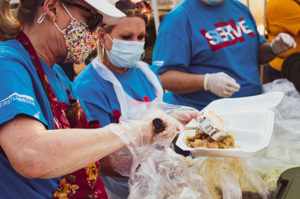
First Baptist Church in Lubbock uses its disaster relief trailer with its fully equipped field kitchen to provide meals at community events—and to offer to pray for people in their community. (Courtesy Photo)
Ramirez found ways throughout the pandemic to build relationships in the community, in part by using a ministry tool the church developed a couple of years earlier for a different purpose.
A few months after Hurricane Harvey devastated the Texas Gulf Coast, First Baptist Church secured a disaster relief unit—a 20-foot trailer equipped with a tilt skillet and convection ovens to serve as a field kitchen.
So far, the TBM-trained volunteers at First Baptist haven’t used the trailer in the aftermath of a natural disaster. However, the unit has been utilized extensively in community ministry events throughout Lubbock and the surrounding area.
“We want to be present in our community with our trailer,” Ramirez said.
Prior to the pandemic, volunteers used the field kitchen to cook hot dogs and other treats for neighborhood block parties and at an annual community fishing event for children.
Serving health care workers during pandemic
Working in partnership with other TBM volunteers, members of the church helped serve 3,900 meals to frontline health care workers at the two largest hospitals in Lubbock, as well as employees at a rehabilitation facility.
Working in partnership with Texas Baptist Men, members of First Baptist Church in Lubbock helped serve 3,900 meals to front-line health care workers at the two largest hospitals in Lubbock, as well as employees of a rehabilitation facility. (Courtesy Photo)
“Our goal every day is to love as Christ loved,” Ramirez said.
When Lubbock public school students were unable to attend in-person classes, volunteers no longer could continue mentoring programs. However, First Baptist Church volunteers prepared snack packs for children in food-insecure households—more than 2,500 snack bags for students at eight schools in 2020.
On several occasions, volunteers from First Baptist also have served meals to teachers at outdoor appreciation lunches at neighborhood public schools.
Ramirez also led the church to make necessary adjustments in community ministries to protect the health and safety of everyone involved. For example, the annual Christmas store for families in need became a drive-through event.
“It’s a little weird wearing masks and wearing gloves when we’re packing stuff, but it’s still working together, and to see that week in and week out is pretty cool,” said Caleb Bender, a missions intern at First Baptist Church and student at South Plains College.
Meeting needs and showing love
Ramirez acknowledged volunteers missed the opportunity for extensive “one-on-one interaction” with people due to social distancing and other safety protocols, but they remained committed to meeting needs and showing love.
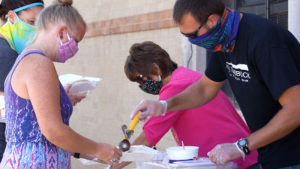
Members of First Baptist Church in Lubbock “Serve Lubbock” and show love to their community by preparing and serving lunches for teachers at public schools. (Courtesy Photo)
Liz Purser, a missions intern at First Baptist in Lubbock and student at Texas Tech University, noted she missed having the “personal connection with people I was serving,” particularly at big events such as feeding meals to frontline medical personnel. Even so, she gained a passion for working in missions and Christian community development.
“It’s a very fulfilling thing to serve,” she said, noting she hopes to continue to work in ministry after she graduates.
Since volunteers were unable to travel on a mission trip in 2020, the church redirected its resources to work in partnership with other ministries to send a container filled with 1 million meals to Belize.
Closer to home, First Baptist also worked in partnership with Lubbock Impact to serve 10,000 meals to individuals and families in need.
Once the pandemic ends, Ramirez looks forward to being able open the First Baptist Church facility as the host site for visiting mission groups who want to volunteer with Serve Lubbock.
And as increasing numbers of church members receive their vaccinations, more are returning to volunteer roles. In time, Ramirez hopes to put many of them to work with at-risk children and youth in low-income apartments—a ministry modeled after the programs Tillie Burgin has developed with Mission Arlington the last three and a half decades.
“Our people are ready to get back to a sense of normalcy in serving our community,” Ramirez said.
“We love people, and people know when we love them with authenticity—when they see that in our lives.”
Read more articles like this in CommonCall magazine. CommonCall explores issues important to Christians and features inspiring stories about disciples of Jesus living out their faith. An annual subscription is only $24. To subscribe to CommonCall, click here.
Family moves to fulfill the need for foster care families
May 11, 2021
Kaari and Lee Vasquez understand when God calls a family to provide children with foster care, he tends to work out the details.
Kaari was drawn to a particular house on Kari Ann Drive as soon as she saw a picture of it. The similarity of the address to her own name caught her attention.
She dragged her sons David and Anthony to an open house “just to see it, and we walked through and just absolutely fell in love. The boys were excited.” She rushed home and told her husband Lee he had to see the house.
But the price was too high for them. Then they started praying.
After submitting an offer below the owners’ asking price, they decided to write a letter explaining their desire to use the home to serve foster children through Buckner.
“We wanted to explain why we made a low offer. We didn’t want to be rude,” Kaari added. “We could just picture our family in this home, and we told them [the owners] how we desired to use it: ‘We’d love to foster siblings, and your home would give us the room to do that.’”
When their realtor called to say their offer was accepted over a higher one, they were “blown away.” And then they learned more. The family selling the house had been a foster family and used the home just as the Vasquezes imagined using it. Their letter hit the spot. God worked it out.
On a foster parenting journey
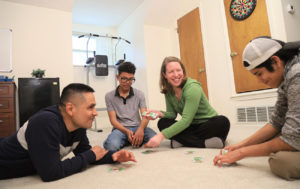
Kaari and Lee Vasquez enjoy family game time with sons Andrew (2nd from left) and David (right). (Buckner Photo / Russ Dilday)
Lee and Kaari started their journey as foster parents 13 years ago in Virginia while living in a one-bedroom apartment. The call came for them to care for a brother and sister. But when the children showed up, it was two boys.
The youngest was a three-month-old named David, who stayed with the Vasquezes, while the 6-year-old went to live with another family. Thirteen years later, David is still with them, but not as a foster child. They adopted him.
Their youngest son, Anthony, came soon after. His mother had aged out of foster care and was headed to jail. Initially, the plan was to keep Anthony as a foster placement for a year. Lee and Kaari agreed they wanted Anthony to maintain a relationship with his birthmother, so they visited her in jail with Anthony in tow.
“That was a very difficult time,” Kaari said. “But God really used that to help her see that we loved her and we cared about her.”
‘God made it very clear’
Kaari, a speech pathologist, had just started working full time again and was overwhelmed with two small boys along with her work.
“God made it very clear what he wanted me to do,” she said.
Andrew joined the Vasquez family when he was young. Kaari Vasquez, who works as a speech pathologist at a school with an outstanding program from children with hearing loss, was able to get Andrew diagnosed and enrolled in programs at the school. (Buckner Photo / Russ Dilday)
She told her boss about Anthony and that she needed to bring him with her to the school where she was working, so the school opened a spot for him.
Lee, an engineer with UPS, was traveling regularly for work then, and Kaari was nearing a breaking point.
“I found myself in my laundry room crying and just asking God why. I wanted to be home, and I thought it would be better for Anthony. At that moment, God gave me peace, and I was just thankful for all that he had provided.”
The day after her laundry-room breakdown, Anthony was diagnosed with hearing loss.
“So, here he was in one of the country’s best schools for children with hearing loss. Had I not been working full time there, he would not have been diagnosed as quickly.”
Co-workers approached her and said things like, “Wow. What are the chances that this child was placed with you and now he has a hearing loss? I don’t believe in God, but that makes me wonder.”
Ministry to families
The irony of Kaari and Lee adopting two foster boys isn’t lost on them. Their motivation for becoming foster parents in the first place was to reunify foster children with their biological families, while taking opportunities to serve the families along the way.
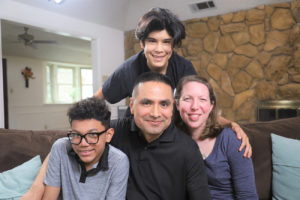
Kaari and Lee Vasquez have made a warm and loving home with sons Andrew (left) and David (back). (Buckner Photo / Russ Dilday)
“It’s not just the child you’re bringing in, you’re going to be alongside the family, or the parent, who is trying to get their child back,” Lee said.
“Sometimes it (our calling) has looked like children being reunited with their birth families,” Kaari added. “But truly, the most powerful and important piece to that calling and what we’ve seen over these years is the healing that comes from them accepting Christ, learning about who Jesus is, and being restored to him.”
Lee believes God has a plan for every family they serve through foster care. That plan “is for individuals, for families who are going through a tough time to see salvation at the end of their suffering. We have to trust that God is going to bring them back together.”
Extended family everywhere
As a result of getting to know the families, Kaari said their own family has grown exponentially because they now have “extended” family everywhere they’ve lived, including two years they served at an orphanage in Baja, Mexico.
Kaari and Lee Vasquez view foster care and adoption as God’s calling for them. (Buckner Photo / Russ Dilday)
“The Vasquez family has felt the pain and grief that comes with loving so deeply,” said Andi Harrison, regional director of foster care and adoption for Buckner. “I am very thankful that we are able to offer our families the counseling to find healing through their journey. The counseling that we are providing families like the Vasquezes extends longevity in this ministry as families receive the support from their organization.”
“The Vasquez family continues to respond to the gospel by saying ‘yes’ to caring for children through foster care, but they take it one step further by showing love and respect to each of the birth parents,” Harrison added.
After finishing their stint at the orphanage, the Vasquezes needed to decide where they would live back in the United States. Kaari researched states needing foster families, especially ones that speak Spanish, and found Texas. As they zeroed in on the state, they contacted Buckner and were told Dallas-Fort Worth had a high need for what they had to offer.
Services available through Buckner
“We knew of Buckner because of some friends at our church in Virginia,” Kaari said. A good friend from the church knew Buckner President and CEO Albert Reyes and recommended they check out the Dallas-based ministry.
“We researched and we really connected with the mission and the vision that Buckner had,” Kaari said. “I called Buckner up before we moved here and asked where the greatest need was for foster parents.”
They chose Texas and the Dallas-Fort Worth area because of Buckner.
“One thing that set Buckner apart from other agencies was the support they offer our family,” Lee said. “Not just the kids that come in to stay with us for a short while, but David and Anthony also get to benefit from therapy through Buckner and us as a family. We’ve worked through some things that are difficult.”
Sharing God’s love
“Whether or not a child is able to reunify, we see the big picture,” Kaari said. “God’s ultimate plan is for us to be able to share his love with others and pray and desire for them to experience that for themselves and ultimately come to know Christ.”
And while their mission is reunifying children, that also means suffering losses along the way. It was that fear of seeing children come and go that caused Lee to hesitate at first.
“I thought, why would we get into foster care? It seemed like something very difficult, an emotional roller coaster,” he said. “If you take in a child, you fall in love with the child, and then you have to give up the child. Why would I do that to myself on purpose?”
“I think the hardest part of this—of doing foster care—is also one of the most important lessons that we’ve learned and that is to be able to trust God with all our children,” Kaari said. “To be able to trust that even when the situation is something that we feel is not best for the child or we feel frustrated with or that we’re questioning, it’s trusting that God has good plans for that boy or girl and that he loves them more than we ever could.”
Reunification has no bigger advocates and fans than Kaari and Lee, because they know children belong with the biological families in which God put them if possible. So, they deal with the goodbyes and pray.
“I always say that the day it becomes easy to say goodbye is the day we should quit,” Kaari said. “Because, really, the children deserve us to become attached to them, to fall in love with them, to love them as our own. They deserve that. They deserve nothing less. And if we were to give them less, it would hurt less.”
May is National Foster Care Month. About 400,000 children are in foster care in the United States, and more than 30,000 of them are in Texas. For more information on how to become involved, click here.
Texas WMU encourages pursuit of God’s calling
May 11, 2021
RICHARDSON—Woman’s Missionary Union of Texas urged participants at its annual meeting and missions celebration to pursue God’s calling on their lives.
The April 16-17 event at First Baptist Church in Richardson drew about 160 participants through a combination of in-person and online viewership at three general sessions, with in-person attendance limited for social distancing purposes.
“This weekend has not been about WMU of Texas,” said Tamiko Jones, executive director-treasurer. “It has been about our God, your relationships with him and his call.”
‘Called to make a difference’
Raquel Contreras Eddinger, director general of the Baptist Spanish Publishing House, spoke from the Gospel of John, emphasizing that the time to pursue God’s call is now.
“We have to leave our jar of water behind and run to tell everyone they need Jesus,” she said, referencing the story of the woman at the well. “We, the women of WMU of Texas, are called to make a difference in our society.”
NAMB Missionaries Ryan and Seané Rice speak about their ministry in New Orleans during the Texas WMU annual meeting and missions celebration in Richardson. (Texas Baptists Communication Photo)
Participants at the annual meeting and missions celebration also heard from Ryan and Seané Rice, North American Mission Board church planters in New Orleans.
“We have to trust that the Holy Spirit is guiding us as we pursue the Lord and that he wants to use us for his glory,” he said. “The hazard of the call of God may be great on our lives, but God is indeed greater.”
David and Laurel Fort, International Mission Board missionaries, also described their ministry in places across the globe. They emphasized the blessing of obedience to God’s call despite fear and challenges.
“Faith which leads to obedience calls us to trust that God is fully aware of the consequences of our obedience,” he said.
Participants heard from the 2021 National Acteens Panelists from Texas—Rana Seddik from Freeman Heights Baptist Church in Garland and Hope Howard from Retama Park Baptist Church in Kingsville. These two young women were chosen by the national WMU for their hard work, dedication to missions education and faithful service.
“Missions are more effective when you do them as a team,” said Howard when asked about the importance of Acteens and Youth on Mission groups. “People see that, and it’s just such a witness-bearing testimony.”
Mary Hill Davis Offering essential in Texas
Baptist General Convention of Texas Executive Director David Hardage described the tremendous impact of the Mary Hill Davis Offering for Texas Missions on the missions and ministry of Texas Baptists.
BGCT Executive Director David Hardage describes the impact of the Mary Hill Davis Offering for Texas Missions. (Texas Baptist Communications Photo)
Hardage focused specifically on how Mary Hill Davis Offering funds support Texas Baptists’ River Ministry and Mexico Missions, Baptist Student Ministry, Go Now Missions, International Mission Board missionaries and church planting.
“So much of the missions and ministry of the Baptist General Convention of Texas couldn’t happen were it not for WMU of Texas and the Mary Hill Davis Offering,” he said. “I believe in this offering. I give to it. I want to personally invite pastors to promote it harder and stronger than they ever have before in 2021.”
Attendees also had the opportunity to participate in a self-guided Mary Hill Davis Offering Prayer Experience and received a 12-month WMU of Texas planner.
“You are going to have missions opportunities right there in front of you on your calendars,” said Teri Ussery, missional lifestyle strategist for WMU of Texas. “We really hope that this is going to encourage, inspire and equip you to be on mission 365 days a year, seven days a week for the next 12 months.”
The Pursue 2021 mission project provided supplies for students at Mendenhall Elementary in East Plano. Mendenhall serves about 600 students, and 86 percent are economically disadvantaged. Of the elementary schools in Plano, Mendenhall serves one of the highest percentages of families dealing with homelessness, single-parent homes, immigration, domestic violence, mental health issues and joblessness.
Over the course of the conference, participants donated basic supplies like clothes, masks and hygiene items, as well as monetary gifts to help care for the students and families of Mendenhall.
Taking care of business
During the business session of the annual meeting, Texas WMU re-elected Earl Ann Bumpus as president and elected Elida Salazar of First Baptist Church Carrizo Springs as vice president and Susan Morgan of Tallowood Baptist Church in Houston as recording secretary.
“We pray these leaders will walk into the future with confidence, knowing that [God has] already planned what they are to be about,” former Executive Director-Treasurer Carolyn Porterfield said during a prayer of dedication for the elected officers.
Jones recognized two former employees of Texas WMU who retired last year. Pam Poole served as special projects coordinator and joined the staff in 2014. Looie Biffar served as a graphic designer and joined the staff in 2015. Both served previously with the BGCT before joining Texas WMU.
Texas WMU also honored the memory of Rebecca “Becky” Ellison, former state consultant for Christian Women’s Job Corps and Christian Men’s Job Corps, who died in May 2020. The CWJC/CMJC Endowment, which began in 2002, was renamed the Becky Ellison CWJC/CMJC Endowment in honor of her life and ministry. Funds support various aspects of this ministry in which women and men learn job skills and life skills in a Christian context. Ellison’s husband Michael was in attendance and received gifts in her memory.
Waco church lifts medical debt burden from families
May 11, 2021
Leading up to Easter this year, members of Highland Baptist Church in Waco not only gave thanks for how Christ paid their debt and lifted their burdens, but also gave to lift the burden of medical debt from 324 area families.
Highland Baptist raised $180,000—more than double the original giving goal and enough to provide close to $19 million in medical debt relief for families in McLennan County and the surrounding area.
A couple of years ago, Pastor John Durham read about a church in Minnesota that paid off millions of dollars of medical debt for families at a fraction of the actual cost, working with the nonprofit organization RIP Medical Debt.
‘Give a little and see a lot accomplished’
John Durham
“I did a little research to learn how they did it and to verify that it was reputable, and I found out about other churches that were able to pay off medical debt at pennies on the dollar,” Durham said.
He learned RIP Medical Debt applies gifts from donors to purchase bundled portfolios of medical debt at a significant discount.
“It’s a way to make an exponential impact—to give a little and see a lot accomplished,” Durham said.
In February, Highland Baptist launched what leaders considered an ambitious campaign, setting a $75,000 giving goal by Easter in an effort to cancel up to $8 million in medical debt. The church tied it to its Easter theme, “Our debts have been paid.”
“It’s about the spiritual debt Jesus paid for us,” Durham explained.
‘They wanted to help’
Families collected change in jars to donate toward medical debt relief. Students employed in workplaces with tip jars donated all their tips to the cause, letting customers know everything they collected would be applied toward that purpose.
Some children in the congregation reported giving their entire allowance for a month to provide medical debt relief for families.
“They couldn’t even understand exactly what that means, but they wanted to help,” Durham said.
Highland Church accepted donations for medical debt relief beginning the week before Palm Sunday and continuing through Easter.
“On Easter Sunday morning, I was able to announce we had surpassed our goal, raising $114,000 so far,” Durham said. “By that afternoon, the total was $180,000.”
To qualify for medical debt relief, families must earn less than twice the federal poverty line, have debt exceeding 5 percent of their annual income or have more debt than assets.
‘How resurrection people live’
Durham noted members of his church recognized how “crippling” medical debt can be for families and individuals.
“I think people were particularly sensitive to the need in light of all the hardship that COVID brought on,” he said.
RIP Medical Debt reports 79 million Americans on a daily basis must choose between paying medical bills or paying for food and shelter. Two-thirds of all bankruptcies in the United States are tied to medical debt, and one-fourth of all credit card debt is medical debt, the organization notes. In communities of color, the percentages are even greater.
Due to federal privacy laws, Highland Baptist members cannot know whose medical debt they helped to eliminate. But families in the Waco area who receive yellow envelopes in the mail from RIP Medical Debt will learn their debt has been cleared, thanks to the generosity of members of Highland Baptist Church.
Church members recognized the significance of their sacrificial gifts making the debt cancellation possible at Easter, Durham added.
“This is how resurrection people live their lives,” he said.
Texas ends ban on spiritual advisers in execution chamber
May 11, 2021
HUNTSVILLE—The Texas Department of Criminal Justice recently reversed course, announcing it will permit death row inmates to be accompanied in the execution chamber by the minister or spiritual adviser of their choice.
The agency’s new policy permits a prisoner facing execution to have a personal spiritual adviser present in the death chamber, subject to verification and a background check.
“The inmate’s spiritual advisor must be included on the inmate’s visitation list and have previously established an ongoing spiritual relationship with the inmate demonstrated by regular communications or in-person visits with the inmate before the inmate’s scheduled execution date,” the revised execution protocol states.
The spiritual adviser also is required to complete a two-hour in-person orientation with a staff member of the TDCJ Rehabilitation Programs Division at least 10 days before the scheduled execution.
Response to court in ‘the exact wrong direction’
In March 2019, the U.S. Supreme Court halted the execution of an inmate who argued his First Amendment rights were violated because his Buddhist spiritual adviser was not permitted in the execution chamber. At the time, TDCJ only permitted its own employees in the death chamber, and the state only employed Christian and Muslim chaplains.
Amanda Tyler
The TDCJ Correctional Institutions Division responded to the court ruling by adopting a policy barring all spiritual advisers from the death chamber—an action that prompted an outcry by the faith community.
Amanda Tyler, executive director of the Baptist Joint Committee for Religious Liberty, said the state responded to the court ruling in “the exact wrong direction.” First, the prisoner had “his religious freedom denied when his request was refused,” she noted. But rather than seeking to accommodate the inmate’s religious beliefs, the state chose to deny any executed prisoner the right to a spiritual adviser in the death chamber.
In July 2019, more than 180 faith leaders from a dozen religious traditions—including at least 10 Baptists—signed a letter asking the TDCJ to permit spiritual advisers of all faiths into the death chamber at the request of condemned inmates.
“The physical companionship of a chaplain in the execution chamber is a small but vital form of human compassion in an otherwise dehumanizing process. The presence of a chaplain or spiritual adviser in the viewing room is no substitute for this direct ministry,” the letter from religious leaders stated.
Storm-damaged church sees help as a gift from God
May 11, 2021
AUSTIN—Surrounded by homes with burst pipes after the February winter storms, St. John’s College Heights Baptist Church in Austin did what it’s called to do—minister to its community in Christ’s name.
The congregation helped people get the assistance they needed in the midst of the crisis.
Little did members realize water was filling up their church’s facilities. For a few days, water from broken pipes flooded the sanctuary, as well as education space.
“The ceiling, all that stuff, came out,” Pastor Michael Harvey said. “We had water all over the place.”
Looking for help, Harvey reached out to Texas Baptist Men as the congregation dried out the buildings.
Shortly thereafter, a TBM rebuild team from Central Texas arrived with a load of drywall and went to work. Soon, the walls were sealed again, and TBM is looking for other ways to assist the church.
Restoring ‘a lighthouse’
Harvey described the assistance as a gift from God.
TBM volunteers replace damaged drywall after a winter storm caused pipes to burst. and flood St. John’s College Heights Baptist Church in Austin. (Photo / Charles Baker)
“It means a whole lot,” he said. “It comes in the time of a pandemic. We had a pipe burst. People aren’t coming to church. Giving is down. This is an incredible blessing.”
Charles Baker, a member of Crestview Baptist Church in Georgetown who led the TBM team, is thankful for the opportunity to strengthen a church committed to its community.
“This church is a lighthouse in its neighborhood,” he said. “It stands out. The buildings stand out. They need to be able to stand out.”
So far, TBM has helped nine homeowners and churches around the state recover from damage caused by the winter storm. Combining the efforts of rebuild teams, supplies of drywall and expertise, TBM leaders are strengthening homes and congregations in difficult days.
“Both homeowners and churches didn’t have the right coverage or got denied on the claim,” said Rupert Robbins, associate director of TBM Disaster Relief. “On some of these, we’re running behind people with a net. After a disaster, it’s not as simple as, ‘Turn the power back on, and let’s go.’”
Helped ‘navigate the systems’
The ministry goes far beyond the rebuild efforts.
“We provide help, hope and healing,” Robbins said. “I’ve had the opportunity to pray with these pastors and homeowners. We’ve helped them navigate the systems to get done what needs to happen.”
Robbins has been refreshed in visiting with the pastors of the churches. God is using the winter storm damage as an opportunity for churches to see new ways to serve.
“It’s amazing how many guys I’ve talked to that God is breathing fresh life into their church,” he said. “It’s amazing how that happens.”
Pastor Joseph Cartwright of North Star Fellowship in Irving has seen that in many ways. A TBM team installed sheetrock where the church is meeting in an apartment complex.
“This was a big leg up for us, to get the building back together so we can move toward some ministry goals we have. It was just such a blessing,” he said, adding the church is “moving into position … to effectively make Jesus famous in the days in which we’re living.”
Baptist churches reach out in love on the border
May 11, 2021
BROWNSVILLE, Texas (BP)—Pastor Olber Roblero lives four miles from the U.S./Mexico border. He can see the fence from his living room window.
Volunteers not only provide food, but also offer to pray with area residents during food distribution events at Iglesia Bautista Horeb in Brownsville. (Photo courtesy of Iglesia Bautista Horeb)
Roblero spends his days distributing shoes, clothes, backpacks and hygiene kits to newly released children and families outside detention centers in the area.
Because of government regulations, Roblero isn’t allowed to go into the shelters. So, he meets many detainees at bus stations where they joyfully reunite with family members.
For those who are not experiencing reunification, spending time at the bus stations is painful. Roberlo has spent many days just waiting with children after they have been released from detention, and there are growing concerns about how to care for the kids upon their release.
‘Opportunity to share Christ’
“We are in a crisis, but this crisis is an opportunity to share Christ,” Roblero said. “The work is left for the church to do. Our church, Iglesia Bautista Horeb, has essentially turned into a distribution center and logistics base for people of many denominations who are helping along the border because our ultimate goal is all the same—to be a light in the darkness.”
Many parents have to wait four or five hours in soup kitchen lines to get food rations, but if they have jobs, they don’t have the time to stand in line. Iglesia Bautista Horeb’s food distribution partnership with 20 other local churches allows parents to keep their jobs while still being able to feed their children.
Send Relief, the collaborative relief ministry of Southern Baptists’ International Mission Board and North American Mission Board, has supported churches in this effort.
The major concern now is matching the pace of distributions with the pace of the need. Five hundred senior citizens are on the church’s doorstep every day for food rations, hundreds of children regularly receive shoes from the church, and the demand for resources is increasing.
‘We can do more to serve our neighbors’
Pastor Carlos Navarro of West Brownsville Baptist Church is all too familiar with this constant need for resources. His church has served nearly 10,000 migrants more than 20,000 meals through its border ministry. The effort has seen nearly 3,500 people dedicate their lives to Christ.
Volunteers from West Brownsville Baptist Church distribute backpacks filled with Bibles and other essentials to migrants in the local bus station. (Submitted photo courtesy of BP)
Because of pandemic restrictions closing West Brownsville’s respite center, Navarro and his team also serve mainly at bus stations, distributing bottled water, sandwiches, pizza and backpacks filled with essentials.
Navarro has started taking cell phones to transit stations for migrants to use, as many haven’t spoken with their families in months. Before they leave the station, Navarro shares a business card requesting contact when they arrive at their final destinations. Through these points of contact, Navarro has been able to connect more than 500 migrants to churches across the United States that can help them find affordable housing, employment and faithful community.
“There are not many churches doing this work, and we can do more to serve our neighbors,” Navarro said. “Seeing children reunited with their moms and dads is such a joy. We aren’t engaged in immigration policy. I am just here to feed the hungry and plant the seeds of the gospel.”
Navarro said many people are moved to tears merely by the sound of their name. Teams from West Brownsville are intentional about treating every person with dignity and welcoming them by name, he noted.
“Their eyes just sparkle when we tell them that God is in their situation, and he loves them,” he said. “I understand it’s a tough situation, but I took a step of faith and spent $7,000 in one month just on benevolence for these efforts. That’s when Send Relief stepped in to help. And that’s why I’m not worried, even though we’re some of the only servants helping these communities. God will pick up the tab.”
Countdown begins soon for Texas legislature
May 11, 2021
With about one month remaining in the 87th Texas Legislative Session, lawmakers in the House and Senate still need to resolve differences about how and whether to spend available federal funds.
The Texas Senate on April 6 unanimously recommended a two-year $250 billion state budget that does not factor in about $38 billion in federal coronavirus aid. After considering 245 amendments, the House of Representatives proposed a $246 billion two-year budget.
Michael Evans Jr., public policy director for the Texas Baptist Christian Life Commission
The budget proposals now go to a conference committee to reconcile differences before returning to both chambers for final approval prior to the end of the session on May 31.
“The biggest/latest thing happening now with the budget is the rejection of Medicaid expansion,” said Michael Evans Jr., public policy director for the Texas Baptist Christian Life Commission.
Failure to expand Medicaid “will negatively affect the working-poor in this country” and deny protection to “the people who need it most and who keep America running,” Evans said.
Texas lawmakers have declined to pass any significant expansion of state and federal health care coverage for the uninsured since the Affordable Care Act of 2010 mandated state expansion of Medicaid—a provision the U.S. Supreme Court later struck down.
The House voted 80-68 after brief debate to reject a budget amendment by Rep. Garnet Coleman, D-Houston, that would have directed the governor and state health officials to use federal funds to expand coverage for the uninsured, including the working poor who cannot afford their own health insurance but earn too much to qualify for Medicaid.
‘Great victory’ for public education
Charles Foster Johnson
The House voted overwhelmingly in favor of an amendment by Rep. Abel Herrero, D-Robstown, to prohibit any state funds from going toward private schools through voucher programs, a move applauded by Charles Foster Johnson, founding executive director of Pastors for Texas Children.
“In 2017, 44 House Republicans voted against the Herrero amendment to ban private school vouchers. This year, that number shrank to 27,” Johnson said.
Significantly, the House approved a budget amendment earmarking $18 billion in federal coronavirus aid for public education. The House also adopted an amendment that would require legislative approval for the distribution of any additional federal relief money that arrives after the conclusion of the legislative session on May 31.
“A budget is a moral document. It illustrates our priorities as a society,” Johnson said. “Bringing children up to grade level after the losses during the pandemic will require an infusion of federal dollars. That’s what these funds are meant for. These are our children, and these are our tax dollars. This is a great victory.”
House committee considers sports betting, casinos
In addition to dealing with the state budget, lawmakers also will consider a variety of other bills in the remaining weeks of the session.
The House State Affairs Committee in mid-April heard testimony on HJR 97, which proposes a constitutional amendment legalizing sports betting in Texas, and HJR 133, which would create the Texas Gaming Commission and authorize a limited number of casinos licensed by the commission. Both bills remain in committee.
Rob Kohler, consultant with the CLC, told lawmakers the sports betting bill “sends a bad message to the youth of the state” and turns professional sports teams into “the state’s online bookies.”
Significantly, Kohler warned, if the state permits legalized sports gambling, it automatically opens the door to Native American tribes operating casinos by triggering a change in classification under the Indian Gaming Regulatory Act of 1988.
Kohler also disputed claims that allowing casinos in Texas would provide a windfall in tax revenue. Based on a 25 percent tax and a 93 percent prize payout, casino gambling slot machines would require 14 times the annual sales of the state lottery to generate the same among of revenue to the state, he noted.
Rodger Weems, chairman of Texans Against Gambling, told lawmakers estimates of income from legalized gambling invariably are inflated by promoters, while social costs are downplayed.
The House State Affairs Committee heard testimony the day before the Las Vegas Sands gambling corporation launched a multimillion-dollar advertising campaign in an effort to build support for casinos in Texas.
Other bills the CLC is tracking include:
HB 4116, which prohibits a credit service organization from obtaining an extension of credit for a consumer or assisting them in obtaining an extension of credit unless they are licensed.
HB 1239, known as the “Freedom to Worship Act,” relates to the prohibited suspension of laws protecting religious freedom and prohibited closure of places of worship.
HB 88, known as the “George Floyd Act,” relates to interactions between law enforcement and individuals detained or arrested and the officers’ liability for those interactions.
HB 686, also called the “Second Look Bill,” creates the possibility of changes in parole eligibility for certain inmates convicted of an offense when younger than age 18.
Editor’s note: The 9th paragraph was edited after it originally was posted.
Longhorn BSM dedicates new facilities
May 11, 2021
The Longhorn Baptist Student Ministry dedicated its new building in Austin on April 17, dedicating the space to God and celebrating the legacy of the longtime ministry to students at the University of Texas.
In-person attendance at the event was limited to fewer than three dozen participants due to COVID-19 restrictions, but the event also was livestreamed on the Longhorn BSM Facebook page.
The BSM celebrated its new facilities, the first two floors of a high-rise student apartment building close to the UT campus. The building sits on the site of the former BSM building, on land sold to the apartment complex in 2017. The Longhorn BSM was founded in 1919 and is one of the oldest Baptist collegiate ministries in the state.
The sale of the previous building and land provided an endowment fund that will pay for the full operations of the new building and for other BSMs around Texas.
“We celebrate God’s provision in this space where we’ve been doing ministry for 100 years and we get to see the vision and the plan for the next 100 years,” said Cody Shouse, director of the Longhorn BSM.
Attendees included former Longhorn BSM directors, local church pastors, Texas Baptist staff, current and former students, and others whose lives had been impacted or who had made an impact there.
‘Great cloud of witnesses’
Mark Jones, director of the Texas Baptists’ Center for Collegiate Ministry, honored Joyce Ashcraft, associate director of the Center for Collegiate Ministry, and thanked her for her hard work in orchestrating the new building.
Jones presented to Ashcraft, who will retire this summer after more than 44 years in collegiate ministry, a watercolor painting of the mural at the Longhorn BSM, which depicts iconic Austin scenes and the BSM.
Ashcraft recognized those who came before to lay the foundations of the BSM, citing Hebrews 12:1-3 as she described “the great cloud of witnesses” who have made the BSM possible.
Joyce Ashcraft, associate director of Texas Baptists’ Center for Collegiate Ministry, tells the history of the Longhorn BSM. (Texas Baptists Photo)
“While this building is new and contemporary and dedicated to engaging students to reach people around the world, it’s because of the people that came before that we are able to be here today,” she said.
Ashcraft particularly pointed to Richard “Rick” Spencer, who served with the BSM 45 years and died in 2017. The prayer room in the new building is dedicated in his memory, and his wife Vicky attended the dedication.
“His love for God’s word he instilled in all the students. … He is an example to us and we want all students to know that he was one of the great cloud of witnesses that came before,” Ashcraft said.
The prayer room also features a stained-glass window from the former BSM building that was stored at Woodlawn Baptist Church two years until it could be installed.
‘A blessing … for years and years to come’
Former BSM director Dan Crawford, who served from 1976 to 1982, spoke fondly of the old building. A group of alumni and former BSM staff gathered at the old building the night before the demolition, sharing memories and reminiscing about the past, he said.
Everyone who had been a part of the BSM in the past prayed for a bright future for those who would come after them, he said.
“We, as alumni and former staff, wish for this building to be even more of a blessing for them than it was for us, for years and years to come,” he said.
Speakers also included Marcy Martinez, associate director of Longhorn BSM; Craig Christina, associate executive director of the Baptist General Convention of Texas; Brian Lightsey, lead pastor of Life Church; Daniel Gao, elder at Austin Christian Fellowship; David Kemerling, director of Longhorn BSM 1990-1999; and Russell Allen, lead pastor of Woodlawn Baptist Church.
Shouse emphasized the prayer of churches, staff, alumni and students is the reason Longhorn BSM has been blessed throughout its ministry.
“Why do we have a 100-year-old ministry? Why do we have the space that we have and the proximity so close to campus?” It’s because people have prayed for us. For a long time, people have been praying for us,” Shouse said at the end of the service.
“So, I ask you to continue praying for us so that we can continue doing the great work that God has called us to do on these 40 acres here in Austin.”
14 Días de Oración en BUA
May 11, 2021
Justo en estos días se está llevando a cabo la campaña de oración 14 Days of Prayer (14 Días de Oración) en la Baptist University of the Americas (Universidad Bautista de las Américas), donde tanto los miembros del personal como los estudiantes pueden interceder juntos por necesidades específicas.
Detalles de la campaña
La campaña inició el lunes 19 de abril y va a terminar el 2 de mayo. Cada participante puede orar en donde esté, o puede reunirse en Piper Village, que es el área residencial de BUA. El tiempo es de 6:00 a 6:30 a.m., y se divide en 5 minutos de alabanza, 5 minutos de lectura bíblica y 20 minutos de oración. Se anima a los participantes a que lean también un capítulo de las cartas de Efesios, Filipenses y Colosenses en la Biblia por cada uno de los catorce días de campaña.
Cómo surgió la idea
La idea de llevar a cabo esta campaña de oración surgió cuando Kleiton Rodrigo Oliveira, un estudiante originario de Brasil, se dio cuenta de la necesidad que él mismo tenía de orar por claridad para los planes futuros y por los retos que él y su familia enfrentan cada día.
Objetivo de la campaña
Así como Kleiton Oliveira tiene sus retos como estudiante, muchos otros estudiantes de BUA pasan por tiempos difíciles. El objetivo principal de la campaña es que tanto el personal como los estudiantes, y cualquier persona que se les quiera unir, tomen un tiempo para reenfocarse espiritualmente y buscar la dirección de Dios al tomar decisiones importantes. Esa es la razón principal por la cual esta campaña de oración se está llevando a cabo al final del año escolar 2020-2021.
Un vistazo al pasado
Aunque ahora Oliveira está cursando su segundo año de maestría en Biblia, hasta antes de cumplir los 20 años su vida estaba destrozada. Fue un amigo suyo quien lo invitó a un retiro de su iglesia, y a partir de ahí, no fue el mismo.
Al poco tiempo Oliveira recibió el llamado de Dios al ministerio, y después de completar dos años de seminario, su pastor lo invitó a servir de tiempo completo en su iglesia, la Primera Iglesia Bautista de Dourados, Brasil.
La vida en un nuevo país
Las cosas marchaban bien para la familia Oliveira en su país. Pero Kleiton tenía un sueño: aprender bien inglés y estudiar una maestría. Un misionero le habló de BUA. Él aplicó, las puertas se abrieron, y se vino con su familia a los Estados Unidos.
Pero vivir en un nuevo lugar no siempre es fácil. “Para mí vivir aquí en los Estados Unidos es un gran desafío”, dice Oliveira. “En Brasil nosotros tenemos una seguridad porque es nuestro país y porque sabemos el idioma, entre otras cosas”.
Él comenta cómo también económicamente ha sido todo un reto. “Yo me había preparado con ahorros para cubrir mis estudios en BUA por tres años, pero con la pandemia todo cambió. El valor del dólar con relación al Real brasileño subió 75 por ciento”.
¿Cuál fue su reacción? “Ahora vivimos por la fe”, afirma Oliveira con seguridad. “Muchas veces tenemos que salir de nuestra zona de comodidad para ver a Dios obrar. Dios puede hacer milagros cuando nosotros no tenemos más el control. Mi hijo de 5 años está teniendo sus propias experiencias con Dios, y todo esto está siendo una experiencia maravillosa para nosotros”.
Cómo va la campaña
“El primer día tuvimos como 7 personas reunidas en Piper Village. El segundo día ocho; el tercero 12, y así cada día están llegando más personas para orar con nosotros”, asegura Oliveira, quien espera que más gente se una a ellos, aun desde sus casas, para orar e interceder por las necesidades que se han dispuesto para cada día.
Usted puede ver más detalles sobre cómo ser parte de esta campaña de oración en el anuncio anexado a esta noticia.
Alma E. Varela es la editora de español de Noticias Baptist Standard.
14 Days of Prayer campaign ongoing at BUA
May 11, 2021
The 14 Days of Prayer campaign is taking place at Baptist University of the Americas, where both staff members and students can intercede together for specific needs.
Campaign Details
The campaign started April 19 and will end on May 2. Each participant can pray wherever they are, or they can meet in Piper Village, which is BUA’s residential area. The time is from 6 to 6:30 a.m., and is divided into five minutes of praise, five minutes of Bible reading, and 20 minutes of prayer.
Participants are encouraged to also read a chapter from the letters of Ephesians, Philippians and Colossians in the Bible for each of the 14 days of the campaign.
How the Idea Started
The idea of carrying out this prayer campaign arose when Kleiton Rodrigo Oliveira, a student from Brazil, realized his own need to pray for clarity for future plans and for the challenges he and his family face every day.
Campaign Goal
Just as Kleiton Oliveira has his challenges as a student, many other BUA students go through difficult times. The main goal of the campaign is that both staff and students, and anyone who wants to join them, take time to refocus spiritually and seek God’s direction when making important decisions. That is the main reason why this prayer campaign is taking place at the end of the 2020-21 school year.
A glimpse into the past
Although Oliveira is now in his second year of pursuing a master’s degree in Bible, before he was 20 years old his life was a mess, he said. A friend of his invited him to a church retreat, and from then on, he never was the same.
Soon after, Oliveira received God’s call to ministry, and after completing two years of seminary, his pastor invited him to serve full-time at his church, Primera Iglesia Bautista de Dourados, in Brazil.
Life in a new country
Things were going well for the Oliveira family in their country. But Kleiton had a dream: to learn English well to complete a master’s degree. A missionary told him about BUA. He applied, the doors opened, and he came with his family to the United States.
But living in a new place is not always easy. “For me, living here in the United States is a great challenge,” Oliveira said. “In Brazil. we feel safe, because it is our country and because we know the language, among other things.”
He comments on how financially it has also been a challenge. “I had prepared myself with savings to cover my studies at BUA for three years. But with the pandemic, everything changed. The value of the dollar in relation to the Brazilian real rose 75 percent.”
What was his reaction? “Now we live by faith,” Oliveira said with confidence. “Many times, we have to get out of our comfort zone to see God at work. God can work miracles when we are no longer in control. My 5-year-old son is having his own experiences with God, and all of this has been a wonderful experience for us.”
How the campaign is going
“The first day we had about 7 people meeting in Piper Village. The second day eight; the third 12, and so every day more people are coming to pray with us,” Oliveira said. He hopes more people will join them, even from their homes, to pray and intercede for the needs that have been planned for each day.
Alma E. Varela is the Spanish editor for Noticias Baptist Standard.








 La campaña inició el lunes 19 de abril y va a terminar el 2 de mayo. Cada participante puede orar en donde esté, o puede reunirse en Piper Village, que es el área residencial de BUA. El tiempo es de 6:00 a 6:30 a.m., y se divide en 5 minutos de alabanza, 5 minutos de lectura bíblica y 20 minutos de oración. Se anima a los participantes a que lean también un capítulo de las cartas de Efesios, Filipenses y Colosenses en la Biblia por cada uno de los catorce días de campaña.