CommonCall: First Blessing—More than a pair of shoes

Glenn Lackey wants children to have shoes on their feet. But more than that, he passionately wants them to have the love of Jesus in their hearts.

He recalled Ronny Marriott, then pastor of First Baptist Church in Temple, challenging members of the congregation to find a way for their lives to intersect intentionally with people who have no connection to church and who may never have heard the gospel.

Lackey and his wife Deborah took the sermon to heart.

“We prayed God would enlarge our sphere of influence with a goal of leading people to the Lord every day,” he said.
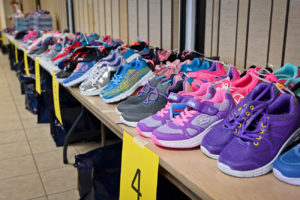
Shoes arranged in line by sizes await children at a First Blessing event at Miller Heights Baptist Church in Belton. (Photo by Nan Dickson)

Glen Lackey spent 25 years in the shoe business, retiring as an executive with experience in multi-store retail sales management. Deborah Lackey worked in marketing and as a television advertising executive.

They made their combined gifts, talents and life experiences available to God, and First Blessing was born.

Lackey knew many children in the Temple area lacked properly fitting shoes, and he recognized what a gift it would be to families in need if their children had new shoes and socks.

He also recognized First Baptist Church could use events in which the church made shoes available as occasions for volunteers from the congregation to engage in meaningful conversations with families they might not encounter otherwise.

‘An environment where the love of Christ can be shared’

“We want to build an environment where the love of Christ can be shared,” Lackey explained. “We enable people to have the conversations they always wanted to have. … I’ve seen grown men who cried, saying it’s the first time they’ve ever presented the gospel to anyone.”
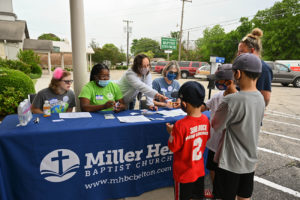
Volunteers (left to right) Beth Kahler, Jameer McDade, Elizabeth Alvarez and Debbie Van Gonten check in registrants and distribute name tags at a First Blessing event at Miller Heights Baptist Church in Belton. (Photo by Nan Dickson)

The Lackeys developed an event in which families identified by local schools on the basis of need are greeted by a volunteer from the church. The volunteer and family begin by sharing a meal together.

“You can’t measure the value of what happens at that table,” Lackey said. “There are opportunities for relational evangelistic conversations.”

Next, the volunteer escorts the parents through the process of their child being fitted for shoes and given the opportunity to select a pair of their choosing. The event is structured so each family comes into contact with at least seven church volunteers.

“Research says people are more likely to become involved in church when they have met seven people they feel comfortable with. That’s what we built into the First Blessing events,” Lackey said.

First Baptist in Temple reached 300 children and their parents at the inaugural event in 2014. The next year’s event involved twice that number.

‘Build relationships with those who are far from God’
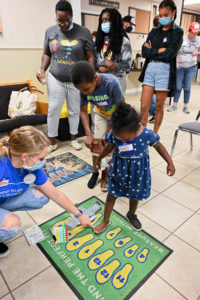
Tessa Respondek helps measure the foot size of a young participant at a First Blessing event at Miller Heights Baptist Church in Belton. (Photo by Nan Dickson)

“Our mission is to collide with those who are far from God,” Lackey said. “We want to touch the unincluded and the unchurched. I’m not really interested in just handing out things.

“Jesus came to heal the sick, and that means getting where the sick are. We want to build relationships with those who are far from God.”

Lackey views follow-up with each family as an essential component of First Blessing. So, he realized if the ministry continued to grow, it would soon become impossible for the members of First Baptist in Temple to do it alone.

So, First Blessing “scaled back” by expanding—allowing other churches to participate. Instead of one event sponsored by a single church with 600 people involved, a half-dozen churches each could sponsor an event for 100 people.

In 2019—before the outbreak of COVID-19—First Blessing worked with 24 churches throughout Texas—as well as two children’s homes in Haiti—to reach about 4,000 children and their families.

Trinity Baptist Church in Kerrville was among the first churches beyond First Baptist in Temple to host a First Blessing event. Lackey presented the idea to Pastor John Wheat and Children’s Minister Kellee Parish, who agreed to take on the project.

First Blessing has become a regular Christmas season activity at Trinity Baptist.

“It has made us an even more giving church,” Wheat said, noting the sense of fulfillment volunteers find in being part of First Blessing. “There’s nothing like seeing little children get their first pair of new shoes.”

Enlisting volunteers and support has been a simple task, Parish said.

“Trinity is a mission-minded church, and our people want to minister in our community. Volunteers are already asking me when we’ll start getting ready” for the next First Blessing event, she said. “We’ve never had to worry about volunteers or money. … We do it to share the gospel and be the light of Christ.”

‘We’re here for you if you need anything’

Coggin Avenue Baptist Church in Brownwood also was among the early adopters of First Blessing. Like Trinity Baptist in Kerrville, Coggin Avenue has incorporated First Blessing into its schedule of Christmas activities.

Along the way, the church has made a few adaptations, noted Chris Stuard, director of Love Brownwood at Coggin Avenue Baptist Church.

“We gave parents the opportunity to wrap shoes, so it’s a present to their children,” Stuard said. Also, the church began charging parents a nominal $3 fee for each pair of shoes, so they feel like they are buying the shoes rather than receiving charity.

The “shepherds”—church volunteers who share a meal with each family and escort them through the First Blessing process—also follow up with families by delivering a family photo taken at the event, along with information about planned Easter activities at Coggin Avenue.

“We want to show people in our community: ‘We love you. We’re here for you if you need anything,’” Stuard said.

‘Making people feel worthy of a relationship’

When Marriott moved from First Baptist Church in Temple to First Baptist Church in Burleson, he soon incorporated First Blessing into his new church’s schedule of ministries. First Blessing quickly gained a “huge buy-in” from volunteers, he noted.

“Seeing the kids face-to-face and interacting with the families offers an opportunity to apply the heart of the gospel,” Marriott said.

As students at First Baptist in Burleson became involved, they asked to add one additional servanthood step to the First Blessing event, which has become a meaningful part of the overall experience.

“It’s awesome to see teenagers washing little kids’ feet,” he said.

While some churches reported families who benefited from First Blessing have made commitments to Christ, kingdom growth—not necessarily the numerical growth of sponsoring churches—remains the goal of First Blessing.

“You may not see anybody walk the aisle at an event, but we’re planting seed,” Lackey said. “Some people are prayed over for the first time in their life. … We’re making people feel worthy of a relationship.”

Read more articles like this in CommonCall magazine. CommonCall explores issues important to Christians and features inspiring stories about disciples of Jesus living out their faith. An annual subscription is only $24. To subscribe to CommonCallclick here.


Corsicana pastor urges vaccine consideration after COVID

CORSICANA (BP)—After a stay in the ICU as he battled COVID-19, Pastor Danny Reeves wants to “testify to the Lord’s goodness,” as well as encourage people to consider getting the vaccine.

Reeves, pastor of First Baptist Church in Corsicana, said he first started experiencing symptoms of the virus in early July. Body aches, a fever and headaches prompted a COVID test that yielded a positive result.

After initially feeling better a few days into his quarantine period, Reeves’ symptoms took a turn for the worse, and he decided to go to the hospital after spending 10 days at home. The virus continued to take its toll, and his struggle to breathe progressed quickly. He was moved to the ICU after two nights in the hospital.

Given a ‘reality check’

The 49-year-old Reeves said the doctors gave him a “reality check” that there was a chance he could die.

“Those are striking words that get your attention,” Reeves said. “There were lots of emotions, and I cried a lot in the hospital. I fought for my life those first three nights in the ICU.”

After 11 days in the hospital, Reeves slowly recovered. Although that time was challenging, he said trusting the Lord is what brought him comfort.

“I have never faced what I would call a near-death experience, and I did feel fear,” Reeves said. “Yet I still felt a lot of confidence. If this was my appointed time for God to call me, I knew I was ready. I look forward to seeing the Lord. I didn’t want that to happen yet, but I knew if that’s what God had determined for me, I had a real peace.”

‘I think I was just overconfident’

Reeves had not received the vaccine before he was diagnosed with the virus, but now he said he wishes he had.

One doctor told him if he had been at the hospital this time last year, he may not have made it, because certain treatment methods for COVID had not been developed yet.

“I just didn’t think it would happen to me, and therefore, I thought I was healthy enough to deal with it if I might get it,” Reeves said. “I learned the hard way that this is not how this disease works.

“I think I was just overconfident. I wish I would have gotten the vaccine, and I believe my case would have been severely diminished if I had done so. I don’t want people to go through the horror that I faced.”

Plans to get vaccine once he is eligible

Reeves now plans to get the vaccine himself once he is eligible for it, as there is a waiting period for those who have recently had the virus. He also now encourages everyone to consider talking to their doctor about getting the vaccine, though he does not support vaccine mandates.

“I’ve wanted to encourage people to consider getting vaccinated,” he said. “I do not believe in mandates …, but I do believe I probably could have been saved the level of horror that I faced if I had taken the vaccine.

“People have called to ask me, and I say everything I’ve read says you could be saved by it. I’ve gotten a lot of feedback on social media from people who have chosen to get vaccinated because of my story, and that means a lot to me. I also think the vaccine could save you and your family, but could also maybe be a way to love our neighbors.

“My plea is don’t get your information from mainstream media, but go to a trusted physician and let them talk to you about it. I had some great talks with doctors in the hospital about the entire vaccination process and how the Pfizer vaccine was handled. I talked to one physician who was actually on the development board for the Pfizer vaccine. I realized the vaccine would have been good for me.”

Pupil in a ‘school of humility’

Reeves marked a small victory when returning to his church office for a couple hours of work earlier this week. As he reflected on the journey, he said he is thankful for the support he received and how it affected him.

“It (support from friends and family) has been irreplaceable, and it’s meant the world to me. My loved ones have been just super,” Reeves said.

“I think I’ve become a better pastor having been a patient to that degree. I learned what it means when somebody calls. I’ve learned what it means when someone cares enough to text, and I’ve learned the value of a card or note. God used all of that mightily to lift my spirit.

“I believe every part of our life is a school for us to learn what God has for us to learn. For me, it was a school of humility, and learning how much I need those around me.”

Trust in the Lord in all things

Additionally, Reeves said he wanted to be a witness for Christ to those around him even during his time at the hospital.

“I felt a real sense of calling even as a patient to minister to every single medical professional I came in contact with,” Reeves said. “I loved every person that came through my door.”

One of the main lessons Reeves has learned through the whole process, and the advice he gives to anyone currently struggling through a COVID-19 battle, is to be courageous and trust the Lord in all things.

“When Christ becomes our foundation, even the darkest of valleys shrink in comparison to God’s great power and love for us,” he said.


Baylor avoids major NCAA penalties for sexual abuse

A five-year investigation “could not conclude” Baylor University violated NCAA rules when some employees failed to report sexual abuse.

Essentially, the NCAA ruled “the culture of non-reporting” during a previous administration at Baylor was so widespread, the athletic department could not be singled out as giving special treatment to student athletes.

“Baylor admitted to moral and ethical failings in its handling of sexual and interpersonal violence on campus but argued those failings, however egregious, did not constitute violations of NCAA rules. Ultimately, and with tremendous reluctance, this panel agrees,” the NCAA Committee on Infractions Hearing Panel stated.

In a joint statement, Baylor President Linda Livingstone and Athletic Director Mack Rhodes said: “As part of the NCAA process, the university acknowledged its significant and moral failings related to sexual and interpersonal violence, and we sincerely regret the actions of a few individuals caused harm to so many. We must remember that the prospect of NCAA penalties pales in comparison to the suffering of the survivors of such horrific assaults.”

NCAA points to ‘campus-wide culture of non-reporting’

The NCAA looked specifically at three specific instances of “alleged actual or threatened” violence by student athletes that were not reported by football staff. The panel examined allegations that Baylor shielded student athletes from disciplinary action.

“The panel found that those instances of non-reporting did not constitute impermissible benefits to football student-athletes because of a campus-wide culture of non-reporting. That culture was driven by the school’s broader failure to prioritize Title IX implementation, creating an environment in which faculty and staff did not know and/or understand their obligations to report allegations of sexual or interpersonal violence,” the NCAA committee stated.

“Because the culture of non-reporting was not limited to cases involving student-athletes, the panel could not find that these instances resulted in impermissible benefits.”

However, the NCAA placed the university on four years of probation, levied a $5,000 fine and placed some recruiting restrictions on Baylor for violating some other rules.

Probation and minor penalties for other offenses

At the same time, the NCAA Committee on Infractions found Baylor guilty of violating some rules related to impermissible benefits to a student athlete and using a predominantly female student-host group as impermissible recruiters of student athletes.

The committee also cited a former assistant director of football operations for failing to participate in the investigation process.

In addition to a four-year probation and a $5,000 fine, the panel imposed the following penalties:

  • A reduction to 30 football official visits, a three-week ban on unofficial visits in football during, and a two-week ban on football recruiting communication during the 2021-22 academic year.
  • A reduction of football evaluation days by three during fall 2021 and by 10 during spring 2022.
  • A five-year “show-cause” order for the former assistant director of football operations. During that period, any NCAA member school employing him must restrict him from any athletically related duties unless it shows cause why the restrictions should not apply.
  • Vacating all records in which student-athletes competed while ineligible in the 2011 season.

“The university agrees with the enforcement staff and the Committee on Infractions that violations did occur, and we take full responsibility,” Livingstone and Rhodes stated. “Our internal and external legal teams will review the full report, and the university will decide on its next steps, if any.”

In a Zoom news conference, Livingstone emphasized the “dramatic changes” in personnel, policies and processes related to Title IX compliance at Baylor in recent years.

“Baylor is a much different university today than it was three, five and certainly 10 years ago,” she said.

In 2017, the Southern Association of Colleges and Schools Commission on Colleges verified Baylor had implemented all 105 recommendations from the attorneys formerly with Pepper Hamilton, the Philadelphia law firm Baylor regents enlisted to investigate the university’s response to sexual assault reports and Title IX compliance.

As a result of the Pepper Hamilton investigation, the Baylor board of regents removed Ken Starr as president, fired Head Football Coach Art Briles and sanctioned Athletic Director Ian McCaw. Starr later stepped down as chancellor and law professor, and McCaw resigned as athletic director.


Some Texas Baptist schools restore mask mandates

After Texas Baptist universities relaxed pandemic-related restrictions in May, at least two schools have reinstituted modified mask mandates for the fall semester in light of a surge in COVID-19 cases and hospitalizations.

While other schools at this point are maintaining “mask-optional” policies, most indicated they are monitoring the situation closely and will make adjustments according to local conditions.

Masks required indoors at Wayland

Wayland Baptist University announced Aug. 5 all students, employees and guests—including those who are fully vaccinated—will be required to wear masks while inside buildings on the Plainview campus.

The requirement followed the July 27 recommendation from the Centers for Disease Control and Prevention that all individuals—including those who are vaccinated—wear face coverings indoors to reduce the spread of the contagious delta variant in areas identified as having substantial transmission rates.

Plainview and Hale County have been identified as having high transmission rates and a low percentage rate of vaccinated residents.

“Our efforts to closely follow CDC guidance have helped us to successfully navigate the pandemic and keep our campuses open and our employees and students healthy,” said Wayland President Bobby Hall.

COVID-19 testing will be available for all Wayland students and employees, both on and off campus, and it will be required for residential students, student athletes and students in the performing arts. Anyone who has not been vaccinated is being encouraged to do so, and the school is strongly encouraging physical distancing and proper handwashing.

New student orientation at Wayland is scheduled Aug. 13, and classes are slated to begin Aug. 18.

ETBU requires masks in class and chapel

Five hundred miles east of Plainview, East Texas Baptist University also has modified its COVID-19 health and safety protocols.

Masks will be required of all individuals—including those who are vaccinated—when they are in ETBU classrooms, attending chapel services or inside the Sisk Health Services building.

At other indoor locations on campus, masks are required for people who are not fully vaccinated and recommended for all others.

“As COVID infections surge with the delta variant in Texas and in our region, East Texas Baptist University must adjust some of our health and safety protocols to provide even greater protection for our entire campus community,” ETBU President J. Blair Blackburn said.

“ETBU remains committed to providing an in-person, on-campus educational experience for our Tigers.”

As previously announced, classrooms and residence halls at ETBU will operate at full capacity. ETBU will observe in-person instruction, with virtual learning available only to students who have been infected or exposed to COVID-19 or symptomatic students who have been isolated or quarantined by health services staff.

Vaccinations are “strongly encouraged” but not required at ETBU. On-campus vaccination clinics are offered during the first week of classes on Aug. 16, 18 and 20.

Teachers can request classroom masks at HBU

At Houston Baptist University, while the school does not have a campus-wide mask requirement, “faculty still reserve the right to request that students wear masks in class, especially those not fully vaccinated,” according to a policy posted online Aug. 10.

HBU is strongly encouraging—but not requiring—students to receive vaccinations, directing them to the free walk-in vaccination clinic at Memorial Hermann Southwest, adjacent to the campus.

“Our ability to return to normalcy depends on everyone doing their part to ensure their own safety and the safety of others,” the online policy states. “The most significant action you can take is to be fully vaccinated.”

All HBU classrooms and campus buildings will operate at 100 percent capacity.

“HBU will continue to clean spaces, provide PathoSans sanitizer in abundance to anyone who would like to perform additional sanitizing, and will continue using CIMR [Continuous Infectious Microbial Reduction] technology to help protect against the spread of COVID,” said John R. Holmes Jr., associate vice president for facilities and campus operations.

The CIMR system sanitizes air and surfaces throughout an indoor environment within 24 hours and then provides continuous protection from airborne and surface infection.

Unvaccinated must mask indoors, be tested weekly at Baylor

Baylor University has not changed its May 17 position that allows fully vaccinated individuals to go without facemasks but requires those who have not been vaccinated to wear face coverings indoors.

While Baylor does not require its students, faculty or staff to receive the COVID-19 vaccine, those who submit confirmation of vaccination are exempt from mandatory weekly COVID-19 testing.

Masks recommended but not required elsewhere

At the University of Mary Hardin-Baylor in Belton, students are encouraged but not required to receive the COVID-19 vaccination, and an on-campus vaccination clinic is scheduled Aug. 12-13. Otherwise, UMHB plans to continue “normal operations” in the fall semester.

“For the 2021-2022 academic year, as a general rule, students, employees, and guests are not required to wear face coverings, practice social distancing, or report COVID-19 symptoms, exposure, or positive tests directly to UMHB. However, it is important for all of us to do our part to keep our campus community safe,” Brandon Skaggs, vice president for student life at UMHB, said in an email to students.

While face masks are optional, they are “strongly recommended” for individuals who are not fully vaccinated, and UMHB makes face coverings available at no cost to those who need them.

“Rest assured, the university will monitor local conditions carefully and will follow all directives issued by the state governor or other federal, state, or local health officials,” Skaggs wrote.

“Should the need arise for UMHB to change our mode of operations for any area of the university during the 2021-2022 academic year, including course delivery methods, we will communicate that as soon as possible.”

An Aug. 2 update on the Hardin-Simmons University website notes the school resumed normal operations May 8, and it will remain at 100 percent occupancy for indoor spaces “provided CDC guidelines do not change.”

“Masks will not be required on campus, although we do encourage them for all unvaccinated individuals. HSU does not currently require the COVID-19 vaccine, but we strongly encourage getting the vaccine if you have not done so already,” the website statement reads.

Baptist University of the Américas has not modified its protocols, which make masks optional but encouraged, particularly in weekly chapel services.

“We continue to monitor the situation in the city of San Antonio, paying special attention to any government directives relevant to containing the spread of COVID-19,” said Gabriel Cortés, chief of staff at BUA.

A Dallas Baptist University spokesman said the school remains committed to in-person events and in-classroom instruction during the fall semester and “at this stage” has not revised its policy that makes masks optional.

A spokesman for Howard Payne University said the Brownwood school will announce its COVID-19 protocols closer to the beginning of the fall semester.


CommonCall: Long obedience the norm at Caldwell church

Maybe there’s something in the drinking water in Caldwell—or in the waters of the baptistry at First Baptist Church.

More likely, it’s in the hearts of the people who consider First Baptist Church in Caldwell their family—a commitment to serve each other and their Lord for years on end.

Eugene Peterson famously defined discipleship as “a long obedience in the same direction.” He could have been describing the Caldwell congregation.

First Baptist in Caldwell boasts an unusual number of people who have labored at the same tasks for decades. Even so, it’s a tight-knit family that continues to embrace new members and gladly offers them places to serve.

“Our people realize it enriches the church to be open and welcoming. There’s a desire to bring more people into the family,” said Paul Batista, whose family has been part of First Baptist in Caldwell six generations.

Setting a high standard

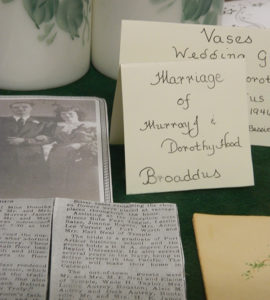
A historical display at First Baptist Church in Caldwell includes the wedding photo and newspaper article announcing the marriage of Murray and Dorothy Broaddus. She has worked 60 years in the church office, including the last four decades as treasurer. (Photo by Ken Camp)

In a church where long-tenured service is the norm, Dorothy Broaddus sets a high standard. She has worked in the church office 60 years, including the last 40 years as church treasurer and financial secretary.

For most of her soon-to-be 96 years, she has lived across the street from the First Baptist building—a fact that initially led to her work in the church office.

“The pastor would holler out the door: ‘Dorothy, are you busy? I need something typed,’” she recalled.

For four decades, she has worked closely with the church’s finance committee, keeping track of all financial matters and preparing a monthly report for the congregation.

“When I started, the church had a $17,000 budget. Now, it’s about $600,000,” she said.

She performs her duties with a pencil, paper and adding machine.

“I don’t even know how to turn a computer on,” she said.

For most of her years as financial secretary, Broaddus has walked from her house to the church office. During the worst part of the COVID-19 pandemic, she worked from home, but in recent months, she has returned to the office across the street.

“God has taken care of me and watched over me,” she said. “God has seen me through it all. It’s not what I’ve done. It’s what God has done through me.”

Grew up in the church’s music ministry

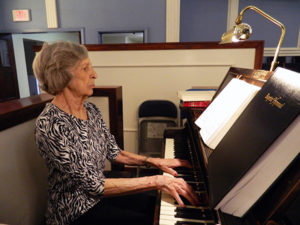
At age 84, Ray Ann Alford, can’t quite match her sister-in-law’s long tenure at First Baptist, but she has been church pianist for 50 years.

It’s not an overstatement to say she has been part of the church’s music ministry nearly her whole life, considering her mother—Ray Broaddus—was the church’s longtime organist and occasional pianist. The duo played together for 15 years—mother on the organ and daughter on the piano—until her mother retired from the post.

Ray Ann Alford as been pianist at First Baptist Church in Caldwell for 50 years, but she has been involved in the church’s music ministry even longer. (Photo by Ken Camp)

“My mother taught all of us (Alford and her sisters) music from the time we were still in the womb,” she said. “I grew up in this church. … It means everything to me.”

Alford fondly recalls the music directors—some paid ministers of music, and others volunteer song leaders—with whom she has worked over the course of five decades. She particularly remembers good times with Dorothy Batista, who led the music more than 20 years and served as interim music director on multiple occasions.

Not surprisingly, given the multi-generational nature of First Baptist in Caldwell, the church’s 150 anniversary history said of Dorothy Batista: “Both her mother and grandparents were instrumental in establishing the wonderful music programs which continue to this day.”

The sesquicentennial history also added, “Anyone who heard Dorothy sing knows that the Lord blessed her with a voice like the angels.”

Her son Paul, certainly agreed, noting his mother’s voice was “strong and pure, like a piece of crystal.” If anyone objected to a woman leading in worship, he never heard about it.

“Everybody knows everybody pretty well, and I think most people saw her as the most qualified person, so they thought she ought to be doing it,” he said.

Alford also speaks highly of her instrumental colleague Cassandra Russell, who began serving as organist at First Baptist in Caldwell 25 years ago, after several years as assistant pianist.

“I had to learn about stops and pedals,” Russell recalled.

‘It’s more a ministry than a job’

Church pianist Ray Ann Alford shows organist Cassandra Russell the organ her mother played for many years. (Photo by Ken Camp)

The organ Ray Broaddus and others played for many years is still in the church’s chapel. Russell plays the “new organ,” dedicated in 1991 in the church sanctuary.

Nadine McManus became church secretary at First Baptist in Caldwell 38 years ago, about eight years after she joined the church.

“It’s more a ministry than a job to me,” she said. “I’m just honored and humbled to serve here.”

That’s characteristic of the attitude of most people at First Baptist in Caldwell, according to Charles and Jane Sebesta. He has been a member 54 years. She joined five years later when they married.

He has been a deacon about 45 years and served on multiple committees. She has taught Sunday school at least 30 years and served in other capacities.

“We have a family attitude here. That’s why we have a group of people who are so faithful,” he said.

While the Sebestas described the church as close-knit family, they noted a significant number of young families who have continued to join in recent years and assume leadership roles.

“They jump right in and work,” she said, pointing particularly to a young mother with four children and a fifth on the way who led in Vacation Bible School. “We welcome the young people. … There are plenty of jobs to go around.”

Read more articles like this in CommonCall magazine. CommonCall explores issues important to Christians and features inspiring stories about disciples of Jesus living out their faith. An annual subscription is only $24. To subscribe to CommonCallclick here.


Del Rio church serves migrants sheltered under bridge

An overwhelming number of migrants arrived at the border in Del Rio, and hundreds camped for days beneath a bridge while they waited to be processed. City Church in Del Rio responded by feeding the hungry.

In four days, City Church prepared and provided more than 2,000 sandwiches for migrants at the request of the U.S. Border Patrol.

‘An act of obedience’

“It’s more than a political issue. It was more than a humanitarian response. It was an act of obedience to Matthew 25 and the command to feed the hungry and welcome the stranger,” Pastor Matt Mayberry said.

Members of City Church in Del Rio prepare sandwiches to deliver to migrants who were camped under a bridge, waiting to be processed. (Photo courtesy of Matt Mayberry)

During the last week of July, the number of migrants who arrived at the border in Del Rio exceeded local processing centers’ capacity to handle them.

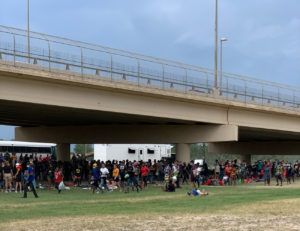
By July 31, with the temperature topping 100 degrees, about 700 sought shade and shelter beneath the bridge.

“Our church has a good relationship with the Border Patrol office here. So, they reached out to us and asked if we could help,” Mayberry said.

He noted Shon Young, associate pastor at the church and a missionary with Texas Baptists’ River Ministry, leads the Val Verde Border Humanitarian Coalition—a coalition initially formed at the request of U.S. Customs and Border Protection to help during an earlier influx of migrants.

Be salt and light

Hundreds of migrants seek shelter from the South Texas heat while waiting to be processed. (Photo courtesy of Matt Mayberry)

Mayberry recently began preaching a series of Sunday messages focused on Jesus’ Sermon on the Mount as recorded in the Gospel of Matthew. On Aug. 1, his text included Matthew 5:13-16, a passage in which Jesus commanded his followers to be the “salt of the earth” and the “light of the world.”

“The Lord prepared the way, and our people obeyed his call to be salt and light,” he said. “I’m certainly proud of our church and how our people responded to God’s word. Our rapid response really was due to the working of the Holy Spirit.”

When church volunteers delivered the initial batch of sandwiches to the migrants beneath the bridge on Sunday evening, it was the first meal some had in three days, Mayberry noted.

Migrants sought relief from the South Texas heat by camping for several days beneath a bridge until they could be processed. (Photo courtesy of Matt Mayberry)

In the days that followed, the number of people waiting to be processed diminished as personnel at processing centers worked through the backlog of cases.

On Aug. 4, Mayberry received word everyone who had been sheltered under a bridge had been moved to processing centers. After four days of frantic activity, church volunteers were able to stop making and delivering sandwiches.

“Lord willing, we won’t have to do this again anytime soon,” Mayberry said. “But when there is a need, we want to be obedient.”


Hispanic Theological Initiative y Convención lanzan una colaboración y un nuevo puesto de prácticas

SAN ANTONIO—La Convención Bautista Hispana de Texas y la Hispanic Theological Initiative ((Iniciativa Teológica Hispana) están colaborando en un nuevo puesto de pasantía que será ocupado por Bobby Martínez, graduado de M. Div. de Truett y estudiante de doctorado en el Departamento de Religión de Baylor.

Martínez servirá como “pasante de la Convención” y ayudará en el desarrollo de nuevas iniciativas de la Convención para las congregaciones bautistas hispanas en Texas.

Uno de los proyectos principales de la colaboración será “Recordando—The Texas Baptist Historical Collection”. Trabajando con la Texas Baptist Historical Collection y su Director, Alan Lafever, Martínez comenzará el arduo trabajo de inventariar y categorizar las numerosas cajas de material de la Colección relacionadas con la historia de los bautistas hispanos en Texas.

“El objetivo final será tener el material digitalizado y disponible para cualquiera que busque entender la historia de la obra de Dios en y a través de los bautistas hispanos en Texas”, dijo Jesse Rincones, Director Ejecutivo de Convención.

Además de su trabajo con “Recordando”, Martínez explorará los pasos para desarrollar aún más el trabajo de Convención con los Jóvenes Líderes Latinos a nivel estatal y regional.

La Iniciativa Teológica Hispana (HTI) tiene su sede en el Seminario Teológico de Princeton. La misión fundacional de HTI fue apoyar a la próxima generación de teólogos con programas y fondos diseñados para animar a los estudiantes de color a completar programas de doctorado. El HTI ha ampliado sus intereses disciplinarios más allá de la teología e incluye historia, sociología, estudios bíblicos y religiosos. También se ha ampliado a la formación de académicos en la etapa inicial y media de su carrera.

El Dr. João Chaves, Director Adjunto de Programación del HTI, se siente animado por la nueva colaboración: “El HTI está encantado de asociarse con la Convención a través de estas prácticas. Estoy deseando celebrar los frutos del gran trabajo que se realizará a través de este esfuerzo conjunto”.

En cuanto a la selección del pasante inaugural, Chaves dijo: “El becario de HTI Bobby Martínez encaja muy bien con Convención, y confío en que Jesse Rincones y toda la familia de Convención utilizarán esta asociación para continuar fortaleciendo el trabajo creativo, cooperativo e innovador que Convención ya ha estado haciendo.”

Desde que comenzó el programa de pasantías de HTI en 2018, que fue posible gracias a una subvención proporcionada por Lilly Endowment Inc., se han establecido 21 pasantías. Estas oportunidades están diseñadas para ayudar a los pasantes a ampliar sus experiencias y redes profesionales y, al mismo tiempo, ampliar la capacidad de las instituciones dirigidas por hispanos o que sirven a los hispanos.

“HTI tiene una larga historia de inversión en estudiantes de doctorado hispanos y en organizaciones que sirven a los hispanos. Estamos muy contentos de que Convención sea ahora parte de ese gran trabajo”, dijo Rincones.

Se anima a los estudiantes de doctorado hispanos a obtener más información sobre las oportunidades de prácticas visitando el sitio web de HTI.  


TBM mission team answers prayer for respite ministry

Rocking chairs on a wrap-around porch, a white picket fence, cozy beds and delicious homemade meals are just a few of the amenities a weary ministry leader can find at Cornerstone Lodge in Scurry, southwest of Kaufman.

For the past 16 years, the three-story, eight-bedroom home nestled in the beautiful countryside has hosted countless ministry leaders and individuals in need of respite.

But when the house began looking faded, Resident Managers Bob and LaDonna Baird started praying about what to do.

“It needed painting really bad,” said Bob Baird, who has managed the facility six years. “The thought of it just loomed over me. I’ve been praying for three or four years about how to get all the work done.”

TBM provides answer to prayer

The Bairds’ prayers were answered when a team of nearly 30 Texas Baptist Men volunteers arrived at the lodge in mid-July ready to work.

A student from Trinity Baptist Church in Mount Pleasant serves with TBM/Texans on Mission at Cornerstone Lodge in Scurry. (TBM Photo)

“This ministry has helped countless pastors and ministers spend some quiet time with God,” said TBM Ministry Advancement Coordinator Sabrina Pinales. “Here, God refreshes them.

“By investing time and energy into these facilities, we hope to bring new life to the ministry as well, strengthening it so it can serve many more leaders.”

Over the course of three days volunteers prepped, pressure washed, sanded and painted different areas of the facility. A volunteer from Azle Avenue Baptist Church in Fort Worth who is a painter by trade even brought his own professional painting equipment, ensuring the job was done quickly and smoothly.

Going back to give back

Twelve students from Trinity Baptist Church in Mount Pleasant also were among the volunteers. Student Minister Carlos Martinez felt led to bring his students after enjoying the lodge as a guest himself earlier this summer.

Carlos Martinez brought a dozen students from Trinity Baptist Church in Mount Pleasant to serve with TBM/Texans on Mission at Cornerstone Lodge in Scurry. (TBM Photo)

“It’s great place to sit, rest and unplug from everything, allowing you to meditate and talk to God,” Martinez said. “It meant a lot to me personally to be able to go back and help Cornerstone. You always like to return the favor when someone does something nice for you.”

Volunteers also placed rocks in the garden, cleaned and painted the rocking chairs that grace the front porch of the picturesque home.

“First impression is a good thing for a lodge like this,” Baird explained. “People like to come here to sit outside, rest and enjoy this place of peace and healing. It’s just a better atmosphere when things look nice. … The volunteers were a big, big answer to prayer.”


Revitalization demands a focus on mission, strategist says

DALLAS (BP)—Jonathan Smith remembers the day he learned his church couldn’t afford a cup of coffee.

Jonathan Smith

He knew the church had struggled. It held plenty of building space but not the people to fill it. An aging membership reflected the difficulties in reaching the next generation. The congregation had been formative in planting other churches, but only because of a couple of splits in the fellowship.

One day, Smith’s ministry assistant was shopping around for a vendor when she called him, saying, “You have to come see this.”

The church’s bank account showed $1.06. On top of that, the large crowds the church had drawn in the 1980s had dwindled to 25.

Nevertheless, a process toward prioritizing the right things had been underway and eventually led to a $750,000 budget and attendance reaching 450.

“You cannot out-mission the Messiah. We had to get back to the Great Commission, the Great Commandment, loving our community and loving the lost,” said Smith, director of church health strategy for the Baptist General Convention of Texas. “Over time, the Lord just turned it around to becoming a really great, strong church.”

Revitalization takes time and trust

In a culture that demands immediate results, it took about eight years for Smith’s church to experience the turnaround. That time consisted of building trust among members while identifying problems related to leadership development and missions involvement.

One of the more difficult steps came through removing ministries serving more as a faded photo from yesteryear than effective outreach of the current day.

“The upside-down church has a very large structure, but a small mission,” Smith pointed out. “It needs to be the other way around. We fall in love with programs, when we need to fall in love with the lost.”

Give priority to missions and evangelism

God began to move after missions and evangelism became a priority. When growth had reached 100 members, 40 of them at any time could be on a mission trip. After returning from Germany one year, Smith asked someone who the person was on stage leading worship for Vacation Bible School.

“That’s Becka,” a church member said.

“Who’s Becka?” Smith asked.

“Oh, her family is one of the ones who came here while you were gone.”

Five families had joined the church during Smith’s two-week absence in Germany.

“That’s when it hit me that the more mission work we do and engage with the mission of Christ, the more people the Lord brought to us,” he said. “I tell pastors that we tend to focus on growing the church, when we should be focused on growing the kingdom.”

Leadership development vital

That growth brought the need to develop leaders. It’s an issue churches tend to ignore when experiencing a time of growth, and when it’s not addressed also can hasten a decline, Smith noted.

“Every pastor wants his church to grow until it does. We weren’t ready for growth, so we had to find ways to take care of the people God brought to us. I learned that you always have to be developing new leaders if you want your church to grow.”

In a recent podcast with Church Answers, Smith called the layperson “the greatest untapped resource of the church. Our role as pastors is to develop and equip the saints.”

Revitalization, he added, requires a sense of urgency but also trust. Of course, those are difficult to mix when one works against time constraints and the other requires them.

One way to address both is to “problem-cast” continuously—identify an issue and place it before the membership for their input.

Celebrate victories

While discussing those issues, find ways to celebrate victories. Rather than have designated baptism Sundays with several individuals, Smith would schedule one for each Sunday. Each person’s story would be thoroughly shared and celebrated with testimonies by friends and family.

As many churches age—both in membership and buildings—many have become more open to the necessary steps of revitalization. In much the same way, pastors and churches adopted online strategies last year when COVID-19 took away in-person gatherings.

Smith maintains such steps are more obvious than churches want to admit and often need to reach a point—like seeing $1.06 in the bank account—to make the move.

“Every church has a psychology and instinctively knows what they’re supposed to be doing,” he added. “Nothing stirs the heart like three things—baptisms, new members and mission work.”


Stephen Reid: Slow down and let Scripture aid in healing

Scripture can help trauma survivors experience healing, but readers must slow down and give the Holy Spirit space to work, a professor at Baylor University’s Truett Theological Seminary told a webinar audience.

“God has given us a self-revelation that helps us read our life not only in its celebratory times, but even in its traumatic events,” said Stephen Reid, professor of Christian Scriptures at Truett Seminary.

Reid spoke on “The Role of Scripture in Healing Trauma” during a webinar sponsored by the Truett Church Network in partnership with Faith Fosters Texas.

Empathy, apathy and triggers

Reid honestly acknowledged the presence of “troublesome” passages in Scripture that have the potential to trigger painful memories for people who have experienced trauma.

Stephen Reid, professor of Christian Scriptures at Truett Theological Seminary, spoke on “The Role of Scripture in Healing Trauma” during a webinar sponsored by the Truett Church Network in partnership with Faith Fosters Texas. (Screen Capture Image)

When faced with biblical passages that deal with violence and abuse, pastors and teachers should help Christians “navigate between three things—apathy, empathy and triggering,” he said.

Some Christians have read difficult passages of Scripture about warfare and abuse so many times—or seen so much violence in popular media—they become “inoculated” to the horror and slip into apathy, he said.

Others who may be less familiar with the Scriptures may be horrified by some details of stories that seasoned Christians tend to gloss over, he said. For example, he pointed to the Old Testament book of Judges, which he said is “just full of violence.”

“If Judges were a movie, it would be a Quintin Tarantino rated-R movie,” he said, noting it invites readers to react with some revulsion. “If you don’t get a sense of abhorrence in reading Judges, you’ve been watching too many bad movies.”

Individuals who have experienced trauma may be triggered by the same stories that have little impact on others, he noted.

Ministers and teachers can serve Christians well by helping them find the healthy middle ground of empathy—relating to suffering in Scripture at a human level without reliving personal trauma, he said.

Develop strategies for troublesome passages

When pastors and teachers recognize potential trauma triggers in Scripture, they can develop strategies for how to deal with troublesome passages in redemptive ways, Reid emphasized.

Begin with prayer, he suggested. Honestly acknowledge the potential for pain in the Scripture passage, and express openness for the Holy Spirit to perform a healing work.

“Slow down,” he said.

In a passage such as Psalm 13, which raises difficult questions that people who have been hurt may relate to, don’t rush through the disturbing questions in an anxious hurry to get to a rapid resolution, he urged.

Instead, he suggested, let the poetry of the psalm provide the rhythm that allows readers time to process the questions the psalmist asks.

“Let the poetry of the psalm really give space for the community to say, ‘Oh yeah, we’ve been there,’” Reid said.

Provide opportunity for readers of Scripture to be transformed—not just informed—by it, he urged.

“At the end of the day, it’s what God does in the human heart,” Reid said.

Be patient with individuals who have experienced abuse or other trauma, recognizing it often takes times for transformation and healing to occur, he emphasized.

“We need to give each other the grace of time as God has given us the grace of time,” he said.


March to Austin: ‘This is our Selma moment’

GEORGETOWN (RNS)—Fifty-six years ago, Martin Luther King Jr. led thousands of clergy and laypeople on a 54-mile voting rights march from Selma to Montgomery, the state capital of Alabama.

On July 28, William J. Barber II will lead a similar contingent on a four-day, 27-mile march from Georgetown to Austin—also for voting rights.

The symbolism is intentional.

The Moral March for Democracy purposely is invoking that earlier trek in an all-out effort to demand the U.S. Senate end the filibuster and vote on a bill that would restore the Voting Rights Act of 1965.

“The similarity today is that there has to be federal action,” said Barber, the prominent pastor, civil rights activist and co-leader of the Poor People’s Campaign, which is sponsoring the march.

“What we see happening in these statehouses is to roll back voting rights, to take away from people processes that allow more people to vote—early voting, same-day registration, mail-in ballots. We have to have federal action.”

This time, Texas, rather than Alabama, is the choice location. That’s because a bill in the Texas Legislature would clamp down on the state’s voting-by-mail rules, bolster protections for partisan poll watchers and embrace new ID requirements for voting by mail. Texas House Democrats fled the state in an effort to block GOP-backed efforts to enact the new voting bill.

But voting rights have been a recent issue in other states as well. Republicans have passed more than 20 laws in states across the country this year, according to the Brennan Center for Justice. Those laws are likely to make voting harder, especially in Black and Latino communities, which lean Democratic.

Viewing voting rights as a justice issue

The Poor People’s Campaign, a movement fashioned after King’s 1968 anti-poverty push, has been successful in mobilizing clergy who see voting rights as an issue of justice.

“It is my personal conviction that one of the greatest derelicts of religion at this time is that faith leaders have remained silent on the issue of justice as it relates to voter suppression,” said James Dixon, pastor of Houston’s Community of Faith Church. “We think the credibility of the pulpit is being diminished by the silence because that speaks to complicity.”

The Texas Poor People’s Campaign chose to hold the march at the end of July for a reason.

The 1965 Voting Rights Act was signed by President Lyndon Johnson on Aug. 6. The campaign wants Congress to pass a federal voting rights bill by that anniversary.

Two federal voting rights bills are awaiting Senate action: the For the People Act, an overhaul of federal election law, and the John Lewis Voting Rights Advancement Act, which would restore significant parts of the Voting Rights Act that the Supreme Court removed in 2013.

One reason for the inaction is that two moderate Democrats, Sen. Joe Manchin III of West Virginia and Sen. Kyrsten Sinema of Arizona, have resisted calls to end the filibuster, which requires 60 votes rather than 51 for a bill to move forward.

More than 30 people, including Barber and Jesse Jackson, were arrested outside Sinema’s Phoenix office during a sit-in demonstration on Monday. They were handcuffed and charged with trespassing on private property, a misdemeanor.

Following his release, Barber flew to Texas for a news conference at Christ Lutheran Church, the official kickoff location for the march.

Relay-style march planned

The march will work as a kind of relay with different people signed up to march for different legs of the 27-mile stretch from Georgetown to Austin. Barber, who has a disabling arthritic condition known as ankylosing spondylitis that causes him chronic pain, said he was committed to joining for shorter portions of the march each day.

Pastor Frederick Haynes III leads Friendship-West Baptist Church in Dallas. (Photo by Jack Akana Jr.)

Pastor Frederick D. Haynes III of Friendship-West Baptist Church in Dallas, a predominantly Black congregation, will join the march on Friday and Saturday. He said the issue of voting rights has been on his church’s agenda for the past eight years, ever since the Supreme Court invalidated parts of the Voting Rights Act.

“We have a history at the church of not only mobilizing people to vote, but since 2013 we’ve been fighting the insidious ways our state has tried to roll back voting rights,” Haynes said.

Stephanie Wilkins, clergy chair for the Texas Poor People’s Campaign, said there would be 125 people marching each day. The campaign limited the number in light of growing COVID-19 cases. But there will be no restrictions on the number of people at Saturday’s rally in front of the Texas Capitol in Austin, though masks will be required.

She said the march’s conclusion will include a 151-car caravan to commemorate the 151st anniversary of the signing of the 15th Amendment, which prohibits the federal government and each state from denying a citizen the right to vote based on that citizen’s “race, color, or previous condition of servitude.” It was ratified in 1870.

“This is our Selma moment, ” Wilkins said. “We won’t quit because we’re on the side of right.”


Mesquite church adjusts to meet needs of families

When COVID-19 forced a Mesquite church to cancel its regularly scheduled mission trip to the Rio Grande Valley, the congregation reallocated missions funds in ways that would make a lasting difference—both locally and in South Texas.

The Crossing Baptist Church has made mission trips to the Rio Grande for nearly two decades, primarily focusing in recent years on the area around Donna in the Lower Rio Grande Valley.

A significant portion of the church’s annual missions offering has been devoted to working with families living in Rio Grande Valley colonias, serving as a partner organization with Hearts4Kids.

Then the COVID-19 pandemic hit.

“Our missions team knew packing everyone into vans and taking them to the Valley would not be safe,” Pastor Patrick Adair said.

Discovering needs, reallocating funds

The missions team wanted to make sure missions funds given to make an impact on the lives of families would achieve that goal. Since hands-on ministry in South Texas was not possible, the missions team wanted to meet a perceived need for access to healthy food in the eastern Mesquite neighborhoods surrounding their church campus.

The congregation had appointed a vision team to examine the church’s future. The team recommended a study of the surrounding community. Personnel from Buckner Children and Family Services conducted a community needs assessment, and it showed a high level of food insecurity in the neighborhoods around the church.

As a result, the church’s missions team recommended funds from the 2020 mission offering—collected each year the Sunday before Thanksgiving—be reallocated to provide funding for a food distribution ministry.

Brian Washington, the church’s minister to students, is a trained social worker who serves on the board of Sharing Life Community Outreach. He recommended to the missions team that The Crossing Baptist Church become a Community Distribution Partner with Sharing Life to make food accessible to families.

To deliver food to hungry individuals and families most efficiently and cost-effectively, the North Texas Food Bank supplies food to hubs—such as Sharing Life—throughout its service region. Churches and other Community Distribution Partners pick up food at the hub and then make it available in their own neighborhoods.

Funds reallocated from the cancelled mission trip to the Rio Grande Valley enabled The Crossing Baptist Church to launch a monthly drive-through food pantry in the church’s parking lot, beginning in March.

“And it has grown very fast,” said Brenda Palmer, volunteer director of the monthly food distribution ministry.

Palmer, who had served in administrative posts on church staffs for 23 years, took on the responsibility after retiring early from a position at Park Cities Baptist Church in Dallas. She estimates she spends about 40 hours a month in the volunteer role—most of it concentrated within a few days.

“I’m thankful the timing worked out so I could be involved in this ministry,” she said.

Monthly drive-through food distribution

On the first Friday morning of each month, several volunteers from The Crossing Baptist pick up food from Sharing Life.

“Initially, it was just grabbing a few guys with pickup trucks and a trailer to meet at the church at 10 a.m.,” Washington said.

Volunteers work at a “packing party” at The Crossing Baptist Church in Mesquite, filling food boxes that will be distributed to families at the church’s monthly drive-through food pantry. (Photo courtesy of Brian Washington)

However, demand has increased in just a few months. So, the church has started renting a 24-foot moving van to cut down on the number of vehicles required and to make the process more efficient.

Washington—a veteran of the U.S. Marine Corps—admittedly has a penchant for finding the most efficient way to carry out a mission. He quite naturally gravitated to the role of logistics coordinator for the monthly food pantry ministry.

On the first Friday evening of the month, The Crossing Baptist Church hosts a “packing party.” About two dozen volunteers of all ages participate in sorting groceries into boxes and bags.

The next morning, 10 to 12 volunteers arrange the bags on tables in the church parking lot. Then as cars line up, the volunteers load an average of 50 lbs. of groceries per family into the vehicles.

Clients who receive groceries at a drive-through food distribution at The Crossing Baptist Church are invited to share any prayer concerns. (Photo by Brian Washington)

Once cars are filled with food, drivers who wish to do so are invited to stop at a station marked by a simple sign that reads, “How can we pray for you?”

Members of the church’s prayer ministry intercede for all those who submit requests.

Currently, food is stored on the first Friday of the month in an early childhood Sunday school room that is not currently being used, Palmer said.

In time, the church’s missions team envisions having a building dedicated to the food pantry and related community ministries, she added.

“This ministry is an expression of our church’s mission statement—sharing Christ, equipping believers and serving people,” Adair said.

And while the hands-on ministry to neighbors in need continues to grow, The Crossing Baptist Church has not forgotten people they have grown to love in the area around Donna.

On July 25, the church voted to use all the remaining funds it would have spent on its 2021 mission trip to the Rio Grande Valley to contribute to the creation of a Buckner Family Hope Center in Donna. Currently, Buckner’s only Family Hope Center in the lower Rio Grande Valley is located in Peñitas, about 35 miles to the west in Hidalgo County.