Symphony of TBM activity meets needs after hurricane
September 15, 2021
GONZALES, La.—Hours before the sun peeks over the horizon, the sound of footsteps on pavement echo through the air at Ascension Baptist Church.
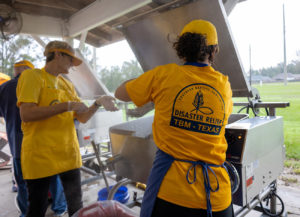
Texas Baptist Men disaster relief volunteers prepare meals for Louisiana residents affected by Hurricane Ida. (TBM Photo)
It’s soon joined by the clunking of plastic containers and the clanking of large metallic skillets. By 5 a.m., the parking lot is filled with a symphony of activity.
In this hurricane-battered area of Southern Louisiana, it’s music to residents’ ears. It means Texas Baptist Men volunteers are cooking meals for them—nutrition that will give residents the strength they need to push forward.
“Every morning, TBM volunteers wake up at 4:30 to prepare lunch,” TBM Disaster Relief Director David Wells said. “Quickly after finishing that, they’re back at it cooking dinner. These are long, tiring days.
“That’s what it takes to serve 7,000 to 10,000 meals a day. But people need to eat and have no other way of getting food. That’s what drives us to serve as Christ did.”
TBM feeding volunteers from across the state have provided more than 70,000 meals since Hurricane Ida made landfall Aug. 30 with 150-mph winds that tore through much of Louisiana. They continued serving even as Hurricane Nicholas moved across the state with heavy rain.
TBM teams spread across the region
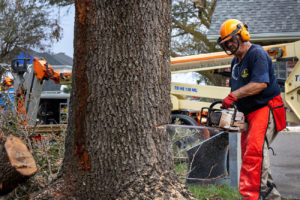
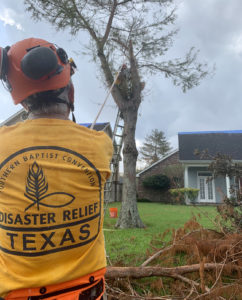
Texas Baptist Men chainsaw crews already have completed more than 100 jobs in South Louisiana, and many more await completion. (TBM Photo)
While the food-service volunteers are based in Gonzales, TBM’s work is spread across South Louisiana. More than two dozen TBM volunteer teams have been serving, including chainsaw teams, shower/laundry teams, an incident management team, chaplains and more.
“Needs are all across Louisiana,” Wells said. “Our chainsaw teams alone are spread across communities along a 30-mile stretch. Electricity is starting to come on, and cities are getting up and running again, but the recovery process will be long. We will continue working for weeks.”
Churches across Texas donated cleaning supplies and bottled water to TBM to help Louisiana churches meet immediate needs. TBM already has sent two tractor-trailer loads, as well as another trailer filled with supplies.
“Texas has wrapped its arms around Louisiana,” Wells said. “It is remarkable how often we hear about a need, and then I turn around and a church is donating items that meet that specific need. In the aftermath of the hurricane, God continues to work wonderfully.”
TBM volunteers are meeting more than physical needs. They’re encouraging people. They’re praying with them. God is comforting people after Hurricane Ida, Wells noted.
“God is transforming lives,” Wells said. “Four people have come to know Christ as Savior. Others have grown closer to him.
“Please continue to pray for Louisiana. Pray for those who are responding to needs. Your prayers are truly making a difference after this storm”
To support TBM disaster relief financially, visit tbmtx.org/donate or send a designated check to Texas Baptist Men, 5351 Catron Drive, Dallas, TX 75227.
Response made a difference in mitigating food insecurity
September 15, 2021
Food insecurity spiked during the first six months of the COVID-19 pandemic, affecting one in four Texas households, according to a recently released analysis of U.S. Department of Agriculture data by Northwestern University.
However, the combined response of the federal government and private-sector charitable organizations—such as ministries supported by the Texas Baptist Hunger Offering—helped mitigate food insecurity later in 2020.
Overall, one in eight Texas households struggled to avoid hunger between 2018 and 2020, with an average 13 percent of Texas households experiencing food insecurity—a comparable percentage to several years before the pandemic.
“Food insecurity is about economic uncertainty, and these latest data reflect the roller-coaster of uncertainty launched by the pandemic. While many Texans experienced this uncertainty for the first time over the last 18 months, the reality is that millions of families faced hunger prior to the pandemic,” said Celia Cole, CEO of Feeding Texas.
“This uncertainty is likely to continue for some time, particularly given the resurgence of the virus. In the meantime, we need to sustain our efforts to keep our neighbors nourished and our communities resilient.”
Private charity, public investment ‘bridge the gap’
Cole emphasized Texas cannot “food bank” its way through the end of the crisis.
“But we have seen clearly that private charity partnered with public investment in nutrition programs, unemployment assistance and child tax credits can bridge the gap. COVID may be a tough battle to conquer, but hunger is easily treated,” she said.
Katie Frugé
The pandemic brought into focus the reality of how many Texas families are potentially vulnerable to food insecurity. But it also reinforced the importance of ministries supported by the Texas Baptist Hunger Offering that “deal with food insecurity in sustainable and holistic ways that minister to the body and soul,” said Katie Frugé, associate director of the Christian Life Commission.
The economic impact of the COVID-19 pandemic reversed many of the “positive gains communities had made in the past few years combatting hunger,” Frugé said.
“Recovering will require us working together, combining the best of all available resources providing training, education and support. Hunger offering ministries provided emergency aid and training at the peak of food insecurity in 2020 and will continue to play a crucial role going forward,” she continued.
“Now more than ever, faithful and continuous support of the hunger offering is one of the most impactful ways to help support Texas Baptists as our hunger ministries work to serve the least of these.”
UN official links global conflict and acute hunger
September 15, 2021
WACO—Chronic hunger has decreased globally in recent years, but armed conflict has increased the prevalence of acute hunger, the chief of the United Nations’ food-assistance and humanitarian agency said.
When he became executive director of the World Food Programme in 2017, “80 million people were marching toward starvation,” David Beasley told a crowd at Baylor University’s Truett Theological Seminary on Sept. 10.
That number rose to 135 million at the beginning of the COVID-19 pandemic, he added.
Beasley pointed to three causes of acute hunger: “Man-made conflict, and I emphasize the gender; global climate extremes; and fragile governance.”
Use food to wage peace
But just as food often is used as a weapon of warfare—and as a recruitment tool for terrorists—he insisted it can be used as a powerful tool “for defusing explosive situations.”
David Beasley, executive director of the U.N. World Food Programme, talks about the link between acute hunger and man-made conflict with Jeremy Everett, executive director of the Baylor Collaborative on Hunger and Poverty, during the Baylor Forum on Global Hunger. (Photo / Ken Camp)
“We can end hunger by 2030, but it won’t happen unless we end man-made conflict,” Beasley told participants at the Forum on Global Hunger, sponsored by the Baylor Collaborative on Hunger and Poverty.
“My goal is to put the WFP out of business” by making peace, eliminating hunger and promoting self-sufficiency, he asserted.
“Food brings peace. Hunger brings conflict and destabilization,” he said.
Last year, Beasley addressed the U.N. Security Council, warning members the world was teetering “on the brink of a hunger pandemic” at the same time it faced the COVID-19 pandemic.
Unless the international community intervened, he predicted the number of starving people could approach 270 million by the end of 2020. International leaders responded, and the most severe possible outcome was averted.
Throughout the COVID-19 pandemic, the WFP not only delivered food around the globe, but also served as the hub for transporting life-saving medical equipment at times when the supply lines and delivery systems were disrupted.
For its efforts to combat hunger, create conditions for peace in areas affected by conflict and “prevent the use of hunger as a weapon of war and conflict,” the WFP received the 2020 Nobel Peace Prize.
See each person as created in God’s image
David Beasley, executive director of the U.N. World Food Programme, was keynote speaker at the Baylor Forum on Global Hunger. (Photo / Ken Camp)
Beasley, former governor of South Carolina, spoke to the issues of making peace and fighting hunger from his own Christian faith. He began his address at Baylor by quoting the words of Jesus in Matthew 25: “Whatever you have done to the least of these, you have done it to me.”
As a Christian, Beasley said, he has been able to appeal to other Christians, Muslims and even atheists to recognize the wisdom of the command in both the Hebrew and Christian Scriptures: “Love your neighbor as yourself.”
In fact, he learned from a Jewish scholar assigned to the Vatican that an alternative translation from Leviticus is “love your neighbor as your equal.” Beasley said he interprets that command as being grounded in the reality that all people are equal because every individual is made in God’s image.
“Even the worst of the worst is created in the image of God,” he said.
So, in his work with WFP, Beasley seeks to appeal to the God-given desire to help people—at least their own people—that exists even among warlords and terrorists.
“We meet with bad guys in bad places,” negotiating for access to deliver food to people in critical situations, he said.
When asked in an interview after his public presentation how he makes peace with difficult people, Beasley suggested: “Be honest. Don’t play games. Speak from the heart. You’ve got to listen and take the time to let them share. That’s how you develop relationships that impact the hearts of leaders—sit down, break bread, and build trust.”
Court halts Texas execution for now, will hear oral arguments
September 15, 2021
The U.S. Supreme Court halted the execution of a Texas inmate who had asked the state to allow his pastor to lay hands on him and pray for him at the moment of his death—a request the state denied.
The court granted the temporary stay of execution hours before John Ramirez, who was convicted and sentenced to die for the 2004 murder and robbery of a Corpus Christi convenience store clerk, was scheduled to die.
Significantly, the court called for oral arguments regarding the case in October or November.
Ramirez had asked prison officials to allow Dana Moore, pastor of Second Baptist Church in Corpus Christi, to lay hands on him and pray for him when he is executed by lethal injection.
When the Texas Department of Criminal Justice denied Ramirez’ request, citing security concerns, Ramirez filled suit.
Lower courts sided with TDCJ, saying the state agency has a “compelling interest in maintaining an orderly, safe and effective process” when carrying out executions.
‘The power of touch’
Moore began his role as spiritual adviser to Ramirez four years ago, after two members of his church who knew the inmate and had been visiting him no longer were able to make the 300-mile trip from Corpus Christi to Livingstone.
After Ramirez made a profession of faith in Christ on Texas Death Row, Second Baptist Church allowed him to join the congregation by proxy, Moore said.
Ramirez wants Moore not only to pray, but also to lay hands on him at his most difficult imaginable moment, and Moore wants to be able to honor that request.
“We learn from Scripture the power of touch,” Moore said. “Jesus touched people, and they were healed. People touched Jesus and received healing. Jesus welcomed children and took them in his arms. … Touch is powerful.”
Several cases regarding spiritual advisers
The Ramirez case marks the fifth time in two years the Supreme Court has been presented with a question regarding a spiritual adviser being present in the execution chamber.
One case involved a Texas Death Row inmate Patrick Henry Murphy, who wanted a Buddhist spiritual adviser in the execution chamber. At the time, TDCJ allowed its employed chaplains in the death chamber, and it only had Christian and Muslim clergy on staff.
For a time, TDCJ responded by prohibiting any spiritual advisers or chaplains from being physically present in the execution chamber, a policy that drew criticism from across the religious spectrum.
That outcry led the TDCJ to change its policy and permit condemned inmates to be accompanied in the execution chamber by the spiritual adviser of their choice, subject to verification and a background check. However, the spiritual adviser is required to stand in the corner and not make physical contact with the condemned during the procedure.
First time court granted full review
While the Supreme Court has been presented with several cases in recent years involving the question of a spiritual adviser in the execution chamber, the Ramirez case marks the first time the court has granted full review, including briefing and oral argument, said Jennifer Hawks, associate general counsel for the Baptist Joint Committee for Religious Liberty.
“Cases about the religious exercise of prisoners boil down to the tension between protecting the ability of inmates to practice their religion and ensuring the safety and security of the prison,” Hawks said. “In agreeing to hear this case, the court takes on the weighty question of whether the safety protocols of an execution justify denial of a prisoner’s free exercise.”
Moore agreed the Supreme Court could render a “big decision” regarding religious liberty.
“It’s a time for prayer,” he said. “Scripture commands us to pray for those in authority, and that includes the Supreme Court—praying for wisdom.”
Keller church prepared to resettle Afghan refugees
September 15, 2021
Northwood Church in Keller has trained 150 members to help resettle Afghan refugees when they arrive in North Texas.
“Every day, we’re told the first families could arrive today, or it might be a week from now,” said Bob Roberts, global senior pastor at Northwood Church, a Tarrant County congregation affiliated with Texas Baptists. “Right now, they are housed in U.S. military bases, just waiting to be resettled.”
The Northwood volunteers will help the new arrivals move into apartments, provide them with transportation and assist them in finding jobs. The church organized 10 ministry teams of volunteers to help refugees.
“Our people already have raised between $60,000 and $70,000” to assist the refugee families, Roberts said.
Responding to request from World Relief
A few weeks ago, Roberts received a call from World Relief saying a significant number of Afghan refugees will be resettled in the Dallas-Fort Worth area.
Northwood Church has a longstanding ministry among the Afghan people. Roberts began helping build schools and medical clinics in Afghanistan not long after the 9/11 attacks 20 years ago.
He and Scott Venable, lead pastor at Northwood Church, announced the need to help resettle refugees and urged members to attend a World Relief-sponsored informational meeting in Fort Worth.
At the meeting at Southcliff Baptist Church a few days later, Northwood members made up about half of those in attendance.
“We began training our people—not only about resettlement, but also Afghan culture. We want to make sure we go slow and be culturally sensitive,” Roberts said.
‘Serve people who are hurting’
As part of the Baptist World Congress, Bob Roberts, senior pastor of Northwood Church in Keller and co-founder of Multi-faith Neighbors Network, leads an online seminar about offering a public witness in a pluralistic world. (Screengrab Image)
He pointed to a three-fold motivation for Northwood’s involvement in refugee resettlement.
“First, it’s an opportunity to serve people who are hurting. Second, it’s an opportunity to present a positive witness of Jesus to people who are in need. And third, in a polarizing time, it’s an opportunity for us to come together to serve,” he said.
In addition to his ministry at Northwood Church, Roberts also is seeking to help Afghan refugees through his leadership role with the Multi-Faith Neighbors Network. The network seeks to “build resilient communities of mutual trust and respect among faith leaders through civic engagement, authentic relationships and honest dialogue.”
As part of a 9/11 Day of Service, the network coordinated a national campaign encouraging churches, mosques and synagogues to assemble personal hygiene kits for Afghan refugees.
Evangelical Christian churches, mosques and synagogues in Dallas-Fort Worth, Houston, Austin, Detroit, Miami, Nashville, Philadelphia, Pittsburgh and Washington, D.C., committed to join the initiative.
TBM faces lengthy response after Hurricane Ida
September 15, 2021
ST. AMANT, La.—The high-pitched buzzing of chainsaw fills the air like clouds fill the sky in this small community northwest of New Orleans. Nearly every home needs some work on trees, most have temporary blue tarps covering the roof, and piles of debris line the sides of the roadway.
A TBM chainsaw crew works in South Louisiana to remove broken limbs from a wind-damaged tree. (TBM Photo / John Hall)
It’s the sound of progress—the sound of brighter tomorrows.
With every cut, a path is cleared for people to move forward, thanks to six Texas Baptist Men volunteer chainsaw teams and nine TBM heavy machinery teams.
The teams are working in multiple sites across more than 30 miles from Baton Rouge to LaPlace, where many neighborhoods have been severely affected by Hurricane Ida.
“I don’t know exactly how wide the devastation is, but I’d say it’s probably at least 20 miles wide, and it’s from the coast all the way through Louisiana. We have at least five or six stations where we’re serving with chainsaw teams,” said Gene Walker, an on-site coordinator for TBM disaster relief.
“Looking down the street, it’s very upsetting. You see everybody’s belongings, sheetrock on the street. And we’re putting trees on top of that. They haven’t had electricity for 12 days or so, and they’re being told it’ll be Sept. 23 before they get it. People are hurting. It’s street after street after street. It’s the whole town. I’m a crotchety old guy, and it makes me tear up.”
Asked to provide 30,000 meals daily
TBM volunteers Stretch Nilson (left) and Ed French transport food in an insulated Cambro to provide for the needs of people in South Louisiana after Hurricane Ida. (TBM Photo / John Hall)
Thirty-seven miles from where Walker was standing, a whirl of TBM volunteers were meeting needs of another kind. The TBM state feeding unit—an 18-wheel tractor-trailer rig equipped with a mobile field kitchen—was preparing 2,200 Salisbury steaks to distribute across the area for lunch. Then, they washed everything up and produced almost 5,000 dinners that afternoon.
Just as they wrapped up the day, the Red Cross asked the team if they would ramp up to provide 30,000 meals a day moving forward, the maximum output for the mobile kitchen.
People are coming back to the disaster area and seeing the devastation to homes they left behind. Still without power in many places, cooking a meal has become at best difficult for many people. It’s impossible for others.
TBM-cooked meals such as red beans and rice, pulled pork, chicken, rice and hamburgers mean more than nutritional help. They’re reminders that people care—that God cares.
“Through all the devastation, it’s just amazing to see God work,” said Gary Finley, on-site coordinator of the state feeding unit. “That’s why I do it—to be the hands and feet of Christ and get out and see what can happen. Helping people is great. Christ met people’s needs. If we can meet people’s needs, and we can introduce them to Jesus, that’s what this is all about.”
Huge area, even greater needs
That approach to serving made a significant impact in Séverine Vicknair’s life. Walker’s team was taking down a tree that had broken in her backyard.
“We got flooded, and I already don’t know anymore where to start or turn, and those wonderful, wonderful men are here and taking so much pressure off my shoulders,” she said. “We are so very much blessed. Thank you so very much.”
With more than 100 volunteers on site and replacement teams forming to serve behind them, TBM leaders anticipate a lengthy response in the area.
“The area is large, and the needs are even larger,” TBM Disaster Relief Director David Wells said. “Our volunteers are working hard and representing Christ well. They’re making a tremendous impact in the lives of people in Louisiana each day. Please keep the people of Louisiana in your prayers as well as TBM volunteers who are responding. Your prayers are truly making an incredible difference.”
To support TBM financially, visit tbmtx.org/donate or send a designated check to Texas Baptist Men, 5351 Catron Drive, Dallas, TX 75227.
Vernon pastor one-third of way into preaching marathon
September 15, 2021
VERNON (BP)—Every day for more than a month, Toby Castleberry has stood behind the pulpit at Calvary Baptist Church to deliver the greatest message he says has been missed in a time of seemingly nothing but bad news and division.
This time a year ago, he and others in his church noted “how you heard nothing but about the election and pandemic,” Castleberry said.
“It was just fighting everywhere and left you feeling hopeless. We started talking about what we could do and realized we need to hold up Christ for others to see,” he said.
‘We know Jesus is the answer’
About a month later, Castleberry felt led by God to preach for 100 straight days about Christ’s love.
“I told a few folks, and they thought it was pretty radical, but we know Jesus is the answer for these situations,” he said.
Early this summer, he settled on preaching through the Gospel of John and began on a Saturday evening, Aug. 7. Since then, he has worked through it verse by verse for his Sunday morning messages and each evening at 6 p.m.
The series is called “So Loved” and focuses on the central verse of John 3:16, pointing out how God so loved the world that he sent his only son to die on behalf of humanity’s sins. Jesus’ death and resurrection is the best news of all, as far as Castleberry is concerned, and it should take precedence over all other.
Two congregational songs precede each sermon, except for Wednesdays, when Calvary’s student band leads worship, and Saturdays, which Castleberry described as a “gospel music service with a full band and choir.” Ten minutes before each gathering, a group meets in Calvary’s foyer to pray over the service.
Taking a toll
Barely a third through the 100 days, he admitted that the physical toll is harder than he expected. Ten years ago, he preached a seven-day revival meeting, but no others beyond three or five days.
“You have to have the mindset that you’re going to do it one more day,” he said.
It’s not like he doesn’t have other things going on, either. The Castleberrys are also a tennis family. And though it’s traditionally regarded as a spring sport, his daughter, Sarah Jo, is beginning her sophomore season for Dallas Baptist University. His sons, Kell and Will, also play. His wife, Carrie, is the head tennis coach at Vernon High School, where the Lions play tennis in both the fall and spring.
“We’re busy all the time, but God led me to preach this series,” he said. “These messages are about how loved we are and how the closer we look, the greater we see his love. It’s astonishing. We’re halfway through the sixth chapter, and it becomes amazing how compassionate God is to sinners.”
Reaching a wide audience
Each service is live-streamed and placed on the church website, as well as Facebook and YouTube. Messages are also available by podcast.
“Last week, [people in] 24 countries—including Pakistan and Saudi Arabia—watched the message, as did 29 states,” he said.
On Aug. 1, the final Sunday before beginning the “So Loved” series, Castleberry completed another series titled “Preparing for Something Great.” In that final message, he noted how God tends to work in two ways—through what is unlikely and what is unorthodox.
Preaching 100 straight days during one of the busiest times of the year checks both of those boxes. But Castleberry has witnessed the series’ impact, both from the viewership around the world as well as within his congregation.
“It’s been amazing to see the church members who have not missed any days,” he said. “Our older adults have been encouraged and are attending. It’s been better than I would have imagined, honestly.”
Castleberry has been in the ministry for 16 years and has read through John several times before. But any focused Bible study, he added, brings new life to Scripture for the reader.
“Time spent in God’s word is a blessing,” he said. “And the more you spend, the greater truths you see about who Christ is.
“As believers we need to be reminded and encouraged about our Savior’s love. That propels us to tell the lost how loved they are. The world has done so much to twist the message of Christ, when really he is the message.”
Incumbent BGCT 1st VP Guarneri nominee for reelection
September 15, 2021
Julio Guarneri, incumbent first vice president of the Baptist General Convention of Texas and lead pastor of Calvary Baptist Church in McAllen, will be nominated for reelection.
Tony Celelli, president of Stark College and Seminary, announced he will nominate Guarneri at Texas Baptists’ annual meeting in Galveston, Nov. 14-16.
Celelli praised Guarneri as “a Baptist statesman for today and for the next season” in Baptist life.
“Julio has a heart for missions and evangelism,” he said, noting the priorities of Guarneri’s ministry are in line with Texas Baptists’ priorities.
Celelli also characterized Guarneri not only as “a product of Texas Baptists,” but also as a “pioneer among Texas Baptists.”
“Calvary Baptist Church is a pioneer in ministry—a church that is multiethnic, multigenerational and multicultural,” he said.
‘Churches need to be encouraged’
Guarneri said he is willing to serve another term if elected, because he is excited about what is happening among Texas Baptists in the areas of discipleship, church planting and church revitalization.
“I want to be part of that and to share in shaping its implementation,” he said.
Reflecting on the challenges churches and their leaders have faced during the COVID-19 pandemic, Guarneri said, “Churches need to be encouraged.”
“By networking, we can help churches recover—to experience healing from the losses they sustained and look to the future with optimism,” he said.
“The role of the convention is to cast a vision and to encourage pastors to cooperate and network.”
Guarneri voiced support for Executive Director David Hardage’s GC2 initiative—emphasizing Texas Baptists’ commitment both to the Great Commission and the Great Commandment as given by Jesus.
“I’d like to see Texas Baptists continue to position themselves in a Christ-like position,” he said, resisting the temptation to be “coopted by a political agenda.”
“We can be kingdom-minded,” he said.
Guarneri also noted his desire to see Texas Baptists’ multicultural and multiethnic work grow and expand.
Leading a cross-cultural congregation
Since 2010, Guarneri has been pastor at Calvary Baptist Church in McAllen, a cross-cultural congregation in the Rio Grande Valley.
Previously, he was pastor of Iglesia Bautista Getsemani in Fort Worth for 17 years. He also served as minister of education and youth at Segunda Iglesia Bautista in Corpus Christi, was founding pastor of Shalom Baptist Mission in Corpus Christi and was pastor of Primera Iglesia Bautista in Taft.
Guarneri was born in Mexico City but attended junior high and high school in South Texas. He earned his undergraduate degree from Texas A&I University in Kingsville, a Master of Arts in Religious Education degree from Southwestern Baptist Theological Seminary and a Ph.D. in Leadership Studies from Dallas Baptist University.
He has served as moderator of Tarrant Baptist Association and on the board of trustees of Buckner International, as well as on the board of what is now Stark College and Seminary.
He and his wife Monica have four children—Josh, Rachel, Mia and Stevan.
Updated: TBM joins major disaster response after Hurricane Ida
September 15, 2021
The first wave of Texas Baptist Men disaster relief volunteers left Dallas early on Aug. 30 en route to South Louisiana, where Hurricane Ida made landfall as a Category 4 storm with maximum sustained winds of 150 mph.
The TBM mobile unit, with a field kitchen capable of preparing 30,000 meals a day, rolled out of the TBM warehouse on Aug. 30, headed for South Louisiana. (TBM Photo)
TBM volunteers will staff a mobile field kitchen capable of providing 30,000 meals a day. They anticipated work in LaPlace, La., about 30 miles west of New Orleans.
In addition to the emergency feeding unit, crews also will operate a shower and laundry unit and an electrical support unit.
The initial group of volunteers also includes an incident management team, who will coordinate operations from Louisiana Baptists’ offices in Alexandria, and damage assessors who will work in the field.
Subsequent TBM teams likely will involve mud-out crews and chainsaw volunteers, once residents who evacuated the area are permitted to return to their homes.
TBM is collecting bottled water and cleaning supplies. An initial delivery of seven pallets of bottled water, three pallets of powdered energy drink mix and two pallets of hand sanitizer from Buckner International was delivered Monday morning. More than 24,000 pounds of humanitarian aid supplies from Buckner, which filled about half of a semi truck, left with the TBM caravan headed for Louisiana.
Once crews arrive in Louisiana, TBM will support the work of Louisiana Baptist disaster relief teams and work in coordination with Southern Baptist disaster relief volunteers from other states, including Arkansas, Missouri, North Carolina, South Carolina and Oklahoma.
Hurricane Ida made landfall west of Grand Isle, a barrier island near Port Fourchon, La., just before noon on Aug. 29. By late evening, about 1 million Louisiana residents were without electricity.
Jamie Dew, president of New Orleans Baptist Theological Seminary, posted on Facebook at 8 a.m. the next morning: “Very thankful this morning. No flooding on campus or major building damage. LOTS of tree and shingle damage.”
He instructed students and employees: “We will open campus as soon as possible, but until you hear from us, DO NOT plan your return to campus just yet.”
To support TBM disaster relief financially, give online at TBMTX.org/donate or mail a check to Texas Baptist Men, 5351 Catron Drive, Dallas 75227.
Originally posted at 9:30 a.m. on Aug. 30, this developing news article was edited at 2:30 p.m. the same day and about 2 p.m. on Aug. 31 to include additional details.
Sutherland Springs church to demolish sanctuary
September 15, 2021
SUTHERLAND SPRINGS (BP)—The decision to demolish the sanctuary where a mass gunman killed 26 people in 2017, including an unborn child, was so painful, members of First Baptist Church in Sutherland Springs couldn’t unravel the details of how to proceed.
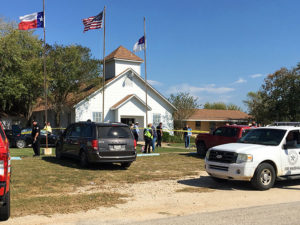
Emergency personnel respond to a fatal mass shooting at First Baptist Church in Sutherland Springs Nov. 5, 2017. (KSAT via AP courtesy of RNS)
Members voted 69-35 on Aug. 22 to demolish the 100-year-old building that had been preserved as a memorial. On Nov. 5, 2017, Devin Kelley methodically walked through the sanctuary killing 25 people, including a pregnant woman, and injuring 20 others before killing himself.
“This decision was loaded down with so much emotion on both sides that we agreed that no more conversation would be had until we voted to see what the future held for the memorial corner, so as not to ruffle anything that would not have had future bearing anyway,” Pastor Frank Pomeroy told Baptist Press Aug. 24. “So, the next conversation will be about when and how to remove the facility.
“Most, if not all, of those that wanted the enclosed facility to stay was for historical purposes of the 100-year-old building. So I have asked them to try and find someone who would disassemble and reassemble (the building) elsewhere for posterity’s sake. At the present time, no one has come forward, but that would be the optimum solution, in my opinion.”
Since 2019, the congregation has worshiped in a new facility funded by the North American Mission Board with gifts made through the Southern Baptist Convention’s Cooperative Program and other donations.
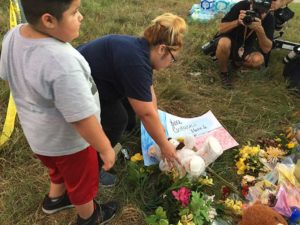
Jennifer Garcia and son Jayden, 6, lay a poster with the words “love conquers hate” at a makeshift shrine in Sutherland Springs. (RNS photo by Yonat Shimron)
The massacre is considered the deadliest mass shooting in Texas history and the deadliest church shooting in the nation. Pomeroy’s 14-year-old daughter Annabelle was among those killed.
Months after the killings, the church preserved the original facility as an enclosed memorial, but Pomeroy long had proposed erecting a memorial garden at the site.
“We as a church have voted to remove the old enclosed memorial facility and replace it with an open air facility that will have 24/7 access. Whereas an appointment was needed previously to go in, now it will be fully open,” Pomeroy said.
“We as a body decided this was the best way to honor the lives that were lost that fateful day and also the survivors that still have to go by the old facility and be reminded of the tragedy. This will give opportunities of worship and prayer at all times to everyone who desires to pay their respects and honor the martyrs of that fateful day.”
While plans remain to be discussed and finalized, Pomeroy said ideas include “a more permanent structure of church ribs with windows holding the old stained glass and benches and QR codes that allow visitors to hear tracks of the deceased and information.”
The tragedy has led to continuing litigation. Among recent court rulings, federal Judge Xavier Rodriguez of the Western District of Texas deemed the federal government was 60 percent responsible for Kelley being able to buy the assault rifle used in the massacre.
Rodriguez said the U.S. Air Force had failed to report to the FBI Kelley’s bad conduct discharge in 2014. Two years earlier, he had been convicted of assaulting his wife and stepson, the Texas Tribune reported. Kelley was able to purchase an assault rifle because his name was not in a database that would have disqualified the purchase, Rodriguez ruled.
Kelley reportedly used a Model 8500 Ruger AR-556 fitted with a 30-round magazine in the attack. In June, the Texas Supreme Court ruled the Academy Sports and Outdoors store that sold Kelley the rifle could not be held liable because Kelley’s name was not in the proper database.
Both the federal and state lawsuits consolidated complaints by several survivors and families of victims. Reportedly, other related lawsuits are outstanding.
Incumbent BGCT president to be nominated for reelection
September 15, 2021
Nederland pastor Jason Burden, incumbent president of the Baptist General Convention of Texas, will be nominated for reelection at Texas Baptists’ annual meeting in Galveston, Nov. 14-16.
Ray Meador, longtime pastor of First Baptist Church in Galveston, announced he will nominate Burden, whom he described as “a man of principle and a man of purpose.”
Jason and Kristi Burden
“He is not only a good pastor and a good leader, but also just a good man—one who has the capability of bringing people together,” said Meador, who is a member at First Baptist Church in Nederland, where Burden is pastor.
‘A man who carries leadership well’
Meador noted he has observed Burden lead through challenging times—several natural disasters in the Nederland area, the COVID-19 pandemic and the birth of twin grandsons who survived a problem pregnancy and were born 16 weeks premature.
“He is a man who carries leadership well,” Meador said, describing his pastor as “unflappable.”
Burden, who marks his 10th anniversary as pastor of First Baptist Church in Nederland this year, said he will allow his nomination for another term as Texas Baptists’ president in large part because he hasn’t had a “normal” year of service.
Between restrictions related to the COVID-19 pandemic and an ice storm in February that forced the cancellation of a BGCT Executive Board meeting, Burden’s time as president has been anything but typical.
Wants to be ‘an ambassador for Texas Baptists’
So, he said, he would welcome another opportunity to “be an ambassador for Texas Baptists,” helping churches across the state feel connected to each other and recognize what can be accomplished when they work together.
“As Texas Baptists, I want to see us direct our energies toward accomplishing some profound things,” he said.
In particular, Burden noted, Texas Baptists working together support institutions of higher education that help produce “the leaders we need tomorrow.”
“Our churches and their pastors should be proud when they send students to our Texas Baptist universities,” he said.
Burden, who grew up in Hico and completed his undergraduate studies at Tarleton State University, earned both his Master of Divinity degree and his Doctor of Ministry degree from a Texas Baptist school—Baylor University’s Truett Theological Seminary.
Prior to his election as BGCT president last year, Burden served two terms as first vice president of the convention.
He also has been moderator of Golden Triangle Baptist Network and served in the same role in Falls Baptist Association when he was pastor at First Baptist Church in Chilton. Previously, he was pastor of Dorcas Wills Memorial Baptist Church in Trinity.
He and his wife Kristi have three children—Hayden, Hallie and Rylie.
Baptists in Texas work together to support global theological education
September 15, 2021
Providing theological education to pastors around the world is one way churches from both Baptist conventions in Texas work together.
Participants in a pastors mission consortium of Global Leadership Development—an initiative of Southwestern Baptist Theological Seminary—appealed to attendees of a steering committee meeting Aug. 19 to consider partnering with a seminary in one of numerous locations around the world to train leaders for Christian ministry.
Among participants in the initiative are churches uniquely or dually aligned with the Baptist General Convention of Texas and/or the Southern Baptists of Texas Convention.
David Mahfouz, pastor of First Baptist Church in Warren, and host of the pastors mission consortium steering committee meeting (Photo Eric Black).
At the beginning of the COVID-19 pandemic, Global Leadership Development counted 325 partner churches known as “Champion Churches.” By Aug. 19, the number of Champion Churches had increased to 354, David Mahfouz, pastor of First Baptist Church in Warren and host of the Pastors Mission Consortium meeting, reported by email.
Not included in that number are member churches of various partnering Baptist associations, such as Golden Triangle Network in Beaumont, he added.
Ira Antoine, director of bivocational ministry for Texas Baptists and bivocational pastor of Minnehulla Baptist Church in Goliad, described how his congregation became a Champion Church.
During initial visits to Tanzania in March and August 2019, Antoine and others saw the need for pastors and ministry leaders there to receive training that in turn would enable them to train more leaders in their country.
The visiting team determined the best way to provide the training needed in Tanzania is to support churches planted by pastors who complete at least a certificate of ministry at the Tanzania Baptist Theological Seminary.
Minnehulla Baptist Church is partnering with Pastor Benson Moses Mwaikuju for one year, providing 50 percent of the resources he needs. The Baptist Convention of Tanzania is providing the remaining 50 percent. One of those resources is a bicycle. In appreciation, Mwaikuju named his bicycle “Texas and Tanzania Church Plant.”
Texas churches can support a church plant for $50 a month, Antoine said, encouraging attendees to connect with the Texas Baptist Missionary Adoption Program.
Steve Branson, pastor of Village Parkway Baptist Church in San Antonio—uniquely aligned with the SBTC—told attendees it took four trips to a restricted country to be able to see what really was needed there. Means of communication is a persistent need, leading Village Parkway to purchase data so Baptist leaders can communicate with one another across the country.
“Every school saw some kind of growth despite the [COVID] lockdown,” Peter Vavrosky, a graduate of Southwestern Seminary and president and director of Trinity Academic, noted. Schools referenced are the 90 seminaries partnering with Global Leadership Development. He attributed at least some of the growth to online resources available to seminaries through a theological education portal provided by Trinity Academic.
In many locations, student enrollment outpaces seminaries’ ability to provide the infrastructure for online learning, Vavrosky explained. Trinity Academic helps these seminaries keep their technology costs low, in part by housing necessary infrastructure—including servers and networks—in the United States, he said.
The theological portal includes a master library through the Alexandria Project, encrypted storage similar to Dropbox, and secure audio and video conferencing. It also facilitates collaboration between Champion Churches and the schools with which they partner.
Lake Arlington Baptist Church—dually aligned with the BGCT and SBTC—began providing financial support for portals in Spain and the Middle East in 2019 and continues to partner with seminaries in both locations, Pastor Eric Herrstrom communicated by email.
“A church plants churches,” and if churches aren’t doing that, then “they’re not functionally a church,” Herrstrom said during the meeting. In one country, seminary students cannot graduate until they have planted two churches, he added.
“Missions is theological education, and theological education is missions,” Mahfouz said.
Seminaries and theological education were “abandoned” when the International Mission Board of the Southern Baptist Convention changed its approach to missions in 1997 in an effort to “eliminate bureaucracy,” Mahfouz asserted.
Global Leadership Development counts 90 related seminaries in all parts of the globe, with an estimated combined enrollment of more than 27,000 students.
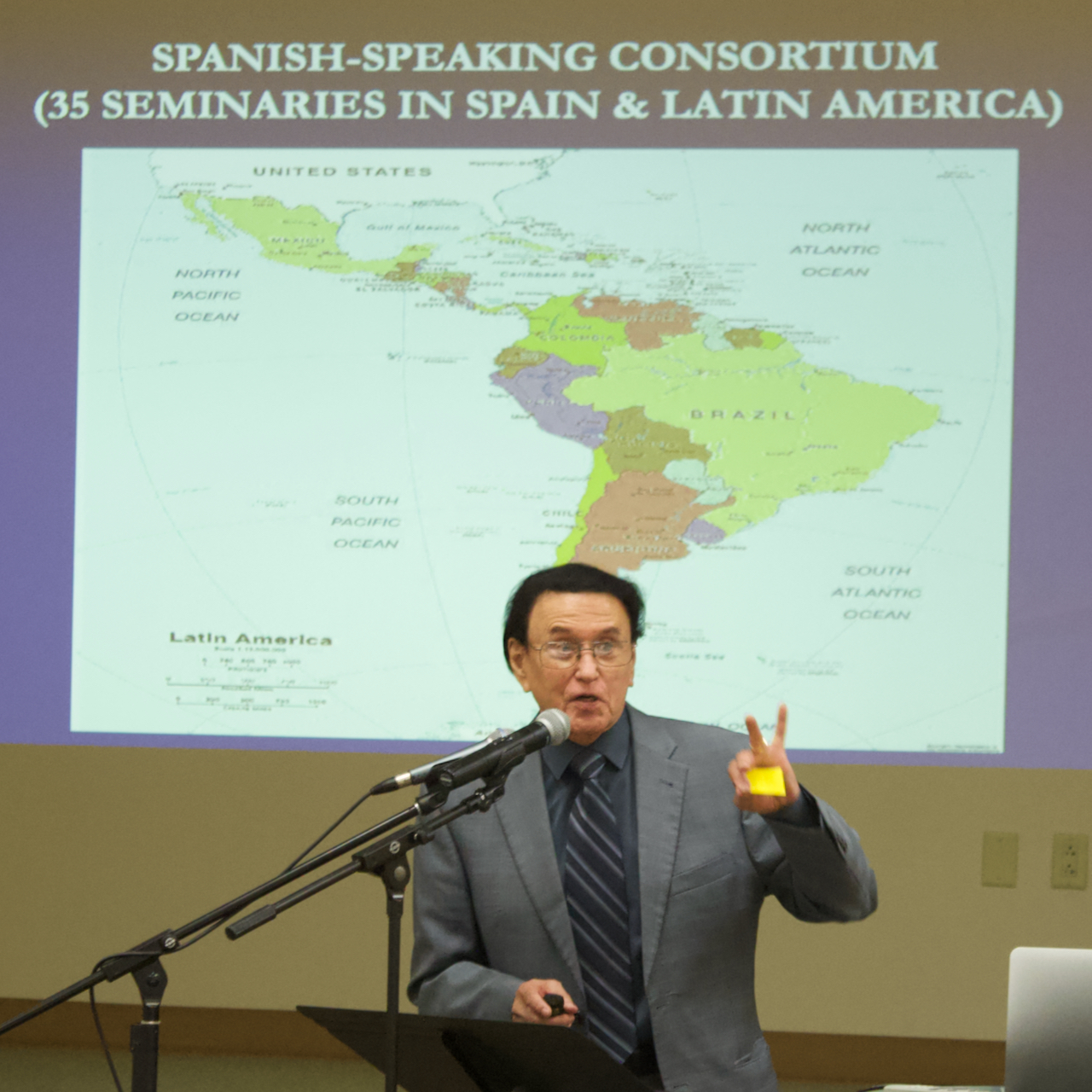
Daniel Sanchez, professor emeritus and ambassador of the World Missions Center at Southwestern Baptist Theological Seminary (Photo Eric Black).
The Global Hispanic Baptist Consortium for Theological Education—the first consortium of Baptist theological schools—formed in 2013 and now includes 35 seminaries from Latin America and Spain.
Seminaries in other regions quickly saw the growth among participants of the consortium and began conversations to form their own consortiums, Daniel Sanchez, distinguished professor emeritus of missions and ambassador of the World Missions Center at Southwestern Seminary, noted.
Possible new consortiums include Portuguese language, Asian Baptist and European Baptist. An African Baptist Theological Network has formed, though it currently does not relate directly to Global Leadership Development.
Global Leadership Development looks for mission-minded churches affiliated with the Southern Baptist Convention and committed to the Cooperative Program and the Lottie Moon Christmas Offering to become Champion Churches.
Champion Churches commit to partner with a seminary for five years. Planning, budgeting, vision trips and discerning the strategic need of a particular seminary occupy the first year of the partnership. Partnerships involve tailored, rather than standardized, agreements.
“For us, this is an extension of our current partnership in Belize, where we have worked to train pastors,” Jim Turnbo, executive director of Golden Triangle Baptist Network, wrote in an email. “In training the Kekchi pastors of Belize, we work with an instructor from the Kekchi seminary in Guatemala. His death from COVID-19 last year impressed on us the need to continually raise up indigenous leaders who train others,” he added.
“The Global Leadership Development partnership allows us an opportunity to serve with greater missional impact. When we send a team and conduct Vacation Bible School, we share the gospel for a week. But when we help solidify the training of indigenous pastors and ministry leaders through the seminaries, we assure the gospel among a people for perpetuity.”