Federal district judge blocks Ten Commandments mandate

A federal district judge in San Antonio blocked implementation of a law mandating the display of a prescribed version of the Ten Commandments in every Texas public school classroom.

(Bigstock Image)

U.S. District Court Judge Fred Biery issued the preliminary injunction Aug. 20 in Rabbi Mara Nathan, et al, v. Alamo Heights Independent School District, et al.

Biery ruled SB 10, due to take effect Sept. 1, violates both the Establishment Clause and the Free Exercise Clause of the First Amendment and “crosses the line from exposure to coercion.”

Texas Attorney General Ken Paxton called the Ten Commandments “a cornerstone of our moral and legal heritage” and “a reminder of the values that guide responsible citizenship.” Paxton said the state will appeal the court’s “flawed decision.”

SB 10—signed into law by Gov. Greg Abbott on June 21—requires a donated poster or framed copy of the Ten Commandments at least 16 by 20 inches to be displayed in every Texas elementary and secondary school classroom.

Law stipulates state-approved language

The state-approved language of the Ten Commandments is an abridged version of Exodus 20:2-17 from the King James Version of the Bible.

Opponents of SB 10—and plaintiffs in Rabbi Nathan v. Alamo Heights—pointed out Jews, Catholics and Protestants number the commandments differently, and their wording varies. So, they asserted, the required language favors the Protestant approach as the state-sanctioned version.

In addition to Alamo Heights ISD, the legal action also names the North East, Lackland, Northside, Austin, Lake Travis, Dripping Springs, Houston, Fort Bend, Cypress Fairbanks and Plano school districts in the San Antonio, Austin, Houston and Dallas metro areas as defendants.

Plaintiffs represent a broad cross-section of families from a variety of religious traditions—including Jewish, Protestant, Hindu and Unitarian Universalist families—as well as atheists and agnostics.

Austin pastor among plaintiffs

James Griffin Martin, pastor of First Baptist Church in Austin, and his wife Abigail are among the plaintiffs, along with Mara Richards Bim, a justice and advocacy resident and candidate for ordination at Royal Lane Baptist Church in Dallas.

In summarizing the Martins’ objections to the mandated display of the Ten Commandments, Biery wrote: “The Martins believe that scripture, including the Ten Commandments, must be taught—especially to children—within the context of a family’s church and particular faith tradition. Learning about and navigating scripture within the context of their faith is critical to ensuring that their children’s understanding of religious texts aligns with the Martins’ Baptist teachings, religious beliefs, and values.”

In presenting the Martins’ position, Biery also stated: “Baptist faith tenets oppose the imposition of religious doctrine in schools and counsel instead that it be taught at church and within the family. Indeed, separation of church and state is a core Baptist principle and one of the Four Fragile Freedoms of the Baptist tradition.”

In his decision, Biery compared SB 10 to a similar Louisiana statute, which was struck down by the Fifth Circuit Court of Appeals as unconstitutional.

“The Texas and Louisiana statutes require the display of the same specific version of the Ten Commandments in public school classrooms,” Biery wrote.

Biery rejected the school districts’ motion to dismiss the plaintiffs’ First Amendment claims. In his decision, he quoted statements by Texas legislators that made clear the religious purpose behind SB 10. He also determined the plaintiffs “sufficiently stated their Establishment Clause and Free Exercise claims.”

Judge offers rationale for blocking SB 10

In granting the preliminary injunction, Biery stated, SB 10 “impermissibly takes sides on theological questions and officially favors Christian denominations over others.”

The classroom displays of the Ten Commandments “are likely to pressure the child-plaintiffs into religious observance, meditation on, veneration, and adoption of the State’s favored religious scripture, and into suppressing expression of their own religious or nonreligious backgrounds and beliefs while at school,” Biery wrote.

The school districts failed to meet the burden of strict scrutiny by demonstrating a “compelling interest” in infringing on a constitutional right and doing so in a “narrowly tailored” manner, he determined.

“There are ways in which students could be taught any relevant history of the Ten Commandments without the state selecting an official version of scripture, approving it in state law, and then displaying it in every classroom on a permanent basis,” Biery wrote.

In conclusion, he added: “Ultimately, in matters of conscience, faith, beliefs and the soul, most people are Garbo-esque. They just want to be left alone, neither proselytized nor ostracized, including what occurs to their children in government-run schools.

“Even though the Ten Commandments would not be affirmatively taught, the captive audience of students likely would have questions, which teachers would feel compelled to answer. That is what they do.”

Plaudits from advocates for church-state separation

Plaintiffs in the case were represented by Americans United for Separation of Church and State, the American Civil Liberties Union, the ACLU of Texas and the Freedom from Religion Foundation.

Lead plaintiff Rabbi Mara Nathan welcomed the ruling, saying, “Children’s religious beliefs should be instilled by parents and faith communities, not politicians and public schools.”

Rachel Laser, president and CEO of Americans United for Separation of Church and State, also applauded the judicial decision.

“Today’s decision will ensure that Texas families—not politicians or public-school officials—get to decide how and when their children engage with religion,” Laser said.

The decision sends “a strong and resounding message across the country that government respects the religious freedom of every student in our public schools,” she added.

Holly Hollman

Holly Hollman, general counsel and associate executive director of the Baptist Joint Committee for Religious Liberty, affirmed the federal court decision.

“This ruling affirms a core constitutional principle: public schools cannot be used by the government to impose religion on children,” Hollman said.

“Faith is most deeply formed in families and religious communities, not by state mandates. Government-imposed displays of sacred texts risk coercing students into religious practice and undermine the religious freedom of every family.

“We urge Texas officials to respect this ruling and the First Amendment’s promise that all children can attend public schools without pressure to adopt a state-endorsed faith. Religious liberty is strongest when the government stays neutral in matters of religion, leaving these sacred choices where they belong; with parents, communities, and individuals.”

Victory for religious freedom protections

John Litzler, public policy director for Texas Baptists’ Christian Life Commission, affirmed the importance of the Ten Commandments—and the importance of protecting the religious freedom of all people.

John Litzler

“We believe the Ten Commandments to be a divine revelation from God to his people, and we strive for all people, including Texas school children, to know and embrace God’s truth. However, today’s ruling echoes many of the same concerns we discussed with legislators as they sought to pass this legislation,” Litzler said.

“Specifically, posting religious texts in public schools, whether from the Christian faith or another religion, can infringe on student’s religious freedoms. SB10 picks winners and losers, even from faith traditions that hold the Ten Commandments sacred, by elevating a particular Protestant version of the text while excluding Jewish and Catholic versions.

“It can be a slippery slope to allow the government to decide which religious teachings from various faiths are required to be displayed in public schools. The court’s ruling is in line with U.S. Supreme Court precedent regarding the Ten Commandments and religious freedom, and it follows a recent opinion from the United States Court of Appeals for the 5th Circuit addressing a law in neighboring Louisiana that is very similar to SB10.”

Paul Brandeis Raushenbush, president and CEO of the Interfaith Alliance, called the ruling “a victory for the Constitution, for Texas families, and for true religious freedom.”

“Public schools should never be used to impose one religious viewpoint on all students,” Raushenbush said.

“By rejecting SB10 as a violation of the First Amendment, the court ensures that public schools remain places where every student belongs, regardless of their and their families’ particular religious belief. And that the home and house of worship be the location for religious instruction, not outsourcing that sacred responsibility to the public school.

“As a pastor, a parent of children in public school, and an American, I applaud the court for defending the constitutional promise of religious freedom for all.”

Charles Foster Johnson

Charles Foster Johnson, founding executive director of Pastors for Texas Children, offered a word to the Texas lawmakers who supported the Ten Commandments displays in public schools

“All this Ten Commandments legislation is about one thing and one thing only: politics,” Johnson said. “It has nothing to do with moral or spiritual uplift. It is an attempt to use the public institutions of our community and neighborhood schools to advance a narrow political agenda.

“If the Texas Legislature worked half as hard on keeping the Ten Commandments as they do on flashing them around for political power, Texas would be a much better state.”

Singing Men of Texas mark 50th anniversary

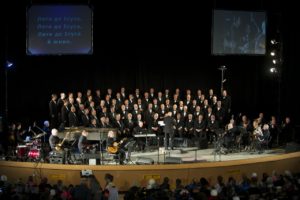
AUSTIN—The Singing Men of Texas celebrated their 50th anniversary Aug. 15 with a concert at Riverbend Centre in Austin.

The concert featured 360 singers and orchestra members, with representatives from all six regional chapters, and welcomed 1,840 attendees.

Musical selections ranged from “I’ll Fly Away,” arranged by Michael Lee, to “How Great Thou Art,” arranged by Dan Forrest.

The Texas Country Boys—a small ensemble originally formed in 2015 for an evangelistic concert tour across Ukraine—provided pre-concert music. The group returned to tour along the eastern border of Ukraine in 2017.

The Texas Country Boys perform at events across the Dallas/Fort Worth area, presenting a variety of musical genres: old-school country, new country, jazz, blues, top 40, gospel, and praise and worship.

50 years of glorifying God through music

Sam Prestidge 200
Sam Prestidge

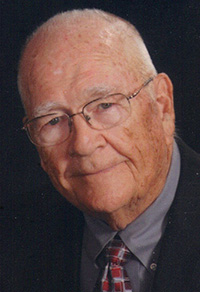
Sam Prestidge, who served the Baptist General Convention of Texas as state music director from 1960 to 1994, established the Singing Men of Texas in 1975.

The Singing Men of Texas exist to glorify God through music, proclaim the gospel of Jesus Christ, and provide an opportunity for Christian growth, inspiration, fellowship and mission service, organizers said.

Tom Tillman, director of music and worship for Texas Baptists, welcomed attendees to the concert. He read a State of Texas resolution from the Texas House of Representatives recognizing the Singing Men of Texas’ anniversary and their “dedication to musical excellence, their commitment to sharing the gospel and their faithful service.”

Tillman recognized special guests who attended the concert: Lisa Prestidge Phillips, daughter of Sam Prestidge, and Jackson Dyer, 2025 Prestidge Endowment Scholarship recipient and Hardin-Simmons University senior.

‘Joy of worshipping together’

Tillman also recognized charter members of the Singing Men of Texas: Robert Bailey, Don Blackley, Larry Caudle, Jim Clayman, Nathan Cook, Ron Davis, Wayne Gadman, Jim Holcomb, Bill Ingram, Jack Jones, Joe Jones, Ed Miller, Larry Shields, Vaughn Tatum, Tim Timmons and Dan Turner.

Turner said “the greatest thing” about the musical group is the community cultivated within it.

“There are many things about Singing Men that changed my ministry that were so effective, and [they] came from other ministers of music,” Turner said.

“The singing was great, but the sharing was especially important, of what other guys were going through and ideas that they had. The greatest thing [about Singing Men of Texas is] the association with all those men. Those that are still here and those that have gone before us have blessed my life immeasurably.”

He said celebrating 50 years of singing with SMOT means celebrating “a lot of memories” and “the joy of worshipping together with men [who are] committed to that.”

History of gospel outreach

Throughout its history, Singing Men of Texas have participated in outreach efforts across Texas and the United States. The group traveled to Australia, Brazil, Canada, Mexico, Eastern and Western Europe, China and Spain, performing concerts tours and conducting personal evangelism in the surrounding communities.

In 2017, the Singing Men of Texas presented concerts in eastern Ukraine, and more than half of the 12,000 who attended made recorded commitments to Christ. (File Photo courtesy of Singing Men of Texas)

In 1982, 82 men across chapters traveled to Brazil for a 14-day tour where they performed concerts in nine cities, kicking off in Salvador at the Brazilian Baptist Convention annual meeting. They recorded a worship album on this trip.

An album was also recorded on a mission trip to Australia in 1985. The North Central chapter recorded their album “Let God Be Praised and Glorified” that same year.

In 2010 and 2012, Singing Men of Texas participated in “four separate evangelistic projects at the invitation of the Ukraine Baptist Union,” where they saw a combined 8,870 faith decisions made.

According to a support raising letter from Tim Studstill, former director of music and worship at Texas Baptists, in May 2012, in each concert the Singing Men of Texas “sang for nearly an hour, and then Texas Evangelist Michael Gott presented a clear gospel message… [and] every person who attended was offered a free CD with music by the Singing Men and a message by Michael Gott, as well as a free Russian/English New Testament.”

According to a November 2012 article, “the evangelistic concert series” that year “recorded 4,305 decisions for Christ.”

“Everywhere we went, the presence of the Holy Spirit, the preached word and the prayers of those back home drew hundreds to Christ,” Studstill wrote. “We were blessed to be vessels of that message and a part of what God is doing in Ukraine.”

In addition to serving on missions around the world, Singing Men of Texas have performed at venues and events such as the Southern Baptist Convention annual meeting, the Morton H. Meyerson Symphony Center in Dallas and Carnegie Hall in New York City.

At the anniversary concert in Austin, the Singing Men of Texas sang original compositions, hymns and contemporary worship songs to celebrate the 50 years of proclaiming Christ through music.

Proceeds from the concert will support the Prestidge Endowment Scholarship Fund, a scholarship awarded annually to a student preparing for full-time music and worship ministry at a Baptist university.


Baylor group takes time before school to help flood victims

WACO—A new semester is on the horizon for college students, faculty and staff across the country, but a group from Baylor University wanted to do something tangible to help others in need before classes start.

Mark Magers, a Baylor University alum, serves with BearAid in San Angelo under the leadership of Texans on Mission. (Photo / Chad Warner / Baylor University)

Four students, 17 faculty and staff members, and one alumnus from Baylor spent a day alongside Texans on Mission volunteers rebuilding homes in flood-devastated San Angelo.

“We care deeply about being able to serve when we can and to help our neighbors in need, and there certainly has been lots of that as a result of the July Fourth storms,” said Molly Simpson, assistant director for service at Baylor and a member of the San Angelo team.

Baylor’s disaster relief group is called BearAid, and they worked in two houses cutting and hanging sheetrock and insulation after being quickly taught what to do by Texans on Mission volunteers.

“They gave us some training at each site and we got to work,” Simpson said.

‘Baylor answered the call to serve’

Sabrina Pinales, director of missions and discipleship with Texans on Mission, worked alongside the BearAid team.

“We are so thankful that Baylor answered the call to serve with Texans on Mission,” she said.

Baylor University student Alyssa Carrol serves with BearAid in San Angelo under the leadership of Texans on Mission. (Photo / Chad Warner / Baylor University)

“Volunteers are essential in rebuilding a community after a disaster,” and the Baylor group has been “a tremendous blessing to families impacted by the recent flooding,” Pinales said.

Sarah Walker, senior coordinator for service at Baylor, said BearAid had already “started to explore what it would look like to partner with Texans on Mission to do some work together this fall” and realized there was “a short window of time before our semester begins that we could take some faculty and staff” to San Angelo.

“We hope this can lead to more opportunities for cooperation … in the upcoming semester and beyond,” Walker said. “We have a really solid group of students who care a lot about other people and want to serve others.

“I’ve been working with the BearAid leadership team to talk through what that could look like to do some future trips with Texans on Mission this fall, such as day trips or weekend trips.”


Mexia church experiences new life after dry season

MEXIA—Earlier this year, there was dirt in the baptistery at First Baptist Church in Mexia. That’s how long it had been since it had been used.

The church had lost about 100 people per decade since the 1990s. It was down to about 115 when Robert Blackmon arrived as pastor last fall. All the ministerial staff had left, as well as the audio/visual team and the praise team.

The search committee chairman was honest about the church’s situation, but Blackmon saw potential.

Robert Blackmon is pastor of First Baptist Church in Mexia.

“I had read a lot about churches in this situation and done a lot of case studies and written about church revitalization,” Blackmon said.

“But the reason I came here was because it seemed like God was giving me an opportunity to put that study into practice and see if God’s word could actually do what I thought it could.”

Over the past few months, God’s movement at First Baptist in Mexia has been no more evident than inside that same baptistery, where a custodian recently spent three hours vacuuming and scrubbing to prepare for what would become 12 successive weeks of baptisms at the newly revived church.

‘We just want somebody to love us’

There were still people in the congregation who remembered the church’s better days, and Blackmon said they did not want to see that completely fade away. At the same time, some expressed to Blackmon that they “kind of felt like God had abandoned them a little bit, or that he had removed the lampstand, if you want to use Revelation language,” he said.

“Preacher,” someone in the congregation told him upon his arrival, “we just want somebody to love us.”

“To have somebody here who was excited about what God could do, it reminded them that even though they’d gone through a dark valley, God hadn’t left them in the process, and he still had a plan for them and they could still make a difference in their community,” Blackmon said.

He started with a commitment to pray, preach the Bible and love God’s people, he said. A monthlong sermon series through Haggai tackled the topic of church revitalization.

The children’s ministry at First Baptist Church in Mexia has grown from around five to more than 30 since last year.

The children’s ministry at First Baptist in Mexia has gone from around five to more than 30 since last year.

“I was really honest about where I thought the church was and what some of [the] issues were and how God’s word could address those things,” Blackmon said.

People who had been hurt by recent conflict in the church needed their new shepherd to listen to them as they processed what had happened, they said. They loved their church and wanted to move forward, but pain was a hindrance at first.

The church began praying together more faithfully, and Blackmon started making a lot of hospital visits.

“People have responded well to that, because they know that I love and care about them,” Blackmon said. “I think they feel God’s love and care through that kind of attention.”

A brighter future

About 200 people now worship at First Baptist in Mexia each Sunday, and the children’s ministry has grown from around five to more than 30. On Easter Sunday, the 350 people who attended marked the largest attendance at any service since the 1990s, the pastor was told.

“To have somebody here who could lay out a plan and say: ‘You’re not the only ones who have ever gone through this, this is really common, even in Southern Baptist churches. And God has turned those churches around, and he can do the same thing here,’” Blackmon said. “That gave them a lot of hope that was lost over the last few years.”

Church members have begun the image repair needed in the community, now spreading excitement about FBC Mexia, as well as sharing the Three Circles evangelism method to spread the name of Jesus. It has become unusual for the church to have a worship service that doesn’t include a baptism.

“We had a young man in his 20s who was coming from a life of sin, and he started coming on Sunday mornings and felt the conviction of the Holy Spirit,” Blackmon said. “He was baptized. I started a discipleship group with young men in the church, and he meets with us every week, goes through a Bible reading plan, keeps a journal, prays with us.”

Giving has increased enough for the church to consider hiring additional staff members.

“I think a lot of people have been faithful here for a very long time and just needed a little bit of direction and vision, but now that they have that, they are the ones jumping in and making ministry happen,” Blackmon said. “My job is really to equip the saints for the work of the ministry, and they are the ones who are out there doing it.”


Richardson marriage ministry delivers community impact

First Baptist Church of Richardson went without a marriage ministry several years. In 2024, Pastor Ronny Marriott decided it was time to make a change.

First Baptist is working in partnership with nonprofit Communio, a ministry that “trains and equips churches to share the gospel through the renewal of healthy relationships, marriages, and the family.”

While at First Baptist Church of Burleson, Marriott had the privilege of working with the nonprofit before and during COVID-19.

Marriott said the partnership with the nonprofit started just before the COVID-19 pandemic in an effort to come up with strategies to meet the needs of the community.

“Their focus is on helping marriages that are in trouble. So. they are really about strengthening marriage in churches and the community,” said Marriott, president of the Baptist General Convention of Texas.

“They have had success doing that in other states. So, we were approached to be a pilot church in our area, and they provided grant money to help us launch this. With direct marketing, they were able to help us pinpoint marriages struggling in our community.”

When COVID-19 hit, Communio assisted the church with meeting digital needs and event hosting for engagement.

“We did virtual date nights. You could sign up and have cooking segments. We had comedians. We couldn’t go out or go to restaurants,” Marriott said.

When the pandemic ended, the church hosted date nights on Wednesday nights and taught line dancing.

Members of First Baptist Church Richardson gathered together for a marriage event. (Photo / FBC Richardson)

“One night, we even did a murder mystery night,” Marriott said.

“So, our goal was to get people on campus to go, ‘OK, these guys can have fun.’ We hit them with a sermon. We did a little bit. Our thing was, ‘Hey, we do this because God loves you, and so do we, and we would love to have you join us for Sunday worship.’”

Marriott hopes that engagement with First Baptist Church Richardson and Communio will assist in decreasing divorce and family violence rates.

A missional church

First Baptist Church of Richardson is more than 160 years old. Marriott said that a church of this age comes with its challenges.

“Churches of that longevity can struggle to become institutionalized and over-programmed. So, trying to move us to be a more mission-minded church,” Marriott said.

Support from Communio helped the church host events like the one during Christmas and Easter events in 2024 and 2025.

“We did a big thing at Christmas. We do a big musical and a snow day for families and kids. We had bounce houses and fake snow,” Marriott said. “Saturday during Easter weekend we had an ‘EGG-stravaganza.’”

The church’s Christmas musical, Carols, attracted 200 more attendees than the previous year due to efforts to distribute a record-breaking 6,000 door hangers, connect with neighbors and build a presence in the community.

After the Easter weekend event, more than 1,000 people showed up, including many who were not church members.

The Communio strategy for the church is to connect with families at least seven times. The same families brought their children to events at First Baptist in Richardson, which led to more families, friends and loved ones showing up.

A couple connecting during a marriage event. (Photo / FBC Richardson)

The relationship building that took place would often lead to attending Sunday morning worship and consideration for membership.

“We just want to get them on our campus. And it gives us a database of prospects, and it gives us a chance to reach out,” Marriott said.

The events serve as an opportunity for the congregation to reach out to guests and invite them to classes on topics related to support for personal matters like finance and familial issues.

“Everything we do, inviting these couples, connects to something else. If they are on campus and they meet our people, they find this is a safe place to be,” Marriott said.

Reflecting on one year in Richardson

Marriott celebrated one year as pastor in Richardson on Aug. 4. At age 60, his years of experience taught him that time and patience is essential when leading a church through change.

“When I was in seminary, they really encouraged you, when you go to a new church, spend the first year building relationships and don’t make any changes,” Marriott said.

“I was at my second church to pastor, and I had a deacon come to me a month in and say: ‘You know, I’m sure they probably told you that you need to ease in, but we’ve been waiting for you for two years. We want you to go.’ So, I changed my philosophy. Take advantage of that honeymoon. Just don’t do anything crazy.”

Marriott did a listening tour with small groups within the congregation to gauge the hopes and dreams of the members. He led by example with a wife who is eager to relate to the members.

“My wife is very extroverted, so we do a lot of stuff as a couple. She’s out greeting people every Sunday just to get to know them, open up our home, that kind of thing. So, we try to build on those relationships as we get down the road,” Marriott added.

As Marriott continued meeting with the congregation, he was asked about the vision of the church.

“When God tells us, we will know that. But let’s discover that together. And I find out by asking a lot of questions: Why do we do this? Is there a better way to do it? And what do we need to stop doing?” Marriott said.


Eastland pastor Kevin Burrow nominee for BGCT president

Kevin Burrow, senior pastor of First Baptist Church in Eastland, will be nominated for president of the Baptist General Convention of Texas at Texas Baptists’ annual meeting, Nov. 16-18 in Abilene.

Shawn Brewer, pastor of First Baptist Church in Paradise, announced his intention to nominate Burrow, praising him as a “man of prayer.”

Burrow is “a Texas Baptist through and through,” said Brewer, who preceded him as pastor at First Baptist in Eastland.

“He has developed a real heart for prayer, particularly corporate prayer. He recognizes prayer is a major need in our churches today,” said Brewer, a regional director for the 6:4 Fellowship. The group, which takes its name from Acts 6:4, is a network of pastors who commit to prayer and the word of God.

Meeting weekly for an hour of prayer

Since January 2024, First Baptist in Eastland has met each Sunday at 7 p.m. to spend an hour in corporate prayer—even on Super Bowl Sunday, Burrow noted.

“It has changed the DNA of our church. … It has become the most important hour of my week,” he said.

Seeing what God has done in his church when it gave priority to prayer, he hopes to share that story with Texas Baptists.

“I know Texas Baptists’ leadership already are people of prayer,” he said. “I’d like to see us do even more to help churches become praying churches and pastors become praying pastors.”

The prayers of God’s people became intensely personal last August, when Burrow’s wife Ashley went into cardiac arrest. Today, she is “alive and well,” he said.

“She endured 90 minutes of CPR,” Burrow said. “There were many of our Texas Baptist people around the state who prayed for her. We walked together through that experience as a family and as a church family.”

As they have gathered to pray, members of First Baptist in Eastland have seen relationships mended, families reconciled and friends receive the salvation Christ offers, Burrow said.

The church prayed for local schools, particularly in regard to an anticipated teacher shortage. The district is beginning the new school year having filled all open faculty positions, he noted.

However, he added, at least half of every prayer gathering is spent in adoration, confession and thanksgiving before requests are voiced to God, Burrow said.

“We are seeking God’s face before seeking God’s hand,” he said.

Alum of Wayland and Truett

Burrow grew up in Tulia and received his undergraduate degree from Wayland Baptist University. He earned both a Master of Divinity degree and a Doctor of Ministry degree from Baylor University’s Truett Theological Seminary.

He was college pastor of Emmanuel Baptist Church in Pullman, Wash., beginning in 2014, until First Baptist Church in Eastland called him as senior pastor in March 2018.

Burrow was vice moderator for Tri-County Baptist Association, and he has served on Texas Baptists’ resolutions committee and the BGCT Committee on Nominations for Boards of Affiliated Ministries.

He and his wife Ashley have four children—Jaxton, Karis, Truett and Colette.

Debbie Potter, incumbent first vice president of the BGCT and children’s pastor at Trinity Baptist Church in San Antonio, already was announced in April as a nominee for Texas Baptists’ president.

Also previously announced are Joseph Adams from First Baptist Church in Hughes Springs as a nominee for first vice president and Ariel Martinez from Del Sol Church in El Pastor as a nominee for second vice president.


Doubter finds way back to faith after deconstruction

Kara Griffis recalled how, as a university student in the late 1990s studying religion and history, she began to experience “contagious doubts” about her faith.

“Up until that time, I had never questioned anything I had been taught in church,” Griffis said. “As I learned more about those topics, for the first time in my life, I had questions I could not answer with a Christianese mantra or Bible verse.

“I began to question if big, confusing and important doctrines were true or just decided by Catholic priests during councils. One question turned into another, and they multiplied quickly.”

She said she grew frightened when she began to question Jesus.

“I remember when I first really started questioning if Jesus really was who he says he was, and I got genuinely afraid,” Griffis said. “I remember in class one time I asked my professor, [who] was talking about what makes somebody an orthodox Christian, and he listed the essential doctrines, and the Trinity was in there.

“And I remember raising my hand and saying, ‘So if you don’t believe in the Trinity, then you’re not a Christian,’ and he stopped and addressed it. … That’s when I got worried about my salvation.”

Griffis said as her doubt snowballed, becoming bigger, she came to a point where she decided, “I can’t believe this anymore.”

‘A long, slow process’ of rebuilding faith

However, she said, “Eventually, after a long and slow process, God restored my faith.”

“Over a really slow amount of time, probably 10 or 15 years, I just reluctantly would take small steps forward. And I mean God was really patient with me, because I would take some steps forward and some steps back,” she said.

“I think that would put up a lot of like kind of walls in me about God, [but] I would surrender a little bit at a time. God restored my faith … and when I started going to the church I’m at right now, I feel like the kind of dominoes started falling into place as far as getting better discipleship and getting [a] better understanding about who God is.”

When Griffis attended the [un]Apologetic Evangelism Conference—an event designed to help individuals strengthen their faith and learn how to engage others with the gospel—it was a “full circle moment” for her, as she was equipped with tools to defend the faith she once doubted.

In February, the conference welcomed Tim Barnett, apologist and speaker with Stand to Reason, and Alisa Childers, an apologist, blogger, speaker and author, who discussed doubt and faith deconstruction.

Griffis said she has been “drawn to apologetics for a few years,” so for about a year, she followed Barnett’s “Red Pen Logic” page on TikTok, where Barnett “applie[s] the red pen” to bad theological thinking. Barnett discussed his book The Deconstruction of Christianity, which he co-wrote with Childers.

“I immediately bought it and read it, and I have passed it along to several friends,” Griffis said.

‘I’m not the only person’

While reading The Deconstruction of Christianity, Griffis said she related to Childers’ testimony of deconstruction. Griffis began following Childers on social media, too, as well as reading her books and listening to her podcast.

“When I [deconstructed], I didn’t call it deconstruction, because it wasn’t a movement. … Everyone I had grown up with was a Christian, and I couldn’t relate to anyone, [and] no one could relate to me,” Griffis said.

“I don’t really know anyone who deconstructed and then came back to historical, biblical Christianity. So Alisa’s story really drew me in in that regard because I don’t know that she ever fully lost her faith, but she started going, I think, in that direction, and then ended up back in truth. So that really made me feel like, ‘Oh, I’m not the only person.’”

So when Childers announced on social media that she would be a keynote speaker at [un]Apologetic Conference alongside Barnett, Griffis registered.

‘Don’t suppress your doubts’

At the conference, Childers presented her testimony, and Barnett followed by teaching attendees how to doubt in a healthy way. He used John the Baptist as an example.

“[Barnett] talked about John the Baptist and how he doubted out loud, and he doubted with others, … [because doubt] snowballs and it kind of gets out of control before anybody is aware of it. So, [he said], ‘Don’t suppress your doubts,’” Griffis said. “[Barnett] said doubts left ignored or unanswered are deadly, and I find that is true for me.”

Griffis said because she didn’t have a solid understanding of “who God is [and] what the gospel is about” before deconstructing. She still struggles with doubt and has “lots of questions,” but her pastor and small-group leader have welcomed those questions. She said that has made a difference in her faith today.

“I will always struggle with understanding some things and having doubts creep in. But I think what’s different is I used to have this almost tortured approach to it, where if I didn’t have an answer for something, I couldn’t move on,” explained Griffis.

“Now. if I don’t have an answer, I still want to answer, but if something doesn’t make sense to me or I can’t really quite wrap my head around it, I think I just have more trust in God that I don’t have to understand it [right away]. … But it doesn’t stop me in my tracks and derail me into a million other doubts and questions.”

Seek answers in a safe place

Griffis said this is partly due to “being able to ask questions to people that I trust” and receive genuine answers.

The second point mentioned at the conference that has impacted her is to “find a safe place with others … and then seek answers.”

“[Childers] listed all these things, ‘What do I know? Truth exists. God is real. The Bible is reliable.’ … and then that Jesus can handle your doubts too,” Griffis said.

At the conference, Barnett encouraged attendees by saying: “[God’s] big enough to handle [doubts and questions]. You don’t have to hide it or stuff it away… [because] doubts are normal, and they actually can be valuable.”

Griffis said she “started doubting [her] doubts” when she found a safe place with her friends.

“I had initially a lot of euphoria about getting out of religion. It felt really freeing, and I’ve never been bitter… It was hard for me to buy into this idea that [God] doesn’t care about anything [and] he doesn’t care about us. … [So,] I kind of started doubting my doubts,” Griffis said.

“Then, I had some friends that would talk to me and try to … gently bring me back in or throw a life jacket out to me … [and] spoke a lot of truth to me, and were really patient about it.”

Restoring faith is ‘God’s work’

Griffis said her friends “didn’t shy away” from her as she expressed doubt and lack of faith, but “treated me like I was still their friend, like there wasn’t anything different.”

She said this taught her that it’s “the work of God” that restores people’s faith.

“Nobody can talk someone back to their faith … because if so, I would have already been back to believing [in Jesus] like two years later or something, but it was really like the work of God in me,” Griffis said.

Her friends were “patient, loving and kind,” she said. They were “gentle and faithful,” modeling a Christlike attitude, “that has been what I’ve seen a lot of the church not do well in my life,” Griffis said. “When I’ve seen it done well, it’s transformational.”

The final point Griffis took from the conference was to seek answers because “the other side of doubt is when you can have a really authentic faith.” She said she has seen this in her own life.

“The other side of doubt is authentic, grounded, rooted faith as opposed to inherited, shallow, regurgitating, platitudes type of religious tradition,” Griffis said.

“I’ve heard people say before that doubts are good for you, but I never had it explained to me [before this conference]. But [by] working through [doubts], you build your own faith. It strengthens your relationship with God, and it helps you make it an authentic thing to you.”

Speak the truth in love

Griffis said learning about apologetics has equipped her with truths that combat unbiblical claims and helped her understand and be rooted in her faith.

“I wish I was that person that could just have big faith without seeing or without [fully understanding], but I’m just not,” she said. “Being able to have grounded truth to understand and to see historically and all this evidence and [the] consistency [of it] is very reaffirming for me.

“It’s nice to have it be something authentically, truly mine, and be able to really believe it, and not halfway believe it and kind of think it’s not true in the back of my mind, but really, truly believe it.”

Griffis said her “spiritual health has accelerated,” and people have noticed.

“It’s interesting because in the last few years, I cannot tell you how many times people have been like, ‘You seem happier.’ The amount of peace and like genuine joy that [I’m experiencing]—it’s obvious to people around me that something is different,” Griffis said.

“Even people who don’t believe the same way as me, they can’t really deny it. There’s no denying it. I’ve had multiple people tell me that, and I’ve said to them, ‘It’s basically just Jesus.”

She encouraged family and friends of someone who is considering or currently deconstructing their faith to speak truth in love and demonstrate the fruit of the Spirit.

 “Never shy away from truth, but always say it with gentleness and love. … [The] work has to be done from God,” Griffis said.

“You’re never going to be able to talk your [loved one] into anything or out of anything, but it’s God’s work to do in them. So, I think our job is to love and speak truth and be the best representative of Jesus that we can … just modeling and being with people, [allowing them] to see that peace that you really have [in Christ].”


Lawmaker calls redistricting exodus an act of faith

(RNS)—Rep. James Talarico, a seminarian who has joined dozens of other Democratic state legislators in leaving Texas to oppose mid-decade redistricting efforts, said he views their protests as an act of faith, reflecting both his personal beliefs and his faith in democracy.

Talarico, a student at Austin Presbyterian Theological Seminary in Texas, discussed the protest in an Aug. 5 webinar Tuesday co-sponsored by the Center for American Progress Action Fund and Interfaith Alliance.

“Democracy is a lot more than just a constitution. It’s a covenant,” he said in speaking against the redistricting plan, which Republicans are pursuing in hopes of helping their party retain control of the U.S. House in the midterms.

“Donald Trump and (Gov.) Greg Abbott and my Republican colleagues back in Texas are attempting to break that sacred promise with every suppressed vote, with every gerrymandered district.”

Rep. James Talarico (right) participates in an Aug. 5 webinar with Guthrie Graves-Fitzsimmons, vice president of the Interfaith Alliance. (Screen capture image)

Talarico spoke to the webinar, which was planned before the protest began, from a nondescript conference room in an Illinois hotel and did not share his exact location due to what he called “security concerns.”

The state representative told Guthrie Graves-Fitzsimmons, a senior fellow of the fund and a vice president of the Interfaith Alliance, he was asked to lead his colleagues in an interfaith prayer before boarding a plane departing Texas to begin their protests.

“We don’t just have Christians in our caucus. We have Jews and Muslims. We have atheists and agnostics,” he said. “But we joined together hand in hand and said a prayer to the power of love and its ability to give us strength and peace and comfort as we embark on this journey on behalf of our constituents and the people of Texas.”

Talarico, the grandson of a Baptist minister in South Texas, said he hopes their prayers will help the protesting lawmakers to withstand reactions from Texas and nationwide.

Governor blasts ‘derelict Democrats’

Att. Gen. Ken Paxton issued a statement Aug. 5 ordering the Democratic legislators to return to the House by the end of the week, saying, “If you don’t show up to work, you get fired.”

Similarly, Abbott posted on social media: “House Democrats fled Texas and their duty to the people who elected them. Hardworking Texans would be fired if they didn’t show up for their jobs. These derelict Democrats should face the same consequences.”

Asked how he would respond to majority Democrat states redistricting to counter the proposed shift in Texas, Talarico said it is a “tricky, strategic and moral question about how blue states should respond to this type of cheating.”

He noted that redistricting typically occurs at the start of each decade to align the population with new Census statistics for fair political representation. Talarico said it is wrong for either Republicans or Democrats to seek to draw district lines that protect their political parties, and he said doing so can negatively affect progress on education, housing and health care.

“But what’s happening in Texas right now is at a whole ’nother level, because they are attempting to redraw those Texas maps in the middle of the decade, because Donald Trump has requested that they give him five more seats in Congress,” Talarico said.

“It’s a little reminiscent of when the president called the Georgia secretary of state and asked him to give him 11,000 votes. Thankfully, Georgia Republicans said, ‘No, sir.’ Texas Republicans said, ‘How about Thursday?’”

Talarico said the “deeply racist” redistricting plan is “breaking apart minority-majority districts,” and would diminish the voting power of people in communities of color.

‘Not a decision we made lightly’

The state GOP legislators’ action prompted their Democratic counterparts to take the unusual action of leaving the state to try to prevent or delay the plans. He likewise said other states’ Democratic leaders may need to take unusual actions of their own.

“My hope is that by threatening retaliation, by maybe even, in some cases, moving forward with retaliation, with blue state power grabs, that that can convince my Texas Republican colleagues and maybe even the president to walk back from the brink,” he said, “not because they feel it’s morally right, but because they’re worried that they’re going to end up losing more seats as a result of this mutually assured destruction. That is my prayer.”

Asked about what acts of faith he is taking while he is out of state, Talarico said he is opening and closing each day in prayer.

“We are facing personal and financial, political and legal consequences, which we knew when we walked into this,” he said, noting that he and his fellow legislators get paid $600 a month and have left behind obligations such as day jobs, young children and aging parents. “It was not a decision we made lightly.”

Talarico added dozens of legislators also are contemplating attending a church’s worship service together on Sunday.

“I think we’re still trying to figure out where that will be and what that will look like,” Talarico said, noting that it could be a logistical challenge for any church that might be selected.

“We don’t want to be a nuisance. But we do want to make sure that we’re engaged in the spiritual aspect of the struggle, because it’s not just a political struggle, it is a spiritual struggle. And we need to shield ourselves and be ready for the fight ahead.”

Talarico has been outspoken in his criticism of Christian nationalism and a recently passed bill mandating the posting of the Ten Commandments in Texas public school classrooms.


Ray Gann mastered mass feeding but found more

WHITESBORO—After 20 years with Texans on Mission’s state mass feeding unit, Ray Gann, 71, has retired as the unit’s leader.

Gann tried again this year to deploy as the unit’s leader—or “blue cap” as on-site leaders are known, setting them apart from the “yellow cap” volunteer workers—but realized he no longer could spare the time away from home.

Gary Finley is the current Blue Cap for the unit, and he said Gann “was around when this unit was transitioning from pots and burners to tilt skillets to become the efficient unit we have today.”

Gann, a member of First Baptist Church in Whitesboro, didn’t want to do mass feeding when state disaster relief leaders first assigned him to the team in 2005.

He recently had returned from working in Mexico after Hurricane Emily and made close friends on that first deployment.

When Hurricane Katrina hit New Orleans in August 2005, “I thought I was going to go … with the same group of people that we went into Mexico with,” Gann said.

Leaders of Texans on Mission—then known as Texas Baptist Men—“looked at me, saw a young guy that was healthy and said, ‘No, you’re going with these guys over here, the state feeding unit.’”

Four hurricanes in one year

In Gann’s first year as a yellow cap volunteer, he served after four hurricanes—Emily, Katrina, Rita and Wilma.

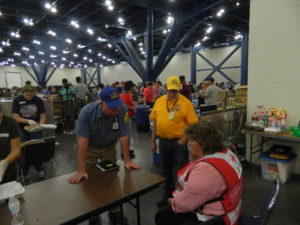
Disaster relief workers (left to right) Travis Maynard, Ray Gann and Albert Fuller discuss the feeding operation in Clear Lake after Hurricane Ike hit Galveston in 2008. Gann said this photo shows a confused yellow cap (himself) with two blue caps, even though Fuller functioned as a yellow cap on this deployment. Gann said Maynard got him involved in disaster relief, and Fuller taught Gann how to do the work. (Texans on Mission Photo)

Eventually, he became a “line chief,” directing the work of a specific component of the unit. Next, he advanced to “chief cook,” overseeing the entire cooking process. About 13 years ago, Gann became the unit’s blue cap.

Gann made his mark early.

“Many of the recipes that are used throughout the nation were developed and perfected by Ray Gann,” Finley said.

Mass feeding is unlike home or restaurant cooking. The Texans on Mission state unit can prepare, cook and package 10,000 meals for lunch and 10,000 more for dinner. That volume involves ordering the needed food in the correct quantity.

It’s done not only with the full quantity in mind, but with the cooking machines and transporting containers in mind, as well.

Do the math

In short, it takes math. And Gann did the math that produced the recipes for mass feeding.

The food cooked by the mass feeding unit is transported to disaster victims and volunteers in insulated containers—Cambros—that keep the food warm and sealed.

Gann used pitchers of water to determine that each Cambro held nine gallons. “And then I began to write recipes about how to fill up a Cambro,” he said.

Ray Gann served as chief cook on the feeding unit in 2008 when Hurricane Dolly hit. (Texans on Mission Photo)

The math work continues in determining how much food to order and how many Cambros will be needed to deliver the needed meals. The math is important, because the process involves lots of food that costs lots of money.

“Twenty thousand meals a day at $3.25 per meal is $65,000 a day,” Gann said.

But mass feeding is more than math.

It takes “35 to 40 really hardy people working to run the whole thing,” Gann said. And working with the yellow caps became the center of Gann’s role as blue cap.

“The worst kind of blue cap in the world is a blue cap who is so involved in the process he doesn’t pay any attention to his people,” Gann said. “He’s worried about production, those numbers, what reports look like.”

‘Being a servant leader’

But as a leader grows spiritually, he looks to the “bigger picture” and sees “God’s involved in people.”

Ray Gann, on-site coordinator for the Texas Baptist Men disaster relief volunteers at Houston’s George R. Brown Convention Center, consults with an American Red Cross official immediately following Hurricane Harvey. (Photo / Ken Camp)

“I started out doing disasters thinking I was going to save the world, you know. I’m going to go cook for all these people,” Gann said.

“But the bigger picture is that God’s working on changing us, and as a blue cap I learned what being a servant leader is because that’s what a blue cap is.

“What we do is make sure that the yellow caps are successful. One of the things that I learned was my ministry was not the meals that I was cooking and sending out. It was the people I was working with. My ministry was my volunteers.”

You can hear Gann’s commitment to yellow caps in the words of his successor as blue cap for the state feeding unit.

“Ray took me under his wing in 2013 because he knew that, as with all of us, this day [retirement] would someday come,” Finley said. “He always tried to help newcomers understand the art of mass feeding.

“He knew that ministry should never be dependent upon one person, so he took every opportunity to share his knowledge with others.

“His encouragement and innovation will be sorely missed.”

Learned to be led by the Holy Spirit

Gann said he understood early that God had called him to serve his kingdom through Texans on Mission.

“By the school of hard knocks, I learned that I had to be led by the Spirit and not by my flesh, that this lifetime is the only time we get to operate in faith. And to the degree we learn to trust God and walk by faith in him has eternal consequences,” he said.

His “life verse” is Hebrews 11:6. It says: “And without faith it is impossible to please God, because anyone who comes to him must believe that he exists and that he rewards those who earnestly seek him” (NIV).

It’s easy to fall into the trap of thinking, “We are all going to go out and cook all this food, and God is going to be pleased with us,” Gann said.

“But you can’t do it in your own strength and energy. You have to operate in faith, and faith in this case is not my faith for salvation. This is the faith to get through the day, faith to trust that he’s going to fix the problem that’s insurmountable.”

In retiring as blue cap, Gann thinks about the future.

“The word of God teaches that one day we will come to face Jesus Christ to be judged for rewards based on what we did by faith in him,” he said. “I believe that at that moment of receiving our reward from Jesus Christ, I will realize, to my regret, that I could have done more for his glory.

“This is what has motivated me over recent years and still does. Now that circumstances of life have caused me to retire from active deployment, … the question of ‘what more’ is God calling me into is on my mind now, and I know that he has more for me.

“This is the challenge that God the Father lays down before all of us. What has he called you to be involved in, and will you answer his call to do more in Christ Jesus, for his glory, because it matters more than we realize here on this side of eternity.”


Late-summer camp offers respite for Hill Country kids

LEAKEY—Kids from Trinity Baptist Church in Kerrville received a much-needed time of fun and rest following last month’s devastating floods in their area.

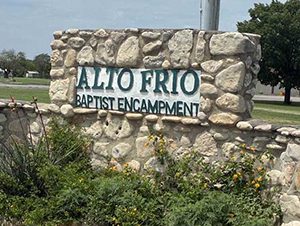
Leaders took a group of third through fifth graders to Alto Frio Baptist Encampment in Leakey on July 21-24—helping these young campers to start taking the first steps towards hope and healing in the aftermath of devastation.

“It was definitely a camp after a crisis, but our church really pulled together to rally around us in prayer,” said children’s minister Kellee Parish.

“The church made prayer cards for the campers, and the counselors received so many encouraging texts throughout the week. Prayer is so vital, and it’s how we are able to keep moving during this time.”

In response to the tragedy at nearby Camp Mystic, organizers of Alto Frio Camp immediately began taking extra precautions to ensure the safety and peace of mind of campers and their families.

Leaders at Alto Frio had already postponed the July 14 start of a youth camp with 500 students to ensure road conditions would allow churches enough time to arrive safely. To help streamline communication, camp organizers also began posting updates on their social media pages to include the condition of the Frio River along with the camp’s emergency response plans.

Opportunity for kids to ‘experience normalcy’

Trinity Baptist Pastor John Wheat said he was confident in the policies and procedures Alto Frio had provided.

“Even during a time of tragedy, there is still a great opportunity to help kids grow in their faith at camp,” Wheat said. “I visited the kids at Alto Frio, and I got to see kids having a blast during worship and trusting the camp experience.

“It was a great opportunity for the kids to learn about trusting God and their leaders. It was exciting as a pastor to see that kids were experiencing normalcy, though there was a tragedy in our community, and that families were able to take a leap of faith and trust the camp experience.”

Parish noted their group only had a couple of visitors who chose not to send their children to camp, but she acknowledged a few other churches dropped out for various reasons.

“Before camp, we had a parent meeting, but surprisingly we didn’t receive a lot of questions from parents,” she said. “Most parents understood that Alto Frio was located on a different river, and we would be taking extra precautions to safeguard the children we were being entrusted with at camp.

‘Good to see kids just being kids’

The church booked its week at camp before knowing a ministry called Xtreme Obedience, which exhibits the obedience skills of dogs, would be there, Parish said.

“It was good timing to have the dogs at the camp because they were almost like therapy dogs and provided a calming presence for the kids,” she said. “It brought a sense of normalcy to camp and helped the kids to have a chance to get away and get back to some normalcy. It was good to see kids laugh and have fun once again. … It was so good to see kids just being kids.”

Although there was a thunderstorm during camp that made some of the campers a little nervous, Parish said in the Lord’s timing and provision, having Xtreme Obedience and its dogs at the campsite reminded them God was in control even during the storms of life.

“I’m so grateful that parents allowed their kids to go to camp,” Parish said. “As a leader, it can be a daunting task taking kids to camp after a crisis, but it definitely makes you more aware of your surroundings and the kids you have been entrusted with.”

‘Supernatural place of safety, comfort and peace’

Keith Smith, pastor of South Sub Church in Littleton, Colo., was the camp speaker and also saw first-hand how the campers and counselors were benefiting from being at camp.

“I went into the week praying for the kids and leaders since they had experienced so much tragedy and trauma from the flood.” Smith said. “I was also aware of what that some of the kids had experienced because of the trauma from school shooting in Uvalde in May 2022. That’s a lot of trauma for kids so young.

“A personal prayer that I wrote in my own journal was, ‘Would you send your Spirit to descend on the camp? Make it a supernatural place of safety, comfort and peace.’”

The camp theme was “GLOW”—an acronym for grace, love, obedience and worship, taken from Ephesians 5:8.

“Throughout the week I never sensed anything different than any of the other 18 years I had preached at the camp,” Smith said. “It was like God did indeed create a safe place for the kids. One night there was rolling thunder and some lightning throughout the night. The next morning the kids seemed as if nothing had transpired.

“The adult leaders are the heroes. They gave up their physical and emotional energy when they probably had very little left by the end of the week.”

Although their time at Alto Frio helped provide a week of relief for the campers, Parish acknowledged that it is a long road ahead for Kerrville.

“We are in this for the long haul,” she said. “Our community is now out of the media and the limelight, but our community is still dealing with the devasting effects of this tragedy. Many people are dealing with PTSD. … This camp provided an opportunity for kids to just be kids and begin to return to a sense of normalcy, but we definitely covet your prayers.”


Hill Country churches mobilize to minister after flood

Texas Baptists churches in the Hill Country continue mobilizing members to aid in relief and recovery efforts after the flooding of the Guadalupe River.

Using their mission center as a headquarters for their response efforts, First Baptist Church in Marble Falls has led in flood recovery for Burnet and Llano counties, mobilizing a network of local pastoral teams to act as chaplains as volunteers serve families and offer counseling services.

‘Deeply invested in the community’

Tucker Edwards, family discipleship pastor at First Baptist in Marble Falls, said each morning, volunteers come to the mission center to receive training for the mud-out process, as well as emotional and spiritual training to offer support while serving families.

Five days after the flood, the church hosted a community-wide night of prayer and worship with more than 300 in attendance.

“We had a lot of our congregation and people that I’d never seen before fill up a lot of our worship space and our staff put together a full hour of prayer and worship,” Edwards said.

“We set up our entire counseling team to be [in the] back [of the worship center] and there were people that were counseled throughout [the evening].”

“We’re deeply invested in the community, and the community is deeply invested in us, and so our heart is to always respond not only with the immediate needs, … but we realize that the greatest need, even beyond that, is the ministry of presence and to be with the people and to show them the love of God in the midst of the tragedy and heartache that they’re going through,” Edwards said.

‘Readily available to just love on people’

Alamo Heights Baptist Church in San Antonio opened its building on the mornings of July 7 and 8 to provide counseling for the community. Alamo Heights and Northside Independent School District counselors provided services, as well as the Alamo Heights Fire and Police Critical Incident Stress Management team.

“It’s a team effort, knowing that this would just be kind of an immediate response, but it would also provide an opportunity to build relationships,” said Bobby Contreras, pastor of Alamo Heights.

Contreras said providing counseling was “the best way that we knew how to respond immediately” as he started receiving text messages from community members who were affected by the flooding of the Guadalupe River.

“We knew we weren’t going to be a part of the immediate search efforts, but our goal has always been to, whether it’s on campus or within our home here in the Alamo Heights community, that we just want to be readily available to just love on people … [and in this case] to be in communication and connecting with people that we knew who were in that area, affected,” Contreras said.

Helping with search and rescue efforts

First Baptist Church in Boerne responded by mobilizing members to aid in search and rescue efforts in Center Point with the volunteer fire department, setting up a volunteer portal.

“We started telling people how we could help. We mobilized about 250 people Sunday to go out to the river banks and aid in the search and recovery efforts,” said Chad Mason, missions and evangelism pastor at First Baptist in Boerne.

“At the end of [the day], they said that they had received an overwhelming number of volunteers … somewhere between 1,500 and 2,000.”

Even after military resources became available and local authorities “asked for no more volunteers,” Mason said, the calls still poured in from other churches and organizations from around the country wanting to volunteer.

“So, we’ve been working really hard to try to build a coalition of churches here in Kendall County that are responding,” he said.

“A lot of the conversations right now are [surrounding] training and developing the right people so that as volunteer opportunities emerge in the coming weeks, we’ll be prepared to meet and to work in the long-term recovery effort.”

‘Opportunity to give grace to others’

First Baptist Church in Center Point partnered with the volunteer fire department by volunteering with the volunteer fire department’s donation center.

Pastor Mike Watson said he and his church members helped unload, organize and distribute donated supplies to families in need. Supplies include toiletries, canned goods, gasoline, tools and even “unusual donations” such as ropes requested by the fire department, he said.

As his church stepped up to volunteer in relief efforts, Watson said his eyes were opened to how compassionate his congregation really is.

“We’re a small church, but I found out through this [that] we’re a compassionate church, and I think sometimes hard things happen so that we know just how compassionate we are,” Watson said. “It’s an opportunity to give grace to others … [and it] speaks [to] people who will go out of their way to help total strangers.”

Open doors to share the gospel

Matt Travis, pastor of Comfort Baptist Church in Comfort, said, “God is using [our church] in a support role.”

While helping coordinate incoming support for relief efforts, the church hosted “a church from San Antonio that set up in our parking lot to just provide barbecue” for the community, Travis said. The church also hosted a food truck “from another state in order to serve breakfast each day.”

Comfort Baptist supported people financially by providing Visa gift cards to those who don’t want to disclose specific needs. The church also raised funds to provide scholarships for people needing equipment rental for area cleanup.

Those ministries “open[ed] the door for us to be able to share the gospel with people,” Travis said.

“Baptists all over have been very faithful. Our phone has been ringing off the hook with people saying: ‘We want to help. How can we help? What is the best way for us to help?’” Travis said. “So, we are very thankful for Texas Baptists, and Baptists from all over the U.S., who have stepped in to help.”

Texas Baptists Counseling Services Director Olga Harris said she is “looking for ways to lock arms with our local churches to provide grief support” for those affected.

Harris’ department offers counseling resources for Texas Baptists ministers and their families. Services include no-cost consultations and referrals, and financial assistance based on certain criteria is available.

To initiate a request, visit txb.org/counseling or contact Olga Harris at counselingservices@texasbaptists.org.


WMU serves Brownsville with back-to-school block party

BROWNSVILLE—Woman’s Missionary Union of Texas, in partnership with Send Relief, a collaboration between the International Mission Board and the North American Mission Board, and Texans on Mission, hosted a weekend-long Serve Brownsville back-to-school block party.

Several families with children received backpacks, school supplies, hygiene kits provided by Texans on Mission, and nearly 900 new pairs of shoes donated by Buckner International.

The goal was to give away 4,000 backpacks and school supply kits including pencils, pens, composition notebooks, binders and folders, according to Texas WMU officials.

Texas WMU and the ministry partners responded to the need in Brownsville, where the poverty rate of 24.9 percent is more than double the national average.

Brownsville Independent School District has an enrollment of more than 37,000 students, and volunteers planned to serve at least 10 percent of students in need.

More than 25 volunteers assisted in handing out backpacks and supplies, sharing mental and physical health resources and ministering to children and families with words of encouragement, bracelets and fun activities.

Serving along the border

Vanessa Lerma and her husband, Osvaldo, serve along the U.S./Mexico border with Send Relief as missionaries. Together, they work in the ministry center in Laredo and spent months coordinating the block party in Brownsville.

With the assistance of Texas WMU, Send Relief, Texans on Mission and partner churches in the area, Lerma and Osvaldo worked to ensure each family was provided backpacks, school supplies, shoes, and a gospel message—that Jesus loves them.

“Being along the border, life, in some families, is transitional,” Vanessa said. “There is … insecurity as it relates to the needs of the family and supplying for them. It is always something of concern for the family in how to supply for their children. Our heart is to meet those needs and see how the Lord impacts their lives and transforms their lives.

“As we are ministering and loving and being the hands and feet of Jesus and doing that through back to school, it is a way to do ministry and be able to reach the community for Christ.”

Her husband added: “I think prayer and the church’s desire to reach out to the community to know that the answer is in the gospel, and we have that treasure.

“The idea is to help those who do not have the necessary school supplies. The statistics show that more than 75 percent of students are economically disadvantaged.”

Teri Ussery, Texas WMU adult/young adult missional lifestyle strategist, said it took teamwork to put together the event.

“Our first connection was to partner with Vanessa, and we kind of started the ball rolling,” Ussery said.

“Osvaldo brought Send Relief and Texans on Mission joined the cause to see what they could do down here. So, we really came together as a team and prayed about what kind of ministry God wanted us to do down here.”

Volunteers also included students from Baylor University’s Louise Herrington School of Nursing.

Nursing the neighborhood

Arabella Hernandez, a nursing student at Baylor set to graduate in 2026, decided to spend a weekend volunteering in her hometown with Texas WMU.

The block party at Primera Iglesia Bautista Mexicana was an opportunity for Hernandez to prepare for her post-graduate dream—to give back to her community.

On Saturday, the team of volunteers met to host another block party for back-to-school at Iglesia Bautista Horeb.

“I’m from the valley, so once I graduate, I’m planning on staying in the valley. And my end goal is … go to med-surg (medical surgery) for a year, and then after that, I’ll try and do hospice,” Hernandez said.

The distance learning program allows Hernandez to stay home and help her community once she graduates. Participating with Texas WMU gave Hernandez a chance to meet parents and children whom she hopes to serve in other ways in the future.

“The reason why I want to stay is to give back to my community. A lot of people leave for school from here and don’t come back. I think it is important to keep people from our area here, because they understand the community best, and they understand the hardships the community faces,” Hernandez said, adding that the community is in great need.

“There are not enough nurses, not enough doctors and a lot of patients. All of the hospitals here are underserved. On top of that, with the recent immigration issues that we are having, there are also a lot of patients who are scared to get care in the first place, because they are afraid it will lead to their deportation.”

Felicity Adjetey, a Baylor nursing student graduating next spring, participated in the back-to-school party to offer support to those affected by current immigration issues.

“Something was calling for me to come and help out and bring good to the community. It has been great. We have volunteered and made donations and helped with community health—just trying to spread good information,” Adjetey said.

Looking up and looking out for those needing Jesus

Ryan Welch, Texans on Mission’s missions and discipleship coordinator, led the morning devotion for the volunteers’ rally. Welch preached from Luke 19 about Jesus meeting Zacchaeus, the chief tax collector and focused on the moment Jesus looked up and insisted Zacchaeus come down and stay at his place.

“Today, we will have opportunities to serve the gospel. But sometimes it takes us pausing and looking up at others,” Welch said. “And notice Zacchaeus was seeking Jesus. Today, there will be people that are seeking Jesus. But we have to stop and look up.”

Months beforehand, Welch met with Texas WMU, Send Relief, and local pastors to coordinate the back-to-school block party.

“We helped provide hygiene kits that will go into the backpacks and they are hygiene kits for kids,” Welch said.

“We also helped with a couple of the block party stations that include our bracelets. We have these gospel bracelets … so children will be able to create some for themselves. We also have our messages of hope where kids can create or draw a picture on packing paper.”

The packing paper is “used after disasters and given to families in need who are packing belongings.”

Welch added disaster relief after the recent Hill Country floods are an example of what Texans on Mission is about, and the partnership with Texas WMU to serve Brownsville is part of their mission.

“When there is a need, and we can respond, we say yes,” Welch said.