Authors discover connection between gender and race
February 21, 2022
WACO—The authors of a pair of bestselling books on gender and evangelicals told a conference on racial healing they discovered how much their subject matter intersects with racial justice issues.
Kristen Du Mez, author of Jesus and John Wayne: How White Evangelicals Corrupted a Faith and Fractured a Nation, and Beth Allison Barr, author of The Making of Biblical Womanhood: How the Subjugation of Women became Gospel Truth, addressed an online audience and an in-person conference at Baylor University’s Truett Theological Seminary.
“I thought I was writing a book about gender but soon realized I was writing about race,” Du Mez, a historian at Calvin College, told participants at a conference titled, “Do we want to be healed? Racism in the White Church.”
‘Gender is always connected to race’
As a graduate student, Du Mez recalled being told repeatedly, “Gender is always connected to race.” At the time, she questioned whether it was true, but not any longer.
Before she began the research that led to her book, Du Mez accepted evangelicals’ self-definition as Christians who hold to the Bebbington Quadrilateral—a commitment to biblical authority, the necessity of conversion, the centrality of the cross and an activist approach toward evangelism.
“A majority of Black Christian pastors could check all those boxes but do not identify as evangelicals,” she said.
As she continued her research, she concluded a series of networks—often centered more on social and cultural issues rather than theology—distinguish the boundaries of evangelicalism.
In working on Jesus and John Wayne, Du Mez examined books on Christian masculinity. While they seldom directly addressed race, the heroes they held up as worthy of emulation were all white men—often men who demonstrated their strength by subduing nonwhite populations.
“Race is not always visible, except it is if you’re not white,” she said.
In those rare instances where racial issues were discussed—such as in the Promise Keepers movement—leaders emphasized racial reconciliation and mutual forgiveness, not racial justice, she noted. Leaders of the movement defined racism in personal terms but did not address its systemic and institutional dimensions, she observed.
She also realized marketers recognize the culture of evangelicalism as overwhelmingly white.
“When we look at how markets are imagined, evangelicals are imagined as white,” she said.
‘White is not normative’
Barr likewise grew to realize African American Christians and white evangelicals who each claim allegiance to biblical authority have not placed equal emphasis on the same passages of Scripture.
“The ways we use the Bible are different, and they say more about culture than the Bible,” she said. “We choose small portions of the Bible to focus on.”
Barr, a historian at Baylor University, understood the rise of fundamentalism and later evangelicalism were “historically hard to separate” both from opposition to the women’s suffrage movement and from support for Jim Crow laws that oppressed Black Americans.
As she conducted her own research on how evangelicals often interpreted Scripture in ways that led to the subjugation of women, she said, “I had to acknowledge that my experience is not the same as a Black woman’s.”
“Race is always a factor, and white is not normative,” Barr said. “When we talk about our experience, we have to be careful about making it normative.”
‘Leaving safe space’
Barr and Du Mez expected their books to trigger debate and controversy.
“Anybody who talks about race is leaving safe space,” Du Mez acknowledged.
However, both were surprised at the level of vitriol and personal attacks—often from professing Christians—on social media.
“It’s shocking that Christians can treat other Christians like that,” Barr said.
Neither Barr nor Du Mez holds out much hope for wholesale changes in denominations. However, they have been encouraged by the reaction of individual readers in white evangelical churches, including congregations aligned with the Presbyterian Churches in America and the Southern Baptist Convention.
Still, when it comes to talking about race, “even convening a conversation [about racism]… takes an act of courage these days,” Du Mez said.
Racial healing requires dismantling oppressive systems
February 21, 2022
WACO—Healing racist systems within the church requires everyone—oppressed and oppressors alike—to recognize they are wounded by racism, a speaker told a hybrid conference offered online and at Baylor University’s Truett Theological Seminary.
Catherine Meeks, executive director of The Absalom Jones Episcopal Center for Racial Healing, remotely delivered the keynote address on the opening day of the conference, “Do you want to be healed? Racism in the White Church.” (Photo by Ken Camp)
“Racism has wounded every soul in this country in one way or another,” said Catherine Meeks, executive director of The Absalom Jones Episcopal Center for Racial Healing.
From Atlanta, Ga., Meeks remotely delivered the keynote address on the opening day of the conference, “Do you want to be healed? Racism in the White Church.”
Short-term interracial projects, one-shot seminars and occasional pulpit exchanges cannot cure what ails American churches, she insisted.
“That is an illusion,” Meeks said. Instead, Christians must “destabilize the systems that marginalize, denigrate and dehumanize people,” she said. “Replace it with something that looks more like what God has in mind.”
The COVID-19 pandemic has offered busy American Christians the rare opportunity to “stand still” and practice introspection, examining the “systems and narratives we have constructed,” Meeks said.
“Racism is like a chronic illness that has to be dealt with every day, every minute,” she added.
‘Find a brave space’
Becoming vulnerable, asking hard questions and discussing sensitive subjects with a person of another race demands courage, she acknowledged.
“Let’s get out of our safe space boxes. Let’s find a brave space where the truth can be told,” she urged.
Responsibility for dismantling oppressive systems begins with white Christians because their forebears created them and maintained them to protect the privilege they enjoyed, she asserted. Tinkering around the edges is not enough, she added.
“It can’t be cleaned up. It has to be healed,” she said.
Greg Garrett, professor of English at Baylor and program organizer, emphasized the same point in explaining why a conference on racism specifically focused on the white church.
“White people created this system, and only white people can dismantle it,” he said.
Sean Palmer, teaching pastor at Ecclesia Community in Houston and author of Unarmed Empire: In Search of Beloved Community, likewise described the pernicious effects of racism.
“Racism always leads to injustice, cover-ups and murder,” he said.
‘Everyday experience’ of Black Americans
Palmer used a personal experience to illustrate how African Americans face suspicion and live with a fear unfamiliar to white Americans.
Palmer recalled an occasion in February 2020 when his home security alarm sounded in the night. He was awakened by a phone call from the security company, who were checking to see if it was a real emergency.
Because he was sound asleep, Palmer was unable to answer the phone before the security company representative hung up. After he determined there was no home intruder, he tried unsuccessfully to call the company. So, he knew the police would arrive at his home soon.
“This was a few weeks after Atatiana Jefferson was killed in her home by police,” he recalled.
When the police came to Palmer’s front door, he answered it and identified himself, making sure the officer could see he was not holding a gun. At the officer’s request, he presented a photo ID.
At that point, the police officer asked him, “Are there any warrants for your arrest?”
Palmer assured the officer he was the homeowner, not a lawbreaker. At that point, his wife—who is white—entered the room. Looking past Palmer, the officer asked the woman, “Ma’am, are you all right?”
Once the policeman was satisfied Palmer’s wife was not in danger, he told her she could go back to bed, but he continued to question Palmer.
After receiving reassurance by radio there were no outstanding warrants for Palmer’s arrest, the officer finally returned his driver’s license, telling him before leaving, “You know, I could cite you for having an unregistered alarm.”
“That is the everyday experience of men and women of color in America,” Palmer said.
‘Lay down rights … become the other’
He cited research by social psychologist Jonathan Haidt, author of The Righteous Mind: Why Good People are Divided by Politics and Religion. Political and religious liberals tend to make moral judgments on the basis of fairness and whether harm occurs, according to Haidt. Conservatives—both political and religious—tend to view moral issues through the lenses of respecting authority, maintaining purity and protecting the in-group, he asserted.
Christians can bridge differences by exercising their “charity muscle” by learning to speak in love and play well with others, Palmer insisted. That means surrendering status and identifying with the marginalized, he explained.
“Healing and redemption come when people lay down their rights, privileges and positions and become the other,” he said.
The Feb. 17-19 conference—jointly sponsored by Baylor University’s Truett Theological Seminary, The Absalom Jones Episcopal Center for Racial Healing and the Public Religion Research Institute—is the first of three planned over the next three years, made possible in part by a grant from the Eula Mae and John Baugh Foundation.
Cliff Temple helps connect community to its history
February 21, 2022
When a racial justice coalition that grew out of Cliff Temple Baptist Church in Dallas discussed tangible ways to build bridges in its community, members decided to help their neighbors connect to past generations.
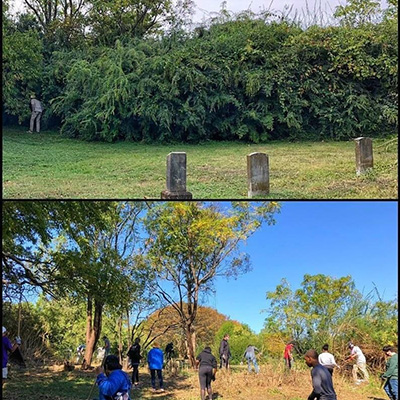
Before-and-after photos show the 30-foot hedge volunteers removed from Oak Cliff Cemetery. The hedgerow had separated the white section of the cemetery from the African American section. (Photo courtesy of Trevor Jamieson)
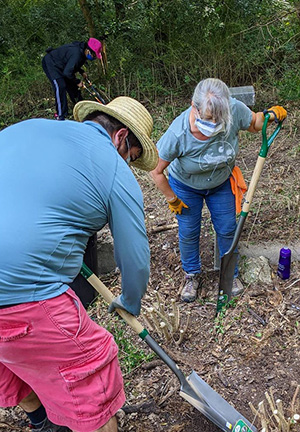
Volunteers from Cliff Temple worked with the Tenth Street Residential Association and others to clear away brush and bramble from overgrown graves in the long-neglected Black section of the segregated Oak Cliff Cemetery.
Members of Cliff Temple were instrumental in forming the Oak Cliff Justice Coalition as a direct result of the racial reckoning that followed the killing of George Floyd, Ahmaud Arbery and Breonna Taylor in 2020.
Cliff Temple’s teaching pastor and minister to young adults, Trevor Jamieson, invited church member Larry Johnson to join a Zoom meeting of the coalition to talk about the history and significance of the Tenth Street neighborhood in Oak Cliff.
Historically significant area
Johnson explained the Tenth Street neighborhood developed as a Freedman’s Town settled by formerly enslaved African Americans in the 19th century. At one time, it was home to Black doctors, lawyers and teachers.
“If you look at it now, it’s a place that’s a symbol of Black flight and redlining,” Johnson said in a later interview. African Americans left parts of the city where they were not welcome to purchase homes in the neighborhood, which now is almost exclusively African American and Hispanic.
Volunteers digged out weeds and invasive plants that had covered the Black section of Oak Cliff Cemetery. (Courtesy Photo)
When Interstate 35 was built in the mid-20th century, dozens of houses in the historic area were bulldozed, and a 2010 ordinance that allowed the city to demolish neglected historic structures smaller than 3,000 square feet led to more home demolitions.
Working with the Tenth Street Historic District and the Tenth Street Residential Association, Johnson became involved in efforts to preserve the neighborhood’s historic character. Among the area’s notable features is Oak Cliff Cemetery, believed to be the oldest public cemetery in Dallas County.
In his presentation to the Oak Cliff Justice Coalition, Johnson noted the crepe myrtles that bloom in the fairly well-maintained white section of the segregated cemetery, while the African-American section was overgrown with invasive privet and weeds.
During the Zoom call with the coalition, a member of Cliff Temple—Stan Granberry, who works with Texas Baptists’ GC2 Press—asked what kind of hands-on project could be completed to help Johnson’s efforts in the Tenth Street neighborhood.
“I threw out the crazy idea of cemetery work,” said Kenny Cheshier, executive pastor at Cliff Temple. “It took on a life of its own.”
Johnson, Jamieson, Cheshier and other members of Cliff Temple led in organizing a series of Saturday workdays at the cemetery.
‘Memorial to Black resiliency’
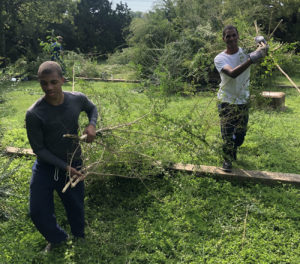
Volunteers cleared brush from the overgrown Black section of Oak Cliff Cemetery. (Courtesy Photo)
“We put it out on social media,” Jamieson said. He noted an ethnically and politically diverse group of volunteers from throughout the community joined members of Cliff Temple in working each Saturday for several months at the cemetery, eager to help restore a “memorial to Black resiliency.”
Johnson noted the Black section of the cemetery is unusually hilly, and that seems reflective of Black history in the United States.
“The terrain is typical of the African American experience in this country—rocky, full of hills to climb and difficult at times,” Johnson said.
When the volunteers began working last year, at least 90 percent of the headstones in the Black section of the cemetery were covered and inaccessible, Johnson said.
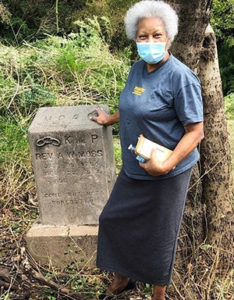
Granberry noted one of the previously obscured graves belonged to A.W. Moss, a former pastor of Griggs Chapel Missionary Baptist Church east of Fair Park in Dallas. Others belonged to relatives of Tenth Street Neighborhood residents who haven’t been able to visit the gravesites in decades.
‘Righting a wrong that was due to neglect’
One of the previously obscured graves in the Black section of Oak Cliff Cemetery belonged to A.W. Moss, a former pastor of Griggs Chapel Missionary Baptist Church east of Fair Park in Dallas. (Courtesy Photo)
“We were righting a wrong that was due to neglect,” Johnson said.
Next, Johnson hopes to secure donated gravel from the Texas Department of Transportation to pave a dirt road into the Black section of the cemetery and restore the grade on the cemetery’s perimeter to prevent further erosion and possible disruption of burial sites.
In the long term, Johnson dreams of seeing Tenth Street become a destination site for people interested in Black history.
“We’d like to give not only the city of Dallas, but also the state of Texas and all of the United States a preserved Freedman’s Town—an African American district comparable to Colonial Williamsburg,” he said.
“There’s a growing curiosity about African American history, but up until now, it’s a story that either has not been told or that has been under-told.”
In the meantime, Cliff Temple looks forward to continuing to work with Johnson on community projects in the Tenth Street neighborhood, Cheshier said.
“It’s been an incredible journey,” he said. “And there’s more to come.”
Fort Stockton couple sees God’s hand in infertility and adoption
February 21, 2022
FORT STOCKTON—When Warren Camp calls his wife Rachel “a planner,” she giggles and nods, admitting she always has appreciated structure and order.
Yet neither would have planned the roller coaster ride they’ve been on since they married in September 2009. At times fraught with pain and anger, at times with pure joy, the ride has been nothing like Rachel envisioned years ago, due to infertility.
The U.S. Department of Health and Human Services defines infertility as the inability to conceive a child after one year. At least 12 percent of couples have trouble getting pregnant, with many factors contributing to the difficulty.
“We had talked about adopting even before we got married,” said Warren, pastor of First Baptist Church in Fort Stockton. “Our plan was that we’d have biological children, and then we would adopt after we got that practice set. That was our thought.”
Diagnosis prompts treatments for infertility
The Camps met as freshmen at Wayland Baptist University, dated for four years and earned their degrees together in May 2009. They married a few months later in September and moved to the Dallas-Fort Worth area for his seminary studies. Rachel worked as a teacher. A few years later, they began wanting to start their family. But after several months, nothing was happening.
“We went in to get testing done and found out I had polycystic ovary syndrome, which many times causes no ovulation,” Rachel explained. “Our infertility treatment story lasted about two years from then.”
The next two years were an emotionally and physically difficult time, with specialists putting Rachel on oral medication and shots given in her stomach, regular blood pregnancy tests and more.
Besides the personal toll, the couple’s financial limits were stretched. Finally, in the summer of 2013, it all came to a halt while the couple was in Colorado for Warren to teach a camp.
“That week at camp, I needed to take a pregnancy test, and it was negative. I was just done. I didn’t want to do it anymore. That month was our last one,” she recalled.
God’s plan led the couple to adopt
The couple resumed their earlier conversations about adoption. The Camps reached out to friends who had adopted and asked many questions about the process. But it took some heart work as well.
“The Lord really started to bring adoption back up to our hearts. We’ve watched people younger than us walk through infertility and just be so hopeless and devastated. They think if I can’t get pregnant then this is the end of everything. I had to keep myself from walking down that path because I am a woman and I should be able to bear children,” Rachel acknowledged.
“There were some times I would let my mind go to those places, but the Lord would say: ‘Stop. I know better, and I have a plan.’
“What started going through my mind was that God’s plans are better than my dreams. It was my dream to get to see what a child between us would look like, and I had to give that to the Lord.”
Warren had to prepare mentally for the next steps as well.
“I was growing a lot and learning a lot in that season while in seminary, and it was a lot of pouring from my own heart,” he said.
“So that was a good forum for me to just say: ‘That’s not where your value comes from. I love you regardless of those things. God brought us together, and we’re doing what he called us to do. So, let’s keep doing that.’”
Saying ‘yes’ to adopting a baby
In November 2013, the Camps first called the Life Tree Agency in Dallas and spoke to the director, Robin. They were open to babies of any ethnicity, and Robin told them a baby was coming in February if they were interested. Since they hadn’t even filed an application, Rachel admitted they didn’t think much about it.
The couple set out on a fundraising campaign, selling T-shirts and asking friends to pray. They drove to Dallas in January 2014 to turn in their first application, and Robin mentioned again the baby was coming soon. She needed an answer in just a few days.
Rachel and Warren Camp meet their son Hudson Scheley.
“At the agency, people turn in booklets for the people to look through, and they had been looking through all of the families and hadn’t had a peace about any of them. Most people we talked to told us it might be a year. So, we expected we were at the beginning of a long journey,” Warren recalled.
“I think we knew our answer, but we just needed a little more prodding from people who could say, ‘I’ve been there, and it’s going to be OK.’ We were affirmed by two different men in two different places that day.”
The couple fasted and prayed separately and then agreed: they would say yes to this baby. The next few weeks were a furious race to paint and furnish a nursery, purchase a car seat and skim quickly through parenting books.
On Feb. 12, Rachel got a call at her school. The birth mother was in labor, and the couple should head to Dallas. Hudson Scheley Camp was born around 9:20 p.m., and their first meeting was magical.
“We were just sitting in the waiting room, and we looked out the window and this nurse is holding a baby. We ran out there and she said, ‘Here’s your son.’ We just stared at him and cried,” Rachel recalled.
“We didn’t have to part from him after that. The birth parents kissed him, told him they loved him and said they were done. I’m excited to tell Hudson that they did care about him. I want our kids to know that their birth parents loved them enough to give them life.”
‘Adoption paints such a picture of the gospel’
Two days later, after waiting the required 48 hours by Texas law for birth parents to sign away their rights, the Camps took their baby boy home. Six months later, a court hearing made it official.
“It’s so cool how adoption paints such a picture of the gospel. People have their own biological children, and they can place them at any time. But we would be in big trouble if we tried to place our children, because they have become legally ours, and we have pledged to love them the rest of our lives,” Warren explained. “It’s a picture of God giving up his flesh and blood to secure people for himself.”
Two years later, the Camps thought they’d try fertility treatments again, now seeing a doctor in Amarillo near their home in Panhandle. Though assured they would find success, three rounds of a more invasive and costly procedure had the same impact—negative pregnancy tests. They headed back to Life Tree in February 2016 with another application.
Quickly matched with a birth mother, they thought lightning might strike twice. But the mom changed her mind after delivering. While disappointed, the Camps said the agency had seen red flags, and they had a peace about the situation.
When the Camps’ adoptive daughter Adeline Rae was born, Rachel shared a hospital room with the birth mother, bonding with the newborn.
In July, another phone call came inviting them to meet a birth mother, who chose the couple quickly and asked Rachel to be in the operating room for her C-section. On Sept. 2, they were in the hospital prepping to meet their little girl.
A kind nurse invited Warren to join them, so the couple witnessed Adeline Rae come into the world that day. The next 48 hours, Rachel shared a hospital room with the birth mother, holding the baby skin-to-skin and just talking to her. After the waiting period was up, the Camps—now a family of four—came home.
And in February 2020, the Camps brought home a third child, a son named Owen William, also a quick process. The Camps are quick to point out that every adoption story is different, and their biggest blessing has been to point out God’s goodness and grace through this entire process.
“You were made for God and his glory, to be satisfied in him and to glorify him and enjoy him forever, as the Westminster catechism says. Those things help us remember that’s what life is for,” Warren said.
“Even now, this story gives us the opportunity not to selfishly lean in and just say we have our family, but this is for God’s story and God’s glory, and it’s about what he’s doing in the world.”
The pain the couple endured has been worth it in the end, Rachel added.
“Being on this side of it and looking back, the Lord so knew what he was doing—obviously,” she said. “This has only been the Lord. We haven’t done any of this because we’re good people. We serve a really big God, and we’re trying to be obedient to him.”
And in a few months, Rachel will deliver a biological child to add to their growing family.
Sutherland Springs shooting survivors awarded $230 million
February 21, 2022
SAN ANTONIO (BP)—A federal district judge ordered the U.S. government to pay more than $230 million to survivors of the 2017 mass shooting of 26 worshipers at First Baptist Church of Sutherland Springs.
U.S. District Judge Xavier Rodriguez of the Western District of Texas awarded the damages Feb. 7 to survivors and heirs of survivors of the Nov. 5, 2017, church shooting, months after determining that the U.S. government was 60 percent liable for the massacre.
Rodriguez levied blame in a July 2021 ruling that the U.S. Air Force had failed to report to the FBI shooter Devin Kelley’s bad conduct discharge in 2014. Two years earlier, Kelley had been convicted of assaulting his wife and stepson. Kelley was able to purchase the rifle used in the shooting because his name was not in a database that would have disqualified the purchase, Rodriguez said in the ruling last year. Rodriguez deemed Kelley 40 percent responsible for the crime.
Rodriguez awarded the 55 plaintiffs individual damages in the ruling, some as high as $10 million or more, according to court documents.
First Baptist Church of Sutherland Springs Senior Pastor Frank Pomeroy, who lost a daughter in the attack, has chosen not to comment on the court case out of respect for the victims. Pomeroy is not listed among plaintiffs.
Nation’s deadliest church shooting
Kelley shot himself in the head after a police chase after he had methodically walked through the church indiscriminately shooting people. It is considered the deadliest mass shooting in Texas history and the deadliest church shooting in the nation.
Kelley reportedly used a Model 8500 Ruger AR-556 fitted with a 30-round magazine in the attack. In June 2021, the Texas Supreme Court ruled that the Academy Sports and Outdoors store that sold Kelley the rifle could not be held liable because Kelley’s name was not in the proper database.
Today, the church worships in a new facility dedicated in 2019. The North American Mission Board funded the construction with financial gifts received and partnerships with dozens of companies that donated $1.5 million in materials and services to the project.
First Sutherland Springs voted in August 2021 to demolish the church building where the shooting occurred, replacing the site with an open-air memorial to the victims. Pomeroy long proposed a memorial garden at the site.
Mixed bag of youth organizations in Baptist churches
February 21, 2022
A few years ago, Jocelyn Whalen wanted to involve her adolescent son and daughter in youth organizations reflecting her family’s values.
American Heritage Girls claims 52,000 girls and adult members in all 50 states. (American Heritage Girls Facebook Page)
From a homeschooling group, she learned about American Heritage Girls and Trail Life USA—organizations formed to provide explicitly Christian alternatives to the Girl Scouts and Boy Scouts, which are faith-based but nonsectarian.
Whalen became a leader in the American Heritage Girls troop at Calvary Hills Baptist Church in San Antonio, where her family worships.
“American Heritage Girls is founded on Christ and on Christian values,” Whalen said. “It’s aligned with our beliefs. … At a time when there are competing voices talking into girls’ lives, it offers Christian influence.”
American Heritage Girls claims 52,000 girls and adult members in all 50 states, and Trail Life reports 36,000 members in more than 850 troops around the country.
No monopoly for denominational missions programs
Many of the troops have found homes in conservative nondenominational congregations. They also are making inroads into some Baptist congregations—territory once occupied primarily by missions-oriented Royal Ambassadors and Challengers programs for boys and Girls in Action and Acteens programs for young women.
Calvary Hills Baptist Church formerly offered GA and RA programs but discontinued them when it was unable to enlist enough leaders to sustain them, said Sharrich Scott, missions leader at the church.
American Heritage Girls—and later Trail Life—became an effective outreach into the community as it attracted children and parents beyond Calvary Hills’ membership, Scott said.
Those parents have been willing to take leadership roles in the organization, and their children have developed leadership skills, she added.
“I have seen them grow,” she said, pointing to the willingness of students not only to volunteer, but also lead service projects such as food drives. “They are learning how to be leaders.”
‘A safe place to learn and grow’
A group of parents in suburban Cincinnati, Ohio, founded American Heritage Girls in 1995 when they became dissatisfied with Girl Scouts. Just prior to that point, the Girl Scout National Council voted to interpret the “serve God” pledge in the Girl Scout Promise broadly enough to accommodate girls from families who identify as “spiritual but not religious.”
Trail Life USA formed in 2013 after the Boy Scouts of America changed its membership policy to allow openly gay leaders and youth of any sexual orientation. Trail Life bills itself as “the largest Christ-centered, boy-focused, scout-type organization in the country.”
Like Boy Scouts and Girl Scouts, both American Heritage Girls and Trail Life focus on character development and leadership in a troop setting. Youth earn badges and work their way through rank advancement.
“It’s a safe space to learn and grow,” Whalen said, specifically describing her daughter’s experience with American Heritage Girls. “Girls can discover their talents and passions, learning from their mistakes.”
Flexibility key to thriving missions programs
Leaders of age-level missions organizations such as RAs and GAs are quick to note those programs not only offer many of the same components, but also provide a strong emphasis on missions education and missions action.
Savion Lee, a Rice University graduate who grew up in First Baptist Church of Wichita Falls, credits Royal Ambassadors with opening his heart and mind to God’s calling on his life. (TBM Photo)
Neither Texas Baptist Men nor Woman’s Missionary Union of Texas track the specific number of churches with RA, Challenger, GA or Acteen chapters, and total membership figures for the age-level missions organizations are not readily available.
However, the TBM-sponsored annual Missions Mania event offers one measure of church involvement in RAs and Challengers. At best, participation was flat in the five years prior to the COVID-19 pandemic. TBM reports 43 churches participated in 2015 and 2016. Participation dipped to 33 in 2017 and 2018 before rebounding somewhat in 2019 with 37 churches at the event.
Even so, the RA and Challenger programs remain strong in some congregations—not only small rural churches, but also larger congregations such as First Baptist Church in Midland and First Baptist Church in Allen, said John Hall, TBM communications director.
The common denominator among thriving programs is flexibility, he noted.
“Across the state, leaders with Royal Ambassadors and Challengers groups are seeing where the young people in their community are and are engaging them with the gospel,” Hall said.
“Sometimes that means going hiking or camping. Other times, it means having pizza together each week. The methods vary. But whatever the approach, boys and young men are learning how they have a role to play in God’s kingdom and are living out that calling.”
Willing to adapt and try innovative approaches
GA and Acteens leaders generally point to similar trends—loyal support in some congregations, but generally, the programs have plateaued or declined.
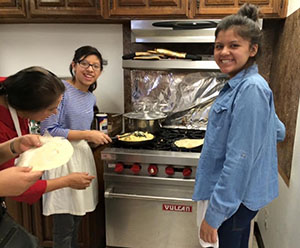
Acteens from Freeman Heights Baptist Church in Garland cook lunch at church to raise funds for a mission trip. (Courtesy Photo)
However, age-level missions organizations continue to thrive in some churches—particularly those that have been willing to adapt and try innovative approaches.
Freeman Heights Baptist Church in Garland continues to offer flourishing age-level missions programs and to raise up new leaders both for its own congregation and for Christian service in general.
In the past two and a half decades, Freeman Heights has produced eight National Acteens Panelists and three state-level Acteens Panelists.
“We don’t have a lot of resources. We’re a very blue-collar church,” said longtime GA and Acteens leader Mary Lou Sinclair.
If the church lacks financial resources, it makes up the difference in creativity and flexibility.
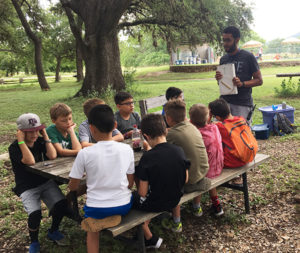
The church’s GA and RA programs meet each week on Wednesday evening for 45 minutes to an hour while parents are involved in a time of prayer and Bible study.
‘We meet them where they are’
Acteens, on the other hand, meet every other week for two to three hours at varied times—sometimes Friday, sometimes Saturday and other times Sunday, depending on school-related commitments and extracurricular activities. Sinclair contacts the Acteens through social media, and they reach a consensus on a day and time to meet that fits their busy schedules.
Acteens from Freeman Heights Baptist Church in Garland lead a summer program at The ROC. (Courtesy Photo)
“There’s really not a time each week, other than Sunday morning, when we have the whole family together at church,” Sinclair said. “It’s still OK for GAs to meet each week on Wednesday, but that doesn’t work with teenagers. We work with their schedules.”
The teenagers enjoy having a longer time together—sharing a meal, working together on a mission project, building relationships and learning about their part in God’s mission together, she noted.
“We meet them where they are,” she said.
Acteens at Freeman Heights engage in missions action through a variety of projects at The ROC—The Re-Creation Outreach Center—in West Garland.
Freeman Heights launched the community center, which now also receives support from several other area churches under the umbrella of Metro Family Ministries. The ROC offers varied after-school programs for children and youth, a pregnancy center, a food pantry, clothes closet and the monthly Neighborhood Table free community dinner.
Acteens are involved in various ministries at The ROC throughout the school year, as well as working as volunteers in summer programs offered there.
Provide opportunities to assume leadership
Marisol Sandoval grew up in the GA and Acteens programs at Freeman Heights, achieving Top Teen status with national WMU her senior year in high school. Sandoval now is an office manager and administration assistant at Texas WMU. She also serves as an adult leader with Acteens at her home church after learning firsthand how age-level missions programs can change lives.
Marisol Sandoval of Freeman Heights Baptist Church in Garland is a former Top Teen who grew up as a member of Mary Lou Sinclair’s Acteens. Sandoval now serves alongside her mentor as an Acteens leader. (Video screen shot by Pam Henderson)
“I came to know Jesus through GA camp,” she said. “And as a GA camper, I saw the Acteens on staff and said to myself, ‘I want to be like that.’
“Mary Lou made it a priority to take Acteens to any and every WMU event possible. She helped us learn, ‘You are a part of something bigger.’”
Sinclair gave Sandoval opportunities to begin accepting leadership roles early, and she continues to work collaboratively with her now.
“It’s what Mary Lou has done for a lot of us. She sees what we can be and helps nurture that, giving us a loving push and encouraging us,” Sandoval said.
Instead of “aging out” of Acteens, young women at Freeman Heights have become involved in age-level missions programs as leaders—either at their home church or elsewhere, she noted.
Sandoval considers Sinclair her “friend and mentor,” and she wants to invest in the lives of young Acteens the way Sinclair invested in hers.
“We build relationships by taking them out to eat or to visit at a coffee shop. It’s the relationships that keep them coming,” Sandoval said.
Both Sinclair and Sandoval emphasized the need for adult leaders to be flexible and be willing to devote the necessary time to developing deep relationships with the Acteens.
“You have to be creative,” Sinclair said. “Be willing to step out of the box.”
Piloting a community missions group model
One outside-the-box approach some Texas Baptists are taking to engage children in missions education is a community missions group model—an approach piloted in Tarrant Baptist Association.
“Our Tarrant team has been exploring the future and looking at avenues for creativity and newly opened doors for ministry,” said Derinda Williams, associational GA/Children in Action consultant.
While it continues to encourage churches to start age-level missions programs, Tarrant Baptist Association also is “developing community missions groups that will reach kids inside and outside the church as God makes it effective in the hearts of his kids,” Williams said.
The Mansfield/South Arlington community mission discipleship group launched in 2019 with leaders drawn from several area churches and a goal of developing a “Christ-centered missional presence in a community that isn’t attached to a specific congregation.”
Williams and her team selected missions curriculum, established a calendar of weekly meetings during the school year, planned monthly missions projects in the community and provided a camp in the summer.
The COVID-19 pandemic forced the associational GA community group to transition last year from in-person meetings to online weekly gatherings, drive-through projects and a virtual summer day camp that featured daily Bible lessons, a craft project and fun activities.
Mansfield/South Arlington community mission discipleship group hopes to involve children from their area in a missions camp in July.
“We actually grew when we were online,” Williams said, noting in-person meetings resumed last fall. “We kept every girl involved.”
Williams believes the community missions groups also could work for Royal Ambassadors and Acteens. She particularly sees the community-based groups as an option for smaller congregations that may not have enough adult leaders to operate programs on their own but could collaborate with sister churches.
As an associational consultant, Williams noted some church leaders want to incorporate missions projects and missions education into existing programs for children and students in the congregations.
She applauds the desire to make missions a component of other church programs. However, rather than try to tack a missions lesson or missions project onto other programs, she tries to help churches find ways to adapt age-level missions resources in creative ways.
“Why not use the curriculum and programs with missions as their focus that already exist?” she asked.
Frugé named director of Center for Cultural Engagement
February 21, 2022
DALLAS—Katie Frugé has been named director of Texas Baptists’ Center for Cultural Engagement and the Christian Life Commission.
Frugé began her service with the Baptist General Convention of Texas in 2019 as the hunger and human care specialist with the CLC. She later took on the role of associate director of the CLC.
“Dr. David Hardage [executive director of the BGCT] and I are grateful to add Dr. Katie Frugé to our Texas Baptists leadership team, and we know she will do a wonderful job guiding the Center for Cultural Engagement and the Christian Life Commission into the next phase of its rich and storied history,” said Craig Christina, associate executive director.
Frugé received her undergraduate degree from Union University in Jackson, Tenn., and she earned her Master of Divinity degree and a Ph.D. in systematic theology from Southwestern Baptist Theological Seminary in Fort Worth. Her doctorate focused on the image of God, which she believes is foundational to a holistic understanding of advocacy for human dignity and worth.
As the parent of special needs children, Frugé also assisted in the formation of the Fort Worth Special Education Parent Teacher Association.
‘Bring the secular toward the sacred’
In her new role, Frugé will oversee all of the Center for Cultural Engagement’s ministries, including the CLC, African American ministries, Texas Baptists en Español, intercultural ministries and chaplaincy relations.
“The Center for Cultural Engagement helps equip Texas Baptists to engage in our respective communities. God calls us to be salt and light. We help bring others into community with God’s people through building bridges between groups, seeking justice, healing brokenness, confronting systemic evils and speaking truth to power,” Frugé said.
“We do this to bring the secular toward the sacred. I’m honored to help serve God’s kingdom and Texas Baptists in this capacity and look to the future with great joy and anticipation.”
Frugé’s Texas Baptists roots run deep as her grandfather, T.W. Hunt, taught at Southwestern Baptist Theological Seminary from 1963 to 1987.
She and her husband, D.L., have lived in Fort Worth more than a decade. They have three daughters, two of whom have special needs. Their experiences with disabilities have been a key reason for her family’s work in educational, health and social advocacy.
Frugé will assume the role from Gus Reyes, who is retiring from the BGCT after serving 21 years. Reyes served in a variety of roles during his time at the BGCT, including serving as the director of congregational relationships, the Hispanic Education Initiative, affinity ministries and the CLC.
He has presented a paper at the United Nations in New York on religious freedom, testified before Senate committees in Austin and Washington, D.C., and been invited to attend briefings at the White House under the Obama and Trump administrations.
Reyes will continue to serve in a contract capacity with Texas Baptists, helping executive leadership continue to reach the Hispanic community.
CEDAR HILL—In his first 18 months as senior pastor at First Baptist Church in Cedar Hill, Josh Prince has baptized a 13-year-old, a man in his 80s and all ages in between.
It marks the beginning of the manifestation of the congregation’s goal to reach all ages with the gospel message.
Prince came to the church in August 2020, in the midst of stringent COVID-19 restrictions and uncertainties about the days ahead. It was his first experience as a senior pastor, and he and the church staff wanted to see the church build on a solid foundation. They focused on preaching the gospel, giving the congregation the confidence to share the gospel, and praying regularly and passionately.
“We wanted to care for the people here, solidify relationships, and really help them dream again as a church and be excited about the work of God. But then we also wanted to give them lots of opportunities to really start reaching Cedar Hill,” Prince explained.
Connecting with young families
Volunteers photograph costumed children at a fall festival at First Baptist Church in Cedar Hill. The church has emphasized connecting with young families in the community. (Courtesy Photo)
The church has emphasized connecting with young families in the community. In the past year, members have been encouraged to see a 10-year-old and a 14-year-old accept Christ and be baptized at the church.
In addition to this work, First Baptist also is emphasizing internal healing and growth.
“As focused as we are on those efforts and reaching our community, there is still important revitalization work on the people within the church, some of whom have been here for 30 or 40 years,” Prince said.
One of the first significant conversations Prince had as the new pastor was with a man in his 80s. The man had been in the church for decades but had struggled with confidence in his salvation. He wondered if he had only been baptized because it was what everyone else in the church had done. He felt inadequate and unworthy of true salvation.
Prince sat down with him and talked through the gospel, answering his questions and ultimately showing him that, even though all men are unworthy, God still loves them and has provided a way for eternal life. He accepted Christ as his Lord and Savior and was, for the first time, completely confident in his salvation.
That man’s baptism was the first Prince carried out at First Baptist in Cedar Hill. The gentleman was one of three adult members Prince was able to counsel and lead through baptism in 2021.
Consultant helped connect the dots
With the goal of strengthening the church and engaging the community in mind, Prince connected with Jonathan Smith, Texas Baptists’ director of church health strategy, in fall 2021. Together, they talked through Prince’s goals for his congregation and looked at models of similar churches.
“He connected all those dots that are big necessities in the church, and we looked at other models of churches and ways to connect them to what we were doing,” Prince explained.
Smith saw Prince as well-equipped to lead a church in a growing community that also is growing in diversity.
“He has the heart to reach everyone, young and old, and the heart to reach all of the beautiful and various ethnicities that are moving into Cedar Hill,” Smith said. “As an equipper, I can teach pastors many things, but I can’t give them a heart to reach the community. Only God can do that.”
Prince sees the recent baptism of adults, including several senior adults, as a clear sign of the work of the Holy Spirit and a strong indication of the great things that are to come for Cedar Hill.
Now, the church staff is working with Smith to develop a clear vision for the church that they can communicate easily with the congregation and the community.
“I want to see us become a diverse church—generationally and ethnically, especially given the extreme diversity in Cedar Hill. We want to see everyone represented within the church,” Prince said. “It’s cool to celebrate the diversity of age, and that’s something we’ve really been blessed with and want to continue to expand on.”
Perryton couple follows God’s call to small African nation
February 21, 2022
Stan and Angie Burleson have made many moves throughout their marriage. But their relocation to Lesotho—a small nation in southern Africa—has been one of the most challenging yet rewarding in their life together.
The Burlesons are missionary church planters supported by First Baptist Church in Perryton. They work in Lesotho’s Matsoku Valley and surrounding areas with a home base in Katse.
Long and winding road
Their journey to the mission field was long and winding, with challenges along the way. Yet both attest that God’s hand prepared the way.
Stan and Angie Burleson have made many moves throughout their marriage. But their relocation to Lesotho—a small nation in southern Africa—has been one of the most challenging yet rewarding in their life together. (Courtesy Photo)
Stan and Angie met in sixth grade in Perryton and dated in high school there before both arriving at Wayland Baptist University as an engaged couple.
They married after their freshman year at Wayland and lived in married housing while completing their degrees—hers in education and his in music. As students, she worked in the campus daycare center, and he worked in the university store.
After graduating in 1992, Angie taught in Plainview. Stan continued working at the campus bookstore a year after he graduated and then went to work for Family Christian Stores. As he worked his way up the corporate ladder, the couple moved to Michigan. Then everything changed.
“God told us to go back to Texas, right back to where Stan started,” Angie said, recalling their move back to Lubbock. “I think that was a huge part of the plan that God had for us to get us on the mission field.”
Stan served as a part-time music minister at a church while working with Family Christian Stores. In time, he left the retail business to become an elementary music teacher and then entered full-time music ministry in Ozona. While there, Angie was invited to attend a mission trip to Belarus with a longtime friend.
“It changed me and changed my whole outlook on life. I came back and said, ‘Stan, you really need to go with me next year,’” she recalled.
‘We knew God was calling us to missions’
“Stan went back with me that next year, just before we moved to Seminole, where he would serve as the music minister. He came back changed from that mission trip also, and we knew God was calling us to missions.”
When visiting missionaries shared at Seminole, Angie bombarded them with questions, prompting the visitors to sense the Burlesons’ call to missions. But the path wasn’t really clear yet. Soon, Stan felt called to return home to First Baptist Church in Perryton as music and missions pastor.
“God obviously knew what he was doing. In his sovereignty, he put Lesotho in front of our church and us within a few months of us getting to Perryton,” Stan recalled.
“We had Mission Aviation Fellowship missionaries come to share with us, and they invited anyone who wanted to come visit them. Two high school girls really felt led to go there. So, the next summer in 2009, the church took its first mission trip there.”
On that trip, Stan met Jim and Teresa Flora, Southern Baptist missionaries in Lesotho. Over the next eight years, the church sent more than 20 teams to the African nation, with Stan attending two to four trips each year. The church agreed to adopt a valley to focus their work, selecting the Matsoku Valley on a vision trip.
“I was nervous, casting this vision that God put upon my heart. I stood in this valley and just looked at the huge mountains and villages, some you could see and some you couldn’t see, and wondered how this little church in the corner of the Texas Panhandle could do this,” Stan recalled. “But like everything, it wasn’t about us doing it. God would do it. We just had to be obedient.”
Making the move to Lesotho
After years of trips to Lesotho, the Burlesons finally decided it was time to make the move. Their two daughters were out of high school, and the church agreed to be their sending partner. They raised additional support quickly and arrived in Africa in early December 2016, just in time to help complete the last six months of a national feeding program that supported 750 families during a historic drought.
While earlier mission trips to Lesotho enabled the Burlesons to become accustomed to the country and meet people there, full-time missionary life was an adjustment.
“I did not grow up around agriculture at all. So, it’s crazy to see how God has taken us to a place where we literally are watching for goats and sheep and cattle and oxcarts and shepherds, just like in biblical times. And there is dirt everywhere,” Stan said.
“We have never been huge outdoor people, but now we climb up and down mountains and down trails and streams, and we ride horses.”
The Burlesons love the Basotho people and spread the gospel in creative ways through building relationships. But their work is not without challenges. While the Basotho are open to the gospel generally, they are heavily entrenched in ancestral worship and African traditions such as the sangoma, or witch doctors.
Many people in the Matsoku Valley are subsistence farmers, growing primarily corn and raising sheep for wool and mohair for the clothing industry. The HIV epidemic left many children in the care of single parents or grandparents. School is provided through grade seven for free, but additional schooling costs more than many families can afford.
‘Mobile moms’ ministry
Angie runs a “mobile mom” program in which Christian women check in on orphans at least once a week to ensure they are healthy, well-fed, clothed and have adequate shelter. They report special needs to Angie for possible solutions.
They focus on new clothing at Christmas, as well as providing blankets and sleeping mats for the orphans, and about 250 are served throughout their ministry area.
The moms also meet monthly for Bible study, an educational lesson, health lesson, and to learn a new Bible story they can teach the children.
“We are trying to work ourselves out of a job essentially. We’re trying to train disciple-makers, using the four-fields process of planting, developing, harvesting and reproducing,” Stan said.
“We’re trying to set them up for a lifetime of Bible study. We have Bibles available for them, and they want to learn.
“Our biggest message to other believers is that being obedient and available is the most important thing in our walk with Christ. When God calls, we must surrender ourselves and say, ‘Yes.’”
CommonCall: Invest in eternity; support foster families
February 21, 2022
Stephanie Baskin understands foster parents need the support of a loving community.
Stephanie and Buck Baskin of Mesquite have fostered 17 children since 2011. Two of those foster children—Niki and James—became part of their forever family through adoption. The Baskns have one biological child, Selah. (Photo by Lupe Zapata)
She wants her church—and other congregations—to provide wraparound care for those who open their homes and hearts to children in the foster care system.
She and her husband Buck have fostered 17 children since 2011, working through Buckner Foster Care and Adoption. They adopted two of them—Niki in 2013 and James in 2014. They also have one biological child, Selah.
The Baskins attend the Mesquite campus of Lakepointe Church, a multisite congregation based in Rockwall, where they found much-needed support and encouragement as foster parents.
In November, she joined the staff at Lakepointe Church as local missions manager to coordinate the church’s ministries to foster parents and adoptive families.
During more than a decade of fostering, she said she and her husband—who works for the Sunnyvale Independent School District in an administrative role—discovered they “couldn’t do without” the support their church family provided.
“Families in the church who are fostering receive a gift card every time they receive a new placement,” Baskin added. “Life groups provide food, putting together a meal train for foster families.”
The church has a longstanding track record of providing quality training conferences for foster and adoptive families. Baskin hopes to begin offering “lunch and learn” continuing education opportunities in the near future.
Foster families can feel isolated
Due to the COVID-19 pandemic, Lakepointe Church paused some ministries related to fostering families, such as respite care nights, when trained volunteers cared for children while parents enjoyed a break, Baskin noted.
Prior to the pandemic, the church also sponsored support groups for foster families that met twice a month—a ministry Baskin hopes to begin again soon.
“Foster families face challenges that can leave them feeling lonely and defeated,” she said. They need the support they find from other families in similar situations.
The foster care system exists to provide safe and nurturing homes for children whose families are in crisis. Whenever possible, the goal is to restore families of origin, Baskin noted. That means foster families live with a never-ending cycle of joy and sorrow.
“When a mom and dad do what is necessary to bring their families back together, it’s a beautiful thing,” Baskin said. “At the same time, a piece of your heart is missing when a child leaves your home.”
Build relationships with CPS personnel
Throughout the pandemic, church members have continued to care for local and area employees of Child Protective Services, a division of Texas Department of Family and Protective Services, she noted.
“We have provided snacks and just loved on the people in the CPS offices,” she said.
Because of the longstanding relationships the church has established with area CPS offices, their personnel know they can call Lakepointe Church when needs arise, she said.
Texas faces an acute shortage in available licensed homes where children and youth in foster care can be placed—particularly older children who have experienced trauma and need an advanced level of care. During the first half of 2021, more than 500 children spent at least one night in an unlicensed state-operated placement, such as a CPS office, a hotel or a church building.
‘Not an easy fix’ to foster care crisis
There is “not an easy fix” to the problem, but children in the foster care system and the families who care for them need the kind of support local churches can offer, said Kathryn Houlton, deputy director of faith-based and community engagement with the Texas Department of Family and Protective Services.
“There are so many different ways for congregations to get involved with supporting families and assisting with the foster care crisis,” Houlton said.
Obviously, churches can encourage couples to consider becoming foster parents. To raise awareness, Houlton suggested churches promote a Blue Sunday event in April in recognition of Child Abuse Prevention Month and a Stand Sunday event in November in support of Foster Care Month.
Not every church has the resources to offer the level of foster care support Lakepointe Church provides to foster families. However, every church can do something, Houlton insisted.
How to help
Pray for children and families.
Host an informational meeting where church members can learn how to become a foster parent or adoptive parent. Encourage members to participate in an online CPS 101 webinar at 10 a.m. on Feb. 10, where they can learn about programs and services the agency provides. To sign up, click here.
Create a foster closet at church to provide clothing and other supplies for children in foster care.
Host a Heart Gallery event, a traveling photographic and audio exhibit created to help find adoptive families for children in foster care. For more information, visit www.heartgalleryofamerica.org.
Sign up to meet the needs of families through CarePortal, an online platform that allows CPS caseworkers to post needs of families and permits congregations to respond directly. Visit www.careportal.org.
Encourage church members to receive training to provide respite care during Parents Night Out events for foster and adoptive families. A Parents Night Out training webinar is scheduled at 10 a.m. on Feb. 24. To register, click here.
Finally, be sensitive to needs of foster families within the church. They are unlikely to ask for help, but they almost always appreciate it when offered, Baskin noted.
“Just ask them, ‘When can I bring you dinner?” she suggested.
Ministry to foster families makes an everlasting impact, Baskin asserted.
“If you want to make a difference in your community, this is a way to do it,” she said. “When you support the families, you’re making an eternal difference in the lives of kids. By investing in their lives, you’re investing in eternity.”
Read more articles like this in CommonCall magazine. CommonCall explores issues important to Christians and features inspiring stories about disciples of Jesus living out their faith. An annual subscription is only $24. To subscribe to CommonCall, click here.
TBM volunteer teams bring hope to Marshall Fire survivors
February 21, 2022
Two weeks after the Marshall Fire ravaged Boulder County, Colo., more than 30 Texas Baptist Men disaster relief volunteers suited up and went to work, sifting through the ashes to bring hope to survivors.
TBM fire recovery teams have helped more than 100 families in Colorado reclaim possessions from their homesites. (Sadie Jane Photos)
The Dec. 30 wind-fueled fire burned more than 6,000 acres of land and destroyed 1,100 homes in less than 24 hours. Before bulldozers could clear the burned-out wreckage, homeowners needed to look through the debris if they hoped to salvage valuables that survived the fire—a monumental task for any family that just experienced such devastating loss.
Five TBM volunteers from Paramount Baptist Church in Amarillo entered the scene Jan. 13 to help sift through the ashes in search of valuables.
“Everything was just burnt to nothing,” team leader Ernie McNabb said about the scene they faced each day. “Cars, trucks, three-story houses just burned to the ground.”
The remaining 22 volunteers from Southeast Texas and Collin County joined the recovery efforts in Colorado two days later. A TBM team from Harmony-Pittsburg Baptist Association relieved them shortly after.
“My first reaction was utter shock,” said Curt Neal, who led the Collin County team. “We’re talking about a whole neighborhood totally burned to the ground, every single home. It was just mind boggling.”
Volunteers divided themselves into groups of five people, and each group worked on two to three homesites each day. Workers dusted ash—and some days snow—off thousands of household goods and treasures buried deep in the rubble.
In all, the TBM teams have helped more than 100 families so far reclaim possessions from their homesites. Among the many treasures recovered was a charred jewelry box holding a ring the homeowner received as a gift from her mother decades ago.
Another irreplaceable discovery was a set of medals belonging to a Vietnam veteran homeowner. Volunteers also uncovered countless family photos, collectibles and more objects with special meanings to their owners.
“I get a real blessing out of finding stuff and helping people,” McNabb said. “It’s a way that I can serve Christ and help people in need.”
Of all the joy the team was able to bring to survivors of the fire, the most unforgettable moment was one that will have an eternal impact, Neal said.
“The best moment for me was witnessing a husband and wife accept Christ after listening to one of our chaplains give the plan of salvation,” he said. “I believe moments like that on these kinds of trips are most memorable.”
East Texas church grows with ‘Who’s Your One’ campaign
February 21, 2022
HENDERSON (BP)—In Rusk County, at least two churches closed because of the pandemic. So, pastor David Higgs of First Baptist Church in Henderson knew his church couldn’t sit in neutral and expect to endure the challenges.
“There are plenty of unchurched and lost people in our community. God wants to use this church to reach the nation for Christ,” Higgs said.
He took his whole staff to Longview last year to attend a Who’s Your One Tour stop at Mobberly Baptist Church to help them get their evangelistic program on track.
The staff at First Baptist Henderson left Longview brainstorming ways they could tailor the content they had learned to fit their church.
When First Baptist Church in Henderson, Texas, implemented a Who’s Your One evangelism emphasis in their church, members affixed cards to a cross with the name of the person on it they committed intentionally to pray for and reach. (FBC Henderson photo)
“You know, one of the things we liked about Who’s Your One in the context of COVID is that it did not require a big event. Four people can meet together and socially distance if they want,” Higgs said.
First Baptist Henderson believes a “Church on Mission” honors God, loves people and meets needs.
“For me as a pastor, I had no idea if anything would happen,” Higgs said. “We rallied the church to do the Who’s Your One strategy, not knowing if we would reach a single person.”
Putting the campaign into action
At the beginning of the campaign, Pastor Higgs asked church members: “Is it a bad time for a campaign? Well, yeah, it’s COVID time, but isn’t it just like God! So, many people are hurting; so many people need the help and the hope that only Jesus Christ can provide. So, maybe it’s just God’s timing that he’s having our church do this campaign during this time.”
Higgs and his leadership team tailored Who’s Your One to their church’s culture and context.
“It made a difference for us. We added evangelism training, and we produced little table tents that we gave to every person to put around in their house that would remind them to pray for their one,” Higgs said. “We put posters around the building. We planned it into a two-month campaign.”
They organized prayer meetings at the church every night throughout the whole campaign, too.
“It was an outdoor prayer meeting, and we just met outside for 15 to 20 minutes,” Higgs said. “Some nights we had a dozen attend, and other nights, we had 65 or 70 people. And then we had membership commitment cards. We asked people to commit to the Who’s Your One campaign, and we had 300 members sign up to participate.”
David Higgs
Each person who signed up was assigned to a team of four. Teams met once a week.
“We asked them to meet Sunday before church or after church to encourage one another and to keep one another accountable,” Higgs said. “As their pastor, I sent out a weekly email to all 300 participants to encourage them and to give them updates. And then the last thing we did was give everyone that signed up—all 300 people—NAMB’s Who’s Your One resources, the 30-day devotional book and the 30-day prayer guide.”
Toward the end of the campaign, the church planned a new and prospective members luncheon so everybody could bring their one to eat and find out more about the church.
The church has seen 41 people come to faith in Christ so far as a result of the campaign.
Getting everyone engaged in evangelism
“We achieve more if we get all the people of God to do all the work of God. The more people we can get engaged in evangelism, the more we will reach,” Higgs said. “It reminds me that God does reward our evangelistic efforts.”
Higgs explained that evangelism impacts every part of the church, from the person who greets to worship and prayer. Even children become involved.
“Evangelism doesn’t just belong to the North American Mission Board,” Higgs said. “It belongs to the body of Christ, and you know, we’re all different. God made us all different, so pastors have to think about their specific flock.”
He hopes to make Who’s Your One an annual event every fall.
“Who’s Your One helped us organize our church for outreach amid COVID,” Higgs said. “It was a great help to our church to find some traction in evangelism during this hard season. If we continue to do what God leads us to do in sharing the name of Christ with somebody, that’s not failure, that’s success.”
 In working on Jesus and John Wayne, Du Mez examined books on Christian masculinity. While they seldom directly addressed race, the heroes they held up as worthy of emulation were all white men—often men who demonstrated their strength by subduing nonwhite populations.
 “The ways we use the Bible are different, and they say more about culture than the Bible,” she said. “We choose small portions of the Bible to focus on.”