Foster care ministry focused on school-age children

SULPHUR SPRINGS (BP)—The new school year can be especially tumultuous for children in foster care, Pastor Jacob Smith of Sulphur Springs’ Union Baptist Church learned as his church prayed about the viability of a foster care ministry.

Seeing God affirm the ministry, Smith contacted Journey Road, a nondenominational nonprofit foster care ministry in nearby Pickton, to learn current needs. The new school year is a prime time to reach out.

“Journey Road let us know there is kind of a massive uptick in CPS (Child Protective Services) actions that result in foster care placements at the beginning of the school year, which is unsurprising,” Smith said.

“These kids are, for the first time in several months, going into a building full of mandatory reporters. Because of that uptick, this became a back-to-school kind of thing.

“These kids are now showing up, and they don’t just need basic toiletries and things like that, but they also need basic school supplies to be provided for them. And so that got wrapped up into one ministry.”

Each backpack contains school supplies, toiletries, a full set of towels, a set of twin sheets, a Bible and information on Union Baptist Church with online access to the gospel.

‘It’s going to come down to churches’

Rachel Draper and her husband founded Journey Road in 2019. The couple learned the needs of foster care parents and children after they became foster parents. A shortage of foster families, support services and resources are prevalent, said Draper, who is recruiting churches to help.

“Our foster care system, people say it’s a broken system. Well, it’s beyond broken,” Draper said. “There’s just so many gaps in the system. Now, can we work through that? Absolutely.

“But I think it’s going to come down to churches. And I don’t really have any other answers, other than that.”

There were about 407,500 children in foster care in the United States in 2020, about 217,000 of whom entered the system that year, according to Kids Count data from the Annie M. Casey Foundation. About 8 in 10 children in foster care in 2020 were placed with families and relatives, as opposed to group homes, the foundation reported.

Church provides foster families with ‘starter kits’

Union Baptist, a congregation of 29 members, packed 20 starter kits during its Aug. 14 evening church service to donate to Journey Road and plans to donate another 20 at the start of the spring semester.

“Oftentimes, foster kids arrive in their new homes with basically nothing but the shirt on their back. Maybe they have a few possessions. These families also don’t get a lot of advance (notice) before they receive a placement,” Smith said.

“There’re times, quite often, when these families will wake up in the morning with a certain number of children or no children, not thinking they’re going to get anymore, and then by the end of the day, they’ve got another kid, or three.”

Draper spoke at Brashear Baptist Church near Sulphur Springs on Aug. 14, encouraging members to support foster care.

“Everyone can be a part of the foster care process. You don’t have to foster to still be a part of this ministry,” she said. “There’re so many different ways that you can be involved, everybody of all ages.

“I believe it’s important for me to provide opportunities for people to serve in this area, to give them an avenue to serve and to be obedient to what God wants us to do. But also, I think it brings more awareness to where we are with foster children. And it just takes everybody.”

Fostering can attract people with improper motives or the wrong mentality to be foster parents, but Draper said it’s difficult to weed those from the crop of good parents.

“But I’m kind of the way, ‘Let’s just water the flowers we have,’” Draper said. “And let’s try to get some more good flowers so the weeds can kind of go out.”

‘Model what could happen’

In addition to foster parenting, Christians can provide supplies, volunteer to provide respite care for up to two weeks when foster parents need to travel, or serve as babysitters for several hours or overnight. Journey provides certification for respite providers and babysitters.

“We just have to have more people of faith stepping it up,” she said.

Journey Road runs a 35-acre rental community for foster parents and respite providers in Northeast Texas, where parents have a community of support.

Draper encourages churches to generate community among foster parents and providers.

“What we want to do is model what could happen if other communities did this,” she said. “Now you don’t have to live on 35 acres together, but you could still have a small community of foster families that get to know each other and start supporting each other this way.”

Journey Road also hosts activities for foster parents and providers from the region, such as an annual back-to-school bash where children receive new clothing and shoes for school and providing Christmas wish lists.

Union Baptist feels compelled to help.

“The kind of feeling we all got in prayer was that it was just kind of a compulsion,” Smith said. “It became one of the only things the Lord would let us think about in terms of ministry. This is an issue that is familiar to us as a church body, and so it was easy, I think, for us as we prayed to begin to feel the Lord’s impression. This is the kind of ministry we can work on, that we can really support these families and bless them and reach out to them.”

Union Baptist plans to partner with Journey Road in various foster care outreach events.

“We’re hoping people come to know Jesus, people come to faith through this work, first and foremost,” Smith said. “But we also want to help these families who are doing kind of one of the ultimate acts of charity. And I don’t mean that in a derogatory way; I mean that in the sense of Christian charity.”


Review of Baylor relationship required by 2011 agreement

The Baptist General Convention of Texas’ announced intention to “review and consider changes” to the special agreement that defines its relationship with Baylor University is a routine matter delayed one year due to the COVID pandemic, BGCT Executive Director David Hardage said.

The BGCT has related to Baylor by special agreement for more than three decades. The renegotiated special agreement the BGCT and Baylor adopted in 2011 calls for periodic review.

“BGCT and Baylor agree to review the terms of this agreement at least every ten years to discuss mutually agreeable revisions to the agreement,” the agreement adopted Nov. 4, 2011, stated. “Notwithstanding the agreement to review at least every ten years, this agreement shall be treated as an agreement without a specific or definite term.”

Reviewing the agreement and considering any changes to it last year would have been “a challenge coming out of the pandemic,” Hardage said in an Aug. 19 interview with the Baptist Standard.

“We just postponed it a year. … It’s something we are supposed to do. … We are fulfilling our responsibilities and duties,” he said.

BGCT leaders are not entering into the review with preconceived ideas about desired changes, but they recognize it has been a decade of change both for Baylor and the convention, he noted.

When the 2011 agreement was negotiated, Linda Livingstone was not Baylor’s president, and Hardage was not the BGCT executive director.

Hardage identified a question for both parties to consider as they review the agreement: “What is the right way for us to relate going forward?”

Hardage:  Prism ‘not driving the conversation’

While Baylor’s decision in April to grant a charter to Prism, an LGBTQ student group, may be discussed as the relationship agreement is reviewed, Hardage said, “It’s not driving the conversation.”

On May 3, the BGCT posted a statement on its website from Hardage: “We are aware of the recent chartering of the Prism at Baylor student organization by Baylor University. We have heard concern expressed by many in the Texas Baptists family and are in the process of communicating those concerns to university leadership. There has been some confusion regarding the group’s chartering, and we are seeking clarification to determine the best course of action moving forward. The BGCT’s position on Human Sexuality and Biblical Marriage has not and will not change.”

Last year, Baylor’s board of regents adopted a resolution saying, “The university remains committed to extending Christ-like love and grace in caring for all our students and meeting them where they are, just as Jesus did, and adhering to traditional biblical teaching of Scripture regarding human sexuality.”

The university did not change its statement on human sexuality, which says in part: “Christian churches across the ages and around the world have affirmed purity in singleness and fidelity in marriage between a man and a woman as the biblical norm. Temptations to deviate from this norm include both heterosexual sex outside of marriage and homosexual behavior. It is thus expected that Baylor students will not participate in advocacy groups which promote understandings of sexuality that are contrary to biblical teaching.”

Baylor provided the BGCT “all the information and clarity we need” regarding the chartering of Prism, Hardage said in the interview.

“The convention is really grateful for the care and concern [Baylor has] exhibited for all their students,” he said.

“We know where they are. … As with all of our institutions, we want them to care about their kids on campus. That’s a unique situation. These are challenging waters to navigate, and we pray for them in navigating those challenging waters.”

The BGCT Institutional Relations Committee at its Aug. 18 meeting heard a report on the need to review the relationship agreement, but it took no action, Hardage said.

“Right now, there are no formal committees tasked with this,” he said. “It’s just convention and university leadership doing what we’re supposed to do—review the agreement and discuss any possible revisions.”


Hardage acknowledges ‘missteps’ regarding GC2

Baptist General Convention of Texas Executive Director David Hardage acknowledged “missteps” in the development of the GC2 statement of faith, and he suggested Texas Baptists press the “pause” button before taking further action.

As a movement focusing Texas Baptists on Christ’s Great Commission and Great Commandment, GC2 has gained broad support. But Hardage frankly admitted BGCT leaders made “missteps along the way” as they attempted to provide organizational structural for an organic movement.

“Texas Baptists do a good job of letting you know what they are comfortable and uncomfortable with. So, I’ve heard that,” Hardage said in a wide-ranging interview with the Baptist Standard.

In particular, leaders failed to think “deeply enough” about a background document presented to the BGCT Executive Board that said the GC2 statement of faith “may also be used to vet the beliefs for BGCT elected/appointed committees, boards or scholarships,” he said.

“That was poorly worded, or maybe should have never been added,” Hardage said. “That’s not who we are. We have never and will never do a vetting like that. We don’t do that. It’s not how we operate.”

When asked further about how the statement became part of the background document, Hardage said, “Somebody did think it was a good idea, and the rest of us just missed it.”

Putting ‘structure around an idea’

Texas Baptist leaders made “missteps” as they tried to “put structure around an idea” that developed organically, he insisted.

Baptist General Convention of Texas Executive Director David Hardage told Texas Baptists’ virtual annual meeting, “We want to be known as a movement of God’s people—a GC2 movement—focused on fulfilling the Great Commission and carrying out the Great Commandment.” (Screen Capture)

Early on in his time as BGCT executive director, Hardage said, he concluded Texas Baptists want to see two things happen: “They want to see lost people saved. And they want to see hurting people helped.”

So, Hardage began to emphasize Texas Baptists as a people united by their desire to obey the Great Commission and the Great Commandment—to share the gospel of Christ and show love to others.

“It seems biblical to be those people,” he said.

About the same time, Texas Baptists responded to a couple of “divine appointments,” he said. The BGCT launched its Missionary Adoption Program at the invitation of Baptists in Brazil, connecting Texas Baptist churches to indigenous missionaries. Texas Baptists also responded to an invitation to help church planters start congregations outside of Texas.

While out-of-state churches and their pastors might be reluctant to identify themselves as Texas Baptists, they might find it easier to identify themselves as part of the “GC2 movement,” Hardage noted.

In his report to the virtual 2020 BGCT annual meeting, Hardage said, “We want to be known as a movement of God’s people—a GC2 movement—focused on fulfilling the Great Commission and carrying out the Great Commandment.”

Reserving the name, preparing for the future

Five months earlier, BGCT Treasurer/CEO Ward Hayes filed a certificate of formation with the Texas Secretary of State, registering GC2 as a nonprofit corporation. The certificate of formation listed three directors of the corporation—Hardage, Hayes and Craig Christina, BGCT associate executive director.

Hardage said convention leaders wanted to protect the “GC2” name and legally “set the stage for something down the road, but it’s way too early to say what that may be.” The nonprofit has no elected board or any governing documents at this point, he said.

Derek Dodson, a member of Seventh and James Baptist Church in Waco, questioned the propriety of the BGCT executive leadership establishing another parallel organization while simultaneously serving the convention.

“It appears to be a conflict of interest,” said Dodson, director of undergraduate studies and senior lecturer in the religion department at Baylor University. Dodson emphasized he was speaking for himself, not the university or its religion department.

Hardage said he does not see a conflict of interest, but he admitted having a second fledgling organization on a track parallel to the BGCT “does create confusion.”

So far, more than 50 churches outside of Texas have affiliated with GC2, but Hardage acknowledged their relationship to the BGCT is “complicated and messy.”

Adopting a GC2 statement of faith

In September 2021, the BGCT Executive Board approved a statement of faith for GC2, which it identified as “a movement of God’s people to share Christ and show love.” Hardage told the board Texas Baptists needed a succinct explanation of their theological identity when approached by entities asking if they could relate to the GC2.

The rationale for the statement of faith presented to the board said it was not intended to replace the Baptist Faith & Message but to “function as a guide for collaboration with like-minded conventions, denominations, churches, ministries, foundations, institutions or Christians.”

The statement of faith was approved by the Executive Board but not presented to messengers at the 2021 BGCT annual meeting. However, messengers to that meeting did approve an amendment to the statement of faith, adding a reference to the ascension of Christ.

“We never should have voted on that. But we did,” Hardage said. “Nobody is opposed to the ascension. But it was not necessary. It should have just been received as a suggestion. But we made a mistake there.”

At its May 2022 meeting, the Executive Board again was asked to approve a GC2 statement of faith, but this time the board recommended it be presented for consideration by messengers to the 2022 BGCT annual meeting in Waco, Nov. 13-15.

Hardage said he now views having the Executive Board vote on what he considered “an information piece” was a mistake—giving the document greater weight than it was intended to have.

What it includes, what it omits

The statement of faith includes basic orthodox Christian doctrines such as the Triune God; Jesus Christ as the head of the church; Jesus’ virgin birth, atoning death, resurrection, ascension and return; the urgency of evangelism; and the Bible as “God’s word and truth without mixture of error.” It declares salvation is “by grace alone, through faith alone, in Christ alone.”

It also includes some distinctive Baptist beliefs, such as the Lord’s Supper and baptism as the two ordinances of the church; “the priesthood of every believer and all believers;” and “the autonomy of the local church in governance and ordination.”

However, it does not include other Baptist distinctives such as religious liberty, separation of church and state, and soul competency.

It also includes some hot-button social issues, affirming “the sanctity of human life from conception to natural death,” defining biblical marriage as “one man and one woman in a covenant relationship with the Lord and one another;” and affirming gender as “a gift from God at birth.”

Uniting or dividing?

“Culture war issues tend to divide instead of unite. They didn’t have to be included,” Dodson said. “It seems like a tool of division. It doesn’t look Baptist.”

Dodson questioned whether the intention is to “morph the BGCT” into GC2 or to provide an alternative to the BGCT to “mend fences with the Southern Baptists of Texas Convention.”

Chris McLain, pastor of First Baptist Church in Bandera, voiced enthusiastic support for an emphasis on the Great Commission and Great Commandment. McLain added he could understand why out-of-state churches that want to identify with Texas Baptists’ mission might identify more readily with GC2 than with the “Texas Baptists” label.

However, he questioned why an “organic movement” needs its own distinctive statement of faith.

McLain asked why important Baptist distinctives such as religious liberty and the separation of church and state were not included in the GC2 statement of faith.

He also expressed concern about giving social and cultural issues equal weight to central Christian doctrines in the statement of faith.

“We should be wise about wading into those waters, allowing the shifting winds of culture to determine the terms of the conversation,” he said.

Hardage acknowledged the questions that have been raised along those lines and said, “It’s probably time to pause and think through all of that.”

Used as a vetting tool?

Unlike the earlier version of the GC2 faith statement the Executive Board approved last year, the background section of the document presented to the board in May said the statement of faith “may also be used to vet the beliefs for BGCT elected/appointed committees, boards or scholarships.” McLain particularly expressed concern about that provision.

“It triggers memories of how the Baptist Faith & Message 2000 was written, and how it moved closer to creedal use than how Baptists historically have understood confessions of faith,” he said.

McLain voiced support for BGCT leadership and said he saw no evidence of “nefarious” intent behind the GC2 statement of faith. But as a former recipient of BGCT ministerial scholarships, he specifically questioned why students would be pressured to affirm a theological statement of faith before beginning their theological studies.

“Many of these students are not yet fully formed theologically,” he said. “It appears we would be asking them to sign onto a statement they may not fully understand. … They are still in the process of figuring out what they believe.”

Dodson questioned how the GC2 statement might be used during a transition time in the life of the BGCT. Hardage announced in June his plans to retire as BGCT executive director. Last month, the officers of the BGCT and its Executive Board announced the membership of a search committee that will recommend the next executive director.

“Will the next executive director be vetted according to the GC2 statement of faith?” Dodson asked.

When asked that question, David Mahfouz, pastor of First Baptist Church of Warren and chair of the search committee, responded by email, “The GC2 statement would not have an impact or relate to the work of [the executive director] search committee at this time in our search process.”

‘We will correct that’

Hardage acknowledged including a sentence about possibly using the GC2 statement as a tool for vetting was a “misstep.”

“We just didn’t think it through deeply enough,” he said. “I wish we hadn’t done that. We will correct that.”

When asked what messengers to the BGCT annual meeting will vote on regarding the GC2 statement of faith, Hardage said, “Probably nothing this time.”

Hardage indicated he will address the matter in his remarks to the BGCT Executive Board at its September meeting.

“I will express my preference in putting that on ‘pause’ while we think through and pray through where that does and does not need to go,” he said.

Particularly in light of his plans to retire within a few months, Hardage said: “I don’t want to put anything onto somebody else that may not be their dream or their vision. So, I think we’ll just put it on ‘pause’ for a little while.”

“If the Lord is in this, let’s let him guide it in his time and in his way, and we’ll try not to run ahead,” he said.

‘Do the right thing the right way’

Moving forward, he voiced support for the idea of having more “sounding boards” in place to consider any statement of faith or organizational structure for GC2. Rather than a small group developing a document, he suggested the convention “get some pastors together in a room two or three times” to discuss it and then “give it some time.”

“We want to do the right thing the right way,” he said.

Rather than “rush” into taking action, the BGCT should “think through it all, read through it all and hear more from our constituents,” he said.

“There’s some messiness we need to try to clean up and more things we need to think through,” he said. “Bottom line: I still love the [GC2] idea. I still love the focus. I hope Texas Baptists always find a way to keep the Great Commission and the Great Commandment at the forefront.

“In the midst of all the messiness we have—and that we sometimes create—Texas Baptists still want to see two things happen: They want to see the lost people saved and hurting people helped.”


TBM volunteers work long hours to meet needs in Kentucky

JACKSON, Ky.—Chelsea has two children, and another is due to arrive any day now. That’s enough to keep anyone busy. Then several feet of mud and river water poured into her home.

Joe Fuller from The Heights Baptist Church in Richardson demonstrates what a dirty job looks like, working on a TBM mud-out crew in Kentucky. (Photo / John Hall)

Neighbors rallied around her to help, but the task was simply too large to tackle.

“We prayed for someone to help,” one of the neighbors said.

Then a group of Texans in yellow shirts arrived. In one long, grueling, mud-soaked day, the Texas Baptist Men flood recovery team removed all the drenched sheetrock, flooring and furniture from Chelsea’s home to make it ready to rebuild.

 “God answered the prayer of a neighbor,” said Jerry Hall from Hillcrest Baptist Church in Cedar Hill, who led the team who worked on Chelsea’s house. “We came in and did the house today. We’re praying everything will be OK moving forward.”

At least 37 people died in widespread flooding across eastern Kentucky, and many people have lost everything they owned. The economically challenged region also has one of the lowest rates of flood insurance in the nation, compounding difficulties as homeowners try to claw out of the predicament.

 “When a disaster hits, people are in positions they can’t get out of on their own,” said David Wells, TBM Disaster Relief director. “TBM volunteers come alongside families to accelerate the recovery process. Christ calls us to help the hurting, and that’s exactly what we’re doing in Kentucky.”

Lifting spirits and sharing the gospel

TBM flood recovery volunteers work on a home in Kentucky. (Photo / John Hall)

TBM flood recovery teams are saving every family they serve thousands of dollars. They’re also lifting spirits as they go house to house. Volunteers talk to people, empowering them to unpack the trauma they’ve experienced.

One woman said she woke up to several feet of water in her house. She, her husband and son swam down the street to safety. Another woman tried desperately to save her horse but was unable to do so.

 When the opportunity arises, TBM volunteers offer to pray with people. They’ve distributed 34 Bibles and talked about God’s love.

 “People are in shock,” Wells said. “They’ve lost everything and are struggling with what to do next. TBM volunteers are providing the help they need to replace the hurt with hope.”

Sometimes that ministry means cleaning out a flooded home. Other times, it’s as simple as doing a load of laundry for someone who can’t because their washer no longer works. A TBM laundry unit runs from 4 a.m.-11 p.m. each day as volunteers wash, dry and fold loads of clothes and blankets for free that arrive drenched with water and covered in mud.

Jerry Hall from Hillcrest Baptist Church in Cedar Hill works as on-site coordinator for a TBM crew serving in Kentucky. (Photo / John Hall)

Some people bring a trash bag full of items to be washed. Others bring several bags. One family brought enough clothes to fill a pickup truck bed.

 “They show up in disbelief,” said Sid Riley, a TBM volunteer on the laundry team. “They want to know how much it cost. They can’t believe it’s free. One woman came in with a small load, and we asked her if she had any bedding. We want to help. They’re very grateful.”

TBM flood recovery, shower, laundry, feeding and chaplain teams continue to serve in eastern Kentucky and will as long as needed, Wells said.

 “When there’s a need, TBM volunteers seek to meet it,” Wells said. “They’re stepping up again here in Kentucky. They’re transforming lives in the name of Christ. Please lift the people of eastern Kentucky up in your prayers as well as TBM volunteers who are serving.”

To support TBM disaster relief ministries financially, send a check designated for disaster relief to Texas Baptist Men, 5351 Catron Dr., Dallas, TX 75227 or click here to give online.


South Texas cowboy church assists Montana flood recovery

Volunteers from a South Texas cowboy church journeyed to Montana to help the owners of a feedlot recover from extensive flooding.

Four members of the Cowboy Fellowship of Atascosa County, a Texas Baptist church in Jourdanton, traveled 1,500 miles from south of San Antonio to South Central Montana. The missions team removed debris and began making repairs at a family-owned feedlot that serves ranchers in the Carbon County area.

When the Clarks Fork of the Yellowstone River overflowed its banks, it left debris everywhere. (Courtesy Photo)

Earlier this summer, the Clarks Fork of the Yellowstone River overflowed its banks, causing massive damage to Fromberg, Bridger and other communities in Carbon County.

Pastor Pete Pawelek, pastor of Cowboy Fellowship of Atascosa County, learned about the need in Montana from his friend Josh Sparkman at No Fences Cowboy Church of Morgan County in Alabama.

“We have done disaster relief for a long time,” Pawelek said. He noted members of the congregation served with Texas Baptist Men disaster relief after several major hurricanes, as well as responding to wildfires and floods close to home.

The prospect of helping ranchers in Montana repair damaged fences, stock pens and barns appealed to his congregation, Pawelek said.

Members of the volunteer mission team from Cowboy Church of Atascosa County who served in Montana were (left to right) David Nelson, team leader Manny Loya, Austin Zinsmeyer and Adam Zinsmeyer. (Courtesy Photo)

“It’s a unique opportunity particularly suited to a cowboy church,” he said.

Through the Alabama congregation, Cowboy Fellowship connected with Danny and Melissa Dorvall, whose feedlot in the Fromberg area sustained significant damage due to floods. Danny Dorvall’s parents—Brad and Tanya Dorvall—also experienced damage at their ranch in Bridger.

Manny Loya led the four-person mission team that also included David Nelson, Adam Zinsmeyer and his son Austin Zinsmeyer. They focused on removing debris from the feedlot.

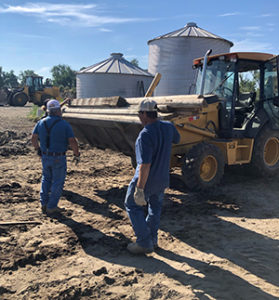
“Water overran the area, and it was washed out,” Loya said. “Pens were knocked over or shifted. Tractor tires were all over the place. There was debris from upstream everywhere, and a lot of knocked over trees. There was a lot of flooded farmland and ranchland, and the floods destroyed fence lines.”

The Texas Baptist volunteers served five working days in Montana, clearing away debris and seeking to restore as much as possible of what the flood damaged.

Dorvall made available all the heavy equipment he owned for the volunteers to use.

“The people there were great,” Loya said. “They fed us and kept us supplied with water and Gatorade. We really had free rein on their property, and they trusted us to do what they asked.”

Four members of the Cowboy Fellowship of Atascosa County, a Texas Baptist church in Jourdanton, traveled 1,500 miles from south of San Antonio to South Central Montana. The missions team removed debris and began making repairs at a family-owned feedlot that serves ranchers in the Carbon County area. (Courtesy Photo)

After the crew began making the trip home to South Texas, Melissa Dorvall wrote a note of appreciation on the church’s Facebook page: “My husband Danny and I cannot thank these men enough for helping to fix our feedlot. They are an answer to prayer, and we will never forget what they have done for us. A huge thank you also to their families and the church! They will forever be our friends.”

Her husband Danny similarly posted photos along with the message: “The saying something good can come out of something bas is one I truly believe now. These four men from Texas were a blessing to my family and proof that the good came out of the bad. … Not only did they help clean up, but they became lifelong friends. I can’t put into words how much their help is appreciated by all of us!”

Both Loya and Pawelek said Cowboy Fellowship hopes to send another mission team to Montana in the near future.

Volunteers interested in learning more about disaster recovery needs in Montana can contact Cowboy Fellowship through its Facebook page or Loya at https://www.facebook.com/profile.php?id=100000227852387.


BGCT considering change in relationship with Baylor

The Baptist General Convention of Texas is seeking to “review and consider changes” to the special agreement that defines its relationship with Baylor University.

The BGCT has related to Baylor by special agreement for more than three decades.

BGCT Executive Director David Hardage issued a brief statement Aug. 16: “The BGCT has entered into initial conversations with Baylor University to review and consider changes to the special agreement between our two institutions. Conversations are kind, gracious and cooperative, but will take some time to complete. We will share additional information as it comes available.”

In response, Baylor University released its own statement: “For more than 175 years, Baylor University and Texas Baptists have served side by side to extend the kingdom of God in Texas and beyond. We remain firmly rooted in our shared history, and the university is committed to continuing to maintain its historic relationship with the BGCT and with Texas Baptists. Such a commitment is at the heart of Baylor’s motto – Pro Ecclesia, Pro Texana, or ‘for the church’ and ‘for Texas.’”

The statement from Hardage did not indicate the reason for reviewing and considering changes to the relationship agreement with Baylor.

However, some Texas Baptists have made known their opposition to Baylor’s decision to grant a charter to Prism, an LGBTQ student organization, on April 19.

On May 3, the BGCT posted a statement on its website from Hardage: “We are aware of the recent chartering of the Prism at Baylor student organization by Baylor University. We have heard concern expressed by many in the Texas Baptists family and are in the process of communicating those concerns to university leadership. There has been some confusion regarding the group’s chartering, and we are seeking clarification to determine the best course of action moving forward. The BGCT’s position on Human Sexuality and Biblical Marriage has not and will not change.”

Relationship based on special agreement

Baylor University was chartered by the Republic of Texas in 1845 at the request of the Texas Baptist Education Society.

From 1886 until 1990, the BGCT elected all of Baylor University’s governing board of trustees. On Sept. 21, 1990, Baylor amended its charter to allow the governing board of regents to elect its own successors. Herbert H. Reynolds, then president of Baylor, said the university took the action to protect it from the kind of “fundamentalist takeover” that already had occurred in the Southern Baptist Convention.

After extensive negotiations, Baylor subsequently agreed to revised its amended charter to allow the BGCT to elect directly up to 25 percent of the board of regents. The agreement stipulated all regents would be Baptist, and 75 percent would be Texas Baptists. Messengers to the 1991 BGCT annual meeting in Waco approved the negotiated relationship agreement by a vote of 5,745 to 3,992.

In 2011, Baylor opened membership on its board of regents to non-Baptist Christians. In response, the BGCT and the university renegotiated its relationship agreement. The agreement granted Baylor greater input into the selection of BGCT-elected regents, with the stipulation that BGCT-elected regents must be members of BGCT-affiliated churches.

Messengers to the 2011 BGCT annual meeting in Amarillo approved the renegotiated relationship agreement with only a smattering of opposition.


Gospel goalie: Central Texas pastor excels on the ice

LEXINGTON—Some preachers are renowned for fiery sermons. One small-town Central Texas pastor is known—at least in some circles—for his skill on the ice.

Chris Bruce, pastor of First Baptist Church in Lexington, is a sought-after goaltender in pick-up hockey games at a rink in Cedar Park, north of Austin. (Photo / Nan Dickson)

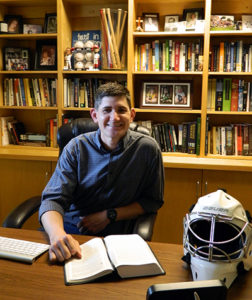
Chris Bruce, pastor of First Baptist Church in Lexington, is a 36-year-old father of three daughters, and an avid reader who enjoys the outdoors. But a couple of times a month, he also is a sought-after goaltender in pick-up hockey games at a rink in Cedar Park, north of Austin.

“I love spending time intentionally sharing the gospel in different environments, but 98 percent of the time here in Lexington, I’m with professing Christians,” Bruce said.

The exception is when he is with other hockey players.

“Somebody will ask, ‘Hey, goalie, what do you do when you’re not here?’ When I say, ‘I’m the pastor of a Baptist church,’ sometimes it’s crickets—the locker room goes silent,” Bruce said.

“But other times, it’s different. One guy asked the question, and when I told him I was a pastor, he said, ‘That’s [expletive] awesome!’ And I said, ‘Yeah, I think it is.’

“Most of the time, hockey players don’t have a lot of pretense. What you see is what you get, and they have a ‘take it or leave it’ attitude, accepting people for what they are.”

Developed early love for playing hockey

Bruce grew up in Allen—a North Texas suburban community better known for its top-ranked high school football team than for hockey.

“Nobody in my family was a big hockey fan,” he said. “But when the Dallas Stars moved to the Metroplex, my dad on a whim took me to a hockey game. I immediately was drawn to it.”

Bruce—who acknowledges Disney’s The Mighty Ducks movies and animated TV series also sparked his interest—began playing driveway hockey on rollerblades before he graduated to House League Hockey.

“I played tennis and golf in high school, but I kind of enjoyed the toughness factor in hockey. It was a little more rough and tumble,” he said.

When First Baptist Church in Lexington called him as pastor in 2013, Chris Bruce thought his hockey-playing days were behind him. He was wrong. (Photo / Ken Camp)

He took an extended break from playing hockey when he moved to Abilene, earning his undergraduate degree from Hardin-Simmons University and his Master of Divinity degree from Logsdon Theological Seminary. He also served University Baptist Church in Abilene, first as pastor to youth and then pastor to college students.

“There’s no ice in Abilene, so for about seven years, I hung up my skates,” he said.

When First Baptist Church in Lexington called him as pastor in 2013, he thought his hockey playing days were behind him.

“It looked like we were coming to a pretty rural environment,” he said. “So when we moved, I sold all my hockey equipment.”

However, during his last semester working on a Doctor of Ministry degree at Baylor University’s Truett Theological Seminary, he went to Cedar Park to watch the Texas Stars—the minor league affiliate of the Dallas Stars.

That game rekindled his interest in hockey, and he celebrated the completion of his doctorate by buying new hockey gear and making plans to begin playing amateur hockey in Cedar Park.

“Then the pandemic hit, and everything shut down,” he said.

‘I like doing something a little different’

Once the rink reopened, he began joining pick-up games two or three times a month.

Pastor Chris Bruce of First Baptist Church in Lexington appreciates the opportunity to build relationships and share his faith with other hockey enthusiasts. (Photo / Nan Dickson)

“I can’t get out of the office enough for league play, but pick-up games are a good fit. It’s pretty relaxed, and goalies play for free because they’re always needed,” he said. “Goaltending is a draw for me because it’s sort of like an individual sport within a team sport.

“It’s kind of a cliché that pastors play golf or fish. That’s fine, but I like doing something a little different.”

While Lexington is more a football town than a hotbed of hockey enthusiasts, Bruce has generated some interest in the sport among members of his church and their friends.

“We took 40 people from the community to a Texas Stars game,” he said.

Bruce appreciates the variety of skill levels among those who participate in the pick-up games in Cedar Park.

“Some played in college. There are even some former minor league players. And then there are some who are doing well just getting their skates under them,” he said.

Austin-area hockey players tend to be “a tight-knit group,” and Bruce typically sees many of the same men from one week to the next. Slowly but surely, he believes he is building relationships that can provide opportunities to share his faith.

“I get a lot of texts from those guys. Most of the time, it’s just, ‘We need a goalie on Friday.’ But sometimes, it’s more than that,” he said.

“It’s not like they are sharing prayer requests or anything that deep. But some of the texts are about more than just asking if I can play. They are relational.”

Along the way, he looks for opportunities to plant a few gospel seeds, subtly encouraging teammates to think about spiritual issues.

One time, he wore a shirt from a mission trip to Haiti that displayed a Creole phrase. When a teammate asked him what it meant, Bruce told him: “It means, ‘Jesus is my friend.’ What do you think about that?’”

“There’s no indication he’s a believer,” Bruce said. “But it’s the beginning of a conversation.”

This article originally was published in the summer issue of CommonCall magazine.


From Death Row to Life Row

LIVINGSTON—About 200 of the inmates at the Allan B. Polunsky Unit—a Texas Department of Criminal Justice maximum-security prison near Livingston—are housed on Death Row, where prisoners typically spend 23 hours a day in a small single-occupancy cell.

‘Broken men become whole’

About 200 of the inmates at the Allan B. Polunsky Unit—a Texas Department of Criminal Justice prison near Livingston—are housed on Death Row. (Photo / Ken Camp)

But Terry Joe Solley, an inmate in the general prison population who devotes 12 to 14 hours a day visiting those otherwise-isolated prisoners, is committed to turning Death Row into “Life Row.”

“We introduce them to the one who can give them spiritual life. They find spiritual life in a place where they have come to die,” Solley said. “On Life Row, broken men become whole.”

Solley is one of six field ministers at the Polunsky Unit. Field ministers are inmates who have completed a Bachelor of Arts in biblical studies degree program, offered to men at the Darrington Unit in Brazoria County (renamed the TDCJ Memorial Unit last year) and to women at the Hobby Unit in Falls County. They receive certification as field ministers after receiving specialized training from the Heart of Texas Foundation Field Ministers Academy.

The two field ministers at the Polunsky Unit—Solley and Hubert “Troop” Foster—are assigned specifically to Death Row where they “are basically pastors to the Death Row population,” Chaplain Joaquin Gay said.

As a field minister, Terry Joe Solley has the freedom to visit prisoners on Texas Death Row without being accompanied by a correctional officer. (Photo / Ken Camp)

Field ministers “are the heart of our Death Row ministry at Polunsky,” Gay said. The field ministers have earned the trust of men housed on Death Row—not only teaching classes and conducting worship services, but also visiting the inmates daily, praying with them and being on-call 24 hours a day, seven days a week, he explained.

The field ministers—who are permitted to enter Death Row without being escorted by a correctional officer—often are awakened in the middle of the night at the request of a condemned inmate who wants to talk.

Some Death Row inmates grow so despondent, they consider suicide, Solley said.

“I’ve had men give me the razor blade they were going to cut themselves with,” he said.

“These men are sons, husbands and fathers. We often lose sight of that. … I want the men on Life Row to see themselves for who they are—people created in God’s image, not just a messed-up life. It’s not about what you did. A single moment doesn’t define us. It’s about who you are.”

‘I wanted to please my father’

Before he surrendered his life to Christ, Solley spent much of his incarceration in administration segregation units—solitary confinement reserved for prisoners considered a safety risk to other inmates or prison staff.

“I spent years on ad seg in a 5-by-9-foot cage, carrying a lot of guilt and shame,” he said. “So, when I talk to the men on Death Row, they know I can relate to them.”

Solley recalled attending First Baptist Church in Lafayette, La., faithfully with his mother from age 7 until he was 14 years old. At that point, his father—who went to prison when his son was 6 years old—was released and came back to his family.

“That’s when he took me to do an armed robbery with him,” Solley said. “I wanted to please my father more than anything.”

At age 18, Solley went to prison, where he served 10 years, seven months and 23 days before being released. Once he returned to the free world, he married, had a child and began a productive life until his father “showed up again,” he said. On March 25, 2006, Solley committed a bank robbery.

“I became everything I said I wouldn’t become,” Solley said.

‘Now I am stronger in the broken places’

During the time he was held in a county jail, before he was convicted and sent to state prison, Solley returned to the faith his mother had tried to teach him and accepted Jesus as Lord of his life.

“God put together the pieces of a broken life, and now I am stronger in the broken places,” he said.

In prison, after he renounced his former gang membership and proved his trustworthiness, he was allowed to enter the seminary program at the Darrington Unit.

“My family was against it, because my dad was at the Darrington Unit,” he said. Initially, Solley wanted no contact with his father, but he eventually agreed to meet him in the prison chapel. His father began attending chapel services regularly.

“He would watch me. One day he said, ‘There’s something different about you,’” Solley said, “I told him, ‘Jesus is now Lord of my life.’”

In April 2012, Solley’s father asked his son to walk with him to the front of the chapel at the end of a worship service.

“He said, ‘I want to give my life to the Lord,’” Solley recalled. Two months later, Solley’s father was diagnosed with Stage 4 liver cancer. He died in September 2012.

“Before he died, God mended our relationship,” Solley said. “For the first time, our relationship wasn’t about pistols and ski masks.”

First faith-based designated units on Death Row

After completing his degree and receiving additional training as a field minister, Solley spent 15 months at the T.L. Roach Unit in Childress before he was invited to transfer to the Polunsky Unit to serve Death Row.

“I didn’t know what to expect,” he confessed.

John Henry Ramirez is part of one of the first designated faith-based units on Texas Death Row. The faith-based initiatives for inmates at the Polunsky Unit have “changed the dynamics of Death Row,” Ramirez said. (Photo / Ken Camp)

But the first inmate he met on Death Row was John Henry Ramirez, who had become a Christian through the prison outreach ministry of Second Baptist Church in Corpus Christi.

“We became fast friends and brothers,” Solley said.

Ramirez said the same thing about field ministers Solley and Foster.

“It’s a privilege to have somebody to confide in,” Ramirez said. “We’re not just spending time in our own heads 24/7. Sometimes, the field ministers listen to people rant. Sometimes, they cry. Regardless, they are there.”

Ramirez is among 28 inmates who are part of the first designated faith-based units on Texas Death Row.

“The faith-based program is an intensive, voluntary, 12- to 18-month program that seeks to provide men with a living area separated from the other inmate population that is conducive to change and designed to provide resident offenders with a curriculum of meaningful opportunities for personal growth and improvement,” Chaplain Gay said.

To qualify for the program, inmates must have a clean disciplinary record, and they need to submit a written request to the chaplain’s office. From those who apply, the chaplain compiles a list of inmates he recommends to the warden for a final security check prior to approval.

“The men who are selected to participate in the faith-based program are moved to an area of Death Row semi-separated from other Death Row inmates. The 28 men are divided up into two adjacent living areas that house 14 men each,” Gay explained.

“Our primary goal of the Death Row faith-based program is to help participants reach a point in their lives where they are truly repentant for their actions, seek forgiveness and find inner peace with God.”

Personally, Gay added, he wants inmates not only to experience the most productive and faith-filled lives possible, but also to “prepare them for the eternal life to come by offering them an eternal hope that is only found in Christ.”

‘Changed the dynamics of Death Row’

In recent months, 14 of the inmates in the Death Row faith-based program participated in a modified Kairos retreat. When a Kairos event typically is offered in the general prison population, the spiritual retreat lasts four days and involves volunteers who lead small-group discussions and worship services and who pray individually with inmates.

A dozen certified volunteer chaplain’s assistants, two field ministers and the chaplain led the Texas Death Row event. The retreat followed a compressed schedule, with inmates remaining in their cells, listening to speakers and musical worship leaders on a sound system at the end of the cell block.

“Over the course of two days, 30-minute talks were given on subjects ranging from forgiveness to being part of a church community,” Gay explained. “After every talk, a [certified volunteer chaplain’s assistant] placed a chair directly in front of two cells for a small-group discussion.”

Beyond the Kairos event and the programs offered specifically for the 28 men in what inmates sometimes call “the God Pod,” other Death Row inmates and prisoners in the general population can take courses offered on “The Tank”—a low-power, prisoner-operated radio station—and listen to broadcasts of other faith-based content.

John Henry Ramirez sends a message to the Christian volunteers who regularly visit him on Texas Death Row. (Photo / Ken Camp)

Taken together, the “God Pod,” the field ministers, religious radio content and other faith-based programs dramatically have altered the prison—particularly Death Row, Ramirez said.

“It’s created a big sense of community here,” he said. “Before, we were all alone. It’s changed the dynamics of Death Row.”

He is not alone in that observation.

“All of the staff on Death Row have commented on how much the faith-based program has helped change the atmosphere on Death Row,” Gay said. “What was once a dark place has now become one of the unit’s beacons of light, as the Lord changes and transforms the men living there. None of the men in our Death Row faith-based program have had a disciplinary issue for some time now.”

Warden sees correctional work as a calling

Both Ramirez and Solley give credit to the prison administration, particularly Warden Daniel Dickerson.

“Correctional work is a calling more than a job,” Dickerson said. “There has never been one person that I have found that grew up wanting to be a correctional officer. Somehow, we are just led to this work, and when we actually understand the purpose and great responsibility, it becomes a passion.”

Dickerson believes strongly in programs to rehabilitate offenders.

“Society gets better when we do better. We can stop the vicious cycle of family members constantly coming to prison every generation if we put all of our faith and efforts into rehabilitating those incarcerated,” he said.

“It’s not an easy calling, but we have amazing people behind the walls giving it their all every day to provide public safety, which is not only keeping those incarcerated inside, but rebuilding them to enter into society in which they can be productive.”

Even for those who never return to society—including those who ultimately are executed—meaningful transformation can occur, Solley asserted.

“On Life Row, the gospel becomes real. If forgiveness of sins is really for all people, then it’s for them,” Solley said, pointing to the example of the thief on the cross next to Jesus who asked the Lord to remember him when he entered his kingdom. “The first man to come to faith in Christ was in the process of being executed.”

This article originally appeared in the Summer 2022 issue of CommonCall magazine.


Welcome Center nourishes hope among inmates’ families

AMARILLO—As families of inmates gather around tables for shared meals at the Hope Welcome Center, they receive more than a nourishing meal. They discover unconditional acceptance and hope.

The Hope Welcome Center opens each weekend to serve the families of inmates incarcerated in five Texas Department of Criminal Justice facilities in the Texas Panhandle.

Soon after he arrived at Amarillo Area Baptist Association in 1997, Harold Scarbrough saw the need for a ministry to serve inmates’ families, and he presented his vision to churches in the area.

Working closely with local leaders—particularly Paul Dunn, pastor of Bethel Baptist Church in Canyon—and with help from the Baptist General Convention of Texas and some charitable foundations, Scarbrough raised the funds needed to develop the welcome center.

The Hope Welcome Center opened its doors to its first guests in 2005. In the years that followed, the center has developed solid working relationships with area prisons, and TDCJ personnel recommend the facility to visitors as a safe place to find lodging, showers and meals.

Relationships nourished around dinner table

The Texas Baptist Hunger Offering helps the center provide food for families, with support from several churches in the area.

The Texas Baptist Hunger Offering helps the Hope Welcome Center provide food for families, with support from several churches in the area. (Courtesy photo)

Each Saturday evening, a host church prepares the main dish for the meal visiting families enjoy, and on-site coordinator Don and Dickie Blankenship add side items to complete the meal. They also provide a continental breakfast to overnight guests on Saturday and Sunday mornings.

A fully stocked kitchen is equipped with easily prepared food items the families also can make for themselves. Tea and coffee always are available, along with plenty of snacks for children. Older teenagers typically stay at the Hope Welcome Center to watch their younger siblings while a parent or grandparent visits their incarcerated loved ones.

Family members build relationships as they share meals and lodging. They also have opportunities to spend time together in the center’s common room.

The Blankenships are responsible for purchasing the food and necessary disposable products. Paper plates and plastic utensils make clean-up easy. Families typically volunteer to help clear the tables and perform other chores, although they are not required to do so.

Opportunity to hear the gospel message

After the Saturday evening meal, a devotion time is scheduled featuring hymn singing, a brief message and a time of prayer. Guests are not required to attend, but most participate.

“In the last two years during our devotion time, we have witnessed four professions of faith” in Christ, Dunn said. “In addition, there have been five or six rededications. We see about one decision a month.”

The Hope Welcome Center had to close for a year and a half due to the COVID-19 pandemic, but it reopened last fall.

“We average about 25 people per month—usually two or three families per weekend,” said Dunn, who has served on the center’s board of directors since its beginning.

Prior to the pandemic, the Hope Welcome Center was filled to capacity nearly every weekend, he noted. Since demand has not reached pre-pandemic levels, the center has relaxed some of its policies.

“We’ve broken our own rules,” Dunn said. “Before the pandemic guests had to make reservations at least a week in advance. Now, if they show up and need a place to stay, we’ll take them in. They are so grateful.”

A safe and affordable place

Dunn recalled a particular woman who stayed at the Hope Welcome Center.

“After she returned home, she wrote a note thanking them for having a safe place to stay … a place that she could afford. Not many people would express love this way, but this woman was truly thankful.”

About one-fourth of the guests respond in some way. A small donation is accepted but not required.

With rising inflation—particularly escalating gasoline prices—the center makes family visits at area prisons possible for some who otherwise could not afford them. In particular, they appreciate having food available at no cost to them.

“We would have to go without food if it was not provided,” one guest said. “With fuel costs so high and having to drive 200 miles one way, the food is greatly appreciated.”

Doors open at the Hope Welcome Center every Friday at 3 p.m., and the center closes at 1 p.m. on Sunday.

“This ministry reaches every age group—from infants to the elderly,” Dunn said. “Mothers bring infants and young children when they visit their husbands. Grandparents visit grandsons and nephews.”

Concerned Christians can support Hope Welcome Center either by giving financially or becoming a prayer partner, he added.

The center not only ministers to inmate families, but also indirectly affects the incarcerated. Frequent family visits build stronger family relationships when inmates are released. And as family members come to know Christ, they influence their loved ones in prison.

“Our inmate population is an overlooked group,” Dunn said. “After they are released, they can make a difference in our world. Families come from foreign countries and from Florida to California. This ministry … is vital in telling others about Christ.”

Carolyn Tomlin writes for the Christian market and teaches the Boot Camp for Christian Writers.


From fires to floods, TBM serves in times of disaster

Most of Texas continues to suffer from extreme drought, and Texas Baptist Men disaster relief volunteers have provided water and meals to firefighters who have battled resulting wildfires.

Now, TBM disaster relief is responding to floods that have ravaged much of eastern Kentucky and parts of Missouri.

“Whether it’s due to wildfires in Texas or flooded homes in Kentucky and St. Louis, people are hurting in many places today,” said Mickey Lenamon, TBM executive director and CEO.

“TBM volunteers are seeking to share God’s love in these difficult situations by meeting needs and offering encouragement. Please be in prayer for TBM teams as they serve, as well as for those who have been impacted by these terrible situations.”

TBM volunteers prepare to deliver pallets of water to firefighters in Kaufman County. (TBM Photo)

In late June and early July, TBM offered meals to firefighters and other emergency personnel who responded to the Dempsey Fire, a wildfire in Palo Pinto County that consumed nearly 11,600 acres.

In the weeks that followed, TBM supplied bottled water to firefighters and first responders in multiple locations around the state, including those who served after a grass fire damaged more than two dozen homes in Balch Springs.

Last week alone, TBM distributed 9,000 bottles of water to Texas firefighters.

In recent days, floods in Kentucky claimed at least 37 lives and displaced hundreds of families. A deluge in the St. Louis, Mo., area caused severe flash flooding in that area.

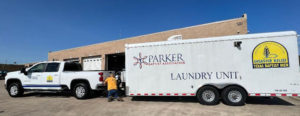
As of Aug. 3, a laundry unit from Parker Baptist Association and several TBM volunteer chaplains were en route to eastern Kentucky, and a flood recovery team was preparing to leave for St. Louis.

Additional flood recovery, food service, shower/laundry, incident management and electrical support teams will follow in the near future, TBM Disaster Relief Director David Wells reported.

A TBM mobile laundry unit from Parker Baptist Association will serve in Kentucky, where floods have devastated the eastern portion of the state. (TBM Photo)

Southern Baptist disaster relief teams from Tennessee, North Carolina, South Carolina, George and Alabama also are serving in Kentucky alongside Kentucky Baptist volunteers.

To date, TBM volunteers have responded to more disasters this year than in all of 2021.

 Wells asked concerned Texas Baptists to spend at least five minutes praying for TBM volunteers and those whose lives have been affected by disaster and another five minutes encouraging other Christians to pray.

“Pray for the people who have been impacted, as well as for TBM volunteers’ strength, health and openness to God’s leading,” he said.

“The Bible tells us wherever two or more are gathered in God’s name, he is there, as well. We’ve seen prayer work time and again in the field.”

To support TBM disaster relief ministries financially, send a check designated for disaster relief to Texas Baptist Men, 5351 Catron Dr., Dallas, TX 75227 or click here to give online.

With additional reporting by John Hall of TBM.  


Church provides families relief from dangerous summer heat

DESOTO—The summer of 2022 is one of the hottest on record, as families without air conditioning in their homes can testify.

A 2018 study by Zillow revealed about 10 percent of the homes sold in the Dallas-Fort Worth area lacked air conditioning. During warm months, it can be uncomfortable; in extreme heat, it can be dangerous.

In response to that need, Community Missionary Baptist Church, south of Dallas, held a “Beat the Heat” event on a mid-July weekend.

During the event, church members gave out about 160 box fans to families and individuals. They also delivered and installed air conditioning units in homes of high-risk individuals.

The fans and units were distributed at each of the church’s campuses—one in DeSoto and one in Cedar Hill.

At first glance, the campuses are located in comfortable, middle-class neighborhoods full of families who appear to be doing fine, Pastor Oscar Epps observed. But looks can be deceiving, and he encouraged people to check on their neighbors, who may be struggling.

Deacon Stephen Jackson delivers a cooling unit to 97-year-old Frank Medlock. (Photo courtesy of Community Missionary Baptist Church)

“We’re in the suburbs, and because we’re in a nicer area, you would never realize the need that was there. They can be right next door to you, and you could never know,” Epps said.

One of the air conditioning unit recipients was Frank Medlock, a 97-year-old living just north of DeSoto. Church members, including Deacon Stephen Jackson, drove to Medlock’s house to deliver a portable air conditioning unit. Because of his age, Medlock is particularly high-risk during the continued heat of the summer.

Jackson, who has served as the church’s outreach ministry director four and a half years, said moments like that make his job wonderful.

“The part of my job that I enjoy most is helping people and being a resource wherever I can so that the needs of our congregation and our community are met,” Jackson said.

While the Beat the Heat event is over, the church still is distributing fans and air conditioning units at its food pantry. The food pantry, which distributes groceries at both church campuses, developed as another response to an immediate need during the worst of the COVID-19 pandemic.

Meeting needs at the heart of outreach and ministry

Meeting the immediate, pressing needs of their community is at the heart of Community Missionary Baptist Church’s outreach and ministry. In addition to the food pantry and Beat the Heat, the church also distributed gas station gift cards to families struggling to afford recent surges in gas prices.

“The Bible tells us that we are the hands and feet of Jesus Christ. So, whatever the need is, we are here to provide that need,” Epps said. “If that’s air conditioning, fans or food, our obligation as a church is to operate outside of our four walls.”

In the near future, Community Missionary Baptist Church will host a “2nd Chance Job and Resource Fair,” which aims to help job seekers of all backgrounds get a job.

The event will feature on-site hiring opportunities, interviewing coaches, resume writers, education resources, housing assistance and other resources designed to give people the tools they need to recover from hard times. The program will also have a record expungement with attorneys on-site to assist.

“We believe in outreach ministry and helping those that are less fortunate and those that are ‘stuck between blessings,’” Epps explained, adding the church is committed to “taking care of our community.”


BGCT executive director search committee named

DALLAS—Officers of the Baptist General Convention of Texas and its Executive Board named a search committee to recommend Texas Baptists’ next executive director.

The committee will review applicants and seek out the next executive director to succeed David Hardage, who announced on July 1 his plans to retire at the end of the year.

The committee is comprised of seven Executive Board members, chosen by the BGCT chair and vice chair, and eight at-large members, chosen by the president and vice presidents. At-large members are members of BGCT churches who are not members of the Executive  Board.

The search committee will be led by Chair David Mahfouz, pastor of First Baptist Church in Warren.

Other members of the committee are;

  • Janice Bloom, member of First Baptist Church in Garland;
  • Goldenstene Davis Sr., associate pastor of education/ministry at Singing Hills Baptist Church in Dallas;
  • Lester Leonares, member of First Philippine Baptist Church in Missouri City;
  • Suzanne Liner, member of First Baptist Church in Lubbock;
  • Pete Pawelek, pastor of Cowboy Fellowship of Atascosa County in Pleasanton;
  • Alfonso Flores, pastor of Primera Iglesia Bautista in San Antonio;
  • Eder Ibarra, director of strategy implementation at Rio Grande Valley Baptist Association and member of Calvary Baptist Church in McAllen;
  • Cindy Wiles, executive director of Restore Hope and member of First Baptist Church in Arlington;
  • Dennis Young, pastor of Missouri City Baptist Church;
  • Darin Wood, pastor of First Baptist Church in Midland;
  • Duane Brooks, pastor of Tallowood Baptist Church in Houston;
  • Mark Rotramel, pastor of First Baptist Church in El Paso;
  • Wendell Wright, director of church, community and denominational relations at Dallas Baptist University and member of Park Cities Baptist Church in Dallas; and
  • Albert Reyes, president and CEO of Buckner International and member of Park Cities Baptist Church.

“I believe that I speak for each member of the committee in sharing that we are honored to be asked to serve in this capacity, but also must confess that it is a humbling experience,” Mahfouz said.

“This role will require an investment of time and energy on the part of each member of the committee. We need the prayers of all Texas Baptists as we embark on this task. Each member of the team needs to bring to the table spiritual discernment, wisdom, patience, and a commitment to build relational trust and cooperation.”

Advisory group formed

In addition to the committee, an advisory group has also been formed to aid in the search. Unlike the committee, the advisory group cannot vote to nominate but can offer advice to the committee as requested.

Advisory group members are Tamiko Jones, executive director-treasurer of Woman’s Missionary Union of Texas; Mickey Lenamon, executive director/CEO of Texas Baptist Men; Todd Still, dean of Baylor University’s Truett Theological Seminary; Cory Hines, president of Howard Payne University; and Phil Miller, director of Texas Baptists’ Center for Church Health.

“While we are saddened by the announcement of Dr. Hardage’s retirement, we celebrate the tremendously positive impact he made on the ministries of Texas Baptists,” said Craig Christina, associate executive director of Texas Baptists.

“The executive board has elected a diverse executive director search committee representing various geographical and ethnic groups across the state. Each member is experienced in Texas Baptist life and will add valuable insights into the nominating process.”

The first step for the committee will be to engage in a time of prayer, orientation and listening to best understand the needs of the convention.

After the committee has developed a profile for the next executive director, the position will be announced formally. A special, designated email address will be set up to receive nominations at that time.

Once the search committee has a nominee, the nominee will be presented to the Executive Board for election.

As the committee begins the search process, members request prayers that God will grant them wisdom, patience, discernment and faithfulness.

Christina added: “We ask all Texas Baptists to continue to pray for David and Kathleen Hardage as he retires; the search committee members as they organize; the new executive director as the Lord calls, equips, and prepares them; and the ongoing work of BGCT ministries and staff as we serve the churches and facilitate the movement of God’s people to share Christ and show love. We have a strong foundation built upon the love of Christ, and the best days for Texas Baptists lie ahead.”