Pastor prophetically ministers to community, congregation

SAN ANTONIO—In more than three and a half decades at Macedonia Baptist Church, Pastor Jerry Dailey has aimed to “minister to the hopes and hurts of the community and the congregation.”

By all accounts, his aim is true, and he has hit the target—whether that takes the form of providing groceries to families in need or speaking uncomfortable truth to power.

Once a month, Macedonia Baptist Church’s Good Samaritan Ministry offers groceries provided by the San Antonio Food Bank to about 150 families in the neighborhood during a drive-through food distribution.

“And it’s always tinged with the message, ‘God loves you,’” Dailey said.

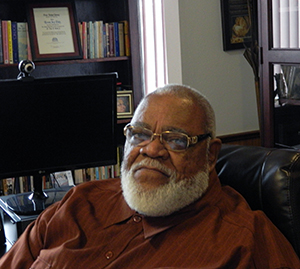
Last month, the Community of Churches for Social Action recognized Dailey for chairing the Black interdenominational group and providing a prophetic voice in tough times.

Jerry Dailey chaired the Community of Churches for Social Action in San Antonio. (Photo / Ken Camp)

After the death of George Floyd at the hands of Minneapolis police officers, the organization called for police reforms including the banning of chokeholds and no-knock warrants, as well as urging local officials to affirm that “Black lives matter.”

Dailey acknowledged that public stand was not universally well-received. Some viewed it as anti-police. Others saw it as a blanket endorsement of the Black Live Matter organization, rather than as a statement of principle.

“It’s not anti-police. It’s for the police but against bad policing,” said Dailey, who was appointed by the San Antonio City Council to serve on the city’s first Police Civilian Advisory Board.

“It’s not about an organization. It’s about saying Black lives matter. Of course, all lives matter, but all lives are not living with being shot down.”

Intentionally chose not to relocate

Dailey sees speaking for justice and calling for improvements in a city he loves as part of ministering to his community.

“Where we are is where we serve,” he said.

For Macedonia Baptist Church, that has meant remaining in a changing area and seeking to serve all its residents. Years ago, the Black congregation made the decision to remain in its largely Hispanic, predominantly Catholic neighborhood in southwest San Antonio.

“After carefully considering it, we intentionally made the decision not to relocate,” Dailey said. “We have stayed in the community all these years. … Our ministries have always revolved around the community.”

In April, Macedonia Baptist Church will become one of 10 host sites for literacy enhancement and tutoring, made possible by a major grant. The program will focus on helping students in grade 9 to grade 12 reverse learning loss due to COVID-related disruptions.

Health care professionals at Macedonia Baptist Church lead regular educational events for the community, along with offering routine screening for diabetes and high blood pressure.

Caring for the congregation

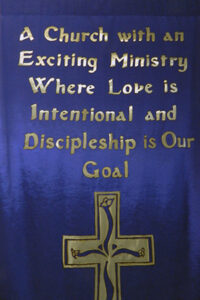
A banner displays the congregation’s mission statement at Macedonia Baptist Church in San Antonio. (Photo / Ken Camp)

The church also cares for its own. After every Sunday worship service, the church provides free COVID testing. Members who line up in the fellowship hall for the tests on Sunday receive the results by email no later than Tuesday.

Macedonia Baptist Church also ensures the “hopes and hurts” of every member receive due attention by assigning them to one of 12 “tribes.” Each tribe corresponds to a different month, based either on an individual’s birth month or the birth month of the head of their household.

New members also automatically are enlisted in a “Fulfillment Hour” class—a Sunday Bible study small group.

“You can choose to sing in the choir. You can choose to serve as an usher. But every member is a member of a tribe and enrolled in a Fulfillment Hour class,” Dailey said.

He sees it as one way Macedonia Baptist fulfills its vision of being “a church with an exciting ministry where love is intentional and discipleship is our goal.”

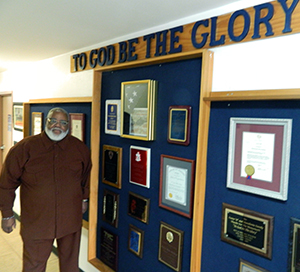
Across the decades, Pastor Jerry Dailey has received numerous honors and been recognized for his service to his community. (Photo / Ken Camp)

Dailey has served 37 years as pastor of Macedonia Baptist Church—almost half of the church’s history. In August, he will mark 50 years in the gospel ministry and 46 years in the pastorate.

“I am a third-generation pastor. That’s the kind of legacy that has been passed down to me,” he said. “Not that I always planned to be a pastor. I wanted to be a basketball coach. But the Lord had other plans.”

Dailey was the first Black moderator of San Antonio Baptist Association. He is a former president of the African American Baptist Fellowship of Texas. He served on the Baptist General Convention of Texas Executive Board and on numerous committees for Texas Baptists, as well as in leadership roles in the National Baptist Convention of America.

While Dailey acknowledges he is “rounding third base,” he doesn’t believe his ministry is complete yet. He still sees disciples that need to be made and needs that must be met.

“I believe our church has been a blessing to the city,” he said. “If we weren’t around, we definitely would be missed. We’re always out in the community, establishing relationships. The people here know, ‘We’re here for you.’”


BH Carroll Institute becomes seminary within ETBU

B.H. Carroll Theological Institute is becoming B.H. Carroll Theological Seminary and will be embedded in East Texas Baptist University.

The governing boards of ETBU on Feb. 3 and of the B.H. Carroll Institute on Feb. 6 approved resolutions authorizing an exclusive agreement to merge the administrative and academic operations of B.H. Carroll as part of ETBU.

B.H. Carroll is accredited to award master’s degrees and doctoral degrees by the Association of Theological Schools and the Association of Biblical Higher Education. ETBU is accredited by the Southern Association of Colleges and Schools Commission on Colleges to award baccalaureate degrees and master’s degrees.

Curriculum and administration proposals will be finalized by this May, and proposals for the accrediting bodies will be submitted by Aug. 25. Documentation for a SACS Commission on Colleges onsite visit will be completed by Jan. 21, 2024.

Pending review and approval by the accrediting bodies, the merger will be finalized and the theological graduate school will become “B.H. Carroll Theological Seminary at East Texas Baptist University” between September 2024 and Jan. 31, 2025.

B.H. Carroll will continue to operate independently until then, but it will work in close collaboration with ETBU administration. The ETBU board of trustees is the governing body for the merged institution, and the seminary will have a board of advisers.

ETBU has pledged to work to incorporate individuals from current and past B.H. Carroll board of governors onto its board of trustees.

First doctoral degree granted by ETBU

The doctor of ministry degree and doctor of philosophy degrees offered by B.H. Carroll Seminary will mark the first doctoral degrees granted by ETBU.

“We are excited to partner with the leadership and faculty of B.H. Carroll Theological Institute as we unite in our Christ-centered calling through graduate theological education,” ETBU President J. Blair Blackburn said.

“The opportunity to educate, equip and serve Carroll and ETBU students will extend the institutions’ great legacies of preparing students for the gospel ministry and will expand our kingdom impact.”

Both ETBU and B.H. Carroll since their beginnings have been committed to preparing students to “advance the kingdom of God” by serving in the local church and in missions, Blackburn noted.

“Their hearts align with ours,” he said.

‘Our spirits are the same’

B.H. Carroll President Gene Wilkes—who will become dean of B.H. Carroll Seminary at ETBU—echoed that shared commitment.

“The mission of B.H. Carroll and ETBU are already very similar. We are a fit because we are both concerned with teaching ministers, chaplains, counselors, educators and lay people for service in the diverse and global ministries of Christ’s church,” Wilkes said.

“Our spirits are the same. We are interested in the growth of God’s kingdom, faithfulness to his word, loving God’s people in the church, and bringing the lost to Christ. We will continue to operate this way when we join ETBU.”

The chairs of the B.H. Carroll and ETBU governing boards similarly affirmed the common commitments shared by both schools.

“This merger of the two institutions connects B. H. Carroll with a university with a similar vision, a rich history, and a kindred desire to prepare students for service in the church,” said Leon Leach, chair of the B.H. Carroll board.

James Webb, chair of ETBU’s board of trustees, likewise expressed enthusiasm regarding the merger.

“East Texas Baptist University and B. H. Carroll Theological Institute have the same mission to equip Christian servant leaders to follow their calling to God and humanity,” he said. “The opportunity for greater kingdom impact can be achieved through a strategic educational and ministry partnership to fulfill the Great Commission.”

Continuity of leadership and instruction

Once the merger is completed, the online Master of Arts in Christian Ministry and Master of Arts in Theological Studies offered by the ETBU School of Christian Studies and Humanities will be provided through B.H. Carroll Seminary.

The School of Christian Studies and Humanities will continue to offer undergraduate programs in Christian ministry and ministry leadership, while graduate degrees will be provided through B.H. Carroll Seminary, Blackburn explained.

An FAQ prepared by ETBU and B.H. Carroll states: “In order to provide for the continuity of leadership and instruction, ETBU intends to retain all full-time faculty from B.H. Carroll Theological Seminary. B.H. Carroll full-time faculty will become a part of the instructional faculty at the institution upon completion of the merger.”

Since its beginning in 2004, B.H. Carroll has stated its commitment to providing “affordable, accessible, achievable and accredited theological education.” B.H. Carroll offers degrees through online and hybrid classes—a model it will continue to follow when it becomes part of ETBU, both Blackburn and Wilkes said.

Once B.H. Carroll is embedded in ETBU, its students will have access to student services, additional scholarship opportunities and financial aid, including federal grants and loans previously unavailable to them.

Students currently at ETBU who are preparing for careers in church ministry are eligible for the Ministerial Finance Assistance scholarship program from the Baptist General Convention of Texas. ETBU will apply to the BGCT Theological Education Council, requesting similar scholarship assistance for students at B.H. Carroll Seminary.

Donor designations remain intact

All donor-designated gifts to the B.H. Carroll Theological Institute remain with B.H. Carroll Seminary at ETBU, both Blackburn and Wilkes emphasized.

The FAQ from ETBU and B.H. Carroll states: “B.H. Carroll Theological Seminary will operate independently until the merger is complete, and endowment funds from B. H. Carroll Seminary will continue to be used for the purposes for which they were given to B. H. Carroll. Once the merger is finalized, the endowed gifts will transfer ownership to B.H. Carroll Theological Seminary at East Texas Baptist University, and the donor intent and designation of the gift will remain intact.

“The investments of the endowments will then be managed by East Texas Baptist University and will be distributed in accordance with the donor’s gift agreement for B. H. Carroll Theological Seminary and under East Texas Baptist University’s policies.”

Like a ‘family reunion’

B.H. Carroll Theological Institute operated as an independent theological education institution, not affiliated with any denomination. However, from its beginning, the school has been closely related to Baptists in Texas.

“It is a shift for us, but I am very comfortable with it,” said Wilkes, who earned his undergraduate degree from Baylor and a Master of Divinity degree and a Ph.D. from Southwestern Seminary. He was pastor of Legacy Church in Plano, a BGCT-affiliated congregation, more than 26 years.

Wilkes said he considered it “significant, historic and meaningful” that the two seminaries within BGCT-affiliated universities—Truett Theological Seminary at Baylor and B.H. Carroll Theological Seminary at ETBU—are named for significant figures in Texas Baptist history.

George W. Truett, pastor of First Baptist Church in Dallas from 1897 to 1944, was a trustee of Baylor University in the 1930s and served as president of both the Southern Baptist Convention and the Baptist World Alliance. B.H. Carroll, pastor of First Baptist Church in Waco 28 years in the late 19th century, was instrumental in the formation of the BGCT and was the founding president of Southwestern Baptist Theological Seminary.

Russell Dilday, former president of Southwestern Seminary in Fort Worth, was founding chancellor of B.H. Carroll Theological Institute. After he was fired in March 1994 by a fundamentalist-dominated board of trustees at Southwestern Seminary, Dilday became distinguished professor of homiletics at Baylor University’s Truett Theological Seminary and also served as acting dean at Truett Seminary at one time.

Bruce Corley, former dean of the School of Theology at Southwestern Seminary, was founding president of B.H. Carroll Theological Institute, serving until 2013. In fact, Corley and the other three founding faculty at B.H. Carroll—James Spivey, Stan Moore and William A. “Budd” Smith—all taught previously at Southwestern Seminary.

Tommy Sanders, provost and vice president for academic affairs at ETBU noted longtime personal friendships and close working relationships with B.H. Carroll faculty and administration.

“This partnership is less of a new merger and more of a family reunion,” Sanders said. “We share educational, theological and denominational heritage.”


BGCT receives $28 million from Dukes estate

The Baptist General Convention of Texas received more than $28 million from the estate of William (Bill) P. and Janie B. Dukes.

Janie Dukes died last June. Her husband preceded her in death in 2015. They were lifelong Baptists.

The Dukes first became involved in Baptist philanthropy in 1990, when they met Bill Arnold, now president emeritus of the Texas Baptist Missions Foundation. With Arnold’s help, they began planning how they would use their resources to benefit Baptist work.

“They wanted to help all ages and all phases of Baptist life,” Arnold said. “They wanted to help children, students, ministers, lost people and everyone in between.”

The William P. and Janie B. Dukes Endowment Fund will help start churches, provide scholarships to students pursuing ministry in the business school at Baylor University, assist senior adults in Texas Baptists’ retirement centers and benefit other ministerial causes. The gift was processed through HighGround Advisors.

“They were humble people with a generous spirit,” said Ward Hayes, BGCT CFO/treasurer. “And now, they’ll be able to help grow the kingdom for many, many years to come.”


TBM volunteers serve after tornadoes hit Southeast Texas

DEER PARK—Along a several-block stretch of Hillshire Drive in Deer Park, limbs are piled along the street as neighbors seek to clean up from a tornado that swept through Jan. 24.

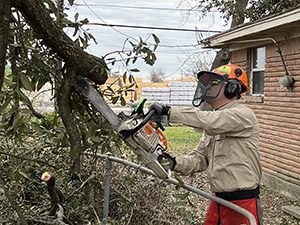
TBM volunteer Matthew Enriquez removes a hanging limb from a storm-damaged tree. (TBM Photo / Ferrell Foster)

The easy cutting had been done, but a Texas Baptist Men disaster relief team from Katy swept in to clear away some of the difficult-to-handle damage.

TBM chainsaw crews removed large branches broken by high winds but still connected to trees. (TBM Photo / Ferrell Foster)

Marcell Hunt led the TBM crew from Kingsland Baptist Church. He described the work as mainly involving “hangers”—large branches broken off but still connected to the tree and dangerous. And limbs were down on roofs.

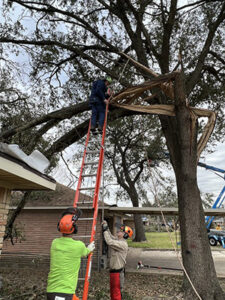
The seven-man team brought chainsaws, a man lift and a skid steer because some of the hangers were large and required multiple cuts for safe removal. The crew used the lift to reach hangers high in the trees above three homes in a row.

Their ministry comes quickly after a series of tornadoes swept across Southeast Texas from the Houston area to Orange.

One of the homeowners affected by the storms, Scott Wilkerson, said the TBM work was a blessing.

TBM volunteer Mike Aronson is mounted on a lift to remove damaged limbs left hanging in trees. (TBM Photo / Ferrell Foster)

“I want to say thank you from the bottom of my heart for what you guys are doing,” he said. “God bless, ya’ll.”

Wilkerson received bids of $6,000 to $7,000 for what the TBM crew did for no charge.

To the Southeast, the TBM Deep East Texas team cut and removed trees in Orange County. They also installed a tarp on a house that was missing half its roof.

David Wells, TBM statewide disaster relief director, praised the work of the Deep East Texas team, as well as the Houston-area teams that assisted tornado survivors.

“The very first part of the Great Commission is to make disciples of the people in your Judea—the area closest to you,” he said. “That’s exactly what these teams are doing. Their neighbors are hurting, and they’re stepping up to help them out in the name of Christ.”

To donate financially to TBM disaster relief, click here or mail checks to Texas Baptist Men, 5351 Catron Drive, Dallas, TX 75227.


Connections key to international students feeling at home

BELTON—When Kanishka Upreti arrived at the University of Mary Hardin-Baylor from India, she remembers not only how excited she was, but also experiencing severe culture shock.

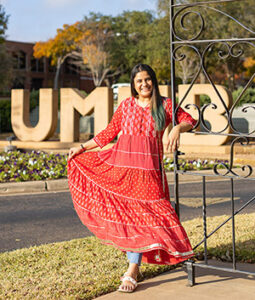
Kanishka Upreti is a senior psychology major from India. (UMHB Photo)

Kanishka, who was raised as a Hindu, was stumped when her Old Testament professor instructed students to open their Bibles to a verse in Psalms. While other students flipped to the middle of the Bible, she had no idea where to start.

“I knew UMHB was a Christian university, but I didn’t know we had to study the Bible,” she said.

This year, 106 international students from 35 coun­tries selected UMHB. For many of them, life as a teenage interna­tional student includes facing many challenges like lan­guage barriers, social and cultural differences, religious differences and academic dissimilarities.

One of the things many of them suffer from is feeling isolated—miles away from family, friends and all things familiar.

During her en­tire freshman year, Kanishka lived in Austin with relatives and took an Uber back and forth to campus in Belton every day. Not only was it a massive $160 daily dent in her budget, but living so far from campus made it difficult to connect and make friends.

For her sopho­more year, Kanishka moved just minutes away from campus, and she quickly found herself meeting more people, making new friends, and joining in activities.

She participated in Missions Emphasis Week, the Psychology Club and Bridges International, a social group that promotes connections between international and domestic students.

Kanishka helped organize the annual multicultural program two years in a row. She cooked Indian food, dressed in traditional Indian attire, performed a Bollywood-style dance and offered henna hand drawings.

‘Find ways to help them connect’

This year, she serves as international student representative for the Student Government Association at UMHB. Her platform was “helping interna­tional students build connections on campus.”

“I know that there’s a gap. A lot of our international students feel very isolated,” she said. “So, hopefully, we can find ways to help them connect.”

Elizabeth Tanaka, director of UMHB Interna­tional Student Services, agrees international stu­dents often take a while to break out of their comfort zones. Some students are better at plugging in, like Kanishka, who has thrived since becoming active on campus. Others, take a little longer.

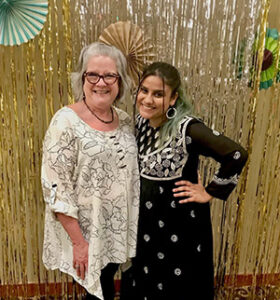
Elizabeth Tanaka, director of UMHB International Student Services, with Kanishka Upreti, a senior psychology major from India. (UMHB Photo)

“International students tend to socialize only with those from their home country,” she said. “It’s un­derstandable, because that is their comfort zone, and so much here is new. But this tends to isolate small groups of students who become dependent on each other rather than becoming part of UMHB as a whole.”

The international students who take an active role in becoming a member of the campus family have experienced great success, Tanaka said.

“They are happy and busy because they get invited to do many activities, even just going to H-E-B with American friends,” she said. “They also tend to be academically successful, because they are at ease with hearing English at a fast pace, and they have friends to study with.”

Tanaka and her team seek ways to help international students get involved, while acknowledging the multiple reasons they choose not to. Sometimes, they are shy about making a mistake in English and “appearing foolish,” she said.

Another reason is because in their free time, instead of joining into activities on cam­pus, they are using Facetime or Zoom to talk with friends back home rather than trying to make new friends in the United States.

Cultural differences also come into play, Tanaka added. Many international students are not as comfortable taking initiative as their American coun­terparts.

“Someone has always told them what to do, when to be there, … and they are just fairly passive about anything that is not a requirement,” she said.

Participate in campus activities

During her international student orientations, she stresses to students that they will have a much more fulfilling experience, both socially and academically, if they will just attend activities.

“Get a couple of people from your country to go with you,” she advises international students. “Even if you sit on the sidelines and do noth­ing for a while, it will get easier and easier to interact.”

She urges international students to give American students a chance to get to know them and build a friendship.

“Say ‘hello’ to someone from your class that you see outside of class. Say ‘hello’ to your professor. Go to a sporting event,” she suggests. “Everyone is there for the same purpose, and no one will ask you to do anything other than watch and applaud.”

Tanaka pointed out some of the ways UMHB encourages international students to get plugged in, including the International Orientation Day her office offers each semester before classes begin.

The Baptist Student Ministry hosts events such as Texas Night for international students to familiarize themselves with “all things Texas.” The BSM also has an international committee that hosts events such as learning to bake a cake and game night.

Bridges International publicizes regular meetings for interna­tional and American students to build friendships, and the library has hosted events specially for international students.

“We will continue to offer as much as possible in hopes of catching the elusive students who are looking for a way to plug in and take advantage of activities,” she said.

She has observed often a single student, who is the only one from his or her home country, participates more often and becomes comfortable on campus much more quickly than those who have a bigger “comfort zone” group where they can hang out.

“The single students tend to live on campus lon­ger, too, because they don’t have a group to rent an (off-campus) apartment with, and I think that encour­ages more participation as well,” she said.

From isolated to involved

Tran Ho Bao “Cherry” Le of Vietnam started classes at UMHB from her laptop, sitting inside a small room she rented from a family friend in Dallas. It was fall 2020 when COVID-19 was surging, and many students opted to take classes online. She missed out on touring campus. There was no Cru Camp and no Welcome Week.

Tran Ho Bao ‘Cherry’ Le is a junior nursing major from Vietnam. (UMHB Photo)

“Technically, I didn’t know anything about UMHB,” she said. “That was not what I imagined of college—not at all.”

Because she didn’t experience college the way she envisioned that first year, she considered transfer­ring, but she decided to give it another try “in person.”

Cherry applied for a sum­mer job as a student worker with the UMHB Center for Academic Excellence and was hired. She moved into Burt Hall, enrolled in summer classes and went to work, helping with Cru Camp. She finally got to experience all the things she missed that first year.

When she started classes in the fall, a friend who served in the Student Government Association suggested Cherry run for the interna­tional representative position.

This year, as a junior, she helped design sets for Stunt Night and is involved in Bridges  Inter­national. During one of her Christmas breaks, she joined other students from around the country for the Vision Conference in Washington, D.C.

This past semester, she attended a fall retreat at Burnet with Bridges International. She’s also been involved with the college group at Taylor’s Valley Baptist Church in Temple.

Getting involved was not easy for Cherry, but she is happy she pushed herself out of her “bubble.”

“I realized that friends do not define us. I do not see them as American or international friends. I just see them as friends,” Cherry explained. “You can just go out there and make friends with people —any of them. If you’re nice to them, they will be nice back.”

Looking over the last two years on campus, Cherry is thankful she found the courage to open her mind to new experiences, and she hopes to inspire other interna­tional students to do the same.

“I feel like UMHB is my family now, and I would love to have other international students feel and experience the same things that I have.”

Adapted and republished by permission from UMHB Life Magazine, Winter 2023


Brotherly love among college friends prompts philanthropy

PLAINVIEW—Almost 50 years after Kent Snodgrass and Jimmy Thomas stole the clothes of a kid from Indiana, one might think their gifts to a scholarship fund established in his honor represent voluntary self-punishment for wrongdoing.

But that’s not what motivated Snodgrass and Thomas to help put the Tim and Janice Powers Endowed Scholarship at Wayland Baptist University above the $100,000 mark in less than three years.

The real reason is the brotherly love these three college friends have shared through years of picking, poking, pranking and praying for each another.

“The fact that Tim Powers speaks to me today is an absolute miracle, because we absolutely played more tricks and pranks on him than anyone in the history of our lives,” Snodgrass said.

Thomas added, “It is a wonderment that Tim would even consider us to be his friends as much mess as we put on him.”

Initial impression not love at first sight

Partners in “classroom crime” since they had met in third grade in Abernathy, Snodgrass and Thomas were freshmen in the fall of 1973 when they met Powers, a kid from Muncie, Ind., who came to play basketball at Wayland.

“Tim was on a full scholarship, and he had no idea about Wayland Baptist University.” Thomas explained. “He had never been to Plainview before accepting the scholarship. It was kind of a crazy deal.”

“It certainly was a God thing,” Powers said of his decision to play for the Pioneers. “I was getting one of my ankles taped, and the assistant coach said, ‘There’s a school down in Texas that’s interested in you.’

“I said, ‘Well, send them the worst tapes that you have on me, because Texas is the last place I want to go.’”

After almost 50 years in the Lone Star State, Powers said, “God had a different plan, for which I am grateful.”

“I had another offer, which I had committed to, but I ended up dropping that offer and coming to Wayland. Eventually, I fell in love with the place.”

But it wasn’t love at first sight. Powers landed in Lubbock with one piece of luggage “stuffed with everything I could think of.” Snodgrass’s brother, a graduate assistant for the basketball team, picked him up at the airport.

“Kent’s older brother, Don, greeted me and put me in his car, which didn’t have an air conditioner, and we started driving toward Plainview,” Powers recalled. “The wind was blowing, and it was hot.

“The first question I asked him was why all the trees were growing sideways. I saw what I thought was a tornado, and he laughed and said it was a dust devil. It was all the same—flat. And I grew up in a place where there were hills and trees, rain and humidity. It was just dry and dusty.”

Three students became ‘fast friends’

The assistant coach dropped Powers at McDonald Hall, one of three men’s residence halls open at that time.

“I found my room and was introduced to my roommate,” he recalled. “Shortly after that, Kent and Jimmy came down, and we went over and played some basketball. That started the friendship that has lasted for almost 50 years.”

The three became “fast friends,” Snodgrass said.

“In Plainview, there was not much to do, so we rolled up the sidewalks together, and spent a lot of time in each other’s room,” Snodgrass said.

It wasn’t long before Snodgrass and Thomas began playing pranks on Powers.

“We basically stole all of his clothes except the ones he had on,” Snodgrass said. “He had one set of clothes and had to wear those four or five days in a row. It was good clean fun for the most part. It was fun for us, but there were times when he wasn’t laughing really hard.”

But generally, Powers took the pranks in stride, Thomas said.

“You could pull a joke on Tim, and he would act like he didn’t even know it happened,” he said. “He would play dumb. We walked into his room that day, and he didn’t have anything, not even a razor or comb or a toothbrush—nothing. We stole everything, and he just walked in the room and laid down on his bed without a mattress. He was like nothing had happened. He didn’t say a word about it. He was so funny.”

Powers always ‘intentional’

Snodgrass and Thomas admit Powers was much more intentional about his studies than they were.

“That is what he has always been—intentional,” Thomas said. “He’s been intentional since he was 18 years old. He came to Wayland and worked hard.

“While we were being stupid and acting crazy and waiting until the last night to do an assignment, he would get the syllabus for the class and start on it the minute he got it. He’d go to the library the first night and be half finished with it.”

“He was very dedicated to what he was doing. And he has been intentional later in life, as far as his jobs, his family and his faith. He’s been very intentional in everything he’s done. He’s probably the hardest working person I have known in my life.”

Powers sees himself as someone who likes to solve a problem when he sees it—including problems between people.

“ If you have an issue with someone, you go to them and try to take care of it,” he said. “Being intentional means developing relationships.”

Much as he treasures his friendship with Thomas and Snodgrass, Powers points to a more important relationship he established at Wayland.

“I was grateful that God had led me there,” Powers said. “That is where I realized I could have a relationship with Christ. I eventually invited him into my life to be my Lord and Savior. It definitely was an eternity-changing decision for me to come to Wayland.”

‘It’s been a brotherhood’

After the trio graduated, they remained best friends.

“We just continued to stay in touch,” Snodgrass said. “Jimmy and Tim stayed out in the Panhandle, and I moved to the Dallas-Fort Worth area.”

Snodgrass enjoyed a successful career in the investment business, while Powers and Thomas became successful school administrators.

Snodgrass called Thomas and Powers “two of the finest men in the world.”

“It doesn’t get any better than to have close, wonderful friends like that,” he said.

Thomas added, “It’s just been a brotherhood.”

Sticking together through trying times

And brothers stick together during difficult times, like when Powers learned he had Stage 4 prostate cancer in June 2016. A local oncologist told him he had two to three years “at the most” to live.

Powers went to MD Anderson Cancer Center in Houston, and the doctors there confirmed the diagnosis. A specialist told him, “It’s not curable, but we can treat it and prolong quality of life for you.” That doctor told Powers he probably had four to six years to live.

“It has been six and a half years, so I think I’m on God’s time,” Powers said. “I truly believe it is because I have had so many people praying that God would intervene with this cancer. I don’t know if he is going to cure it. That is up to him. But I know that if it hadn’t been for people praying for me on a regular basis, I would not be here now.”

“The whole process was a blow to both Janice and me, but we realized we could get bitter, or we could get better. We both chose to do this and get better, to be a reflection of God’s love. … I’ve grown so much closer to the Lord. … I’ve grown more deeply in understanding what he wants from me. I want to take every opportunity to share that as best as I can with others. But it all starts with the idea that God led me to Wayland.”

Powers said his wife is his No. 1 encourager, but Thomas and Snodgrass have been there for him each step of his journey.

“Jimmy and Kent pray for me constantly and call and check on me,” he said. “Kent comes quite often to Lubbock from Fort Worth. He always stops by to see me. They and others support me. I am truly blessed. I have been able to see God’s love working in real life.”

Launching an endowed scholarship

Snodgrass took a lead role in launching the Tim and Janice Powers Endowed Scholarship at Wayland.

“They were going to establish the scholarship fund, and Tim called and asked me,” Snodgrass recalled. “He wanted me to come to the gala in Lubbock. I inquired about it and decided to become the core sponsor of the event.”

But that was just the beginning.

“I’ve just continued to try to support that on an annual basis or more often than that,” Snodgrass said. “It’s basically for the love of Tim that I have done that. I just know how much joy it gives him. So, I’ve been blessed and able to do that. It is just a great way to say how much I appreciate him and Janice.”

Thomas also has contributed to helping get the endowment over $100,000.

“I can’t say enough about Tim Powers. I am glad to be a part of this,” Thomas said of the endowment.

‘Substantial and real’

Even while undergoing regular treatments that often result in hospitalization, Powers continues to serve as a professor at Wayland’s Lubbock campus.

“With the challenges he has had over the last few years, you never hear him complain,” Snodgrass said. “He is an absolute warrior and an incredibly intentional person. You are not going to find a harder worker and a more intentional great Christian man than Tim Powers. The things he is involved in are substantial and real.”

Powers described Snodgrass and Thomas as “those two yahoos” before quoting Proverbs 18:24—“But there is a friend who sticks closer than a brother.”

“That’s really what this has turned into,” he said. “It’s a friendship that is more than just acquaintances. Just knowing that you have someone in your life like that and knowing Wayland was the central focus for having the opportunity to develop that relationship is invaluable.

“One of the many blessings of being diagnosed with Stage 4 prostate cancer is the fact that we have grown stronger. We have grown more closely together through God’s word and just kind of reinforcing each other and reminding each other of God’s promises. It’s reminders that this is not the end, it is just the stuff you go through this side of heaven. There are better things to come than this.”

Powers said one of the greatest honors of his life came last fall when the university recognized him with Trustee Emeritus status. Snodgrass and Thomas were with him as he was honored.

“As an 18-year-old, I would never have imagined that Wayland would have such an impact on my life as well as these lifelong friendships,” he said. “I truly believe that if I had not come to Wayland, I would still be a lost soul. I know I will be in heaven and greeted by the Lord when that time comes.”

“I cannot believe how blessed I am to have such friends as Kent and Jimmy in my life. I know that friendship will last for eternity. I know there will be a time when we are rejoicing and praising the Lord in heaven, and I can’t think of anything sweeter than that.”

No lives lost when façade collapsed at Stephenville church

First Baptist Church in Stephenville gathered for worship on Jan. 22, four days after the façade on the exterior of one of its buildings collapsed, injuring two construction workers.

A portion of the arched façade on the north side of the church’s education building collapsed at 1:58 p.m. on Jan. 18. The century-old building—part of the city’s historic district—is undergoing renovation and restoration.

Pastor Ken May was in his office at the south end of the church campus when he and others heard the crash.

“By the time I walked around the building, first responders were already there,” he said in a phone interview.

One of the workers injured in the accident was discharged from the hospital the same day he was treated. The other was transported to a hospital in Fort Worth, where he is “stable and improving,” May said.

“Buildings are valuable resources, but human lives are what are really precious,” he said.

‘God is with us’

During the Jan. 22 morning worship service, May encouraged his congregation to praise God for his presence in difficult times and thank God for the protection he provides.

Pastor Ken May speaks to his congregation during a Sunday worship service four days after a portion of the facade collapsed at the entrance to its educational building. (Video screen grab)

“God is good. All the time, God is good,” he said. “It has been a tough week. … Even when the façade on the church crumbles, God is with us.”

The church’s Kinderbridge Preschool meets in the education building, but no children or staff were injured. The collapse occurred after the time when the children were outdoors on a playground and prior to dismissal, when they would have been exiting the building with their parents, May noted.

“They were inside taking naps,” he said. Child care workers immediately followed emergency protocols, relocating the children to a safe location away from the affected part of the building.

“The engineer has inspected the building and concluded that most can be occupied,” a social media post on the church’s Facebook page stated, prior to the Sunday worship service.

While some preschool classes were moved to the church’s fellowship hall and a couple of adult Bible study classes relocated to the sanctuary on Jan. 22, most were able to meet in their usual areas. All classes were expected to be in their normal locations on Jan. 29.

“In life, you have to be flexible. … You just don’t know what’s going to happen. We’ve had to do that in the last few years with the pandemic,” May said.

While individuals are asked to stay clear of the area near the collapsed façade until it can be cleared, an engineer who examined the facility and compiled a 10-page report said it remains structurally sound, May told the congregation.

 “Thank you so much for your prayers,” he said. “Prayer is powerful.”

In a social media update posted Jan. 24, May called on the church to praise God.

“This week, we have become mindful of how quickly life can change. We have been confronted with the frailty of our nature and aware of our dependence upon God. Without him, we have no hope, no power and no future. Today is a day of praise,” he wrote.

“Praise him for being a God who is always in control, and One who is never caught by surprise. … Praise him for being a loving and kind God who watches over us, protects us and provides.”


Pastors enter public service to ‘be a light’ in communities

MANSFIELD (BP)—Michael Evans developed a heart for public service when he was 8 years old.

Early each morning, after his mother and great-grandmother boarded the bus to work, he had to prepare breakfast, get his 3-year-old sister Michelle on the bus to preschool and walk himself the two miles to class without getting in trouble along the way, he said.

“My mother depended on me. I saw her cry too many times because of what we didn’t have,” said Evans, mayor of Mansfield and senior pastor of Bethlehem Baptist Church there.

‘Be the solution’

Paducah, Ky., City Commissioner Raynarldo Henderson (left) was sworn in by Judge Christopher Shea Nickell.

Raynarldo Henderson, city commissioner in Paducah, Ky., and pastor of Washington Street Missionary Baptist Church there more than 30 years, was inspired for public service during his early adulthood in Chicago when the late Harold Washington was mayor.

“There were fights on the (city council) floor. I remember one alderman … standing up on the table,” Henderson said. “Those first four years for Harold Washington were rough. They gave him a hard time. And it was watching those city council meetings that it was like: ‘Wow. I can be a solution. I can make a difference.’

“I was taught that if you see a problem, you be the solution.”

Both Evans and Henderson are fulltime pastors who concurrently serve in elected office in the public square. Both see their pastorates and their elected governmental posts as godly callings. Both express the ability to uphold the laws of the land while also exhibiting godly behavior as the Lord’s ambassadors.

“There are some people who think pastors shouldn’t be in politics,” Henderson said. “But obviously, I think the exact opposite, because we do get an opportunity to impact” communities.

Longtime involvement in community

Evans, a Houston native elected to his second mayoral term in November 2022, came to the office after holding various public posts as early as 2007, including terms on the Mansfield Independent School District Board and the Tarrant County College District. He was a commissioned officer and reserve chaplain in the U.S. Navy, and he is a former president of the Baptist General Convention of Texas.

Michael Evans is mayor of Mansfield and senior pastor of Bethlehem Baptist Church in Mansfield. He is a former president of the Baptist General Convention of Texas.

Evans, who eventually became the oldest of six children when his mother remarried, experienced both provision and lack during his childhood, he said. His birth parents divorced after his father returned from the Vietnam War.

“When you see people hurting and you encounter people who are hurting, and I was blessed to have grandparents on the maternal and paternal side that held us up while our parents were going through,” Evans said.

“So, when you have those experiences, you say: ‘Lord, help me to pay back, because I know that it’s been given to me. So, so help me to give it back.’”

Bethlehem Baptist Church elected him pastor when he was 24 years old, when Mansfield was a rural community of just 15,000 residents.

“They helped me grow up here as a young man,” he said of the congregation that averaged 1,200 in worship before the COVID-19 pandemic and draws 600 in worship today.

‘Love and serve’ all

Evans sees himself as exposed to a diversity of public opinion as a mayor, but covered by God as his servant.

“Character counts. I believe people will read you before they read the Bible. I’ve got to love and serve even those that don’t like me. I learned that in the pastorate,” he said. “Bethlehem got me ready for that. I praise God for giving me a covering, and it is here at Bethlehem.”

Evans doesn’t compromise God’s word, he said, but upholds the constitutions of Texas and the United States, as he is sworn to do as mayor.

“My job (as mayor) is to not allow you to be mistreated or discriminated against because of the way you think. That’s just right to do. I cannot stand by and allow any person to be mistreated,” Evans said. “I believe that the best way to save a person is for the people to see Christ in the (other) person. And they can’t see that with me hating them. …

“[I]n regard to society, you’ve got to know that I’m going to respect your position. I don’t have to accept your position, but I have to respect it and I have to protect it and protect you, because I made a vow to do just that. To do otherwise would be dishonest. I shouldn’t even take the oath if I didn’t mean to be right.”

Integrity essential

He sees integrity as a way of sharing the gospel.

“You share it by being fair to the parties that come before you,” Evans said. “You share it by loving those who you know hate your guts because you’re Black. You share it by demonstrating condolence when bad things happen in the city. It’s lifestyle evangelism.”

Henderson’s road to elected office included three campaigns before his winning run as city commissioner in November 2020.

“I’m just not a quitter. You don’t stop, my mom always taught us, you don’t stop because you come to a wall,” he said. “You go over the wall, under the wall, around the wall.

“I kept on going because I knew that was what God had for me. Because I believe that in my heart, I kept pressing. If God has called you to it, he’ll bring you through it.”

Today, Henderson is known affectionately as “Pastor Commish.”

Make an impact

Henderson enjoys his public office, particularly frequent opportunities to offer the invocation at public meetings.

“I get an opportunity through my prayer to set the tone or the atmosphere of meetings. If a meeting goes well, I feel like it has had something to do with what I prayed and how I asked God’s presence to be in our meetings,” he said. “I get an opportunity to say to our other commissioners or mayor, I feel God is leading me to do this.

“I have an opportunity to be a witness or to be a light in our community. Obviously, I don’t stand on a street corner with a megaphone, but just my presence. People know that I’m a pastor. People know that I’m a preacher. And therefore, they call upon me on many cases.”

Henderson leads Washington Street Baptist Church to be active and present in the community. Among its ministries are feeding ministries, outreaches to the elderly, and a warming center with resources for the homeless on cold nights, offering showers, a bed, food and clothing.

“I ask our church often: ‘If Washington Street Church were no longer here, would this community know the difference and would they even care?’

“I believe that the church has a responsibility to be in the community. We have a responsibility to impact the community. And just being the commissioner gives me an added opportunity to make an impact.”


Conference offers training and equipping in evangelism

SAN ANTONIO—Saying the church’s “evangelism has fallen short of our calling,” Pastor Tony Evans urged attendees at Texas Baptists’ Statewide Evangelism Conference to go and make disciples.

The Jan. 23 conference saw 1,125 pastors, lay leaders and other attendees registered for a time of equipping and training at First Baptist Church of San Antonio.

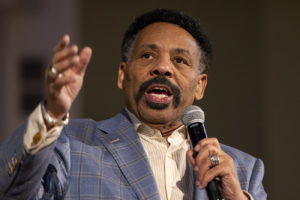
Pastor Tony Evans of Oak Cliff Bible Fellowship in Dallas challenges attendees at Texas Baptists’ Statewide Evangelism Conference to share the gospel. (Texas Baptists Photo)

Likening the gathering to a huddle in a football game, Evans reminded congregants that the conference was not the main objective, but rather a time to come together and strategize.

What’s important is “what difference the huddle makes,” Evans said. “Having huddled, can you now score?”

Evans, the senior pastor of Oak Cliff Bible Fellowship in Dallas, exhorted Christians not to join in the “chaotic conflict” of the culture by joining a team, but to be more like referees— representatives of God, with his authority.

He urged attendees to make disciples—which he defined as “visible, verbal” followers of Jesus who “replicate the Master”—and to take what they had learned in the evangelism conference and spread the gospel.

“The church is good at huddling,” Evans said. “But (Jesus) said, ‘I want you to go!’”

The Jan. 23 event—with the theme “Can I Ask You a Question?”—was Texas Baptists’ first statewide evangelism conference following a 15-year hiatus.

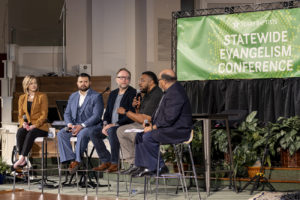
A panel (left to right: Katie McCoy, Eric Hernandez, Steve Bezner, Robert White, Victor Rodriguez) answers audience questions about evangelism. (Texas Baptists Photo)

Large crowds filled the worship center for each of the seven sessions. Along with sermons and presentations, the conference included a question-and-answer panel with speakers.

“That’s what this conference is about,” Leighton Flowers, director of evangelism for Texas Baptists, told attendees. “To equip you and train you, to give you tools, so you can go back to your churches and to your homes and spread the gospel to your friends and neighbors.”

The evangelism conference’s theme is shared by a five-book curriculum bundle, published by GC2Press, with the same name: “Can I Ask You a Question?”

The curriculum teaches Christians the basics of sharing the gospel and engaging nonbelievers, noting Jesus often asked questions to further spiritual conversations.

‘The desire of every generation’

Katie McCoy, director of Women’s Ministry for Texas Baptists, outlined the post-Christian environment in which Texas Baptists now bear witness. Today’s culture resembles that of first-century Roman culture, McCoy said. That creates undeniable challenges but provides tremendous opportunity for Christ followers, she added.

 McCoy said the prevailing cultural way of life inevitably leaves people isolated, searching for significance and hungering for wholeness.

 “The message of Jesus and the community of his people are the desire of every generation,” she said.

But McCoy also warned conference-goers to focus on what is important—proclaiming the gospel. The early church, even as it was still developing, “kept the main things the main thing,” she said.

Be the ‘salt of the earth’

Eric Hernandez, apologetics lead and millennial specialist for Texas Baptists, emphasized the need to couple the ability to defend the faith with the practice of sharing one’s faith.

Beginning with Jesus’ words from Matthew 5:13—“You are the salt of the earth”—he asked attendees: “Why are you a Christian? Why should someone else be a Christian?”

In 2 Corinthians 10:3-5, the Apostle Paul teaches Christians are to “refute arguments and reasonings and every proud and lofty thing that sets itself up against the knowledge of God.” Hernandez posited that “the biggest threat to Christianity” is not atheists or other external opponents, but instead Christians “who cannot effectively engage in spiritual warfare by recognizing, rationally responding to and tearing down strongholds.”

Hernandez encouraged attendees to participate in the [un]Apologetic Conference, scheduled Feb. 25 in San Marcos.

“Let us not just learn to present the gospel, but defend it, because, ‘You are the salt of the earth.’ God has not just given us the truth but given us the evidence to show why it is true,” he said.

Issue a ‘broader invitation’

Robert White, lead pastor of Freedom Church in Bedford, implored attendees to issue a “broader invitation.” While Christians must proclaim the gospel, the invitation to Christ is “broader than just the words presented,” because it includes the example of their lives, he said.

“Before we can invite others to respond to the invitation, we need to accept the invitation that has been given to us to live like Jesus,” White said.

Preaching from Philippians 1:27-30, he exhorted Christians to gospel conduct—living lives worthy of the gospel—and to live in “gospel community” with each other.

He also called Christians to gospel confidence, noting there is no reason for fear, and to gospel commitment, recognizing that following Christ will mean suffering for the sake of Christ (Philippians 1:29).

Focus on those ‘on the outside’

Steve Bezner, senior pastor of Houston Northwest Church, called pastors to emphasize evangelism and to break out of a “chaplain” mindset, believing “our primary job is simply to care for those who are inside our churches.”

“We can easily forget that there are so many on the outside who do not have life in Christ,” he said. “Let’s be honest. If we don’t think about it, who will?”

Houston Northwest Church has experienced a surge in baptisms, he said, as the church has emphasized corporate prayer in recent years. Noting Gallup research projects fewer than 50 percent of Americans will identify as Christian by 2050, he exhorted pastors not to forget the power of the gospel.

“The world may be falling apart, the culture may be confused, things may be terrible in your neighborhood right now, but guess what?” Bezner said. “Jesus still saves. The cross still forgives. The empty tomb still promises eternal life. And Jesus is still pouring out his Holy Spirit on the most heathen among us.”

Next generation looking for authenticity

Shane Pruitt, National Next Gen Director for the North American Mission Board, urged attendees to focus on reaching Gen Z and then send them to reach their peers.

Despite statistics that show Gen Z identifies less with religion than previous generations, Pruitt said, he has seen more conversions among young people in the last three years than in his previous 15 years of ministry. The pandemic, he said, brought them “to the end of themselves” more rapidly than those in previous generations.

“You don’t have to be young. You don’t have to be cool,” he said. “Young people are not looking for cool leaders. They’re looking for real and authentic leaders. If you have the gospel, you have what it takes.”

Pruitt encouraged leaders not to refer to young people as the “future of the church.”

“They are the church now, and they can handle” the responsibility of fulfilling the Great Commission, he asserted.


Mary’s House provides home for stateside missionaries

When Mary’s House recently opened its doors to provide a fully furnished residence for a missionary family, it marked a dream come true for Woman’s Missionary Union of Texas and the World Missions Center at Southwestern Baptist Theological Seminary.

In 2019, Brent Ray—then director of the World Missions Center—contacted Texas WMU to discuss his idea of providing an on-campus home for international missionary families on temporary stateside assignment.

He envisioned a cozy home where missionaries-in-residence could find rest and renewal, while also inspiring seminary students with their testimonies of service on international mission fields.

Representatives from Texas WMU met with Ray and saw a proposed site for missionary housing—an old duplex on the corner of West Broadus Street and Stanley Avenue.

‘It was in pretty bad shape’

At one point, the building housed the library of the late E. Earl Ellis, emeritus research professor of theology. After the Ellis collection was moved to the A. Webb Roberts Library, the house sat vacant for years.

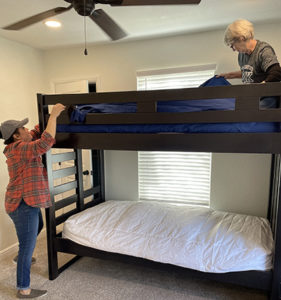
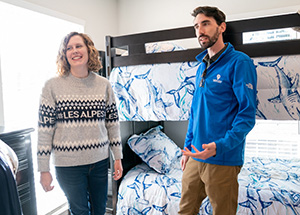
Marisol Sandoval (left) and Freddie Martinka with the Woman’s Missionary of Texas staff help put sheets on a bunk bed at Mary’s House. (Southwestern Seminary Photo)

“Honestly, it was in pretty bad shape,” said Teri Ussery of Texas WMU. “But Dr. Ray could see the vision.”

Ray and Tamiko Jones, executive director-treasurer of Texas WMU, agreed the house should be named for Mary Hill Davis, who was president of Texas WMU from 1906 to 1931.

Funds from the offering for Texas missions that bears her name and money raised by Texas WMU financed the total renovation of the old house at 1721 W. Broadus.

The COVID-19 pandemic delayed progress on the renovation, but it also made possible an unexpected blessing. Since Texas WMU did not use all its operating budget in 2020, it was able to invest the funds in Mary’s House.

The architecture team at the Baptist General Convention of Texas developed plans for the remodeling project.

“Workers took it down to the studs, completely remodeling it,” Ussery said.

They discovered hardwood floors hidden beneath well-worn and soiled carpet, and they installed up-to-date appliances for two residences—one downstairs and the other upstairs.

Wanting missionaries to ‘feel that love’

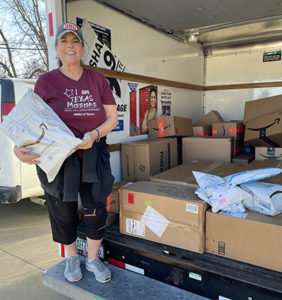
Teri Ussery from Woman’s Missionary Union of Texas helps unload packages from an Amazon gift registry that WMU groups and individuals bought for Mary’s House. (Southwestern Seminary Photo)

Texas WMU provided all the furnishings, and Baptist Women around the state purchased household goods, selecting from among more than 100 items on an Amazon registry.

“The dream was for a missionary family to be able to walk into Mary’s House with suitcases in hand and immediately move in,” Ussery said.

Jones and Ussery, along with Texas WMU President Earl Ann Bumpus and Beth Campbell, project manager for the Mary Hill Davis Offering, participated in a Jan. 13 ribbon-cutting ceremony for Mary’s House.

Jones emphasized the desire of Texas WMU to show love and support to missionaries.

“We want to care for them, so that whenever God does send them back out, or while they’re just serving here, they feel that love and they’re able to then pour that back out to continue to do what [God] called them to do. So, we’re excited to be a part of this,” Jones said.

Joining the Texas WMU representatives for the dedication service were Ian Buntain, current director of the World Mission Center; John Massey, dean of the Roy J. Fish School of Evangelism and Missions; and Matt Queen, interim provost at Southwestern Seminary.

“I’m so grateful that in Texas, these women are dreaming dreams about a place like this where missionaries can not only have sanctuary, but where this place can be a sanctuary for students who will have exposure to normal missionaries,” Buntain said.

First family moves into Mary’s House

Holley and Thomas Sieberhagen, missionaries to Belgium, moved into Mary’s House with their two children. (Southwestern Seminary Photo)

The first family to move into Mary’s House were Thomas and Holley Sieberhagen and their two children. The Sieberhagens serve with the International Mission Board as church planters among the French-speaking population in Belgium.

“When you’re on stateside [assignment], you don’t just need time to kind of detox and rest from a busy term the year is coming to. You also need a place where you can really recharge and spiritually get ready for the coming term and to go back,” Thomas Sieberhagen said. “Having a place like this is just the perfect place to be able to do both those things.”

A second family—who serve overseas in an undisclosed location and whose identities are protected for security reasons—moved in soon after the Sieberhagens.

Ray—the World Mission Center director and missionary to South America who first envisioned the on-campus home for missionary families—died unexpectedly in 2020 before having the opportunity to see the project completed.

But Ussery is not so sure about that.

“It all began with Brent Ray. His vision started the process,” she said. “I have to believe he is a part of that great cloud of witnesses, looking at what has been done and smiling at the fulfillment of that vision.”

With additional reporting by Ashley Allen of Southwestern Baptist Theological Seminary.


Texas plane crash kills four from Tennessee church

YOAKUM (BP)—A plane crash in Lavaca County killed four members of Harvest Church in Germantown, Tenn., and left one person hospitalized.

Bill Garner, the church’s executive pastor, was among those killed. Lead pastor Kennon Vaughn was reported in stable condition in a Victoria hospital after surgery.

Tyler Springer, a native of Denton, also was among the fatalities. He is the eldest son of Brad Springer, executive director of Camp Copass.

A notice on the Camp Copass Facebook page requested prayer for Brad and Denise Springer.

“We are all mourning the loss of their oldest son. … While our hearts are heavy, we do not grieve like those who have no hope, because Tyler trusted Jesus Christ as his Savior.”

According to a statement Harvest Church posted on social media, other church members killed in the crash were Steve Tucker and Tyler Patterson.

According to the Memphis Commercial Appeal, Tucker was pilot of the fixed-wing, single-engine plane when it crashed around 11 a.m. on Jan. 17 about a mile from Yoakum Municipal Airport, about 40 miles north of Victoria.

The cause of the crash is under investigation.

Harvest Church, a Southern Baptist congregation, released a statement on social media saying the four individuals who were killed “were beloved members of Harvest Church, and their loss currently leaves us without the proper words to articulate our grief. … We ask for your prayers and kindly request that the families of all involved are given the proper space to grieve at this time.”

Camp Copass provided an online platform where individuals can express condolences and offer words of comfort to the Springer family. To access the site, click here.

Compiled by Lonnie Wilkey, editor of the Baptist and Reflector in Tennessee, with additional reporting by Baptist Standard Managing Editor Ken Camp.


BGCT search committee accepting nominations

DALLAS—The search committee is accepting nominations for the next executive director of the Baptist General Convention of Texas through Jan. 31.

As noted in the search prospectus and job description posted on the Texas Baptists’ website, the next executive director will provide the comprehensive spiritual, visionary, relational and organizational leadership necessary to ensure the effective implementation of the BGCT’s mission.

The search committee is seeking an individual who is an active member in good standing of a Baptist church uniquely aligned with the BGCT and who is capable of serving ably as the Christ-centered spiritual leader of the BGCT.

Nominators will need to provide information about themselves and the nominee, including church membership and affiliation status, as well as a description of why they believe their candidate would be fit for the role.

Following the Jan. 31 deadline, the committee will begin a confidential review of the candidates. Nominees will be informed of their nomination and asked to provide additional information about themselves, including verifying their contact information, completing a formal application for the position and submitting their current professional resume.

Search committee updates can be found by clicking here. Nominations may be sent to search@texasbaptists.org.

The search committee was formed in July 2022 following former Executive Director David Hardage’s retirement announcement. David Mahfouz, pastor of First Baptist Church in Warren, serves as committee chair.