DBU launches Ministry Fellowship Program

The Graduate School of Ministry at Dallas Baptist University has launched a Ministry Fellowship Program offering fully accredited classes for participants in residency programs at partnering churches.
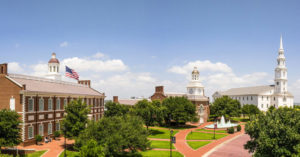
(Photo by Shannon Faulk)

Residents who complete required courses in a specific area of study earn an advanced certificate from DBU that enables them to transfer courses directly toward a master’s degree in the student’s respective field of ministry.

Areas of specialization include children’s ministry leadership, Christian counseling, education ministry leadership, family ministry leadership, global leadership, special needs children’s ministry, theological studies and worship studies.

“The Ministry Fellowship Program was developed out of DBU’s desire to be a kingdom resource to churches who either already have a residency or internship program or are in the process of developing one,” said program director Shelly Melia, associate dean of DBU’s Graduate School of Ministry.

“Previous church staffing models relied on ministers attending seminary prior to serving in a local church. However, a growing number of new ministers often serve in a church without any formal theological training. The Ministry Fellowship Program is designed to provide theological education alongside the valuable practical experience a resident is getting while serving inside the local church.”

Through a private donation, DBU can partner with a local church to provide an advanced certificate in ministry to the church’s resident or intern at no tuition cost to the student.

“This partnership has been a great blessing at just the right time as we are building a younger team with very gifted residents and ministers,” said Isai Cazares, discipleship pastor at Northwood Church, a Baptist General Convention of Texas-affiliated congregation in Keller.

“This program has facilitated our intentional development of these young leaders but also has elevated their sense of the experience of being on the Northwood team. It communicates clearly to our students that we care about them and their ongoing professional development.”

Becoming a partner of the program “was a no-brainer opportunity for us, especially when we learned how easy the process to get started and onboard a new student was,” Cazares added.

“We were motivated by this partnership because we knew the quality education students at DBU receive. Because of the list of learning focuses, the Ministry Fellowship Program is able to aid in providing the specialized learning and tools needed to further equip our interns, residents and young staff,” he said.

“It allows us as a ministry staff to focus more on providing the opportunities and environment for them to gain hands-on ministry experience and ensure they are healthy disciples.”

Dan Gibson, vice president for graduate affairs, expressed excitement about the opportunity to partner with churches through the program.

“The Ministry Fellowship Program equips ministers in their respective fields of calling, while also being a kingdom resource to their church and congregations. We are incredibly grateful for the generosity of our partners to make this endeavor a reality,” Gibson said.

In addition to Northwood Church, other participating congregations include The Heights Church in Richardson, Cornerstone Baptist Church in Dallas, Oak View Baptist Church in Irving, Longbranch Community Baptist Church in Midlothian, Fielder Church in Arlington and Valley Ranch Baptist Church in Coppell.

Other Texas churches participating are El Buen Pastor Church in Fort Worth, Community Life Church in Forney, Northwest Bible Church in Dallas, Champion Forest Church in Houston, Cross Creek Church in Colleyville, Igreja Batista Brasileira in Bedford, Stonegate Church in Midlothian, Rush Creek Church in Arlington and The Avenue Church in Waxahachie.

Two out-of-state congregations also are participants in the program—King’s Covenant Church in Bridgewater, N.J., and Primera Iglesia Bautista in Pompano Beach, Fla.

Based on reporting by Dallas Baptist University’s communcations office.


CLC consultant testifies against Texas Lottery budget

AUSTIN—Texas lawmakers recognize Rob Kohler as a steadfast gambling opponent who often has testified before legislative committees in the past two decades. But Kohler never testified in opposition to the Texas Lottery’s budget—until last week.

Kohler, a consultant with Texas Baptists’ Christian Life Commission, testified before the Senate Finance Committee.

He opposed the budget because the Texas Lottery Commission changed its rules during the COVID-19 pandemic to allow lottery ticket sales by phone via the internet using third-party companies rather than appearing in person at a licensed retailer.

“In many instances, these are offshore gambling companies,” Kohler told the committee. “What it used to mean to play the lottery has changed. From 1992 when we first started until August 2022, it was a face-to-face interaction.”

In fact, the Texas Administrative Code stipulates that a lottery player must be “physically present” at a licensed terminal location. The statute specifically prohibits the sale of lottery tickets “by mail, phone, fax, or other similar method of communication.”

However, in summer 2020, the Texas Lottery Commission “went through a rulemaking process that in essence changed what it means to sell lottery tickets in this state,” Kohler said.

The Texas Lottery changed the rules to delete the “present at the terminal” language and to make possible selling instant scratch-off game tickets by phone. The commission also changed a rule that said a retailer “shall not accept telephone or mail-in requests to issue a ticket.”

“We strongly believe you have the authority to change these things. We respect the process, and we think it should be done in the open by the people that are elected by the citizens of this state—not state agency staff,” Kohler told the Senate committee.

In discussion following Kohler’s testimony, some senators on the committee noted concern about the addictive nature of lottery ticket sales over the phone, as well as opposition to the process by which rules were changed.


TBM disaster relief teams continue ice storm response

Hurricanes typically are named. Most other disasters are not. But due to its devastating impact, February’s Texas ice storm received a name—Mara.

Since the winter storm, TBM has received 335 requests for help. Of those, 254 projects have been completed, and 81 remain to be processed. Almost all of the jobs required the work of chainsaw crews. (TBM Photo)

Winter Storm Mara no longer is in the news, but Texas Baptist Men disaster relief chainsaw volunteers still are active more than three weeks after the ice storm and expect to wrap up this week.

Since the storm, TBM has received 335 requests for help as of Feb. 20. Of those, 254 projects have been completed, and 81 remain to be processed. Almost all of the jobs required the work of chainsaw crews. To date, TBM disaster relief workers have given 8,727 total volunteer hours.

“We expect the work to continue through the week,” said David Wells, director of TBM disaster relief. “That’s a month’s worth of work, and our volunteers are responding extremely well. The devastation is really widespread and extensive.”

Volunteers from Waco Regional Baptist Association were among those responding to the damage in Temple, where resident Alexis Weldin told KXXV News, “I’ve never seen it where tree limbs were just snapping off, just breaking and slamming down to the ground.”

She expressed special appreciation for TBM Disaster Relief volunteers, saying, “It takes a giant burden off of you to have that resource out there to come and help.”

Three TBM chainsaw teams remained active in the field Feb. 20, plus several teams responding in their local areas.

All work is being coordinated by an Incident Management Team at TBM headquarters in Dallas and by site coordinators at Temple and Austin. Assessors have completed their work and returned to their home locations.

Volunteers provide trained labor, but safely removing downed trees and limbs requires heavy-duty equipment, Wells said.

Heavy equipment operators supported the chainsaw crews’ work with three man-lifts and two skid steers. Two feeding teams and two shower and laundry units also supported other TBM disaster relief volunteers.

“TBM Disaster Relief is built on volunteer service and the funds to support their work in the field,” he said. “It takes a lot, and TBM’s volunteers and supporters give a lot.”

To donate financially to TBM disaster relief, click here or mail checks to Texas Baptist Men, 5351 Catron Drive, Dallas, TX 75227.


Committee affirms BGCT-Baylor relationship

DALLAS—The Baptist General Convention of Texas Executive Board heard a committee report affirming Texas Baptists’ relationship with Baylor University and a prayer challenge from the BGCT president.

Jeff Williams, pastor of First Baptist Church in Denton and chair of the BGCT institutional relations committee, told the board his committee unanimously voted to affirm the existing relationship agreement with Baylor for the next 10 years.

The terms of the agreement call for its review every 10 years. The last time the agreement was approved was Nov. 4, 2011. Its regularly scheduled review was delayed due to the COVID pandemic.

Since there were no changes in the agreement, no board action was required.

Baylor has related to the BGCT by had a special agreement for more than three decades. However, Baylor’s relationship to Texas Baptists dates back to its founding in 1845.

“For 178 years, Baylor and Texas Baptists have served side by side to shine a light on God’s kingdom across Texas, the United States and worldwide,” said Baylor President Linda A. Livingstone.

“We remain firmly rooted in our shared history, and Baylor remains committed to maintaining our historic, mutually beneficial relationship with the BGCT and Baptists in Texas. We look forward to continuing our special relationship over the next decade and beyond.”

“The BGCT is optimistic about continuing this mutually beneficial special relationship agreement with Baylor University for another ten years as together we prepare Christian leaders for service in and through Texas Baptists’ churches,” said BGCT Associate Executive Director Craig Christina.

“This relationship enables the BGCT to offer a positive, Christ-centered influence on the issues confronting Baylor’s campus, will strengthen the presence of Baptist Student Ministry on Baylor’s campus, and will ensure our continued partnership with the George W. Truett Theological Seminary.”

At the Feb. 21 Executive Board meeting in Dallas, BGCT President Julio Guarneri, lead pastor of Calvary Baptist Church in McAllen, called on board members to encourage their churches to participate in seven weeks of prayer.

Specifically, he is urging Texas Baptists to pray “your kingdom come”—as Jesus did in the model prayer—beginning the day after Easter and continuing until Pentecost, April 10 to May 28.

“Pentecost did not come without prayer,” Guarneri said, pointing to Acts 2. “It’s not that we can pray down revival, but we can put ourselves in a posture to receive revival when God sends it.”

The specific objective is to “engage Texas Baptists in a concerted prayer effort for God’s kingdom to come in the work of our churches, institutions, associations and churches.”

He offered a guided week-by-week prayer focus that can be downloaded here.

Taking care of business

In a routine business session, the BGCT Executive Board approved a recommendation from its finance committee to allocate $425,000 in available funds from the JK Wadley Endowment Fund, with $150,000 dedicated to Baptist Student Ministry campus missionary interns, $150,000 to BSM building maintenance, $50,000 for a cross-cultural mobilizer, $50,000 for western heritage ministry and $25,000 for MinistrySafe child protection.

The board also approved a committee recommendation to elect Allison Howell from First Baptist Church in Nederland to fill a vacancy on the Executive Board.

At the recommendation of the committee on nominations for boards of affiliated ministries, the Executive Board elected:

  • Belinda Reyes from Park Cities Baptist Church in Dallas, Sam Medina from One Accord Fellowship Church in Lubbock and W.H. “Bill” Brian from First Baptist Church in Amarillo to the board of trustees at Baptist University of the Américas.
  • Tyler Cooper from Park Cities Baptist Church in Dallas to the Baylor University board of regents.
  • Drue Pounds from First Baptist Church in Grapevine and Daniel Stahl from Vista Community Church of Bell County in Temple to the board of trustees at Hardin-Simmons University.
  • Rodrick Robinson from First McKinney Baptist Church in McKinney to the Baylor Health Care System board of trustees.

EDITOR’S NOTE: This article originally was posted Feb. 21. It was updated Feb. 22 to include additional quotes provided by Texas Baptists’ communications office.


Jemar Tisby offers lessons from an ‘evangelical reject’

WACO—Predominantly white spaces—particularly in evangelical circles—seldom welcome African Americans who focus on racial justice, author Jemar Tisby told a conference at Baylor University’s Truett Theological Seminary.

 “If you persist in fighting racism in predominantly white spaces long enough, you will either sell out, burn out, or get pushed out,” said Tisby, author of The Color of Compromise and How to Fight Racism.

Tisby was the closing keynote speaker for a conference called “Time to Wake Up: Racism in the White Church.” The event—the second in a three-year series focused on racism and the church—was made possible by a grant from the John and Eula Mae Baugh Family Foundation.

As a Christian who came to faith in a predominantly white evangelical church and attended a predominantly white Reformed seminary in preparation for ministry in a predominantly white denomination, Tisby considered himself “pushed out.”

He offered what he called “seven lessons from an evangelical reject,” based on his experience:

  • “There is a difference between intent and impact.”

He recalled the high school youth group where issues of race never were acknowledged.

“The issue wasn’t what they said. It was what they didn’t say. It’s not what they did. It’s what they didn’t do,” Tisby said.

“I felt invisible. … They never once did anything malicious. … But the impact was real. The impact was that I was in but not of.”

  • “Priestly proximity builds empathy.”

After he graduated from Notre Dame University, Tisby joined the Teach for America program. His assignment was to teach sixth graders in the Arkansas Delta.

“I was confronted with a reality I had never been immersed in before,” he said.

Tisby served in the nation’s fourth-poorest county in a town where 43 percent of the residents lived at or below the poverty level.

Working first as a classroom teacher and later as a principal, he learned “up close” about the lives of Black children trapped in generational poverty for reasons that date back to the era of chattel slavery.

While the Bible had much to say about the kind of injustice he witnessed, Tisby said, his church had nothing to say about the subject.

  • “There is a difference between racial reconciliation and racial justice.”

Evangelicals emphasize individual accountability and interpersonal relationships, Tisby observed. So, their idea of racial reconciliation is focused solely on building relationships.

“Fighting racism takes more than handshakes and hugs,” he said. “It takes more than a pulpit swap. It takes more than a heart-to-heart conversation over a cup of coffee or tea where we pour out our life stories, share and hug it out in the end.”

The white evangelical emphasis on individual accountability and relationship building is accompanied by a mistrust of systems and structures that makes any discussion of systemic racism “off-limits.”

 “Black lives matter” emerged as a “heart cry” and “expression of lament” after police shootings of young Black men, Tisby noted. And when whites countered by saying, “No, all lives matter,” many Black people felt their pain was minimized and they were misunderstood.

“‘Black lives matter’ doesn’t mean ‘only Black lives matter.’ ‘Black lives matter’ means ‘Black lives matter, too’—as well as, in addition to, ‘all lives matter,’” he said.

  • “Sometimes, you have to build your own table.”

Too often, white institutions may want Black faces in the crowd, but they don’t want Black voices speaking from their own experience, Tisby said.

“They value our presence but not our perspective. They value our faces but not our feelings. They like our attendance but not our experience,” he said.

Rather than continuing to work within predominantly white structures where they are not valued, asking for a place at the table, it sometimes may be best for Black people to create their own structures, he noted.

  • “Justice takes sides.”

“There’s an oppressed and an oppressor—which is Bible language. You’ll see on the Internet all the time, ‘To say the word—oppressed—is CRT.’ No, that’s Bible. Look it up,” he said.

Too often, any discussion of racial justice is discounted as “woke” or branded as “critical race theory,” he said.

When Tisby spoke at Grove City College in October 2020, he described his on-campus reception as “tense but polite.”

However, a year later an online petition—Save GCC from CRT—circulated, and the board of trustees created a special committee to investigate “mission drift” within the institution. The committee produced a report the trustees voted to receive and adopt.

In part, the report stated: “Most of those in GCC leadership with whom we spoke observed that ‘the Jemar Tisby that we thought we invited in 2019 is not the Jemar Tisby that we heard in 2020 or that we now read about.’ They allow that, in hindsight, inviting Mr. Tisby to speak in chapel was a mistake.”

Since the reaction rose to the level of official action by a university’s governing board, Tisby said he chose to speak up. He noted his views on racial justice were formed by the study of history and Scripture—not a study of critical race theory.

Tisby wrote: “History and Jesus will determine whether my words were divisive and un-Christian and whether the actions of the Grove City College committee represented a defense of the “faith once and for all delivered to the saints” (Jude 3).

 “We are living in times that call us to take sides, either the side of justice or injustice. The side of righteousness or unrighteousness. Choose this day whom you will serve … and what Christian college or university you will support.”

  • “Go where you are celebrated, not tolerated.”

In recent years, Black worshippers began what originally was described as a “quiet exodus” from predominantly white evangelical churches.

In response, Tisby and others promoted #LeaveLoud—a call for Blacks to reclaim their dignity from institutions where they did not feel valued.

Institutions cannot “repair hurt and harm” unless they hear the stories from those whom they have injured, he said.

Last fall, Tisby accepted a faculty position as professor of history at Simmons College, a historically Black institution in Kentucky.

  • “Be strong and courageous.”

Tisby pointed to the promise of Joshua 1:9—if God’s people show strength and courage, and if they step out in faith, they can be assured of God’s presence.

 “If you want a closer walk with Jesus, then you need to step up and be strong and courageous,” he said. “When you stand up for racial justice, you are on God’s side. Why are you timid? What are you afraid of?”


Beth Moore: Does God value justice? Read the Bible

White evangelicals who fail to stand against racism and injustice need to read their Bible, Beth Moore told a crowd at Baylor University’s Truett Theological Seminary.

“How do people who claim to love God and place such a high value on Scripture place such a low value on justice?” Moore asked participants at a conference titled, “Time to Wake Up: Racism in the White Church.”

Moore described how the study of Scripture and several national events beginning with the 2012 killing of Trayvon Martin prompted her halting pilgrimage toward social justice that gained clarity “when the fog started clearing” in 2016.

“I need you to think of me on this journey toward anti-racism as a middle-schooler at best. … Know that I have just begun my own journey,” she said. “I have been part of the white church and of white thinking within the church all my white life.”

Moore described growing up in Arkadelphia, Ark., where she never heard racism mentioned at church.

“There was no need to make a big deal about race in my church. We were as white as our walls­—whiter than snow, you might say. Just the way many of us would have told you God preferred it,” she said.

‘Fear was a core value’

She recalled her churchgoing and Bible-reading grandmother standing at the window watching her and her older sister cross the street each morning to make sure they arrived safely at school. She feared they would  be raped by the Black young men sitting on the schoolhouse steps.

“You need to understand, fear was a core value in my home. I might suggest it also is a core value in our country. And God help us, has it ever been a core value in the white church,” Moore said.

“If you want to control us, tell us everything is a threat—that everything is at stake every minute and everything is a slippery slope.”

Even as a young school girl, she understood her grandmother’s racism was wrong, but only because she “took it too far.” To many in majority-white culture—and certainly in the white church—there is an acceptable level of racism, as long as it isn’t taken too far, she asserted.

At age 41, when Moore wrote the “Breaking Free” Bible study, it included a session on the stronghold of racial prejudice, and she said her church honestly wanted to become more diverse but didn’t know how.

“I believed that generations of deep bonds to racism had been broken in my generation and in me by the very grace of God,” she said.

Slow awakening to racism

In the years that followed, she confessed she was so busy leading Bible conferences she did not pay attention to social issues that would have made it clear racism was still prevalent.

“At that time, such things as the titanic need for criminal justice reform had not even registered with me,” she said. “But disturbance did come stubbornly, and it did refuse to depart.”

Moore recalled the murder of Trayvon Martin in 2012 and how white evangelical churches for the most part chose to “remain deafeningly silent.”

Then came the presidential election in 2016, at which point the evangelicalism she had known became “completely unrecognizable,” she said.

“What became increasingly and startlingly clear was that our politics informed our faith, rather than our faith informing our politics,” Moore said.

“And we can’t even see it. … I’ve been so much nicer on Twitter than I wanted to be. What I wanted to say is: ‘You’re not reading your Bible. You’re not reading the very Bible you are quoting. When your favorite verses are the ones that somehow support your sins and strongholds, something has gone terribly awry.’”

White supremacy is “deeply ingrained” in much of white culture and white churches, it requires “hard work” to uproot it, she said.

White evangelical Christians need to humble themselves enough to learn from the experiences of Black brothers and sisters, Moore said.

The Bible tells me so

Any injustice is too much injustice according to Scripture, she asserted, pointing to examples from the Hebrew prophets, the Gospels and the New Testament epistles.

“You cannot read the Bible through and through, you cannot read the whole counsel and get to the end of it and think justice is not a matter of great gospel importance to God,” Moore said.

She particularly cited the teaching of Jesus, echoed in the epistle of James, that the royal law is to love one’s neighbor as oneself.

“We have come to a point in time when even to put ‘love your neighbor’ on social media is to be called ‘woke,’” she lamented.

White Christian Americans have been reluctant to condemn injustice because they have benefitted from it, Moore asserted.

“Racism and injustice are not in step with the gospel,” she said.

Gradual healing from racism

Speaking from her own experience, Moore said white Christians need to examine closely the attitudes and beliefs about race that have shaped them.

“The question is not whether we have absorbed it. The question is how deeply and invasively we have absorbed it,” she said.

Too often, white evangelicals want ethnic diversity, but only if they remain in authority and “control the narrative,” she said.

Given the pervasive power of racism, the process of moving toward anti-racism can be a slow and awkward process, Moore said.

She pointed to the story in Mark 8 in which Jesus healed a blind man haltingly and gradually. After Jesus spit on the man’s eyes and laid hands on him, the blind man said he saw people “as trees walking.” So, Jesus again touched him, and the man then saw clearly.

“I’ve got such a long way to go in my healing,” Moore said. “I’m just going to keep saying to Jesus, ‘Keep touching them, spit on my sight, until I see people the way you see people.’”


Abbott highlights education issues in speech

In his State of the State address, Gov. Greg Abbott highlighted “education freedom” and school safety among his priorities for the Texas Legislature.

Speaking from a venue in San Marcos on Feb. 16 rather than the Texas Capitol, Abbott identified seven emergency items for state lawmakers to act upon immediately.

The emergency items included creating state-funded education savings accounts parents can use for private schools, improving school safety and addressing the fentanyl crisis.

Cutting property taxes, ending COVID-19 pandemic restrictions, reforming bail policies and securing the border with Mexico rounded out the governor’s list of emergency items.

Normally, state lawmakers cannot pass legislation until after the 60th day of a legislative session. However, the governor has authority to designate emergency items that can be approved prior to that date, which is March 10 this year.

State-funded accounts for private schools

Abbott stressed a need to “empower parents”—both by giving them greater influence over curriculum and library content, and by enabling them to access state funds for private schools.

“Let’s be clear. Our schools are for education, not indoctrination,” Abbott said. “Schools should not be pushing a woke agenda—period.”

He also voiced support for “education freedom,” specifically access to taxpayer-funded education savings accounts for private school tuition or homeschooling costs.

A broad coalition of rural Republicans and urban Democrats repeatedly has rejected similar voucher-style programs for more than two decades.

Turning to the issue of school safety, Abbott called for lawmakers to enhance safety standards and provide more mental health professionals in public schools.

Response to voucher-style program

John Litzler, public policy director for the Texas Baptist Christian Life Commission, affirmed the governor’s emphasis on school safety but called his support for taxpayer-funded education savings accounts “misguided.”

“Voucher programs would leave the poorest and most vulnerable Texas children in increasingly underfunded schools. The CLC is grateful for and proud of the schools that join in cooperative ministry with Texas Baptists. But no Texas resident should be compelled, through taxation, to provide for religious education to students,” Litzler said.

“Texas is behind the national average for public student funding by over $4,000 per student. Texas is behind the national average for public school teacher salaries by over $7,500 per teacher. The real emergency item for the Texas Legislature this session is properly funding public education, not diverting tax dollars to private schools.”

‘Egregious moral violation’

Charles Foster Johnson, executive director of Pastors for Texas Children, asserted Abbott’s support for a state-funded program to benefit private schools is based on the governor’s national political aspirations.

“So, he has tied up the entire legislature this session, at the cost of millions of tax dollars, in his own petty personal political agenda,” Johnson said.

In a public statement, Pastors for Texas Children said: “Using public tax dollars, taken from our 5.4 million Texas schoolchildren, to underwrite the private education of a few is an egregious moral violation.”

Furthermore, the organization said using “public funding to advance and establish religious programs in private schools” violates the First Amendment to the U.S. Constitution and separation of church and state.

“Pastors for Texas Children calls upon the Texas Legislature to stand firm for the true Texas conservative value of universal education for all Texas schoolchildren, provided and protected by the public, by defeating a private school voucher policy once again,” the organization stated.

In response to a surge in fentanyl deaths in Texas, the governor said, those cases should be prosecuted as murder. He also called for expanded access to Narcan, a drug that reduces overdoses.

Litzler applauded the emphasis on addressing the fentanyl issue.

“We share the governor’s concern on the fentanyl crisis in Texas and support all legislation that would cultivate a culture of life. Increasing the supply of Narcan is a life-saving and common-sense action step we support,” he said.


Faith leaders urge clemency for Death Row inmate

At least a dozen Baptists are among the 100-plus Texas faith leaders and 10 national evangelicals who have urged clemency for a Texas Death Row inmate whom they believe suffers from severe mental illness.

Andre Thomas is scheduled to be executed April 5 for the 2004 stabbing death of his estranged wife, Laura Boren; their 4-year-old son, Andre; and his 13-month-old step-daughter, Leyha Hughes.

After leaving the scene of the deadly assault, Thomas walked to his residence and stabbed himself in the chest three times. Five days later, while in the Grayson County Jail, he plucked out his right eye, citing a literal interpretation of Matthew 5:29 as his reason. Three years later, after he was found guilty and sentenced to Texas Death Row, he gouged out his other eye and swallowed it.

‘Extreme and undeniable’ mental illness

“Mr. Thomas’ mental illness is extreme and undeniable,” states a letter to Gov. Greg Abbott and the Texas Board of Pardons and Paroles signed by more than 100 Texas faith leaders representing 12 denominations and religious traditions.

Pastors Steve Wells of South Main Baptist Church in Houston, Garrett Vickrey of Woodland Baptist Church in San Antonio and Jake Maxwell of Second Baptist Church in Lubbock, along with Associate Pastor Scotty Swingler of Sugar Land Baptist Church are among the faith leaders who signed the Feb. 15 letter urging clemency for Thomas.

“As we understand it, granting clemency to Mr. Thomas would mean that he would spend the rest of his life in a secure psychiatric prison facility and would keep Texans safe,” the letter states.

Others who signed the letter include Stephen Reeves, executive director of Fellowship Southwest; David Morgan, executive director of the T.B. Maston Foundation for Christian Ethics; Rick McClatchy, coordinator of the Cooperative Baptist Fellowship of Texas; and Pastor Frederick Haynes of Friendship West Baptist Church in Dallas.

‘Perpetuate violence and compound injustice’

The letter asserts Thomas began hearing voices in his head at age 9 and attempted suicide the first time at age 10, but his mental illness went untreated. Two days before his crime, he went to an emergency room, where he was found to be psychotic. However, he was left unattended and walked out of the hospital.

“In Andre Thomas’ case, we are firmly convinced that granting him clemency is the path of morality, faith and justice,” the letter states.

Texas failed both Thomas and his victims when he was denied the treatment he needed, Reeves said.

“As a Texan and a Christian, I cannot image what good it does for us to kill a man who is so clearly mentally ill,” he said.

“To kill him now would surely be cruel and unusual punishment. He is no threat to others behind bars, but his execution will only perpetuate violence and compound the injustice.”

‘Healing, salvation, redemption and restoration’

Swingler emphasized he signed the letter requesting clemency “not out of any political conviction, but a spiritual conviction, because I want Andre to have every opportunity for healing, salvation, redemption and restoration.”

The death penalty “puts a finite timeline on someone’s opportunity for redemption,” he said.

“In Jesus’ name, I want to give every human life every available second to be healed of their wounds and saved for God’s glory. By cutting any life short, we say ‘no’ to God’s healing power and redemptive work.”

In Thomas’ case, Christians have a duty to “pray for his mind and heart, that God would perform a miracle and heal him” Swingler said. “Ending his life is to give up on healing, salvation, redemption and love.”

Morgan said his opposition to capital punishment centers on concern “that its imposition is impacted and influenced by race and poverty.”

News reports of the Thomas trial raise particular issues, he added.

“I think the reports of racial bias in the jury—that might very specifically have impacted this case—warrant, at the least, additional investigation,” Morgan said.

Vengeance, not justice

Paul Basden, pastor of Preston Trail Community Church, a Baptist General Convention of Texas-affiliated congregation in Frisco, signed a separate letter to Abbott and the board from evangelical leaders.

Others who endorsed that letter included Walter Kim, president of the National Association of Evangelicals; Shane Claiborne, cofounder of Red-Letter Christians; and Fisher Humphreys, professor emeritus at Samford University.

“Mr. Thomas suffers from schizophrenia, which led him to horrific acts of self-mutilation throughout his time in prison,” their letter states. “He is indisputably one of the most severely mentally ill incarcerated individuals in Texas history.”

The letter asserts if Thomas had received the intervention and treatment he needed, the outcome could have been different.

“Allowing Mr. Thomas to be executed—in his permanently disabled, mentally incompetent, and vulnerable state—would serve no useful purpose other than pure vengeance, which we believe is not something Christians can or should pursue,” the letter states.


Belief and Belonging Festival explores evolving faith

WASHINGTON (RNS)—Michael Liga was a student at Baylor University’s Truett Theological Seminary in Waco when a terrorist bombing 8,000 miles away killed 20 people and injured more than 100 in his hometown in the Philippines.

The attack, later claimed by affiliates of the Islamic State group, came as Sunday Mass was being celebrated on a late January morning in 2019 at the Cathedral of Our Lady of Mount Carmel on Jolo Island.

Walking home from class far from his family, Liga scrolled through WhatsApp messages about the attack.

“Some of the deaths included family and friends, people who took care of me when I was younger, my mom and dad’s teachers, and friends who supported my family,” Liga told Religion News Service. “I remember my aunt showing me pictures of bodies decapitated and it was so traumatic. It brought a lot of anger, sadness, numbness.”

Liga, now a hospice chaplain at the Mayo Clinic in Minnesota, wrestled for years with spiritual questions, trying to make sense of the attack, but he had never talked about them publicly.

Then, in November, he was invited to speak at the Belief and Belonging Festival in Waco, an event dedicated to exploring the notion that when our beliefs shift, it changes how we fit into our belief communities.

Event examines belief and belonging

The festival is the brainchild of Sharyl West Loeung, a consultant on social change who has worked on diversity and inclusion issues at Baylor University and for the Baptist General Convention of Texas, and Kristen Donnelly, a sociologist and founder of the corporate training firm Abbey Research.

The two friends, who had met in seminary at Truett, had dreamed up the festival early in 2022 while West Loeung was visiting Donnelly in Philadelphia and a winter storm hit. They spent the time dreaming up a forum that could get to themes about Americans’ evolving beliefs and their changing notions of belonging, conversations they felt were missing in civic life.

“In my experience, there are two basic platforms—stages for nonreligious content, and religious conferences that want nothing too political, personal or issue-based,” West Loeung told RNS.

To fill this gap, West Loeung and Donnelly, both TEDx veterans, wanted to create an event where people could explore experiences that were inclusive and diverse and that broke open participants’ and audiences’ assumptions about their faiths and what it means to belong or to leave them.

“Even if we vehemently reject a religious tradition of our childhood, the very nature of acting in antithesis of that system still leaves us orienting around it,” said West Loeung.

“If we’re going to be so shaped by our religious traditions, rejection of religion, former traditions or quest for a new worldview that fits, we should learn how to talk about all these things openly in our community settings.”

Mariah Humphries

In the inaugural festival in November, held at University Baptist Church in Waco, educator and author Mariah Humphries talked about navigating between her Native American and Christian identities.

Sofi Hersher Andorsky, founder of Grand View Strategies, spoke about the lessons she learned about pluralistic democracy while preparing her Jewish wedding.

Noor Saleh, a government relations coordinator at Minaret Foundation, a Muslim civic organization, encouraged the audience to talk to people different from themselves to replace their biases with those people’s stories.

Engaging with people who think differently

Saleh told RNS she has cultivated a passion for engaging people who think very differently from her, for the sake of advocating for policies such as child welfare and food security that should not be partisan issues.

“Once you reach across divides and start creating those relationships,” Saleh said, “you realize that they’ve got opinions and I disagree with many of them, but I also have to recognize that this is the way they’ve experienced the world, which is different from the way I’ve experienced the world, and we can find common ground.”

Not all of the presentations were TED-esque. Poems were offered by Bob Left-Foot and Saddiq Granger, the latter accompanying himself on violin in a piece titled “Fate.” Marcus Hollingsworth, a high school teacher in Grapevine, concluded his talk about the role of Baptist hymns in his journey to reconcile his sexuality with his family and his faith by singing a soulful bass rendition of “My Shepherd Will Supply My Need.”

Liga had known West Loeung when she was at Baylor working in interfaith campus ministry. They had had conversations then about his evolving understanding of Islam during his time in Texas, and she invited him to close the festival as the last speaker.

Describing his experience of the 2019 terrorist attack in his hometown and the violent history of Muslim-Christian relations in the Philippines, Liga used the extended metaphor of Japanese Kintsugi—the art of repairing broken pottery with gold lacquer to make something more beautiful out of something broken.

Liga told of meeting a Muslim woman in the interfaith group at Baylor and forging a friendship even as he was still struggling to trust members of the religion he had known as a group that had killed people he knew and loved.

As the Muslim woman and he became closer, Liga shared his feelings of anger and mistrust. He told the festival audience this young woman, his good friend, told him though she was not responsible for the violence, she was deeply sorry for what Liga and his community experienced.

These words, given to him freely by a friend in a moment without fear, changed his life, Liga said.

“Sharing this story onstage, I felt really empowered. In life, I have had many things taken away from me. As an immigrant, my language, my sense of belonging, my sense of independent thought, coming from a church background that says you kind of have to believe this certain way,” he said. “I never had that freedom to think for myself in many ways. This process was something to reclaim about myself that I can speak authentically about who I am.”

Now planning the second Belief and Belonging Festival for October of this year, West Loeung and Donnelly believe the need for the conversations that address the reorganization of many religious communities is only starting.

“If you look at the data from Pew Research,” West Loeung said, “things are changing quite a bit, and we need to seriously look at the migration of belief, whether it is along the lines of changing orthopraxy or orthodoxy, and people’s emotional needs—how they respond to whether their communities have supported them in difficult times.”


Personal experience births ministry to strengthen families

WACO—Byron and Carla Weathersbee experienced every parent’s worst nightmare when their 2-year-old son was diagnosed with cancer.

During his two years of medical treatment, the Weathersbees also experienced the love of their family and their church in an unforgettable way.

“They strengthened us during that time. They deepened our faith, our love for [Christ], for the church, and for family” Carla Weathersbee said. “[They] just showed us what is valuable.”

Having experienced the love of a family and a Christ-centered church, Carla said she and her husband “came out of that season really excited” to give back in a way that would benefit churches and other families in the future.

Waco-based Legacy Family Ministries was born five years later from the Weathersbees’ dedication and desire to serve.

Prepare and equip couples

Since 1995, Legacy Family Ministries has sought to prepare, equip, and restore the relationships and marriages of couples and families. Whether pre-engaged, engaged, newly married, or married with children, Legacy strives to connect couples with resources to help them prepare and establish a Christ-centered marriage.

With combined backgrounds in ministry and higher education, the Weathersbees built Legacy upon a wealth of information and experience with which to carry out their calling.

 Today, Legacy Family Ministries offers marriage preparation classes, small-group Bible studies, retreats, counseling, books and a podcast geared toward couples and families.

The Weathersbees see it as a way to fulfill their mission of passing along biblical principles from one generation to another.

Carla Weathersbee explained Legacy seeks to prepare couples “on the front end [for] how to have a godly marriage” and “helping them build a strong foundation” centered on Christ.

“We want them to live for a story that’s bigger than themselves,” she said.

Countdown to marriage

A couple work through Countdown Marriage Prep materials from Legacy Family Ministries. (Legacy Photo)

Legacy offers three Countdown Marriage Prep class options. The six-week class includes weekly small-group sessions and concludes with a weekend retreat.

The “weekender” class is a condensed version of the six-week class that allows couples to cover the material on their own but still offers the opportunity to attend the weekend retreat.

Legacy also offers an entirely online version of their preparation course. It allows couples to access material at their own pace with no commitments to meet in person.

Countdown classes equip couples with “biblical, experiential, authentic, relational and practical” tools to help them prepare for and succeed in their upcoming marriages, the ministry explains on its website.

The Weathersbees have also written many books, including two curriculum workbooks, as well as a standalone pre-marriage guide titled before forever. A podcast, blog and additional information is accessible through the Legacy Family Ministries website.

Biblical foundation and life experiences

The Weathersbees outline a clear and definitive statement of faith based upon both biblical teachings and their own experience as a married couple of almost 40 years.

On June 16, 1984, Carla and Byron married in the midst of finishing up their undergraduate work at Baylor University. Carla continued her education in the area of exercise physiology, and Byron went on to earn a Master of Arts in Religious Education degree and a Doctor of Education degree in leadership from Southwestern Baptist Theological Seminary.

The couple then began their careers in ministry, serving on church staff for more than 15 years. Byron also served as vice president for student life at the University of Mary Hardin-Baylor.

Their combined educational and ministerial experience helped them create Legacy Family Ministries and develop the many resources they offer today.

Legacy offers its  resources to couples in all stages of their relationship, but the Weathersbees strongly feel called to minister to those either pre-engaged or engaged.

Byron explains these couples are experiencing a “critical decade” between the ages of 18 and 28.

“The decisions they’re making now will impact what’s going to happen 10, 15, 20…50 years from now,” he said.

‘Walk into marriage with eyes wide open’

Pastor John Durham at Highland Baptist Church in Waco recommends Legacy to all young couples in his congregation.

“It is a biblically based, robust, thorough and unbelievably helpful program for engaged couples who want to walk into marriage with their eyes wide open,” Durham said.

Highland Baptist has hosted the Weathersbees for sessions and seminars, and the church uses their books and written curriculum in couple-led studies.

Over the years, Highland has sent “somewhere between 200 and 250 couples” to Legacy, Durham said, including his own son and daughter and their fiancées.

“I know very personally how great of a job Legacy Family does and have seen the benefit in my own family of their outstanding counsel and program,” he said.

Legacy recognizes the need and importance for guidance during the crucial beginning stages of a marriage, and it helps churches minister to their young couples.

That preparation is “vital,” Byron said.

“The first 18 months of a marriage set the patterns and the pace for the first five years,” he said. “And those first five years are foundational to sustain [a marriage] for the next 50.”

Rose Comstive, a student at East Texas Baptist University, is serving this semester as an intern with the Baptist Standard.


Fostering Hope Amarillo cares for children and families

AMARILLO—Sydney and David Rieff know the Texas foster care system has great needs, and they choose to be part of the solution.

The Rieffs are directors of Fostering Hope Amarillo, a ministry of First Baptist Church in Amarillo. The ministry seeks to help children, families and agencies in the Amarillo area involved in foster care or adoption.

As a guide to their life’s work, the Rieffs have adopted as their own the proverb: “God doesn’t call the equipped. God equips the called.”

The Texas Baptist Hunger Offering helps Fostering Hope purchase and provide groceries to struggling families and youth who age out of the foster care system.

Funds made possible through the offering also provide meals for newly placed foster families, as well as refreshments for foster care agency events.

David Rieff recalled a grandmother who had to take in children and a newborn baby because the mother was on drugs. Diapers and food provided through the Texas Baptist Hunger Offering was a blessing to that grandmother, he noted.

Works with agencies to help families

Fostering Hope works in cooperation with Buckner Children and Family Services and other agencies not only to provide care for those already in the system, but also to work “upstream” to address factors that result in children being placed in foster care.

“That is what Fostering Hope is about,” Rieff said. “We try to help and understand why more and more children are being placed in foster care.”

Fostering Hope works with agencies to help reunite families when possible. The requirement that each child have his or her own bed may create financial stress in households that lack space for individual beds.

So, volunteers seek out bunk beds at estate sales and purchase new mattresses. They provide all bedding, including sheets, pillows and blankets.

Variety of gifts benefit Fostering Hope

Volunteers have different gifts, and they share them with Fostering Hope Amarillo, Rieff noted.

About a dozen women at First Baptist who like to cook prepare meals in their homes and take them to foster families. Volunteers Beverly Adcock, Meredith Creighton and Joy Souther coordinate the grocery shopping and meal preparation.

They explain how to feed a family nutritious food on a tight budget by looking for sales and buying seasonal produce when it is less expensive. Sharing recipes written on notecards is another way of serving foster families.

“Volunteers number about 75 people in Amarillo” Rieff said, noting members of First Baptist Church comprise about 90 percent of the volunteer base.

“They pray for the individuals and families. In fact, they are the hands and feet of Jesus. They all have a specific niche to fill,” he said.

Sydney Rieff uses her background in banking, management and organization to handle much of the administration of Fostering Hope.

Care boxes for youth aging out of system

Any youth who was in foster care in Texas can go to a state university or trade school and receive a tuition waver from the state. Fostering Hope and other partners provide care boxes for these students and other young adults who have aged out of the foster care program.

Teen volunteers write encouraging notes with Scripture verses to include in care boxes for youth aging out of foster care. (Courtesy Photo)

Once a month, volunteers Gaylia Polk and Laura Schelin make sure care boxes are filled with nutritious snacks and prepaid cards for laundry or other necessities.

The care package project was so successful, the program won the Community Resource of the Year Award from the Texas Council Welfare Board for exceptional service on behalf of the State of Texas. Polk and Schelin were honored for their dedication to this endeavor.

Fostering Hope leaders continue praying to find the best way to use funds to help in foster care.

“Help may be needed by a woman who has escaped domestic violence, or a water pipe has burst, or a portable heater is needed to heat their home,” David Rieff said.

A Christmas party fed 100 students. During a COVID surge, a drive-through event attracted numerous students.

The Rieffs insist Fostering Hope Amarillo has changed their lives.

“We’re more aware and empathetic to people in need,” David Rieff said.

Carolyn Tomlin of Jackson, Tenn., writes for the Christian market and teaches the Boot Camp for Christian Writers.


San Antonio pastor felt called to care for the homeless

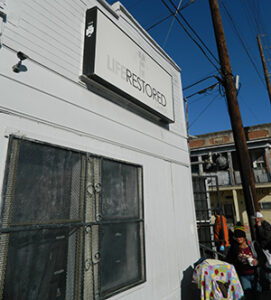
SAN ANTONIO—Life Restored Church made radical adjustments to focus on San Antonio’s poorest residents for one simple reason. Pastor Alex Fleming believes God told him to do it.

Fleming already felt a calling to minister to people in poverty. The median household income is less than $23,000 in the 78207 ZIP Code on San Antonio’s West Side, where Life Restored Church’s building is located on a corner across the street from railroad tracks.

Life Restored Church in San Antonio serves about 300 meals a week to homeless individuals, with volunteer help from other San Antonio churches. (Photo / Ken Camp)

But one Sunday morning about eight years ago—after learning a homeless person had frozen to death near the church—Fleming sensed God had a more specific mission field in mind.

“I was making the morning announcements when I heard the Holy Spirit say, ‘You are going to take in the homeless today,’” he recalled.

Fleming said he felt overwhelmed and didn’t know where to start. After all, about 2,000 homeless people live on the streets within a two-mile radius of his church.

“When I told the congregation, I could see the looks of concern,” he recalled.

Subsequently, Fleming went outside the church to film a video for social media in which he removed his shirt.

“I did the ‘take-off-your-shirt challenge,’” he said. “I said to other pastors: ‘If you can’t take off your shirt in the cold for 30 seconds, imagine what it is like for people who are spending all night on the streets. So, either come help us take in the homeless, or open up your own church tonight.’”

The social media post attracted local media attention, and the news reports prompted San Antonio residents to drop off donated coats, blankets and sleeping bags at the church.

The first night Life Restored Church opened its doors, 40 homeless individuals slept overnight in the church facility.

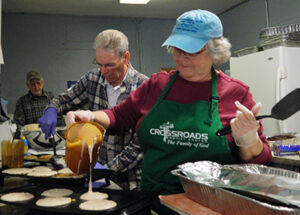
Stan Young, a retired geneticist, and Karen Rosales—both from Crossroads Baptist Church in San Antonio—cook pancakes for homeless individuals at Life Restored Church. (Photo / Ken Camp)

“Some people who saw the video on Facebook said, ‘Man, what a great marketing strategy.’ And I had to tell them there was no strategy. I just did what God told me to do,” Fleming said.

Crossroads Baptist Church in San Antonio was one of Life Restored Church’s earliest ministry partners. Volunteers from Crossroads continue to serve the homeless every week, cooking pancakes for about 100 people each Thursday morning.

Since they began working with Life Restored Church, Ron Purcell—who leads Crossroads’ ministry to the unhoused—estimates volunteers from his congregation have served about 25,000 meals.

Other churches help Life Restored Church serve breakfast to unhoused people each Tuesday and Saturday, and some local restaurants donate food.

‘It was a rough area’

Purcell recalled helping the struggling congregation make repairs to its building.

“The first time we came here, you could see sunlight through the ceiling,” he said. “We’d been here working on the building two days when we found a guy dead in the gutter from an overdose. There was a crack house just down the road then. … It was a rough area.”

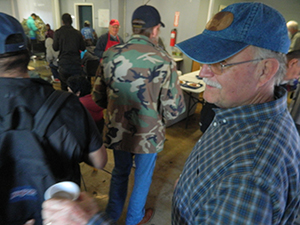
Ron Purcell leads volunteers from Crossroad Baptist Church in San Antonio as they serve breakfast to homeless individuals at Life Restored Church. (Photo / Ken Camp)

Initially, Purcell and other volunteers cultivated a good relationship with neighbors in the surrounding area, visiting elderly residents and helping them by making basic home repairs.

But when the homeowners died and their children took over their property, some of them opposed Life Restored Church’s ministry to the homeless population.

“They actually threatened us with guns,” Fleming said, noting they also repeatedly reported the church to the city for code violations. “They told all kind of lies about us. They even accused us of running a brothel here.”

Local media picked up the story about a struggling ministry trying to help an underserved population and meeting with resistance from city agencies.

“Somebody told me, ‘Your adversaries become your advertisement.’ And that’s what happened,” Fleming said.

The publicity sparked donations from throughout the city, and citizens made their concerns known to elected officials. Some of those officials advocated on behalf of Life Restored Church and helped make it easier for the church to work through the system to be code compliant.

In recent years, the ministry at Life Restored Church has “pivoted,” Fleming said.

Initially, he envisioned a congregation where unhoused individuals and local residents would worship together.

In the short term, that model worked. But over time, the distractions that often accompany ministry to homeless people became too great for members of the established church, and they left.

‘A church of churches’

“Now, we are a church of churches,” Fleming said. “We provide a base where churches can serve.”

Three mornings a week, Life Restored Church opens its doors to ministry partners from other congregations who serve meals to the unhoused and lead times of worship and Bible study for them.

“It would be a great training ground for young preachers,” Fleming said. “If you can preach to the homeless and keep their attention, you can preach anywhere.”

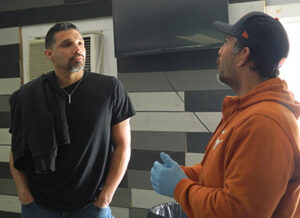
Pastor Alex Fleming (left) talks with his associate John Anaya at Life Restored Church in San Antonio. (Photo / Ken Camp)

John Anaya, who has known Fleming since they were teenagers, runs the day-to-day operations at Life Restored Church and is committed to its mission to the unhoused.

“It’s an obedience issue for me—obedience to the Lord and his calling on my life,” Anaya said. “And it’s a matter of love—love for the Lord, love for seeing people set free and delivered, and love for being around God’s people when they are doing God’s work.”

For now, Life Restored Church temporarily has discontinued offering overnight lodging for homeless people in its facility due to a lack of volunteers.

‘Turn the hearts of pastors back to the poor’

However, Fleming was instrumental in organizing a coalition of churches that offer unhoused people a place to sleep on exceptionally cold winter nights, such as during the ice storm that hit South Central Texas earlier this month.

“I want to restore the hearts of pastors back to the poor” he said.

With all its challenges, ministry to the poorest of the poor has its rewarding moments, Fleming noted.

Recently, a well-dressed man in a new, white pickup truck pulled up to the church. The man explained he had been helped by the church when he was homeless, and God turned his life around. He pulled out an envelope filled with $300 cash, saying he wanted to give back to a ministry that helped him when he needed it.

 “People don’t come back when you treat them like cattle, running them through as quick as you can. They come back when they are treated like they are made in the image of God and shown dignity by the body of Christ—the children of God,” Fleming said.

Encounters with formerly homeless people whose lives have been transformed by God provide motivation for continued ministry, and Fleming sees them as divine encouragement to keep serving.

“One lady who used to be homeless came back to see us,” Fleming recalled. “She said: ‘I used to go to church here. I would eat the pancakes and hear the messages. That helped me move on and get to the next chapter in my life.’

“Sometimes, it’s easy to wonder if it is making a difference. We don’t always know what happens to everybody. But once in a while, when we’re able to see lives restored, I get those kisses on the forehead from God.”