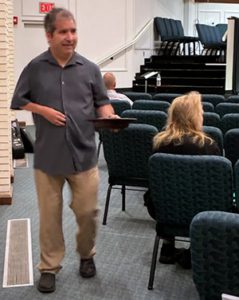
Chris Clayman: Frontier people groups deserve priority

Frontier people groups—unreached people groups where Christians number less than 1 in 1,000—represent about 20 percent of the global population, Chris Clayman, CEO of the Joshua Project, told participants at a Waco missions conference.

Christians should prioritize outreach to frontier people groups, Clayman told the “Beyond Us … From Neighborhoods to Nations” missions conference at First Baptist Church in Waco. Waco-area churches sponsored the conference in collaboration with Baylor University’s Truett Theological Seminary and Baylor Spiritual Life.

Clayman presented 10 reasons why frontier people groups—whose numbers exceed 1.5 billion—deserve priority.

  • “God is gathering worshippers from all peoples and commands us to join him.”

From the time of Abraham until Christ returns, God’s plan is to bless all nations and people groups, Clayman said.

  • “There are seats missing at the wedding banquet.”

Luke 14 records Jesus’ parable of a wedding feast to which all are invited. Revelation 19 presents the vision of the marriage supper of the Lamb, where all the redeemed of the ages gather.

However, not everyone who should be at the table is there yet. “God’s heart is for the unreached,” Clayman said.

  • “The primary propagation of the gospel happens through the church.”

Frontier people groups need “breakthrough churches” in their language and culture where they feel welcomed.

  • “Many mission efforts work primarily with existing churches, diverting focus away from frontier peoples needing cross-cultural efforts.”

Frontier people groups who lack local, culturally relevant churches never will be reached if mission efforts are confined to working with churches on the mission field.

  • “Most missionaries go where they are invited, not to frontier people groups.”

If there are no Christians within a people group to invite missionaries, those people never will receive a missionary if an invitation is required. Furthermore, missionary candidates tend to favor groups with whom they already have some cultural connection.

“A lot of frontier people groups live in cultures you’re not going to connect with, and you’re not going to like their food,” Clayman said.

  • “Frontier people groups make up the largest group of unreached people groups.”

Clayman reported 72 percent of unreached people groups are frontier peoples, but they receive only a tiny fraction of the missionaries.

  • “Paul set an example of not building on someone else’s foundation.”

In Romans 15:20-21, Paul expressed his desire to take the gospel to areas that had not heard the gospel rather than continue work where there already was a gospel witness.

“In many ways, it’s like gospel triage,” Clayman said—giving attention where the need is greatest.

  • “We have clarity about where the greatest church planting need is in the world, and the populations there are growing rapidly.”

Four out of five unreached people groups are in the 10/40 window—the area of North Africa, the Middle East and Asia between 10 degrees north and 40 degrees north latitude. Furthermore, the birth rate is higher in unreached areas than in predominantly Christian countries.

  • “There is great imbalance and injustice of opportunity for those born into frontier people groups.”

Individuals in frontier people groups are least likely to hear a clear presentation of the gospel or encounter a Christian witness.

“Christians are rightfully concerned about justice issues. … But I don’t really hear much about the injustice linked to frontier people groups not having the opportunity to hear about Jesus in their lifetime,” Clayman said.

  • “Frontier people groups require highly intentional, difficult, cross-cultural mission efforts.”

Christians looking for an immediate return on investment are not attracted to frontier people groups, and working among those groups is challenging.

“It demands a lot of sacrifice,” Clayman said.

Frontier people group missions “requires our most careful attention, mobilization, training and prioritized deployment of resources,” Clayman asserted.


Tony Evans’ next chapter, undisclosed ‘sin’ and new book

Dallas megachurch founder Tony Evans has lived a mostly private life for more than a year, after announcing an undisclosed “sin” caused him to step away from the prominent pulpit where he preached for almost five decades.

His church, Oak Cliff Bible Fellowship, announced Sunday, Oct. 5, that he completed a restoration process but is not returning to its leadership.

However, Evans, 76, is working on new public-facing projects, mostly through his ministry The Urban Alternative.

His latest book, Unleashed: Releasing God’s Glorious Kingdom in and Through You, is set to be released by Thomas Nelson Publishers on Oct. 28.

He’s also scheduling speaking engagements at churches and conferences after his first major address in more than a year at a conservative Christian summit in Des Moines, Iowa, in July.

The elder board of his predominantly Black nondenominational church also announced his son, Jonathan Evans, has been appointed an elder and is expected to be installed officially as lead pastor.

In an interview with Religion News Service days before his church’s “Restoration Sunday,” the elder Evans said he has faced challenges with people not accepting his marriage to his second wife, Carla Evans, after the death of Lois Evans, to whom he was married for 49 years.

He also said there have been other personal matters, which he chose not to discuss in the interview, that he has grappled with as his son is gaining more church responsibilities.

When he’s in town, Evans now sits at the front of the church with his family, and he said he’s supportive of Jonathan Evans’ leadership and impressed by his preaching.

In the interview, which has been edited for length and clarity, Evans talked about his new book, why he left his church’s leadership, the next phase of his life and his thoughts about eternity.

You have previously written books on your beliefs about what you call the “kingdom power” of God. How do you sum up those convictions, and how are you approaching that topic differently this time?

In the book Unleashed, I’m trying to focus on taking the concept of the kingdom and releasing it in and through your life.

Many Christians don’t have a kingdom worldview. They’ve accepted Christ. They’re on their way to heaven. But this rule of God on the way there for them on Earth is often missing. And so, we’re trying to go deeper in seeing it being practically activated in your life.

Your book discusses choices and standards you think Christians should embrace, and you seem to have made a choice for yourself about standards when you stepped down from pastoral leadership at Oak Cliff Bible Fellowship last year.

Can you share what the undisclosed sin was that prompted that decision, and if your healing and restoration process is continuing?

There was a decision made as I moved into a new relationship. My wife passed away in 2019, and I remarried (four) years later, and there was such consternation around that, and people who were not as excited about it (laughs). And we were already in transition with my son (in leading the church).

So, we just said this would be the best time to go ahead and make that transition, so that all the consternation around it wouldn’t interfere with that process. There was some underlying things, but that was the decision that was made as we moved forward.

And who made that decision—you or the church?

A combination. It was a shared one.

You used the word “sin” in your statement, and now you’re using the word “consternation.” Can you explain what you mean?

There just was some personal matters that we’re not free to go into, but some personal matters that precipitated that decision.

Anything more you can say? That’s a little unclear.

I know, but because the church wanted to just keep it within the bounds of the church, that’s why we’re honoring that.

Your son is now preaching regularly at Oak Cliff Bible Fellowship. How has that transition gone? Are you solely a member there, or are you involved in the church in other ways now?

I am the founding pastor, and my goal is to support him in every way. It has freed me up to do some of the national events that we are doing.

We’re doing a new podcast that we’re taping now. We also (are producing) an “Unbound” documentary series showing how the Bible moved throughout history. So, it’s created a freedom that I’ve never had before (laughs).

How soon do you think you’ll be back in the pulpit preaching?

We have some meetings coming up to discuss the plan for that, because we are trying to not let his movement into this new arena be overshadowed by my 48 years. So, it’s a timing thing, and we haven’t gotten specific yet, but we’re working toward that.

In your son’s sermon on Sept. 28, he said he initially complained to God about this season that Oak Cliff Bible Fellowship began when you stepped away, but said he realized he should be grateful for your decades-long ministry and God’s faithfulness in it. What has it been like watching his sermons and seeing him lead?

He’s blowing my mind, actually. He’s got this—it’s an old term—but this “New Jack City” thing (laughs), the media thing and this new generation thing, but he is solidly expositional in the word. So, I am loving the exposition. I’m loving the relevancy.

This younger generation of preachers, they tend to be much more casual, much more relaxed. This is a new world that I don’t fully get, but I can appreciate the fact that we want to reach it in a relevant way.

When you say “media,” what do you mean?

I’m certainly meaning his use of social media, but media in the service—video clips and staging and props and all that.

You note in your book that when people have mountains, so to speak, or difficulties, they tend to talk to other people about their problems rather than talking to God about them—or to the mountain. What’s an example of when you spoke to a mountain, maybe especially in the last year or so?

During this year, we have had to address some major issues with regard to our projects, our funding. We’re having to raise $9 million to do all that we’re doing around the world. And so, we had to speak to God about being our source, but we also had to speak to the source. We had one donor who unexpectedly gave us a million dollars.

Did the difficulty of fundraising have anything to do with the fact that you stepped away?

No, it has had to do with the need of the moment. It’s a couple of projects. One is “Unbound,” where we’re tracing from the medieval age through the Renaissance to the Reformation to the Enlightenment to the modern times how God has moved his word along.

When we take these trips to the different countries with these events, “Unbound” is showing how God used the social, political, economic and personality dynamics to move his word along.

When you spoke in July to the Family Leadership Summit in Iowa, you told them, “You’re not first Democrat, you’re not first Republican. You are first of all, a representative of another king and another kingdom, and everything else is second to that.”

In a time when politics are often dividing the church, are you concerned that evangelical Christians are often described as following their party more than their faith?

That’s a major concern, because what we’ve done is turned politics into an idol, and anything idolatrous is going to be rejected by God.

God is involved in politics all through Scripture, but he’s involved as God. He’s not riding the backs of donkeys or elephants. Neither can Christians be riding the backs of donkeys or elephants.

So absolutely, Christians should be engaged in politics. We should bring God’s point of view to politics, but we should never believe we’re going to be delivered or saved by politics.

Was there something you learned about yourself or that you’re taking forward now that this restoration process has concluded?

Through this year, there have been a number of losses of people; some of our leaders who have passed away. And a dear part of our ministry, one of our board members who I was very close to, passed away from cancer.

I think I’ve gone deeper in thinking about eternity. Always thought about it, but deeper in that vein. So, whatever life I have left, I want to maximize at the highest possible level for God’s kingdom and for eternity.
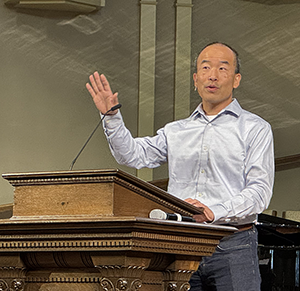


Christians called to missional—not comfortable—lives

Christ calls his followers to missional lives, not lives of comfort and ease, speakers emphasized at the “Beyond Us … From Neighborhoods to Nations” Missions Conference at First Baptist Church in Waco.

Waco-area churches sponsored the conference in collaboration with Baylor University’s Truett Theological Seminary and Baylor Spiritual Life.

“There’s no easy way to be about the Father’s business,” said Christine Caine, author, evangelist and founder of the A21 campaign to fight human trafficking.

“To me, there is nothing more important than taking the gospel of Jesus Christ into all the world.”

Too many Christians suffer from “passion deficit disorder,” she said, offering her prayer that God will ignite a passion within the church “for the thing that God’s heart beats for, which is a lost and a broken world.”

“Passion is the fuel that keeps us going,” she said.

Caine grew up in poverty as the adopted child of a Greek immigrant couple in Australia. As a survivor of long-term sexual abuse, she spoke about how God redeemed her when she came to faith in Christ.

“When I learned to make what Jesus did for me at Calvary bigger than what anyone had done to me who had abused me, it changed my whole life,” she said. “Why would I not want a lost and broken world to know that?”

‘Willing to be interrupted and inconvenienced’

In 2008, she and her husband Nick founded A21 with a goal of abolishing modern-day slavery—human trafficking—in the 21st century. The organization works in 19 locations in 14 countries, seeking to reach, rescue, recover and restore trafficking victims.

Like the priest and the Levite in the parable of the Good Samaritan, many Christians too often pass by the wounded because they are busy and preoccupied, Caine said.

Instead, followers of Jesus are to be like the Samaritan who was “willing to be interrupted and inconvenienced” to care for someone who was broken and hurting, she said.

“The church is not about the Father’s business because we are not willing to be interrupted or inconvenienced,” she said.

When God’s people move beyond “little Christian ‘bless me’ clubs” and commit to be his witnesses to a lost and broken world, God will “do something unlike anything we’ve ever seen,” Caine said.

Reawakened love for the lost

“We need a reawakening in the church of what our mission is—a love for the lost,” she said.

While Jesus told his followers to be “in the world but not of it,” too many Christians today are “of the world but not in it,” Caine said.

Jesus called on his disciples to be salt and light—catalytic agents that bring about change, she emphasized.

“You can’t change a world you’re not in, and you can’t reach lost people who you don’t have close proximity to. And if you’re of it—the same substance as it—you won’t bring about change,” she said.

Christians need God to help them see the world as he sees it, Caine asserted.

“It’s so easy to ignore suffering when it is nameless and faceless and it’s just a statistic. God doesn’t make numbers. He makes people. … God sees people as people,” she said.

“We talk about the poor, the lost, the marginalized and the disenfranchised as if they are just statistics. They are people created in the image of God, and they are the ones to whom we’re sent to be salt and light.”

‘God doesn’t give comfortable callings’

Tom Lin, president and CEO of InterVarsity Christian Fellowship, described how responding to God’s call meant abandoning the dreams his parents had for him.

“God doesn’t give comfortable callings,” Lin said.

As the child of immigrants, Lin said he was raised to pursue the American dream of comfort and security.

After Lin earned his undergraduate degree in economics from Harvard University, his parents were devastated when he told them he was following God’s call to pioneer missions in Mongolia.

“My parents came from poverty in Asia so I wouldn’t have to live in poverty in Asia,” he said.

From Genesis to Revelation, God’s plan has been for his people to “put feet to their faith” and be a blessing to all nations, Lin asserted.

“Each of us has a purpose, and it is to be bless the nations. This is not an optional activity,” he said. “I often tell college students, ‘This is not like extra credit.’”

In a time of unprecedented need in the world, Christians have unprecedented opportunities to bless the nations, but obedience to God’s call demands defying the dominant culture, Lin insisted.

“Culture teaches us to do everything we can to bless ourselves—to bless our own Christian bubble, our own Christian churches, and to avoid suffering,” he said.

“God’s purpose for his people is to bless the nations, and it often requires leaving comfort, he said. But when God’s people obey his call, he added, “We see God’s faithfulness.”

Christ gave the Great Commission to the whole church

Obedience to God’s call means recognizing Jesus gave his Great Commission—making disciples of all nations—to the whole church, not the select few, said Bob Roberts, founder of GlocalNet and co-founder of the Multi-Faith Neighbors Network.

While God calls some Christians to vocational service as cross-cultural missionaries, God also calls every follower of Jesus to use his or her skills, talents, gifts and areas of expertise for kingdom purposes, Roberts said.


Christians earn the right to spread the gospel by going through “the front door,” as welcomed guests in other countries who contribute to society rather than operating secretively or deceptively, he said.

Countries that may be closed to traditional missionaries eagerly welcome Christians who are “bringing value” to their people through their vocations and contributing to “human flourishing,” he said.

Christians with experience in education, health care, business and agriculture can use those abilities to advance the kingdom of God and bring wholeness as God desires, Roberts said.

“You don’t have to take the culture over. You just have to be salt and light in the culture,” he said. “I don’t want Christian nationalism. I want Holy Spirit presence.”

For example, when Roberts was pastor of Northwood Church in Keller, the congregation established a relationship with Hanoi about 30 years ago.

That ongoing relationship led to the opportunity for educators in the church to develop a special-education curriculum for the entire nation of Vietnam.

“We tend to do missions to people. We need to do missions with people,” Roberts said.

‘God always pushes us beyond our boundaries’

Love for God, love for others and Christ’s command to make disciples motivates Christians to move outside the narrow confines of what is comfortable and familiar, said Julio Guarneri, executive director of the Baptist General Convention of Texas.

“God always pushes us beyond our own boundaries. If you have been transformed by the gospel, you cannot stay in the same place. … He always invites us to go beyond ourselves,” Guarneri said.

Christians find their motivation for missional living in the cross of Christ, he said.

“We are not motivated by need or by guilt,” Guarneri said. “We are motivated by the love we see at the cross.”

The call of God compels his people to go beyond their preconceived ideas and gain a new perspective, he said. Even after Christ’s resurrection, his disciples still did not understand what Jesus had been teaching about the kingdom of God. Before his ascension, they asked Christ when he would “restore the kingdom to Israel.”

“They thought the kingdom was about making Israel great again. It’s not about national greatness but about a global witness,” Guarneri said.

Christ called the provincial disciples is to become “cross-cultural ambassadors of God’s love,” he said.

God calls his people to the ministry of reconciliation, Guarneri said. Sin alienates people from God and each other, but God’s grace reconciles.

“We have been deputized as agents of reconciliation,” Guarneri said.


Conclave attendees urged ‘never get over the gospel’

ARLINGTON—More than 640 leaders and volunteers for children, teen and young adult ministry gathered Oct. 6 and 7 at First Baptist Church in Arlington to worship and learn how to reach current and future generations for Christ and the church.

Shane Pruitt, national next gen director for the North American Mission Board, spoke during the first general session on lessons he learned in his 20 years of ministry.

Always focus on the depth of ministry, never stop being a servant, get good friends, know fruit always surprises, learn to say “no” and let the thorns lead to the throne, Pruitt urged.

“Never get over the power of the gospel in your life … If God can save you, God can save anyone,” Pruitt said. “Because Jesus lives … that’s why we get to do what we do.”

Pruitt addressed the importance of maintaining character and integrity in ministry and building relationships with family and friends.

The solution is the discipline of prayer and staying close to Jesus, he said.

“Focus on the depth of your ministry and let the Lord focus on the width and platform of it—

spiritual discipline, praying and staying at the feet of Jesus,” Pruitt said.

Pruitt added ministry is about serving, and comparisons can be a snare for anyone in ministry.

“Ministry is not a calling to stardom. It is a calling to servanthood. God’s love for you is not dependent on your size of ministry,” Pruitt said.

Bobby Contreras, pastor of Alamo Heights Baptist Church, preached from Proverbs 6:6-8 during a general session, emphasizing the need to reflect Jesus to point others to him.

“Do we truly live in his goodness when storms come? At times, I don’t because his goodness seems so far away in times I deem as bad, broken or hurting. So, will we store up? It is time to store up. It does us no good to store up if we don’t share it,” Contreras said.

NextGen conversations and AI

The trend of young adult Gen Z and Millennials attending church is going up, David Kinnaman, CEO of Barna Group, said during a general session.

Barna group confirmed “the average was close to one weekend per month. Those rates are up nearly one extra weekend a month, nearly double the rates of just five years ago.”

“This generation is open to Jesus,” Kinnaman said, adding Gen Alpha will be the generation known by the rise of AI.

“This generation, our generation, is going to be taking these deep questions to a new place, a new kind of median response to all humans,” he continued.

“And remember that the way these large language models are built, they are not built on any kind of Christian context. They are doing their very best to take the averages of all these complex pieces of information and spit out something that a human being can read and understand.”

Practical use of AI—such as ChatGPT—for everyday ministry work consists of cross-referencing of biblical texts, biblical language assistance and summarization of books and research material, Katie Frugé, director for Texas Baptists’ Center of Cultural Engagement, said during a pastors track on artificial intelligence and ethical challenges.

Regarding ethical considerations, Fruge said AI is not neutral and can be manipulated.

“Just utilize the current ‘gold standard’ programs that integrate AI into the system. Think machine learning, not content generation,” Frugé said, adding AI should be utilized as a resource to support, not replace, what pastors already are doing.

“More Gen Z and Millennials say and feel more like themselves online than offline,” Trent Brent of Next Gen Catalyst said during a breakout session on the latest generation trends. “Online matters,” he added.

Breakout sessions highlight resilience and inclusion

Shelly Melia, associate dean of the Graduate School of Ministry at Dallas Baptist University, talked about building resilience in children.

Using a fishing analogy from childhood fishing trips, Melia addressed the many hooks that can keep a child from recovering from challenges and failures in life, such as fear, anxiety, family dysfunction and a lack of necessities like food and shelter.

“Resilience is not a fixed trait. … It is not always unique to children,” Melia said.

Building resilience requires action and not being passive toward issues causing distress, she said.

Laura Roodenburg, ministry relations manager for Joni & Friends, emphasized the importance of relationship building and taking small, immediate steps toward inclusion for people with disabilities.

“Not every barrier is physical. For some it is sensory overload,” she said.

“Imagine how hard church is when those lights flicker, the sound is painfully loud, or a bulletin is cluttered with fine print. Noise-reducing headphones, a printed order of service, a simple visual chart for kids—those can make all the difference between a meltdown and a worship,” Roodenburg said.

Within 90 days, a church can take subtle steps toward making itself more accessible by adjusting Bible study locations, integrating seating, and employing accessibility webpages, ramps, lifts, interpreters and sensory supports, Roodenburg said.


Tony Evans will not return to lead Dallas megachurch

(RNS)—Dallas megachurch founder Tony Evans, who stepped back from leading his church due to an undisclosed “sin” he announced last year, will not return as pastor of Oak Cliff Bible Fellowship.

Evans apologized to his congregation and his family on Oct. 5, after the elder board of Oak Cliff Bible Fellowship announced the pastor had completed a “restoration process” and will not return to lead the church.

“To the flock, to the congregation, for the consternation I may have caused you with questions and wondering and uncertainty, I’m sorry,” he said as he sat on the church’s stage during a worship service and answered questions from his son, Jonathan Evans, who has been preaching regularly at the church.

“I apologize sincerely for any instability that this season has caused you because you are my treasure.”

Evans, who abruptly announced he was “stepping away” in June 2024, is the first African American to have both a study Bible and a full-Bible commentary bearing his name. In addition to his church, he founded the Christian Bible teaching ministry The Urban Alternative, which continues to air his messages on radio outlets worldwide.

Nature of sin not disclosed

During the “Restoration Sunday” service, which lasted an hour and 40 minutes, neither Evans nor Chris Wheel, associate pastor of outreach, disclosed the sin Evans described in June 2024 as requiring “the same biblical standard of repentance and restoration” he had applied to other people.

“While I have committed no crime, I did not use righteous judgment in my actions,” Evans, now 76, said at the time. “In light of this, I am stepping away from my pastoral duties and am submitting to a healing and restoration process established by the elders.”

Some churches offer or demand a restoration process of their leaders to overcome what they consider a violation of the Bible.

During the worship service at the nondenominational, predominantly Black church, Wheel said Evans’ “discipline and restoration process” included counseling with professionals outside the church’s staff, “evidence of genuine repentance and godly sorrow” and pastoral mentoring.

Citing the Bible’s epistle to the Galatians’ guidance about restoring a sinful person, Wheel said: “In keeping with this biblical framework, the elder board exercised deliberate and prayerful discretion regarding the timing, the manner of disclosing specific details throughout the restoration process.”

“This was not done to conceal wrongdoing, but rather to uphold the integrity of the process, to protect the dignity of all involved, and prevent unnecessary speculation or sensationalism,” he said, adding that Evans “fully submitted” to the restoration process.

Wheel said Evans also took a 12-month absence from pulpit ministry to “focus on personal growth.”

“In alignment with biblical principles and unanimous affirmation of the elder board, Dr. Evans has successfully completed this restoration journey,” Wheel said.

Jonathan Evans likely next pastor of church

As the congregation applauded and cheered, Evans entered the stage.

“While he will not be returning in a staff nor leadership role at OCBF, we joyfully look forward to seeing how God uses Dr. Evans’ gifts and calling to proclaim the truth of Scripture with clarity and conviction for the strengthening of the body of Christ,” Wheel said.

Evans made a major public appearance shortly after his yearlong absence concluded, speaking at the July summit of The Family Leader, a Christian organization known for its conservative evangelical stances, in Des Moines, Iowa.

Wheel said more details about the future plans for the church will be announced at a “Vision Sunday” service, set for Oct. 12.

“Key steps include Jonathan Evans has been appointed as an elder,” he said. “Our expectation is that he will formally be installed as the lead pastor of Oak Cliff Bible Fellowship.”

As soon as Wheel concluded speaking, Jonathan Evans led the congregation in a brief Communion service.

“Somebody celebrate our Lord for restoration, forgiveness and reconciliation,” Jonathan Evans said.

‘Hardest part was disappointing the Lord’

The service then pivoted to him sitting with his father for a 20-minute discussion in which the two men expressed their pride in each other, and the elder Evans thanked the church, his family and friends for their endurance and described the “bittersweet” period that had just concluded. He said those days often were filled with depression, loneliness and tears.

“It’s certainly bitter when you’ve done something for 48 years every day, every week, and then you’re no longer doing it—and it’s your fault,” Evans said. “I had to search for God, but not for a sermon.”

Asked about the hardest part of the yearlong process, Evans said, “The most important and hardest was disappointing the Lord, who had given me so much and in such a unique way.”

He said he particularly was thankful for the support of his wife, the former Carla Crummie, whom he married in December 2023, after Lois Evans, his first wife of 49 years, died in 2019.

“The way we came together was shared loss,” he said. “Our mates died a few days apart as she and her late husband were on their way to my wife’s funeral.”

Evans said he was concerned about “many things that were not true being said” on social media.

“The way they beat up on my wife who knew nothing about any of this, and then the way they came after my children and then came after the Lord,” he said. “And I was the reason why all of that was happening, on a worldwide scale.”

Speaking directly to the congregation, he said, “For anything that has hurt you from me, I’m sorry, but I’m so glad I have you and you have me.”


Beautiful Hope Ministries aids trafficking survivors

University of Mary Hardin-Baylor sophomore Hannah Balkenbush knows exactly where her hope lies—in Jesus Christ. That conviction is the driving force behind Beautiful Hope Ministries, a nonprofit she founded in 2021 to raise awareness about human trafficking and to offer Christ-centered restoration to survivors.

The seeds of Balkenbush’s mission were planted during her freshman year of high school when she partnered with Unbound Now, an anti-trafficking ministry. Her first event—a benefit concert at her church—raised $12,000.

That early success led to even greater impact. In 2023, she organized a gala that raised $75,000 to support the rescue of more than 100 children.

“I decided long-term that I didn’t just want to fundraise—I wanted to do the work myself,” Balkenbush said.

In 2022, she officially launched Beautiful Hope Ministries, which since has become a 501(c)(3) nonprofit organization.

Support and restore survivors in Jesus’ name

At the heart of Beautiful Hope Ministries is a simple but profound belief—without Jesus, there is no hope.

“Our mission is to support and restore survivors of trafficking and poverty in Jesus’ name,” Balkenbush said. “Outside of Christ, there is no lasting hope.”

Balkenbush’s passion for ministry has taken her across the globe—from the impoverished neighborhoods of Honduras to the streets of Paris and Warsaw.

In Honduras, she met villagers who had gone without water for eight days. When she asked how they were surviving, her translator replied, “They live off the breath of God.”

To date, Hannah has raised more than $120,000 for anti-trafficking efforts, helping rescue hundreds of children.

In addition, Hannah was invited to Paris ahead of the 2024 Olympics, where she met with an ambassador from the International Olympic Committee, France’s Minister of the Interior, and undercover agents from the U.S. Embassy.

Together, they worked to establish the French National Human Trafficking Hotline in preparation for the expected surge in trafficking during the games.

“If a girl doesn’t find her worth in Christ, she’ll look for it elsewhere,” Balkenbush said. “When she goes searching for things other than Christ, she is going to find darkness.”

Developed a Care Closet to provide essentials

As a freshman at UMHB, Balkenbush started developing a Care Closet with Beautiful Hope Ministries to provide essentials for children and young people in need. She’s also researching nonprofits in Belton and Temple to find ways Beautiful Hope can help fill unmet needs locally.

Long term, her goal is to build orphanages and safe houses around the world, “specifically in the 10/40 Window, because that is where the majority of the unreached people groups in the world are,” she said.

The 10/40 Window is the rectangular area of North Africa, the Middle East and Asia approximately between 10 degrees north and 40 degrees north latitude.

Even though she knows there are numerous steps to get to that point, Balkenbush has faith and is patiently waiting on the Lord, knowing that is what he calls his children to do.

“God can do the impossible even through suffering and brokenness,” she said.


David Barton to advise Texas State Board of Education

David Barton, a conservative Christian activist who considers the separation of church and state a myth, will serve as an “expert content adviser” to the Texas State Board of Education when it develops new state standards for teaching social studies.

Republican activist David Barton, from Aledo, speaks before testifying to a meeting of the State Board of Education where it began hearings on a new social studies curriculum Sept. 17, 2009, in Austin, Texas. (AP File Photo/Harry Cabluck)

Barton is founding president of WallBuilders, an Aledo-based organization devoted to teaching what it calls “the true story of America and our Biblical foundation,” according to the group’s website.

Two members of the board—Julie Pickren of Pearland and Brandon Hall of Aledo—announced Barton as their choice to serve in the advisory role. Barton, a former vice chair of the Republican Party of Texas, served in a similar role in 2010 when the board revised social studies state standards.

 “I am excited for the State of Texas to retain the expertise of someone I believe to be the foremost American historian of our day,” Hall posted on Facebook. He pointed to Barton’s appointment as the fulfillment of a campaign promise he made.

Barton holds an undergraduate degree in religious education from Oral Roberts University. While WallBuilders describes him as an “expert in historical and constitutional issues,” Barton holds no formal educational credentials in either history or constitutional law.

Book withdrawn by publisher

In the press release announcing Barton’s appointment, Pickren and Hall referred to him as “a recognized author of numerous works on American history and a highly sought after speaker and lecturer.”

In 2012, Christian publisher Thomas Nelson withdrew one of Barton’s books, The Jefferson Lies: Exposing the Myths You’ve Always Believed About Thomas Jefferson, because the publisher had “lost confidence” in the book’s historical details.

WND Books, a publishing house related to the far-right media outlet formerly known as WorldNetDaily, released a revised version of the book in 2016.

Pickren and Hall said they look forward to working with Barton and other advisers “to craft standards that will equip the next generation of students to become well-educated, proud Texans and patriotic Americans.”

‘Propensity to misquote, misinterpret or manufacture quotations’

Baptist historian Mike Williams acknowledged Barton “deserves some credit for trying to answer progressive secularists” who have downplayed the role of faith in U.S. history and who “lampooned evangelicals as redneck fundamentalists from the backwoods of the Deep South.”

“Unfortunately, he ignores the truth about Christianity and religion in colonial America: Religious faith was far more diverse in its origins than just the Puritans and those he incorrectly identifies as evangelicals among the founders,” said Williams, a recently retired professor of history.

“He forgets or never learned something I stress to students from freshman history to graduate courses—context, context, context. His propensity to misquote, misinterpret or manufacture quotations causes most of what he writes to be ignored by legitimate evangelical historians, political scientists and theologians.

“Such inaccuracies hurt historians who are clearly Christian from being respected in broader academic circles and makes them work harder to prove their ideas are valid. His writings seem to confirm to non-Christians that Christians are all lying hypocrites who ‘can’t handle the truth.’”

If the State Board of Education considers Barton an expert adviser, Williams suggested the board also include legitimate historians and political scientists “as a counterweight to what might be considered ‘fake history.’”

Promoting a ‘false narrative’

Amanda Tyler

Amanda Tyler, executive director of the Baptist Joint Committee for Religious Liberty, also critiqued Barton for promoting a “false narrative” about U.S. history.

“For decades, David Barton has consistently pushed the false narrative that America was founded as a Christian nation, legally and historically. It is deeply concerning that he will be advising the State Board of Education on social studies standards in Texas,” Tyler said.

“The ‘Christian nation’ mythology is easily rebutted by reference to constitutional text and history. We should be preparing Texas students to live in an increasingly pluralistic country by teaching them accurate history, not a cherry-picked, false narrative that furthers theocratic interests.”

John Litzler, public policy director for Texas Baptists’ Christian Life Commission, also noted “serious concerns” raised about Barton’s “version of the historical record of the United States and the veracity of several of his claims.”

Separation of church and state ‘neither a myth nor a modern invention’

Texas Baptists particularly should be concerned about Barton’s statements denying the separation of church and state, Litzler said.

John Litzler

“Separation of church and state is neither a myth nor a modern invention. Baptist ministers like John Leland and Isaac Backus were instrumental in ensuring both the establishment and free exercise clauses of the First Amendment were included in our nation’s Bill of Rights,” Litzler said.

He noted Thomas Jefferson wrote his famous words about a “wall of separation between church and state” in direct response to the Danbury Baptist Association in Connecticut, whose religious liberties were being infringed upon by the government-established church in their state.

“From our earliest days, Baptists have been pioneers in including separation as a key element of religious freedom in our articles of faith. Every version of the Baptist Faith and Message contains the simple statement that, ‘Church and state should be separate.’ This belief is a hallmark of the Baptist faith,” Litzler said.

He echoed Williams’ call for the State Board of Education to listen to other content advisers who might “provide a differing view from Barton’s on this issue to bring balance to the process and help give voice to the millions of Baptists in Texas as the SBOE develops their new social studies agenda.”

“We thank the SBOE for their diligent and important work, while also urging them to seek input from Baptists and others on key issues of religious liberty and the history of the American church,” Litzler said.

‘Truth is unkillable’

Truth—including a true account of American history and the separation of church and state—is strong enough to stand on its own merits without embellishment, Williams asserted.

“Unvarnished truth about U.S. history, including religious history and Christianity, and vital ideas on religious liberty and separation of church and state, can stand on their own. They do not need to be propped up by rewriting history to fit with current political agendas,” he said.

Williams quoted Anabaptist Reformation theologian Baltasar Hubmaier, who often signed his theological treatises, “Truth is unkillable.”

“When American history is taught, it should be the ‘whole truth and nothing but the truth,’” Williams said, “not a fictionalized enhanced version of it that makes heroes from history into 21st century Bartonites. The truth sometimes hurts, but it must be told.”


Deacon with a disability serves Lubbock church

Victor Reta, a member of Bacon Heights Baptist Church in Lubbock, lives with “very severe” aphasia, a language disability that affects one’s ability to speak and understand what others say. Even so, he serves in several capacities on Sunday mornings despite his disability.

“He loves [Bacon Heights],” said his mother, Rosie Rodriguez. “He’s always around. I don’t think there’s one person in the whole church that doesn’t know his name.”

In 2017, Bacon Heights’ previous pastor approached Rodriguez with a desire to honor her son, who is “always helping,” “always opening doors,” “always smiling,” and is an active participant in the congregation and the church’s special needs ministry.

‘God working in him’

“Our pastor came, and he said the deacons want to do something for Victor. … I thought, ‘OK, they want to give him some chocolate, coupons or something [else],’” she said.

Instead, the pastor told her, “The deacons have talked and they voted, and they would like to ordain him as a deacon.”

Rodriguez said Reta’s desire to serve “came on its own,” so showing up to serve has “started growing him and blessing him in ways that we were not aware [of].” She said through the years, he has “gotten so many recognitions at church [and] at work” for his service.

“I call him our Forrest Gump because all he does is show up, and he’s Victor. He just does what Victor does. But then all these other blessings come his way without him even asking or knowing about it,” Rodriguez said.

“God has really used him and we’re really proud of him, but we know that it’s God working in him.”

Serves in a variety of roles

Deacon Victor Reta helps collect the offering at Bacon Heights Baptist Church in Lubbock. (Courtesy Photo)

As a deacon, Reta serves as a greeter and takes up the offering at the end of Sunday service, helps new members and guests get to the right places, and even helps out in Bacon Heights’ special needs ministry Sunday school class.

He also volunteers during the week, helping his best friend and church facilities manager John Kjosa with building upkeep.

Kjosa participated in Reta’s deacon ordination ceremony by washing his feet, “which [was] such a special thing for [him].”

Bacon Heights Lead Pastor Sammy Elliott, who joined the church staff in 2021, said, “an exciting thing in the life of Bacon Heights is their emphasis and strategy of loving well … [and] that shows up in so many ways, [especially] with special friends.”

The special needs ministry hosts a Sunday school class called “Aspire,” which gives special friends “learning opportunities and activities” during both service hours.

Once a month, the special needs ministry also hosts “First Fridays,” a worship service specifically for special friends.

“One of our pillars of our vision and mission is that we love as Jesus loved. And that’s easy to see on paper, but we see that play out and fleshed out in all of our ministries, but especially our special friends ministries,” Elliott said.

‘Here’s what I can bring’

Elliott said Reta “provides a light for us to follow” in serving in the church.

“When you see somebody like Victor serve, it removes excuses,” Elliott said.

Elliott said “[Victor’s] willingness to say, ‘Here’s what I can bring,’” encourages the congregation to do the same.

“When he’s up here, that’s his offering to God … with that mindset [and] heart behind what he does, how can it not be encouraging to others to say, ‘Here’s what I can bring,’” Elliott said.

In addition to serving as a deacon, Reta also has participated as a camper for 25 years at Texas Baptists’ Special Friends Retreat, an event for individuals aged 12 and older with cognitive or intellectual disabilities.

Reta said going to retreat every year reminds him of how deeply Jesus loves him. His favorite part of the weekend, he said, is getting to worship with his friends.

The first of four Special Friends Retreats is scheduled Oct. 3-4 at Mt. Lebanon Baptist Camp and Conference Center in Cedar Hill. A Special Friend Retreat is scheduled for four weekends at locations around the state, including at Bacon Heights on Dec. 6. 


Singletary steps down as dean of Baylor social work school

Jon Singletary will cease to be dean of Baylor University’s Diana R. Garland School of Social Work, effective Oct. 15.

In a Sept. 25 announcement to Baylor faculty and staff, Provost Nancy Brickhouse wrote Singletary notified her earlier in the week “of his decision to step down from his leadership role” in the Garland School.

“As many of you are aware, these are incredibly difficult times for professionals in the field of social work, and Jon felt the need to step away to take better care of himself, as well as to dedicate more time to his family,” Brickhouse stated.

“Following a sabbatical, Jon intends to return to the faculty and focus on interdisciplinary research and approaches to tackling the growing crisis of mental health in our country.”

Luci Ramos Hoppe, clinical associate professor and director of the undergraduate social work program, will serve as interim dean, Brickhouse said, noting she will announce a national search for Singleton’s successor in late spring 2026.

Center of controversy over grant

While the provost’s announcement makes no mention of it, controversy swirled around the Diana R. Garland School of Social Work this summer.

On June 30, the School of Social Work announced a $643,401 grant awarded to Baylor’s Center for Church and Community Impact. The grant from the Eula Mae and John Baugh Foundation was to focus on the study of “disenfranchisement and exclusion of LGBTQIA+ individuals and women” in churches.

On July 9, Baylor President Linda Livingstone issued a statement saying Singletary and principal investigator Gaynor Yancey “voluntarily offered to rescind their acceptance of this grant on behalf of the School of Social Work and return all associated funds to the Baugh Foundation.”

“We recognize that this situation has caused concern and confusion for many within the Baylor Family and among our broader community of churches, partner organizations, and supporters,” Livingstone stated.

“This has been a learning opportunity for many involved in this situation, and we aim to work alongside our college and school leaders, faculty, and research community, particularly during these challenging times for higher education.”

Served nine years as dean, one as interim dean

Dr. Jon Singletary

Singletary was named dean of the Garland School of Social Work in May 2016 after serving a year as interim dean.

He succeeded the school’s founding dean and namesake, Diana R. Garland, who died in September 2015 of pancreatic cancer.

Singletary joined Baylor’s School of Social Work faculty in 2003, serving as director of the Baylor Center for Family and Community Ministries from 2005 to 2011.

He was associate dean for baccalaureate studies from 2011 to 2014 and associate dean for graduate studies from 2014 to 2015.

Singletary has held the Diana R. Garland Endowed Chair in Child and Family Studies since 2010, conducting research on community, family and congregational life.

Before joining the Baylor faculty, he was pastor of Richmond Mennonite Fellowship in Richmond, Va.

He earned his undergraduate degree from Baylor, a Master of Social Work degree and Ph.D. from Virginia Commonwealth University, and a Master of Divinity degree from the Baptist Theological Seminary in Richmond.


Families file suit over Ten Commandments displays

More than a dozen Texas families filed a lawsuit in U.S. District Court on Sept. 22 seeking to stop their school districts from displaying a state-prescribed version of the Ten Commandments in public school classrooms.

The suit maintains the mandated displays violate the First Amendment to the U.S. Constitution. It further asserts the state’s main interest in requiring the classroom Ten Commandments displays is “the imposition of religious beliefs and tenets on public-school children.”

Plaintiffs in Cribbs Ringer v. Comal Independent School District are asking the court to declare the law mandating the Ten Commandments displays violates the Establishment Clause and Free Exercise Clause of the First Amendment.

They also are seeking a temporary restraining order and preliminary injunction that would require their districts to remove any classroom Ten Commandments displays and refrain from hanging new ones pending resolution of the suit.

In addition to Comal ISD, other school districts named in the suit are Georgetown, Conroe, Flour Bluff, Fort Worth, Arlington, McKinney, Frisco, Northwest, Azle, Rockwall, Lovejoy, Mansfield and McAllen.

“The displays will pressure students, including the minor-child Plaintiffs, into religious observance, veneration, and adoption of the state’s favored religious scripture,” the lawsuit states.

“The displays will also send the harmful and religiously divisive message that students who do not subscribe to the Ten Commandments—or, more precisely, the specific version of the Ten Commandments that SB 10 requires—do not belong in their own school community, pressuring them to refrain from expressing any faith practices or beliefs that are not aligned with the state’s religious preferences.”

Earlier ruling affected 11 other districts

On Aug. 20, U.S. District Court Judge Fred Biery issued a preliminary injunction in Rabbi Mara Nathan, et al, v. Alamo Heights Independent School District, et al, blocking classroom Ten Commandments displays in 11 school districts.

Biery ruled SB 10, which took effect Sept. 1, violates both the Establishment Clause and the Free Exercise Clause of the First Amendment and “crosses the line from exposure to coercion.”

Texas Attorney General Ken Paxton appealed the ruling and filed a motion asking the U.S. Court of Appeals for the Fifth Circuit to hear the case en banc—with all active judges of the court involved, rather than a three-judge panel.

“The Ten Commandments are a cornerstone of American law, and that fact simply cannot be erased by radical, anti-American groups trying to ignore our moral heritage,” Paxton stated.

“There is no legal reason to stop Texas from honoring a core ethical foundation of our law, especially not a bogus claim about the ‘separation of church and state,’ which is a phrase found nowhere in the Constitution.”

State-approved version of the Ten Commandments

SB 10—approved in the regular session of the Texas Legislature and signed into law by Gov. Greg Abbott on June 21—requires a donated poster or framed copy of the Ten Commandments at least 16 by 20 inches to be displayed in every Texas elementary and secondary school classroom.

At the time he signed the bill, Abbott posted on social media: “Signed a law to put the Ten Commandments in Texas classrooms. Faith and freedom are the foundation of our nation. If anyone sues, we’ll win that battle. Just like when I defended the Ten Commandments Monument on Texas Capitol grounds at SCOTUS.”

The state-approved language of the Ten Commandments is an abridged version of Exodus 20:2-17 from the King James Version of the Bible.

Plaintiffs pointed out Jews, Catholics and Protestants number the commandments differently, and their wording varies. So, they asserted, the required language favors the Protestant approach as the state-sanctioned version.

The plaintiff families represent a variety of religious backgrounds—Christian, Jewish, Hindu and Baha’i, as well as humanist and nonreligious.

Families want to guide children’s spiritual formation

Plaintiff Kristin Klade stated: “As a devout Christian and a Lutheran pastor, the spiritual formation of my children is a privilege I take more seriously than anything else in my life. … I address questions about God and faith with great care, and I emphatically reject the notion that the state would do this for me.”

The families are represented by Americans United for Separation of Church and State, the American Civil Liberties Union of Texas, the American ACLU and the Freedom From Religion Foundation.

“Our Constitution’s guarantee of church-state separation means that families—not politicians—get to decide when and how public-school children engage with religion,” said Rachel Laser, president and CEO of Americans United.

“Multiple federal courts, including in Texas, have been clear: Ten Commandments displays in public schools violate students’ and families’ religious freedom. These displays must be removed.”

Charles Foster Johnson

Charles Foster Johnson, founding executive director of Pastors for Texas Children, voiced hope the courts will agree with the call to halt the mandated classroom Ten Commandments displays.

“Pastors for Texas Children is pleased that parents all over Texas are pushing back on these unjust laws that violate the God-given religious liberty of everyone,” Johnson said.

“All true faith is voluntary. It neither needs nor benefits from the endorsement of government. In fact, it suffers from it.

“This state needs to get back to the true conservatism that has fashioned the Texas spirit—limited government and local control that honors the ‘liberties and rights of the people,’ as the Texas Constitution so beautifully puts it.

“Just because current Texas politicians want to use religion to further consolidate their political power, doesn’t mean they can disregard God’s law and American law. God is not mocked by them. We pray the courts will shut this down quickly.”


BGCT board approves church insurance expansion

The Baptist General Convention of Texas Executive Board approved plans to expand its church property and liability insurance program beyond Texas Baptist churches.

BGCT Associate Executive Director Craig Christina announced a “soft launch” of the insurance program in October for 241 churches that participated in an initial feasibility study when Texas Baptists began exploring creation of such a program.

Based on the business principle of “strength through volume,” he anticipates the insurance program will be opened to all churches affiliated with the BGCT or the Southern Baptists of Texas Convention by early November.

Within several months, he said, it will expand beyond Texas to “like-minded churches from other denominations and nondenominational networks.” The program will follow the same doctrinal guidelines for inclusion Guidestone Financial Services follows.

Greater volume will provide the needed “strength, value and sustainability” for the insurance program, Christina said.

While it will make insurance as available and affordable as possible for all churches, churches that give in an undesignated manner to the BGCT will qualify for additional “deeper discounts” of 1 percent to 5 percent, Christina said.

‘Committed to keeping costs low’

“This is your church’s insurance program,” he emphasized. “We are committed to keeping costs low. We are committed to maintaining low premiums.”

After major insurance carriers left the Texas market, many churches either were unable to renew their policies or had to absorb steep premium and deductible increases.

In response to previous action by the Executive Board last September and a motion approved at the BGCT annual meeting last November, the board in February authorized investing up to $12 million from undesignated investment funds in an insurance program to fund the necessary insurance reserve.

When the BGCT committed to make insurance affordable for churches, legal experts advised Texas Baptists to create the two nonprofit entities separate from the BGCT to provide “layers of separation” to protect the state convention.

Initially, Texas Baptist leaders anticipated churches contracting with Texas Baptists Risk Management to receive coverage through the Texas Baptists Indemnity Program.

However, Christina reported he and other leaders discovered that, due to differences in state rules and regulations, churches would be served best by a captive insurance company based in South Carolina. As they looked for partners, they also learned about Artex, a national risk solutions provider.

Establish Covenant Solutions

So, acting on authority granted by messengers to Texas Baptists’ 2024 annual meeting, BGCT executive leaders have taken steps to establish a South Carolina-based captive insurance company, Covenant Solutions.

Covenant Solutions, in turn, will work directly with a new national insurance company, King’s Cover, that will provide underwriting for churches.

The board authorized the Texas Baptists Indemnity Program board of directors to consider transferring up to $12 million to capitalize Covenant Solutions’ insurance reserve.

Texas Baptists’ Executive Board elected Christina as president, GC2 Network Director Sergio Ramos as vice president and BGCT Chief Financial Officer Ward Hayes as secretary-treasurer.

The BGCT Executive Board also elected the board of directors for Covenant Solutions: Christina as chair, Ramos as vice chair and Hayes as secretary, along with Dennis Young, pastor of Missouri City Baptist Church; David Bowman, executive director of Tarrant Baptist Association; and Ann West of Artex as a South Carolina representative.

Budget recommended for 2026

The Executive Board voted to recommend a $37.5 million total Texas budget for 2026, an increase from the $36.7 million budget adopted for 2025. The proposed budget will be presented for approval to messengers at the BGCT annual meeting, Nov. 16-18 in Abilene.

The total budget includes a $36 million net Texas Baptist budget, up from the $35.16 million in the 2025 budget. It depends on more than $28 million in Texas Cooperative Program giving from churches and an anticipated $7.98 million from investment income. It also projects $1.48 million in additional revenue from conference and booth fees and product sales.

An anticipated $1.1 million in worldwide missions giving will allocate $850,000 to international missions and partnerships and $250,000 to North American missions and partnerships.

The Executive Board also elected officers for the next year: Suzanne Liner of First Baptist Church in Lubbock as chair, and Keith Warren, executive pastor of North Side Baptist Church in Weatherford as vice chair.

Executive Board Disciplinary Committee created

At the recommendation of the BGCT Sexual Abuse Task Force Implementation Committee, the board approved a policy creating an Executive Board Disciplinary Committee.

The committee will address any allegations that an Executive Board member has violated the BGCT code of ethics. Members of the disciplinary committee are the board’s chair and vice chair, along with the BGCT associate executive director.

The policy establishes an appellate process and names an appellate committee consisting of all members of the disciplinary committee along with the BGCT president, first vice president and second vice president.

The board also approved revisions to policies related to the Family Medical Leave Act, background investigations and harassment.

For the second consecutive meeting, the board went into a brief executive session.

In other business, the Executive Board approved enlisting the Batts Morrison Wales & Lee accounting firm to conduct the independent financial audit for 2025.

Filling vacancies

The board also filled board, council and commission vacancies by electing:

  • Charles Whiteside of First Baptist Church in Kilgore to the East Texas Baptist University board of trustees.
  • Maggie Pepper of First Baptist Church in San Angelo, Corbin Couch of First Baptist Church in Burleson, Jill Larson of The Heights Baptist Church in Richardson, Jennifer Clements of Park Cities Baptist Church in Dallas, Deborah Woods of First Baptist Church in Farmers Branch and Heather Fairman of First Baptist Church in Anna to the Institutions Audit Council.
  • Sylvia Villareal of Cliff Temple Baptist Church in Dallas, Fernando Rojas of Azle Avenue Baptist Church in Fort Worth and Jeremy Johnston of First Baptist Church in Hallsville to the Hispanic Education Council.
  • Sharon Darwin of First Baptist Church in Dallas, David Mahfouz of First Baptist Church in Warren and Betty Booth of First Baptist Church in Tyler to the Baptist History and Distinctives Council.
  • Paul Kim of Forest Community Church in Plano, Jerry Ramirez of First Baptist Church in Lubbock, Bill Brian of First Baptist Church in Amarillo, Bill Bevill of First Baptist Church in Corpus Christi, D.M. Edwards of First Baptist Church in Tyler, David Paul of Sugar Land Baptist Church in Sugar Land, Charles Whiteside of First Baptist Church in Kilgore and Carla Robinson of Park Cities Baptist Church in Dallas to the Texas Baptist Missions Foundation Council.
  • Reagan Miller of Lakeshore Drive Baptist Church in Hudson Oaks and David Goddard of First Baptist Church in Temple to the GC2 Press Advisory Council.
  • Austin Lambert of First Baptist Church in Sherman and John Wheat of Trinity Baptist Church in Kerrville to the Baptist Student Ministry Council.
  • Steve Bezner of Houston Northwest Baptist Church and Kevin Lintz of University Baptist Church in Fort Worth to the Christian Life Commission.
  • Jim Browning of First Baptist Church in Floresville; Amy Hall of Madison Heights Baptist Church in Madison Heights, Va.; Ken May of First Baptist Church in Stephenville; Ben Sprouse of Memorial Baptist Church in Staunton, Va.; and David Cross of Westgate Memorial Baptist Church in Beaumont to the Chaplaincy Endorsement Council.
  • Rolando Aguirre of Park Cities Baptist Church in Dallas to the Affinity Ministries Council.
  • Charlie Nassar of Top Rail Cowboy Church in Greenville and Chris Maddux of the Cowboy Church of Ellis County in Waxahachie to the Western Heritage Council.
  • Joseph Adams of First Baptist Church in Mount Pleasant, René Maciel of First Woodway Baptist Church in Waco and Wisdom Asita of First African Baptist Church in Fort Worth to the Missions Funding Council.


Baptist women in ministry gather to refill

With “You Can’t Pour from an Empty Cup” as their theme, Texas Baptist Women in Ministry gathered at The Crossing Baptist Church in Mesquite to discuss stress and burnout.

Organizers planned the event to help ministry leaders and guests grasp the importance of self-care through quiet time with God, art, community service and appointments with licensed professional counselors.

Speaker Judy Jarratt, executive director and dean at the Wayland Baptist University Lubbock campus, said rest, communication and relationships with others within and outside of the church is key to overcoming stress and burnout.

Jarratt acknowledged a feeling of loneliness as a woman who preaches, teaches and serves within the local church.

“When we talk about loneliness, women in ministry—just that leadership role is lonely. Being a woman in a leadership role has its own loneliness. But I assert that men in ministry are also lonely and face many of the same problems. So, connections are vital,” Jarratt said.

Connection and support are vital for leaders and the men and woman who serve within various ministries within the church, she said.

“There needs to be connection with the leader and the members of the congregation. The congregation should support, encourage and be there for the minister,” Jarratt said.

“But the minister or leader also needs people outside of the church for connection. They need to be involved in the community. It is important to be recognized in the community as a leader so that maybe they are involved with a school or chamber of commerce.”

Loneliness comes due to high expectations from others within the church and in the community, Jarrett said.

She described the differences between stress and burnout, describing burnout as “a defense characterized by discouragement” and stress as “over-engagement” and that burnout is “demoralization” and stress as “a loss of fuel and energy.”

“Do what you can do,” Jarratt said. “Talk to your leaders. Ask them: ‘How can I serve?’ and ‘How can I help take the load off what you’re doing?’ If you have a talent, a skill, let the leaders know. They can’t just know that.”

Attendee Pat Jackson, member of Mount Calvary Baptist Church in Athens said she planned to share what she learned with her congregation.

“It gave me some thoughts that I don’t have to do everything on my own, so I will take a lot of this to heart and put it to work and make things work better for us,” Jackson said.