Matt Queen joins church staff in Irving

IRVING, Texas (BP)—Matt Queen, the former interim Southwestern Baptist Theological Seminary provost who pleaded guilty a year ago to making a false statement to federal investigators, has joined the staff of Plymouth Park Baptist Church in Irving as associate pastor.

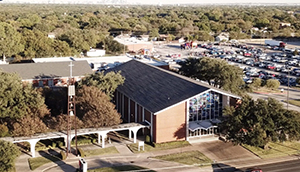
Exterior view of the Plymouth Park Baptist Church facility in Irving. (Facebook Post via BP)

Plymouth Park Church pointed to Queen’s “three decades of experience in a variety of roles and contexts as a leading voice in evangelism” and called him “a passionate evangelist and author” of several books.

Queen’s case came about through the Department of Justice’s investigation into allegations of mishandling claims of sexual abuse in the Southern Baptist Convention. He ultimately received a judgment of time served with one year of supervised release and six months of home confinement, alongside paying a $2,000 fine and $100 special assessment.

Supervised release required Queen to participate in outpatient mental health treatment and continued usage of prescribed medications.

Queen’s plea centered around falsified notes investigators said he provided in the spring of 2023 following a report of sexual abuse by a student at Texas Baptist College, Southwestern’s undergraduate arm.

Plymouth Park Pastor Matt Henslee told The Roys Report news outlet that while he did recommend Queen, a longtime friend, for the position, he was not part of the hiring process.

The church’s trustees and legal counsel “perused every single page of those court documents,” Henslee told The Roys Report. Church leaders also interviewed Queen for two and a half hours.

Queen was the only individual publicly indicted in the Department of Justice investigation launched in August 2022 and concluded in March of this year. No sexual abuse-related charges were filed as a result of the investigation.


Call to ban foreign entities from targeting churches

Texas Baptists’ Christian Life Commission is urging church leaders to sign a letter to U.S. Attorney General Pamela Bondi calling on the Department of Justice to prohibit foreign governments from using tracking technologies to send targeted messages to worshippers in U.S. churches without their consent.

On Sept. 27, Show Faith by Works—an organization acting as an agent of Israel’s Ministry of Foreign Affairs—filed disclosures with the Justice Department as required by the Foreign Agents Registration Act.

The disclosures revealed the organization’s intent to use geolocation and geofencing technology to send targeted messages to the mobile devices of individuals on the property of 465 churches—including more than 200 in Texas—without their knowledge and consent.

‘Crosses a line that should concern all Americans’

“We recognize the importance of diplomatic relations and the legitimate interests of allied nations. However, the surreptitious targeting of American worshipers on the grounds of their churches crosses a line that should concern all Americans who value religious freedom and privacy,” the letter to Bondi from Texas Baptists states.

John Litzler

John Litzler, CLC director of public policy and general counsel for the Baptist General Convention of Texas, noted most smartphone apps request user permission before accessing a user’s geographic location.

“Because of privacy rights, users typically have a choice whether to deny access to their location, always grant access to their location, or grant access to their location only while using the application. In these instances there is a knowing and voluntary decision by the user,” Litzler explained.

“If I allow a restaurant to know my location, for example, I may be able to place mobile orders and receive an occasional free chicken sandwich.

“In contrast, the targeting described in this filing would be done without the knowledge or consent of pastors and congregants.”

The letter to Bondi raises five key issues:

  • Violations of religious liberty, freedom of association and free assembly.

Houses of worship historically have been “protected spaces where Americans gather freely to practice their faith without government surveillance or foreign interference,” the letter states.

“Allowing government-sanctioned foreign surveillance and influence operations within church sanctuaries fundamentally undermines this separation by entangling houses of worship with state-approved foreign political campaigns.”

Targeting individuals in places of worship also can have a “chilling effect” on the freedom to assemble and freely exercise faith, the letter notes.

“Allowing a foreign government access to geolocation data to every phone located on a church premises is akin to requiring the churches to turn over their membership lists,” the letter states.

  • Violations of property and privacy.

Most of the places of worship listed in the filing are the private property of the faith communities that assemble there, the letter notes.

“Property rights are built on the principle that property owners should have the right to exclude others from their property,” the letter states.

“Geofencing, without the knowledge or consent of the property owner, circumvents these ownership rights by tracking individuals’ whereabouts everywhere on church property from the prayer room to the bathroom.”

  • Lack of informed consent.

Individual worshippers “have no knowledge they are being targeted and are provided no ability to opt out,” the letter states.

  • Violation of religious autonomy.

Houses of worship and their leaders “should have the right to determine what outside influences, particularly from foreign governments, are permitted to communicate with their congregations on church property,” the letter states.

  • Sets a dangerous precedent.

“Allowing agents of foreign governments to use surveillance technology to target faith communities sets a troubling precedent that could be exploited by any foreign actor, whether allied or adversarial to the United States,” the letter states.

‘Potential for gross violations’ of civil rights

Two years ago, Calvary Chapel in San Jose, Calif., sued Santa Clara County for geofencing its premises to track congregants who attended worship services during a COVID-19 pandemic “shelter-in-place” order.

The claims in that lawsuit “demonstrate the potential for gross violations of Americans’ civil rights when foreign or domestic governments are allowed to use this technology to track church attendees,” Litzler said.

“If a local, state or federal government entity tried to compel churches to turn over their membership lists, Christians would rightly be concerned about infringement on our rights of religious freedom and freedom of association,” he said.

“By setting a geofence around a church and collecting information about who enters that area each Sunday, foreign actors will gain enough information about church attendees that it’s tantamount to turning over a membership list to them.”

The letter from Texas Baptists to Bondi asks the Department of Justice to:

  • Prohibit agents of foreign governments from using geolocation, geofencing or similar tracking technologies “to target individuals at houses of worship in the United States without their consent.”
  • Establish an opt-in requirement that would allow foreign governments and their agents to use tracking technologies only at places of worship that have “explicitly and voluntarily consented in writing.” It would require full disclosure of “the foreign entity involved and the nature of the messaging to be delivered.”

“Houses of worship should remain sanctuaries free from uninvited foreign government surveillance and influence,” the letter to Bondi states.

“We ask that you act swiftly to protect the integrity of our religious institutions and the rights of all Americans to worship freely according to their conscience.”

Church leaders can sign the letter by clicking here.


Panelists identify dangers of religious nationalism

Religious nationalism “cheapens” religion and exchanges genuine love of country for a blank check that justifies any action a country takes, panelists said during the Global Religious Freedom Gathering at Dallas Baptist University.

Randel Everett, director of DBU’s Center for Global Religious Freedom, moderated a panel discussion Oct. 20 on “Religious Nationalism Globally and Its Effect on Minorities.”

Panelists were Jack Goodyear, dean of the College of Humanities and Social Sciences at DBU; Anna Lee Stangl, head of advocacy for Christian Solidarity Worldwide; and Katie Frugé, director of Texas Baptists’ Christian Life Commission.

Christian nationalism—which conflates Christianity and national identity—“compromises the faith, and it compromises the gospel,” Frugé said.

“This nationalistic merging with your faith cheapens the faith. It cheapens your experience with the Holy Spirit,” she said. “Really, at the end of the day, it becomes something that’s not even a true gospel. It’s a hindrance to your spiritual health.

“So, if our goal is human flourishing as a society, the best way for that to happen is to have faithful, real, authentic relationships with our Creator. And the best way toward that is not nationalism.”

Distinction between patriotism and nationalism

Goodyear drew a distinction between healthy patriotism—loving one’s country enough to hold it accountable when it fails to live up to its ideals—and unhealthy nationalism, particularly religious nationalism.

“Nationalism would tend to justify anything your country is doing, and anybody who opposes that are the ones who are [seen as] wrong,” he said. “Healthy patriotism allows you to love your country while still calling to account your country.”

Stangl agreed true patriotism means “speaking truth into what is happening” in a country and what it is doing abroad.

That becomes problematic when national identity and religious identity are combined, she observed.

Hindu nationalists in India, Buddhist nationalists in Myanmar and Sri Lanka, and Orthodox Christian nationalists in Russia offer contemporary international examples of how religious nationalism leads to “othering” and persecution of minorities, she said.

Furthermore, the parameters for acceptable religion continually shrink, she observed.

“When you raise up one group, that group will inevitably narrow,” Stangl said.

In Russia, for instance, the Orthodox Church is linked to Vladimir Putin, but dissident Orthodox groups are not, she said. So, only one dominant group within the Orthodox Church is recognized as legitimate.

Grants permission for ‘dehumanization’

Similarly, Frugé said, the rise of Christian nationalism in the United States begs the question, “Which version of Christianity?”

Eventually, the field narrows and one dominant group prevails at the expense of all others, she observed.

“It has the dynamic of ‘us versus them,’” Frugé said. “You have to have an ‘other’ who becomes the enemy, the target of the opposition. It creates a permission structure of dehumanization—to treat others as ‘less than.’”

That approach “chips away” at the fundamental Christian idea of each person bearing the image of God and possessing inherent worth, she asserted.

“It’s an unsustainable system,” she said.

Christian nationalism often “promotes fear” of those who are different, Stangl said.

Simply “being in proximity” to people of other faiths and recognizing they do not present any danger can help dispel those fears, she noted.

Same terminology, different meanings

Panelists acknowledged the challenge of confronting religious nationalism when it uses some of the same language and terminology of traditional religion while redefining terms and reshaping identity.

“For me, sometimes it begins with a gentle conversation of just establishing our terms and what we mean,” Frugé said.

For Baptists, it means “rooting the conversation in historicity” and making it clear an insistence on religious liberty for all is “who we’ve always been,” she added.

Goodyear emphasized the importance of telling stories about religious liberty that allow individuals to “see the human element and how it impacts people” instead of simply presenting hard facts.

Churches can help promote conversations that bring together people from diverse backgrounds to “mellow extremism” and help them see the viewpoints of others, he suggested.

Stangl offered an international example of churches teaching basic democratic principles to members.

She cited the example of a pastor in an authoritarian country who taught his people the importance of voting on simple decisions affecting the congregation and abiding by the will of the majority.

The pastor intentionally was preparing church members for the time when they might have the right to vote on national matters, she said.

Stangl also emphasized the value not only in telling stories from history, but also stories about what is going on around the world.

“It’s important to be talking about what’s happening in Burma and what’s happening in Russia and then tying it to here,” she said.

“I think a lot of Christians here who may be falling in love with the idea of Christian nationalism would immediately say, ‘It’s horrible what’s happening there.’”


Prior emphasizes living in purpose without AI

DALLAS—The craft of writing and the ethics of writing, just as with spiritual growth and maturity, offer no shortcuts, author Karen Swallow Prior said during her Oct. 16 lecture sponsored by the Institute for Global Engagement at Dallas Baptist University.

Using AI never can replace the skills or purpose of writing and reading, and there are risks such as plagiarism and stolen sources, Prior said.

“You have to know enough of the craft to recognize whether or not a tool’s effects are correct or good,” said Prior, author of The Evangelical Imagination, On Reading Well and You Have a Calling.

The purpose of reading and writing

To refresh her mind, Prior said, she often goes for runs around her neighborhood, fulfilling her purpose to keep her mind and heart clear.

To Prior, to read and write are ways to connect spiritually with God and others and to fulfill the purpose God has given.

 “You don’t get writing assignments because your professor needs more work to do. It all goes back to purpose. And shortcuts to fulfilling our purpose only can defeat the purpose,” Prior said.

Both reading and writing are important, Prior said, because we are made in the image of God, and he spoke the sky, land, sea and all of creation into existence with words.

“We, too, are made to use language to steward, to create with our words, and not just poems and stories and songs and final papers. We were made to create with words to offer love to one another, to ourselves, to our neighbors … to bring light and clarity,” Prior said.

“AI is just stolen words jumbled together and spit back out by a machine,” she continued.

“[AI] may be artificial, but it is not intelligent,” Prior noted.

“People were right about the printing press, too. I am hoping that AI becomes something better. But it is not there yet,” she added.

During the Q&A following the lecture, Prior agreed reading multiple works of literature help build empathy toward others.

Soulless versus meaningful

Prior told a story about one of her students who turned in a paper written with the help of ChatGPT, a program she was unfamiliar with at the time.

Familiar with searching for plagiarism and citation errors, Prior searched throughout the perfectly written paper and was astonished by how accurate and perfect it was. But the paper lacked a soul, a point Prior made to the audience while comparing writing with and without AI.

“We are meaning-making creatures. This is what we are made to do, and this is what we do,” Prior said.

“We are constantly searching for and trying to make meaning. And that’s what reading is literally and metaphorically. It is the effort to make meaning, whether you’re a 5-year-old … or whether you’re reading dense works of philosophy or reading the Bible to interpret it or reading each other’s faces,” Prior continued.

“I write because I don’t know what I think until I read what I say,” Prior said, quoting author Flannery O’Connor.

Prior told the audience to practice reading a lot of different things, from children’s material to classic fiction to written works encouraging intellectual thought.

Reading and writing are part of the larger journey of our own story and purpose in life, Prior said, and over time, a person can learn to read and write better if one doesn’t use AI.


Christians called to combat all religious persecution

Christians are commanded, commissioned and called to combat all religious persecution, international human rights attorney Knox Thames told a gathering at Dallas Baptist University.

Two-thirds of the global population live in countries that restrict the free practice of faith, Thames informed the Global Religious Freedom Gathering, sponsored by Christians Against All Persecution and DBU’s Center for Global Religious Freedom.

Thames, author of Ending Persecution: Charting the Path to Global Religious Freedom, distinguished genuine persecution from the loss of privileged status enjoyed by a specific group.

“Persecution is violence or severe punishment on account of victims’ belief or non-beliefs or membership—real or perceived—in a religious community, combined with a lack of accountability,” he said.

Thames identified four forms of persecution:

  • Authoritarian persecution occurs when the state exercises power against religious activity or religious groups, such as in China.
  • Extremist persecution takes place when non-state actors and individuals are allowed to commit acts of violence against those who practice a particular religion or fail to adhere to the state-sanctioned religion, such as in Pakistan.
  • Terrorist persecution occurs when extremist groups commit acts of extreme violence against particular religious groups, such as ISIS targeting Yazidis and Christians in Iraq.
  • Democratic persecution happens when the dominant religious community uses majority rule to trample the rights of adherents of minority religions, such as in India.

The global “pandemic of persecution” does not affect followers of only one religion, said Thames, senior fellow at Pepperdine University.

Rather, it “goes after everyone” and endangers freedom of thought and practice of all wherever it occurs, he stressed.

‘Be light in the darkness’

The global “pandemic of persecution” does not affect followers of only one religion, international human rights lawyer Knox Thames told a gathering at Dallas Baptist University. (Photo / Ken Camp)

Christians have the responsibility to pray for all persecuted people and advocate for the religious freedom of every person, Thames emphasized.

“Advocacy demonstrates God’s love in a tangible way,” he said.

Jesus commanded his followers to love their neighbors and commissioned them to make disciples of all people groups everywhere—not just those who are like them, Thames said.

Citing both the Hebrew prophets and the New Testament, he pointed to ways God calls his people to stand up for the rights of the oppressed and vulnerable.

“One small light can pierce the darkness,” Thames said. “We are called to be light in darkness.”

During the gathering at DBU, participants not only prayed for a Christian pastor from Turkey and a Nigerian pastor, but also a representative of Pakistan’s Ahmadiyya Muslim community and a Shia Muslim from the Hazara people of Afghanistan.

Lead with love, start with service

Non-Christians find the gospel more compelling when Christians lead with love and start with service, rather than seek power and exercise privilege, former Houston pastor Steve Bezner said.

Non-Christians find the gospel more compelling when Christians lead with love and start with service, rather than seek power and exercise privilege, Steve Bezner told participants at a Dallas Baptist University chapel service. (Photo / Ken Camp)

Bezner, now associate professor at Baylor University’s Truett Theological Seminary, spoke in the DBU chapel service during the Global Religious Freedom Gathering.

History, diplomacy and theology should lead Baptists in the United States to care about religious persecution and advocate for the religious freedom of all people, he said.

Baptists in colonial America learned early what it meant to be “on the receiving end of persecution,” said Bezner, citing pastors Roger Williams, Obadiah Holmes and Isaac Backus as examples.

On a practical level today, when Christians in the United States insist on religious freedom for all people domestically, appeals by U.S. diplomats for international human rights carry greater weight, he added.

Theologically, true faith demands the freedom to choose freely, not coerced conformity to mandated religion, said Bezner, author of Your Jesus is Too American: Calling the Church to Reclaim Kingdom Values Over the American Dream.

“Jesus wants all to freely come to him,” he said.

Establish relationships

Bezner recalled the backlash against Muslims when an Islamist extremist killed 49 people and wounded 58 others at the Pulse nightclub in Orlando in 2016—the deadliest mass shooting in American history up to that point.

At the time, Bezner had been pastor of Houston Northwest Church about three years. He felt God leading him to stop at a Houston mosque in the immediate aftermath of the mass shooting and seek to befriend the imam there.

A frank and honest exchange—in which the pastor and the imam each affirmed their distinctive beliefs—provided the foundation for mutual respect and resulted in Bezner receiving invitations to speak at three local mosques.

“The gospel runs on the rail of relationships,” he said.

He also described how members of Houston Northwest Church spent two months in “mud-out” work after Hurricane Harvey hit their city in August 2017.

Church volunteers worked in the flooded homes of their neighbors—many of them non-Christians—clearing out mud, discarding debris, removing damaged drywall and disinfecting surfaces to eliminate mold.

Christians make a lasting impact not by “taking over the White House” but by “going house to house” serving their neighbors, Bezner said.

Peacemaking group receives award

Wissam al-Saliby, president of 21Wilberforce,  presented the Frank Wolf International Freedom Award to Churches for Middle East Peace. Mae Elise Cannon, executive director of CMEP, accepted the award on behalf of the organization. (Photo / Ken Camp)

The Global Religious Freedom Gathering at DBU also featured panel discussions involving pastors, international students and advocates from human rights groups focused on religious freedom.

At a dinner held in conjunction with the gathering, the 21Wilberforce human rights organization presented its annual Frank Wolf International Freedom Award to Churches for Middle East Peace. Mae Elise Cannon, executive director of CMEP, accepted the award.

The coalition—representing more than 30 national communions and organizations—mobilizes Christians in the United States to advocate holistically for equality, human rights, security and justice for Israelis, Palestinians and all people of the Middle East.

Previous award recipients include Bob Roberts, co-founder of the Multi-Faith Neighbors Network; Bob Fu, founder of ChinaAid; Sam Brownback, former U.S. ambassador-at-large for international religious freedom; Archbishop Ben Kwashi and Gloria Kwashi of Nigeria; and the city of Midland.

EDITOR’S NOTE: The third paragraph from the end was edited after the article initially was published.


Truett Seminary establishes Anglican Episcopal House

Baylor University’s Truett Theological Seminary announced Oct. 13 the formation of an Anglican Episcopal House of Studies.

In making its announcement, the seminary stated the graduate-level program “will cultivate theologically grounded, liturgically formed and missionally engaged clergy and lay leaders for service in Anglican and Episcopal contexts.”

Todd Still (Baylor Photo)

“Since its inception, Baylor’s Truett Seminary has welcomed and trained ministers both within and beyond Baptist life. In recent years, especially through Truett’s Wesley House of Studies, our seminary has enjoyed an influx of students from other Christian denominations,” Dean Todd Still said.

“Indeed, there are currently no less than 26 different denominations represented in our school’s student body.”

Currently, 15 Truett Seminary students are enrolled from various dioceses within the Anglican Church in North America, The Episcopal Church and from other provinces internationally.

“The launching of the Anglican Episcopal House of Studies at Truett is due primarily to our commitment and desire to equip more fully the Anglican and Episcopalian students who are already studying with us and have been entrusted to us,” Still said.

“Our present and future hope is that we would prepare them and other such seminarians well so that they might thoughtfully, faithfully and skillfully serve as ministers of the gospel across this vast and vibrant communion of believers around the world.”

Truett aims to strengthen support for current students while deepening relationships with the ecclesial bodies already represented at the seminary. The seminary also will seek to build new connections with other like-minded bishops, rectors and prospective students, the announcement stated.

On Oct. 28-29, Rowan Williams, Archbishop of Canterbury from 2002 to 2012, will deliver the annual Parchman Lectures at Truett Seminary.

Once the Anglican Episcopal House of Studies is firmly in place at Truett Seminary’s Waco campus, the seminary will expand its course offerings to its Houston and San Antonio campuses.

Matthew Aughtry named acting director

Truett Seminary has appointed Matthew Aughtry as acting director of the Anglican Episcopal House of Studies. A priest in the Anglican Church in North America and resident within the Diocese of Churches for the Sake of Others, Aughtry’s time as an Anglican has primarily been defined by assisting various church plants in both Los Angeles and Waco.

Truett Theological Seminary has appointed Matthew Aughtry as acting director of its Anglican Episcopal House of Studies.

He also serves Baylor University as an associate chaplain, working as the assistant director for chapel and ministry in the arts in Baylor Spiritual Life.

Aughtry, who grew up in a small-town Baptist church, was drawn to the Anglican tradition through the writings of C.S. Lewis.

He particularly cited Mere Christianity, “with vision of the Church as a mansion—its broad hallways full of lively conversation, yet its rooms alone reserved for offering food, fire and rest.”

“Seminary ushered me into the Anglican room of this great estate,” Aughtry said. “The Prayer Book’s sustaining patterns have become a safe harbor for me through years of church-planting and ministry in Baylor Chapel.

“I am honored by Dean Still’s invitation to join the launch of this initiative at Truett Seminary, a place I have experienced as akin to Mere Christianity’s magnificent mansion. It is my joy to serve this room, and I anticipate the ways doing so will further the mission of the entire home.”

Charles Ramsey, university chaplain and dean of Spiritual Life at Baylor, expressed “joy” at the launch of Truett Seminary’s Anglican Episcopal House of Studies.

“Faithful proclamation of the gospel in word and deed is at the heart of Baylor University and Truett Seminary. God has blessed this faithfulness and is drawing people from across denominational lines to become formed and equipped for kingdom service,” Ramsey said.

“It is a joy to celebrate the opening of the Anglican Episcopal House of Studies at Truett Seminary and to welcome these brothers and sisters as we seek to glorify and serve God together in the church and the world.”

‘Serve the broader body of Christ’

The announcement from Baylor University quoted Stephen Stookey, director of theological education and institutional engagement with Texas Baptists, who voiced support for Truett Seminary’s decision to launch the Anglican Episcopal House of Studies.

“This initiative is a thoughtful and faithful effort to serve the broader body of Christ through ecumenical engagement and academic excellence, rooted in the historic Christian faith,” Stookey said.

“As a Baptist community, we value our distinctives while also embracing opportunities to collaborate with Christian sisters and brothers who seek to proclaim the gospel, foster spiritual formation, and equip leaders for Great Commandment/Great Commission ministry.”

By establishing the Anglican Episcopal House of Studies, Truett Seminary is demonstrating its “ongoing commitment to forming ministers from a variety of traditions within the one body of Christ,” Stookey said.

“I am confident that this new initiative will enrich the seminary community, broaden theological dialogue, and enhance the preparation of students called to serve in their respective ecclesial contexts,” he said.

“It is my prayer that this partnership will bear lasting fruit for the kingdom of God.”

‘A prophetic vision’

Chris Backert, senior director of Ascent Movement, an emerging mission network, praised Truett Seminary for its willingness to collaborate outside of Baptist circles.

“Truett Seminary has uplifted a prophetic vision to offer space for distinction in polity and Christian heritage within a broader commitment to a globally engaged, evangelically orthodox theological witness,” Backert said.

By launching the Anglican Episcopal House of Studies alongside its Wesley House of Studies, Truett Seminary is demonstrating “for theological education what the wider church must attend to in other arenas,” he said.

“If the broader, joyfully confessional evangelical community can find its way together to prepare future church leaders, then perhaps our congregations, denominational structures, mission agencies and the like will follow suit,” Backert said.

Elizabeth Newman, vice chair of the Baptist World Alliance Commission on Baptist Doctrine and Christian Unity, praised Truett Seminary for continuing to “expand its vision of theological education by establishing an Anglican Episcopal House of Studies.”

“This initiative opens up rich possibilities for ecumenical formation while also enhancing the mission of the church,” said Newman, adjunct professor of theology at Duke Divinity School.

“I am delighted to see this kind of seminary response to Jesus’ prayer that all may be one so that the world may know.”

A Truett Seminary spokesperson said the “next area of focus” will be the Baptist World Alliance program approved this summer. The seminary is now preparing to search for a candidate to fill the newly created Lampsato Endowed Chair of Baptist World Missional Engagement.


Chris Clayman: Frontier people groups deserve priority

Frontier people groups—unreached people groups where Christians number less than 1 in 1,000—represent about 20 percent of the global population, Chris Clayman, CEO of the Joshua Project, told participants at a Waco missions conference.

Christians should prioritize outreach to frontier people groups, Clayman told the “Beyond Us … From Neighborhoods to Nations” missions conference at First Baptist Church in Waco. Waco-area churches sponsored the conference in collaboration with Baylor University’s Truett Theological Seminary and Baylor Spiritual Life.

Clayman presented 10 reasons why frontier people groups—whose numbers exceed 1.5 billion—deserve priority.

  • “God is gathering worshippers from all peoples and commands us to join him.”

From the time of Abraham until Christ returns, God’s plan is to bless all nations and people groups, Clayman said.

  • “There are seats missing at the wedding banquet.”

Luke 14 records Jesus’ parable of a wedding feast to which all are invited. Revelation 19 presents the vision of the marriage supper of the Lamb, where all the redeemed of the ages gather.

However, not everyone who should be at the table is there yet. “God’s heart is for the unreached,” Clayman said.

  • “The primary propagation of the gospel happens through the church.”

Frontier people groups need “breakthrough churches” in their language and culture where they feel welcomed.

  • “Many mission efforts work primarily with existing churches, diverting focus away from frontier peoples needing cross-cultural efforts.”

Frontier people groups who lack local, culturally relevant churches never will be reached if mission efforts are confined to working with churches on the mission field.

  • “Most missionaries go where they are invited, not to frontier people groups.”

If there are no Christians within a people group to invite missionaries, those people never will receive a missionary if an invitation is required. Furthermore, missionary candidates tend to favor groups with whom they already have some cultural connection.

“A lot of frontier people groups live in cultures you’re not going to connect with, and you’re not going to like their food,” Clayman said.

  • “Frontier people groups make up the largest group of unreached people groups.”

Clayman reported 72 percent of unreached people groups are frontier peoples, but they receive only a tiny fraction of the missionaries.

  • “Paul set an example of not building on someone else’s foundation.”

In Romans 15:20-21, Paul expressed his desire to take the gospel to areas that had not heard the gospel rather than continue work where there already was a gospel witness.

“In many ways, it’s like gospel triage,” Clayman said—giving attention where the need is greatest.

  • “We have clarity about where the greatest church planting need is in the world, and the populations there are growing rapidly.”

Four out of five unreached people groups are in the 10/40 window—the area of North Africa, the Middle East and Asia between 10 degrees north and 40 degrees north latitude. Furthermore, the birth rate is higher in unreached areas than in predominantly Christian countries.

  • “There is great imbalance and injustice of opportunity for those born into frontier people groups.”

Individuals in frontier people groups are least likely to hear a clear presentation of the gospel or encounter a Christian witness.

“Christians are rightfully concerned about justice issues. … But I don’t really hear much about the injustice linked to frontier people groups not having the opportunity to hear about Jesus in their lifetime,” Clayman said.

  • “Frontier people groups require highly intentional, difficult, cross-cultural mission efforts.”

Christians looking for an immediate return on investment are not attracted to frontier people groups, and working among those groups is challenging.

“It demands a lot of sacrifice,” Clayman said.

Frontier people group missions “requires our most careful attention, mobilization, training and prioritized deployment of resources,” Clayman asserted.


Tony Evans’ next chapter, undisclosed ‘sin’ and new book

Dallas megachurch founder Tony Evans has lived a mostly private life for more than a year, after announcing an undisclosed “sin” caused him to step away from the prominent pulpit where he preached for almost five decades.

His church, Oak Cliff Bible Fellowship, announced Sunday, Oct. 5, that he completed a restoration process but is not returning to its leadership.

However, Evans, 76, is working on new public-facing projects, mostly through his ministry The Urban Alternative.

His latest book, Unleashed: Releasing God’s Glorious Kingdom in and Through You, is set to be released by Thomas Nelson Publishers on Oct. 28.

He’s also scheduling speaking engagements at churches and conferences after his first major address in more than a year at a conservative Christian summit in Des Moines, Iowa, in July.

The elder board of his predominantly Black nondenominational church also announced his son, Jonathan Evans, has been appointed an elder and is expected to be installed officially as lead pastor.

In an interview with Religion News Service days before his church’s “Restoration Sunday,” the elder Evans said he has faced challenges with people not accepting his marriage to his second wife, Carla Evans, after the death of Lois Evans, to whom he was married for 49 years.

He also said there have been other personal matters, which he chose not to discuss in the interview, that he has grappled with as his son is gaining more church responsibilities.

When he’s in town, Evans now sits at the front of the church with his family, and he said he’s supportive of Jonathan Evans’ leadership and impressed by his preaching.

In the interview, which has been edited for length and clarity, Evans talked about his new book, why he left his church’s leadership, the next phase of his life and his thoughts about eternity.

You have previously written books on your beliefs about what you call the “kingdom power” of God. How do you sum up those convictions, and how are you approaching that topic differently this time?

In the book Unleashed, I’m trying to focus on taking the concept of the kingdom and releasing it in and through your life.

Many Christians don’t have a kingdom worldview. They’ve accepted Christ. They’re on their way to heaven. But this rule of God on the way there for them on Earth is often missing. And so, we’re trying to go deeper in seeing it being practically activated in your life.

Your book discusses choices and standards you think Christians should embrace, and you seem to have made a choice for yourself about standards when you stepped down from pastoral leadership at Oak Cliff Bible Fellowship last year.

Can you share what the undisclosed sin was that prompted that decision, and if your healing and restoration process is continuing?

There was a decision made as I moved into a new relationship. My wife passed away in 2019, and I remarried (four) years later, and there was such consternation around that, and people who were not as excited about it (laughs). And we were already in transition with my son (in leading the church).

So, we just said this would be the best time to go ahead and make that transition, so that all the consternation around it wouldn’t interfere with that process. There was some underlying things, but that was the decision that was made as we moved forward.

And who made that decision—you or the church?

A combination. It was a shared one.

You used the word “sin” in your statement, and now you’re using the word “consternation.” Can you explain what you mean?

There just was some personal matters that we’re not free to go into, but some personal matters that precipitated that decision.

Anything more you can say? That’s a little unclear.

I know, but because the church wanted to just keep it within the bounds of the church, that’s why we’re honoring that.

Your son is now preaching regularly at Oak Cliff Bible Fellowship. How has that transition gone? Are you solely a member there, or are you involved in the church in other ways now?

I am the founding pastor, and my goal is to support him in every way. It has freed me up to do some of the national events that we are doing.

We’re doing a new podcast that we’re taping now. We also (are producing) an “Unbound” documentary series showing how the Bible moved throughout history. So, it’s created a freedom that I’ve never had before (laughs).

How soon do you think you’ll be back in the pulpit preaching?

We have some meetings coming up to discuss the plan for that, because we are trying to not let his movement into this new arena be overshadowed by my 48 years. So, it’s a timing thing, and we haven’t gotten specific yet, but we’re working toward that.

In your son’s sermon on Sept. 28, he said he initially complained to God about this season that Oak Cliff Bible Fellowship began when you stepped away, but said he realized he should be grateful for your decades-long ministry and God’s faithfulness in it. What has it been like watching his sermons and seeing him lead?

He’s blowing my mind, actually. He’s got this—it’s an old term—but this “New Jack City” thing (laughs), the media thing and this new generation thing, but he is solidly expositional in the word. So, I am loving the exposition. I’m loving the relevancy.

This younger generation of preachers, they tend to be much more casual, much more relaxed. This is a new world that I don’t fully get, but I can appreciate the fact that we want to reach it in a relevant way.

When you say “media,” what do you mean?

I’m certainly meaning his use of social media, but media in the service—video clips and staging and props and all that.

You note in your book that when people have mountains, so to speak, or difficulties, they tend to talk to other people about their problems rather than talking to God about them—or to the mountain. What’s an example of when you spoke to a mountain, maybe especially in the last year or so?

During this year, we have had to address some major issues with regard to our projects, our funding. We’re having to raise $9 million to do all that we’re doing around the world. And so, we had to speak to God about being our source, but we also had to speak to the source. We had one donor who unexpectedly gave us a million dollars.

Did the difficulty of fundraising have anything to do with the fact that you stepped away?

No, it has had to do with the need of the moment. It’s a couple of projects. One is “Unbound,” where we’re tracing from the medieval age through the Renaissance to the Reformation to the Enlightenment to the modern times how God has moved his word along.

When we take these trips to the different countries with these events, “Unbound” is showing how God used the social, political, economic and personality dynamics to move his word along.

When you spoke in July to the Family Leadership Summit in Iowa, you told them, “You’re not first Democrat, you’re not first Republican. You are first of all, a representative of another king and another kingdom, and everything else is second to that.”

In a time when politics are often dividing the church, are you concerned that evangelical Christians are often described as following their party more than their faith?

That’s a major concern, because what we’ve done is turned politics into an idol, and anything idolatrous is going to be rejected by God.

God is involved in politics all through Scripture, but he’s involved as God. He’s not riding the backs of donkeys or elephants. Neither can Christians be riding the backs of donkeys or elephants.

So absolutely, Christians should be engaged in politics. We should bring God’s point of view to politics, but we should never believe we’re going to be delivered or saved by politics.

Was there something you learned about yourself or that you’re taking forward now that this restoration process has concluded?

Through this year, there have been a number of losses of people; some of our leaders who have passed away. And a dear part of our ministry, one of our board members who I was very close to, passed away from cancer.

I think I’ve gone deeper in thinking about eternity. Always thought about it, but deeper in that vein. So, whatever life I have left, I want to maximize at the highest possible level for God’s kingdom and for eternity.



Christians called to missional—not comfortable—lives

Christ calls his followers to missional lives, not lives of comfort and ease, speakers emphasized at the “Beyond Us … From Neighborhoods to Nations” Missions Conference at First Baptist Church in Waco.

Waco-area churches sponsored the conference in collaboration with Baylor University’s Truett Theological Seminary and Baylor Spiritual Life.

“There’s no easy way to be about the Father’s business,” said Christine Caine, author, evangelist and founder of the A21 campaign to fight human trafficking.

“To me, there is nothing more important than taking the gospel of Jesus Christ into all the world.”

Too many Christians suffer from “passion deficit disorder,” she said, offering her prayer that God will ignite a passion within the church “for the thing that God’s heart beats for, which is a lost and a broken world.”

“Passion is the fuel that keeps us going,” she said.

Caine grew up in poverty as the adopted child of a Greek immigrant couple in Australia. As a survivor of long-term sexual abuse, she spoke about how God redeemed her when she came to faith in Christ.

“When I learned to make what Jesus did for me at Calvary bigger than what anyone had done to me who had abused me, it changed my whole life,” she said. “Why would I not want a lost and broken world to know that?”

‘Willing to be interrupted and inconvenienced’

In 2008, she and her husband Nick founded A21 with a goal of abolishing modern-day slavery—human trafficking—in the 21st century. The organization works in 19 locations in 14 countries, seeking to reach, rescue, recover and restore trafficking victims.

Like the priest and the Levite in the parable of the Good Samaritan, many Christians too often pass by the wounded because they are busy and preoccupied, Caine said.

Instead, followers of Jesus are to be like the Samaritan who was “willing to be interrupted and inconvenienced” to care for someone who was broken and hurting, she said.

“The church is not about the Father’s business because we are not willing to be interrupted or inconvenienced,” she said.

When God’s people move beyond “little Christian ‘bless me’ clubs” and commit to be his witnesses to a lost and broken world, God will “do something unlike anything we’ve ever seen,” Caine said.

Reawakened love for the lost

“We need a reawakening in the church of what our mission is—a love for the lost,” she said.

While Jesus told his followers to be “in the world but not of it,” too many Christians today are “of the world but not in it,” Caine said.

Jesus called on his disciples to be salt and light—catalytic agents that bring about change, she emphasized.

“You can’t change a world you’re not in, and you can’t reach lost people who you don’t have close proximity to. And if you’re of it—the same substance as it—you won’t bring about change,” she said.

Christians need God to help them see the world as he sees it, Caine asserted.

“It’s so easy to ignore suffering when it is nameless and faceless and it’s just a statistic. God doesn’t make numbers. He makes people. … God sees people as people,” she said.

“We talk about the poor, the lost, the marginalized and the disenfranchised as if they are just statistics. They are people created in the image of God, and they are the ones to whom we’re sent to be salt and light.”

‘God doesn’t give comfortable callings’

Tom Lin, president and CEO of InterVarsity Christian Fellowship, described how responding to God’s call meant abandoning the dreams his parents had for him.

“God doesn’t give comfortable callings,” Lin said.

As the child of immigrants, Lin said he was raised to pursue the American dream of comfort and security.

After Lin earned his undergraduate degree in economics from Harvard University, his parents were devastated when he told them he was following God’s call to pioneer missions in Mongolia.

“My parents came from poverty in Asia so I wouldn’t have to live in poverty in Asia,” he said.

From Genesis to Revelation, God’s plan has been for his people to “put feet to their faith” and be a blessing to all nations, Lin asserted.

“Each of us has a purpose, and it is to be bless the nations. This is not an optional activity,” he said. “I often tell college students, ‘This is not like extra credit.’”

In a time of unprecedented need in the world, Christians have unprecedented opportunities to bless the nations, but obedience to God’s call demands defying the dominant culture, Lin insisted.

“Culture teaches us to do everything we can to bless ourselves—to bless our own Christian bubble, our own Christian churches, and to avoid suffering,” he said.

“God’s purpose for his people is to bless the nations, and it often requires leaving comfort, he said. But when God’s people obey his call, he added, “We see God’s faithfulness.”

Christ gave the Great Commission to the whole church

Obedience to God’s call means recognizing Jesus gave his Great Commission—making disciples of all nations—to the whole church, not the select few, said Bob Roberts, founder of GlocalNet and co-founder of the Multi-Faith Neighbors Network.

While God calls some Christians to vocational service as cross-cultural missionaries, God also calls every follower of Jesus to use his or her skills, talents, gifts and areas of expertise for kingdom purposes, Roberts said.

Christians earn the right to spread the gospel by going through “the front door,” as welcomed guests in other countries who contribute to society rather than operating secretively or deceptively, he said.

Countries that may be closed to traditional missionaries eagerly welcome Christians who are “bringing value” to their people through their vocations and contributing to “human flourishing,” he said.

Christians with experience in education, health care, business and agriculture can use those abilities to advance the kingdom of God and bring wholeness as God desires, Roberts said.

“You don’t have to take the culture over. You just have to be salt and light in the culture,” he said. “I don’t want Christian nationalism. I want Holy Spirit presence.”

For example, when Roberts was pastor of Northwood Church in Keller, the congregation established a relationship with Hanoi about 30 years ago.

That ongoing relationship led to the opportunity for educators in the church to develop a special-education curriculum for the entire nation of Vietnam.

“We tend to do missions to people. We need to do missions with people,” Roberts said.

‘God always pushes us beyond our boundaries’

Love for God, love for others and Christ’s command to make disciples motivates Christians to move outside the narrow confines of what is comfortable and familiar, said Julio Guarneri, executive director of the Baptist General Convention of Texas.

“God always pushes us beyond our own boundaries. If you have been transformed by the gospel, you cannot stay in the same place. … He always invites us to go beyond ourselves,” Guarneri said.

Christians find their motivation for missional living in the cross of Christ, he said.

“We are not motivated by need or by guilt,” Guarneri said. “We are motivated by the love we see at the cross.”

The call of God compels his people to go beyond their preconceived ideas and gain a new perspective, he said. Even after Christ’s resurrection, his disciples still did not understand what Jesus had been teaching about the kingdom of God. Before his ascension, they asked Christ when he would “restore the kingdom to Israel.”

“They thought the kingdom was about making Israel great again. It’s not about national greatness but about a global witness,” Guarneri said.

Christ called the provincial disciples is to become “cross-cultural ambassadors of God’s love,” he said.

God calls his people to the ministry of reconciliation, Guarneri said. Sin alienates people from God and each other, but God’s grace reconciles.

“We have been deputized as agents of reconciliation,” Guarneri said.


Conclave attendees urged ‘never get over the gospel’

ARLINGTON—More than 640 leaders and volunteers for children, teen and young adult ministry gathered Oct. 6 and 7 at First Baptist Church in Arlington to worship and learn how to reach current and future generations for Christ and the church.

Shane Pruitt, national next gen director for the North American Mission Board, spoke during the first general session on lessons he learned in his 20 years of ministry.

Always focus on the depth of ministry, never stop being a servant, get good friends, know fruit always surprises, learn to say “no” and let the thorns lead to the throne, Pruitt urged.

“Never get over the power of the gospel in your life … If God can save you, God can save anyone,” Pruitt said. “Because Jesus lives … that’s why we get to do what we do.”

Pruitt addressed the importance of maintaining character and integrity in ministry and building relationships with family and friends.

The solution is the discipline of prayer and staying close to Jesus, he said.

“Focus on the depth of your ministry and let the Lord focus on the width and platform of it—

spiritual discipline, praying and staying at the feet of Jesus,” Pruitt said.

Pruitt added ministry is about serving, and comparisons can be a snare for anyone in ministry.

“Ministry is not a calling to stardom. It is a calling to servanthood. God’s love for you is not dependent on your size of ministry,” Pruitt said.

Bobby Contreras, pastor of Alamo Heights Baptist Church, preached from Proverbs 6:6-8 during a general session, emphasizing the need to reflect Jesus to point others to him.

“Do we truly live in his goodness when storms come? At times, I don’t because his goodness seems so far away in times I deem as bad, broken or hurting. So, will we store up? It is time to store up. It does us no good to store up if we don’t share it,” Contreras said.

NextGen conversations and AI

The trend of young adult Gen Z and Millennials attending church is going up, David Kinnaman, CEO of Barna Group, said during a general session.

Barna group confirmed “the average was close to one weekend per month. Those rates are up nearly one extra weekend a month, nearly double the rates of just five years ago.”

“This generation is open to Jesus,” Kinnaman said, adding Gen Alpha will be the generation known by the rise of AI.

“This generation, our generation, is going to be taking these deep questions to a new place, a new kind of median response to all humans,” he continued.

“And remember that the way these large language models are built, they are not built on any kind of Christian context. They are doing their very best to take the averages of all these complex pieces of information and spit out something that a human being can read and understand.”

Practical use of AI—such as ChatGPT—for everyday ministry work consists of cross-referencing of biblical texts, biblical language assistance and summarization of books and research material, Katie Frugé, director for Texas Baptists’ Center of Cultural Engagement, said during a pastors track on artificial intelligence and ethical challenges.

Regarding ethical considerations, Fruge said AI is not neutral and can be manipulated.

“Just utilize the current ‘gold standard’ programs that integrate AI into the system. Think machine learning, not content generation,” Frugé said, adding AI should be utilized as a resource to support, not replace, what pastors already are doing.

“More Gen Z and Millennials say and feel more like themselves online than offline,” Trent Brent of Next Gen Catalyst said during a breakout session on the latest generation trends. “Online matters,” he added.

Breakout sessions highlight resilience and inclusion

Shelly Melia, associate dean of the Graduate School of Ministry at Dallas Baptist University, talked about building resilience in children.

Using a fishing analogy from childhood fishing trips, Melia addressed the many hooks that can keep a child from recovering from challenges and failures in life, such as fear, anxiety, family dysfunction and a lack of necessities like food and shelter.

“Resilience is not a fixed trait. … It is not always unique to children,” Melia said.

Building resilience requires action and not being passive toward issues causing distress, she said.

Laura Roodenburg, ministry relations manager for Joni & Friends, emphasized the importance of relationship building and taking small, immediate steps toward inclusion for people with disabilities.

“Not every barrier is physical. For some it is sensory overload,” she said.

“Imagine how hard church is when those lights flicker, the sound is painfully loud, or a bulletin is cluttered with fine print. Noise-reducing headphones, a printed order of service, a simple visual chart for kids—those can make all the difference between a meltdown and a worship,” Roodenburg said.

Within 90 days, a church can take subtle steps toward making itself more accessible by adjusting Bible study locations, integrating seating, and employing accessibility webpages, ramps, lifts, interpreters and sensory supports, Roodenburg said.


Tony Evans will not return to lead Dallas megachurch

(RNS)—Dallas megachurch founder Tony Evans, who stepped back from leading his church due to an undisclosed “sin” he announced last year, will not return as pastor of Oak Cliff Bible Fellowship.

Evans apologized to his congregation and his family on Oct. 5, after the elder board of Oak Cliff Bible Fellowship announced the pastor had completed a “restoration process” and will not return to lead the church.

“To the flock, to the congregation, for the consternation I may have caused you with questions and wondering and uncertainty, I’m sorry,” he said as he sat on the church’s stage during a worship service and answered questions from his son, Jonathan Evans, who has been preaching regularly at the church.

“I apologize sincerely for any instability that this season has caused you because you are my treasure.”

Evans, who abruptly announced he was “stepping away” in June 2024, is the first African American to have both a study Bible and a full-Bible commentary bearing his name. In addition to his church, he founded the Christian Bible teaching ministry The Urban Alternative, which continues to air his messages on radio outlets worldwide.

Nature of sin not disclosed

During the “Restoration Sunday” service, which lasted an hour and 40 minutes, neither Evans nor Chris Wheel, associate pastor of outreach, disclosed the sin Evans described in June 2024 as requiring “the same biblical standard of repentance and restoration” he had applied to other people.

“While I have committed no crime, I did not use righteous judgment in my actions,” Evans, now 76, said at the time. “In light of this, I am stepping away from my pastoral duties and am submitting to a healing and restoration process established by the elders.”

Some churches offer or demand a restoration process of their leaders to overcome what they consider a violation of the Bible.

During the worship service at the nondenominational, predominantly Black church, Wheel said Evans’ “discipline and restoration process” included counseling with professionals outside the church’s staff, “evidence of genuine repentance and godly sorrow” and pastoral mentoring.

Citing the Bible’s epistle to the Galatians’ guidance about restoring a sinful person, Wheel said: “In keeping with this biblical framework, the elder board exercised deliberate and prayerful discretion regarding the timing, the manner of disclosing specific details throughout the restoration process.”

“This was not done to conceal wrongdoing, but rather to uphold the integrity of the process, to protect the dignity of all involved, and prevent unnecessary speculation or sensationalism,” he said, adding that Evans “fully submitted” to the restoration process.

Wheel said Evans also took a 12-month absence from pulpit ministry to “focus on personal growth.”

“In alignment with biblical principles and unanimous affirmation of the elder board, Dr. Evans has successfully completed this restoration journey,” Wheel said.

Jonathan Evans likely next pastor of church

As the congregation applauded and cheered, Evans entered the stage.

“While he will not be returning in a staff nor leadership role at OCBF, we joyfully look forward to seeing how God uses Dr. Evans’ gifts and calling to proclaim the truth of Scripture with clarity and conviction for the strengthening of the body of Christ,” Wheel said.

Evans made a major public appearance shortly after his yearlong absence concluded, speaking at the July summit of The Family Leader, a Christian organization known for its conservative evangelical stances, in Des Moines, Iowa.

Wheel said more details about the future plans for the church will be announced at a “Vision Sunday” service, set for Oct. 12.

“Key steps include Jonathan Evans has been appointed as an elder,” he said. “Our expectation is that he will formally be installed as the lead pastor of Oak Cliff Bible Fellowship.”

As soon as Wheel concluded speaking, Jonathan Evans led the congregation in a brief Communion service.

“Somebody celebrate our Lord for restoration, forgiveness and reconciliation,” Jonathan Evans said.

‘Hardest part was disappointing the Lord’

The service then pivoted to him sitting with his father for a 20-minute discussion in which the two men expressed their pride in each other, and the elder Evans thanked the church, his family and friends for their endurance and described the “bittersweet” period that had just concluded. He said those days often were filled with depression, loneliness and tears.

“It’s certainly bitter when you’ve done something for 48 years every day, every week, and then you’re no longer doing it—and it’s your fault,” Evans said. “I had to search for God, but not for a sermon.”

Asked about the hardest part of the yearlong process, Evans said, “The most important and hardest was disappointing the Lord, who had given me so much and in such a unique way.”

He said he particularly was thankful for the support of his wife, the former Carla Crummie, whom he married in December 2023, after Lois Evans, his first wife of 49 years, died in 2019.

“The way we came together was shared loss,” he said. “Our mates died a few days apart as she and her late husband were on their way to my wife’s funeral.”

Evans said he was concerned about “many things that were not true being said” on social media.

“The way they beat up on my wife who knew nothing about any of this, and then the way they came after my children and then came after the Lord,” he said. “And I was the reason why all of that was happening, on a worldwide scale.”

Speaking directly to the congregation, he said, “For anything that has hurt you from me, I’m sorry, but I’m so glad I have you and you have me.”


Beautiful Hope Ministries aids trafficking survivors

University of Mary Hardin-Baylor sophomore Hannah Balkenbush knows exactly where her hope lies—in Jesus Christ. That conviction is the driving force behind Beautiful Hope Ministries, a nonprofit she founded in 2021 to raise awareness about human trafficking and to offer Christ-centered restoration to survivors.

The seeds of Balkenbush’s mission were planted during her freshman year of high school when she partnered with Unbound Now, an anti-trafficking ministry. Her first event—a benefit concert at her church—raised $12,000.

That early success led to even greater impact. In 2023, she organized a gala that raised $75,000 to support the rescue of more than 100 children.

“I decided long-term that I didn’t just want to fundraise—I wanted to do the work myself,” Balkenbush said.

In 2022, she officially launched Beautiful Hope Ministries, which since has become a 501(c)(3) nonprofit organization.

Support and restore survivors in Jesus’ name

At the heart of Beautiful Hope Ministries is a simple but profound belief—without Jesus, there is no hope.

“Our mission is to support and restore survivors of trafficking and poverty in Jesus’ name,” Balkenbush said. “Outside of Christ, there is no lasting hope.”

Balkenbush’s passion for ministry has taken her across the globe—from the impoverished neighborhoods of Honduras to the streets of Paris and Warsaw.

In Honduras, she met villagers who had gone without water for eight days. When she asked how they were surviving, her translator replied, “They live off the breath of God.”

To date, Hannah has raised more than $120,000 for anti-trafficking efforts, helping rescue hundreds of children.

In addition, Hannah was invited to Paris ahead of the 2024 Olympics, where she met with an ambassador from the International Olympic Committee, France’s Minister of the Interior, and undercover agents from the U.S. Embassy.

Together, they worked to establish the French National Human Trafficking Hotline in preparation for the expected surge in trafficking during the games.

“If a girl doesn’t find her worth in Christ, she’ll look for it elsewhere,” Balkenbush said. “When she goes searching for things other than Christ, she is going to find darkness.”

Developed a Care Closet to provide essentials

As a freshman at UMHB, Balkenbush started developing a Care Closet with Beautiful Hope Ministries to provide essentials for children and young people in need. She’s also researching nonprofits in Belton and Temple to find ways Beautiful Hope can help fill unmet needs locally.

Long term, her goal is to build orphanages and safe houses around the world, “specifically in the 10/40 Window, because that is where the majority of the unreached people groups in the world are,” she said.

The 10/40 Window is the rectangular area of North Africa, the Middle East and Asia approximately between 10 degrees north and 40 degrees north latitude.

Even though she knows there are numerous steps to get to that point, Balkenbush has faith and is patiently waiting on the Lord, knowing that is what he calls his children to do.

“God can do the impossible even through suffering and brokenness,” she said.