Texas Baptist Men, pastor rebuild in hope

NEMO—Texas Baptist Men builders have nearly finished reconstructing New Prospect Baptist Church, which was partially destroyed in an April storm.

“Things have been going great. We’ve been here two and a half days, and we’ve got a lot done!” said Bill Pigott, director of retiree builders with Texas Baptist Men.

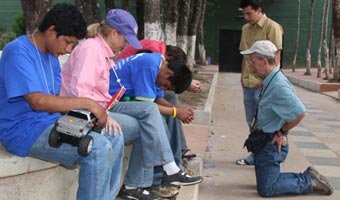
Bill Pigott of Texas Baptist Men and Pastor Denver Dugle check on volunteer Builders’ progress at New Prospect Baptist Church in Nemo (Photos by Carrie Joynton)

Pigott heard about the project from builder Ray Keller, who attends New Prospect with his wife Anita. Builders received word through a prayer chain managed by one of the TBM wives. In no time, Pigott began receiving volunteers.

“That’s just how it is with builders; they’re willing to step up and do what needs to be done,” Pigott said.

The new church buildings at New Prospect replace two temporary buildings swept away by high winds. Founded in 1892, the church with its new buildings will tell quite a story of generosity and survival. But it’s not the only survivor in the picture.

Pastor Denver Dugle, at New Prospect since January 2007, said he answered the call to ministry at his family’s prompting.

“They told me, ‘The Lord’s called you to be a pastor, and you ain’t sending your resumes out!’”

From Iraq to New Prospect

Dugle had returned from three combat tours in Iraq and was working in construction in Aubrey. Migraines—a result of his years in combat—made his work nearly impossible, and he had used up his sick days. Dugle decided to resign and look for something new.
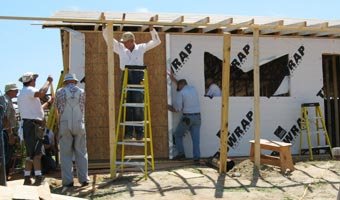
Texas Baptist Men retiree builders work on reconstructing New Prospect Baptist Church in Nemo.


“I asked the Lord to take care of us. The day I ran out of money, we got 100 percent disability” from the Department of Veterans Affairs, Dugle said.

When New Prospect called Dugle as pastor, he accepted the part-time position.

“The Lord’s worked it out,” Dugle explained. “The church couldn’t afford a full-time pastor, and the Lord provided me the money with the VA disability. I used to feel like I was on welfare, but I don’t anymore. I just did what my country wanted me to do, and I earned that disability.”

The church understands Dugle’s situation and has been very flexible, he said. Although he suffers from migraines three to five times a week, each lasting up to 48 hours, Dugle said that at New Prospect, he’s never had a migraine on a Sunday.

“I’ll wake up with one, and just pray, ‘Lord, I need to preach your word.’ It sometimes comes back at night, but in the morning it goes away. He takes them away,” Dugle said.

Not long after he arrived, Dugle said he received specific instructions from God about his ministry at New Prospect.

Disciple the flock

Texas Baptist Men retiree builders work on reconstructing New Prospect Baptist Church in Nemo.

“The Holy Spirit told me he wants me to disciple the flock that’s here, to get the soil fertile, so that when others come into that church, they’ll be able to disciple them,” Dugle said.

“Instead of addition, the church should multiply. That’s what the New Testament church did.”

New Prospect ministers primarily to farmers and the surrounding rural community. The church also rents out its building during the week to a special-needs school that graduated 58 students this past year. The superintendent told Dugle he thought the church had a positive influence on the students, Dugle said.

The students certainly were helpful on the morning after the storm.

“They showed up about 8. They were like fire ants—just started cleaning up debris from around the church and other houses,” Dugle said. Their arrival ended a long morning for Dugle, who had watched the storm from his bedroom window when it hit at 3 a.m.

“I had finished building a barn that night, hammered the last nail in at dusk,” Dugle said.

“At 3 a.m. I looked out and watched it get taken up in the air, and slammed back down.”

Surviving the storm

The storm flattened a gazebo on church property, destroyed a bus barn, and uprooted seven cedars that were deposited about 30 feet away.

Despite heavy damage, New Prospect survived the storm and is reemerging with a strong foundation—and so is its pastor. Relying on God’s strength and the strength of others reinforces Dugle’s dedication to his ministry.

The call hasn’t been an easy one, Dugle said.

“I thought the hardest job I’d ever have was doing three tours in Iraq. It’s not. It’s pastoring a church—spiritual warfare goes on every day.”

“Satan wants to destroy me, my church, and my family,” but his church and his family give him the support he needs, he said.

He and his wife, Sarah, have grown especially close, he noted.

“She’s a trooper,” Dugle said.

Pigott of TBM noted his 33 years in military service helped him bond quickly with Dugle.

“It’s tough to be a Christian in the military,” Pigott said.

Though Dugle agreed that being in combat “is the ultimate fire and brimstone,” he also said the experience has formed him personally and influences his leadership in ministry.

“I say to the church, ‘I have nothing to hide.’ I know if you do that, it opens up the opportunity to get hurt, but the military taught me to lead by example. If I lead by being open and honest and transparent, I hope they’ll learn to live by that example.”


Cookbook evangelism serves heaping helping of gospel

HONDO—The pastor of First Baptist Church in Hondo cooked up a new recipe for helping his church members share their faith.

Early last year, Ross Chandler approached his congregation with the unconventional notion of cookbook evangelism, an approach he learned from Bruce Webb when Webb was pastor at Central Baptist Church in Jacksonville.

“The cookbook is not an ordinary cookbook. The recipes are secondary,” Chandler said.

“The church members write what Jesus Christ means to them and their testimony along with the recipe.”

First Baptist Church in Hondo gave out hundreds of evangelistic cookbooks in their town, and the effort help church members become more comfortable in sharing their faith.


The goal of the cookbook evangelism project was to give church members an opportunity to deliver cookbooks personally to all 2,700 homes in Hondo and share the hope of Christ with the residents during last December.

The initiative enabled the Hondo church to get a head start on Texas Hope 2010, a Baptist General Convention of Texas challenge to present the gospel to every Texan by Easter 2010.

“When everyone started giving the recipes to us and we read some of the testimonies, we were blown away,” said Keni Rodgers, one of the coordinators for the project. “We quickly realized that with so many testimonies from members of all ages, we would be able to touch everyone who read it, with one story or another.”

Recipes and testimonies

In order to get the congregation excited about the endeavor, the planning team published recipes and testimonies in the Sunday bulletin, gave several humorous skits explaining the event and even had a recipe sampling lunch so church members would know how the recipes tasted.

While the cookbooks were being printed, former pastor Les Chaney set a Saturday delivery date, recruited volunteers to deliver the cookbooks, promoted delivery to the community through newspaper ads and organized all the details for that day.

“On the delivery day, more than 200 people from our church that averages slightly less than that in Sunday School each week showed up to deliver books,” Rodgers said.

Teams of two or three people were able to reach the whole city in Hondo within five hours, sharing hope and love and praying for the needs of those they met.

Goal was to say 'we love you'

“When people asked why we were doing this, our goal was to say we love you and we want to give you a Christmas gift and tell you that Christ loves you,” Chandler said.

After that experience, members became comfortable sharing their faith—even door-to-door evangelism, which many previously found intimidating.

“A lot of church members are really busy and they may not have the time to go on a mission trip or to help with a long project,” Chandler said. “But everyone has one day where they can help.”

Besides seeing members’ faith grow from serving in the cookbook outreach, the church received many letters of appreciation from the community and saw two families join the church. The members have also set another day to deliver the cookbooks again this Christmas to reach out to D’Hanis, a town near Hondo.


McBeth honored as Elder Statesman

INDEPENDENCE—Leon McBeth, who wrote the definitive history of Texas Baptists and taught church history to a generation of seminary students, received the 2008 Texas Baptist Elder Statesman Award.

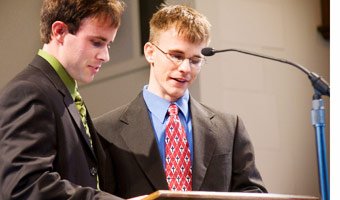
Leon McBeth, retired distinguished professor of church history at Southwestern Baptist Theological Seminary, accepts the 2008 Texas Baptist Elder Statesman Award from Bill Pitts, president of Independence Association and professor at Baylor University. (BGCT Photo)

Independence Association—formed to emphasize the importance of Christian higher education and Baptist heritage—presents the award for distinguished Christian service each year in conjunction with the Baptist General Convention of Texas Baptist Distinctives Council.

McBeth, a native Texan, graduated from Plainview High School and earned his undergraduate degree at Wayland Baptist University. He went on to earn his master’s and doctorate degrees at Southwestern Baptist Theological Seminary, where he taught 43 years.

In addition to numerous articles for scholarly journals and Baptist state papers, McBeth also has written nine books, including The Baptist Heritage and Texas Baptists: A Sesquicentennial History.

He was chair of the BGCT Baptist History Committee and was a member of the BGCT Baptist Distinctives Commmittee. He served as a trustee of Wayland Baptist University eight years and as a trustee of the Southern Baptist Convention’s Historical Commission seven years, including three years as chair.

He received the first George W. Truett Religious Freedom Award from the Texas Baptist Heritage Center and has been honored as a distinguished alumnus both of Wayland and Southwestern Seminary.


San Antonio success story headed to elite college in Vermont

SAN ANTONIO—Jerry Romano is not afraid to blaze a trail.

Romano, the first member of his family to complete high school, will enroll at Middlebury College in Vermont this fall—ranked the fifth best college nationally by U.S. News & World Report. He won a full tuition scholarship through VISTA, a partner program of Baptist Child & Family Services that focuses on San Antonio high schools with low rates of students who advance to college.

Since VISTA began two years ago, all graduating students in the program—five in 2007 and eight this year—have been accepted into universities and been awarded a total of $570,000 in scholarships.

Despite not graduating themselves, Romano’s parents always encouraged him to attend college. But he never considered going to school outside of San Antonio until he met Maria Fernandez.

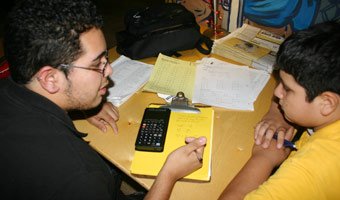
Jerry Romano tutors a middle school student at the Guadalupe Street Coffee House. (BCFS Photo)


Fernandez founded the VISTA, which encourages students on the West Side—where high school dropout rates sometimes approach 50 percent—to attend college, especially if no one in their families has before. VISTA partners with Baptist Child & Family Services and the agency’s Guadalupe Street Coffee House.

Fernandez “is the one who encouraged me to leave San Antonio and Texas and apply elsewhere to keep my options open,” Romano said.

Romano’s parents supported his plans to look outside the city and state for schools, which Romano appreciates.

“I have spoken to many other students, and it is very interesting to see how many of their parents don’t want them to move away,” said Romano. “I can’t say the same about my parents, and I am grateful for the encouragement.”

With that, Romano began looking for colleges with stellar language departments, since he plans to major in international studies and has a personal goal of mastering 10 languages.

Currently, Romano plans to use his education at Middlebury to one day teach in China and ultimately work for the United Nations.

Fernandez has no doubts that Romano will succeed in whatever career choice he makes.

“Students like Jerry will make it wherever they go because they truly like to discover,” she said.

Fernandez plans to take Romano to Middlebury this summer to tour the campus, since he was interviewed for his scholarship by a local Middlebury alumnus and has yet to visit the school.

While it will be hard for Romano’s parents to see him leave, they know it’s for the best.

“We’re just giving him the opportunity to do what he wants,” said his mother, Margaret Romano. “He has his mind set.”

She had to drop out of school at age 14 when her mother died, leaving her to care for her brothers and sisters. She insisted her siblings stay in school. 

“I made sure all of them graduated,” she said. “Later, I was able to get training to be a medical assistant.”

Though still young, Romano looks forward to the day when he can share his story with students.

“Whenever I have a chance to come back to San Antonio,I will enjoy speaking to the students about allowing their dreams to flourish because anything is possible,” he said.


Texas WMU supporters concerned, former presidents call for prayer

Former missionaries joined some past members of the Woman’s Missionary Union of Texas board and others in sending an open letter to the mission organization’s board of directors, expressing concern over the termination of Interim Executive Director-Treasurer Nina Pinkston and other developments.

Meanwhile, all eight living former presidents of Texas WMU joined in issuing a call to prayer for WMU—particularly for the board’s June 16-17 meeting, for God’s direction as the organization’s personnel committee seeks a new executive leader and for the possibility of hiring “an experienced intentional interim” director.

Cindy Gaskins, who served on the Texas WMU staff as state Acteens consultant from 1986 to 1998, initiated the letter to the board, which included the signatures of 58 other “friends of WMU of Texas.”

“This esteemed organization seems to be moving in a direction contrary to her historic principles and practices. We are deeply disturbed and wonder how this could have happened,” the letter stated.

The May 29 letter came in response to Pinkston’s May 8 abrupt dismissal, as well as Executive Director-Treasurer Carolyn Porterfield’s resignation last October.

Pinkston reported her termination came without warning.

At the time President Paula Jeser of El Paso said the dismissal 'was not an easy decision' but involved 'lengthly discussion' by the board's executive committee.

Jeser was traveling and had not seen the letter to the board. So, she was not able to respond to specific concerns raised in it.

Gaskins noted she was “embarrassed, bewildered and shocked” when she learned about Pinkston’s termination and the events surrounding it.

“How could this happen within WMU?” she asked.

The letter to the board noted four issues:

• Pinkston’s dismissal “in a manner totally unlike Texas WMU.” Pinkston reported she arrived at a scheduled staff retreat, found out it had been cancelled without her knowledge, called the state WMU office and was told by Jeser she had been terminated.

“All this calls to mind the unexpected resignation of Carolyn Porterfield,” the letter said. “Were both these leaders simply trying to told the organization and staff accountable but were met with resistance? And after the resignation of Carolyn, the board was reportedly told ‘not to ask questions.’ How can this be, considering the responsibilities of the board? Something seems amiss.”

• Jeser was named interim executive director on a volunteer basis. As such, she serves as chief executive officer of the staff, presiding officer of the organization and chair of the board.

“This violates one of our historic principles of shared leadership,” the letter said. “We feel this is out of compliance with the spirit of the bylaws and the organization.”

• Four long-time employees—Waunice Newton, Ruby Vargas, Cathy Gunnin and Judy Champion—left Texas WMU in the last eight months, either resigning or taking early retirement.

“These women have worked long and hard for Texas WMU and possess a wealth of knowledge and experience that cannot easily be replaced,” the letter said. “We would like to know if anyone conducted exit interviews to determine if there were concerns that prompted their decision to leave.”

• A perception Texas WMU is distancing itself from the Baptist General Convention of Texas. Pinkston had noted some BGCT Executive Board staff felt they had been “shut out of the process this year” in determining Mary Hill Davis Offering allocations. She also noted a persistent rumor Texas WMU planned to move its offices out of the Baptist Building.

“What is happening to the faithful partnership woven with prayerful cooperation between WMU and BGCT?” the letter asked.

The letter stated those who signed it were “grieved beyond telling” by recent events.

“We wonder if any of the actions of the last months have put Texas WMU in jeopardy financially and/or legally,” the letter said. “At the very least, trust has eroded.

“Please put aside any reticence and consider your responsibilities as board members and your response to these concerns. We ask you to seek the collective wisdom of leadership represented by former WMU presidents and BGCT leaders. Certainly, we want to move ahead in truth and honor as ‘laborers together with God.’”

Gaskins did not specifically ask signers of the letter for permission to publish their names in the Baptist Standard. But representative individuals who signed the letter—and who indicated their willingness to affirm it publicly—included former WMU officers such as Kaye Glazener of Fort Worth and Earl Ann Bumpus of Mineral Wells; former missionaries such as Mary Carpenter of Brownwood; and former WMU conference leaders such as Deirdre LaNoue of Dallas.

Eight former Texas WMU presidents issued a call for prayer to Texas Baptists, noting: “During this time, when the office of executive director-treasurer is vacant, pray for President Paula Jeser and the personnel committee as they search for a new executive director-treasurer.”

Specifically, the past presidents called on Texas Baptists pray:

• “God will lead them to a strong, godly, knowledgeable woman with a proven record of service in WMU and missions.” 

• “About the possibility of hiring an experienced intentional interim executive director-treasurer to serve in the position until God’s woman is found.”

• “For the upcoming meeting of the board of directors of Woman’s Missionary Union of Texas, June 16-17.”

• “For all of the board members and members of committees … that God will give them wisdom, discernment and courage as they seek his will concerning crucial issues facing WMU.”

Issuing the call to prayer were former WMU president Ophelia Humphrey, Mauriece Johnston, Amelia Bishop, Gerry Dunkin, Mary Humphries, Jeane Law, Kathy Hillman and Nelda Taylor.


Rethink purposes and practice of worship

ARLINGTON—Scholars David Peterson and Bruce Leafblad challenged students at the B.H. Carroll Theological Institute’s 2008 summer colloquy to rethink the purpose and practice of worship. 

Peterson of Moore Theological College in Sydney, Australia, urged church leaders to plan worship grounded in Scripture and rooted in tradition.

He warned against the “rush to be culturally relevant and to keep up with the charismatics and the Pentecostals” and advised using more Scripture and statements of purpose in church services.

“I’m a strong advocate of modern songs, but so often people get their theology from songs. How much theology is taught in our music?” Peterson said.

The distinctions among man-to-man, man-to-God, and God-to-man relationships in worship are artificial, Peterson continued, because in worship, all happen simultaneously.

Horizontal relationship 

The “horizontal relationship” of a person giving his or her testimony to another person does not exclude God’s involvement in that exchange, Peterson explained.

Distinctions between worship and “the rest of the service” indicate many churchgoers’ categorizing mentality that denies the power of each part of worship, he said.

“If we expect to encounter God and be ministered to by his word and his Spirit in corporate worship, we need to say so regularly, and pray to that end,” Peterson said.

Retired Southwestern Baptist Theological Seminary professor Bruce Leafblad took a different tack. Leafblad discussed the meaning and practice of worship through close analysis of Exodus 33:2-18, where Moses meets God in “the little tent of meeting” outside the Israelite camp.

Leafblad used different elements of the scene to derive “universal principles of worship.”

Intimate communion

Through these principles, Leafblad described worship as a meeting of intimate communion with God that expresses a personal relationship in authentic conversation. This relationship is distinguished by the presence of God and an insatiable desire for his glory.

“Religion can be practiced by anyone, but true worship requires a relationship. … We express that relationship in worship, but it is neither logical, nor inevitable, nor acceptable outside of that relationship,” he explained.

Sharing a personal relationship with God is necessary for true worship, Leafblad said.  Father-child, husband-wife, and best friendship provide the three most common models of intimacy in Scripture, Leafblad noted.

“Authentic worship will always be expressed in relational terms,” he said. “God’s best gift to us is himself.

“The glory of God is both the proximate goal and ultimate purpose of worship. … The life of worship is appointed to all believers as a privilege and a gift.”


Mentoring program helps ministers chart true course

No one ever promised vocational ministry would be easy, said Michael Godfrey, executive director of True Course Ministries . That’s why he knew his mentoring program for clergy would meet an immediate need.

Godfrey’s 32 years experience in Christian ministry revealed to him a huge disconnect between seminary education and the practical demands of full-time ministry.

Bumps and bruises

“I’ve had my own bumps and bruises along the way, in terms of just dysfunctional situations, relational situations … issues with self-awareness, perceptions of others,” Godfrey said. 
After leaving one particularly difficult situation, Godfrey realized his struggles weren’t unique. 

“I came to the realization that people and systems can turn, and you can get caught in the middle of it. It just opened my eyes and I saw there was a whole lot of that,” he said.

In 2001, Godfrey began pursuing a doctor of ministry degree at Baylor University’s Truett Theological Seminary. While enrolled at Truett, Godfrey found the direction he had been seeking during a visit to the Baptist General Convention of Texas minister/church relations office.

J. Michael Godfrey

 “When I was working on my D.Min., I went to Jan Daehnert’s office and asked him: ‘Where’s the hole? Where’s the need?’ He said we have plenty of after-care (for forced termination), but we don’t have any preventive care. That’s the hole,” Godfrey said.

Support and education

Godfrey developed True Course Ministries as he felt God directing him to find a way to offer support and continued education to ministers. 

“About 90 percent of ministers feel inadequately trained,” he said.  
The program, now completing its fifth year, earned the Malcolm S. Knowles Award for Excellence in Adult Education from the American Association of Adult and Continuing Education in 2007.  

“It’s a ministry God put on me to equip people,” Godfrey said.  
Several months of informal survey showed Godfrey ministers were seeking mentors to help deal with feelings of isolation, loneliness, and burnout. Godfrey also wanted his program to address church struggles and prevent forced terminations. 

True Course Ministries focuses on issues of administration, leadership, social and emotional understanding and communication.
“I really knew God wanted this,” Godfrey said. “Within the first six months, I just started talking to people … and the thing we kept hearing again and again, almost without hesitation, was, ‘This is a need.’”

Mentoring

One-on-one, personal mentorship with individually customized goals distinguishes True Course Ministries. Concerned church members sometimes refer ministers to True Course, but church staff members also seek out the program themselves—often simply to develop skills and further education. At the first meeting, mentors work with ministers to write a mutual covenant of responsibility.

They continue to meet monthly to discuss issues, growth and future goals.  Official collaboration can last up to two years, but many participants keep a close friendship with mentors long after the sessions’ completion.True Course Ministries mentors are seasoned ministers themselves, well-experienced in the ups and downs of full-time ministry. 

According to the description on the ministry’s website, truecourseministries.com, they are “highly trained in adult education and experienced in leadership of volunteer organizations.”  

Mentors also must remain active in church leadership. Some serve as interim pastors. Others focus on conflict management, and counseling ministers and their families following forced termination. Pastor Taylor Sandlin at Southland Baptist Church in San Angelo recalled a positive experience with True Course. Sandlin contacted Godfrey, whom he met during seminary, after he entered full-time ministry. Sandlin wanted to continue his education after seminary, and the True Course program appealed to his desire for accountability and educated feedback, he said.

“Ministry can often be a lonely endeavor,” Sandlin wrote in a testimonial about True Course. The program helped connect him to other ministers and to transition from the close-knit community of seminary to full-time congregational ministry, he said.  “Michael and (his wife) Susan have become for my family more than mentors; they have become our friends—kindred spirits in this life of faith,” Sandlin wrote.

In his sessions with Godfrey, Sandlin said they focused on creating and maintaining long-term vision, a skill that has shaped his decisions ever since.  

“Developing goals … is probably the thing that I’ve carried with me,” Sandlin said.  “What do I want my ministry to look like? What do I want to look like, in spiritual or family life, in five years, and how do I get there? By developing those goals, and focusing on those goals, it’s allowed me to say ‘no’ to a lot of good things that nevertheless would have taken away from those long-term goals of family time and nurturing a healthy church.”


Central Texas church touches lives of children, families in Macedonia

PRIDDY—Their church building may be small and unassuming, but the members of Priddy Baptist Church are making a powerful impact on children living in the ghetto of Skopje, Macedonia.

A few years ago, Cooperative Baptist Fellowship field personnel Darrell and Kathy Smith spoke at Priddy Baptist Church, about 25 miles east of Brownwood.

The Smiths told the congregation about their ministry in Macedonia—the languages, culture, ethnicities and the needs. The Smiths, who have served with CBF since 1996, have been involved in environmental sustainability projects and ministering to children and families living in poverty. 

Priddy Baptist Church—which has about 30 members and half that number in average attendance—was moved by the stories of the children living in poverty in Macedonia. A few months later, the church invited the Smiths to speak again.

Kindergarten provides a free education to children in the ghettos of Skojpe, Macedonia.


“When we were invited back, the church wanted to know more about the kindergarten project,” Smith said. “The kindergarten had touched the heart of this church and given them a vision for where God was working.”

In Macedonia, there are no state-sponsored kindergartens or preschool programs, but children still are required to pass a test before they can start first grade. The kindergarten started by the Smiths and CBF field personnel Arville and Shelia Earl provides a free education to children living in the ghettos of Skopje, who otherwise might not have access to education.

In addition to their annual contributions to missions, Priddy Baptist members gave $17,000 last year to support the kindergarten in Skopje, and they have pledged to do the same again this year.

“We are a very small church, and contact and support for this project gives us a sense of contributing to a cause outside and greater than ourselves,” Pastor Butch Pesch said.

“We love the Smiths and the Earls and are thrilled to have a small part in what God is doing in Macedonia.”

The church’s funds have provided educational opportunities for 40 children, paying for the expenses of the kindergarten for half the year—utilities and rent, plus backpacks and school supplies.

“Just as hope came into the world as a small child, so hope has come to the families of the kindergarten through the efforts of a small church,” Mrs. Smith said. “Though they might never meet each other, Priddy Baptist has changed the lives of these children and their families. Only God knows how these seeds of hope that have been planted will sprout and grow.”


Short-term volunteers make long-term missions impact

Kevin and Naomi Scantlan of Columbia, Mo., feel called to international missions.

But as integrated technology services analysts at University of Missouri Health Care and church lay leaders, committing to years abroad really isn’t feasible.

That’s why they’re planning their second mission trip to Kenya, along with eight members of Memorial Baptist Church, to provide medical services and teach Vacation Bible School to orphans and at-risk children supported by Buckner International.

Naomi Scantlan of Columbia, Mo. is planning her second short-term mission trip, along with her husband Kevin, to Kenya this summer through Buckner International. This time they will be taking eight members from Memorial Baptist Church with them to support orphans through Vacation Bible School and medical care. (Photo courtesy of Kevin Scantlan)


They are among the 2 million to 3 million Christians from the United States engaged in short-term missions work around the globe today, according to Cooperative Baptist Fellowship Global Missions Coordinator Rob Nash. Only 18,000 people were involved in 1984.

“This is a profound and revolutionary shift,” he said.

“For much of the 20th century, the only U.S. Christians engaged beyond the United States were missionaries, diplomats and military types. With jet planes and globalization, this reality (has) shifted dramatically.”

Call to missions redefined

Buckner International President Ken Hall remembers growing up in a Baptist family and struggling with the “call to missions.”

“For too long, we were led to believe that being called to missions meant 30 or 40 years in Africa,” he said. “That led to a lot of guilty feelings, but it also provided a good excuse for not becoming a missionary.”

Hall believes all Christians are called to be missionaries and that the Bible mandates it in Matthew 28:18-20, where Jesus issued the Great Commission.

“First-century missionaries were not so much vocational missionaries as professionals with a vocation that went on missions,” he said.

“Paul was a tentmaker. … He didn’t stay in one place. The Book of Acts records Paul’s three missionary journeys. In reality, Paul was a short-term missionary.”

Wendy Norvelle, associate vice president in the office of mobilization at the Southern Baptist International Mission Board, sees volunteers as involved not only in hands-on ministry, but also in strategic planning.

Kevin Scantlan and his wife Naomi are lay leaders at Memorial Baptist Church in Columbia, Mo. They are organizing their church’s first international mission trip to minister to orphans living at the Buckner-operated Seed of Hope orphanage in Kitale, Kenya. (Photo courtesy of Kevin Scantlan)


“We are seeing a new generation of volunteer missions, where churches are becoming strategically involved with particular teams or people groups overseas and in longer-term relationships. Churches and those who go on short-term mission trips are at the table in developing mission strategies. It’s a brand-new strategic environment,” Norvelle said.

“In a sense, we’re moving away from the word ‘volunteers,’ and instead are using ‘short-term mission teams.’ We really do see that the (local) church has a strategic role in fulfilling the Great Commission and in being a significant partner in reaching people groups.”

Many critics question the effectiveness of short-term missions, but Hall sees their impact on children and families every day.

Buckner's role

Buckner International sends about 4,000 volunteers on short-term mission trips each year to minister to orphans, at-risk children and families in the United States and nine countries around the world.

These volunteer missionaries travel to support indigenous Christian staff employed by Buckner to provide follow-up evangelistic work in orphanages, distribute humanitarian aid, train and support foster families and network with Christian churches to provide sustainable ministries to aid children and families in need.

“Short-term missions workers can have an impact,” Hall said. “But that impact is far greater when we work with people inside the country, who prepare for our trips and help us work in a culturally sensitive and effective way.”

Norvelle agreed. “If (short-term and long-term mission workers) are together in developing strategy, it’s an asset. The key is that the strategy is one that everyone buys into,” she said. “The longer-term missionary perhaps has an insight into the culture and the beliefs and world views (of a region), which a church at the beginning would not have, though a church can learn it. But the energy and creativity of short-term mission teams can enhance” the work of long-term missionaries.

The Scantlans may be organizing their first church trip to Kenya, but they’ve already seen a huge response among members through fundraising and prayer support. Although future plans have not been made, Kevin Scantlan expects his church will continue to support the work they’ve started.

Partner together

“One church cannot support a whole area,” he said. “But if you get a number of churches who do that and partner together … maybe not so much with each other, but through an organization like Buckner, you can make a bigger impact.”

Members of Park Cities Baptist Church in Dallas lead a group of tough teenage boys in a Bible story at the San Gabriel boys’ orphanage in Guatemala City. Jeff Byrd, associate pastor for missions at Park Cities, said he's seen members of their church become “more active in every aspect of the church’s ministries because they went on a mission trip.” (Photo by Russ Dilday/Buckner)


Building relationships and making the missions experience personal “can be a life-changing thing for someone,” his wife said. “And not just for us, but for the whole church. If we don’t get involved ourselves, then it doesn’t change us.”

Personal involvement changed Dallas Baptist University student Chris Holloway’s life. He said he’s seen his passion for people and for international mission work grow since he took two short-term mission trips to Guatemala with Buckner in 2007.

“These trips really opened my eyes to see that God is not just the God of America, but the God of the whole world,” he said.

Though he currently works as resident director on DBU’s campus, Holloway said he’s entertained the idea of moving to Guatemala to pursue full-time mission work with orphans.

“These trips have given me a deeper heart for missions and for the need for missions,” he said. “So whether or not I end up as a businessman or a full-time missionary, I know that I will definitely be involved in missions for the rest of my life. … It’s a passion.”

Jeff Byrd, associate pastor for missions at Park Cities Baptist Church in Dallas, has seen church members grow as leaders after participating in short-term missions.

“The church body is strengthened by this faithful obedience and by parti-cipating in God’s plan,” he said. “We have numerous examples of individuals that have experienced this transformational power in their lives and gone on to become church leaders, mission team leaders and missionaries. … They’ve become more active in every aspect of the church’s ministries because they went on a mission trip.”

Long-term missionaries still needed

Byrd stresses that while the impact of short-term missions is effective, it does not outweigh the importance of long-term missionaries.

“Short-term volunteers cannot be effective without a recipient infrastructure,” he said.

Bob Hefner, member at Park Cities Baptist Church in Dallas, leads a group of boys in prayer at the San Gabriel orphanage in Guatemala City. Park Cities takes an average of 10 short-term mission trips every year—five of them with Buckner International. (Photo by Russ Dilday/Buckner)


Victor Upton, vice president of missions resource for Buckner, said that employing in-country Christian personnel is the key to Buckner’s work abroad.

“Long after we’re gone, the indigenous personnel are the ones who will carry on the work,” Upton said. “Whether it be feeding programs, group homes, foster care, kinship care … they are the true missionaries. We’re just there to support.”

When violence broke out in Kenya early this year following its presidential election, Buckner staff remained in the field caring for children, working with churches and talking with public officials, he said. “Many of the long-term U.S. missionaries had to leave, but we were … still able to sustain operations.”

Nash thinks the focus of any ministry efforts, in the United States or abroad, has to be sustainability.

“I’m glad that many short-term responders grasp the fact that a single mission trip that lasts a week can make a real difference in the lives of both the participants and the people to whom they minister,” he said.

“I’ve seen a short-term responder’s life absolutely revolutionized because of the experience. But the greatest transformation comes in a long-term engagement that is strategic and sustainable.”

Karen Hatley, a former missionary in the United Arab Emirates, agrees.

“The problem with short-term missions is that people often look at them as, ‘Oh, this is great for me,’ … but their work should definitely be part of a long-term goal or commitment, whether to a certain area or people group or ministry,” said Hatley, who works with WorldconneX, missions network of the Baptist General Convention of Texas.

Being the learner, helper and supporter

Using short-term mission volunteers, global Christians and long-term missionaries would be the ideal situation for maximum impact, she said.

“But it takes a lot of work to collaborate and work together and listen to each other,” she added. “It’s important for Americans to come in as the learner, helper and supporter.”

Nash thinks the global church will play the most critical role in missions in the 21st century.

“The global church has joined the U.S. church in a dramatic way,” he said. “In many instances it’s much more spiritually and missionally vital than the U.S. church.

“It is important that we connect these Christians who serve effectively around the world and that we bring them into partnerships with each other so that all of us are more strategic as we share the good news of the gospel of Jesus Christ.”


With additional reporting by Robert Dilday, managing editor of the Virginia Religious Herald


Three generations of the Perkins family make a joyful noise to God

ATLANTA—The Perkins family claims six ordained music ministers, and one thing they have in common is that they sing not just from their diaphragms but from their hearts.

Ask sons—Dale Jr., Stacy or Clay—or grandsons—Aaron and Adam—and each will say they simply are following the model of family patriarch Dale Perkins Sr., who was minister of music at Mobberly Baptist Church in Longview more than 40 years.

“One of the things I’ve tried to always remember is that our confidence should be in our message and not in ourselves,” the veteran music minister said. “Why God chose me when there are so many who have more talent in their little finger than I possess in my whole body—it’s amazing how God chose to bless me by allowing me to be his servant.”

The Perkins family of East Texas includes six ordained music ministers spanning three generations—(left to right, back row) Dale Perkins Sr., who served more than 40 years at Mobberly Baptist Church in Longview; Clay Perkins, who recently resigned after more than 20 years as his father’s assistant at Mobberly Baptist Church; Stacy Perkins, music minister at Harmony Hill Baptist Church in Tyler; Dale Perkins Jr., minister of music at First Baptist Church in Atlanta; (front row) Aaron Perkins, minister of music at Woodland Hills Baptist Church in Longview; and Adam Perkins, music minister at Little Flock Baptist Church in Longview. (Photo/Randy Grissom/Sterling Image Photography)


When asked why his sons and their sons decided to enter the music ministry, Perkins said he remains convinced it first comes from God’s calling.

“The most im-portant thing is that God has placed his hand on their heads and his voice in their hearts and told them he wants them to serve him,” he said.

But several factors may have helped them to hear the call to vocational Christian service, he added.

“The first thing is that my wife and I never discussed controversial issues at the table, in the car, or anywhere in their presence,” he said. “They thought everyone loved us. And most of them did.”

The church where his sons spent their childhood and teen years also positively shaped their view of ministry, he noted.

“They had the privilege of growing up in a church with a true shepherd in Laney Johnson. He was pastor there 32 years and a real man of God,” Perkins said. “They probably thought they were going to have the same sort of pastors as he was, and for the most part, they have.”

The church provided each of the Perkins boys opportunities to serve early in life to see what music ministry was all about. “Mobberly is a very supportive, gracious church,” he said.

Dale Jr., minister of music at First Baptist Church in Atlanta, noted music ministry has been a part of his life as long as he can remember.

“We never knew any different,” he said. “We thought everybody’s house was like ours—and music was such a large part of our lives. My daddy would take us different places to sing with him, and music was always front and center in our lives.”

While he enjoyed being a part of his father’s ministry as a boy, he wanted his calling to be his own, so he started his adult life by owning a business that sold and repaired electronic devices.

“The call on my daddy’s life was always so apparent, and I wanted my call to be just as clear. So, I took a side trip in life but wasn’t happy in it. I had a long talk with Daddy, who told me, ‘If you can find happiness doing anything else, do it.’ Well, I had already tried that and decided that didn’t work for me,” he said. “Music was such a large part of our lives, it was odd not to be a part of it.”

His brother, Stacy, knew music was to be his calling at an earlier age.

“As a child, I could sense that God had gifted our family in the area of music. I knew all along, from an early age, that I wanted to do something with music,” he said. While working as a high school choir director, he developed nodules on his vocal chords, and he couldn’t sing or speak.

“It was God telling me, ‘Be still and listen to me,’” he said.

God clarified his calling to vocational music ministry during that time. He now is music minister at Harmony Hill Baptist Church in Tyler.

Aaron and Adam Perkins sing together.


He points to his father’s ministry as a key factor that drew him to music.

“I saw God use it effectively through my dad, and what impressed me most was the joy that it brought him,” he said.

He also learned from his father that music ministry is not about performing but worshipping.

“We were taught that this is a ministry to people. The quality comes through their desire to worship. The voices of angels are added to our own when we sing to God in worship,” he said.

Clay Perkins recently resigned after more than 20 years as his father’s assistant at Mobberly Baptist Church. He was the minister in charge of the youth choir and the Academy of Performing Arts.

“My calling came out of a sheer desire to praise and honor the Lord,” he said. “We’ve witnessed that in our family from generation to generation. I don’t know how anyone could be part of a ministry whose focus isn’t praise and worship.”

Adam and Aaron Perkins, sons of Dale Jr., recently were ordained in a joint service at First Baptist Church in Atlanta. Adam is minister of music at Little Flock Baptist Church, and Aaron is music minister at Woodland Hills Baptist Church, both in Longview.

Adam’s call to ministry was confirmed in a dream one night at college as he pursued a pre-med degree.

“I always felt called to music ministry, but I was afraid of music ministry because I was afraid of being in front of people,” he said.

“One night in my dorm room, I told God I would surrender if he could take away my fears. That night, all night long I was in front of these huge crowds of people, and I had such a peace. The next morning when I woke up, I knew I was going to be a music minister.

His first Sunday to lead music came on Easter.

“It was the most highly attended Sunday of the year, but God took care of me,” he recalled.

Aaron Perkins felt a call to music at a young age as well. He started by leading a girl’s ensemble at First Baptist Church in Atlanta when he was a freshman in high school.

“I just grew to love it. I knew that I loved music, but there wasn’t a definite calling on my life at that time,” he recalled.

Not long after, Antioch Baptist Church asked him to come and lead music there—even though he was only 15 years old.

“It was a wonderful experience,” he said. “The Lord has put me in situations where it was never anything but good.”

He later left to go to Arkansas on a track scholarship, but he injured his knee. Even before that, God had made his calling clear, he said. He then went to East Texas Baptist University to pursue a degree in music.

In what seems to be a constant refrain from the Perkins clan, Aaron said his grandfather had a tremendous impact on his life.

“More than anything, I just wanted to get in on this joy that I had seen comes with ministry,” he said.


Physically challenged Truett grad looks forward to return to ministry in India

The One who made the blind see and the lame walk has been cajoling Heather Herschap of Waco to set her sights on India for his glory, she said.

Herschap, who graduated in December from Baylor University’s Truett Theological Seminary, has had a heart for the Asian subcontinent for more than four of the 10 years she’s lived in Waco—particularly for the handicapped of Bangalore, third-largest city of the nation of 1.13 billion people.

ProVision Asia, a nongovernmental organization based in Bangalore, India, played host to visiting Baptist seminary student Heather Herschap for month-long trips in 2005 and 2006. On those first two trips abroad, fellow Truett Seminary students traveled with Herschap as personal caregivers. Herschap hopes to get to India by early autumn for a year-long commitment to proVision Asia. The organization helps physically challenged people in India secure medical help and gain the skills they need to become self-supporting.


Herschap understands something about the challenges they face. She has cerebral palsy, uses a wheelchair and has only limited movement in one arm. But her heart soars when she talks about her dream to be a missionary to India’s neglected—even despised— physically disabled population.

Herschap has been on two previous trips to Bangalore as a student. She made month-long excursions in 2005 and 2006 with the help of Truett classmates and WorldconneX, the Baptist General Convention of Texas missions network. She worked with proVision Asia, counseling and ministering to the physically challenged.

“In the past, I sat on the porch with clients, helping them rebuild their self-esteem, talking about the emotional hurts they’re experiencing,” she recalled.

Many tribal cultures in India scorn the disabled as being cursed by the gods and punished for bad karma earned in a previous life.

“They wish they were not disabled. They do everything possible to hide the disability and to become less disabled,” Herschap said.

Indeed, she added, some of her clients in India—especially young women—have questioned why they are alive, and expressed suicidal thoughts.

“I believe that I am called to India to show them that God has a purpose and a plan, but most importantly, that he loves these young women who have no one to love them and who do not even love themselves,” Herschap said.

“The disabled face enormous issues and need so much love. This is a very big problem and deserves the attention of so many others. But all I can offer is myself,” she told members of Seventh & James Baptist Church in Waco.

But for her to make the final leap overseas for duty in Bangalore, Herschap said, she’ll need someone as committed to India and its disabled community as she, as well as committed to being her primary caregiver.

Heather Herschap


An Indian family could offer personal care, she said, “but I really need an American assistant to give the others a break. That’s a big thing to face for me. But I’m confident such a person exists.”

As she looks for her comissionary/assistant, she is preparing for her upcoming year-long placement in India with proVision Asia by attending school in Colorado Springs, Colo., at Mission Training International. MTI is a 54-year-old organization offering specialized, pre-field cross-cultural education for more than 150 evangelical mission-sending agencies.

At MTI, she said, she will be immersed in what she’ll need to know for her yearlong stay in Bangalore. She’ll return to Waco for weeks of required reading for her next assignment, and then will leave the area in August for her final training sessions at the Seattle, Wash., headquarters of Mission to Unreached Peoples.

MUP is a “broadly interdenominational” 25-year-old organization that mobilizes lay Christians to use their job skills as an entree into sometimes-hostile cultures with the gospel message, she said.

“The whole Heather team thinks this is a much better route,” Herschap said, speaking of her support staff of friends and family. “So, my plan hasn’t changed, just the route I will take to get there.”

She hopes to be in-country by early fall—monsoon season, as it so happens in that part of the globe.

This time around, she said, she will be able to delve more deeply into spreading the gospel and spiritual formation with her Indian clients.

“The first year I went, I met a lot of clients who walked around with crutches or canes or even walkers to get around easier. The second year, I met a lot of clients in wheelchairs and those who physically could not leave the house even if they wanted to,” she added, “They are put in the corner and given basic needs, but no love or affection. That’s why I am going, to tell them their life has a purpose, even if they cannot see it at that moment.”

Meanwhile, Herschap is networking and fund-raising to cover the estimated cost of her year overseas, about $15,000. She has less than $5,000 on hand now.

“When I return to India, I will be working alongside the same organization, but my responsibilities will expand to include ministering specifically to the spiritual needs of their clients. I think this experience expresses my calling as a whole, which is to minister to those who have physical challenges or other difficulties and to be a witness to God’s strength, mercy and grace.”

To contact Herschap, e-mail HerschapAH@gmail.com.


‘Go and baptize’ a command for all church members in Granbury

GRANBURY—Until the last moment, there was no assurance Jaden Solomon was going to enter the baptismal waters. He was nervous.

While it’s not unusual for a 15-year-old to be a bit nervous in the baptistry, his reasons were out of the ordinary. He wasn’t being baptized; he was baptizing someone else.

At Gateway Community Church in Granbury, when a church member leads someone to faith in Christ, the personal evangelist is given the opportunity to perform the baptism. Solomon had led 10-year-old Chase White to faith in Jesus Christ.

Margie Solomon baptizes Tamara Sanford in a service at Gateway Community Church in Granbury.

“We encouraged this because we’re always talking about involving our youth and children in the total worship of the church, but then we often segregate them from the rest of the community of faith,” said Pastor C.C. Risenhoover.

“That’s not going to be the case at Gateway. We’re committed to involving our children and young people in every area of worship.”

Risenhoover’s plan for his congregation is by no means limited to youth leading people to Christ. His goal is to help every member lead someone to Christ and baptize someone in the name of the Father, Son and Holy Spirit.

Over the past several months, several laypeople—men and women—have performed baptisms at Gateway. Fifteen people have been baptized so far this year, with another dozen awaiting baptism.

Statewide, Texas Baptists have been challenged to ensure every person in the state has an opportunity to respond to the gospel by Easter 2010.

Risenhoover’s vision of each member winning someone and then baptizing them came after reading the annual reports of Paluxy Baptist Association, where he said he found 22 churches had baptized 171 people.

“What we’re finding is that it’s a life-changing experience for the person doing the baptism, as well as for the one being baptized. When a person baptizes another individual, it gives them a better spiritual understanding as to the real meaning of baptism,” Risenhoover said.

Some people have walked the aisle in the traditional fashion, but then they have chosen someone other than the pastor to perform their baptism, which is fine with him, he noted.

“I’ve been looking at the New Testament church. And it seems to me we’ve gotten so far from that model of a New Testament church in that the paid clergy does everything and the people are left out,” he explained.

The practice has excited his congregation that swelled to 320 on Easter but averages about half that, he said.

“I’m confident it will ignite the fires of revival in our church,” he said.

In addition, Gateway also is employing its younger members in preparing and serving the Lord’s Supper.

“Baptism and communion are not exclusively the bailiwick of ordained clergy,” he said.

“And people who try to prove with Scripture that they are have to do some unusual shenanigans and manipulation, mixing a little Scripture with a lot of tradition.

“Every Christian—man, woman, boy or girl—is a soldier in the army of Christ, and none should be limited as to what they can do for the cause of Christ. The Christian army is too short-handed to play Mickey Mouse games as to who’s in charge of this and who’s in charge of that.”