DBU students, staff serve from Southeast Texas to South Korea

DALLAS—Three teams of Dallas Baptist University students and staff used their fall break to served in Houston, rural Louisiana and South Korea.

Jon Dooley, director of Baptist Student Ministry at DBU, and Justin Gandy, director of the DBU Center for Service-Learning, led nine students to Houston in response to the devastation caused by Hurricane Ike.

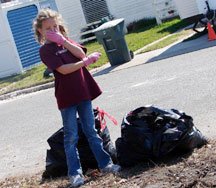
Dallas Baptist University student Misty Cotton played with the granddaughter of a woman helped by the student volunteers.

Working in conjunction with First Baptist Church of Houston, the DBU team offered helping hands wherever they found a need—aiding an elderly woman whose property was ravaged by storms, helping disaster-relief volunteers prepare and deliver more than 14,000 meals, and working to prepare the future site of the mission center at First Baptist Church.

“Our students worked tirelessly the entire week and worked together as a team to accomplish difficult tasks,” Gandy said.

Eleven student volunteers and five staff members—including Blair Blackburn, executive vice president, and Tyler Knox, assistant director of athletics—traveled to Louisiana to help construct a home for an impoverished family.

The DBU team worked on weatherproofing and making additions to a house. They also focused on presenting a positive Christian witness to their coworkers, as they served alongside members of Louisiana Youth Challenge and trustees of Webster Parish Cor-rectional Farm.

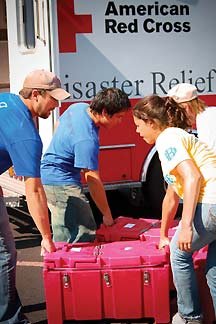
Jon Dooley (left), director of the Dallas Baptist University Baptist Student Ministries, along with DBU students Mike Rivas and Elise Nicol, helps load meals for distribution in Houston. (PHOTOS/DBU)

“We were able to influence these individuals in a positive way and show the love of Christ through our services,” Knox said. “It turned out to be a great experience and a highlight of the trip.”

Meanwhile, on the other side of the globe, 20 DBU students led by Jay Harley, dean of spiritual life, Chris Crawford, director of apartment life, and Christy Gandy, assistant director of spiritual life, traveled to Seoul, South Korea.

They worked as English-as-a-Second-Language teachers at several private Christian schools, but they also were able to spend some time attending churches, meeting Korean pastors, leading youth ministry activities, and volunteering as greeters and general staff at the Passion Conference in Seoul—an international student-centered gathering aimed at spiritual awakening.

“We had a wonderful time serving in a variety of ways,” Gandy said. “And there are several of our students who are considering the possibility of returning to Korea someday to serve again and for a longer term.”


Katy church ministers to victims in Galveston

KATY—Redeemer Community Church went outside its walls one Sunday morning to help people in Galveston who no longer had walls.

“We had told our people on Sept. 7 that we were going to do an outreach event on Nov. 2, but we didn’t know what that event might be until about three or four weeks before we actually did it,” said Bill Freund, student and outreach pastor at Redeemer, a Baptist church in Katy.

Hurricane Ike hit the Texas Gulf Coast Sept. 13, and the church’s mission became clearer.

Cale Kibbe, Kelsey Wells, Chris Long and Jason Hannan from Redeemer Community Church in Katy load a bus with supplies to help benefit storm victims in Galveston.

“We had all seen the pictures of the devastation left there after Hurricane Ike. And when you see FEMA pull out and then see the Red Cross pull out, you think maybe it’s time to step in and help,” Freund said.

One hundred people made the 80-minute drive to Galveston, half the number in the pews most Sundays at Redeemer, plus another 30 workers and children who stayed behind at the church.

Those at the church had an outreach effort of their own.

The children drew colorful pictures and workers hand- addressed envelopes as the pictures were used to decorate Christmas cards for the 1,000 homes closest to the church. The cards included an invitation to the church’s upcoming Christmas events.

Nathan Dagley from Redeemer Community Church in Katy hauls a pallet.

The workers in Galveston had a much more physically taxing job. Good News Galveston—a faith-based organization made up of about 200 churches and other organizations working to rebuild the island community—had been given the use of Alamo Elementary School for at least a year. The school will serve as a dorm and feeding facility for volunteer crews from across the country as they come to help with the rebuilding.

The Redeemer team helped move the organization’s accumulated food supplies and other equipment from the funeral home where they had been stored.

“With what we were able to accomplish, they could use the school to house and feed volunteers as early as the next day,” Freund said.

“We were kind of like a bunch of John the Baptists,” he continued. “We were forerunners of the ministry that is to come.”

Jessica Freund from Redeemer Community Church in Katy takes out the garbage.

Volunteers also helped with general cleanup in the neighborhood around the school.

They cut down damaged trees, picked up trash and generally offered residents working on their homes that day any assistance they could.

The crew was made up of many families, with children and teenagers getting the opportunity to do missions alongside their parents.

“We had a praise service that evening, and a number said that it was moving for them to see the families and the children work so hard,” Freund said. “I think the impact of that day will be felt for a long time.”

Pastor Mitch Maher agreed. “I’m hopeful that this sort of thing will become the DNA of who we are as a church—doing tangible acts of love and service.”

The congregation will meet future acts of service with enthusiasm, he believes. “They saw this sort of thing as not only fun but helpful. They also saw that if we organize and strategize, we can accomplish a lot in a short time.”


Baptist churches draw gay-rights supporters’ protests

DALLAS (ABP)—About 100 people stood outside First Baptist Church of Dallas Nov. 9 to protest a sermon publicized on the church marquee with the title, “Why gay is not OK.”

“To say in today’s culture that homosexuality is a perversion of God’s plan or to say on the marquee that ‘gay is not OK’ is going to be to subject yourself to charges of being bigoted and ignorant and hateful,” Pastor Robert Jeffress said in the first of a two-part sermon on homosexuality. It was part of an ongoing series of messages themed “Politically Incorrect.”

The Dallas church wasn’t the only high-profile Southern Baptist congregation met by protests the weekend after gay-rights foes won ballot victories in four states. Protesters also gathered outside of Saddleback Church in Lake Forest, Calif., accusing Pastor Rick Warren of misleading the public in his support of Proposition 8. The amendment to the California Constitution, which passed narrowly Nov. 4, undid a recent court decision legalizing same-sex marriage in the state.

Sign made her sad 

Laura McFerrin, who helped organize the Dallas protest, told the Dallas-Fort Worth NBC affiliate that the message on the church sign made her “really sad.”

“I believe I was born a lesbian (and) that there’s nothing wrong with that,” she said. “I’m upset because children who are having to go into that church who might be gay or lesbian will think something about them is wrong, and that makes me sad.”

McFerrin and her mother spent Nov. 8 making signs and fliers encouraging others to come out and support the protest.

“I am surprised that in 2008 any church would have a sign like this out,” her mother, Grace McFerrin, added. “I feel that churches should not support hate—which is what a sign like this does, is allow people to think it’s acceptable to hate other people.”

Jeffress said in his sermon it is surprising to consider how quickly public opinion has accepted efforts by gay activists, aided by the mass media, to “to normalize homosexuality in our culture.”

He noted that, just over 40 years ago, a Time magazine article described homosexuality as “a misuse of the sexual faculty,” a “pathetic little second-rate substitute for reality” and “a pernicious sickness.” As recently as 1972, the American Psychiatric Association regarded homosexuality as a psychological disorder meriting treatment.

“Today, it is no longer homosexuals who need therapy, but those who speak out against” homosexuality, he said.

Jeffress said the “homosexual agenda” has made inroads not only into the culture but among Christians as well.

“Those who are involved especially in the emerging-church movement are embracing homosexuality as a viable alternative lifestyle,” he said, referring to a church-planting movement popular among younger evangelicals.

"Myths" about homosexuality 

Jeffress said that is because Christians and non-Christians alike have embraced several “myths” about homosexuality fed to them by culture.

One myth, he said, is that the only prohibitions against homosexuality are in the Old Testament.

But Jeffries also cited what he believes are condemnations of homosexuality in New Testament passages, including Romans 1:26-29, 1 Corinthians 6:9-10 and 1 Timothy 1:9-10.

It is impossible for a God-fearing Christian to be gay, Jeffress said.

“You can’t fear God and disobey God at the same time,” he said. “People out there who are homosexuals, who are worshipping God or are in church and worshipping God, they’re not worshipping the God of the Bible. They’re worshipping the God of their own creation, the God of their own imagination.”

Another myth, he said, is that Jesus never condemned homosexuality. Jesus condemned homosexuality by upholding God’s plan for human sexuality, he asserted. “God’s plan for human sexuality is very clear,” Jeffress said. “God said sex is reserved for a marriage relationship between a man and woman.”

In his Nov. 16 sermon, Jeffress said, he planned to talk about the question of sexual orientation. “Is it fixed forever, or can it be changed?” he asked. “And what do you say to a friend or a family member who comes to you and says, ‘I believe God made me gay?’ We’re going to continue next time with five more myths about homosexuality.”


2010 = kingdom assignment

FORT WORTH—Randel Everett’s greatest fear is that Texas Baptists will miss out on their “kingdom assignment” from God.

“I want to see Texas Baptists carried by the great force of that assignment and to be in the middle of the river of God’s missional activity,” Everett, the Baptist General Convention of Texas’ executive director, told a breakfast gathering at the BGCT annual meeting in Fort Worth Nov. 11.

Specifically, he challenged Texas Baptists to meet the goals of Texas Hope 2010—to share the gospel with every Texan by Easter 2010 and ensure no child in the state goes hungry.

Everett spoke to the annual breakfast meeting of Texas Baptists Com-mitted, the organization that mobilized political opposition to fundamentalism for two decades. But missions—not politics—took center stage at this year’s event.

The change in emphasis reflects a changing role for the organization, Texas Baptists Committed Executive Director David Currie said.

“We don’t come to the convention to fight anymore. Those days are over,” Currie said.

Instead, Texas Baptists Committed is directing its energy toward helping teach Baptist principles and helping church search committees not be deceived by ministers with a different understanding of what it means to be Baptist, he stressed.


Foundation presents annual missions awards

FORT WORTH—The Texas Baptist Missions Foundation recognized the work and ministry of three missions leaders—Paul Powell, Chris Simmons and Joe T. Lenamon—during a luncheon at the Baptist General Convention of Texas annual meeting.

Powell, dean emeritus of Baylor University’s Truett Theological Seminary, received the Adventurer Award for leadership in missions. The award is given to individuals who work to advance missions through significant mission activities, outstanding financial support or leadership in ministry opportunity.

Simmons, pastor of Cornerstone Baptist Church in Dallas, received the Innovator Award for creativity in missions. The Innovator Award honors those who provide models for missions that others can adopt.

For more than 20 years, Cornerstone has begun many creative mission outreach projects in South Dallas. Under Simmons’ leadership, the church has started children’s ministries, outreach projects for former convicts, missions for the homeless and educational training for community residents.

The church has worked in partnership with Buckner International, Texas Baptist Offering for World Hunger, Texas Restorative Justice Ministry Network and the Texas Baptist Missions Foundation.

Lenamon received this year’s Pioneer Award for service in missions, which recognizes those who have been a lifelong leader in mission work that impacts Texas Baptist Life.

Lenamon has been a leader in Texas Royal Ambassadors and with Texas Baptist Men, serving as one of three original TBM vice presidents and as president of the group from 1974 to 1976. He was key in helping to found a Baptist encampment in Aquilla whose mission is to train men and boys to serve as missionaries. The camp later was named Lake Lenamon in his honor.

He has served on the board of numerous Baptist institutions and foundations, including the Brotherhood Com-mission, Hardin-Simmons University, Riverbend Retreat Center near Glen Rose and the Tarrant Baptist Association Brotherhood.


Ministry awards honor perseverance, empathy & creative care for others

FORT WORTH—The 2008 Texas Baptist Ministry Awards honored a long-tenured small-church pastor, a pioneer in ministry to the mentally disabled and a leader in teaching English to adults.

Baylor University and the Baptist Standard presented the awards during the Friends of Truett Seminary Dinner, held in conjunction with the Baptist General Convention of Texas annual meeting in Fort Worth.

This year’s honorees were Bill Wright, pastor of First Baptist Church in Plains; Joel Pulis, founding pastor/executive director of the Well Community in Dallas; and Robin Feistel of Nacogdoches, longtime English-as-a-Second-Language teacher and author of a new ESL training program.

Baylor University Interim President David Garland (left), dean of Truett Theological Seminary, and Baptist Standard Editor Marv Knox (right) present the 2008 Texas Baptist Ministry Awards during the Friends of Truett Seminary Dinner, held in conjunction with the Baptist General Convention of Texas annual meeting in Fort Worth. Award recipients are (left to right) Bill Wright, pastor of First Baptist Church in Plains; Robin Feistel of Nacogdoches, a longtime English-as-a-Second-Language teacher and author of a new ESL training program; and Joel Pulis, founding pastor/executive director of the Well Community in Dallas.

“Baylor and the Standard present the Texas Baptist Ministry Awards for three important reasons,” Standard Editor Marv Knox explained. “We want to affirm and elevate the ministerial calling. We are blessed to recognize and honor exemplary ministers. And in highlighting those ministers, we also lift up role models for ministry, which can and should be followed by all of us.”

Bill Wright

• Wright, pastor of the Plains congregation since 1992, received the W. Winfred Moore Award for Lifetime Ministry Achievement. Moore was a longtime pastor of First Baptist Church in Amarillo and convention leader who taught at Baylor in retirement.

Wright describes himself as “just a pastor,” Knox told the dinner audience. “But while Texas Baptists who have known Bill Wright through the years would agree with the ‘pastor’ part of his description, they will argue that he’s never been ‘just’ anything.”

Wright was a young businessman in El Paso when God called him to become a pastor 40 years ago. Since then, he has led four small-town churches at one time or another.

First Baptist Church in Plains, where Wright has been pastor since 1992, is known as one of the strongest missions-minded churches of any size anywhere. The church accomplishes so much because Wright’s leadership style convinces laypeople they’re capable of doing anything God asks them to do, Knox said.

The church consistently involves a large percentage of its members in ministries. For example, they provide disaster relief all over the nation, build churches along the Rio Grande, and operate a Wednesday meal program that feeds not only the church, but also most of the poor children and homebound senior adults in their community, about 75 miles southwest of Lubbock. Church members credit Wright and his wife, Linda, as their inspiration.

Before moving to Plains, Wright was pastor of First Baptist churches in Canutillo; Anthony, N.M.; and Gordon. He’s been involved in associational and state Baptist ministries, including River Ministry, the Baptist General Convention of Texas State Missions Commission and the Texas 2000 planning committee.

Wright prepared for ministry at Southwestern Baptist Theological Seminary. The Wrights have three children—Greg and his wife, Debbie; Kay; and Shane and his wife, Julie; and three grandchildren.

Joel Pulis

• Pulis accepted the George W. Truett Award for Ministerial Excellence, which recognizes a Texas Baptist minister for a singular ministry achievement in the recent past. Truett was pastor of First Baptist Church in Dallas from 1897 to 1944 and widely recognized as a world Baptist leader.

Pulis launched what became the Well Community in the Oak Cliff neighborhood of Dallas in early 2001. Since then, he has led that ministry, which grew out of Cliff Temple Baptist Church, to become the only faith-based organization in Dallas working to bring recovery services to one of the city’s neediest and most neglected groups—the mentally ill.

The Well focuses on the core issues related to mental illness—isolation, hopelessness, poverty—by providing community members with a healthy environment and access to needed resources. Pulis has compared the Well to a ministry to orphans—psychiatric orphans who have been pushed away by family and spiritual orphans who have trouble fitting into a traditional congregation.

The Well is a church that is about 40 percent Anglo, 40 percent African-American and 15 percent Hispanic, with a sprinkling of Asian, American Indian and other ethnicities. It also is a community development organization, providing resources to neighbors in need—particularly people with bipolar disorder, schizophrenia and other brain dysfunctions.

Pulis grew up in Oak Cliff, and several members of his family have suffered the effects of mental illness. Before he began the Well Community, he served on staff at Cliff Temple Baptist

Church, where he was ordained in August 2000.

He holds an undergraduate degree in sociology from Baylor University, and he has pursued graduate studies at Dallas Baptist University, the Antioch Training School in Waco and Southwestern Seminary.

The Well received the statewide Genesis Award for Innovative Ministry from the Baptist General Convention of Texas in 2004. Last year, the ministry was featured in People magazine.

Both the ministry and its founder have been recognized by the Foundation for Com-munity Empowerment and its Building Capacity/Building Communities program.

Pulis received the Community Support Award from the Dallas chapter of the National Alliance on Mental Illness in 2005.

He is married to Laura. They have one daughter, Grace.

Robin Feistel

• Feistel took home the Marie Mathis Award for Lay Ministry, which recognizes a Texas Baptist layperson for either recent singular or lifetime ministry achievement. Mathis directed Baylor’s Student Union 25 years and led women’s missionary programs at the state, national and international levels.

Feistel has enabled countless people to speak and read English, and through that association, she has led many of them to faith in Christ.

When the English-as-a-Second-Language program at First Baptist Church in Richardson needed a director, Feistel expanded the ministry. Later, when her family moved to East Texas and their “plan” called for her to get a paying job, she saw another need and devoted almost full time to the ESL program at First Baptist Church in Nacogdoches, at Stephen F. Austin State University and in the community.

When Feistel learned the library at Baylor University’s Center for Literacy needed to be reorganized, she drove to Waco, stayed with a friend and got the job done.

And when she realized the wave of immigration was creating monumental need for trained ESL teachers, Feistel developed Teaching English with Excellence, an innovative training methodology, which was published this year.

“Competent, selfless dedication to the ministry of helping others learn … English is at the core of who Robin Feistel is. No task is too small or price too high to keep her from fulfilling what she knows is her calling by God,” noted Robin Rogers, director of Baylor’s Center for Literacy.

Feistel earned two degrees from Northwestern State Uni-versity and then served five years in China, two as a missionary journeyman and three as a schoolteacher and administrator.

In addition to hands-on ESL work, she has been a literacy missions associate for the Southern Baptist North American Mission Board and trainer/consultant with Liter-acy ConneXus.

She and her husband, Robert, are members of First Baptist Church in Nacog-doches. They have two children, Helen, married to Jason Handlin, and Andrew, married to Katie.


Worship should transform participants, educator tells Texas Baptist workshop

FORT WORTH—When it comes to worship, too many Christians resemble neutrinos—subatomic particles that can pass through matter without being affected, a workshop leader told a Texas Baptist group.

“By definition, worship should mean transformation. It should mean change,” Jim Lemons, director of the master of arts in worship leadership degree program at Dallas Baptist University , told a workshop on transformational worship, offered in conjunction with the Baptist General Convention of Texas annual meeting.

Lemons decried neutrino-style worship—where worshippers can “pass through unchanged.”

Quoting Jeff Patton, author of God at the Crossroads, Lemons pointed to four components that cross to a “divine intersection” in worship—the lived world, the self, the void and the holy.

He identified the lived world as “the environment in which life is experienced—the good, the bad and the ugly.”

When Lemon spoke of the self, he stressed the importance of bringing all of human personhood—mind, body, emotions and spirit—into the worship experience.

The void can be “experiences that try to rob us of meaning and purpose,” he explained.

But worship also involves the holy—“God’s invasion of our lives,” he said. “When the holy shows up, God fills the void, makes the lived world meaningful and makes the self valuable.”

And in the process, Christians grow into the image of Christ, he added.

“People become like the thing that they worship,” he said.

Worship leaders cannot and should not manufacture transformative experiences, but they can create a climate in which they occur.

“What are we doing to set the stage for transformation in worship?” Lemon asked. He offered six principles to make worship transformational:

Make God the target. While many church-growth experts focus on the importance of congregations targeting a niche audience of potential converts, Lemon stressed, “God is the audience.”

Invoke the whole person. Rather than allowing people to be passive spectators in worship services, he encouraged worship planners to look for ways to engage worshippers mentally, emotionally and physically.

Strive for worship that is sensory-encompassing. While much of the activity in worship is primarily auditory and secondarily visual, Lemon urged worship planners to seek ways to involve worshippers through taste, touch and smell.

He particularly stressed opportunities to make the Lord’s Supper a multisensory worship experience.

Focus on prayer with consistency and variety. “Just 20- to 30-second prayers don’t cut it,” he said. He encouraged the use of small-group prayers and scheduled times of silence for personal silent prayer.

Develop contexts for divine intersections. “Be invitational,” he urged. Keep in mind the life experiences of worshippers and their struggles to find meaning and purpose.

Create a presence-based worship. “Keep the focus on God and the presence of the holy,” he said. “Our worship should be about seeking more of God. If we do that, people will come, and lives will be transformed.”


Not all missionaries are Baptist, but all Baptists should be missionaries, speakers maintain

FORT WORTH—The call to engage in missions is not a distinctively Baptist belief, but devotion to Baptist principles should produce a commitment to missions, ethics professor Bill Tillman told a Texas Baptist workshop.

“You implement those distinctives, and you will go and tell,” he said. “There’s a responsibility on each of us to go and tell.”

Tillman, professor of ethics at Hardin-Simmons University’s Logsdon School of Theology , and Steve Vernon, Baptist General Convention of Texas associate executive director, discussed Baptist heritage and history in missions, as well as current opportunities to cooperate in missions with other Baptist churches through the BGCT. 

Tillman made a distinction between “mission” and “missions,” saying the former indicated God’s charge to all believers, while the latter refers to the working out of that plan—the practical picture of carrying out God’s mission for Christians.

Mission is “essentially … what God has said and done in human history, and what humans are supposed to do in response to that,” Tillman said.

At the workshop, WorldconneX representatives led participants in a demonstration that illustrated proportions of how resources are used to support missions throughout the world. Nametags and props assigned people into groups of “reached” or “unreached” groups throughout the world, and the representatives discussed statistics about imbalanced use of re-sources to reach people without access to the gospel.

For example, eight out of 10 missionaries go to “reached” countries, and a good number of those missionaries go to predominantly Christian locations.

In response to this knowledge, Texas Baptists need to cooperate and focus various Baptist missions efforts to make them more effective, Vernon said.

“Missions is not what we do; it’s who we are,” he said. “It defines us.”


Activating a church for missions: Don’t nag. Listen, equip and release

FORT WORTH—Rather than plead for people to get involved in mission work, Mary Carpenter, assistant professor of Christian studies at Howard Payne University , believes churches would benefit by listening, equipping and releasing members for service.

Carpenter led a workshop on “igniting all the church for missions” during the Baptist General Convention of Texas annual meeting.

The traditional model for missions outreach involves a church-centered, institutional method, Carpenter said. A specific ministry is formulated and continued for years, and the church tries to fill volunteer slots. Too often, slots remained unfilled due to lack of volunteers.

Carpenter suggested a different approach. Instead of beginning with the program, begin with the people. She believes all of the abilities a church needs to do the mission God has for that church are sitting in the pews. The church just needs to listen.

Process of discovery 

The church needs to undertake a process of discovery, beginning with a discussion of the distinctive role of the church within its neighborhood and in the nations, she suggested. Ask, “Who has God gifted you with?” Perhaps the congregation is filled with teachers or business professionals or lawyers or mechanics or homemakers. By discovering the make-up of the congregation, the church can better understand its role.

Next, locate resources in the church. “Some of the best resources are those who come to church and do very little but have an amazing life outside of the church,” she said.

Carpenter told about a businessman whose work took him into the Middle East, where he found himself in front of a classroom of Islamic school children.

Unfortunately, the man never was encouraged to see his work as being kingdom-oriented. Instead of greeting the group on behalf of Jesus, he greeted them only on behalf of the state of Texas. His failure to witness was a failing of the church, Carpenter said.

“Nobody told him,” she lamented. “Nobody empowered him. Nobody released him.”

Celebrating the diversity of gifts

A key to empowering and releasing people comes by affirming and celebrating the diversity of gifts outside of the vocational ministry.

Carpenter encouraged workshop participants to return to their churches and have special times in worship services, praying specifically for teachers or lawyers or nurses or mothers or whoever is in the pews.

In so doing, the church will work to break down the perspective that classifies some jobs as holy and others as secular, she said.

Finally, the church should expect new and sometimes unexpected initiatives.

But, Carpenter warned, the church should not be too quick to discourage these new directions, placing a hold on them so that years of training come ahead of any actual activity.

Understandably, some element of guidance and equipping should come from the church. But in the end, the work needs to be handed over to the people to take as they feel led, she said.

“We need to be free to release people and let the Holy Spirit train and guide,” Carpenter explained.


Ministry to mentally challenged demands commitment, sensitivity

FORT WORTH—Including mentally challenged children and adults in church ministry presents unique difficulties and opportunities, but Christians have a responsibility to reach “the most neglected group of Texans,” conference leaders told participants at a workshop during the Baptist General Convention of Texas annual meeting.

“The church needs to learn how to be accepting of them, just as God is accepting of us,” said workshop leader Diane Lane, BGCT preschool/children’s ministry specialist. Lane led the workshop in partnership with James Aldridge, pastor of New Horizon Baptist Church in Lubbock.

Lane addressed difficult questions many fear to voice.

Diane Lane, BGCT preschool/children’s ministry specialist, leads a workshop on ministry to mentally challenged people. Lane led the workshop in partnership with James Aldridge, pastor of New Horizon Baptist Church in Lubbock. (BGCT PHOTO)

“How do we respond when mentally challenged adults act out in worship?” Lane asked.

Education about the different levels of functionality among the mentally challenged can help Christians understand how to respond.

Aldridge, the father of two mentally challenged daughters, explained how physical appearance often affects people’s perception of mental capability.

“Physical appearance causes people to have different expectations,” he said. It’s frustrating for many people to interact with someone who looks like a mature adult, but who functions on a 6-year-old level, Aldridge continued.

Having people willing to commit to consistent service in ministry to the mentally challenged is critical to a program’s success, Lane said. In a Sunday school class, for example, two adult teachers must always be present. Some ministries have a rotating schedule of volunteers to ensure two teachers for every Sunday, even if it’s not the same people each week, Lane explained.

The first step in beginning ministry to the mentally challenged is to involve the pastor, Lane emphasized. Secondly, people interested in becoming involved must be aware of the discomfort and constant demands that come with this specific ministry.

Most importantly, people must be committed long-term and recognize that ministering to the mentally challenged also includes ministering to their families.

“You have to have committed people who are willing to give. An hour on Sunday isn’t long enough. You have to touch and heal families,” Lane said.

“Many times, families are forgotten.”

Aldridge offered some practical suggestions for ministering to families with mentally challenged children.

“Sometimes, the best ministry to parents is to provide Sunday school for their children, and let the parents stay at home and read the paper,” Aldridge said.

Volunteers also can offer parents time to come and sit with their child. “Be proactive,” Aldridge encouraged.

“In order for us to be Great Commission churches, we need to reach all the population,” he said. “And that includes these people.”


Want to influence Texas? Love your neighbor, pastor urges in convention sermon

FORT WORTH—The best way to take care of Texas is by taking care of others, Phil Lineberger, pastor of Williams Trace Baptist Church in Sugar Land, told Texas Baptists.

Lineberger preached the convention sermon at the Baptist General Convention of Texas annual meeting in Fort Worth.

Phil Lineberger (Photo/Brianna McLane/Baylor)

“Loving our needy neighbor, that’s how we will influence Texas,” Lineberger said.

To meet the needs of people, Texas Baptists must love, serve and give, he stressed.

Referring to Jesus’ parable of the Good Samaritan, he said people are never more like Jesus than when they love someone by meeting their need.

“The prosperity gospel wants us to do everything in our power to get and consume more. But the kingdom commands that we give what God has given us to those who don’t have,” Lineberger said.

“The Samaritan did two things that we should also do for our state. He was willing to give what it took then, and he promised to give what it would take to get that man back on the road to recovery.”

To illustrate sacrificial love, Lineberger shared the story of a man who saw a girl with three younger children who looked like her younger siblings. The man was holding a banana, and he offered it to the girl. The girl crossed the road to take it, thanked him and then returned to the three younger children. She split the banana into three parts, and licked the peel.

“We have to overcome the barrier of being unaware,” Lineberger said.

“We also need to overcome the barrier of short-term memory, because one time, someone reached out to help us. …

“We need to overcome the barrier of selfishness. We need to deny ourselves to serve those in need.”


BGCT director challenges Texas Baptists to share the gospel with the entire state

FORT WORTH—Even though the Texas Baptist family is a diverse and complex group of 5,600 congregations, Baptist General Convention of Texas Executive Director Randel Everett believes the family has room to grow.

In his first report to the annual meeting of the Baptist General Convention of Texas, Everett reported on the spiritual state of Texas, where 48 percent of the state has no church affiliation. He also presented the convention’s new emphasis to reach the state for Christ—Texas Hope 2010, a challenge to present the gospel to every Texan by Easter 2010 and eliminate hunger in the state.

“Let’s make sure that every person in Texas has a chance to hear the gospel of Jesus Christ,” Everett said. “Everyone should have an opportunity to respond to the hope of God in their own language.”

Texas Executive Director Randel Everett reports to the BGCT annual meeting in Fort Worth.

In his first eight months as executive director, Everett said, his tour of the state’s educational institutions, hospitals, child care organizations and many churches has made him proud of what Texas is doing already to reach out to the communities around them. But there still is much to be done, as a great number of Texas residents remain unchurched.

Three questions 

Everett asked three questions: Who are Texas Baptists? What are the needs of Texas? And what strategies do we have to address those needs?

He found the “who” question the easiest, touching on the diverse group of churches from African-American congregations to the growing group of western-heritage churches, which account for 10 percent of all baptisms for the past year.

“We are Jesus people,” Everett said. “He is head of the body, the church, so he might have first place in all things. When we come together today, we are people who have been redeemed, who have been reconciled.”

While the needs of Texans are vast, the problem of poverty and hunger remains at the forefront, Everett said. One million Texans do not know from where their next meal will come, and two of the four poorest counties in the United States are in Texas, he said.

“With all our Texas Baptist resources, can’t we at least make sure every person in Texas has a nutritious meal every day?” Everett asked the gathered assembly.

The solution 

The solution, he said, lies in Texas Hope 2010, an emphasis that calls on Baptists to pray urgently for the needs and salvation of Texans, care about their needs and put that care into action, and share the gospel fervently.

Texas Baptists are urged to pray at noon daily for the hungry and spiritually lost in the state, then to call their churches together to pray corporately for the salvation of many. Secondly, he encouraged churches to pool their resources for human-care projects that help alleviate the suffering and basic physical needs of the state.

Finally, churches and individuals are urged to share the gospel in whatever way they can to as many people as possible. One strategy Everett suggested was to help support an effort to provide audio CDs of the gospel message in John 3 to every household in Texas, at the cost of $1 each through Faith Comes by Hearing, an Albuquerque-based organization. The CDs provide the gospel in 300 languages as well as a downloadable New Testament in 311 printed languages.

“The good news is that we have all the money we need for that project,” Everett said with a smile. “It’s still in your pockets, but we have all the money we need for that.”

While he hopes churches, associations, campus student ministries and other organizations get behind the effort, Everett said ultimately the success of the emphasis will depend on the commitment of each Texas Baptist.

“What if we left here tonight, and 100 people said, ‘By the grace of God, whatever it takes’? What would happen if 1,000?” Everett asked. “It’s now time for us to enjoy each other’s fellowship. But as we leave, let us go back into our state and share the hope of Christ so that they might be rescued from darkness and know the fullness of God.”